
Problemas del 1973 AMC 12
¡Desplázate hacia abajo y presiona Iniciar para intentar el examen! O ve al PDF imprimible, la clave de respuestas, o las soluciones profesionales preparadas por LIVE by Po-Shen Loh.
Todos los problemas se usan con el permiso legal oficial de la Mathematical Association of America (MAA).
O salta directamente a un solo problema con su solución: 1 · 2 · 3 · 4 · 5 · 6 · 7 · 8 · 9 · 10 · 11 · 12 · 13 · 14 · 15 · 16 · 17 · 18 · 19 · 20 · 21 · 22 · 23 · 24 · 25 · 26 · 27 · 28 · 29 · 30 · 31 · 32 · 33 · 34 · 35
¿Quieres aprender de forma profesional con clases interactivas en video?
Con tiempo
1:15:00
1.
Una cuerda que es la mediatriz de un radio de longitud en un círculo tiene longitud
A chord which is the perpendicular bisector of a radius of length in a circle has length
ninguna de las anteriores
none of these
Respuesta: D
Pista pequeña:
La cuerda corta perpendicularmente al radio en su punto medio
The chord meets the radius halfway from the center and at a right angle
Pista grande:
Halla la mitad de la cuerda con el teorema de Pitágoras y luego duplícala
Find half the chord with the Pythagorean theorem, then double it
Solución:
Sea el punto medio de la cuerda y también el punto medio del radio. La distancia del centro a es mientras que el radio del círculo es Si es un extremo de la cuerda, entonces La cuerda completa tiene longitud
Por lo tanto, la respuesta correcta es D.
Let be the midpoint of the chord and also the midpoint of the radius. The distance from the center to is while the circle’s radius is If is one endpoint of the chord, then The full chord has length
Therefore, the correct answer is D.
2.
Se unen mil cubos unitarios para formar un cubo grande de arista unidades; se pinta el cubo grande y luego se separa en los cubos originales. El número de cubos unitarios que tienen al menos una cara pintada es
One thousand unit cubes are fastened together to form a large cube with edge length units; this is painted and then separated into the original cubes. The number of these unit cubes which have at least one face painted is
Respuesta: C
Pista pequeña:
Cuenta en su lugar los cubos que no tienen ninguna cara pintada
Count the cubes with no painted face instead
Pista grande:
Al quitar la capa exterior queda un cubo de
Removing the outer layer leaves an cube
Solución:
Los cubos sin pintar son precisamente los del cubo interior de . Por lo tanto, el número que tiene al menos una cara pintada es
Por lo tanto, la respuesta correcta es C.
The unpainted cubes are precisely the interior cube. Therefore the number having at least one painted face is
Therefore, the correct answer is C.
3.
La conjetura fuerte de Goldbach afirma que todo entero par mayor que puede escribirse como suma de dos números primos distintos. Entre tales representaciones del número par la mayor diferencia posible entre los dos primos es
Nota: La conjetura usual de Goldbach afirma que todo entero par mayor que puede expresarse como suma de dos primos. Ni esta conjetura ni su versión fuerte han sido resueltas.
The stronger Goldbach conjecture states that any even integer greater than can be written as the sum of two different prime numbers. For such representations of the even number the largest possible difference between the two primes is
Note: The regular Goldbach conjecture states that any even integer greater than is expressible as a sum of two primes. Neither this conjecture nor the stronger version has been settled.
Respuesta: B
Pista pequeña:
Para una suma fija, maximiza la diferencia minimizando el primo menor
For a fixed sum, maximize the difference by minimizing the smaller prime
Pista grande:
Prueba los primos hasta que su complemento respecto de sea primo
Test the primes until the complement to is prime
Solución:
Para primos con la diferencia es máxima cuando es lo menor posible. Los complementos de y son y ninguno de los cuales es primo. Para el complemento es que sí es primo. Así, la mayor diferencia es
Por lo tanto, la respuesta correcta es B.
For primes with the difference is largest when is as small as possible. The complements of and are and none prime. For the complement is which is prime. Thus the largest difference is
Therefore, the correct answer is B.
4.
Dos triángulos congruentes de -- se colocan de modo que se superponen parcialmente y sus hipotenusas coinciden. Si la hipotenusa de cada triángulo mide el área común a ambos triángulos es
Two congruent -- triangles are placed so that they overlap partly and their hypotenuses coincide. If the hypotenuse of each triangle is the area common to both triangles is
Respuesta: D
Pista pequeña:
Coloca la hipotenusa común sobre el eje e intercambia el extremo que tiene el ángulo de
Place the common hypotenuse on the -axis and reverse which endpoint has the angle
Pista grande:
La frontera superior de la superposición consta de dos rectas que forman ángulos de con la hipotenusa
The upper boundary of the overlap consists of two lines making angles with the hypotenuse
Solución:
Coloca la hipotenusa común desde hasta Los terceros vértices de los triángulos son y Su región común es el triángulo de base cuyo vértice está donde se cortan y . Esto ocurre en con altura Por lo tanto, el área común es
Por lo tanto, la respuesta correcta es D.
Put the common hypotenuse from to The two triangles have their third vertices at and Their common region is the triangle with base and apex where and meet. This occurs at with height Hence the common area is
Therefore, the correct answer is D.
5.
De las siguientes cinco afirmaciones, de a sobre la operación binaria de promediar (media aritmética),
Promediar es asociativo
Promediar es conmutativo
Promediar es distributivo respecto de la suma
La suma es distributiva respecto de promediar
La operación de promediar tiene un elemento identidad
las que siempre son verdaderas son
Of the following five statements, to about the binary operation of averaging (arithmetic mean),
Averaging is associative
Averaging is commutative
Averaging distributes over addition
Addition distributes over averaging
Averaging has an identity element
those which are always true are
Todas
All
solo y
and only
solo y
and only
solo y
and only
solo y
and only
Respuesta: D
Pista pequeña:
Escribe la operación de promediar como
Write the averaging operation as
Pista grande:
Desarrolla cada identidad propuesta; un solo contraejemplo basta para descartar una propiedad
Expand each proposed identity; one counterexample is enough to reject a property
Solución:
Sea La conmutatividad es inmediata. Además, por lo que la suma es distributiva respecto de promediar.
La asociatividad falla porque Promediar no es distributivo respecto de la suma, pues en general Por último, un elemento identidad exigiría que para todo es decir, que lo cual es imposible para un fijo. Por tanto, solo y se cumplen siempre.
Por lo tanto, la respuesta correcta es D.
Let Commutativity is immediate. Also so addition distributes over averaging.
Associativity fails because Averaging does not distribute over addition since generally Finally, an identity would require for every or which is impossible for a fixed Thus only and always hold.
Therefore, the correct answer is D.
6.
Si es la representación en base del cuadrado del número cuya representación en base es entonces escrito en base es igual a
If is the base representation of the square of the number whose base representation is then when written in base equals
Respuesta: C
Pista pequeña:
Convierte y en expresiones polinómicas en base diez
Translate and into base-ten polynomial expressions
Pista grande:
Después de resolver la cuadrática resultante, recuerda que una base que contiene el dígito debe ser mayor que
After solving the resulting quadratic, enforce that a base containing digit must exceed
Solución:
En base diez, Por lo tanto, Una base es positiva y debe ser mayor que así que
Por lo tanto, la respuesta correcta es C.
In base ten, Therefore A base is positive and must exceed so
Therefore, the correct answer is C.
7.
La suma de todos los enteros entre y que terminan en es
The sum of all the integers between and which end in is
Respuesta: A
Pista pequeña:
Los enteros forman una sucesión aritmética desde hasta
The integers form an arithmetic sequence from through
Pista grande:
Usa la diferencia común para contar los términos y luego empareja el primero con el último
Use the common difference to count the terms, then pair the first and last
Solución:
La sucesión es Tiene términos. Por lo tanto, su suma es
Por lo tanto, la respuesta correcta es A.
The sequence is It has terms. Its sum is therefore
Therefore, the correct answer is A.
8.
Si se necesita pinta de pintura para pintar una estatua de pies de altura, entonces el número de pintas necesarias para pintar, con el mismo grosor, estatuas semejantes a la original pero de solo pie de altura es
If pint of paint is needed to paint a statue ft. high, then the number of pints it will take to paint (to the same thickness) statues similar to the original but only ft. high is
Respuesta: E
Pista pequeña:
La pintura necesaria escala con el área superficial, no con el volumen
Paint required scales with surface area, not volume
Pista grande:
Reducir cada longitud por un factor de reduce la pintura por estatua por el cuadrado de ese factor
Reducing every length by a factor of reduces the paint per statue by the square of that factor
Solución:
Una estatua de pie tiene escala lineal respecto de la original, por lo que su área superficial y su necesidad de pintura son de las originales. Por lo tanto, las estatuas pequeñas requieren pintas.
Por lo tanto, la respuesta correcta es E.
A -ft. statue has linear scale relative to the original, so its surface area and paint requirement are as large. The small statues therefore require pints.
Therefore, the correct answer is E.
9.
En , con ángulo recto en la altura y la mediana trisecan el ángulo recto. Si el área de es entonces el área de es
In with right angle at altitude and median trisect the right angle. If the area of is then the area of is
Respuesta: E
Pista pequeña:
Compara los triángulos rectángulos y usando los ángulos de la trisección
Compare the right triangles and using the trisection angles
Pista grande:
Después de ubicar y sobre compara con toda la base
After locating and on compare with the whole base
Solución:
Como tanto como son rectángulos en La trisección produce ángulos agudos iguales en y los triángulos comparten el lado por lo que son congruentes. Así,
Como es el punto medio de se tiene A lo largo de la hipotenusa, el orden es y Por lo tanto, Los triángulos y tienen bases sobre la misma recta y la misma altura desde por lo que sus áreas están en la razón Así, el área de es
Por lo tanto, la respuesta correcta es E.
Since both and are right at The trisection gives equal acute angles at and the triangles share side so they are congruent. Hence
Because is the midpoint of Along the hypotenuse the order is and Thus Triangles and have bases on the same line and the same altitude from so their areas are in the ratio Therefore the area of is
Therefore, the correct answer is E.
10.
Si es un número real, entonces el sistema simultáneo no tiene solución si y solo si es igual a
If is a real number, then the simultaneous system has no solution if and only if is equal to
o
or
Respuesta: A
Pista pequeña:
Suma las tres ecuaciones y examina el coeficiente de
Add all three equations and inspect the coefficient of
Pista grande:
Para cualquier otro valor de prueba la elección simétrica
For every remaining value of try the symmetric choice
Solución:
Al sumar las ecuaciones se obtiene Cuando esto se convierte en por lo que no hay solución. Si la asignación simétrica satisface las tres ecuaciones. Por lo tanto, el sistema no tiene solución exactamente cuando
Por lo tanto, la respuesta correcta es A.
Adding the equations gives When this becomes so no solution exists. If the symmetric assignment satisfies all three equations. Hence the system has no solution exactly when
Therefore, the correct answer is A.
11.
En cada una de las figuras a se muestra un círculo con un cuadrado circunscrito y otro inscrito, centrados en el origen de un sistema de coordenadas rectangulares cuyos ejes positivos e son y .
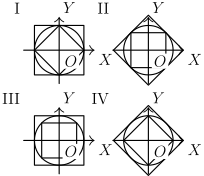
Las desigualdades están representadas geométricamente por la figura número
Representación geométrica: Una desigualdad para todos se representa mediante una figura que muestra, para un número real típico la inclusión
A circle with a circumscribed and an inscribed square centered at the origin of a rectangular coordinate system with positive - and -axes and is shown in each figure to below.
The inequalities are represented geometrically by the figure numbered
Geometric representation: An inequality for all is represented by a figure showing, for a typical real number the containment
ninguna de las anteriores
none of these
Respuesta: B
Pista pequeña:
Identifica las formas de los conjuntos de subnivel de y
Identify the shapes of the sublevel sets for and
Pista grande:
La desigualdad invierte el orden de inclusión de los conjuntos de subnivel correspondientes
The inequality reverses the order of containment of the corresponding sublevel sets
Solución:
Para un positivo fijo, el conjunto es un cuadrado con lados paralelos a los ejes. El conjunto es su círculo circunscrito, y es el rombo circunscrito a ese círculo. Por lo tanto, la disposición requerida es un cuadrado interior alineado con los ejes, luego un círculo y finalmente un rombo exterior, que corresponde a la figura
Por lo tanto, la respuesta correcta es B.
For a fixed positive the set is an axis-aligned square. The set is its circumscribed circle, and is the diamond circumscribed about that circle. Thus the required nesting is an inner axis-aligned square, then a circle, then an outer diamond, which is figure
Therefore, the correct answer is B.
12.
La edad promedio (media aritmética) de un grupo formado por médicos y abogados es Si la edad promedio de los médicos es y la de los abogados es entonces la razón entre el número de médicos y el número de abogados es
The average (arithmetic mean) age of a group consisting of doctors and lawyers is If the doctors average and the lawyers years old, then the ratio of the number of doctors to the number of lawyers is
Respuesta: D
Pista pequeña:
Sean y los números de médicos y abogados
Let and be the numbers of doctors and lawyers
Pista grande:
Iguala la suma de las edades con
Equate the total age to
Solución:
Si hay médicos y abogados, entonces Así, por lo que
Por lo tanto, la respuesta correcta es D.
If there are doctors and lawyers, then Thus so
Therefore, the correct answer is D.
13.
La fracción es igual a
The fraction is equal to
Respuesta: D
Pista pequeña:
Todas las cantidades son positivas, así que compara el cuadrado de la fracción con los cuadrados de las opciones
All quantities are positive, so compare the square of the fraction with the squares of the choices
Pista grande:
Usa
Use
Solución:
La fracción es positiva, y su cuadrado es Por lo tanto, la fracción original es
Por lo tanto, la respuesta correcta es D.
The fraction is positive, and its square is Therefore the original fraction is
Therefore, the correct answer is D.
14.
Cada válvula y cuando está abierta, vierte agua en un tanque a su propia tasa constante. Con las tres válvulas abiertas, el tanque se llena en hora; con solo y abiertas tarda horas; y con solo y abiertas tarda horas. El número de horas necesarias con solo y abiertas es
Each valve and when open, releases water into a tank at its own constant rate. With all three valves open, the tank fills in hour, with only valves and open it takes hours, and with only valves and open it takes hours. The number of hours required with only valves and open is
Respuesta: C
Pista pequeña:
Sean las fracciones del tanque que llenan por hora las tres válvulas
Let be the fractions of the tank filled per hour by the three valves
Pista grande:
Combina y para hallar
Combine and to find
Solución:
Sean las tasas por hora, medidas en tanques completos. Entonces, El doble de la primera ecuación menos las otras dos da Por lo tanto, las válvulas y llenan el tanque en horas.
Por lo tanto, la respuesta correcta es C.
Let be the hourly rates in tankfuls. Then Twice the first equation minus the other two gives Thus valves and fill the tank in hours.
Therefore, the correct answer is C.
15.
Se recorta de un círculo de radio un sector cuyo ángulo central agudo es El radio del círculo circunscrito al sector es
A sector with acute central angle is cut from a circle of radius The radius of the circle circumscribed about the sector is
Respuesta: D
Pista pequeña:
Considera los dos radios y la cuerda del sector como un triángulo isósceles
Treat the sector’s two radii and chord as an isosceles triangle
Pista grande:
Expresa la cuerda usando y luego aplica la ley de senos extendida
Express the chord using then apply the extended sine rule
Solución:
Los dos radios y la cuerda del sector forman un triángulo isósceles cuyos lados iguales miden y cuyo ángulo del vértice es Su base mide Si es el circunradio del triángulo, la ley de senos extendida da Como
Por lo tanto, la respuesta correcta es D.
The two radii and the sector’s chord form an isosceles triangle with equal sides and vertex angle Its base has length If is the triangle’s circumradius, the extended sine rule gives Since
Therefore, the correct answer is D.
16.
Si la suma de todos los ángulos de un polígono convexo excepto uno es entonces el número de lados del polígono debe ser
If the sum of all the angles except one of a convex polygon is then the number of sides of the polygon must be
Respuesta: B
Pista pequeña:
Sea el ángulo interior omitido y el número de lados
Let the omitted interior angle be and the number of sides be
Pista grande:
Usa para encerrar el entero en un intervalo de longitud
Use to trap the integer in an interval of length
Solución:
Si el ángulo omitido es la convexidad da Por lo tanto, de modo que Esto es El único entero posible es así que
Por lo tanto, la respuesta correcta es B.
If the omitted angle is then convexity gives Hence so This is The only possible integer is so
Therefore, the correct answer is B.
17.
Si es un ángulo agudo y entonces es igual a
If is an acute angle and then equals
Respuesta: E
Pista pequeña:
Usa
Use
Pista grande:
Una vez conocido , aplica y usa que es agudo
Once is known, apply and use that is acute
Solución:
La identidad de medio ángulo da Por lo tanto, Como es agudo, su tangente es positiva, así que
Por lo tanto, la respuesta correcta es E.
The half-angle identity gives Therefore Because is acute, its tangent is positive, so
Therefore, the correct answer is E.
18.
Si es un número primo, entonces divide a sin residuo
If is a prime number, then divides without remainder
nunca
never
solo algunas veces
sometimes only
siempre
always
solo si
only if
ninguna de las anteriores
none of these
Respuesta: C
Pista pequeña:
Factoriza
Factor
Pista grande:
Entre los tres enteros consecutivos localiza factores de y
Among the three consecutive integers locate factors of and
Solución:
Un primo es impar, así que y son enteros pares consecutivos. Uno de ellos es divisible por por lo que su producto es divisible por Entre los tres enteros consecutivos uno es divisible por No puede ser pues es primo, así que también divide a Como y son coprimos, siempre es divisible por
Por lo tanto, la respuesta correcta es C.
A prime is odd, so and are consecutive even integers. One is divisible by making their product divisible by Among the three consecutive integers one is divisible by It cannot be since is prime, so also divides Because and are relatively prime, is always divisible by
Therefore, the correct answer is C.
19.
Para y positivos, define como donde es el mayor entero para el cual Entonces, el cociente es igual a
Define for positive and to be where is the greatest integer for which Then the quotient is equal to
Respuesta: D
Pista pequeña:
Escribe ambos factoriales generalizados como nueve factores explícitos
Write both generalized factorials as nine explicit factors
Pista grande:
Extrae de cada término del numerador y de cada término del denominador
Factor from every numerator term and from every denominator term
Solución:
Los dos productos son Por lo tanto, su cociente es
Por lo tanto, la respuesta correcta es D.
The two products are Their quotient is therefore
Therefore, the correct answer is D.
20.
Un vaquero está millas al sur de un arroyo que fluye directamente hacia el este. También está millas al oeste y millas al norte de su cabaña. Desea dar de beber a su caballo en el arroyo y regresar a casa. La menor distancia, en millas, que puede recorrer para lograrlo es
A cowboy is miles south of a stream which flows due east. He is also miles west and miles north of his cabin. He wishes to water his horse at the stream and return home. The shortest distance (in miles) he can travel and accomplish this is
Respuesta: C
Pista pequeña:
Refleja el punto de partida del vaquero respecto del arroyo recto
Reflect the cowboy’s starting point across the straight stream
Pista grande:
Después de la reflexión, el trayecto de dos tramos que pasa por el arroyo se convierte en un solo segmento recto hasta la cabaña
After reflection, the two-leg trip through the stream becomes one straight segment to the cabin
Solución:
Toma el arroyo como el eje y coloca al vaquero en Su cabaña está entonces en Refleja respecto del arroyo para obtener Para cualquier punto del arroyo, así que minimizar equivale a minimizar Esto ocurre cuando son colineales. La distancia mínima es
Por lo tanto, la respuesta correcta es C.
Take the stream as the -axis and put the cowboy at His cabin is then Reflect across the stream to For any point on the stream, so minimizing is the same as minimizing This occurs when are collinear. The minimum distance is
Therefore, the correct answer is C.
21.
El número de conjuntos de dos o más enteros positivos consecutivos cuya suma es es
The number of sets of two or more consecutive positive integers whose sum is is
Respuesta: B
Pista pequeña:
Si hay términos que comienzan con duplica la suma para obtener
If there are terms beginning with double the sum to obtain
Pista grande:
Examina los divisores y exige que sea un entero positivo
Check divisors and enforce that is a positive integer
Solución:
Para enteros positivos consecutivos que comienzan con La positividad da así que los posibles divisores de son De solo y producen lados derechos positivos y pares. Dan los conjuntos y Por lo tanto, hay conjuntos.
Por lo tanto, la respuesta correcta es B.
For consecutive positive integers starting at Positivity gives so the possible divisors of are From only and give positive even right-hand sides. They yield the sets and Hence there are sets.
Therefore, the correct answer is B.
22.
El conjunto de todas las soluciones reales de la desigualdad es
The set of all real solutions of the inequality is
(vacío)
(empty)
Respuesta: A
Pista pequeña:
Interpreta los dos valores absolutos como las distancias de a y a
Interpret the two absolute values as the distances from to and to
Pista grande:
Entre y la suma es constante; fuera de ese intervalo aumenta en el doble de la distancia al extremo más cercano
Between and the sum is constant; outside that interval it increases by twice the distance from the nearer endpoint
Solución:
Para la suma de las distancias de a y es Si está a una distancia fuera de este intervalo, la suma es Así, Al extender el intervalo en por cada extremo se obtiene
Por lo tanto, la respuesta correcta es A.
For the sum of the distances from to and is If lies a distance outside this interval, the sum is Thus Extending the interval by at each end gives
Therefore, the correct answer is A.
23.
Hay dos tarjetas; una es roja por ambos lados y la otra es roja por un lado y azul por el otro. Las tarjetas tienen la misma probabilidad de ser elegidas, y se elige una y se coloca sobre la mesa. Si la cara superior de la tarjeta es roja, la probabilidad de que la cara inferior también sea roja es
There are two cards; one is red on both sides and the other is red on one side and blue on the other. The cards have the same probability of being chosen, and one is chosen and placed on the table. If the upper side of the card on the table is red, then the probability that the under-side is also red is
Respuesta: D
Pista pequeña:
Condiciona según cada cara individual que podría estar mostrando rojo
Condition on the individual card sides that could be showing red
Pista grande:
Hay tres caras rojas visibles igualmente probables; determina el color detrás de cada una
There are three equally likely visible red faces; determine the color behind each
Solución:
Entre los resultados con una cara superior roja, puede quedar arriba cualquiera de las dos caras rojas de la tarjeta roja-roja o la cara roja de la tarjeta roja-azul. Estas tres caras rojas visibles son igualmente probables. La cara inferior es roja en los dos primeros casos y azul en el tercero, así que la probabilidad condicional es
Por lo tanto, la respuesta correcta es D.
Among outcomes having a red upper side, either of the two red faces of the red-red card or the red face of the red-blue card can be uppermost. These three visible red faces are equally likely. The underside is red in the first two cases and blue in the third, so the conditional probability is
Therefore, the correct answer is D.
24.
La cuenta de un almuerzo de sándwiches, tazas de café y una porción de tarta fue de La cuenta de un almuerzo de sándwiches, tazas de café y una porción de tarta fue de en el mismo lugar. El costo de un almuerzo con un sándwich, una taza de café y una porción de tarta será
The check for a luncheon of sandwiches, cups of coffee and one piece of pie came to The check for a luncheon consisting of sandwiches, cups of coffee and one piece of pie came to at the same place. The cost of a luncheon consisting of one sandwich, one cup of coffee and one piece of pie at the same place will come to
Respuesta: D
Pista pequeña:
Sean los precios de los tres artículos; solo se necesita
Let be the three item prices; only is required
Pista grande:
Una combinación lineal adecuada de y aísla la suma deseada
A suitable linear combination of and isolates the desired sum
Solución:
Sean los precios de un sándwich, un café y una porción de tarta. Las cuentas dan Tres veces la primera ecuación menos dos veces la segunda da El almuerzo pedido cuesta
Por lo tanto, la respuesta correcta es D.
Let be the prices of a sandwich, coffee, and pie. The checks give Three times the first equation minus twice the second gives The requested luncheon costs
Therefore, the correct answer is D.
25.
Un terreno circular de césped de pies de diámetro es atravesado por un sendero recto de grava de pies de ancho, uno de cuyos bordes pasa por el centro del terreno. El número de pies cuadrados de césped que quedan es
A circular grass plot feet in diameter is cut by a straight gravel path feet wide, one edge of which passes through the center of the plot. The number of square feet in the remaining grass area is
Respuesta: E
Pista pequeña:
Biseca el sendero con el diámetro perpendicular del terreno circular
Bisect the path by the perpendicular diameter of the circular plot
Pista grande:
Cada mitad del sendero es un sector de junto con un triángulo de --
Each half of the path is a sector together with a -- triangle
Solución:
El terreno tiene radio En el otro borde del sendero, la distancia perpendicular desde el centro es así que el radio hasta un punto de intersección forma un ángulo de con el borde que pasa por el centro. La mitad del sendero consta de un sector de y radio , junto con un triángulo rectángulo de catetos y Su área es Así, el sendero completo tiene área y el área de césped restante es
Por lo tanto, la respuesta correcta es E.
The plot has radius At the path’s other edge, the perpendicular distance from the center is so the radius to an intersection point makes a angle with the edge through the center. Half of the path consists of a sector of radius and a right triangle with legs and Its area is Thus the whole path has area and the remaining grass area is
Therefore, the correct answer is E.
26.
El número de términos de una progresión aritmética es par. Las sumas de los términos con índices impares y pares son y respectivamente. Si el último término supera al primero en el número de términos de la progresión es
The number of terms in an A.P. (Arithmetic Progression) is even. The sums of the odd- and even-numbered terms are and respectively. If the last term exceeds the first by the number of terms in the A.P. is
Respuesta: E
Pista pequeña:
Escribe el número de términos como y la diferencia común como
Write the number of terms as and the common difference as
Pista grande:
Empareja cada término con índice impar con el término par siguiente para obtener
Pair each odd-numbered term with the following even-numbered term to get
Solución:
Sea la progresión de términos y diferencia común Al emparejar cada término con índice impar con su sucesor se obtiene La diferencia entre el último y el primer término es Como al restar se obtiene Por lo tanto, y la progresión tiene términos.
Por lo tanto, la respuesta correcta es E.
Let the progression have terms and common difference Pairing each odd-numbered term with its successor shows that The difference between the last and first terms is Since subtraction gives Hence and the progression has terms.
Therefore, the correct answer is E.
27.
Los automóviles y recorren la misma distancia. El automóvil recorre la mitad de esa distancia a millas por hora y la otra mitad a millas por hora. El automóvil viaja la mitad del tiempo a millas por hora y la otra mitad a millas por hora. La rapidez promedio de es millas por hora y la de es millas por hora. Entonces siempre se cumple
Cars and travel the same distance. Car travels half that distance at miles per hour and half at miles per hour. Car travels half the time at miles per hour and half at miles per hour. The average speed of Car is miles per hour and that of Car is miles per hour. Then we always have
Respuesta: A
Pista pequeña:
El promedio del automóvil es la media armónica de y mientras que el del automóvil es su media aritmética
Car ’s average is the harmonic mean of and while Car ’s is their arithmetic mean
Pista grande:
Resta las dos medias y factoriza el numerador como un cuadrado
Subtract the two means and factor the numerator as a square
Solución:
El promedio por distancias iguales del automóvil y el promedio por tiempos iguales del automóvil son Su diferencia es Así, con igualdad posible cuando
Por lo tanto, la respuesta correcta es A.
Car ’s equal-distance average and Car ’s equal-time average are Their difference is Thus with equality possible when
Therefore, the correct answer is A.
28.
Si y están en progresión geométrica con y es un entero, entonces forman una sucesión
If and are in geometric progression (G.P.) with and is an integer, then form a sequence
que es una progresión geométrica
which is a G.P.
que es una progresión aritmética
which is an arithmetic progression (A.P.)
en la que los recíprocos de los términos forman una progresión aritmética
in which the reciprocals of the terms form an A.P.
en la que el segundo y el tercer término son, respectivamente, las potencias -ésimas del primero y del segundo
in which the second and third terms are the th powers of the first and second respectively
ninguna de las anteriores
none of these
Respuesta: C
Pista pequeña:
Toma recíprocos y usa
Take reciprocals and use
Pista grande:
Aplica logaritmos a la relación de progresión geométrica
Apply logarithms to the geometric-progression relation
Solución:
Por cambio de base, Como están en progresión geométrica, Al tomar logaritmos en base se obtiene Por lo tanto, los recíprocos de los tres términos dados forman una progresión aritmética.
Por lo tanto, la respuesta correcta es C.
By change of base, Since are in geometric progression, Taking logarithms to base gives Hence the reciprocals of the three given terms form an arithmetic progression.
Therefore, the correct answer is C.
29.
Dos muchachos comienzan a moverse desde el mismo punto de una pista circular, pero en sentidos opuestos. Sus velocidades son pies por segundo y pies por segundo. Si parten al mismo tiempo y terminan cuando se encuentran por primera vez de nuevo en entonces el número de veces que se encuentran, excluyendo la salida y la llegada, es
Two boys start moving from the same point on a circular track but in opposite directions. Their speeds are ft. per sec. and ft. per sec. If they start at the same time and finish when they first meet at the point again, then the number of times they meet, excluding the start and finish, is
infinito
infinity
ninguna de las anteriores
none of these
Respuesta: A
Pista pequeña:
Como y son coprimos, determina cuándo ambos muchachos completan por primera vez números enteros de vueltas
Because and are relatively prime, determine when both boys first complete whole numbers of laps
Pista grande:
Antes de ese instante final, se encuentran cada vez que su distancia combinada suma otra vuelta completa
Before that finish time, meetings occur whenever their combined distance is another whole lap
Solución:
Sea la longitud de la pista. Como el primer instante positivo en que ambos regresan a es : han completado y vueltas. Su rapidez relativa es así que antes del tiempo se encuentran en Por lo tanto, hay encuentros sin contar la salida ni la llegada.
Por lo tanto, la respuesta correcta es A.
Let the track length be Since the first positive time when both boys are back at is : they have completed and laps. Their relative speed is so before time they meet at Thus there are meetings excluding the start and finish.
Therefore, the correct answer is A.
30.
Sea el mayor entero que no excede a donde y Entonces se cumple
Let denote the greatest integer not exceeding where and Then we have
el punto no pertenece a para ningún
the point does not belong to for any
para todo
for all
está contenido en el primer cuadrante para todo
is contained in the first quadrant for all
el centro de para cualquier está en la recta
the center of for any is on the line
ninguna de las otras afirmaciones es verdadera
none of the other statements is true
Respuesta: B
Pista pequeña:
Reconoce como la parte fraccionaria de
Recognize as the fractional part of
Pista grande:
Interpreta la ecuación de como un disco e identifica su centro y su radio
Interpret the equation for as a disk and identify its center and radius
Solución:
La parte fraccionaria satisface El conjunto es el disco cerrado de centro y radio Su área es así que lo cual en particular da El origen pertenece a todos esos discos, el disco se extiende por debajo del eje cuando y su centro en general no está sobre
Por lo tanto, la respuesta correcta es B.
The fractional part satisfies The set is the closed disk centered at with radius Its area is so which in particular gives The origin lies on every such disk, the disk extends below the -axis when and its center is generally not on
Therefore, the correct answer is B.
31.
En la siguiente ecuación, cada letra representa de manera única un dígito distinto en base diez: La suma es igual a
In the following equation, each of the letters represents uniquely a different digit in base ten: The sum equals
Respuesta: C
Pista pequeña:
Usa
Use
Pista grande:
El primo debe dividir uno de los factores de dos dígitos; prueba sus múltiplos de dos dígitos que terminan en el dígito común
The prime must divide one of the two-digit factors; test its two-digit multiples ending in the common digit
Solución:
Como el primo divide a uno de y Un múltiplo de dos dígitos de es o El valor es imposible: el otro factor de dos dígitos que termina en es al menos y Por lo tanto, un factor es así que
El dígito de las unidades del producto es el dígito de las unidades de así que Por lo tanto, el producto es y el otro factor es Los cuatro dígitos son cuya suma es
Por lo tanto, la respuesta correcta es C.
Since the prime divides one of and A two-digit multiple of is or The value is impossible: the other two-digit factor ending in is at least and Hence one factor is so
The units digit of the product is the units digit of so Thus the product is and the other factor is The four digits are whose sum is
Therefore, the correct answer is C.
32.
El volumen de una pirámide cuya base es un triángulo equilátero de lado y cuyas demás aristas miden es
The volume of a pyramid whose base is an equilateral triangle of side length and whose other edges are each of length is
ninguna de las anteriores
none of these
Respuesta: A
Pista pequeña:
La altura desde el vértice corta la base en el circuncentro del triángulo equilátero
The altitude from the apex meets the base at the equilateral triangle’s circumcenter
Pista grande:
Usa el circunradio de la base y una arista lateral para hallar la altura
Use the base circumradius and a lateral edge to find the height
Solución:
El área de la base es Como el vértice está a la misma distancia de los tres vértices de la base, su proyección perpendicular es el circuncentro de la base. El circunradio de la base equilátera es Si es la altura de la pirámide, entonces así que El volumen es
Por lo tanto, la respuesta correcta es A.
The base area is Because the apex is equally distant from all three base vertices, its perpendicular projection is the base circumcenter. The circumradius of the equilateral base is If is the pyramid’s height, then so The volume is
Therefore, the correct answer is A.
33.
Al añadir una onza de agua a una mezcla de ácido y agua, la nueva mezcla contiene de ácido. Al añadir una onza de ácido a la nueva mezcla, el resultado contiene de ácido. El porcentaje de ácido en la mezcla original es
When one ounce of water is added to a mixture of acid and water, the new mixture is acid. When one ounce of acid is added to the new mixture, the result is acid. The percentage of acid in the original mixture is
Respuesta: C
Pista pequeña:
Sean y las onzas originales de agua y ácido
Let and be the original ounces of water and acid
Pista grande:
Escribe una ecuación de concentración después de añadir agua y otra después de añadir posteriormente el ácido
Write one concentration equation after adding water and another after subsequently adding acid
Solución:
Sea la mezcla original de onzas de agua y onzas de ácido. Las dos adiciones dan Estas ecuaciones se simplifican a Por lo tanto, y El porcentaje original de ácido era
Por lo tanto, la respuesta correcta es C.
Let the original mixture contain ounces of water and ounces of acid. The two additions give These simplify to Hence and The original acid percentage was
Therefore, the correct answer is C.
34.
Un avión voló directamente contra el viento entre dos ciudades en minutos y regresó con el viento en minutos menos de lo que tardaría con aire en calma. El número de minutos, con dos respuestas, del viaje de regreso fue
A plane flew straight against a wind between two towns in minutes and returned with that wind in minutes less than it would take in still air. The number of minutes (two answers) for the return trip was
o
or
o
or
o
or
o
or
o
or
Respuesta: C
Pista pequeña:
Sea el tiempo de regreso; el tiempo con aire en calma es entonces
Let be the return time; the still-air time is then
Pista grande:
La velocidad del avión en aire en calma es el promedio de sus velocidades terrestres contra el viento y a favor del viento
The plane’s still-air speed is the average of its against-wind and with-wind ground speeds
Solución:
Sea la distancia y minutos el tiempo de regreso. Las velocidades contra el viento y a favor del viento son y Su promedio es la velocidad en aire en calma Por lo tanto, Al eliminar denominadores se obtiene Ambos valores positivos son compatibles con las condiciones dadas, así que los dos tiempos de regreso son y minutos.
Por lo tanto, la respuesta correcta es C.
Let the distance be and the return time be minutes. The against-wind and with-wind speeds are and Their average is the still-air speed Therefore Clearing denominators gives Both positive values are consistent with the stated conditions, so the two return times are and minutes.
Therefore, the correct answer is C.
35.
En el círculo unitario mostrado, las cuerdas y son paralelas al radio unitario del círculo con centro Las cuerdas y miden unidades cada una, y la cuerda mide unidades.
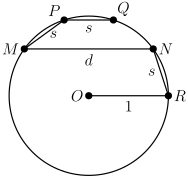
De las tres ecuaciones las que son necesariamente verdaderas son
In the unit circle shown in the figure, chords and are parallel to the unit radius of the circle with center at Chords and are each units long and chord is units long.
Of the three equations those which are necessarily true are
solo
only
solo
only
solo
only
solo y
and only
y
and
Respuesta: E
Pista pequeña:
Usa la simetría respecto del diámetro vertical para ver que la semicircunferencia superior está dividida por cinco cuerdas iguales
Use symmetry across the vertical diameter to see that the upper semicircle is divided into five equal chords
Pista grande:
Escribe y y luego relaciona cada uno con el cuadrado del otro
Write and then relate each to the square of the other
Solución:
Sea el extremo izquierdo del diámetro horizontal. La reflexión respecto del diámetro vertical muestra que y Junto con las cuerdas iguales dadas, la semicircunferencia superior queda dividida en cinco arcos iguales. Cada uno subtiende en Por lo tanto,
Usando las identidades de ángulo doble, Al sumar estas ecuaciones se obtiene Como se sigue que Al sustituir en se obtiene Por lo tanto, y Las tres ecuaciones son necesariamente verdaderas.
Por lo tanto, la respuesta correcta es E.
Let be the left endpoint of the horizontal diameter. Reflection across the vertical diameter shows that and Together with the given equal chords, the upper semicircle is split into five equal arcs. Each subtends at Thus
Using the double-angle identities, Adding these equations gives Since it follows that Substituting into yields Therefore and All three equations are necessarily true.
Therefore, the correct answer is E.