
Problemas del 1960 AMC 12
¡Desplázate hacia abajo y presiona Iniciar para intentar el examen! O ve al PDF imprimible, la clave de respuestas, o las soluciones profesionales preparadas por LIVE by Po-Shen Loh.
Todos los problemas se usan con el permiso legal oficial de la Mathematical Association of America (MAA).
O salta directamente a un solo problema con su solución: 1 · 2 · 3 · 4 · 5 · 6 · 7 · 8 · 9 · 10 · 11 · 12 · 13 · 14 · 15 · 16 · 17 · 18 · 19 · 20 · 21 · 22 · 23 · 24 · 25 · 26 · 27 · 28 · 29 · 30 · 31 · 32 · 33 · 34 · 35 · 36 · 37 · 38 · 39 · 40
¿Quieres aprender de forma profesional con clases interactivas en video?
Con tiempo
1:15:00
1.
Si es una solución (raíz) de entonces es igual a:
If is a solution (root) of then equals:
Respuesta: E
Pista pequeña:
Sustituye en la ecuación
Substitute into the equation
Pista grande:
Resuelve la ecuación lineal resultante para hallar
Solve the resulting linear equation for
Solución:
Al sustituir la raíz dada se obtiene Por tanto, de modo que
Por lo tanto, la respuesta correcta es E.
Substituting the given root gives Thus so
Therefore, the correct answer is E.
2.
Un reloj tarda segundos en dar las campanadas, comenzando exactamente a las . Si las campanadas están espaciadas uniformemente, ¿cuántos segundos tarda en dar las campanadas?
It takes seconds for a clock to strike o’clock beginning at o’clock precisely. If the strikings are uniformly spaced, how long, in seconds, does it take to strike o’clock?
ninguna de estas
none of these
Respuesta: C
Pista pequeña:
Seis campanadas contienen solo cinco intervalos de tiempo
Six strikes contain only five time intervals
Pista grande:
Doce campanadas contienen once intervalos de la misma duración
Twelve strikes contain eleven intervals of the same length
Solución:
Desde la primera hasta la última de las campanadas hay intervalos iguales, así que cada intervalo dura segundo. Doce campanadas contienen intervalos de ese tipo y, por tanto, tardan segundos.
Por lo tanto, la respuesta correcta es C.
There are equal intervals from the first of strikes to the last, so each interval lasts second. Twelve strikes contain such intervals and therefore take seconds.
Thus, the correct answer is C.
3.
Aplicada a una cuenta de , la diferencia, expresada en dólares, entre un descuento de y dos descuentos sucesivos de y es:
Applied to a bill for the difference between a discount of and two successive discounts of and expressed in dollars, is:
Respuesta: B
Pista pequeña:
Los descuentos sucesivos se aplican uno después del otro; no se suman
Successive discounts are applied one after the other, not added
Pista grande:
Compara el de la cuenta con el más el del restante
Compare of the bill with plus of the remaining
Solución:
Un descuento de es Los descuentos sucesivos suman La diferencia es dólares.
Por lo tanto, la respuesta correcta es B.
A discount is The successive discounts total Their difference is dollars.
Therefore, the correct answer is B.
4.
Dos ángulos de un triángulo miden cada uno y el lado comprendido entre ellos mide pulgadas. El área del triángulo, en pulgadas cuadradas, es:
Each of two angles of a triangle is and the included side is inches. The area of the triangle, in square inches, is:
Respuesta: C
Pista pequeña:
Determina el tercer ángulo del triángulo
Determine the third angle of the triangle
Pista grande:
Usa la fórmula del área de un triángulo equilátero de lado
Use the area formula for an equilateral triangle of side
Solución:
El tercer ángulo también mide así que el triángulo es equilátero y su lado mide Su área es
Por lo tanto, la respuesta correcta es C.
The third angle is also so the triangle is equilateral with side Its area is
Thus, the correct answer is C.
5.
El número de puntos distintos comunes a las gráficas de y es:
The number of distinct points common to the graphs of and is:
infinitos
infinitely many
cuatro
four
dos
two
uno
one
ninguno
none
Respuesta: C
Pista pequeña:
Sustituye en la ecuación del círculo
Substitute into the circle equation
Pista grande:
Después de hallar cuenta los valores posibles de
After finding count the possible values of
Solución:
La sustitución da por lo que Luego da o Por tanto, hay dos puntos comunes.
Por lo tanto, la respuesta correcta es C.
Substitution gives so Then gives or Hence there are two common points.
Therefore, the correct answer is C.
6.
La circunferencia de un círculo mide pulgadas. El lado de un cuadrado inscrito en este círculo, expresado en pulgadas, es:
The circumference of a circle is inches. The side of a square inscribed in this circle, expressed in inches, is:
Respuesta: B
Pista pequeña:
Halla el diámetro a partir de la circunferencia
Find the diameter from the circumference
Pista grande:
La diagonal del cuadrado inscrito es el diámetro del círculo
The diagonal of the inscribed square is the circle’s diameter
Solución:
El diámetro es Si el lado del cuadrado es su diagonal es así que Por lo tanto,
Por lo tanto, la respuesta correcta es B.
The diameter is If the square has side its diagonal is so Therefore
Thus, the correct answer is B.
7.
El círculo I pasa por el centro del círculo II y es tangente a él. El área del círculo I es de pulgadas cuadradas. Entonces el área del círculo II, en pulgadas cuadradas, es:
Circle I passes through the center of, and is tangent to, circle II. The area of circle I is square inches. Then the area of circle II, in square inches, is:
Respuesta: D
Pista pequeña:
Traza la recta que pasa por los dos centros y el punto de tangencia
Draw the line through the two centers and the tangency point
Pista grande:
El radio del círculo II es el doble del radio del círculo I
The radius of circle II is twice the radius of circle I
Solución:
Como el círculo I pasa por el centro del círculo II, la distancia entre los centros es igual al radio del círculo I. La tangencia interna también hace que esa distancia sea donde es el radio del círculo II. Así, y el área se multiplica por Por lo tanto, es
Por lo tanto, la respuesta correcta es D.
Because circle I passes through the center of circle II, the distance between the centers equals the radius of circle I. Internal tangency also makes that distance where is the radius of circle II. Thus and the area is multiplied by It is therefore
Thus, the correct answer is D.
8.
El número puede escribirse como una fracción. Al reducirla a términos mínimos, la suma del numerador y el denominador es:
The number can be written as a fraction. When reduced to lowest terms the sum of the numerator and denominator of this fraction is:
ninguna de estas
none of these
Respuesta: D
Pista pequeña:
Escribe la parte periódica con denominador
Write the repeating part using a denominator of
Pista grande:
Suma la parte entera y luego reduce la fracción
Add the integer part and then reduce the fraction
Solución:
Tenemos Esta fracción ya está reducida a términos mínimos, y
Por lo tanto, la respuesta correcta es D.
We have This fraction is already in lowest terms, and
Therefore, the correct answer is D.
9.
La fracción es, con restricciones adecuadas sobre los valores de y :
The fraction is (with suitable restrictions on the values of and ):
irreducible
reducible a
reducible to
reducible a un polinomio de tres términos
reducible to a polynomial of three terms
reducible a
reducible to
reducible a
reducible to
Respuesta: E
Pista pequeña:
Reescribe cada expresión cuadrática como una diferencia de cuadrados
Rewrite each quadratic expression as a difference of squares
Pista grande:
El numerador y el denominador comparten el factor
The numerator and denominator share a factor
Solución:
Al factorizar se obtiene Al cancelar el factor común, bajo las restricciones adecuadas indicadas, queda
Por lo tanto, la respuesta correcta es E.
Factoring gives Cancelling the common factor, under the stated suitable restrictions, leaves
Thus, the correct answer is E.
10.
Se dan las seis afirmaciones siguientes:
Todas las mujeres son buenas conductoras.
Algunas mujeres son buenas conductoras.
Ningún hombre es buen conductor.
Todos los hombres son malos conductores.
Al menos un hombre es mal conductor.
Todos los hombres son buenos conductores.
La afirmación que niega la afirmación es:
Given the following six statements:
All women are good drivers.
Some women are good drivers.
No men are good drivers.
All men are bad drivers.
At least one man is a bad driver.
All men are good drivers.
The statement that negates statement is:
Respuesta: E
Pista pequeña:
Negar «todos» produce una afirmación de existencia
Negating “all” produces an existence statement
Pista grande:
Para negar la afirmación basta un solo hombre que no sea buen conductor
The negation needs only one man who is not a good driver
Solución:
La negación de «Todos los hombres son buenos conductores» es «Al menos un hombre no es buen conductor». En la terminología de las opciones, esa es la afirmación «Al menos un hombre es mal conductor».
Por lo tanto, la respuesta correcta es E.
The negation of “All men are good drivers” is “At least one man is not a good driver.” In the terminology of the choices, that is statement “At least one man is a bad driver.”
Therefore, the correct answer is E.
11.
Para cierto valor de el producto de las raíces de es Las raíces pueden caracterizarse como:
For a given value of the product of the roots of is The roots may be characterized as:
enteras y positivas
integral and positive
enteras y negativas
integral and negative
racionales, pero no enteras
rational, but not integral
irracionales
irrational
imaginarias
imaginary
Respuesta: D
Pista pequeña:
Usa el término constante para determinar los valores posibles de
Use the constant term to determine the possible values of
Pista grande:
Para cada valor de examina la fórmula cuadrática o el discriminante
For either value of examine the quadratic formula or discriminant
Solución:
Por las fórmulas de Vieta, así que Las raíces son cuando y cuando En ambos casos, las dos raíces son irracionales.
Por lo tanto, la respuesta correcta es D.
By Vieta’s formulas, so The roots are when and when In either case both roots are irrational.
Thus, the correct answer is D.
12.
El lugar geométrico de los centros de todos los círculos de radio dado situados en el mismo plano y que pasan por un punto fijo, es:
The locus of the centers of all circles of given radius in the same plane, passing through a fixed point, is:
un punto
a point
una recta
a straight line
dos rectas
two straight lines
un círculo
a circle
dos círculos
two circles
Respuesta: D
Pista pequeña:
Cada centro debe estar exactamente a un radio del punto fijo
Every center must be exactly one radius from the fixed point
Pista grande:
Identifica el lugar geométrico de los puntos que están a una distancia positiva fija de un punto
Identify the locus of points at a fixed positive distance from one point
Solución:
Un círculo de radio pasa por el punto fijo exactamente cuando su centro está a distancia de ese punto. El lugar geométrico de todos esos centros es un círculo de radio
Por lo tanto, la respuesta correcta es D.
A circle of radius passes through the fixed point exactly when its center is distance from that point. The locus of all such centers is a circle of radius
Therefore, the correct answer is D.
13.
El polígono formado por y es:
The polygon(s) formed by and is (are):
un triángulo equilátero
an equilateral triangle
un triángulo isósceles
an isosceles triangle
un triángulo rectángulo
a right triangle
un triángulo y un trapecio
a triangle and a trapezoid
un cuadrilátero
a quadrilateral
Respuesta: B
Pista pequeña:
Halla las tres intersecciones por pares de las rectas
Find the three pairwise intersections of the lines
Pista grande:
Las dos rectas inclinadas son imágenes especulares respecto del eje
The two slanted lines are mirror images across the -axis
Solución:
Las rectas inclinadas se cortan en mientras que sus intersecciones con son y Estos dos últimos puntos son simétricos respecto del eje , así que los dos lados inclinados tienen la misma longitud. La figura es un triángulo isósceles.
Por lo tanto, la respuesta correcta es B.
The slanted lines meet at while their intersections with are and The latter two points are symmetric about the -axis, so the two slanted sides have equal length. The figure is an isosceles triangle.
Thus, the correct answer is B.
14.
Si y son números reales, la ecuación tiene una solución única [el símbolo significa que es distinto de cero]:
If and are real numbers, the equation has a unique solution [the symbol means that is different from zero]:
para todos y
for all and
si
if
si
if
si
if
si
if
Respuesta: E
Pista pequeña:
Reúne los términos con en un lado
Collect the -terms on one side
Pista grande:
Una ecuación lineal tiene una solución única cuando el coeficiente de no es cero
A linear equation has a unique solution when the coefficient of is nonzero
Solución:
Al reordenar se obtiene Esto tiene una solución única exactamente cuando es decir, cuando
Por lo tanto, la respuesta correcta es E.
Rearranging gives This has a unique solution exactly when or
Thus, the correct answer is E.
15.
El triángulo I es equilátero, con lado perímetro área y circunradio (radio del círculo circunscrito). El triángulo II es equilátero, con lado perímetro área y circunradio Si es distinto de entonces:
Triangle I is equilateral with side perimeter area and circumradius (radius of the circumscribed circle). Triangle II is equilateral with side perimeter area and circumradius If is different from then:
solo algunas veces
only sometimes
siempre
always
solo algunas veces
only sometimes
siempre
always
solo algunas veces
only sometimes
Respuesta: B
Pista pequeña:
Todos los triángulos equiláteros son semejantes
All equilateral triangles are similar
Pista grande:
Tanto el perímetro como el circunradio varían linealmente con la longitud del lado
Perimeter and circumradius both scale linearly with side length
Solución:
Para los triángulos equiláteros, y con fórmulas análogas para y Por lo tanto, para cualquier pareja de triángulos de este tipo.
Por lo tanto, la respuesta correcta es B.
For equilateral triangles, and with analogous formulas for and Therefore for every such pair of triangles.
Thus, the correct answer is B.
16.
En el sistema de numeración de base se cuenta así: El número que en el sistema decimal se representa como al escribirse en base , tiene:
In the numeration system with base counting is as follows: The number whose description in the decimal system is when described in the base system, is a number with:
dos dígitos consecutivos
two consecutive digits
dos dígitos no consecutivos
two non-consecutive digits
tres dígitos consecutivos
three consecutive digits
tres dígitos no consecutivos
three non-consecutive digits
cuatro dígitos
four digits
Respuesta: C
Pista pequeña:
Expresa mediante potencias de
Express using powers of
Pista grande:
Después de hallar los dígitos en base , compara sus valores
After finding the base- digits, compare their values
Solución:
Como su representación en base es Sus tres dígitos y son consecutivos.
Por lo tanto, la respuesta correcta es C.
Since its base- representation is Its three digits and are consecutive.
Therefore, the correct answer is C.
17.
Para cierto grupo, la fórmula da el número de personas cuyos ingresos superan dólares. El menor ingreso, en dólares, entre las personas más ricas es por lo menos:
The formula gives, for a certain group, the number of individuals whose income exceeds dollars. The lowest income, in dollars, of the wealthiest individuals is at least:
Respuesta: A
Pista pequeña:
En el umbral de ingresos, fija
Set at the income cutoff
Pista grande:
Después de simplificar las potencias de resuelve
After simplifying powers of solve
Solución:
En el umbral, Por tanto, y al elevar ambos lados a la potencia se obtiene
Por lo tanto, la respuesta correcta es A.
At the cutoff, Hence and raising both sides to the power gives
Thus, the correct answer is A.
18.
El sistema de ecuaciones y tiene:
The pair of equations and has:
ninguna solución común
no common solution
la solución
the solution
la solución
the solution
una solución común formada por un entero positivo y uno negativo
a common solution in positive and negative integers
ninguna de estas
none of these
Respuesta: E
Pista pequeña:
Reescribe como en ambas ecuaciones
Rewrite as in both equations
Pista grande:
Resuelve el sistema resultante para y
Solve the resulting system for and
Solución:
La primera ecuación da La segunda da así que Por lo tanto, y Este par no aparece entre las primeras cuatro opciones.
Por lo tanto, la respuesta correcta es E.
The first equation gives The second gives so Therefore and This pair is not listed among the first four choices.
Thus, the correct answer is E.
19.
Considera la ecuación I: donde y son enteros positivos, y la ecuación II: donde y son enteros positivos. Entonces:
Consider equation I: where and are positive integers, and equation II: where and are positive integers. Then:
puede resolverse con enteros consecutivos
can be solved in consecutive integers
puede resolverse con enteros pares consecutivos
can be solved in consecutive even integers
puede resolverse con enteros consecutivos
can be solved in consecutive integers
puede resolverse con enteros pares consecutivos
can be solved in consecutive even integers
puede resolverse con enteros impares consecutivos
can be solved in consecutive odd integers
Respuesta: C
Pista pequeña:
Escribe las sumas de tres y de cuatro enteros consecutivos
Write the sums of three and four consecutive integers
Pista grande:
Comprueba cuál de los promedios necesarios es compatible con
Check which required average is compatible with
Solución:
La suma de tres enteros consecutivos es divisible por así que no puede ser Cuatro enteros consecutivos que comienzan con tienen suma Al imponer se obtiene y, en efecto,
Por lo tanto, la respuesta correcta es C.
The sum of three consecutive integers is divisible by so it cannot be Four consecutive integers beginning with have sum Setting gives and indeed
Therefore, the correct answer is C.
20.
El coeficiente de en el desarrollo de es:
The coefficient of in the expansion of is:
Respuesta: D
Pista pequeña:
En un término que usa factores de determina el exponente de
In a term using copies of determine the exponent of
Pista grande:
Resuelve y después calcula ese coeficiente binomial
Solve and then compute that binomial coefficient
Solución:
El término que usa factores de tiene exponente Para obtener necesitamos Su coeficiente es
Por lo tanto, la respuesta correcta es D.
The term using factors of has exponent To obtain we need Its coefficient is
Thus, the correct answer is D.
21.
La diagonal del cuadrado I es El perímetro del cuadrado II, cuya área es el doble de la del cuadrado I, es:
The diagonal of square I is The perimeter of square II with twice the area of I is:
Respuesta: E
Pista pequeña:
Expresa el área del cuadrado I en función de su diagonal
Express the area of square I in terms of its diagonal
Pista grande:
El área del cuadrado II es así que halla la longitud de su lado
Square II’s area is so find its side length
Solución:
Un cuadrado con diagonal tiene área Por tanto, el cuadrado II tiene área así que su lado es y su perímetro es
Por lo tanto, la respuesta correcta es E.
A square with diagonal has area Square II therefore has area so its side is and its perimeter is
Thus, the correct answer is E.
22.
La igualdad donde y son constantes no nulas y distintas, se satisface con , donde:
The equality where and are unequal non-zero constants, is satisfied by where:
y tiene un único valor no nulo
has a unique non-zero value
y tiene dos valores no nulos
has two non-zero values
y tiene un único valor no nulo
has a unique non-zero value
y tiene dos valores no nulos
has two non-zero values
y tienen cada uno un único valor no nulo
and each have a unique non-zero value
Respuesta: A
Pista pequeña:
Factoriza la diferencia de los dos cuadrados
Factor the difference of the two squares
Pista grande:
Cancela el factor no nulo y despeja
Cancel the nonzero factor and solve for
Solución:
Al factorizar y usar se obtiene Por tanto, así que Luego y un único valor no nulo.
Por lo tanto, la respuesta correcta es A.
Factoring and using gives Hence so Thus and a unique nonzero value.
Therefore, the correct answer is A.
23.
El radio de una caja cilíndrica mide pulgadas y la altura mide pulgadas. El volumen debe aumentar en la misma cantidad positiva fija cuando aumenta pulgadas que cuando aumenta pulgadas. Esta condición se satisface con:
The radius of a cylindrical box is inches, the height is inches. The volume is to be increased by the same fixed positive amount when is increased by inches as when is increased by inches. This condition is satisfied by:
ningún valor real de
no real value of
un valor entero de
one integral value of
un valor racional, pero no entero, de
one rational, but not integral, value of
un valor irracional de
one irrational value of
dos valores reales de
two real values of
Respuesta: C
Pista pequeña:
Escribe el aumento de volumen una vez con radio y otra con altura
Write the volume increase once with radius and once with height
Pista grande:
Iguala los aumentos y descarta la solución no positiva
Equate the increases and discard the nonpositive solution
Solución:
Al aumentar el radio, el volumen cambia en mientras que al aumentar la altura cambia en Al igualar estas expresiones se obtiene así que o El aumento debe ser positivo, por lo que queda un solo valor racional no entero.
Por lo tanto, la respuesta correcta es C.
Increasing the radius changes the volume by while increasing the height changes it by Equating these gives so or The increase must be positive, leaving one rational but nonintegral value.
Thus, the correct answer is C.
24.
Si donde es real, entonces es:
If where is real, then is:
un entero que no es cuadrado ni cubo perfecto
a non-square, non-cube integer
un racional no entero que no es cuadrado ni cubo perfecto
a non-square, non-cube, non-integral rational number
un número irracional
an irrational number
un cuadrado perfecto
a perfect square
un cubo perfecto
a perfect cube
Pista pequeña:
Convierte la ecuación logarítmica en
Convert the logarithmic equation to
Pista grande:
Usa para reconocer una solución real
Use to recognize a real solution
Solución:
La ecuación equivale a Como satisface la ecuación. Para ver que es la única solución real admisible, observa que la base exige y en se tiene mientras que para la función es estrictamente creciente. Así, un entero que no es cuadrado ni cubo perfecto.
Por lo tanto, la respuesta correcta es A.
The equation is equivalent to Since satisfies the equation. To see it is the only admissible real solution, note that the base requires and on while for the function is strictly increasing. Thus a non-square, non-cube integer.
Therefore, the correct answer is A.
25.
Sean y dos números impares cualesquiera, con menor que El mayor entero que divide todos los números posibles de la forma es:
Let and be any two odd numbers, with less than The largest integer which divides all possible numbers of the form is:
Respuesta: D
Pista pequeña:
Factoriza en dos factores pares
Factor into two even factors
Pista grande:
Entre y uno es divisible por ; después prueba un par pequeño
Among and one is divisible by ; then test a small pair
Solución:
Tenemos Ambos factores son pares y uno es divisible por así que toda diferencia de este tipo es divisible por Al tomar se obtiene lo que demuestra que ningún entero mayor la divide siempre.
Por lo tanto, la respuesta correcta es D.
We have Both factors are even, and one is divisible by so every such difference is divisible by Taking gives proving that no larger integer always divides it.
Thus, the correct answer is D.
26.
Halla el conjunto de valores de que satisfacen la desigualdad [El símbolo significa si es positivo, si es negativo y si es cero. La notación significa que puede tomar cualquier valor entre y sin incluir ni ]
Find the set of -values satisfying the inequality [The symbol means if is positive, if is negative, if is zero. The notation means that can have any value between and excluding and ]
x>11
Respuesta: B
Pista pequeña:
Multiplica la desigualdad por
Multiply the inequality by
Pista grande:
Reescribe como una desigualdad compuesta
Rewrite as a compound inequality
Solución:
La desigualdad equivale a así que Al restar e invertir los signos según sea necesario se obtiene
Por lo tanto, la respuesta correcta es B.
The inequality is equivalent to so Subtracting and reversing signs as needed gives
Therefore, the correct answer is B.
27.
Sea la suma de los ángulos interiores de un polígono , en el cual cada ángulo interior es veces el ángulo exterior en el mismo vértice. Entonces:
Let be the sum of the interior angles of a polygon for which each interior angle is times the exterior angle at the same vertex. Then:
y puede ser regular
and may be regular
y no es regular
and is not regular
y es regular
and is regular
y no es regular
and is not regular
y puede ser regular o no serlo
and may or may not be regular
Respuesta: E
Pista pequeña:
Un ángulo interior y su ángulo exterior correspondiente suman
An interior angle and its corresponding exterior angle sum to
Pista grande:
La condición determina todos los ángulos, pero no dice nada sobre las longitudes de los lados
The condition fixes every angle but says nothing about the side lengths
Solución:
Si un ángulo exterior es entonces así que Como los ángulos exteriores suman el polígono tiene vértices y Todos sus ángulos son iguales, pero sus lados no tienen que serlo, por lo que puede ser regular o no.
Por lo tanto, la respuesta correcta es E.
If an exterior angle is then so Since the exterior angles total the polygon has vertices and All its angles are equal, but its sides need not be equal, so it may or may not be regular.
Thus, the correct answer is E.
28.
La ecuación tiene:
The equation has:
infinitas raíces enteras
infinitely many integral roots
ninguna raíz
no root
una raíz entera
one integral root
dos raíces enteras iguales
two equal integral roots
dos raíces no enteras iguales
two equal non-integral roots
Respuesta: B
Pista pequeña:
Los términos fraccionarios idénticos se cancelan donde la ecuación está definida
The identical fractional terms cancel wherever the equation is defined
Pista grande:
Comprueba si el valor resultante pertenece al dominio original
Check whether the resulting value lies in the original domain
Solución:
Para al restar las fracciones idénticas de ambos lados queda Pero hace cero los denominadores originales, así que no pertenece al dominio. La ecuación no tiene raíces.
Por lo tanto, la respuesta correcta es B.
For subtracting the identical fractions from both sides leaves But makes the original denominators zero, so it is not in the domain. The equation has no root.
Therefore, the correct answer is B.
29.
Cinco veces el dinero de , más el dinero de , supera Tres veces el dinero de , menos el dinero de , es Si representa el dinero de en dólares y representa el dinero de en dólares, entonces:
Five times ’s money added to ’s money is more than Three times ’s money minus ’s money is If represents ’s money in dollars and represents ’s money in dollars, then:
a>9, b>6
a>9,
a>9,
a>9, pero no podemos imponer cotas a
a>9, but we can put no bounds on
Respuesta: A
Pista pequeña:
Usa para expresar en función de
Use to express in terms of
Pista grande:
Sustituye en
Substitute into
Solución:
De se obtiene Al sustituir en la desigualdad resulta así que De aquí se sigue que
Por lo tanto, la respuesta correcta es A.
From we have Substitution into the inequality gives so It follows that
Thus, the correct answer is A.
30.
Dada la recta , se considera un punto de ella equidistante de los ejes coordenados. Un punto así existe en:
Given the line and a point on this line equidistant from the coordinate axes. Such a point exists in:
ningún cuadrante
none of the quadrants
solo el cuadrante
quadrant only
solo los cuadrantes
quadrants only
solo los cuadrantes
quadrants only
cada uno de los cuadrantes
each of the quadrants
Respuesta: C
Pista pequeña:
Un punto equidistante de los ejes satisface
A point equidistant from the axes satisfies
Pista grande:
Interseca la recta dada con y con
Intersect the given line with both and
Solución:
Para la recta da lo que produce un punto en el cuadrante I. Para da de modo que y lo que produce un punto en el cuadrante II. No hay otras posibilidades.
Por lo tanto, la respuesta correcta es C.
For the line gives producing a point in quadrant I. For it gives so and producing a point in quadrant II. There are no other possibilities.
Therefore, the correct answer is C.
31.
Para que sea un factor de los valores de y deben ser, respectivamente:
For to be a factor of the values of and must be, respectively:
Respuesta: D
Pista pequeña:
Trabaja módulo de modo que
Work modulo so
Pista grande:
Reduce a una expresión lineal y haz cero los dos coeficientes del residuo
Reduce to a linear expression and make both remainder coefficients zero
Solución:
Módulo tenemos Entonces Por tanto, Ambos coeficientes se anulan cuando y
Por lo tanto, la respuesta correcta es D.
Modulo we have Then Thus Both coefficients vanish when and
Therefore, the correct answer is D.
32.
En esta figura, el centro del círculo es es una recta, y la longitud de es el doble del radio. Entonces:
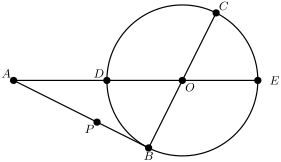
In this figure the center of the circle is is a straight line, and has a length twice the radius. Then:
ninguna de estas
none of these
Respuesta: A
Pista pequeña:
Sea el radio y expresa en función de y
Let the radius be and write in terms of and
Pista grande:
Usa la relación de tangencia junto con
Use the tangent relation together with
Solución:
Sea el radio Como es tangente en Escribe Como la secante pasa por el centro, mientras que Por tanto, Además, y La ecuación mostrada se reordena como Por lo tanto,
Por lo tanto, la respuesta correcta es A.
Let the radius be Since is tangent at Write Because the secant passes through the center, while Hence Also and The displayed equation rearranges to Therefore
Thus, the correct answer is A.
33.
Se da una sucesión de términos; cada término tiene la forma , donde representa el producto de todos los números primos menores o iguales que y toma sucesivamente los valores Sea el número de primos que aparecen en esta sucesión. Entonces es:
You are given a sequence of terms; each term has the form where stands for the product of all prime numbers less than or equal to and takes, successively, the values Let be the number of primes appearing in this sequence. Then is:
Respuesta: A
Pista pequeña:
Todo desde hasta tiene un divisor primo no mayor que
Every from through has a prime divisor at most
Pista grande:
Ese mismo divisor primo divide tanto a como a
That same prime divisor divides both and
Solución:
Para cada del intervalo dado, elige un divisor primo de Como es uno de los factores de Por tanto, divide a Además, así que es compuesto. Ningún término es primo y
Por lo tanto, la respuesta correcta es A.
For each in the given range, choose a prime divisor of Since it is one of the factors of Therefore divides Moreover so is composite. No term is prime, and
Thus, the correct answer is A.
34.
Dos nadadores, situados en extremos opuestos de una piscina de pies, empiezan a nadar a lo largo de ella, uno a pies por segundo y el otro a pies por segundo. Nadan de un lado a otro durante minutos. Suponiendo que no pierden tiempo al dar la vuelta, halla el número de veces que se cruzan.
Two swimmers, at opposite ends of a -foot pool, start to swim the length of the pool, one at the rate of feet per second, the other at feet per second. They swim back and forth for minutes. Allowing no loss of time at the turns, find the number of times they pass each other.
Respuesta: C
Pista pequeña:
Refleja la piscina cada vez que un nadador da la vuelta para que ambas trayectorias se vuelvan rectas
Reflect the pool each time a swimmer turns so both paths become straight
Pista grande:
El patrón conjunto de posiciones se repite cada segundos; examina un ciclo completo, incluidas las coincidencias en los extremos
The joint position pattern repeats every seconds; inspect one full cycle, including endpoint coincidences
Solución:
La posición del nadador más rápido se repite cada segundos y la del más lento, cada segundos. Por tanto, el patrón conjunto se repite cada segundos. Durante un ciclo, sus posiciones coinciden en segundos. La interpretación de la respuesta oficial cuenta como encuentro el giro simultáneo en el extremo cuando . Así, se cuentan encuentros por ciclo y hay ciclos en minutos, lo que da .
Por lo tanto, la respuesta correcta es C.
The faster swimmer’s position repeats every seconds, and the slower swimmer’s position repeats every seconds. Thus their joint position pattern repeats every seconds. During one such cycle, their positions coincide at seconds. The keyed interpretation counts the simultaneous turn at the endpoint when as one of these encounters. Thus there are counted encounters per cycle and cycles in minutes, giving
Therefore, the correct answer is C.
35.
Desde un punto exterior a un círculo de circunferencia unidades se traza una tangente. También desde se traza una secante que divide el círculo en arcos desiguales de longitudes y Se sabe que la longitud de la tangente, es la media proporcional entre y Si y son enteros, entonces puede tomar el siguiente número de valores:
From point outside a circle, with a circumference of units, a tangent is drawn. Also from a secant is drawn dividing the circle into unequal arcs with lengths and It is found that the length of the tangent, is the mean proportional between and If and are integers, then may have the following number of values:
cero
zero
uno
one
dos
two
tres
three
infinitos
infinitely many
Respuesta: C
Pista pequeña:
Usa y
Use and
Pista grande:
Prueba los valores enteros excluyendo los arcos iguales
Test the integer values excluding equal arcs
Solución:
Las longitudes de los arcos satisfacen mientras que la condición de media proporcional da Para valores enteros de desde hasta los productos posibles, salvo simetría, son y El último corresponde a arcos iguales y se excluye. Los cuadrados restantes dan y dos valores.
Por lo tanto, la respuesta correcta es C.
The arc lengths satisfy while the mean-proportional condition gives For integral from through the possible products, up to symmetry, are and The last comes from equal arcs and is excluded. The remaining squares give and two values.
Thus, the correct answer is C.
36.
Sean las sumas respectivas de términos de la misma progresión aritmética, con como primer término y como diferencia común. Sea Entonces depende de:
Let be the respective sums of terms of the same arithmetic progression with as the first term and as the common difference. Let Then is dependent on:
y
and
y
and
y
and
y
and
ni , ni , ni
neither nor nor
Respuesta: B
Pista pequeña:
Usa
Use
Pista grande:
Sustituye y agrupa por separado los términos con y con
Substitute and collect the -terms and -terms separately
Solución:
Usando la fórmula de la suma aritmética, En el coeficiente de es Al simplificar los términos restantes se obtiene Así, depende de y pero no de
Por lo tanto, la respuesta correcta es B.
Using the arithmetic-series formula, In the coefficient of is Simplifying the remaining terms gives Thus depends on and but not on
Therefore, the correct answer is B.
37.
La base de un triángulo tiene longitud y su altura tiene longitud Se inscribe en el triángulo un rectángulo de altura , con la base del rectángulo sobre la base del triángulo. El área del rectángulo es:
The base of a triangle is of length and the altitude is of length A rectangle of height is inscribed in the triangle with the base of the rectangle in the base of the triangle. The area of the rectangle is:
Respuesta: A
Pista pequeña:
A la altura usa semejanza para hallar el ancho horizontal del triángulo
At height use similarity to find the horizontal width of the triangle
Pista grande:
El ancho disponible es ; multiplícalo por la altura del rectángulo
The available width is ; multiply it by the rectangle’s height
Solución:
Por semejanza, la sección paralela a la base a la altura tiene ancho Al multiplicar por la altura del rectángulo se obtiene
Por lo tanto, la respuesta correcta es A.
The cross-section parallel to the base at height has width by similarity. Multiplying by the rectangle’s height gives
Thus, the correct answer is A.
38.
En este diagrama, y son los lados iguales de un triángulo isósceles en el cual está inscrito el triángulo equilátero Denota el ángulo por el ángulo por y el ángulo por Entonces:
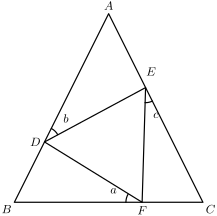
In this diagram and are the equal sides of an isosceles triangle in which is inscribed equilateral triangle Designate angle by angle by and angle by Then:
ninguna de estas
none of these
Respuesta: D
Pista pequeña:
Sea cada ángulo de la base de
Let each base angle of be
Pista grande:
Compara las direcciones de y usando los ángulos de del triángulo equilátero
Compare the directions of and using the angles of the equilateral triangle
Solución:
Sea cada ángulo de la base de igual a Medida desde la dirección de la recta tiene dirección así que la condición equilátera hace que tenga dirección En De manera análoga, al perseguir ángulos en se obtiene Al sumar estas ecuaciones resulta
Por lo tanto, y la respuesta correcta es D.
Let each base angle of be Measured from the direction the line has direction so the equilateral condition makes have direction At Similarly, angle chasing at gives Adding these equations yields
Therefore and the correct answer is D.
39.
Para satisfacer la ecuación y deben ser:
To satisfy the equation and must be:
ambos racionales
both rational
ambos reales, pero no racionales
both real but not rational
ambos no reales
both not real
uno real y otro no real
one real, one not real
uno real y otro no real, o ambos no reales
one real, one not real or both not real
Respuesta: E
Pista pequeña:
Después de observar que los denominadores deben ser no nulos, sea
Let after noting that the denominators must be nonzero
Pista grande:
La cuadrática resultante tiene discriminante negativo
The resulting quadratic has negative discriminant
Solución:
Los denominadores exigen y Al tomar y multiplicar en cruz se obtiene o bien Su discriminante es así que no es real. Por tanto, y no pueden ser ambos reales. Según la escala compleja no nula elegida para uno puede ser real y el otro no real, o ambos pueden ser no reales.
Por lo tanto, la respuesta correcta es E.
The denominators require and Setting and cross-multiplying gives or Its discriminant is so is not real. Therefore and cannot both be real. Depending on the nonzero complex scale chosen for one can be real and the other nonreal, or both can be nonreal.
Thus, the correct answer is E.
40.
Dado el triángulo rectángulo con catetos Halla la longitud de la trisectriz angular más corta desde hasta la hipotenusa:
Given right triangle with legs Find the length of the shorter angle trisector from to the hypotenuse:
Respuesta: A
Pista pequeña:
Coloca
Place
Pista grande:
Las dos semirrectas trisectoras forman ángulos de y con ; interseca cada una con
The two trisector rays make angles and with ; intersect each with
Solución:
Coloca La hipotenusa tiene ecuación La semirrecta trisectora de es Al sustituir se obtiene Su longitud es y por tanto La semirrecta de da la trisectriz más larga.
Por lo tanto, la respuesta correcta es A.
Place The hypotenuse has equation The trisector ray is Substitution gives Its length is hence The ray gives the longer trisector.
Thus, the correct answer is A.