
Problemas del 2009 AMC 12A
¡Desplázate hacia abajo y presiona Iniciar para intentar el examen! O ve al PDF imprimible, la clave de respuestas, o las soluciones profesionales preparadas por LIVE by Po-Shen Loh.
Todos los problemas se usan con el permiso legal oficial de la Mathematical Association of America (MAA).
O salta directamente a un solo problema con su solución: 1 · 2 · 3 · 4 · 5 · 6 · 7 · 8 · 9 · 10 · 11 · 12 · 13 · 14 · 15 · 16 · 17 · 18 · 19 · 20 · 21 · 22 · 23 · 24 · 25
¿Quieres aprender de forma profesional con clases interactivas en video?
Con tiempo
1:15:00
1.
El vuelo de Kim despegó de Newark a las am y aterrizó en Miami a la pm. Ambas ciudades están en la misma zona horaria. Si su vuelo duró horas y minutos, con ¿cuánto vale ?
Kim’s flight took off from Newark at am and landed in Miami at pm. Both cities are in the same time zone. If her flight took hours and minutes, with what is
Respuesta: A
Pista pequeña:
Cuenta los minutos desde las am hasta las am, y luego continúa a partir de ahí.
Count the minutes from am up to am, then continue from there
Pista grande:
El vuelo dura horas y minutos.
The flight lasts hours and minutes
Solución:
De las am a las am hay minutos, de las am a la pm hay horas, y de la pm a la pm hay minutos.
Así que el vuelo duró horas y minutos. Por lo tanto y
Por lo tanto, la respuesta correcta es A.
From am to am is minutes, from am to pm is hours, and from pm to pm is minutes.
So the flight lasted hours and minutes. Thus and
Thus, the correct answer is A.
2.
¿A cuál de los siguientes valores es igual
Which of the following is equal to
Respuesta: C
Pista pequeña:
Trabaja desde la fracción más interna hacia afuera.
Work outward from the innermost fraction
Pista grande:
Primero simplifica y luego toma su recíproco.
First simplify then take its reciprocal
Solución:
Empezando por dentro, así que Luego y
Por lo tanto, la respuesta correcta es C.
Starting inside, so Then and
Thus, the correct answer is C.
3.
¿Qué número está a un tercio del camino de a ?
What number is one third of the way from to
Respuesta: B
Pista pequeña:
La distancia de a es .
The distance from to is
Pista grande:
Suma un tercio de esa distancia a .
Add one third of that distance to
Solución:
El intervalo es Avanzar un tercio del camino suma
Así que el número es
Por lo tanto, la respuesta correcta es B.
The gap is One third of the way adds
So the number is
Thus, the correct answer is B.
4.
Se sacan cuatro monedas de una alcancía que contiene una colección de monedas de un centavo, de cinco centavos, de diez centavos y de veinticinco centavos. ¿Cuál de los siguientes no podría ser el valor total de las cuatro monedas, en centavos?
Four coins are picked out of a piggy bank that contains a collection of pennies, nickels, dimes, and quarters. Which of the following could not be the total value of the four coins, in cents?
Respuesta: A
Pista pequeña:
Una selección que incluya al menos una moneda de un centavo no puede sumar un múltiplo de .
A selection that includes at least one penny cannot total a multiple of
Pista grande:
Sin una moneda de un centavo, las cuatro monedas valen al menos centavos cada una.
Without a penny, all four coins are worth at least cents each
Solución:
Si las cuatro monedas incluyen una de un centavo, el total no es múltiplo de así que no puede ser ninguno de los cinco valores listados, todos múltiplos de Si no hay ninguna de un centavo, cada moneda vale al menos centavos, por lo que el total es al menos centavos. En cualquier caso, es imposible.
Los demás valores son alcanzables: y
Por lo tanto, la respuesta correcta es A.
If the four coins include a penny, the total is not a multiple of so it cannot equal any of the five listed multiples of If there is no penny, every coin is worth at least cents, so the total is at least cents. Either way, is impossible.
The other amounts are attainable: and
Thus, the correct answer is A.
5.
Una dimensión de un cubo se aumenta en otra se disminuye en y la tercera se deja sin cambios. El volumen del nuevo sólido rectangular es menos que el del cubo. ¿Cuál era el volumen del cubo?
One dimension of a cube is increased by another is decreased by and the third is left unchanged. The volume of the new rectangular solid is less than that of the cube. What was the volume of the cube?
Respuesta: D
Pista pequeña:
Sea la longitud del lado del cubo y escribe el nuevo volumen como un producto.
Let the cube have side length and write the new volume as a product
Pista grande:
El nuevo sólido tiene volumen .
The new solid has volume
Solución:
El lado del cubo mide El nuevo sólido tiene dimensiones y así que su volumen es
Igualando esto a se obtiene así que
El volumen del cubo es
Por lo tanto, la respuesta correcta es D.
Let the cube have side length The new solid has dimensions and so its volume is
Setting this equal to gives so
The cube’s volume is
Thus, the correct answer is D.
6.
Supón que y ¿Cuál de las siguientes expresiones es igual a para todo par de enteros ?
Suppose that and Which of the following is equal to for every pair of integers
Respuesta: E
Pista pequeña:
Escribe .
Write
Pista grande:
Entonces .
Then
Solución:
Como
Por lo tanto, la respuesta correcta es E.
Since
Thus, the correct answer is E.
7.
Los primeros tres términos de una progresión aritmética son y respectivamente. El -ésimo término de la progresión es ¿Cuánto vale ?
The first three terms of an arithmetic sequence are and respectively. The th term of the sequence is What is
Respuesta: B
Pista pequeña:
Las diferencias consecutivas son iguales: .
Consecutive differences are equal:
Pista grande:
Despeja y luego halla el primer término y la diferencia común.
Solve for then find the first term and common difference
Solución:
Las diferencias consecutivas iguales dan es decir así que
Los primeros tres términos son con diferencia común
El -ésimo término satisface así que y
Por lo tanto, la respuesta correcta es B.
Equal consecutive differences give that is so
The first three terms are with common difference
The th term satisfies so and
Thus, the correct answer is B.
8.
Se colocan cuatro rectángulos congruentes como se muestra. El área del cuadrado exterior es veces la del cuadrado interior. ¿Cuál es la razón entre la longitud del lado más largo de cada rectángulo y la longitud de su lado más corto?

Four congruent rectangles are placed as shown. The area of the outer square is times that of the inner square. What is the ratio of the length of the longer side of each rectangle to the length of its shorter side?
Respuesta: A
Pista pequeña:
Sea el lado más corto de cada rectángulo y el más largo.
Let each rectangle have shorter side and longer side
Pista grande:
El cuadrado exterior tiene lado el interior tiene lado y la razón de sus lados es .
The outer square has side the inner square has side and their side ratio is
Solución:
Los rectángulos tienen lado más corto y lado más largo El cuadrado exterior tiene lado y el interior tiene lado
Como el área exterior es veces la interior, la razón de los lados es así que
Esto da así que la razón del lado más largo al más corto es
Por lo tanto, la respuesta correcta es A.
Let the rectangles have shorter side and longer side The outer square has side and the inner square has side
Since the outer area is times the inner area, the side ratio is so
This gives so the ratio of longer to shorter side is
Thus, the correct answer is A.
9.
Supón que y ¿Cuánto vale ?
Suppose that and What is
Respuesta: D
Pista pequeña:
.
Pista grande:
Escribe y usa la fórmula dada para .
Write and use the given formula for
Solución:
Nota que
Usando con se obtiene
Por lo tanto, la respuesta correcta es D.
Note that
Using with gives
Thus, the correct answer is D.
10.
En el cuadrilátero y es un entero. ¿Cuánto vale ?
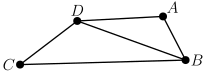
In quadrilateral and is an integer. What is
Respuesta: C
Pista pequeña:
Aplica la desigualdad triangular a y .
Apply the triangle inequality to and
Pista grande:
Del y del .
From and from
Solución:
En la desigualdad triangular da así que y
En así que
El único entero con es
Por lo tanto, la respuesta correcta es C.
In the triangle inequality gives so and
In so
The only integer with is
Thus, the correct answer is C.
11.
Las figuras y que se muestran son las primeras de una sucesión de figuras. Para se construye a partir de rodeándola con un cuadrado y colocando en cada lado del nuevo cuadrado un rombo más de los que tenía en cada lado de su cuadrado exterior. Por ejemplo, la figura tiene rombos. ¿Cuántos rombos hay en la figura ?
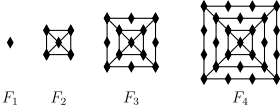
The figures and shown are the first in a sequence of figures. For is constructed from by surrounding it with a square and placing one more diamond on each side of the new square than had on each side of its outside square. For example, figure has diamonds. How many diamonds are there in figure
Respuesta: E
Pista pequeña:
El cuadrado exterior de tiene rombos.
The outside square of has diamonds
Pista grande:
Sumando sobre todos los anillos, tiene rombos.
Summing over all rings, has diamonds
Solución:
El cuadrado exterior de tiene rombos más que el de y el cuadrado exterior de tiene así que el cuadrado exterior de tiene rombos.
Sumando todos los anillos,
Para esto es
Por lo tanto, la respuesta correcta es E.
The outside square of has more diamonds than that of and the outside square of has so the outside square of has diamonds.
Adding all the rings,
For this is
Thus, the correct answer is E.
12.
¿Cuántos enteros positivos menores que son veces la suma de sus dígitos?
How many positive integers less than are times the sum of their digits?
Respuesta: B
Pista pequeña:
Si es igual a veces la suma de sus dígitos, entonces es múltiplo de y es pequeño.
If equals times its digit sum, then is a multiple of and is small
Pista grande:
La suma de los dígitos de un número menor que es a lo sumo así que .
The digit sum of a number below is at most so
Solución:
Si entonces, dado que la suma de los dígitos de un número menor que es a lo sumo tenemos
Para un número de dos dígitos, da lo que obliga a y así que Un número de un dígito necesitaría imposible para Un número de tres dígitos da cuyo lado izquierdo es al menos mientras el lado derecho es a lo sumo así que no hay solución.
Por lo tanto, exactamente un número, funciona.
Por lo tanto, la respuesta correcta es B.
If then since the digit sum of a number below is at most we have
For a two-digit number gives forcing and so A one-digit number would need impossible for A three-digit number gives whose left side is at least while the right side is at most so there is no solution.
Hence exactly one number, works.
Thus, the correct answer is B.
13.
Un barco navega millas en línea recta de a gira un ángulo entre y y luego navega otras millas hasta Sea medido en millas. ¿Cuál de los siguientes intervalos contiene ?
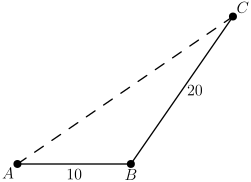
A ship sails miles in a straight line from to turns through an angle between and and then sails another miles to Let be measured in miles. Which of the following intervals contains
Respuesta: D
Pista pequeña:
Por la ley de cosenos, .
By the Law of Cosines,
Pista grande:
El giro es entre y así que está entre y .
The turn is between and so is between and
Solución:
Por la ley de cosenos,
El barco gira un ángulo entre y así que el ángulo interior está entre y
Como y
Así que está en
Por lo tanto, la respuesta correcta es D.
By the Law of Cosines,
The ship turns through an angle between and so the interior angle lies between and
Since and
So lies in
Thus, the correct answer is D.
14.
Un triángulo tiene vértices y y la recta divide el triángulo en dos triángulos de áreas iguales. ¿Cuál es la suma de todos los posibles valores de ?
A triangle has vertices and and the line divides the triangle into two triangles of equal area. What is the sum of all possible values of
Respuesta: B
Pista pequeña:
La recta pasa por el vértice así que para bisecar el área debe pasar por el punto medio del lado opuesto.
The line passes through the vertex so to bisect the area it must hit the midpoint of the opposite side
Pista grande:
Impón que el punto medio del segmento de a esté sobre la recta .
Set the midpoint of the segment from to on the line
Solución:
La recta pasa por el vértice así que biseca el área del triángulo exactamente cuando pasa por el punto medio del lado opuesto, que une y Ese punto medio es
Exigir que satisfaga da así que es decir
Los posibles valores son y cuya suma es
Por lo tanto, la respuesta correcta es B.
The line passes through the vertex so it bisects the triangle’s area exactly when it passes through the midpoint of the opposite side, joining and That midpoint is
Requiring it to satisfy gives so that is
The possible values are and whose sum is
Thus, the correct answer is B.
15.
¿Para qué valor de se cumple Nota: aquí
For what value of is Note: here
Respuesta: D
Pista pequeña:
Agrupa los términos en bloques de cuatro potencias consecutivas de .
Group the terms in blocks of four consecutive powers of
Pista grande:
Cada bloque con múltiplo de es igual a .
Each block with a multiple of equals
Solución:
Para múltiplo de
Sumar los primeros términos (es decir bloques) da
Sumar el siguiente término produce Así que
Por lo tanto, la respuesta correcta es D.
For a multiple of
Summing the first terms (that is blocks) gives
Adding the next term yields So
Thus, the correct answer is D.
16.
Un círculo con centro es tangente a los semiejes positivos e , y tangente externamente al círculo centrado en de radio ¿Cuál es la suma de todos los posibles radios del círculo con centro ?
A circle with center is tangent to the positive - and -axes and externally tangent to the circle centered at with radius What is the sum of all possible radii of the circle with center
Respuesta: D
Pista pequeña:
Un círculo tangente a ambos semiejes positivos con radio tiene centro .
A circle tangent to both positive axes with radius has center
Pista grande:
La tangencia externa da distancia entre y forma una ecuación cuadrática en y usa Vieta.
External tangency gives distance between and form a quadratic in and use Vieta
Solución:
Un círculo tangente a ambos semiejes positivos con radio tiene centro La tangencia externa con el círculo en de radio significa que la distancia entre centros es :
Desarrollando se obtiene Ambas raíces son positivas, y por las fórmulas de Vieta su suma es
Por lo tanto, la respuesta correcta es D.
A circle tangent to both positive axes with radius has center External tangency to the circle at of radius means the distance between centers is :
Expanding gives Both roots are positive, and by Vieta’s formulas their sum is
Thus, the correct answer is D.
17.
Sean y dos series geométricas infinitas distintas de números positivos con el mismo primer término. La suma de la primera serie es y la suma de la segunda serie es ¿Cuánto vale ?
Let and be two different infinite geometric series of positive numbers with the same first term. The sum of the first series is and the sum of the second series is What is
Respuesta: C
Pista pequeña:
La suma de una serie geométrica infinita con primer término y razón es .
The sum of an infinite geometric series with first term and ratio is
Pista grande:
Cada razón satisface es decir usa Vieta sobre las dos raíces.
Each ratio satisfies that is use Vieta on the two roots
Solución:
Para una serie con primer término y razón la suma es así que
Tanto como satisfacen esta misma ecuación cuadrática, y como las dos series son distintas, así que son sus dos raíces distintas. Por las fórmulas de Vieta,
Por lo tanto, la respuesta correcta es C.
For a series with first term and ratio the sum is so
Both and satisfy this same quadratic, and since the two series are different, so they are its two distinct roots. By Vieta’s formulas,
Thus, the correct answer is C.
18.
Para sea donde hay ceros entre el y el Sea el número de factores de en la factorización prima de ¿Cuál es el valor máximo de ?
For let where there are zeros between the and the Let be the number of factors of in the prime factorization of What is the maximum value of
Respuesta: B
Pista pequeña:
Escribe .
Write
Pista grande:
Factoriza la menor potencia de el mayor conteo ocurre en donde aporta un factor de adicional.
Factor out the smaller power of the largest count comes at where supplies one extra factor of
Solución:
Nota que
Para el primer término tiene menos de factores de así que Para el primer término es divisible por pero el término no lo es, así que
Para Como y aporta exactamente un factor más de obtenemos
Así que el valor máximo es
Por lo tanto, la respuesta correcta es B.
Note that
For the first term has fewer than factors of so For the first term is divisible by but the term is not, so
For Since and contributes exactly one more factor of we get
So the maximum value is
Thus, the correct answer is B.
19.
Andrea inscribió un círculo dentro de un pentágono regular, circunscribió un círculo alrededor del pentágono, y calculó el área de la región entre los dos círculos. Bethany hizo lo mismo con un heptágono regular ( lados). Las áreas de las dos regiones fueron y respectivamente. Cada polígono tenía longitud de lado ¿Cuál de las siguientes afirmaciones es verdadera?
Andrea inscribed a circle inside a regular pentagon, circumscribed a circle around the pentagon, and calculated the area of the region between the two circles. Bethany did the same with a regular heptagon ( sides). The areas of the two regions were and respectively. Each polygon had a side length of Which of the following is true?
Respuesta: C
Pista pequeña:
Para un polígono regular de lado sean y el inradio y el circunradio, y observa el centro, el punto medio de un lado y su extremo.
For a regular polygon with side let and be the inradius and circumradius, and look at the center, a side’s midpoint, and its endpoint
Pista grande:
Ese triángulo rectángulo tiene catetos y e hipotenusa así que sin importar el número de lados.
That right triangle has legs and and hypotenuse so regardless of the number of sides
Solución:
Para un polígono regular de lado sea el centro, el punto medio de un lado, y un extremo de ese lado. Entonces tiene un ángulo recto en con (inradio), y (circunradio).
Así que y el área entre los círculos es para cualquier número de lados. Por lo tanto
Por lo tanto, la respuesta correcta es C.
For a regular polygon with side length let be the center, the midpoint of a side, and an endpoint of that side. Then has a right angle at with (inradius), and (circumradius).
So and the area between the circles is for any number of sides. Hence
Thus, the correct answer is C.
20.
El cuadrilátero convexo tiene y Las diagonales y se cortan en y y tienen áreas iguales. ¿Cuánto vale ?
Convex quadrilateral has and Diagonals and intersect at and and have equal areas. What is
Respuesta: E
Pista pequeña:
Las áreas iguales de y implican que y tienen áreas iguales.
Equal areas of and imply and have equal areas
Pista grande:
Esto obliga a haciendo que con razón .
That forces making with ratio
Solución:
Sumar a cada uno de y muestra que y tienen áreas iguales. Comparten la base así que y equidistan de la recta lo que significa
Entonces con razón así que
Escribiendo y obtenemos así que y
Por lo tanto, la respuesta correcta es E.
Adding to each of and shows and have equal areas. They share base so and are equidistant from line meaning
Then with ratio so
Writing and we get so and
Thus, the correct answer is E.
21.
Sea donde y son números complejos. Supón que ¿Cuál es el número de ceros no reales de ?
Let where and are complex numbers. Suppose that What is the number of nonreal zeros of
Respuesta: C
Pista pequeña:
Nota que .
Notice that
Pista grande:
Así que los ceros satisfacen o cuenta las raíces cuartas no reales.
So the zeros satisfy or count the nonreal fourth roots
Solución:
Como un valor es un cero exactamente cuando es igual a una de las raíces de a saber o
La ecuación tiene cuatro raíces no reales distintas. Cada una de y tiene dos raíces reales y dos raíces no reales.
Así que los ceros no reales suman
Por lo tanto, la respuesta correcta es C.
Since a value is a zero exactly when equals one of the roots of namely or
The equation has four distinct nonreal roots. Each of and has two real roots and two nonreal roots.
So the nonreal zeros number
Thus, the correct answer is C.
22.
Un octaedro regular tiene longitud de lado Un plano paralelo a dos de sus caras opuestas corta el octaedro en dos sólidos congruentes. El polígono formado por la intersección del plano y el octaedro tiene área donde y son enteros positivos, y son primos entre sí, y no es divisible por el cuadrado de ningún primo. ¿Cuánto vale ?
A regular octahedron has side length A plane parallel to two of its opposite faces cuts the octahedron into two congruent solids. The polygon formed by the intersection of the plane and the octahedron has area where and are positive integers, and are relatively prime, and is not divisible by the square of any prime. What is
Respuesta: E
Pista pequeña:
El plano de corte pasa por los puntos medios de las seis aristas que no pertenecen a las dos caras paralelas.
The cutting plane passes through the midpoints of the six edges that do not belong to the two parallel faces
Pista grande:
Esos puntos medios forman un hexágono regular de lado halla su área.
Those midpoints form a regular hexagon with side find its area
Solución:
Sean las dos caras paralelas triángulos. El plano pasa por los puntos medios de las seis aristas que no están en esas caras, formando un hexágono equilátero de lado que por simetría también es equiángulo y por lo tanto regular.
Un hexágono regular son seis triángulos equiláteros, así que su área es
Por lo tanto y
Por lo tanto, la respuesta correcta es E.
Let the two parallel faces be triangles. The plane passes through the midpoints of the six edges not on those faces, forming an equilateral hexagon of side which by symmetry is also equiangular and hence regular.
A regular hexagon is six equilateral triangles, so its area is
Thus and
Thus, the correct answer is E.
23.
Las funciones y son cuadráticas, y la gráfica de contiene el vértice de la gráfica de Las cuatro intersecciones con el eje en las dos gráficas tienen coordenadas iguales a y en orden creciente, y El valor de es donde y son enteros positivos, y no es divisible por el cuadrado de ningún primo. ¿Cuánto vale ?
Functions and are quadratic, and the graph of contains the vertex of the graph of The four -intercepts on the two graphs have -coordinates and in increasing order, and The value of is where and are positive integers, and is not divisible by the square of any prime. What is
Respuesta: D
Pista pequeña:
La aplicación es una rotación de alrededor de que envía la gráfica de a la gráfica de .
The map is a rotation about that sends the graph of to the graph of
Pista grande:
Así que las raíces se emparejan como con halla y usa la condición del vértice.
So the roots pair as with find and use the vertex condition
Solución:
Como las gráficas de y son reflexiones una de otra a través del punto así que las cuatro intersecciones se emparejan con
Con obtenemos y
Toma como las raíces de cuyo vértice tiene coordenada igual a así que La condición de que el vértice de esté sobre la gráfica de da lo que da Como debe ser menor que necesitamos así que
Entonces así que Por lo tanto
Por lo tanto, la respuesta correcta es D.
Because the graphs of and are reflections of each other through the point so the four intercepts pair up with
With we get and
Take as the roots of whose vertex has -coordinate so The condition that the vertex of lies on the graph of gives which gives Since must be less than we need so
Then so Hence
Thus, the correct answer is D.
24.
La función torre de doses se define recursivamente como sigue: y para Sea y ¿Cuál es el mayor entero tal que está definido?
The tower function of twos is defined recursively as follows: and for Let and What is the largest integer such that is defined?
Pista pequeña:
Aplicar repetidamente quita un nivel de una torre: .
Repeatedly applying peels one level off a tower:
Pista grande:
Sigue cuántos logaritmos puede resistir antes de que el valor caiga por debajo de .
Track how many logs can survive before the value drops below
Solución:
Como cada aplicación de elimina un de la cima de una torre de doses.
Escribamos y sea el resultado de aplicar a exactamente veces. Los dos primeros resultados son
Para la cota inferior, Al tomar logaritmos repetidamente se obtiene para En particular, así que y Por tanto, está definido.
Para la cota superior, así que Al repetir la última comparación se obtiene para De aquí, Junto con la cota inferior, esto da así que Por lo tanto, no está definido, y el mayor valor posible de es
Así, la respuesta correcta es E.
Since each application of strips one off the top of a tower of twos.
Write and let be the result of applying to exactly times. The first two results are
For the lower bound, Repeatedly taking logarithms gives for In particular, so and Thus is defined.
For the upper bound, so Repeating the last comparison gives for Hence Together with the lower bound, this yields so Therefore is undefined, and the largest possible is
Thus, the correct answer is E.
25.
Los primeros dos términos de una sucesión son y Para ¿Cuánto vale ?
The first two terms of a sequence are and For What is
Respuesta: A
Pista pequeña:
La recursión coincide con la fórmula de la tangente de una suma .
The recursion matches the tangent addition formula
Pista grande:
Como y escribe y sigue .
Since and write and track
Solución:
La recursión es exactamente la fórmula de la tangente de una suma, y
Escribiendo con y la sucesión es que es periódica con período
Como así que y
Por lo tanto, la respuesta correcta es A.
The recursion is exactly the tangent addition formula, and
Writing with and the sequence is which is periodic with period
Since so and
Thus, the correct answer is A.