
Problemas del 1966 AMC 12
¡Desplázate hacia abajo y presiona Iniciar para intentar el examen! O ve al PDF imprimible, la clave de respuestas, o las soluciones profesionales preparadas por LIVE by Po-Shen Loh.
Todos los problemas se usan con el permiso legal oficial de la Mathematical Association of America (MAA).
O salta directamente a un solo problema con su solución: 1 · 2 · 3 · 4 · 5 · 6 · 7 · 8 · 9 · 10 · 11 · 12 · 13 · 14 · 15 · 16 · 17 · 18 · 19 · 20 · 21 · 22 · 23 · 24 · 25 · 26 · 27 · 28 · 29 · 30 · 31 · 32 · 33 · 34 · 35 · 36 · 37 · 38 · 39 · 40
¿Quieres aprender de forma profesional con clases interactivas en video?
Con tiempo
1:15:00
1.
Dado que la razón de a es constante y que cuando entonces, cuando es igual a:
Given that the ratio of to is constant, and when then, when equals:
Respuesta: C
Pista pequeña:
Usa y para hallar la razón constante
Use and to find the constant ratio
Pista grande:
Mantén igual a esa razón cuando
Keep equal to that ratio when
Solución:
El par dado hace que la razón sea Por lo tanto, cuando así que y
Por lo tanto, la respuesta correcta es C.
The given pair makes the ratio Therefore, when so and
Therefore, the correct answer is C.
2.
Cuando la base de un triángulo aumenta y la altura correspondiente disminuye el cambio en el área es:
When the base of a triangle is increased and the altitude to this base is decreased the change in area is:
aumento de
increase
aumento de
increase
disminución de
decrease
disminución de
decrease
Respuesta: E
Pista pequeña:
El área es proporcional al producto de la base por la altura
The area is proportional to the product of base and altitude
Pista grande:
Multiplica los factores de escala y
Multiply the scale factors and
Solución:
El área nueva es veces la anterior. Por lo tanto, es menor.
Por lo tanto, la respuesta correcta es E.
The new area is times the old area. It is therefore smaller.
Thus, the correct answer is E.
3.
Si la media aritmética de dos números es y su media geométrica es entonces una ecuación que tiene esos dos números como raíces es:
If the arithmetic mean of two numbers is and their geometric mean is then an equation with the given two numbers as roots is:
Respuesta: D
Pista pequeña:
Los dos números tienen suma y producto
The two numbers have sum and product
Pista grande:
Las raíces de suma y producto satisfacen
Roots with sum and product satisfy
Solución:
Si los números son y entonces da mientras que da La ecuación mónica con esas raíces es es decir,
Por lo tanto, la respuesta correcta es D.
If the numbers are and then gives while gives The monic equation with those roots is or
Therefore, the correct answer is D.
4.
El círculo está circunscrito a un cuadrado dado y el círculo está inscrito en él. Si es la razón entre el área del círculo y la del círculo entonces es igual a:
Circle is circumscribed about a given square and circle is inscribed in the given square. If is the ratio of the area of circle to that of circle then equals:
Respuesta: B
Pista pequeña:
Para un cuadrado de lado compara los radios y
For square side compare radii and
Pista grande:
Las áreas de los círculos son proporcionales a los cuadrados de sus radios
Circle areas are proportional to the squares of their radii
Solución:
Para un cuadrado de lado el círculo exterior tiene radio mientras que el interior tiene radio Por ello,
Por lo tanto, la respuesta correcta es B.
For square side the outer circle has radius while the inner circle has radius Hence
Therefore, the correct answer is B.
5.
El número de valores de que satisfacen la ecuación
es:
The number of values of satisfying the equation
is:
cero
zero
uno
one
dos
two
tres
three
un entero mayor que
an integer greater than
Respuesta: A
Pista pequeña:
Factoriza el numerador y el denominador antes de resolver
Factor numerator and denominator before solving
Pista grande:
No admitas valores que anulen el denominador original
Do not admit values that make the original denominator zero
Solución:
El denominador exige y En ese dominio, La ecuación restante da que está excluido. Por lo tanto, no hay soluciones.
Por lo tanto, la respuesta correcta es A.
The denominator requires and On that domain, The remaining equation gives which is excluded. Thus there are no solutions.
Therefore, the correct answer is A.
6.
es el diámetro de un círculo con centro es un punto del círculo tal que el ángulo mide Si el diámetro mide pulgadas, la longitud de la cuerda en pulgadas, es:
is a diameter of a circle centered at is a point on the circle such that angle is If the diameter of the circle is inches, the length of chord expressed in inches, is:
ninguna de las anteriores
none of these
Respuesta: C
Pista pequeña:
Como es un diámetro,
Because is a diameter,
Pista grande:
Divide el triángulo isósceles en dos triángulos --
Split isosceles triangle into two -- triangles
Solución:
El radio es y Una cuerda que subtiende tiene longitud
Por lo tanto, la respuesta correcta es C.
The radius is and A chord subtending has length
Therefore, the correct answer is C.
7.
Sea
una identidad en El valor numérico de es:
Let
be an identity in The numerical value of is:
Respuesta: A
Pista pequeña:
Combina las dos fracciones sobre
Combine the two fractions over
Pista grande:
Compara el coeficiente de y el término constante
Compare the coefficient of and the constant term
Solución:
Al combinar el lado derecho se obtiene el numerador Así, y Por lo tanto, y
Por lo tanto, la respuesta correcta es A.
Combining the right side gives numerator Thus and Hence and
Therefore, the correct answer is A.
8.
La cuerda común de dos círculos que se cortan mide pies. Si los radios miden y pies, un valor posible de la distancia entre los centros, expresada en pies, es:
The length of the common chord of two intersecting circles is feet. If the radii are feet and feet, a possible value for the distance between the centers of the circles, expressed in feet, is:
indeterminado
undetermined
Respuesta: B
Pista pequeña:
La recta de los centros biseca perpendicularmente la cuerda común
The line of centers perpendicularly bisects the common chord
Pista grande:
Halla la distancia de cada centro a la cuerda usando la semicuarda
Find each center’s distance from the chord using half-chord
Solución:
La semicuarda mide Las dos distancias perpendiculares de los centros a su recta son Si los centros están en lados opuestos de la cuerda, su distancia es que es un valor posible.
Por lo tanto, la respuesta correcta es B.
The half-chord has length The two perpendicular distances from the centers to its line are If the centers lie on opposite sides of the chord, their distance is which is a possible value.
Therefore, the correct answer is B.
9.
Si entonces es igual a:
If then equals:
Pista pequeña:
Evalúa y por separado
Evaluate and separately
Pista grande:
Expresa la potencia resultante como potencia de
Express the resulting power as a power of
Solución:
Tenemos y Por lo tanto, así que
Por lo tanto, la respuesta correcta es A.
We have and Therefore so
Thus, the correct answer is A.
10.
Si la suma de dos números es y su producto es entonces la suma de sus cubos es, donde
If the sum of two numbers is and their product is then the sum of their cubes is, where
Respuesta: E
Pista pequeña:
Usa
Use
Pista grande:
Sustituye directamente la suma y el producto dados
Substitute the given sum and product directly
Solución:
Si los números son y entonces
Por lo tanto, la respuesta correcta es E.
If the numbers are and then
Therefore, the correct answer is E.
11.
Los lados del triángulo están en la razón es la bisectriz trazada hacia el lado más corto que lo divide en los segmentos y Si mide entonces la longitud del segmento mayor de es:
The sides of triangle are in the ratio is the angle-bisector drawn to the shortest side dividing it into segments and If the length of is then the length of the longer segment of is:
Respuesta: C
Pista pequeña:
Como es el lado más corto, los lados adyacentes están en razón
Since is the shortest side, the adjacent sides are in ratio
Pista grande:
Aplica el teorema de la bisectriz a
Apply the angle-bisector theorem to
Solución:
Los lados adyacentes al ángulo están en razón Por el teorema de la bisectriz, Por lo tanto, la mayor de las dos partes es
Por lo tanto, la respuesta correcta es C.
The sides adjacent to angle are in ratio By the angle-bisector theorem, The longer of the two parts is therefore
Therefore, the correct answer is C.
12.
El número de valores reales de que satisfacen la ecuación
es:
The number of real values of that satisfy the equation
is:
mayor que
greater than
Respuesta: E
Pista pequeña:
Reescribe cada término con base
Rewrite every term with base
Pista grande:
Compara el exponente total de cada lado antes de intentar despejar
Compare the total exponent on each side before trying to solve for
Solución:
En base el exponente del lado izquierdo es y el del lado derecho es La ecuación es una identidad para todo real, así que tiene más de tres soluciones reales.
Por lo tanto, la respuesta correcta es E.
In base the left exponent is and the right exponent is The equation is an identity for every real so it has more than three real solutions.
Therefore, the correct answer is E.
13.
El número de puntos con coordenadas racionales positivas entre los puntos del plano que satisfacen es:
The number of points with positive rational coordinates selected from the set of points in the -plane such that is:
infinito
infinite
Respuesta: E
Pista pequeña:
Intenta fijar una coordenada racional positiva
Try fixing one positive rational coordinate
Pista grande:
Hay infinitos números racionales positivos en un intervalo
There are infinitely many positive rational numbers in an interval
Solución:
Por ejemplo, toma Cada racional positivo da entonces un punto permitido y hay infinitos racionales de ese tipo.
Por lo tanto, la respuesta correcta es E.
For example, set Every positive rational then gives an allowed point and there are infinitely many such rationals.
Therefore, the correct answer is E.
14.
El rectángulo mide pulgadas de largo y de ancho. Los puntos y dividen la diagonal en tres segmentos iguales. El área del triángulo expresada en pulgadas cuadradas, es:
The length of rectangle is inches and its width is inches. Diagonal is divided into three equal segments by points and The area of triangle expressed in square inches, is:
Respuesta: C
Pista pequeña:
Coloca el rectángulo en y
Place the rectangle at and
Pista grande:
Los puntos de trisección de la diagonal tienen coordenadas sencillas
The trisection points of diagonal have easy coordinates
Solución:
Toma y Entonces y La fórmula del determinante da
Por lo tanto, la respuesta correcta es C.
Take and Then and The determinant formula gives
Therefore, the correct answer is C.
15.
Si y entonces:
If and then:
y
and
y
and
Respuesta: D
Pista pequeña:
Resta en ambos lados de la primera desigualdad
Subtract from the first inequality
Pista grande:
Resta en ambos lados de la segunda desigualdad
Subtract from the second inequality
Solución:
De se obtiene por lo que De se obtiene
Por lo tanto, la respuesta correcta es D.
From we get so From we get
Therefore, the correct answer is D.
16.
Si
y son números reales, entonces es igual a:
If
and are real numbers, then equals:
Respuesta: B
Pista pequeña:
Reescribe las dos ecuaciones con bases y
Rewrite both equations with bases and
Pista grande:
Iguala exponentes para obtener dos ecuaciones lineales en y
Equate exponents to obtain two linear equations in and
Solución:
La primera ecuación se convierte en por lo que La segunda se convierte en por lo que Al resolver se obtiene y por ello
Por lo tanto, la respuesta correcta es B.
The first equation becomes so The second becomes so Solving gives and hence
Therefore, the correct answer is B.
17.
El número de puntos distintos comunes a las curvas y es:
The number of distinct points common to the curves and is:
Respuesta: C
Pista pequeña:
Usa la primera ecuación para sustituir en la segunda
Use the first equation to substitute for in the second
Pista grande:
Después de hallar cuenta los dos signos posibles de
After finding count both possible signs of
Solución:
De la primera ecuación, Al sustituir en la segunda se obtiene por lo que Entonces lo que da los dos puntos y
Por lo tanto, la respuesta correcta es C.
From the first equation, Substitution into the second gives so Then giving the two points and
Therefore, the correct answer is C.
18.
En cierta sucesión aritmética, el primer término es el último es y la suma de todos los términos es La diferencia común es:
In a given arithmetic sequence the first term is the last term is and the sum of all the terms is The common difference is:
Respuesta: A
Pista pequeña:
Usa para hallar el número de términos
Use to find the number of terms
Pista grande:
Luego usa
Then use
Solución:
La fórmula de la suma da por lo que Entonces y
Por lo tanto, la respuesta correcta es A.
The sum formula gives so Therefore and
Thus, the correct answer is A.
19.
Sea la suma de los primeros términos de la sucesión aritmética , y sea la suma de los primeros términos de la sucesión aritmética Entonces para:
Let be the sum of the first terms of the arithmetic sequence and let be the sum of the first terms of the arithmetic sequence Then for:
ningún valor de
no value of
un valor de
one value of
dos valores de
two values of
cuatro valores de
four values of
más de cuatro valores de
more than four values of
Respuesta: B
Pista pequeña:
Escribe una fórmula de suma para cada progresión
Write a sum formula for each progression
Pista grande:
Cancela el factor positivo después de igualar las sumas
Cancel the positive factor after equating the sums
Solución:
Las dos sumas son Al igualarlas se obtiene Como el número de términos es positivo, solo funciona , así que hay un valor.
Por lo tanto, la respuesta correcta es B.
The two sums are Equality gives Since a number of terms is positive, only works, so there is one value.
Therefore, the correct answer is B.
20.
Si la proposición “” es verdadera, la negación de la proposición “Para valores reales de y si entonces ” es:
If the proposition “” is true, the negation of the proposition “For real values of and if then ” is:
Si entonces
If then
Si entonces
If then
Si entonces
If then
Si entonces
If then
Si entonces
If then
Respuesta: C
Pista pequeña:
La negación de una conclusión verdadera es su enunciado opuesto
The negation of a true conclusion is its opposite statement
Pista grande:
Bajo la suposición dada niega la conclusión
Under the stated assumption negate the conclusion
Solución:
Se supone verdadera la premisa . Por ello, negar la implicación niega su conclusión: se convierte en Así, el enunciado pedido es “Si entonces ”
Por lo tanto, la respuesta correcta es C.
The stated premise is assumed true. Negating the implication therefore negates its conclusion: becomes Thus the required statement is “If then ”
Therefore, the correct answer is C.
21.
Se forma una “estrella de puntas” así: los lados de un polígono convexo se numeran consecutivamente para los valores de los lados y no son paralelos, y los lados y son respectivamente idénticos a los lados y se prolongan los pares de lados numerados y hasta que se corten. (Se muestra una figura para el caso )
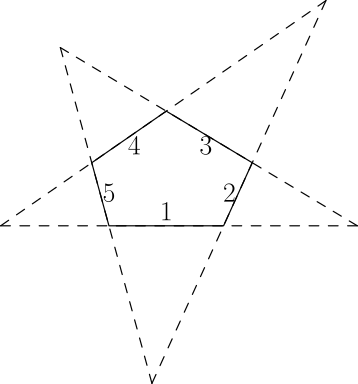
Sea la suma en grados de los ángulos interiores en las puntas de la estrella; entonces es igual a:
An “-pointed star” is formed as follows: the sides of a convex polygon are numbered consecutively for all values of sides and are non-parallel, sides and being respectively identical with sides and prolong the pairs of sides numbered and until they meet. (A figure is shown for the case )
Let be the degree-sum of the interior angles at the points of the star; then equals:
Respuesta: E
Pista pequeña:
Relaciona cada ángulo de una punta con dos ángulos interiores adyacentes del polígono original
Relate each star-tip angle to two adjacent interior angles of the original polygon
Pista grande:
La suma de los ángulos interiores del polígono original es grados
The original polygon’s interior-angle sum is degrees
Solución:
Sean los ángulos interiores del polígono original. El ángulo de la estrella formado por los lados y es Al sumar cíclicamente se cuenta cada dos veces. Por ello,
Por lo tanto, la respuesta correcta es E.
Let the original polygon’s interior angles be The star angle made from sides and equals Summing cyclically counts each twice. Hence
Therefore, the correct answer is E.
22.
Considera las afirmaciones:
donde se permite que y sean números reales o complejos. Las afirmaciones que tienen soluciones distintas de y son:
Consider the statements:
where we allow and to be real or complex numbers. Those statements for which there exist solutions other than and are:
solo
only
solo
only
solo
only
solo
only
Respuesta: A
Pista pequeña:
Basta un ejemplo no nulo para cada afirmación
One nonzero example is enough for each statement
Pista grande:
Prueba para valores positivos iguales para y para y
Try for equal positive values for and for and
Solución:
Cada afirmación tiene una solución no nula. Para usa Para usa lo que da Para y usa Por lo tanto, sirven las cuatro afirmaciones.
Por lo tanto, la respuesta correcta es A.
Every statement has a nonzero solution. For use For use giving For both and use Thus all four statements qualify.
Therefore, the correct answer is A.
23.
Si es real y entonces el conjunto completo de valores de para los que es real es:
If is real and then the complete set of values of for which is real, is:
o
or
o
or
o
or
Respuesta: A
Pista pequeña:
Trata la ecuación como una cuadrática en
Treat the equation as a quadratic in
Pista grande:
Exige que su discriminante sea no negativo
Require its discriminant to be nonnegative
Solución:
Como cuadrática en la ecuación tiene discriminante Este es no negativo exactamente cuando o
Por lo tanto, la respuesta correcta es A.
As a quadratic in the equation has discriminant This is nonnegative exactly when or
Therefore, the correct answer is A.
24.
Si y entonces es igual a:
If and then equals:
un número mayor que y menor que
a number greater than and less than
Respuesta: B
Pista pequeña:
Escribe ambos logaritmos mediante logaritmos naturales
Write both logarithms using natural logs
Pista grande:
La igualdad da ; usa
The equality gives ; use
Solución:
El cambio de base da por lo que La igualdad de los propios logaritmos daría lo cual está excluido. Por ello, y Así,
Por lo tanto, la respuesta correcta es B.
Change of base gives so Equality of the logs themselves would give which is excluded. Hence and Thus
Therefore, the correct answer is B.
25.
Si para y entonces es igual a:
If for and then equals:
Respuesta: D
Pista pequeña:
Simplifica la recurrencia a
Simplify the recurrence to
Pista grande:
Cuenta los incrementos desde hasta
Count the increments from to
Solución:
Cada paso suma Hay pasos desde hasta por lo que
Por lo tanto, la respuesta correcta es D.
Each step adds There are steps from to so
Therefore, the correct answer is D.
26.
Sea un entero positivo, y supongamos que las rectas y se cortan en un punto de coordenadas enteras. Entonces puede ser:
Let be a positive integer and let the lines and intersect in a point whose coordinates are integers. Then can be:
solo
only
solo
only
solo
only
solo
only
uno de los enteros y otro entero positivo
one of the integers and one other positive integer
Respuesta: C
Pista pequeña:
Sustituye en la primera recta
Substitute into the first line
Pista grande:
Para que sea entero, debe dividir a
For integer the number must divide
Solución:
La sustitución da Así, debe ser un divisor positivo de Entre los divisores mayores que solo es congruente con Por ello, así que
Por lo tanto, la respuesta correcta es C.
Substitution gives Thus must be a positive divisor of Among divisors greater than only is congruent to Hence so
Therefore, the correct answer is C.
27.
A su velocidad habitual, un hombre rema millas río abajo en cinco horas menos de lo que tarda en regresar. Si duplica su velocidad habitual, el tiempo río abajo es solo una hora menor que el tiempo río arriba. La velocidad de la corriente, en millas por hora, es:
At his usual rate a man rows miles downstream in five hours less time than it takes him to return. If he doubles his usual rate, the time downstream is only one hour less than the time upstream. In miles per hour, the rate of the stream’s current is:
Respuesta: A
Pista pequeña:
Sea la velocidad del remero en agua quieta y la de la corriente
Let be the rower’s still-water speed and the current speed
Pista grande:
Expresa las dos diferencias de tiempo usando las velocidades y
Translate the two time differences using speeds and
Solución:
Las dos diferencias de tiempo dan Estas se simplifican a y Al sustituir en la segunda se obtiene Como se tiene
Por lo tanto, la respuesta correcta es A.
The two time differences give These simplify to and Substituting into the second gives Since we have
Therefore, the correct answer is A.
28.
Se toman, en este orden, cinco puntos sobre una recta, con distancias y es un punto de la recta entre y tal que Entonces es igual a:
Five points are taken in order on a straight line with distances and is a point on the line between and and such that Then equals:
Respuesta: B
Pista pequeña:
Escribe Entonces y
Write Then and
Pista grande:
Multiplica en cruz la igualdad de razones después de esas sustituciones
Cross-multiply the two given ratios after making those substitutions
Solución:
Sea La razón dada se convierte en Al multiplicar en cruz se cancelan los términos y se obtiene Por lo tanto,
Por lo tanto, la respuesta correcta es B.
Let The given ratio becomes Cross-multiplication cancels the terms and yields Therefore
Thus, the correct answer is B.
29.
El número de enteros positivos menores que que no son divisibles ni por ni por es:
The number of positive integers less than divisible by neither nor is:
Respuesta: B
Pista pequeña:
Hay enteros positivos menores que
There are positive integers below
Pista grande:
Resta los múltiplos de y , y luego vuelve a sumar los múltiplos de
Subtract multiples of and , then add back multiples of
Solución:
Por inclusión-exclusión, la cantidad es
Por lo tanto, la respuesta correcta es B.
By inclusion-exclusion, the count is
Therefore, the correct answer is B.
30.
Si tres de las raíces de son y entonces el valor de es:
If three of the roots of are and then the value of is:
Respuesta: D
Pista pequeña:
La ausencia del coeficiente de hace que la suma de las cuatro raíces sea cero
The missing coefficient makes the sum of all four roots zero
Pista grande:
Usa la cuarta raíz para calcular la suma por pares y el producto
Use the fourth root to compute the pairwise sum and product
Solución:
La cuarta raíz es porque la suma de las raíces es cero. La suma de los productos por pares es mientras que el producto es Así,
Por lo tanto, la respuesta correcta es D.
The fourth root is because the root sum is zero. The sum of pairwise products is while the product is Thus
Therefore, the correct answer is D.
31.
El triángulo está inscrito en un círculo de centro Un círculo de centro está inscrito en el triángulo Se traza y se prolonga hasta cortar el círculo mayor en Entonces necesariamente:
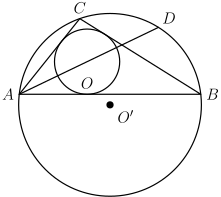
Triangle is inscribed in a circle with center A circle with center is inscribed in triangle is drawn, and extended to intersect the larger circle in Then we must have:
Respuesta: D
Pista pequeña:
La recta biseca por lo que es el punto medio del arco
Line bisects so is the midpoint of arc
Pista grande:
Compara los ángulos del triángulo para demostrar
Compare angles in triangle to show
Solución:
Como es una bisectriz, los ángulos inscritos y son iguales. Por ello, los arcos y , y por consiguiente las cuerdas y son iguales.
Sean y Entonces En el triángulo el ángulo exterior también es Así, por lo que
Por lo tanto, la respuesta correcta es D.
Because is an angle bisector, the inscribed angles and are equal. Hence arcs and , and therefore chords and are equal.
Let and Then In triangle the exterior angle also equals Thus so
Therefore, the correct answer is D.
32.
Sea el punto medio del lado del triángulo Sea un punto de entre y y trácese paralela a , que corta a en Si la razón entre el área del triángulo y la del triángulo se denota por entonces:
Let be the midpoint of side of triangle Let be a point on between and and let be drawn parallel to and intersecting at If the ratio of the area of triangle to that of triangle is denoted by then:
, según la posición de
depending upon the position of
, independientemente de la posición de
independent of the position of
, según la posición de
depending upon the position of
, según la posición de
depending upon the position of
, independientemente de la posición de
independent of the position of
Respuesta: B
Pista pequeña:
Los triángulos y tienen bases iguales sobre rectas paralelas
Triangles and have equal bases on parallel lines
Pista grande:
Suma sus áreas a y usa que es una mediana
Add their areas to and use that is a median
Solución:
Como los triángulos y tienen la misma base y alturas iguales, así que sus áreas son iguales. Por ello, Como es una mediana, Así, para todo permitido.
Por lo tanto, la respuesta correcta es B.
Since triangles and have the same base and equal altitudes, so their areas are equal. Hence Because is a median, Thus for every allowed
Therefore, the correct answer is B.
33.
Si y el número de valores distintos de que satisfacen la ecuación
es:
If and the number of distinct values of satisfying the equation
is:
Respuesta: D
Pista pequeña:
Tras combinar términos, ambos lados contienen el numerador
Both sides contain the numerator after combining terms
Pista grande:
Factoriza la ecuación como ese numerador por una diferencia de recíprocos
Factor the equation into that numerator times a difference of reciprocals
Solución:
Sea Al combinar cada lado se obtiene El primer factor da El segundo da o bien lo que da y Las hipótesis garantizan que los tres están definidos y son distintos.
Por lo tanto, la respuesta correcta es D.
Let Combining each side gives The first factor gives The second gives or giving and The hypotheses ensure that all three are defined and distinct.
Therefore, the correct answer is D.
34.
Sea la velocidad en millas por hora a la que avanza una rueda de pies de circunferencia. Si el tiempo de una vuelta completa se reduce en de segundo, la velocidad aumenta millas por hora. Entonces es:
Let be the speed in miles per hour at which a wheel, feet in circumference, travels. If the time for a complete rotation of the wheel is shortened by of a second, the speed is increased by miles per hour. Then is:
Respuesta: B
Pista pequeña:
A millas por hora, una vuelta tarda segundos
At miles per hour, one rotation takes seconds
Pista grande:
Plantea
Set
Solución:
Como pies son de milla, una vuelta a millas por hora tarda segundos. Por ello, Esto se reduce a o La velocidad positiva es
Por lo tanto, la respuesta correcta es B.
Since feet is mile, one rotation at mph takes seconds. Thus This reduces to or The positive speed is
Therefore, the correct answer is B.
35.
Sea un punto interior del triángulo y sea Si entonces:
Let be an interior point of triangle and let If then:
para todo triángulo, y
for every triangle and
para todo triángulo, y
for every triangle and
para todo triángulo, y
for every triangle and
para todo triángulo, y
for every triangle and
ni , ni , ni , ni se aplica a todo triángulo
neither nor nor nor applies to every triangle
Respuesta: C
Pista pequeña:
Suma y
Add and
Pista grande:
Prolonga hasta el lado para demostrar y repite cíclicamente
Extend to side to prove and cycle
Solución:
Al sumar las tres desigualdades triangulares estrictas se obtiene
Para la cota superior, prolonga hasta en Entonces y por lo que al cancelar se obtiene Al repetir cíclicamente y sumar se obtiene Por lo tanto, y
Por lo tanto, la respuesta correcta es C.
Adding the three strict triangle inequalities gives
For the upper bound, extend to on Then and so cancellation gives Cycling and adding yields Therefore and
Thus, the correct answer is C.
36.
Sea
una identidad en Si tomamos entonces es igual a:
Let
be an identity in If we let then equals:
Respuesta: E
Pista pequeña:
Evalúa el polinomio en y
Evaluate the polynomial at and
Pista grande:
Al sumar esos dos valores se cancelan todos los coeficientes de grado impar
Adding those two values cancels all odd-degree coefficients
Solución:
Sea Entonces es la suma de todos los coeficientes, mientras que es la suma de los coeficientes pares menos la de los impares. Por lo tanto,
Por lo tanto, la respuesta correcta es E.
Let Then is the sum of all coefficients, while is the even-coefficient sum minus the odd-coefficient sum. Therefore
Therefore, the correct answer is E.
37.
Tres hombres, Alfa, Beta y Gamma, trabajando juntos, terminan un trabajo en horas menos que Alfa solo, en hora menos que Beta solo y en la mitad del tiempo que necesita Gamma solo. Sea el número de horas que necesitan Alfa y Beta, trabajando juntos, para terminarlo. Entonces es igual a:
Three men, Alpha, Beta, and Gamma, working together, do a job in hours less time than Alpha alone, in hour less time than Beta alone, and in one-half the time needed by Gamma when working alone. Let be the number of hours needed by Alpha and Beta, working together, to do the job. Then equals:
Respuesta: C
Pista pequeña:
Sea el tiempo que tardan los tres juntos
Let be the time all three take together
Pista grande:
Sus tiempos individuales son y ; suma las tasas recíprocas
Their individual times are and ; add reciprocal rates
Solución:
Si los tres juntos tardan horas, entonces Esto se simplifica a por lo que Alfa y Beta solos tardan y horas, así que su tasa conjunta es Por ello,
Por lo tanto, la respuesta correcta es C.
If all three together take hours, then This simplifies to so Alpha and Beta alone take and hours, so their combined rate is Hence
Therefore, the correct answer is C.
38.
En el triángulo , las medianas y a los lados y respectivamente, se cortan en es el punto medio del lado y corta a en Si el área del triángulo es entonces el área del triángulo es:
In triangle the medians and to sides and respectively, intersect in point is the midpoint of side and intersects in If the area of triangle is then the area of triangle is:
Respuesta: D
Pista pequeña:
Usa un modelo afín y
Use an affine model and
Pista grande:
Halla y compara las dos áreas
Find and compare the two areas
Solución:
Las razones de áreas son invariantes bajo transformaciones afines, así que toma y Entonces La recta es y corta la mediana en Así, mientras que Su razón es por lo que
Por lo tanto, la respuesta correcta es D.
Area ratios are affine-invariant, so take and Then Line is and it meets median at Thus while Their ratio is so
Therefore, the correct answer is D.
39.
En base , la expansión de la fracción es y la de es En base , la fracción al expandirse, se convierte en mientras que se convierte en La suma de y escritos ambos en base diez, es:
In base the expanded fraction becomes and the expanded fraction becomes In base fraction when expanded, becomes while fraction becomes The sum of and each written in base ten, is:
Respuesta: E
Pista pequeña:
Un par repetido en base es igual a
A repeating pair in base equals
Pista grande:
Suma las ecuaciones de y y luego réstalas
Add the equations for and then subtract them
Solución:
Las dos descripciones dan Al sumar se obtiene o Al restar se obtiene o Al resolver se obtiene cuya suma es
Por lo tanto, la respuesta correcta es E.
The two descriptions give Adding yields or Subtracting yields or Solving gives whose sum is
Therefore, the correct answer is E.
40.
En esta figura, es el diámetro de un círculo de centro y radio Se traza la cuerda y se prolonga hasta cortar en la tangente al círculo en Se toma el punto en de modo que Si las coordenadas de son entonces:
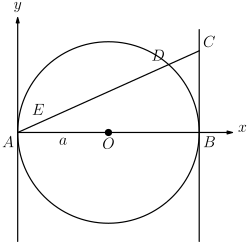
In this figure is a diameter of a circle, centered at with radius A chord is drawn and extended to meet the tangent to the circle at in point Point is taken on so that If the coordinates of are then:
Respuesta: A
Pista pequeña:
Traza perpendiculares desde y al diámetro
Drop perpendiculars from and to diameter
Pista grande:
Usa entre las dos tangentes paralelas y combina el teorema de la altura con triángulos semejantes
Use between the two parallel tangents, then combine the altitude theorem with similar triangles
Solución:
Traza las perpendiculares y a Como y las tangentes por son paralelas, sus proyecciones dan Por ello, En el triángulo rectángulo el teorema de la altura da Los triángulos semejantes y dan por lo que La sustitución y la cancelación producen
Por lo tanto, la respuesta correcta es A.
Drop perpendiculars and to Since and the tangents through are parallel, their projections give Hence In right triangle the altitude theorem gives Similar triangles and give so Substitution and cancellation yield
Therefore, the correct answer is A.