
Problemas del 1963 AMC 12
¡Desplázate hacia abajo y presiona Iniciar para intentar el examen! O ve al PDF imprimible, la clave de respuestas, o las soluciones profesionales preparadas por LIVE by Po-Shen Loh.
Todos los problemas se usan con el permiso legal oficial de la Mathematical Association of America (MAA).
O salta directamente a un solo problema con su solución: 1 · 2 · 3 · 4 · 5 · 6 · 7 · 8 · 9 · 10 · 11 · 12 · 13 · 14 · 15 · 16 · 17 · 18 · 19 · 20 · 21 · 22 · 23 · 24 · 25 · 26 · 27 · 28 · 29 · 30 · 31 · 32 · 33 · 34 · 35 · 36 · 37 · 38 · 39 · 40
¿Quieres aprender de forma profesional con clases interactivas en video?
Con tiempo
1:15:00
1.
¿Cuál de los siguientes puntos no está en la gráfica de ?
Which one of the following points is not on the graph of
Respuesta: D
Pista pequeña:
Comprueba el dominio antes de sustituir las coordenadas
Check the domain before substituting coordinates
Pista grande:
El denominador se anula en una de las coordenadas indicadas
The denominator vanishes at one of the listed -coordinates
Solución:
La expresión no está definida cuando Por lo tanto, ningún punto cuya primera coordenada sea puede estar en su gráfica.
Así, la respuesta correcta es D.
The expression is undefined when Therefore no point whose first coordinate is can lie on its graph.
Thus, the correct answer is D.
2.
Sea Halla cuando y
Let Find when and
Respuesta: A
Pista pequeña:
Calcula primero el exponente
First compute the exponent
Pista grande:
Evalúa la potencia antes de restarla de
Evaluate the power before subtracting it from
Solución:
Aquí por lo que
Por lo tanto, la respuesta correcta es A.
Here so
Therefore, the correct answer is A.
3.
Si el recíproco de es entonces es igual a:
If the reciprocal of is then equals:
ninguna de estas opciones
none of these
Respuesta: E
Pista pequeña:
Traduce «el recíproco de » a una ecuación
Translate “the reciprocal of ” into an equation
Pista grande:
Multiplicar por produce una diferencia de cuadrados
Multiplying by leads to a difference of squares
Solución:
La ecuación es Por tanto, de modo que Ninguno de estos valores aparece en la lista.
Así, la respuesta correcta es E.
The equation is Hence so Neither value is listed.
Thus, the correct answer is E.
4.
¿Para qué valor o valores de tienen las ecuaciones y dos soluciones idénticas?
For what value(s) of does the pair of equations and have two identical solutions?
Respuesta: D
Pista pequeña:
Iguala las dos expresiones de
Set the two expressions for equal
Pista grande:
Una intersección doble hace que el discriminante de la cuadrática resultante sea cero
A repeated intersection makes the resulting quadratic’s discriminant zero
Solución:
Las intersecciones satisfacen Para que haya dos soluciones idénticas se requiere lo que da
Por lo tanto, la respuesta correcta es D.
Intersections satisfy Two identical solutions require giving
Therefore, the correct answer is D.
5.
Si y son números reales y entonces:
If and are real numbers and then:
Respuesta: E
Pista pequeña:
Un logaritmo real requiere un argumento positivo
A real logarithm requires a positive argument
Pista grande:
Compara con
Compare with
Solución:
El logaritmo es real solo si Como la base es mayor que la desigualdad implica
Así, la respuesta correcta es E.
The logarithm is real only for Since base is greater than implies
Thus, the correct answer is E.
6.
El triángulo es rectángulo en En hay un punto tal que y La medida del ángulo en grados, es:
Triangle is right-angled at On there is a point for which and The magnitude of angle in degrees, is:
Respuesta: B
Pista pequeña:
El punto medio de la hipotenusa de un triángulo rectángulo equidista de los tres vértices
A midpoint of a right triangle’s hypotenuse is equidistant from all three vertices
Pista grande:
Usa
Use
Solución:
Como es el punto medio de la hipotenusa se tiene Dado que el triángulo es equilátero. Por tanto,
Así, la respuesta correcta es B.
Since is the midpoint of hypotenuse Given triangle is equilateral. Thus
Therefore, the correct answer is B.
7.
Dadas las cuatro ecuaciones:
El par que representa rectas perpendiculares es:
Given the four equations:
The pair representing perpendicular lines is:
y
and
y
and
y
and
y
and
y
and
Respuesta: A
Pista pequeña:
Reescribe cada ecuación en forma pendiente-intersección
Rewrite each equation in slope-intercept form
Pista grande:
Las pendientes de dos rectas no verticales perpendiculares tienen producto
Perpendicular nonvertical lines have slopes whose product is
Solución:
La recta tiene pendiente y la recta tiene pendiente Su producto es así que estas dos rectas son perpendiculares.
Por lo tanto, la respuesta correcta es A.
Line has slope and line has slope Their product is so these two lines are perpendicular.
Thus, the correct answer is A.
8.
El menor entero positivo para el cual donde es un entero, es:
The smallest positive integer for which where is an integer, is:
Respuesta: D
Pista pequeña:
Factoriza en primos
Factor into primes
Pista grande:
Eleva cada exponente primo hasta el siguiente múltiplo de
Raise every prime exponent to the next multiple of
Solución:
Como el menor multiplicador que hace que todos los exponentes sean divisibles por es
Así, la respuesta correcta es D.
Since the least multiplier making every exponent divisible by is
Thus, the correct answer is D.
9.
En el desarrollo de , el coeficiente de es:
In the expansion of the coefficient of is:
Respuesta: C
Pista pequeña:
El término que elige el segundo sumando veces tiene exponente
The term choosing the second summand times has exponent
Pista grande:
Iguala ese exponente a antes de hallar el coeficiente binomial y el signo
Set that exponent equal to before finding the binomial coefficient and sign
Solución:
El término que usa exactamente veces tiene exponente Al igualarlo a se obtiene Su coeficiente es
Por lo tanto, la respuesta correcta es C.
The term using exactly times has exponent Setting this to gives Its coefficient is
Therefore, the correct answer is C.
10.
Se toma un punto en el interior de un cuadrado de lado , de manera que equidista de dos vértices consecutivos y del lado opuesto a esos vértices. Si representa la distancia común, entonces es igual a:
Point is taken interior to a square with side-length and such that it is equally distant from two consecutive vertices and from the side opposite these vertices. If represents the common distance, then equals:
Respuesta: B
Pista pequeña:
Las distancias iguales a dos vértices consecutivos sitúan a en la mediatriz del segmento que los une
The equal distances to two consecutive vertices put on their perpendicular bisector
Pista grande:
Si la distancia al lado opuesto es usa un triángulo rectángulo con catetos y
If the distance to the opposite side is use a right triangle with legs and
Solución:
Coloca el lado opuesto a altura y los dos vértices a altura Entonces Igualar la distancia al vértice con da de modo que y
Así, la respuesta correcta es B.
Place the opposite side at height and the two vertices at height Then Equality of the vertex distance and gives so and
Thus, the correct answer is B.
11.
La media aritmética de un conjunto de números es Si se eliminan dos números del conjunto, concretamente y la media aritmética de los números restantes es:
The arithmetic mean of a set of numbers is If two numbers of the set, namely and are discarded, the arithmetic mean of the remaining set of numbers is:
Respuesta: B
Pista pequeña:
Recupera la suma original a partir de la media
Recover the original sum from the mean
Pista grande:
Resta y divide entre
Subtract and divide by
Solución:
La suma original es Después de eliminar la suma restante es así que la nueva media es
Así, la respuesta correcta es B.
The original sum is After removing the remaining sum is so the new mean is
Thus, the correct answer is B.
12.
Tres vértices del paralelogramo son , con y como vértices opuestos. La suma de las coordenadas del vértice es:
Three vertices of parallelogram are with and diagonally opposite. The sum of the coordinates of vertex is:
Respuesta: E
Pista pequeña:
Las diagonales de un paralelogramo se bisecan
The diagonals of a parallelogram bisect each other
Pista grande:
Usa la relación vectorial
Use the vector relation
Solución:
Como La suma de las coordenadas es
Por lo tanto, la respuesta correcta es E.
Since The coordinate sum is
Therefore, the correct answer is E.
13.
Si ¿cuántos de los enteros pueden ser negativos como máximo?
If the number of integers which can possibly be negative is, at most:
Respuesta: E
Pista pequeña:
Un denominador reducido del lado izquierdo solo puede contener mientras que uno del lado derecho solo puede contener
A reduced denominator on the left can contain only while one on the right can contain only
Pista grande:
Concluye que ambos lados deben ser enteros y luego analiza cuándo una suma de dos potencias negativas puede ser entera
Conclude both sides must be integers, then examine when a sum of two negative powers can be integral
Solución:
En forma reducida, el lado izquierdo solo puede tener una potencia de en el denominador, mientras que el lado derecho solo puede tener una potencia de La igualdad obliga entonces a que ambos lados sean enteros. Si o fuera negativo, conservaría un factor en el denominador. Por tanto,
De igual manera, un valor negativo de o solo puede dar un entero en el caso excepcional cuya suma es Pero Por ello, también , así que ninguno puede ser negativo.
Así, la respuesta correcta es E.
In lowest terms, the left side can have only a power of in its denominator, while the right side can have only a power of Equality therefore forces both sides to be integers. If either or were negative, would retain a factor in its denominator. Thus
Likewise, negative or can give an integer only in the exceptional case whose sum is But Hence as well, so none can be negative.
Thus, the correct answer is E.
14.
Dadas las ecuaciones y Si, al ordenar adecuadamente las raíces, cada raíz de la segunda ecuación es mayor que la raíz correspondiente de la primera, entonces es igual a:
Given the equations and If, when the roots of the equations are suitably listed, each root of the second equation is more than the corresponding root of the first equation, then equals:
ninguna de estas opciones
none of these
Respuesta: A
Pista pequeña:
Compara las sumas de los dos pares de raíces
Compare the sums of the two pairs of roots
Pista grande:
Sumar a cada raíz aumenta su suma en
Adding to each root increases their sum by
Solución:
El primer par de raíces tiene suma mientras que el segundo tiene suma Como ambas raíces aumentan en se tiene de modo que
Por lo tanto, la respuesta correcta es A.
The first pair of roots has sum while the second has sum Since both roots increase by so
Therefore, the correct answer is A.
15.
Un círculo está inscrito en un triángulo equilátero y un cuadrado está inscrito en el círculo. La razón entre el área del triángulo y la del cuadrado es:
A circle is inscribed in an equilateral triangle, and a square is inscribed in the circle. The ratio of the area of the triangle to the area of the square is:
Respuesta: C
Pista pequeña:
Expresa ambas áreas mediante el radio del círculo
Express both areas using the circle’s radius
Pista grande:
El lado del triángulo es y la diagonal del cuadrado es
The triangle’s side is and the square’s diagonal is
Solución:
Si el círculo tiene radio el triángulo equilátero tiene lado y área El cuadrado tiene lado y área La razón es
Así, la respuesta correcta es C.
If the circle has radius the equilateral triangle has side and area The square has side and area The ratio is
Thus, the correct answer is C.
16.
Tres números no nulos forman una progresión aritmética. Aumentar en o aumentar en produce una progresión geométrica. Entonces es igual a:
Three numbers none zero, form an arithmetic progression. Increasing by or increasing by results in a geometric progression. Then equals:
Respuesta: C
Pista pequeña:
Traduce las tres condiciones de progresión en ecuaciones que contengan y
Translate the three progression conditions into equations involving and
Pista grande:
Compara primero
Compare first
Solución:
Las condiciones dan Comparando las dos últimas se obtiene Así, y Como resulta y por tanto
Así, la respuesta correcta es C.
The conditions give Comparing the last two yields Thus and Since so
Therefore, the correct answer is C.
17.
La expresión
con real y tiene el valor para:
The expression
real, has the value for:
todos los valores reales de salvo dos
all but two real values of
solo dos valores reales de
only two real values of
todos los valores reales de
all real values of
solo un valor real de
only one real value of
ningún valor real de
no real values of
Respuesta: A
Pista pequeña:
Combina por separado las dos fracciones del numerador y del denominador
Combine the two fractions in the numerator and denominator separately
Pista grande:
Ten en cuenta los valores excluidos
Keep track of the excluded values
Solución:
Para el numerador se simplifica a y el denominador a su opuesto. Por tanto, el cociente es La expresión no está definida para ni para
Así, la respuesta correcta es A.
For the numerator simplifies to and the denominator to its negative. Their quotient is therefore The two values and are undefined.
Thus, the correct answer is A.
18.
La cuerda es la mediatriz de la cuerda a la que corta en Se toma un punto entre y , y la prolongación de corta al círculo en Para cualquier elección de descrita así, el triángulo es semejante al triángulo:
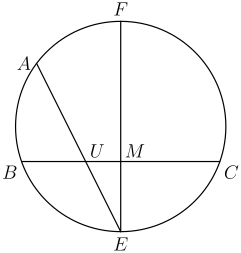
Chord is the perpendicular bisector of chord intersecting it in Between and point is taken, and extended meets the circle in Then, for any selection of as described, triangle is similar to triangle:
Pista pequeña:
Como la mediatriz de una cuerda pasa por el centro, es un diámetro
Because the perpendicular bisector of a chord passes through the center, is a diameter
Pista grande:
Compara los ángulos rectos y el ángulo común en
Compare the right angles and the shared angle at
Solución:
Como es un diámetro, Además, así que Como son colineales, los dos triángulos comparten el mismo ángulo agudo en Por ello,
Por lo tanto, la respuesta correcta es A.
Since is a diameter, Also so Because are collinear, the two triangles share the same acute angle at Hence
Therefore, the correct answer is A.
19.
Al contar bolas de colores, unas rojas y otras negras, se encontró que de las primeras eran rojas. A partir de entonces, de cada bolas contadas eran rojas. Si al menos el de todas las bolas contadas eran rojas, el valor máximo de es:
In counting colored balls, some red and some black, it was found that of the first counted were red. Thereafter, out of every counted were red. If, in all, or more of the balls counted were red, the maximum value of is:
Respuesta: B
Pista pequeña:
Escribe el número de bolas rojas como
Write the number of red balls as
Pista grande:
Exige que esa cantidad sea al menos
Require that quantity to be at least
Solución:
La condición es Al simplificar se obtiene así que El máximo es
Así, la respuesta correcta es B.
The condition is Simplifying gives so The maximum is
Thus, the correct answer is B.
20.
Dos hombres situados en los puntos y separados por millas, parten al mismo tiempo caminando uno hacia el otro. El hombre en camina uniformemente a millas por hora; el hombre en camina a millas por hora durante la primera hora, a millas por hora durante la segunda, y así sucesivamente en progresión aritmética. Si se encuentran después de un número entero de horas en un punto que está millas más cerca de que de , entonces es:
Two men at points and miles apart, set out at the same time to walk towards each other. The man at walks uniformly at miles per hour; the man at walks at miles per hour for the first hour, at miles per hour for the second hour, and so on, in arithmetic progression. If the men meet miles nearer than in an integral number of hours, then is:
Respuesta: D
Pista pequeña:
Sea el número entero de horas hasta el encuentro y suma las distancias horarias del segundo hombre
Let the integral meeting time be hours and sum the second man’s hourly distances
Pista grande:
La ecuación de la distancia combinada se simplifica a
Their combined distance equation simplifies to
Solución:
En horas, el primer hombre camina El segundo recorre la suma de la progresión aritmética Sus distancias suman lo que da cuya raíz positiva es Recorren y millas, de modo que el punto de encuentro está millas más cerca de que de
Por lo tanto, la respuesta correcta es D.
In hours the first man walks The second walks an arithmetic-series total Their distances sum to giving whose positive root is They walk and miles, so the meeting point is miles nearer than
Thus, the correct answer is D.
21.
La expresión tiene:
The expression has:
ningún factor lineal con coeficientes enteros y exponentes enteros
no linear factor with integer coefficients and integer exponents
el factor
the factor
el factor
the factor
el factor
the factor
el factor
the factor
Respuesta: E
Pista pequeña:
Agrupa como una sola expresión
Group as a single expression
Pista grande:
Reescribe el polinomio como
Rewrite the polynomial as
Solución:
Sea Los dos grupos se factorizan como Por tanto, toda la expresión es y uno de sus factores es
Por lo tanto, la respuesta correcta es E.
Let The two groups factor as Thus the whole expression is and one factor is
Therefore, the correct answer is E.
22.
El triángulo acutángulo está inscrito en un círculo con centro y Se toma un punto en el arco menor tal que es perpendicular a Entonces la razón entre las medidas de los ángulos y es:
Acute-angled triangle is inscribed in a circle with center at and A point is taken in minor arc such that is perpendicular to Then the ratio of the magnitudes of angles and is:
Respuesta: D
Pista pequeña:
Halla el arco menor y luego usa para situar en su punto medio
Find minor arc then use to locate at its midpoint
Pista grande:
Calcula el ángulo central y el ángulo inscrito
Compute the central angle and the inscribed angle
Solución:
El arco menor mide Como el punto biseca ese arco, por lo que El triángulo isósceles da mientras que Su razón es
Así, la respuesta correcta es D.
Minor arc has measure Since bisects that arc, so Isosceles triangle gives while Their ratio is
Thus, the correct answer is D.
23.
le da a tantos centavos como tiene y a tantos centavos como tiene . Después, da de igual manera a y a tantos centavos como tiene cada uno en ese momento. Luego , de la misma forma, da a y a tantos centavos como tiene cada uno. Si al final cada uno tiene centavos, ¿con cuántos centavos comienza ?
gives as many cents as has and as many cents as has. Similarly, then gives and as many cents as each then has. , similarly, then gives and as many cents as each then has. If each finally has cents, with how many cents does start?
Respuesta: B
Pista pequeña:
Trabaja hacia atrás desde las cantidades finales
Work backward from the final holdings
Pista grande:
Justo antes de que alguien entregue dinero, cada receptor debe tener la mitad de lo que tiene inmediatamente después
Immediately before someone gives, each recipient must have half of the amount held just after that gift
Solución:
Invierte las transacciones. Antes de que entregue dinero, las cantidades son Antes de que entregue dinero, son Antes de que entregue dinero, y deben tener y centavos, mientras que tiene
Por lo tanto, la respuesta correcta es B.
Reverse the transactions. Before gives, the holdings are Before gives, they are Before gives, and must have had and while had
Therefore, the correct answer is B.
24.
Considera ecuaciones de la forma ¿Cuántas de estas ecuaciones tienen raíces reales y coeficientes y elegidos del conjunto de enteros ?
Consider equations of the form How many such equations have real roots and have coefficients and selected from the set of integers
Respuesta: B
Pista pequeña:
Las raíces reales requieren
Real roots require
Pista grande:
Para cada cuenta los valores permitidos de
For each count the allowed values of
Solución:
Para igual a y la condición permite respectivamente y valores de en el conjunto dado. Su suma es
Así, la respuesta correcta es B.
For equal to and the condition permits respectively and values of in the given set. Their sum is
Thus, the correct answer is B.
25.
Se toma el punto en el lado del cuadrado Por se traza una perpendicular a que corta a la prolongación de en El área de es pulgadas cuadradas y el área del triángulo es pulgadas cuadradas. Entonces el número de pulgadas de es:
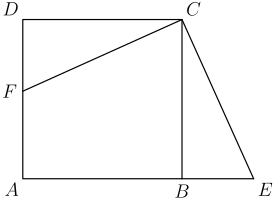
Point is taken in side of square At a perpendicular is drawn to meeting extended at The area of is square inches and the area of triangle is square inches. Then the number of inches in is:
Respuesta: A
Pista pequeña:
Demuestra que los triángulos rectángulos y son congruentes
Show that right triangles and are congruent
Pista grande:
Entonces así que usa el área del triángulo rectángulo
Then so use the area of right triangle
Solución:
Los ángulos agudos complementarios y los lados iguales del cuadrado dan y por tanto Como de modo que El lado del cuadrado mide y el triángulo rectángulo da
Por lo tanto, la respuesta correcta es A.
The complementary acute angles and the equal square sides give hence Since so The square side is and right triangle gives
Therefore, the correct answer is A.
26.
Forma I. Considera los enunciados
donde son proposiciones. ¿Cuántos de ellos implican la verdad de ?
Forma II. Considera los enunciados y son verdaderos y es falso, es verdadero y y son falsos, es verdadero y y son falsos, y son verdaderos y es falso. ¿Cuántos de ellos implican la verdad del enunciado « está implicado por la afirmación de que implica »?
Form I. Consider the statements
where are propositions. How many of these imply the truth of
Form II. Consider the statements and are true and is false, is true and and are false, is true and and are false, and are true and is false. How many of these imply the truth of the statement “ is implied by the statement that implies ”?
Respuesta: E
Pista pequeña:
Una implicación es falsa solo cuando su antecedente es verdadero y su consecuente es falso
An implication is false only when its antecedent is true and its consequent is false
Pista grande:
Evalúa primero en cada una de las cuatro asignaciones
Evaluate first in each of the four assignments
Solución:
En los casos y la proposición es falsa, así que la implicación exterior es verdadera. En los casos y la proposición es verdadera, pero también es verdadera, por lo que la implicación exterior vuelve a ser verdadera. Los cuatro enunciados la implican.
Así, la respuesta correcta es E.
In cases and is false, so the outer implication is true. In cases and is true, but is also true, so the outer implication is again true. All four statements imply it.
Thus, the correct answer is E.
27.
Se trazan seis rectas en un plano, sin que dos sean paralelas ni tres sean concurrentes. El número de regiones en que dividen el plano es:
Six straight lines are drawn in a plane with no two parallel and no three concurrent. The number of regions into which they divide the plane is:
Respuesta: C
Pista pequeña:
Las rectas anteriores cortan la -ésima recta en partes
The th line is cut into pieces by the previous lines
Pista grande:
Empieza con una región y suma
Start with one region and add
Solución:
Las rectas sucesivas crean regiones nuevas. Por tanto, el total es
Por lo tanto, la respuesta correcta es C.
Successive lines create new regions. Thus the total is
Therefore, the correct answer is C.
28.
Dada la ecuación con raíces reales, el valor de para el cual el producto de las raíces es máximo es:
Given the equation with real roots. The value of for which the product of the roots of the equation is a maximum is:
Respuesta: D
Pista pequeña:
El producto de las raíces es
The product of the roots is
Pista grande:
Usa la condición del discriminante para hallar el mayor permitido
Use the discriminant condition to find the largest allowed
Solución:
Las raíces reales requieren así que El producto de las raíces es que crece con Por tanto, es máximo cuando
Así, la respuesta correcta es D.
Real roots require so The root product is which increases with It is therefore largest at
Thus, the correct answer is D.
29.
Una partícula lanzada verticalmente hacia arriba alcanza, al cabo de segundos, una altura de pies, donde La altura máxima es:
A particle projected vertically upward reaches, at the end of seconds, an elevation of feet where The highest elevation is:
Respuesta: C
Pista pequeña:
La altura es una cuadrática que abre hacia abajo
The height is a downward-opening quadratic
Pista grande:
Halla el tiempo del vértice usando
Find its vertex time using
Solución:
El vértice se alcanza cuando Entonces
Así, la respuesta correcta es C.
The vertex occurs at Then
Thus, the correct answer is C.
30.
Sea
Obtén una nueva función reemplazando cada de por
y simplifica. La expresión simplificada es igual a:
Let
Form a new function by replacing each in by
and simplify. The simplified expression is equal to:
Respuesta: C
Pista pequeña:
Llama a la fracción sustituida y simplifica
Call the substituted fraction and simplify
Pista grande:
Su numerador y su denominador se factorizan como cubos
Its numerator and denominator factor as cubes
Solución:
Para Por tanto, así que
Así, la respuesta correcta es C.
For Therefore so
Thus, the correct answer is C.
31.
El número de soluciones en enteros positivos de es:
The number of solutions in positive integers of is:
Respuesta: D
Pista pequeña:
Despeja
Solve for
Pista grande:
Para que sea un entero positivo, debe ser un entero positivo impar menor que
Positive integral requires to be an odd positive integer below
Solución:
Necesitamos que sea impar para que sea par, y la positividad da Los valores impares y son
Por lo tanto, la respuesta correcta es D.
We need odd so that is even, and positivity gives The odd values and number
Therefore, the correct answer is D.
32.
Las dimensiones de un rectángulo son y con Se quiere obtener un rectángulo de dimensiones y con de modo que su perímetro sea un tercio del de y su área sea un tercio de la de El número de rectángulos distintos de este tipo es:
The dimensions of a rectangle are and It is required to obtain a rectangle with dimensions and so that its perimeter is one-third that of and its area is one-third that of The number of such (different) rectangles is:
infinitos
infinitely many
Respuesta: A
Pista pequeña:
Traduce las condiciones en y
Translate the conditions into and
Pista grande:
Divide la ecuación de la suma entre la del producto y compara recíprocos usando y
Divide the sum equation by the product equation and compare reciprocals using and
Solución:
Las condiciones dan y Al dividir se obtiene Pero y hacen que el lado izquierdo sea mayor que mientras que hace que el derecho sea menor que Esto es imposible.
Así, la respuesta correcta es A.
The conditions give and Dividing yields But and make the left side greater than while makes the right side less than This is impossible.
Thus, the correct answer is A.
33.
Dada la recta y una recta paralela a ella y situada a unidades de distancia, una posible ecuación de es:
Given the line and a line parallel to the given line and units from it. A possible equation for is:
Respuesta: A
Pista pequeña:
Escribe las rectas paralelas como
Write parallel lines as
Pista grande:
La distancia es el valor absoluto de la diferencia de las constantes dividido entre
The distance equals the absolute difference of constants divided by
Solución:
La recta dada es Una recta paralela es por lo que la distancia es Al igualarla a se obtiene de donde o La opción A es posible.
Así, la respuesta correcta es A.
The given line is A parallel line is so the distance is Setting this equal to gives hence or Choice A is possible.
Thus, the correct answer is A.
34.
En el triángulo el lado el lado y el lado Sea el mayor número tal que la medida, en grados, del ángulo opuesto al lado supera a Entonces es igual a:
In triangle side side and side Let be the largest number such that the magnitude, in degrees, of the angle opposite side exceeds Then equals:
Respuesta: B
Pista pequeña:
Usa la ley de los cosenos para el ángulo opuesto a
Use the law of cosines for the angle opposite
Pista grande:
Compara con el caso límite
Compare with the limiting case
Solución:
La ley de los cosenos da Como se tiene así que Los valores pueden acercarse a cuando se aproxima a por encima, por lo que la mayor cota garantizada es
Por lo tanto, la respuesta correcta es B.
The law of cosines gives Since so Values can approach as approaches from above, so the largest guaranteed bound is
Therefore, the correct answer is B.
35.
Las longitudes de los lados de un triángulo son enteros, y su área también es un entero. Un lado mide y el perímetro es El lado más corto mide:
The lengths of the sides of a triangle are integers, and its area is also an integer. One side is and the perimeter is The shortest side is:
Respuesta: B
Pista pequeña:
Escribe los otros lados como y , con semiperímetro
Write the other sides as and , with semiperimeter
Pista grande:
La fórmula de Herón hace que el área al cuadrado sea
Heron’s formula makes the squared area
Solución:
Sean los otros lados y con El semiperímetro es así que la fórmula de Herón da Las desigualdades del triángulo dan Al comprobar estos enteros, la expresión no es un cuadrado para mientras que para vale Por tanto, el lado más corto mide
Así, la respuesta correcta es B.
Let the other sides be and with The semiperimeter is so Heron’s formula gives The triangle inequalities give Checking these integers, the expression is not a square for while at it is Thus the shortest side is
Therefore, the correct answer is B.
36.
Una persona comienza con centavos y hace apuestas. Gana tres veces y pierde tres veces, con las victorias y derrotas en orden aleatorio, y la probabilidad de ganar es igual a la de perder. Si cada apuesta es por la mitad del dinero que queda en ese momento, entonces el resultado final es:
A person starting with cents and making bets, wins three times and loses three times, the wins and losses occurring in random order. The chance for a win is equal to the chance for a loss. If each wager is for half the money remaining at the time of the bet, then the final result is:
una pérdida de ¢
a loss of ¢
una ganancia de ¢
a gain of ¢
una pérdida de ¢
a loss of ¢
ni ganancia ni pérdida
neither a gain nor a loss
una ganancia o una pérdida según el orden de las victorias y derrotas
a gain or a loss depending upon the order in which the wins and losses occur
Respuesta: C
Pista pequeña:
Una victoria multiplica la cantidad actual por , mientras que una derrota la multiplica por
A win multiplies the current amount by , while a loss multiplies it by
Pista grande:
La multiplicación hace que el orden sea irrelevante
Multiplication makes the order irrelevant
Solución:
Después de tres victorias y tres derrotas, la cantidad, en centavos, es La pérdida es de centavos, sin importar el orden.
Así, la respuesta correcta es C.
After three wins and three losses, the amount, in cents, is The loss is cents, regardless of order.
Thus, the correct answer is C.
37.
Se dan los puntos sobre una recta, en el orden indicado, aunque no necesariamente equiespaciados. Sea un punto cualquiera de la recta y sea la suma de las longitudes no dirigidas
Entonces es mínimo si y solo si el punto está:
Given points on a straight line, in the order stated (not necessarily evenly spaced). Let be an arbitrarily selected point on the line and let be the sum of the undirected lengths
Then is smallest if and only if the point is:
a mitad de camino entre y
midway between and
a mitad de camino entre y
midway between and
a mitad de camino entre y
midway between and
en
at
en
at
Respuesta: D
Pista pequeña:
Empareja las distancias a , luego las de , y finalmente las de
Pair the distances to , then , then
Pista grande:
Cada suma emparejada es mínima en todo el segmento entre sus puntos; el punto central no emparejado selecciona una posición
Each paired sum is minimized throughout its intervening segment; the unpaired middle point selects one location
Solución:
Para cualquier par la suma es mínima cuando está entre ellos. Los tres intervalos de este tipo contienen El término restante es mínimo únicamente cuando
Así, la respuesta correcta es D.
For any pair the sum is minimized when lies between them. The three such intervals all contain The remaining term is uniquely minimized at
Thus, the correct answer is D.
38.
El punto se toma en la prolongación del lado del paralelogramo La recta corta a la diagonal en y al lado en Si y entonces es igual a:
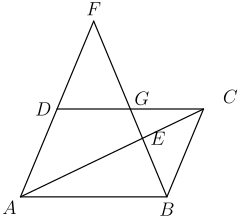
Point is taken on the extension of side of parallelogram intersects diagonal at and side at If and then equals:
Respuesta: E
Pista pequeña:
Parametriza los puntos de por la fracción de la distancia de a
Parameterize points on by their fraction of the distance from to
Pista grande:
Si en coordenadas afines con origen en los parámetros de y son y
If in affine coordinates based at the parameters of and are and
Solución:
Usa coordenadas afines y Un punto de es La intersección con da mientras que la intersección con da Por tanto, de modo que y Así, por lo que y
Por lo tanto, la respuesta correcta es E.
Use affine coordinates and A point on is Intersecting gives while intersecting gives Therefore so and Thus making and
Therefore, the correct answer is E.
39.
En el triángulo se trazan las rectas y de modo que y
Sea donde es el punto de intersección de y Entonces es igual a:
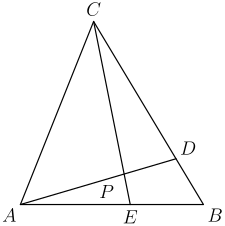
In triangle lines and are drawn so that and
Let where is the intersection point of and Then equals:
Respuesta: D
Pista pequeña:
Asigna masas a los extremos inversamente proporcionales a las razones laterales dadas
Assign endpoint masses inversely proportional to the given side ratios
Pista grande:
Elige masas y , y luego halla la masa en
Choose masses and , then find the mass at
Solución:
La razón se representa con masas y La razón da entonces El punto tiene masa así que a lo largo de la ceviana
Así, la respuesta correcta es D.
The ratio is represented by masses and The ratio then gives Point has mass so along cevian
Thus, the correct answer is D.
40.
Si es un número que satisface la ecuación entonces está entre:
If is a number satisfying the equation then is between:
y
and
y
and
y
and
y
and
y
and
Respuesta: C
Pista pequeña:
Sea y
Set and
Pista grande:
Usa tanto como para hallar
Use both and to find
Solución:
Sea y Entonces y por lo que Al comparar con se obtiene Por tanto, Al elevar al cubo se obtiene y en ambos casos que está entre y
Por lo tanto, la respuesta correcta es C.
Let and Then and so Comparing with gives Hence Cubing gives and either way between and
Therefore, the correct answer is C.