
Problemas del 2002 AMC 10A
¡Desplázate hacia abajo y presiona Iniciar para intentar el examen! O ve al PDF imprimible, la clave de respuestas, o las soluciones profesionales preparadas por LIVE by Po-Shen Loh.
Todos los problemas se usan con el permiso legal oficial de la Mathematical Association of America (MAA).
O salta directamente a un solo problema con su solución: 1 · 2 · 3 · 4 · 5 · 6 · 7 · 8 · 9 · 10 · 11 · 12 · 13 · 14 · 15 · 16 · 17 · 18 · 19 · 20 · 21 · 22 · 23 · 24 · 25
¿Quieres aprender de forma profesional con clases interactivas en video?
Con tiempo
1:15:00
1.
La razón ¿a cuál de los siguientes números se aproxima más?
The ratio is closest to which of the following numbers?
Respuesta: D
Pista pequeña:
Factoriza del numerador.
Factor out of the numerator
Pista grande:
El denominador es igual a .
The denominator equals
Solución:
Al factorizar se obtiene que se aproxima más a
Por lo tanto, la respuesta correcta es D.
Factoring gives which is closest to
Thus, the correct answer is D.
2.
Para los números no nulos y se define Calcula
For the nonzero numbers and define Find
Respuesta: C
Pista pequeña:
Sustituye .
Substitute
Pista grande:
Suma con un denominador común.
Add over a common denominator
Solución:
Con denominador esto es
Por lo tanto, la respuesta correcta es C.
Over a denominator of this is
Thus, the correct answer is C.
3.
Según la convención estándar para la potenciación, Si se cambia el orden en que se realizan las potencias, ¿cuántos otros valores son posibles?
According to the standard convention for exponentiation, If the order in which the exponentiations are performed is changed, how many other values are possible?
Respuesta: B
Pista pequeña:
Enumera las cinco maneras de agrupar con paréntesis una torre de cuatro .
List the five ways to parenthesize a tower of four ’s
Pista grande:
Cada agrupación da como resultado o .
Every grouping evaluates to either or
Solución:
Hay cinco maneras de agrupar la torre con paréntesis. Tres de ellas, y valen todas Las otras dos dan el valor estándar
Así pues, solo es posible un valor más, además del estándar.
Por lo tanto, la respuesta correcta es B.
There are five ways to parenthesize the tower. Three of them, and all equal The other two both give the standard value
So exactly one other value, is possible.
Thus, the correct answer is B.
4.
¿Para cuántos enteros positivos existe al menos un entero positivo tal que ?
For how many positive integers does there exist at least one positive integer such that
infinitos
infinitely many
Respuesta: E
Pista pequeña:
Prueba un valor positivo muy pequeño de .
Try a very small positive value of
Pista grande:
Comprueba si la desigualdad resultante impone alguna cota superior a .
See whether the resulting inequality places any upper bound on
Solución:
Toma Entonces se convierte en que se cumple para todo entero positivo
Así que todo entero positivo funciona, lo que da infinitos.
Por lo tanto, la respuesta correcta es E.
Take Then becomes which holds for every positive integer
So every positive integer works, giving infinitely many.
Thus, the correct answer is E.
5.
Cada uno de los círculos pequeños de la figura tiene radio uno. El círculo más interno es tangente a los seis círculos que lo rodean, y cada uno de esos círculos es tangente al círculo grande y a sus círculos pequeños vecinos. Halla el área de la región sombreada.
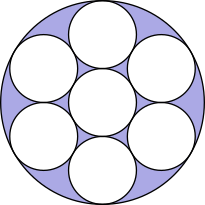
Each of the small circles in the figure has radius one. The innermost circle is tangent to the six circles that surround it, and each of those circles is tangent to the large circle and to its small-circle neighbors. Find the area of the shaded region.
Respuesta: C
Pista pequeña:
El radio grande abarca el círculo central más dos radios adicionales.
The large radius spans the center circle plus two more radii
Pista grande:
Resta los siete círculos unitarios del círculo grande.
Subtract the seven unit circles from the large circle
Solución:
El centro de uno de los círculos que rodean al central está a del centro (dos radios), y al sumar su propio radio se obtiene un radio grande de
El círculo grande tiene área y los siete círculos unitarios tienen área total así que la región sombreada es
Por lo tanto, la respuesta correcta es C.
The center of a surrounding circle is from the center (two radii), and adding its own radius gives a large radius of
The large circle has area and the seven unit circles have total area so the shaded region is
Thus, the correct answer is C.
6.
La maestra le pidió a Cindy que restara a cierto número y luego dividiera el resultado entre En cambio, ella restó y luego dividió el resultado entre obteniendo una respuesta de ¿Cuál habría sido su respuesta si hubiera resuelto el problema correctamente?
Cindy was asked by her teacher to subtract from a certain number and then divide the result by Instead, she subtracted and then divided the result by giving an answer of What would her answer have been had she worked the problem correctly?
Respuesta: A
Pista pequeña:
Recupera el número original a partir de los pasos incorrectos de Cindy.
Recover the original number from Cindy’s incorrect steps
Pista grande:
Resuelve .
Solve
Solución:
Sea el número. Cindy calculó así que y
El cálculo correcto es
Por lo tanto, la respuesta correcta es A.
Let be the number. Cindy computed so and
The correct computation is
Thus, the correct answer is A.
7.
Si un arco de en el círculo tiene la misma longitud que un arco de en el círculo entonces la razón entre el área del círculo y el área del círculo es
If an arc of on circle has the same length as an arc of on circle then the ratio of the area of circle to the area of circle is
Respuesta: A
Pista pequeña:
La longitud de arco es .
Arc length is
Pista grande:
Longitudes de arco iguales dan la razón .
Equal arc lengths give the ratio
Solución:
Longitudes de arco iguales dan así que y
La razón entre las áreas es
Por lo tanto, la respuesta correcta es A.
Equal arc lengths give so and
The ratio of areas is
Thus, the correct answer is A.
8.
Betsy diseñó una bandera usando triángulos azules, pequeños cuadrados blancos y un cuadrado rojo central, como se muestra. Sea el área total de los triángulos azules, el área total de los cuadrados blancos y el área del cuadrado rojo. ¿Cuál de las siguientes afirmaciones es correcta?
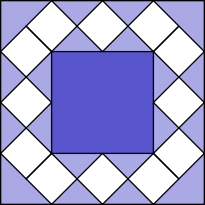
Betsy designed a flag using blue triangles, small white squares, and a red center square, as shown. Let be the total area of the blue triangles, the total area of the white squares, and the area of the red square. Which of the following is correct?
Respuesta: A
Pista pequeña:
Corta toda la bandera en triángulos rectángulos congruentes.
Cut the whole flag into congruent right triangles
Pista grande:
Cuenta cuántos de esos triángulos congruentes rellenan cada color.
Count how many of those congruent triangles fill each color
Solución:
Divide la bandera en triángulos rectángulos congruentes trazando las líneas de la cuadrícula y las diagonales. Al contar se obtienen triángulos en la región azul, en la región blanca y en la región roja.
De aquí que
Por lo tanto, la respuesta correcta es A.
Divide the flag into congruent right triangles by drawing the grid lines and diagonals. Counting gives triangles in the blue region, in the white region, and in the red region.
Hence
Thus, the correct answer is A.
9.
Supón que y son tres números para los cuales y El promedio de los tres números y es
Suppose and are three numbers for which and The average of the three numbers and is
no está determinado de forma única
not uniquely determined
Respuesta: B
Pista pequeña:
Suma las dos ecuaciones.
Add the two equations together
Pista grande:
La suma se reduce a un múltiplo de .
The sum collapses to a multiple of
Solución:
Al sumar las ecuaciones,
Así que y el promedio es
Por lo tanto, la respuesta correcta es B.
Adding the equations,
So and the average is
Thus, the correct answer is B.
10.
Calcula la suma de todas las raíces de
Compute the sum of all the roots of
Respuesta: A
Pista pequeña:
Factoriza el término común .
Factor out the common
Pista grande:
Combina dentro del corchete.
Combine inside the bracket
Solución:
Al factorizar,
Las raíces son y cuya suma es
Por lo tanto, la respuesta correcta es A.
Factoring,
The roots are and which sum to
Thus, the correct answer is A.
11.
Jamal quiere guardar archivos de computadora en disquetes, cada uno con una capacidad de megabytes (mb). Tres de sus archivos requieren mb de memoria cada uno, otros requieren mb cada uno, y los restantes requieren mb cada uno. Ningún archivo puede dividirse entre disquetes. ¿Cuál es el número mínimo de disquetes que contendrá todos los archivos?
Jamal wants to store computer files on floppy disks, each of which has a capacity of megabytes (mb). Three of his files require mb of memory each, more require mb each, and the remaining require mb each. No file can be split between floppy disks. What is the minimal number of floppy disks that will hold all the files?
Respuesta: B
Pista pequeña:
Un archivo de mb deja espacio para solo un archivo de mb en su disquete
A mb file leaves room for only one mb file on its disk
Pista grande:
Ten en cuenta el espacio desperdiciado en los tres disquetes con archivos de mb, y luego construye un empaquetado que alcance la cota
Account for the wasted space on the three mb disks, then build a packing that reaches the bound
Solución:
Los archivos necesitan mb. En cualquier disquete que contenga un archivo de mb, solo cabe junto a él un archivo de mb (ya que ), dejando al menos mb desperdiciados. En los tres disquetes de ese tipo eso suma al menos mb, así que la demanda efectiva es al menos mb, lo que requiere al menos disquetes.
Esto es alcanzable: disquetes contienen cada uno un archivo de y uno de , disquetes contienen cada uno dos archivos de , y disquetes contienen cada uno tres archivos de .
Por lo tanto, la respuesta correcta es B.
The files need mb. On any disk holding a mb file, only one mb file fits alongside it (since ), leaving at least mb wasted. Across the three such disks that is at least mb, so the effective demand is at least mb, requiring at least disks.
This is achievable: disks each hold one file and one file, disks each hold two files, and disks each hold three files.
Thus, the correct answer is B.
12.
El señor Earl E. Bird sale de su casa hacia el trabajo exactamente a las a. m. cada mañana. Cuando conduce a una velocidad media de millas por hora, llega tres minutos tarde. Cuando conduce a una velocidad media de millas por hora, llega tres minutos temprano. ¿A qué velocidad media, en millas por hora, debe conducir el señor Bird para llegar exactamente a tiempo?
Mr. Earl E. Bird leaves his house for work at exactly A.M. every morning. When he averages miles per hour, he arrives at his workplace three minutes late. When he averages miles per hour, he arrives three minutes early. At what average speed, in miles per hour, should Mr. Bird drive to arrive at his workplace precisely on time?
Respuesta: B
Pista pequeña:
Sea el tiempo de viaje para llegar a tiempo, en horas; tres minutos son horas
Let be the on-time travel time in hours; three minutes is hours
Pista grande:
La distancia es la misma en ambos casos:
The distance is the same both ways:
Solución:
Sea el tiempo de viaje a tiempo, en horas. Como minutos son horas, Entonces así que
La distancia es millas, así que la velocidad requerida es mph.
Por lo tanto, la respuesta correcta es B.
Let hours be the on-time travel time. Since minutes is hours, Then so
The distance is miles, so the required speed is mph.
Thus, the correct answer is B.
13.
Los lados de un triángulo tienen longitudes y Halla la longitud de la altura más corta.
The sides of a triangle have lengths of and Find the length of the shortest altitude.
Respuesta: B
Pista pequeña:
Comprueba si forman un triángulo rectángulo.
Check whether is a right triangle
Pista grande:
La altura más corta se traza hacia el lado más largo.
The shortest altitude is drawn to the longest side
Solución:
Como el triángulo es rectángulo con catetos y y área
La altura más corta cae sobre el lado más largo y es igual a
Por lo tanto, la respuesta correcta es B.
Since the triangle is right with legs and and area
The shortest altitude falls to the longest side and equals
Thus, the correct answer is B.
14.
Ambas raíces de la ecuación cuadrática son números primos. El número de valores posibles de es
Both roots of the quadratic equation are prime numbers. The number of possible values of is
más de cuatro
more than four
Respuesta: B
Pista pequeña:
Las raíces suman y su producto es .
The roots sum to and multiply to
Pista grande:
Una suma impar de dos primos obliga a que uno de ellos sea .
An odd sum of two primes forces one of them to be
Solución:
Si las raíces son los primos y entonces y Como es impar, uno de los primos debe ser haciendo que el otro sea que es primo.
Así que es el único valor posible.
Por lo tanto, la respuesta correcta es B.
If the roots are primes and then and Because is odd, one prime must be making the other which is prime.
So is the only possible value.
Thus, the correct answer is B.
15.
Los dígitos y se usan para formar cuatro números primos de dos dígitos, usando cada dígito exactamente una vez. ¿Cuál es la suma de estos cuatro primos?
The digits and are used to form four two-digit prime numbers, with each digit used exactly once. What is the sum of these four primes?
Respuesta: E
Pista pequeña:
Un primo de dos dígitos no puede terminar en o .
A two-digit prime cannot end in or
Pista grande:
Por lo tanto, esos cuatro dígitos deben ser los de las decenas.
Those four digits must therefore be the tens digits
Solución:
Un primo de dos dígitos no puede terminar en o así que estos cuatro son los dígitos de las decenas y y son los de las unidades.
La suma es Un conjunto válido es
Por lo tanto, la respuesta correcta es E.
A two-digit prime cannot end in or so these four are the tens digits and and are the units digits.
The sum is One valid set is
Thus, the correct answer is E.
16.
Si entonces es
If then is
Respuesta: B
Pista pequeña:
Iguala todas las expresiones a un único valor .
Set every expression equal to a single value
Pista grande:
Escribe en términos de y súmalos.
Write in terms of and add them
Solución:
Sea el valor común igual a Entonces así que
Como obtenemos así que y Entonces
Por lo tanto, la respuesta correcta es B.
Let the common value be Then so
Since we get so and Then
Thus, the correct answer is B.
17.
Sarah vierte cuatro onzas de café en una taza de ocho onzas y cuatro onzas de crema en una segunda taza del mismo tamaño. Luego transfiere la mitad del café de la primera taza a la segunda y, después de revolver bien, transfiere la mitad del líquido de la segunda taza de vuelta a la primera. ¿Qué fracción del líquido de la primera taza es ahora crema?
Sarah pours four ounces of coffee into an eight-ounce cup and four ounces of cream into a second cup of the same size. She then transfers half the coffee from the first cup to the second and, after stirring thoroughly, transfers half the liquid in the second cup back to the first. What fraction of the liquid in the first cup is now cream?
Respuesta: D
Pista pequeña:
Lleva la cuenta de las onzas de café y crema después de cada transferencia.
Track ounces of coffee and cream after each transfer
Pista grande:
La segunda taza está mezclada uniformemente antes de la segunda transferencia.
The second cup is uniformly mixed before the second transfer
Solución:
Después de transferir oz de café, la taza tiene oz de café y la taza tiene oz de café más oz de crema, un total de oz.
Transferir de vuelta la mitad de la taza (es decir oz, que consisten en oz de café y oz de crema) deja la taza con oz de café y oz de crema. La fracción que es crema es
Por lo tanto, la respuesta correcta es D.
After transferring oz of coffee, cup has oz coffee and cup has oz coffee plus oz cream, a total of oz.
Transferring back half of cup (that is oz, consisting of oz coffee and oz cream) leaves cup with oz coffee and oz cream. The fraction that is cream is
Thus, the correct answer is D.
18.
Un cubo se forma pegando dados cúbicos estándar. (En un dado estándar, la suma de los números en cualquier par de caras opuestas es ) La menor suma posible de todos los números visibles en la superficie del cubo es
A cube is formed by gluing together standard cubical dice. (On a standard die, the sum of the numbers on any pair of opposite faces is ) The smallest possible sum of all the numbers showing on the surface of the cube is
Respuesta: D
Pista pequeña:
Clasifica los dados como dados de esquina, de arista, de centro de cara e interiores.
Classify the dice as corner, edge, face-center, and interior dice
Pista grande:
Minimiza las caras visibles de cada dado: las esquinas muestran las aristas muestran los centros de cara muestran .
Minimize each die’s showing faces: corners show edges show face-centers show
Solución:
Los dados de esquina muestran caras cada uno, minimizadas en contribuyendo Los dados de arista muestran caras, minimizadas en contribuyendo
Los dados de centro de cara muestran cara, minimizada en contribuyendo y el dado interior oculto contribuye El total es
Por lo tanto, la respuesta correcta es D.
The corner dice show faces each, minimized at contributing The edge dice show faces, minimized at contributing
The face-center dice show face, minimized at contributing and the hidden interior die contributes The total is
Thus, the correct answer is D.
19.
La casa del perro Spot tiene una base hexagonal regular que mide una yarda por lado. Está atado a un vértice con una cuerda de dos yardas. ¿Cuál es el área, en yardas cuadradas, de la región fuera de la casa que Spot puede alcanzar?
Spot’s doghouse has a regular hexagonal base that measures one yard on each side. He is tethered to a vertex with a two-yard rope. What is the area, in square yards, of the region outside the doghouse that Spot can reach?
Respuesta: E
Pista pequeña:
El ángulo interior de un hexágono regular es así que Spot barre con radio .
The interior angle of a regular hexagon is so Spot sweeps at radius
Pista grande:
Alrededor de cada vértice adyacente, el tramo restante de yarda de cuerda barre un sector de .
Around each adjacent vertex the leftover yard of rope sweeps a sector
Solución:
En el vértice de amarre, el hexágono bloquea su ángulo interior de , dejando un sector de de radio área
Al rodear cada uno de los dos vértices adyacentes, queda yarda de cuerda que barre un sector de : El total es
Por lo tanto, la respuesta correcta es E.
At the tether vertex the hexagon blocks its interior angle, leaving a sector of radius area
Wrapping around each of the two adjacent vertices, yard of rope remains and sweeps a sector: The total is
Thus, the correct answer is E.
20.
Los puntos y están, en ese orden, sobre dividiéndolo en cinco segmentos, cada uno de longitud El punto no está sobre la recta El punto está sobre y el punto está sobre Los segmentos y son paralelos. Halla
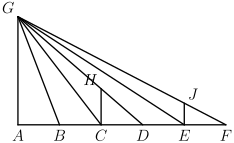
Points and lie, in that order, on dividing it into five segments, each of length Point is not on line Point lies on and point lies on The line segments and are parallel. Find
Respuesta: D
Pista pequeña:
da en términos de .
gives in terms of
Pista grande:
da en términos de .
gives in terms of
Solución:
Como así que dando
Como así que dando
En consecuencia
Por lo tanto, la respuesta correcta es D.
Since so giving
Since so giving
Therefore
Thus, the correct answer is D.
21.
La media, la mediana, la moda única y el rango de una colección de ocho enteros son todos iguales a El mayor entero que puede ser elemento de esta colección es
The mean, median, unique mode, and range of a collection of eight integers are all equal to The largest integer that can be an element of this collection is
Respuesta: D
Pista pequeña:
Los ocho enteros suman y un rango de vincula el mayor con el menor.
The eight integers sum to and a range of ties the largest and smallest together
Pista grande:
Prueba los valores candidatos más grandes, manteniendo tanto la mediana como la moda única iguales a .
Test the largest candidate values while keeping both the median and unique mode equal to
Solución:
La suma es La colección tiene media, mediana, moda única y rango iguales a así que es alcanzable.
Si el mayor fuera por lo menos el rango obligaría a que el menor fuera al menos Una media de obligaría entonces a que los ocho enteros fueran contradiciendo el rango.
Si el mayor fuera el rango obligaría a que el menor fuera así que los ocho enteros serían al menos Los otros siete sumarían lo que obliga a que todos sean Pero entonces la mediana y la moda serían no una contradicción.
Por lo tanto, la respuesta correcta es D.
The sum is The collection has mean, median, unique mode, and range all equal to so is attainable.
If the largest were at least the range condition would make the smallest at least A mean of would then force all eight integers to equal contradicting the range.
If the largest were the range forces the smallest to be so all eight integers are at least The other seven then sum to forcing every one of them to equal But then the median and mode would be not a contradiction.
Thus, the correct answer is D.
22.
Un conjunto de fichas numeradas del al se modifica repetidamente mediante la siguiente operación: se quitan todas las fichas numeradas con un cuadrado perfecto, y se renumeran las fichas restantes de forma consecutiva empezando por ¿Cuántas veces debe realizarse la operación para reducir el número de fichas del conjunto a una?
A set of tiles numbered through is modified repeatedly by the following operation: remove all tiles numbered with a perfect square, and renumber the remaining tiles consecutively starting with How many times must the operation be performed to reduce the number of tiles in the set to one?
Respuesta: C
Pista pequeña:
Quitar los cuadrados perfectos de fichas deja fichas.
Removing the perfect squares from tiles leaves tiles
Pista grande:
Dos operaciones reducen fichas a .
Two operations take tiles down to
Solución:
Partiendo de fichas, una operación quita los cuadrados perfectos, dejando La siguiente operación quita cuadrados perfectos, dejando
Así que cada dos operaciones reducen a Ir de hasta requiere operaciones.
Por lo tanto, la respuesta correcta es C.
Starting from tiles, one operation removes the perfect squares, leaving The next operation removes perfect squares, leaving
So every two operations reduce to Going from down to takes operations.
Thus, the correct answer is C.
23.
Los puntos y están sobre una recta, en ese orden, con y El punto no está sobre la recta, y El perímetro de es el doble del perímetro de Halla
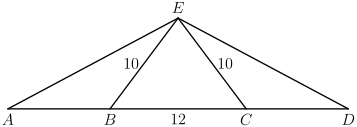
Points and lie on a line, in that order, with and Point is not on the line, and The perimeter of is twice the perimeter of Find
Respuesta: D
Pista pequeña:
Sea el punto medio de entonces y .
Let be the midpoint of then and
Pista grande:
Con y usa la condición de perímetro y el teorema de Pitágoras.
With and use the perimeter condition and the Pythagorean theorem
Solución:
Sea el punto medio de Como y Por simetría escribe y
La condición de perímetro da así que Además
Sustituyendo lo que se simplifica a así que y
Por lo tanto, la respuesta correcta es D.
Let be the midpoint of Since and By symmetry write and
The perimeter condition gives so Also
Substituting which simplifies to so and
Thus, the correct answer is D.
24.
Tina selecciona al azar dos números distintos del conjunto y Sergio selecciona al azar un número del conjunto La probabilidad de que el número de Sergio sea mayor que la suma de los dos números elegidos por Tina es
Tina randomly selects two distinct numbers from the set and Sergio randomly selects a number from the set The probability that Sergio’s number is larger than the sum of the two numbers chosen by Tina is
Respuesta: A
Pista pequeña:
Enumera las diez sumas posibles que Tina puede formar y con qué frecuencia aparece cada una.
List the ten possible sums Tina can make and how often each occurs
Pista grande:
Para una suma el número de Sergio la supera con probabilidad .
For a sum Sergio’s number exceeds it with probability
Solución:
Los pares igualmente probables de Tina dan las sumas y Para una suma el número de Sergio la supera con probabilidad
Promediando la probabilidad de éxito sobre los diez pares, el total es
Por lo tanto, la respuesta correcta es A.
Tina’s equally likely pairs give sums and For a sum Sergio’s number exceeds it with probability
Averaging the winning probability over the ten pairs, the total is
Thus, the correct answer is A.
25.
En el trapecio con bases y tenemos y El área de es
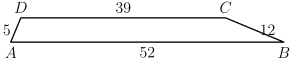
In trapezoid with bases and we have and The area of is
Respuesta: C
Pista pequeña:
Extiende los lados y hasta que se encuentren en un punto .
Extend the legs and until they meet at a point
Pista grande:
con razón .
with ratio
Solución:
Extiende y hasta encontrarse en Como con razón De obtenemos y análogamente
Entonces así que es un ángulo recto. El área de es
Por lo tanto, la respuesta correcta es C.
Extend and to meet at Since with ratio From we get and similarly
Then so is a right angle. The area of is
Thus, the correct answer is C.