
Problemas del 2016 AMC 12A
¡Desplázate hacia abajo y presiona Iniciar para intentar el examen! O ve al PDF imprimible, la clave de respuestas, o las soluciones profesionales preparadas por LIVE by Po-Shen Loh.
Todos los problemas se usan con el permiso legal oficial de la Mathematical Association of America (MAA).
O salta directamente a un solo problema con su solución: 1 · 2 · 3 · 4 · 5 · 6 · 7 · 8 · 9 · 10 · 11 · 12 · 13 · 14 · 15 · 16 · 17 · 18 · 19 · 20 · 21 · 22 · 23 · 24 · 25
¿Quieres aprender de forma profesional con clases interactivas en video?
Con tiempo
1:15:00
1.
¿Cuál es el valor de
What is the value of
Respuesta: B
Pista pequeña:
Factoriza del numerador.
Factor out of the numerator
Pista grande:
y .
and
Solución:
Al factorizar el numerador se obtiene
Por lo tanto, la respuesta correcta es B.
Factoring the numerator gives
Thus, the correct answer is B.
2.
¿Para qué valor de se cumple ?
For what value of does
Respuesta: C
Pista pequeña:
Escribe cada base como una potencia de .
Write every base as a power of
Pista grande:
El lado izquierdo se convierte en y el derecho en .
The left side becomes and the right side
Solución:
Como y la ecuación se convierte en así que Entonces lo que da
Por lo tanto, la respuesta correcta es C.
Since and the equation becomes so Then giving
Thus, the correct answer is C.
3.
La función resto puede definirse para todos los números reales e con mediante donde denota el mayor entero menor o igual que ¿Cuál es el valor de ?
The remainder function can be defined for all real numbers and with by where denotes the greatest integer less than or equal to What is the value of
Respuesta: B
Pista pequeña:
Calcula primero .
Compute first
Pista grande:
.
Solución:
Primero, y
Por consiguiente
Por lo tanto, la respuesta correcta es B.
First, and
Therefore
Thus, the correct answer is B.
4.
La media, la mediana y la moda de los valores son todas iguales a ¿Cuál es el valor de ?
The mean, median, and mode of the data values are all equal to What is the value of
Respuesta: D
Pista pequeña:
Iguala la media a .
Set the mean equal to
Pista grande:
luego confirma la mediana y la moda.
then confirm the median and mode
Solución:
La condición sobre la media da así que y
En orden no decreciente los datos son de modo que la mediana es y la moda es como se requería.
Por lo tanto, la respuesta correcta es D.
The mean condition gives so and
In nondecreasing order the data are so the median is and the mode is as required.
Thus, the correct answer is D.
5.
La conjetura de Goldbach afirma que todo entero par mayor que puede escribirse como la suma de dos números primos (por ejemplo, ). Hasta ahora, nadie ha logrado demostrar que la conjetura es verdadera, y nadie ha encontrado un contraejemplo que muestre que es falsa. ¿En qué consistiría un contraejemplo?
Goldbach’s conjecture states that every even integer greater than can be written as the sum of two prime numbers (for example, ). So far, no one has been able to prove that the conjecture is true, and no one has found a counterexample to show that the conjecture is false. What would a counterexample consist of?
un entero impar mayor que que puede escribirse como la
suma de dos números primos
an odd integer greater than that can be written as the
sum of two prime numbers
un entero impar mayor que que no puede escribirse como la
suma de dos números primos
an odd integer greater than that cannot be written as the
sum of two prime numbers
un entero par mayor que que puede escribirse como la suma
de dos números que no son primos
an even integer greater than that can be written as the
sum of two numbers that are not prime
un entero par mayor que que puede escribirse como la suma
de dos números primos
an even integer greater than that can be written as the
sum of two prime numbers
un entero par mayor que que no puede
escribirse como la suma de dos números primos
an even integer greater than that cannot
be written as the sum of two prime numbers
Respuesta: E
Pista pequeña:
Un contraejemplo mantiene la hipótesis pero rompe la conclusión.
A counterexample keeps the hypothesis but breaks the conclusion
Pista grande:
La hipótesis es “un entero par mayor que ”; la conclusión es “una suma de dos primos”.
The hypothesis is “even integer greater than ”; the conclusion is “a sum of two primes”
Solución:
Un contraejemplo debe satisfacer la hipótesis de ser un entero par mayor que y a la vez incumplir la conclusión de que puede escribirse como la suma de dos números primos.
Por lo tanto, la respuesta correcta es E.
A counterexample must satisfy the hypothesis of being an even integer greater than while failing the conclusion that it can be written as the sum of two prime numbers.
Thus, the correct answer is E.
6.
Un arreglo triangular de monedas tiene moneda en la primera fila, monedas en la segunda fila, monedas en la tercera fila, y así sucesivamente hasta monedas en la fila . ¿Cuál es la suma de los dígitos de ?
A triangular array of coins has coin in the first row, coins in the second row, coins in the third row, and so on up to coins in the th row. What is the sum of the digits of
Respuesta: D
Pista pequeña:
.
Pista grande:
Resuelve observando que .
Solve by noting
Solución:
El número total de monedas es así que Como tenemos y la suma de sus dígitos es
Por lo tanto, la respuesta correcta es D.
The total number of coins is so Since we have and the sum of its digits is
Thus, the correct answer is D.
7.
¿Cuál de estas opciones describe la gráfica de ?
Which of these describes the graph of
dos rectas paralelas
two parallel lines
dos rectas que se cortan
two intersecting lines
tres rectas que pasan todas por un punto común
three lines that all pass through a common point
tres rectas que no pasan todas por un punto
común
three lines that do not all pass through a
common point
una recta y una parábola
a line and a parabola
Respuesta: D
Pista pequeña:
Mueve todo a un lado y factoriza .
Move everything to one side and factor out
Pista grande:
es la unión de tres rectas.
is the union of three lines
Solución:
Al pasar todos los términos a un lado se obtiene que se factoriza como Por lo tanto, la gráfica es la unión de las rectas y
Las dos primeras rectas se cortan en el origen, pero la tercera recta es paralela a y no pasa por el origen. Así que la gráfica consta de tres rectas que no pasan todas por un punto común.
Por lo tanto, la respuesta correcta es D.
Moving all terms to one side gives which factors as The graph is therefore the union of the lines and
The first two lines intersect at the origin, but the third line is parallel to and does not pass through the origin. So the graph consists of three lines that do not all pass through a common point.
Thus, the correct answer is D.
8.
¿Cuál es el área de la región sombreada del rectángulo dado?
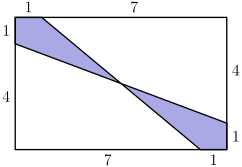
What is the area of the shaded region of the given rectangle?
Respuesta: D
Pista pequeña:
Cada segmento dibujado pasa por el centro del rectángulo.
Every drawn segment passes through the center of the rectangle
Pista grande:
La diagonal principal divide la región sombreada en cuatro triángulos, cada uno con base .
The main diagonal splits the shaded region into four triangles, each with base
Solución:
La diagonal del rectángulo, desde la esquina superior izquierda hasta la esquina inferior derecha, divide la región sombreada en cuatro triángulos, que se encuentran todos en el centro del rectángulo.
Dos de estos triángulos tienen base horizontal de longitud y altura y los otros dos tienen base vertical de longitud y altura El área total es
Por lo tanto, la respuesta correcta es D.
The diagonal of the rectangle from the upper-left corner to the lower-right corner divides the shaded region into four triangles, all meeting at the center of the rectangle.
Two of these triangles have a horizontal base of length and altitude and the other two have a vertical base of length and altitude The total area is
Thus, the correct answer is D.
9.
Los cinco pequeños cuadrados sombreados dentro de este cuadrado unitario son congruentes y tienen interiores disjuntos. El punto medio de cada lado del cuadrado central coincide con uno de los vértices de los otros cuatro cuadrados pequeños, como se muestra. La longitud del lado común es donde y son enteros positivos. ¿Cuánto vale ?
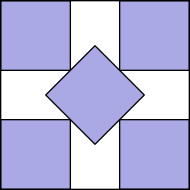
The five small shaded squares inside this unit square are congruent and have disjoint interiors. The midpoint of each side of the middle square coincides with one of the vertices of the other four small squares as shown. The common side length is where and are positive integers. What is
Respuesta: E
Pista pequeña:
Traza la diagonal del cuadrado unitario, que tiene longitud .
Draw the diagonal of the unit square, which has length
Pista grande:
Esa diagonal equivale a dos diagonales de cuadrado pequeño más un lado de cuadrado pequeño: .
That diagonal equals two small-square diagonals plus one small-square side:
Solución:
Sea la longitud del lado común. La diagonal del cuadrado unitario tiene longitud y está formada por dos diagonales de cuadrado pequeño (cada una ) más un lado de cuadrado pequeño de longitud así que
Al resolver, Así, y
Por lo tanto, la respuesta correcta es E.
Let be the common side length. The diagonal of the unit square has length and consists of two small-square diagonals (each ) plus one small-square side length so
Solving, Thus and
Thus, the correct answer is E.
10.
Cinco amigos se sentaron en una fila de asientos de un cine, numerados del al de izquierda a derecha. (Las direcciones “izquierda” y “derecha” son desde el punto de vista de las personas sentadas en los asientos.) Durante la película, Ada fue al vestíbulo a comprar palomitas. Cuando regresó, encontró que Bea se había movido dos asientos a la derecha, Ceci se había movido un asiento a la izquierda, y Dee y Edie habían intercambiado asientos, dejando un asiento del extremo para Ada. ¿En qué asiento había estado sentada Ada antes de levantarse?
Five friends sat in a movie theater in a row containing seats, numbered to from left to right. (The directions “left” and “right” are from the point of view of the people as they sit in the seats.) During the movie Ada went to the lobby to get some popcorn. When she returned, she found that Bea had moved two seats to the right, Ceci had moved one seat to the left, and Dee and Edie had switched seats, leaving an end seat for Ada. In which seat had Ada been sitting before she got up?
Respuesta: B
Pista pequeña:
El movimiento total hacia la derecha debe igualar al movimiento total hacia la izquierda.
The total rightward movement must equal the total leftward movement
Pista grande:
Bea se mueve Ceci se mueve y Dee y Edie se cancelan; halla el desplazamiento de Ada.
Bea moves Ceci moves and Dee and Edie cancel; find Ada’s shift
Solución:
El desplazamiento neto de los cinco amigos es cero. Dee y Edie intercambiaron asientos, así que sus movimientos se cancelan. Bea se movió y Ceci se movió un neto de por lo que Ada debe moverse para equilibrar.
Ada regresa a un asiento del extremo; como se movió un asiento a la izquierda, ese asiento debe ser el asiento así que había estado sentada en el asiento
Por lo tanto, la respuesta correcta es B.
The net displacement of all five friends is zero. Dee and Edie swapped seats, so their movements cancel. Bea moved and Ceci moved a net of so Ada must move to balance.
Ada returns to an end seat; since she moved one seat to the left, that seat must be seat so she had been sitting in seat
Thus, the correct answer is B.
11.
Cada uno de los estudiantes de cierto campamento de verano sabe cantar, bailar o actuar. Algunos estudiantes tienen más de un talento, pero ninguno tiene los tres. Hay estudiantes que no saben cantar, que no saben bailar y que no saben actuar. ¿Cuántos estudiantes tienen dos de estos talentos?
Each of the students in a certain summer camp can either sing, dance, or act. Some students have more than one talent, but no student has all three talents. There are students who cannot sing, students who cannot dance, and students who cannot act. How many students have two of these talents?
Respuesta: E
Pista pequeña:
Cuenta cuántos estudiantes pueden hacer cada actividad.
Count how many students can do each activity
Pista grande:
Al sumar los tres conteos, los estudiantes con dos talentos se cuentan dos veces; resta .
Adding the three counts tallies two-talent students twice; subtract
Solución:
Los números de quienes saben cantar, bailar y actuar son y respectivamente, para un total de
Como ningún estudiante tiene los tres talentos, cada estudiante tiene uno o dos talentos, de modo que los de un solo talento se cuentan una vez y los de dos talentos se cuentan dos veces. El número contado dos veces es
Por lo tanto, la respuesta correcta es E.
The numbers who can sing, dance, and act are and respectively, for a total of
Since no student has all three talents, each student has one or two talents, so single-talent students are counted once and two-talent students are counted twice. The number counted twice is
Thus, the correct answer is E.
12.
En y El punto está sobre y biseca El punto está sobre y biseca Las bisectrices se cortan en ¿Cuál es la razón ?
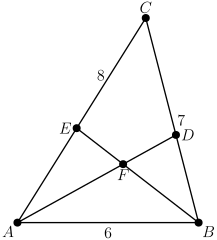
In and Point lies on and bisects Point lies on and bisects The bisectors intersect at What is the ratio
Respuesta: C
Pista pequeña:
Aplica el teorema de la bisectriz en para hallar .
Apply the Angle Bisector Theorem in to find
Pista grande:
En el segmento biseca así que .
In segment bisects so
Solución:
Al aplicar el teorema de la bisectriz al se obtiene así que
Ahora está sobre la bisectriz de en así que, por el teorema de la bisectriz de nuevo,
Por lo tanto, la respuesta correcta es C.
Applying the Angle Bisector Theorem to gives so
Now lies along the bisector of in so by the Angle Bisector Theorem again,
Thus, the correct answer is C.
13.
Sea un múltiplo positivo de Una bola roja y bolas verdes se ordenan en una fila en orden aleatorio. Sea la probabilidad de que al menos de las bolas verdes estén del mismo lado de la bola roja. Observa que y que tiende a cuando crece. ¿Cuál es la suma de los dígitos del menor valor de tal que ?
Let be a positive multiple of One red ball and green balls are arranged in a line in random order. Let be the probability that at least of the green balls are on the same side of the red ball. Observe that and that approaches as grows large. What is the sum of the digits of the least value of such that
Respuesta: A
Pista pequeña:
Escribe la bola roja tiene posiciones igualmente probables.
Write the red ball has equally likely positions
Pista grande:
resuelve .
solve
Solución:
Escribe Numera las posiciones de la bola roja desde un extremo; hay posiciones igualmente probables.
Menos de de las bolas verdes quedan de cada lado exactamente cuando la bola roja está en una de las posiciones que son posiciones. Por lo tanto
Al resolver se obtiene así que y es decir Por lo tanto y cuya suma de dígitos es
Por lo tanto, la respuesta correcta es A.
Write Number the positions of the red ball from one end; there are equally likely positions.
Fewer than of the green balls lie on each side exactly when the red ball is in one of the positions which is positions. Hence
Solving gives so and meaning Thus and whose digit sum is
Thus, the correct answer is A.
14.
Cada vértice de un cubo debe etiquetarse con un entero de a usando cada entero una sola vez, de modo que la suma de los cuatro números en los vértices de una cara sea la misma para cada cara. Las disposiciones que pueden obtenerse una de otra mediante rotaciones del cubo se consideran iguales. ¿Cuántas disposiciones diferentes son posibles?
Each vertex of a cube is to be labeled with an integer from through with each integer being used once, in such a way that the sum of the four numbers on the vertices of a face is the same for each face. Arrangements that can be obtained from each other through rotations of the cube are considered to be the same. How many different arrangements are possible?
Respuesta: C
Pista pequeña:
Cada vértice está en caras, así que las seis sumas de caras totalizan .
Each vertex lies on faces, so the six face-sums total
Pista grande:
La suma por cara es demuestra que y deben estar en vértices adyacentes.
The face-sum is show and must be on adjacent vertices
Solución:
Cada vértice pertenece a caras, así que y la suma de cada cara es
Los subconjuntos de cuatro elementos que contienen y suman son y Solo uno omite así que al menos dos de las tres caras distintas que pasan por contienen Dos vértices de un cubo pertenecen a dos caras comunes exactamente cuando son adyacentes; por tanto, y son adyacentes.
Rotemos el cubo para que esté en el vértice inferior izquierdo delantero y en el inferior derecho delantero. La única cara que pasa por y no contiene debe usar que pueden colocarse en órdenes. Cada orden obliga a poner en los tres vértices opuestos, y las demás caras suman entonces Por tanto, hay disposiciones.
Por lo tanto, la respuesta correcta es C.
Each vertex belongs to faces, so giving each face-sum
The four-element subsets containing with sum are and Only one omits so at least two of the three distinct faces through contain Two vertices of a cube lie on two common faces exactly when they are adjacent; hence and are adjacent.
Rotate the cube so that is at the lower-left-front vertex and at the lower-right-front vertex. The unique face through that does not contain must use and these can be placed in orders. Each order forces at the three opposite vertices, and the remaining face sums are then Hence there are arrangements.
Thus, the correct answer is C.
15.
Las circunferencias con centros y de radios y respectivamente, están del mismo lado de la recta y son tangentes a en y respectivamente, con entre y La circunferencia con centro es tangente exterior a cada una de las otras dos. ¿Cuál es el área del ?
Circles with centers and having radii and respectively, lie on the same side of line and are tangent to at and respectively, with between and The circle with center is externally tangent to each of the other two circles. What is the area of
Respuesta: D
Pista pequeña:
La distancia horizontal entre dos puntos de tangencia es .
The horizontal distance between two tangent points is
Pista grande:
Coloca a alturas y usa la fórmula del cordón.
Place at heights and use the shoelace formula
Solución:
Los centros están a alturas y sobre la recta Como la circunferencia es tangente exterior a la circunferencia tenemos por lo que la distancia horizontal es Como la circunferencia es tangente a la circunferencia tenemos así que
Coloca y Por la fórmula del cordón, el área es
Por lo tanto, la respuesta correcta es D.
The centers lie at heights and above line Since circle is externally tangent to circle we have so the horizontal distance is Since circle is tangent to circle we have so
Place and By the shoelace formula, the area is
Thus, the correct answer is D.
16.
Las gráficas de y se trazan en el mismo sistema de ejes. ¿Cuántos puntos del plano con coordenada positiva están sobre dos o más de las gráficas?
The graphs of and are plotted on the same set of axes. How many points in the plane with positive -coordinates lie on two or more of the graphs?
Respuesta: D
Pista pequeña:
Sea y reescribe las cuatro como .
Let and rewrite all four as
Pista grande:
Halla cada donde dos de estas cuatro expresiones sean iguales.
Find every where two of these four expressions are equal
Solución:
Sea Entonces y Dos gráficas se encuentran donde dos de son iguales para algún valor válido
Igualar da así que o igualar da los mismos valores. Igualar da es decir donde y son ambos Los emparejamientos restantes no tienen solución real.
Los puntos de intersección distintos son y así que hay
Por lo tanto, la respuesta correcta es D.
Let Then and Two graphs meet where two of are equal for some valid
Setting gives so or setting gives the same values. Setting gives i.e. where and are both The remaining pairings have no real solution.
The distinct intersection points are and so there are
Thus, the correct answer is D.
17.
Sea un cuadrado. Sean y los centros, respectivamente, de triángulos equiláteros con bases y cada uno exterior al cuadrado. ¿Cuál es la razón entre el área del cuadrado y el área del cuadrado ?
Let be a square. Let and be the centers, respectively, of equilateral triangles with bases and each exterior to the square. What is the ratio of the area of square to the area of square
Respuesta: B
Pista pequeña:
El centro de un triángulo equilátero está a de su altura desde la base.
The center of an equilateral triangle lies of its height from the base
Pista grande:
Compara las diagonales de los dos cuadrados; la razón de áreas es el cuadrado de la razón de longitudes.
Compare diagonals of the two squares; the area ratio is the square of the length ratio
Solución:
Sea el cuadrado de lado Cada triángulo equilátero tiene altura y su centro está a de esa altura, es decir del lado del cuadrado.
El cuadrado tiene diagonal El cuadrado tiene diagonal igual al lado de más dos veces es decir La razón de áreas es el cuadrado de la razón de diagonales:
Por lo tanto, la respuesta correcta es B.
Let square have side length Each equilateral triangle has height and its center lies of that height, namely from the square’s side.
Square has diagonal Square has diagonal equal to the side of plus twice namely The area ratio is the square of the ratio of diagonals:
Thus, the correct answer is B.
18.
Para cierto entero positivo el número tiene divisores enteros positivos, incluyendo y el propio número ¿Cuántos divisores enteros positivos tiene el número ?
For some positive integer the number has positive integer divisors, including and the number How many positive integer divisors does the number have?
Respuesta: D
Pista pequeña:
así que tiene exactamente tres factores primos.
so has exactly three prime factors
Pista grande:
Los exponentes más uno se multiplican para dar deduce .
The exponents plus one multiply to deduce
Solución:
El número es divisible entre los tres primos distintos Si sus exponentes primos son entonces donde Como ya hay al menos tres factores mayores que hay exactamente tres, así que ningún otro primo divide a
Cada exponente de es por lo que cada factor del número de divisores es Los factores tienen todos esa forma, así que los exponentes son en algún orden. Tras restar el exponente aportado por y dividir entre los exponentes de son en algún orden. Por tanto, para dos primos distintos elegidos de
En consecuencia, tiene exponentes y mientras que introduce un tercer primo porque no es divisible por Así, la cantidad de divisores de es
Por lo tanto, la respuesta correcta es D.
The number is divisible by the three distinct primes If its prime exponents are then where Because there are already at least three factors greater than there are exactly three, so no other prime divides
Each exponent in is so each divisor-count factor is The factors all have that form, so the exponents are in some order. After subtracting the exponent from and dividing by the exponents in are in some order. Thus for two distinct primes chosen from
Consequently has exponents and while introduces a third prime because is not divisible by Hence the number of divisors of is
Thus, the correct answer is D.
19.
Jerry parte del en la recta numérica real. Lanza una moneda justa veces. Cuando sale cara, se mueve unidad en la dirección positiva; cuando sale cruz, se mueve unidad en la dirección negativa. La probabilidad de que alcance en algún momento de este proceso es donde y son enteros positivos primos entre sí. ¿Cuánto vale ? (Por ejemplo, tiene éxito si su secuencia de lanzamientos es HTHHHHHH.)
Jerry starts at on the real number line. He tosses a fair coin times. When he gets heads, he moves unit in the positive direction; when he gets tails, he moves unit in the negative direction. The probability that he reaches at some time during this process is where and are relatively prime positive integers. What is (For example, he succeeds if his sequence of tosses is HTHHHHHH.)
Respuesta: B
Pista pequeña:
Cuenta las secuencias de lanzamientos en las que el total acumulado alcanza .
Count the toss sequences in which the running total reaches
Pista grande:
Con a lo sumo cruces siempre alcanza con o cruces solo funcionan algunos órdenes.
With at most tails he always reaches with or tails only some orders work
Solución:
Contemos las secuencias de lanzamientos cuyo total acumulado alcanza Con a lo sumo cruces, con seguridad alcanza lo que aporta secuencias.
Con exactamente cruces, puede alcanzar por primera vez en el lanzamiento o en el Alcanzarlo en el lanzamiento requiere cuatro caras iniciales, tras las cuales la cara restante tiene posiciones posibles. En caso contrario, los lanzamientos y son caras, uno de los cuatro primeros es cruz y los dos últimos son cruces, lo que da otras posibilidades. Así, este caso aporta Con exactamente cruces, solo funciona HHHHTTTT, lo que da No puede alcanzar con menos de caras.
Por tanto, hay secuencias favorables de una probabilidad de Entonces
Por lo tanto, la respuesta correcta es B.
Count the sequences of tosses whose running total reaches With at most tails he certainly reaches contributing sequences.
With exactly tails, he can first reach on toss or toss Reaching it on toss requires four initial heads, after which the remaining head has possible positions. Otherwise, tosses and are heads, one of the first four tosses is a tail, and the last two are tails, again giving possibilities. Thus this case contributes With exactly tails, only HHHHTTTT works, giving He cannot reach with fewer than heads.
So there are favorable sequences out of a probability of Then
Thus, the correct answer is B.
20.
Una operación binaria tiene las propiedades de que y que para todos los números reales no nulos y (Aquí el punto representa la operación de multiplicación usual.) La solución de la ecuación puede escribirse como donde y son enteros positivos primos entre sí. ¿Cuánto vale ?
A binary operation has the properties that and that for all nonzero real numbers and (Here the dot represents the usual multiplication operation.) The solution to the equation can be written as where and are relatively prime positive integers. What is
Respuesta: A
Pista pequeña:
Usa para simplificar .
Use to simplify
Pista grande:
Demuestra que así que .
Show so
Solución:
Al poner se obtiene Luego, al poner se obtiene así que
Por lo tanto así que y
Por lo tanto, la respuesta correcta es A.
Setting gives Then setting gives so
Therefore so and
Thus, the correct answer is A.
21.
Un cuadrilátero está inscrito en una circunferencia de radio Tres de los lados de este cuadrilátero tienen longitud ¿Cuál es la longitud de su cuarto lado?
A quadrilateral is inscribed in a circle of radius Three of the sides of this quadrilateral have length What is the length of its fourth side?
Respuesta: E
Pista pequeña:
Cada lado de longitud subtiende un ángulo central con .
Each side of length subtends a central angle with
Pista grande:
El cuarto lado subtiende usa .
The fourth chord has the same length as one subtending use
Solución:
Sea el ángulo central que subtiende un lado de longitud con radio Por la ley de los cosenos en el triángulo isósceles formado con el centro, así que
Los tres lados iguales ocupan tres arcos consecutivos de ángulo por lo que el cuarto arco tiene ángulo Su cuerda tiene la misma longitud que una cuerda de ángulo central y El cuadrado de su longitud es así que el cuarto lado mide
Por tanto, la respuesta correcta es E.
Let be the central angle subtending a side of length with radius By the law of cosines on the isosceles triangle from the center, so
The three equal sides use three consecutive arcs of angle so the fourth arc has angle Its chord has the same length as a chord with central angle and Its length squared is so the fourth side is
Thus, the correct answer is E.
22.
¿Cuántas ternas ordenadas de enteros positivos satisfacen y ?
How many ordered triples of positive integers satisfy and
Respuesta: A
Pista pequeña:
Factoriza: .
Factor:
Pista grande:
Trata cada primo por separado, usando el de los exponentes.
Handle each prime separately, using of the exponents
Solución:
Como y el factor divide a mientras que ni ni es divisible por Además, divide a mientras que ni ni es divisible por y debe tener el factor
Escribiendo y las condiciones de lcm requieren y El primer par puede ser y el segundo puede ser Así, hay ternas ordenadas.
Por lo tanto, la respuesta correcta es A.
Because and the factor divides while neither nor is divisible by Also divides while neither nor is divisible by and must have the factor
Writing and the lcm conditions require and The first pair can be and the second can be Thus there are ordered triples.
Thus, the correct answer is A.
23.
Se eligen tres números en el intervalo de forma independiente y al azar. ¿Cuál es la probabilidad de que los números elegidos sean las longitudes de los lados de un triángulo de área positiva?
Three numbers in the interval are chosen independently and at random. What is the probability that the chosen numbers are the side lengths of a triangle with positive area?
Respuesta: C
Pista pequeña:
Las ternas llenan un cubo unitario; el fallo significa que un número es que la suma de los otros dos.
The triples fill a unit cube; failure means one number the sum of the other two
Pista grande:
Cada región como es un tetraedro de volumen .
Each region such as is a tetrahedron of volume
Solución:
Las ternas ordenadas llenan el cubo unitario de volumen No forman un triángulo exactamente cuando un valor es al menos la suma de los otros dos.
La región es un tetraedro con vértices de volumen Las regiones análogas y también tienen volumen y tienen interiores disjuntos. Así que la probabilidad de fallo es y la probabilidad de triángulo es
Por lo tanto, la respuesta correcta es C.
The ordered triples fill the unit cube of volume They fail to form a triangle exactly when one value is at least the sum of the other two.
The region is a tetrahedron with vertices of volume The analogous regions and also have volume and have disjoint interiors. So the failure probability is and the triangle probability is
Thus, the correct answer is C.
24.
Existe un menor número real positivo tal que existe un número real positivo para el cual todas las raíces del polinomio son reales. De hecho, para este valor de el valor de es único. ¿Cuál es este valor de ?
There is a smallest positive real number such that there exists a positive real number such that all the roots of the polynomial are real. In fact, for this value of the value of is unique. What is this value of
Respuesta: B
Pista pequeña:
Si las raíces son entonces y .
If the roots are then and
Pista grande:
Aplica la desigualdad MA-MG a el mínimo obliga a .
Apply AM-GM to the minimum forces
Solución:
Por las fórmulas de Vieta, las raíces reales satisfacen y así que
El producto positivo significa que las tres raíces son positivas o que dos son negativas. En el segundo caso, escribamos las raíces como con La suma positiva obliga a y entonces una contradicción. Por tanto, las tres raíces son positivas.
Por la desigualdad MA-MG, de modo que con igualdad si y solo si Para este menor
Por lo tanto, la respuesta correcta es B.
By Vieta’s formulas, the real roots satisfy and so
The positive product means either all three roots are positive or two are negative. In the latter case write the roots as with The positive sum forces and then a contradiction. Hence all three roots are positive.
By the AM-GM inequality, so with equality if and only if At this smallest
Thus, the correct answer is B.
25.
Sea un entero positivo. Bernardo y Silvia se turnan para escribir y borrar números en una pizarra de la siguiente manera: Bernardo empieza escribiendo el menor cuadrado perfecto con dígitos. Cada vez que Bernardo escribe un número, Silvia borra los últimos dígitos de él. Bernardo escribe entonces el siguiente cuadrado perfecto, Silvia borra los últimos dígitos, y este proceso continúa hasta que los dos últimos números que quedan en la pizarra difieren en al menos Sea el menor entero positivo que no se escribió en la pizarra. Por ejemplo, si los números que Bernardo escribe son y y los números que muestran en la pizarra tras borrar Silvia son y de modo que ¿Cuál es la suma de los dígitos de ?
Let be a positive integer. Bernardo and Silvia take turns writing and erasing numbers on a blackboard as follows: Bernardo starts by writing the smallest perfect square with digits. Every time Bernardo writes a number, Silvia erases the last digits of it. Bernardo then writes the next perfect square, Silvia erases the last digits of it, and this process continues until the last two numbers that remain on the board differ by at least Let be the smallest positive integer not written on the board. For example, if then the numbers that Bernardo writes are and and the numbers showing on the board after Silvia erases are and and thus What is the sum of the digits of
Respuesta: E
Pista pequeña:
Para el caso par los números mostrados son para .
For even the numbers shown are for
Pista grande:
Demuestra que luego suma sobre .
Show then add over
Solución:
Tomemos El menor cuadrado perfecto con cifras es y después de que Silvia borra las cifras, los números mostrados son para
Sea Un salto de al menos de a exige así que escribimos con El caso produce un salto de solo de modo que el primer salto mayor tiene Sean y Como es divisible por
Por tanto, el primer salto de al menos ocurre para el primer tal que Como este valor es El último valor mostrado antes del hueco es así que el menor entero ausente es
Sumando para No hay acarreos, así que la suma de cifras es
Por tanto, la respuesta correcta es E.
Take The smallest perfect square with digits is and after Silvia erases, the numbers shown are for
Put A jump of at least from to requires so write with The case gives a jump of only so the first larger jump has Let and Because is divisible by
Therefore the first jump of at least occurs at the first for which Since this is The last displayed value before the gap is so the smallest missing integer is
Summing over There are no carries, so the digit sum is
Thus, the correct answer is E.