
Problemas del 2014 AMC 12A
¡Desplázate hacia abajo y presiona Iniciar para intentar el examen! O ve al PDF imprimible, la clave de respuestas, o las soluciones profesionales preparadas por LIVE by Po-Shen Loh.
Todos los problemas se usan con el permiso legal oficial de la Mathematical Association of America (MAA).
O salta directamente a un solo problema con su solución: 1 · 2 · 3 · 4 · 5 · 6 · 7 · 8 · 9 · 10 · 11 · 12 · 13 · 14 · 15 · 16 · 17 · 18 · 19 · 20 · 21 · 22 · 23 · 24 · 25
¿Quieres aprender de forma profesional con clases interactivas en video?
Con tiempo
1:15:00
1.
¿Cuál es el valor de
What is
Pista pequeña:
Primero suma las tres fracciones dentro del paréntesis.
Add the three fractions inside the parentheses first
Pista grande:
, luego toma el recíproco y multiplica por .
, then take the reciprocal and multiply by
Solución:
La suma dentro del paréntesis es
Su recíproco es así que la expresión es igual a
Por lo tanto, la respuesta correcta es C.
The sum inside the parentheses is
Its reciprocal is so the expression equals
Thus, the correct answer is C.
2.
En el teatro los niños entran a mitad de precio. El precio de entradas de adulto y entradas de niño es ¿Cuánto costarían entradas de adulto y entradas de niño?
At the theater children get in for half price. The price for adult tickets and child tickets is How much would adult tickets and child tickets cost?
Respuesta: B
Pista pequeña:
Una entrada de niño cuesta la mitad de una de adulto, así que mide todo en entradas de adulto.
A child ticket costs half an adult ticket, so measure everything in adult tickets
Pista grande:
entradas de adulto cuestan ; halla el costo de entradas de adulto.
adult tickets cost ; find the cost of adult tickets
Solución:
Como una entrada de niño es la mitad de una de adulto, entradas de adulto y de niño equivalen a entradas de adulto, así que una entrada de adulto cuesta
La segunda compra equivale a entradas de adulto, con un costo de
Por lo tanto, la respuesta correcta es B.
Since a child ticket is half an adult ticket, adult and child tickets equal adult tickets, so one adult ticket costs
The second purchase equals adult tickets, costing
Thus, the correct answer is B.
3.
Caminando por Jane Street, Ralph pasó por cuatro casas seguidas, cada una pintada de un color distinto. Pasó por la casa naranja antes que por la roja, y pasó por la casa azul antes que por la amarilla. La casa azul no estaba junto a la amarilla. ¿Cuántos ordenamientos de las casas de colores son posibles?
Walking down Jane Street, Ralph passed four houses in a row, each painted a different color. He passed the orange house before the red house, and he passed the blue house before the yellow house. The blue house was not next to the yellow house. How many orderings of the colored houses are possible?
Respuesta: B
Pista pequeña:
Divide en casos según si la casa naranja o la azul aparece primero.
Split into cases by whether the orange house or the blue house comes first
Pista grande:
Como la azul y la amarilla no pueden ser adyacentes, al menos una casa debe separarlas.
Because blue and yellow cannot be adjacent, at least one house must separate them
Solución:
Si la naranja aparece primero, entonces la azul y la amarilla no pueden ser adyacentes, lo que obliga al orden naranja, azul, roja, amarilla.
Si la azul aparece primero, la amarilla puede ocupar la tercera o la cuarta posición (nunca la segunda, para evitar la adyacencia), lo que da azul, naranja, amarilla, roja y azul, naranja, roja, amarilla.
Estos son los únicos ordenamientos válidos.
Por lo tanto, la respuesta correcta es B.
If orange comes first, then blue and yellow cannot be adjacent, forcing the order orange, blue, red, yellow.
If blue comes first, yellow can be in the third or fourth position (never second, to avoid adjacency), giving blue, orange, yellow, red and blue, orange, red, yellow.
These are the only valid orderings.
Thus, the correct answer is B.
4.
Supongamos que vacas dan galones de leche en días. A este ritmo, ¿cuántos galones de leche darán vacas en días?
Suppose that cows give gallons of milk in days. At this rate, how many gallons of milk will cows give in days?
Respuesta: A
Pista pequeña:
Halla cuánta leche da una vaca en un día.
Find how much milk one cow gives in one day
Pista grande:
Una vaca da galones por día; escala por vacas y días.
One cow gives gallons per day; scale by cows and days
Solución:
El ritmo es galones por vaca por día.
Así que vacas en días producen galones.
Por lo tanto, la respuesta correcta es A.
The rate is gallons per cow per day.
So cows over days produce gallons.
Thus, the correct answer is A.
5.
En una prueba de álgebra, el de los estudiantes obtuvo puntos, el obtuvo puntos, el obtuvo puntos y el resto obtuvo puntos. ¿Cuál es la diferencia entre la media y la mediana de las puntuaciones de los estudiantes en esta prueba?
On an algebra quiz, of the students scored points, scored points, scored points, and the rest scored points. What is the difference between the mean and the median of the students’ scores on this quiz?
Respuesta: C
Pista pequeña:
La mediana es la puntuación del estudiante del medio después de ordenar a todos.
The median is the score of the middle student after ordering everyone
Pista grande:
Calcula la media ponderada y compárala con la mediana.
Compute the weighted mean and compare it to the median
Solución:
El restante obtuvo Como el obtuvo a lo sumo y el obtuvo a lo sumo la mediana es
La media es
La diferencia es
Por lo tanto, la respuesta correcta es C.
The remaining scored Since scored at most and scored at most the median is
The mean is
The difference is
Thus, the correct answer is C.
6.
La diferencia entre un número de dos dígitos y el número que se obtiene al invertir sus dígitos es veces la suma de los dígitos de cualquiera de los dos números. ¿Cuál es la suma del número de dos dígitos y su inverso?
The difference between a two-digit number and the number obtained by reversing its digits is times the sum of the digits of either number. What is the sum of the two-digit number and its reverse?
Respuesta: D
Pista pequeña:
Escribe el número como y su inverso como .
Write the number as and its reverse as
Pista grande:
La diferencia es , e igualarla a da .
The difference is , and setting it equal to gives
Solución:
Sea el número mayor. Entonces, lo cual se simplifica a
Los únicos dígitos no nulos que satisfacen esta ecuación son y así que el número es y su reverso es
La suma es
Así, la respuesta correcta es D.
Let the larger number be Then which simplifies to
The only nonzero digits satisfying this are and so the number is and its reverse is
Their sum is
Thus, the correct answer is D.
7.
Los primeros tres términos de una progresión geométrica son y ¿Cuál es el cuarto término?
The first three terms of a geometric progression are and What is the fourth term?
Respuesta: A
Pista pequeña:
Reescribe cada término como una potencia de : .
Rewrite each term as a power of :
Pista grande:
La razón común es ; multiplica el tercer término por ella.
The common ratio is ; multiply the third term by it
Solución:
Escribiendo los términos como potencias de son La razón común es
El cuarto término es
Por lo tanto, la respuesta correcta es A.
Writing the terms as powers of they are The common ratio is
The fourth term is
Thus, the correct answer is A.
8.
Un cliente que piensa comprar un electrodoméstico tiene tres cupones, de los cuales solo puede usar uno:
Cupón de descuento sobre el precio de lista si el precio de lista es de al menos .
Cupón de descuento sobre el precio de lista si el precio de lista es de al menos .
Cupón de descuento sobre la cantidad en que el precio de lista supera los .
¿Para cuál de los siguientes precios de lista ofrecerá el cupón una reducción de precio mayor que la del cupón o la del cupón ?
A customer who intends to purchase an appliance has three coupons, only one of which may be used:
Coupon off the listed price if the listed price is at least
Coupon off the listed price if the listed price is at least
Coupon off the amount by which the listed price exceeds
For which of the following listed prices will coupon offer a greater price reduction than either coupon or coupon
Respuesta: C
Pista pequeña:
Sea el precio de lista y escribe la reducción de cada cupón como una expresión en .
Let be the listed price and write each coupon’s reduction as an expression in
Pista grande:
El cupón supera al cupón cuando y supera al cupón cuando .
Coupon beats coupon when and beats coupon when
Solución:
Para un precio las reducciones son y
El cupón supera al cupón cuando es decir El cupón supera al cupón cuando es decir
El único precio de lista en es
Por lo tanto, la respuesta correcta es C.
For a price the reductions are and
Coupon beats coupon when that is Coupon beats coupon when that is
The only listed price in is
Thus, the correct answer is C.
9.
Cinco enteros positivos consecutivos que comienzan con tienen promedio ¿Cuál es el promedio de enteros consecutivos que comienzan con ?
Five positive consecutive integers starting with have average What is the average of consecutive integers that start with
Respuesta: B
Pista pequeña:
El promedio de enteros consecutivos es el del medio.
The average of consecutive integers is the middle one
Pista grande:
Del primer conjunto , y el nuevo promedio es .
From the first set , and the new average is
Solución:
Los enteros tienen promedio así que
Los enteros que comienzan en tienen promedio
Por lo tanto, la respuesta correcta es B.
The integers have average so
The integers starting at have average
Thus, the correct answer is B.
10.
Se construyen tres triángulos isósceles congruentes con sus bases sobre los lados de un triángulo equilátero de lado La suma de las áreas de los tres triángulos isósceles es igual al área del triángulo equilátero. ¿Cuál es la longitud de uno de los dos lados congruentes de uno de los triángulos isósceles?
Three congruent isosceles triangles are constructed with their bases on the sides of an equilateral triangle of side length The sum of the areas of the three isosceles triangles is the same as the area of the equilateral triangle. What is the length of one of the two congruent sides of one of the isosceles triangles?
Respuesta: B
Pista pequeña:
Cada triángulo isósceles tiene base ; sea su altura.
Each isosceles triangle has base ; let its height be
Pista grande:
Tres triángulos de área suman ; despeja , luego usa el teorema de Pitágoras.
Three triangles of area sum to ; solve for , then use the Pythagorean theorem
Solución:
El triángulo equilátero tiene área Cada triángulo isósceles tiene base y altura así que lo que da
Un lado congruente es la hipotenusa desde el vértice superior hasta un extremo de la base, cuya longitud es
Por lo tanto, la respuesta correcta es B.
The equilateral triangle has area Each isosceles triangle has base and height so giving
A congruent side is the hypotenuse from the apex to a base endpoint:
Thus, the correct answer is B.
11.
David conduce desde su casa hasta el aeropuerto para tomar un vuelo. Conduce millas en la primera hora, pero se da cuenta de que llegará hora tarde si continúa a esta velocidad. Aumenta su velocidad en millas por hora durante el resto del camino al aeropuerto y llega minutos antes. ¿A cuántas millas está el aeropuerto de su casa?
David drives from his home to the airport to catch a flight. He drives miles in the first hour, but realizes that he will be hour late if he continues at this speed. He increases his speed by miles per hour for the rest of the way to the airport and arrives minutes early. How many miles is the airport from his home?
Respuesta: C
Pista pequeña:
Sea el tiempo que aún falta después de la primera hora, y escribe la distancia restante de dos maneras.
Let be the time still needed after the first hour, and write the remaining distance two ways
Pista grande:
La distancia sobrante satisface y .
The leftover distance satisfies and
Solución:
Sea la distancia restante después de una hora y el tiempo que falta hasta el vuelo. A mph llegaría una hora tarde, así que A mph llega media hora antes, así que
Igualando ambas se obtiene así que y
La distancia total es millas.
Por lo tanto, la respuesta correcta es C.
Let be the remaining distance after one hour and the remaining time until the flight. At mph he would be an hour late, so At mph he is half an hour early, so
Setting these equal gives so and
The total distance is miles.
Thus, the correct answer is C.
12.
Dos círculos se intersecan en los puntos y Los arcos menores miden en un círculo y en el otro círculo. ¿Cuál es la razón entre el área del círculo mayor y el área del círculo menor?
Two circles intersect at points and The minor arcs measure on one circle and on the other circle. What is the ratio of the area of the larger circle to the area of the smaller circle?
Respuesta: D
Pista pequeña:
La cuerda común es igual a en un círculo y a en el otro.
The common chord equals in one circle and in the other
Pista grande:
La razón de áreas es , y .
The area ratio is , and
Solución:
Sean los círculos de radios (con el arco de ) y (con el arco de ). La cuerda común tiene longitud así que
El ángulo central menor corresponde al radio mayor, así que La razón de áreas es
Por lo tanto, la respuesta correcta es D.
Let the circles have radii (with the arc) and (with the arc). The common chord has length so
The smaller central angle gives the larger radius, so The area ratio is
Thus, the correct answer is D.
13.
Una elegante posada tipo bed and breakfast tiene habitaciones, cada una con una decoración distintiva codificada por colores. Un día llegan amigos a pasar la noche. Esa noche no hay otros huéspedes. Los amigos pueden alojarse en cualquier combinación que deseen, pero con no más de amigos por habitación. ¿De cuántas maneras puede el posadero asignar a los huéspedes a las habitaciones?
A fancy bed and breakfast inn has rooms, each with a distinctive color-coded decor. One day friends arrive to spend the night. There are no other guests that night. The friends can room in any combination they wish, but with no more than friends per room. In how many ways can the innkeeper assign the guests to the rooms?
Respuesta: B
Pista pequeña:
Divide en casos según las ocupaciones de las habitaciones: todos solos, una pareja o dos parejas.
Split into cases by the room occupancies: all singles, one pair, or two pairs
Pista grande:
Cuenta cada caso como (maneras de formar los grupos) por (maneras de colocar los grupos en habitaciones distintas).
Count each case as (ways to form the groups) times (ways to place the groups into distinct rooms)
Solución:
Todos solos: asigna amigos a habitaciones de maneras.
Una pareja: elige la pareja de maneras, luego coloca los grupos en las habitaciones de maneras, lo que da
Dos parejas: elige al amigo que va solo de maneras y divide al resto en dos parejas de maneras ( agrupaciones), luego coloca los grupos en las habitaciones de maneras, lo que da
El total es
Por lo tanto, la respuesta correcta es B.
All singles: assign friends to rooms in ways.
One pair: choose the pair in ways, then place the groups into rooms in ways, giving
Two pairs: choose the solo friend in ways and split the rest into two pairs in ways ( groupings), then place the groups into rooms in ways, giving
The total is
Thus, the correct answer is B.
14.
Sean tres enteros tales que es una progresión aritmética y es una progresión geométrica. ¿Cuál es el menor valor posible de ?
Let be three integers such that is an arithmetic progression and is a geometric progression. What is the smallest possible value for
Respuesta: C
Pista pequeña:
Sea la diferencia común: y .
Let the common difference be : and
Pista grande:
Como es geométrica, ; esto se simplifica a .
Since is geometric, ; this simplifies to
Solución:
Sea , así que y . Como es geométrica, lo que se simplifica a , así que .
Entonces y para un entero positivo , lo que da . El menor valor es (con , , ).
Por lo tanto, la respuesta correcta es C.
Let so and Since is geometric, which simplifies to so
Then and for a positive integer giving The smallest value is (with ).
Thus, the correct answer is C.
15.
Un palíndromo de cinco dígitos es un entero positivo con dígitos respectivos donde no es cero. Sea la suma de todos los palíndromos de cinco dígitos. ¿Cuál es la suma de los dígitos de ?
A five-digit palindrome is a positive integer with respective digits where is not zero. Let be the sum of all five-digit palindromes. What is the sum of the digits of
Respuesta: B
Pista pequeña:
Un palíndromo es igual a .
A palindrome equals
Pista grande:
Cada aparece en palíndromos, cada en , cada en ; combínalo con la suma de dígitos .
Each appears in palindromes, each in , each in ; combine with the digit sum
Solución:
Escribe Al sumar sobre todos los palíndromos, cada valor de ocurre con opciones de y cada valor de o ocurre con opciones de los otros dos dígitos.
Usando
La suma de los dígitos de es
Por lo tanto, la respuesta correcta es B.
Write Summing over all palindromes, each value of occurs with choices of and each value of or occurs with choices of the other two digits.
Using
The sum of the digits of is
Thus, the correct answer is B.
16.
En el producto el segundo factor tiene dígitos. Ese producto es un entero cuyos dígitos suman ¿Cuánto vale ?
The product where the second factor has digits, is an integer whose digits have a sum of What is
Respuesta: D
Pista pequeña:
Multiplica casos pequeños: .
Multiply small cases:
Pista grande:
El producto es cuya suma de dígitos es .
The product is whose digit sum is
Solución:
Al efectuar la multiplicación, que tiene unos.
La suma de dígitos es Al poner se obtiene
Por lo tanto, la respuesta correcta es D.
By carrying out the multiplication, which has ones.
The digit sum is Setting gives
Thus, the correct answer is D.
17.
Una caja rectangular de contiene una esfera de radio y ocho esferas más pequeñas de radio Cada una de las esferas pequeñas es tangente a tres caras de la caja, y la esfera mayor es tangente a cada una de las esferas pequeñas. ¿Cuánto vale ?
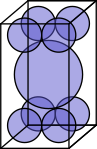
A rectangular box contains a sphere of radius and eight smaller spheres of radius The smaller spheres are each tangent to three sides of the box, and the larger sphere is tangent to each of the smaller spheres. What is
Respuesta: A
Pista pequeña:
Los centros de las cuatro esferas pequeñas superiores forman un cuadrado de lado , justo debajo del centro de la esfera grande.
The four top small-sphere centers form a square of side , directly below the big sphere’s center
Pista grande:
Con una distancia entre centros de (suma de radios) y un desplazamiento horizontal de , la separación vertical es ; luego suma arriba y abajo.
With center distance (sum of radii) and horizontal offset , the vertical gap is ; then add at the top and bottom
Solución:
Coloquemos la caja con una esquina en el origen. Cada esfera pequeña ocupa una esquina y su centro está a unidad de tres caras. Los centros de las cuatro esferas pequeñas superiores forman un cuadrado de lado cuyo centro está sobre el eje de la caja; cada vértice de ese cuadrado está a del centro.
El centro de la esfera grande está sobre el eje, a una distancia de cada centro pequeño superior. La separación vertical entre ellos es
El centro grande está a una altura , y los centros pequeños superiores están a una altura así que de donde y
Así, la respuesta correcta es A.
Place the box with a corner at the origin. Each small sphere sits in a corner with center unit from three faces. The four top small-sphere centers form a square of side whose center lies on the box axis; a corner of that square is from the center.
The big sphere’s center is on the axis, at distance from each top small center. The vertical gap between them is
The big center is at height and the top small centers at height so giving and
Thus, the correct answer is A.
18.
El dominio de la función es un intervalo de longitud , donde y son enteros positivos primos entre sí. ¿Cuánto vale ?
The domain of the function is an interval of length where and are relatively prime positive integers. What is
Respuesta: C
Pista pequeña:
Pela los logaritmos de afuera hacia adentro, exigiendo que cada argumento sea positivo.
Peel the logarithms from the outside in, requiring each argument to be positive
Pista grande:
Recuerda que las bases menores que invierten las desigualdades; traduce cada condición de positividad sucesiva antes de pasar al siguiente logaritmo interior.
Remember that bases below reverse inequalities; translate each successive positivity condition before moving to the next inner logarithm
Solución:
Trabajando desde afuera, está definida exactamente cuando lo que equivale a
Como la base esto significa de donde
Como esto se invierte a es decir La longitud es así que
Por lo tanto, la respuesta correcta es C.
Working from the outside, is defined exactly when which is equivalent to
Since the base this means hence
As this reverses to i.e. The length is so
Thus, the correct answer is C.
19.
Existen exactamente números racionales distintos tales que , de modo que la ecuación tiene al menos una solución entera . ¿Cuánto vale ?
There are exactly distinct rational numbers such that and has at least one integer solution for What is
Respuesta: E
Pista pequeña:
Si es una raíz entera, despeja .
If is an integer root, solve for
Pista grande:
Exige , y comprueba que los valores de resultantes son todos distintos.
Require , and check the resulting values of are all distinct
Solución:
Si un entero es raíz, entonces así que Para crece, y da mientras que da
Así recorre que son valores. Si dos enteros dieran el mismo entonces obliga a que no tiene soluciones enteras, así que los valores de son todos distintos.
Por lo tanto, la respuesta correcta es E.
If an integer is a root, then so For increases, and gives while gives
Thus ranges over which is values. If two integers gave the same then forces which has no integer solutions, so all values of are distinct.
Thus, the correct answer is E.
20.
En y Los puntos y están sobre y respectivamente. ¿Cuál es el mínimo valor posible de ?
In and Points and lie on and respectively. What is the minimum possible value of
Respuesta: D
Pista pequeña:
Refleja sobre la recta para obtener y sobre la recta para obtener
Reflect over line to and over line to
Pista grande:
El camino se convierte en , que se minimiza como el segmento recto ; usa la ley de cosenos con .
The path becomes , minimized as the straight segment ; use the Law of Cosines with
Solución:
Refleja sobre la recta para obtener y refleja sobre la recta para obtener Entonces y así que un camino quebrado de a
Esto se minimiza cuando el camino es el segmento recto Tenemos y
Por la ley de cosenos, así que
Por lo tanto, la respuesta correcta es D.
Reflect across line to get and reflect across line to get Then and so a broken path from to
This is minimized when the path is the straight segment We have and
By the Law of Cosines, so
Thus, the correct answer is D.
21.
Para todo número real sea el mayor entero que no excede a y sea El conjunto de todos los números tales que y es una unión de intervalos disjuntos. ¿Cuál es la suma de las longitudes de esos intervalos?
For every real number let denote the greatest integer not exceeding and let The set of all numbers such that and is a union of disjoint intervals. What is the sum of the lengths of those intervals?
Respuesta: A
Pista pequeña:
Escribe con y así que .
Write with and so
Pista grande:
La condición da ; suma estas longitudes y telescopa.
The condition gives ; sum these lengths and telescope
Solución:
Escribe con entero () y Entonces y se convierte en es decir
Cada aporta un intervalo de longitud así que el total es
Por lo tanto, la respuesta correcta es A.
Write with integer () and Then and becomes i.e.
Each contributes an interval of length so the total is
Thus, the correct answer is A.
22.
El número está entre y ¿Cuántos pares de enteros hay tales que y
The number is between and How many pairs of integers are there such that and
Respuesta: B
Pista pequeña:
Entre potencias consecutivas y hay dos o tres potencias de .
Between consecutive powers and there are either two or three powers of
Pista grande:
La desigualdad pide tres de esas potencias; si cuentan los huecos con dos y con tres potencias, entonces y .
The inequality asks for three such powers; if count the two-power and three-power gaps, then and
Solución:
Como cada intervalo contiene dos o tres potencias de La cadena se cumple exactamente cuando el intervalo contiene tres potencias consecutivas de y entonces hay un único
Sean y las cantidades de intervalos con que contienen dos y tres potencias de respectivamente. Como hay potencias de en total, lo que da y
Resolviendo,
Por lo tanto, la respuesta correcta es B.
Because each interval contains either two or three powers of The chain holds exactly when the interval contains three consecutive powers of and then there is a unique such
Let and be the numbers of intervals for containing two and three powers of respectively. Since there are powers of in total, giving and
Solving,
Thus, the correct answer is B.
23.
La fracción donde es la longitud del período de la expansión decimal periódica. ¿Cuál es la suma ?
The fraction where is the length of the period of the repeating decimal expansion. What is the sum
Respuesta: B
Pista pequeña:
Como , el bloque periódico satisface .
Since , the repeating block satisfies
Pista grande:
Agrupa el decimal periódico en cifras de base y usa sigue los acarreos hasta que se repita la primera cifra de base
Group the repeating decimal into base- digits and use follow the carries until the first base- digit repeats
Solución:
Leyendo el bloque por pares de dígitos (en base ), se expande como pues Sea el -ésimo dígito en base del bloque periódico. Al multiplicar el bloque por , primero se obtiene El acarreo resultante da y después ya no hay acarreo, con sucesivamente para El siguiente dígito vuelve a ser así que el período es omitiendo .
Si aparecieran todos los bloques de a , la suma de dígitos sería Al quitar el ausente se resta lo que da
Por lo tanto, la respuesta correcta es B.
Reading the block in pairs of digits (base ), expands as since Let be the th base- digit of the repeating block. Multiplying the block by shows first that The resulting carry gives after which there is no carry and successively for The next digit is again so the period is with omitted.
If the blocks through all appeared, the digit sum would be Removing the missing subtracts giving
Thus, the correct answer is B.
24.
Sea y para sea ¿Para cuántos valores de se cumple ?
Let and for let For how many values of is
Respuesta: C
Pista pequeña:
Si para un entero no negativo entonces y después los valores se repiten en ciclo
If for a nonnegative integer then and afterward the values cycle
Pista grande:
Así que requiere con ; grafica y cuenta las intersecciones con cada recta .
So needs with ; graph and count intersections with each line
Solución:
Si entonces Así que si para un entero no negativo entonces tras lo cual la sucesión alterna Por lo tanto exactamente cuando para algún entero
Ahora es igual a para a para y a para Su gráfica es lineal por tramos con puntos de inflexión y
Una recta corta esta gráfica tres veces para y dos veces para El total es
Por lo tanto, la respuesta correcta es C.
If then So if for a nonnegative integer then after which the sequence alternates Thus exactly when for some integer
Now equals for for and for Its graph is piecewise linear with turning points and
A line meets this graph three times for and twice for The total is
Thus, the correct answer is C.
25.
La parábola tiene foco y pasa por los puntos y ¿Para cuántos puntos con coordenadas enteras se cumple que ?
The parabola has focus and goes through the points and For how many points with integer coordinates is it true that
Respuesta: B
Pista pequeña:
es el punto medio de y así que esta cuerda es el lado recto y la directriz es paralela a ella
is the midpoint of and so this chord is the latus rectum and the directrix is parallel to it
Pista grande:
La directriz es ; parametriza los puntos reticulares y reduce a .
The directrix is ; parametrize the lattice points and reduce to
Solución:
Como es el punto medio de y el segmento es el lado recto, así que la directriz es paralela a a distancia del lado opuesto, a saber
Igualando las distancias al foco y a la directriz se obtiene Escribir obliga a que sea múltiplo de y obliga a que sea impar; con los puntos enteros son
Entonces si y solo si es decir Eso da puntos reticulares.
Por lo tanto, la respuesta correcta es B.
Since is the midpoint of and the segment is the latus rectum, so the directrix is parallel to at distance on the far side, namely
Equating distances to focus and directrix gives Writing forces to be a multiple of and forces odd; with the integer points are
Then iff i.e. That gives lattice points.
Thus, the correct answer is B.