
Problemas del 2012 AMC 12A
¡Desplázate hacia abajo y presiona Iniciar para intentar el examen! O ve al PDF imprimible, la clave de respuestas, o las soluciones profesionales preparadas por LIVE by Po-Shen Loh.
Todos los problemas se usan con el permiso legal oficial de la Mathematical Association of America (MAA).
O salta directamente a un solo problema con su solución: 1 · 2 · 3 · 4 · 5 · 6 · 7 · 8 · 9 · 10 · 11 · 12 · 13 · 14 · 15 · 16 · 17 · 18 · 19 · 20 · 21 · 22 · 23 · 24 · 25
¿Quieres aprender de forma profesional con clases interactivas en video?
Con tiempo
1:15:00
1.
Un insecto se arrastra a lo largo de una recta numérica, comenzando en Se arrastra hasta luego da la vuelta y se arrastra hasta ¿Cuántas unidades se arrastra el insecto en total?
A bug crawls along a number line, starting at It crawls to then turns around and crawls to How many units does the bug crawl altogether?
Respuesta: E
Pista pequeña:
Suma las dos distancias de arrastre por separado, en lugar del desplazamiento neto
Add the two separate crawl distances rather than the net displacement
Pista grande:
El primer tramo es y el segundo es
The first leg is and the second is
Solución:
El insecto se arrastra unidades en el primer tramo y unidades en el segundo tramo.
La distancia total es
Por lo tanto, la respuesta correcta es E.
The bug crawls units on the first leg and units on the second leg.
The total distance is
Thus, the correct answer is E.
2.
Cagney puede glasear un cupcake cada segundos y Lacey puede glasear un cupcake cada segundos. Trabajando juntas, ¿cuántos cupcakes pueden glasear en minutos?
Cagney can frost a cupcake every seconds and Lacey can frost a cupcake every seconds. Working together, how many cupcakes can they frost in minutes?
Respuesta: D
Pista pequeña:
Convierte minutos a segundos, o cuenta los cupcakes por minuto de cada persona
Convert minutes to seconds, or count each person’s cupcakes per minute
Pista grande:
En minutos Cagney glasea y Lacey glasea
In minutes Cagney frosts and Lacey frosts
Solución:
En minutos hay segundos. Cagney glasea cupcakes y Lacey glasea cupcakes.
Juntas glasean cupcakes.
Por lo tanto, la respuesta correcta es D.
In minutes there are seconds. Cagney frosts cupcakes and Lacey frosts cupcakes.
Together they frost cupcakes.
Thus, the correct answer is D.
3.
Una caja de centímetros de alto, centímetros de ancho y centímetros de largo puede contener gramos de arcilla. Una segunda caja con el doble de altura, el triple de ancho y el mismo largo que la primera puede contener gramos de arcilla. ¿Cuánto vale ?
A box centimeters high, centimeters wide, and centimeters long can hold grams of clay. A second box with twice the height, three times the width, and the same length as the first box can hold grams of clay. What is
Respuesta: D
Pista pequeña:
La capacidad es proporcional al volumen
The capacity is proportional to the volume
Pista grande:
El volumen se multiplica por
The volume is multiplied by
Solución:
La segunda caja tiene veces el volumen de la primera, así que contiene veces más arcilla.
Por lo tanto
Por lo tanto, la respuesta correcta es D.
The second box has times the volume of the first, so it holds times as much clay.
Therefore
Thus, the correct answer is D.
4.
En una bolsa de canicas, de las canicas son azules y el resto son rojas. Si el número de canicas rojas se duplica y el número de canicas azules permanece igual, ¿qué fracción de las canicas serán rojas?
In a bag of marbles, of the marbles are blue and the rest are red. If the number of red marbles is doubled and the number of blue marbles stays the same, what fraction of the marbles will be red?
Respuesta: C
Pista pequeña:
Comienza con un total conveniente, como canicas
Start with a convenient total, such as marbles
Pista grande:
Las azules y rojas empiezan en y ; al duplicar las rojas quedan azules y rojas
Blue and red begin at and ; doubling the red gives blue and red
Solución:
Supongamos que hay canicas: azules y rojas. Al duplicar las rojas quedan rojas, mientras que las azules siguen en
El total ahora es así que la fracción que es roja es
Por lo tanto, la respuesta correcta es C.
Suppose there are marbles: blue and red. Doubling the red gives red while the blue stays at
The total is now so the fraction that is red is
Thus, the correct answer is C.
5.
Una ensalada de frutas está compuesta por arándanos, frambuesas, uvas y cerezas. La ensalada de frutas tiene un total de piezas de fruta. Hay el doble de frambuesas que de arándanos, el triple de uvas que de cerezas y cuatro veces más cerezas que frambuesas. ¿Cuántas cerezas hay en la ensalada de frutas?
A fruit salad consists of blueberries, raspberries, grapes, and cherries. The fruit salad has a total of pieces of fruit. There are twice as many raspberries as blueberries, three times as many grapes as cherries, and four times as many cherries as raspberries. How many cherries are there in the fruit salad?
Respuesta: D
Pista pequeña:
Expresa cada cantidad en términos del número de arándanos
Express every count in terms of the number of blueberries
Pista grande:
Con arándanos hay frambuesas, cerezas y uvas
With blueberries there are raspberries, cherries, and grapes
Solución:
Sea el número de arándanos. Entonces hay frambuesas, cerezas y uvas.
El total es así que y hay cerezas.
Por lo tanto, la respuesta correcta es D.
Let be the number of blueberries. Then there are raspberries, cherries, and grapes.
The total is so and there are cherries.
Thus, the correct answer is D.
6.
Las sumas de tres números enteros tomados en pares son y ¿Cuál es el número del medio?
The sums of three whole numbers taken in pairs are and What is the middle number?
Respuesta: D
Pista pequeña:
Al sumar las tres sumas por pares se cuenta cada número dos veces
Adding all three pairwise sums counts each number twice
Pista grande:
El total es la mitad de ; resta cada suma de pares para obtener el tercer número
The total is half of ; subtract each pair sum to get the third number
Solución:
Sean los números Sumar las tres sumas por pares da así que
Entonces y El número del medio es
Por lo tanto, la respuesta correcta es D.
Let the numbers be Adding the three pairwise sums gives so
Then and The middle number is
Thus, the correct answer is D.
7.
Mary divide un círculo en sectores. Los ángulos centrales de estos sectores, medidos en grados, son todos enteros y forman una progresión aritmética. ¿Cuál es la medida en grados del menor ángulo de sector posible?
Mary divides a circle into sectors. The central angles of these sectors, measured in degrees, are all integers and they form an arithmetic sequence. What is the degree measure of the smallest possible sector angle?
Respuesta: C
Pista pequeña:
Los doce ángulos suman
The twelve angles sum to
Pista grande:
Con primer término y diferencia común así que
With first term and common difference so
Solución:
Sea el ángulo más pequeño y la diferencia común. La suma de los ángulos es así que
Para hacer pequeño, toma grande. Como debe ser par, es par, y da así que Un par mayor hace que sea no positivo.
Por lo tanto, la respuesta correcta es C.
Let be the smallest angle and the common difference. The sum of the angles is so
To make small, take large. Since must be even, is even, and gives so A larger even makes non-positive.
Thus, the correct answer is C.
8.
Un promedio iterativo de los números y se calcula de la siguiente manera. Ordena los cinco números en algún orden. Halla la media de los dos primeros números, luego halla la media de eso con el tercer número, luego la media de eso con el cuarto número y, finalmente, la media de eso con el quinto número. ¿Cuál es la diferencia entre el mayor y el menor valor posible que se puede obtener mediante este procedimiento?
An iterative average of the numbers and is computed in the following way. Arrange the five numbers in some order. Find the mean of the first two numbers, then find the mean of that with the third number, then the mean of that with the fourth number, and finally the mean of that with the fifth number. What is the difference between the largest and smallest possible values that can be obtained using this procedure?
Respuesta: C
Pista pequeña:
Calcula el peso que cada posición aporta al promedio final
Work out the weight each position contributes to the final average
Pista grande:
Para el orden , el resultado es ; las últimas posiciones son las que más importan
For the order the result is ; the last entries matter most
Solución:
Para el orden el promedio iterativo es Las posiciones posteriores tienen el mayor peso.
El valor máximo usa dando y el mínimo usa dando .
La diferencia es .
Por lo tanto, la respuesta correcta es C.
For the order the iterative average is The later positions carry the most weight.
The largest value uses giving and the smallest uses giving
The difference is
Thus, the correct answer is C.
9.
Un año es bisiesto si y solo si el número del año es divisible entre (como ) o es divisible entre pero no entre (como ). El º aniversario del nacimiento del novelista Charles Dickens se celebró el de febrero de un martes. ¿En qué día de la semana nació Dickens?
A year is a leap year if and only if the year number is divisible by (such as ) or is divisible by but not by (such as ). The th anniversary of the birth of novelist Charles Dickens was celebrated on February a Tuesday. On what day of the week was Dickens born?
Viernes
Friday
Sábado
Saturday
Domingo
Sunday
Lunes
Monday
Martes
Tuesday
Respuesta: A
Pista pequeña:
Cuenta el número total de días entre las dos fechas del de febrero, trabajando módulo
Count the total number of days between the two February th dates, working modulo
Pista grande:
En años hay días ordinarios más uno adicional por cada año bisiesto; no es bisiesto
In years there are ordinary days plus one extra for each leap year; is not a leap year
Solución:
Del de febrero de al de febrero de hay días ordinarios más uno por cada día bisiesto.
Una cuarta parte de los años contienen un día bisiesto, salvo lo que da días bisiestos. Así que el intervalo abarca días.
Como el día de nacimiento fue días antes de un martes, que es un viernes.
Por lo tanto, la respuesta correcta es A.
From February to February there are ordinary days plus one for each leap day.
One quarter of the years contain a leap day, except giving leap days. So the span is days.
Since the birth day was days before a Tuesday, which is a Friday.
Thus, the correct answer is A.
10.
Un triángulo tiene área un lado de longitud y la mediana a ese lado de longitud Sea el ángulo agudo formado por ese lado y la mediana. ¿Cuánto vale ?
A triangle has area one side of length and the median to that side of length Let be the acute angle formed by that side and the median. What is
Respuesta: D
Pista pequeña:
Una mediana divide un triángulo en dos partes de igual área
A median splits a triangle into two pieces of equal area
Pista grande:
Uno de los medios triángulos tiene lados y con ángulo comprendido y área
One half-triangle has sides and with included angle and area
Solución:
La mediana divide el triángulo en dos triángulos de igual área Uno de ellos tiene los dos lados de longitud (la mitad de la base) y (la mediana) que se encuentran en el ángulo
Su área es así que
Por lo tanto, la respuesta correcta es D.
The median divides the triangle into two triangles of equal area One of them has the two sides of length (half the base) and (the median) meeting at angle
Its area is so
Thus, the correct answer is D.
11.
Alex, Mel y Chelsea juegan un juego que tiene rondas. En cada ronda hay un único ganador, y los resultados de las rondas son independientes. En cada ronda la probabilidad de que Alex gane es y Mel tiene el doble de probabilidad de ganar que Chelsea. ¿Cuál es la probabilidad de que Alex gane tres rondas, Mel gane dos rondas y Chelsea gane una ronda?
Alex, Mel, and Chelsea play a game that has rounds. In each round there is a single winner, and the outcomes of the rounds are independent. For each round the probability that Alex wins is and Mel is twice as likely to win as Chelsea. What is the probability that Alex wins three rounds, Mel wins two rounds, and Chelsea wins one round?
Respuesta: B
Pista pequeña:
Primero halla la probabilidad de victoria por ronda de cada jugador
First find each player’s per-round win probability
Pista grande:
Como y multiplica por el número de disposiciones
Since and multiply by the number of arrangements
Solución:
Como Alex gana con probabilidad los otros dos se reparten el restante. Con Mel dos veces más probable que Chelsea, y
El número de ordenamientos de las victorias es La probabilidad es
Por lo tanto, la respuesta correcta es B.
Since Alex wins with probability the others share the remaining With Mel twice as likely as Chelsea, and
The number of orderings of the wins is The probability is
Thus, the correct answer is B.
12.
Una región cuadrada es tangente exteriormente al círculo de ecuación en el punto sobre el lado Los vértices y están sobre el círculo de ecuación ¿Cuál es la longitud del lado de este cuadrado?
A square region is externally tangent to the circle with equation at the point on the side Vertices and are on the circle with equation What is the side length of this square?
Respuesta: D
Pista pequeña:
Usa la simetría respecto al eje para escribir y
Use the symmetry across the -axis to write and
Pista grande:
La longitud del lado es en horizontal y en vertical, así que ; sustituye en
The side length is horizontally and vertically, so ; substitute into
Solución:
Por simetría, sea con y El cuadrado se apoya en el punto de tangencia así que su ancho horizontal es y su altura es
Como estos son iguales, lo que da
Al sustituir en se obtiene La raíz positiva es así que la longitud del lado es
Por lo tanto, la respuesta correcta es D.
By symmetry let with and The square sits on the tangent point so its horizontal width is and its height is
Since these are equal, giving
Substituting into yields The positive root is so the side length is
Thus, the correct answer is D.
13.
Paula la pintora y sus dos ayudantes pintan cada uno a un ritmo constante, pero diferente. Siempre comienzan a las AM y los tres siempre tardan lo mismo en almorzar. El lunes los tres pintaron el de una casa y terminaron a las PM. El martes, cuando Paula no estaba, los dos ayudantes pintaron solo el de la casa y terminaron a las PM. El miércoles Paula trabajó sola y terminó la casa trabajando hasta las PM. ¿Cuántos minutos duraba el descanso para almorzar cada día?
Paula the painter and her two helpers each paint at constant, but different, rates. They always start at AM and all three always take the same amount of time to eat lunch. On Monday the three of them painted of a house, quitting at PM. On Tuesday, when Paula wasn’t there, the two helpers painted only of the house and quit at PM. On Wednesday Paula worked by herself and finished the house by working until PM. How long, in minutes, was each day’s lunch break?
Respuesta: D
Pista pequeña:
Sea el descanso para almorzar en minutos y sean y los ritmos de pintado (porcentaje por minuto)
Let the lunch break be minutes and let and be the painting rates (percent per minute)
Pista grande:
Los minutos de trabajo son y ; plantea
Working minutes are and ; set up
Solución:
Sea la duración del almuerzo en minutos. Los tres trabajaron minutos el lunes, los ayudantes minutos el martes, y Paula minutos el miércoles.
Si Paula pinta por minuto y los ayudantes juntos pintan por minuto, entonces
Sumar las dos últimas ecuaciones y restarlas de la primera da así que Al resolver el sistema se obtiene y
Por lo tanto, la respuesta correcta es D.
Let be the lunch length in minutes. The three worked minutes Monday, the helpers minutes Tuesday, and Paula minutes Wednesday.
If Paula paints per minute and the helpers together paint per minute, then
Adding the last two equations and subtracting from the first gives so Solving the system gives and
Thus, the correct answer is D.
14.
La curva cerrada de la figura está formada por arcos circulares congruentes, cada uno de longitud donde cada uno de los centros de los círculos correspondientes está entre los vértices de un hexágono regular de lado ¿Cuál es el área encerrada por la curva?
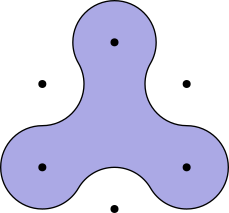
The closed curve in the figure is made up of congruent circular arcs each of length where each of the centers of the corresponding circles is among the vertices of a regular hexagon of side What is the area enclosed by the curve?
Respuesta: E
Pista pequeña:
Cada arco es un sector de de un círculo unitario, ya que una longitud de arco significa radio
Each arc is a sector of a unit circle, since arc length means radius
Pista grande:
Los sectores hacia afuera y hacia adentro se reordenan en un círculo unitario completo añadido al hexágono de lado
The outward and inward sectors rearrange into one full unit circle added to the hexagon of side
Solución:
Cada arco tiene longitud en un círculo unitario, así que es un sector de . Los nueve sectores iguales se pueden reensamblar de modo que la región encerrada sea igual al hexágono regular de lado más un círculo completo de radio
Un hexágono regular de lado se divide en triángulos equiláteros de lado así que su área es
Al sumar el área del círculo unitario se obtiene
Por lo tanto, la respuesta correcta es E.
Each arc has length on a unit circle, so it is a sector. The nine equal sectors can be reassembled so that the enclosed region equals the regular hexagon of side plus one full circle of radius
A regular hexagon of side splits into equilateral triangles of side so its area is
Adding the unit circle’s area gives
Thus, the correct answer is E.
15.
Un cuadrado de se divide en cuadrados unitarios. Cada cuadrado unitario se pinta de blanco o de negro, siendo cada color igualmente probable, elegido de forma independiente y al azar. Luego el cuadrado se rota en sentido horario alrededor de su centro, y todo cuadrado blanco que quede en una posición antes ocupada por un cuadrado negro se pinta de negro. Los colores de todos los demás cuadrados permanecen sin cambios. ¿Cuál es la probabilidad de que la cuadrícula sea ahora completamente negra?
A square is partitioned into unit squares. Each unit square is painted either white or black with each color being equally likely, chosen independently and at random. The square is then rotated clockwise about its center, and every white square in a position formerly occupied by a black square is painted black. The colors of all other squares are left unchanged. What is the probability that the grid is now entirely black?
Respuesta: A
Pista pequeña:
Trata las cuatro esquinas, los cuatro bordes y el centro como tres grupos independientes
Treat the four corners, the four edges, and the center as three independent groups
Pista grande:
Un cuadrado termina negro a menos que sea blanco y el cuadrado que la rotación lleva a su posición también fuera blanco; el centro debe empezar negro
A square ends black unless it is white and the square rotated into its position was also white; the center must start black
Solución:
Las cuatro esquinas forman un ciclo bajo la rotación, los cuatro cuadrados de los bordes forman otro, y el centro queda fijo. Estos tres grupos son independientes.
Una posición sigue blanca exactamente cuando tanto ella como el cuadrado que gira hasta ella eran blancos al principio. Por tanto, las esquinas terminan todas negras exactamente cuando su cadena cíclica no tiene dos blancos adyacentes. Las cadenas permitidas son la totalmente negra, las que tienen un blanco y las que tienen dos blancos opuestos: de las posibilidades. Así, la probabilidad para las esquinas es El mismo argumento vale para los cuatro cuadrados de los bordes.
El centro termina negro solo si empezó negro, con probabilidad Al multiplicar, toda la cuadrícula queda negra con probabilidad
Por lo tanto, la respuesta correcta es A.
The four corners form one cycle under the rotation, the four edge squares form another, and the center is fixed. These three groups are independent.
A position remains white exactly when both it and the square rotated into it were originally white. Thus the corners end black exactly when their cyclic string has no adjacent pair of whites. The allowed strings are the all-black string, the strings with one white, and the strings with two opposite whites: of the possibilities. Hence the corner probability is The same argument applies to the four edge squares.
The center is black at the end only if it started black, with probability Multiplying, the whole grid is black with probability
Thus, the correct answer is A.
16.
El círculo tiene su centro sobre el círculo Los dos círculos se cortan en y El punto , en el exterior de , está sobre el círculo y y ¿Cuál es el radio del círculo ?
Circle has its center lying on circle The two circles meet at and Point in the exterior of lies on circle and and What is the radius of circle
Respuesta: E
Pista pequeña:
Sea el radio, de modo que ; estas cuerdas iguales de subtienden ángulos iguales en
Let be the radius, so ; these equal chords of subtend equal angles at
Pista grande:
Aplica la ley de cosenos a los triángulos y e iguala las dos expresiones para
Apply the Law of Cosines to triangles and and set the two expressions for equal
Solución:
Sea el radio de de modo que Estas son cuerdas iguales de así que subtienden ángulos iguales en
Aplicando la ley de cosenos a los triángulos y
Al eliminar los denominadores y resolver se obtiene así que
Por lo tanto, la respuesta correcta es E.
Let be the radius of so These are equal chords of so they subtend equal angles at
Applying the Law of Cosines to triangles and
Clearing denominators and solving gives so
Thus, the correct answer is E.
17.
Sea un subconjunto de con la propiedad de que ningún par de elementos distintos de tiene una suma divisible entre ¿Cuál es el mayor tamaño posible de ?
Let be a subset of with the property that no pair of distinct elements in has a sum divisible by What is the largest possible size of
Respuesta: B
Pista pequeña:
Ordena los números por su residuo módulo ; hay números en cada clase
Sort the numbers by their remainder modulo ; there are numbers in each class
Pista grande:
Los residuos y no pueden aparecer ambos, ni tampoco y y se permite a lo sumo un múltiplo de
Residues and cannot both appear, nor can and and at most one multiple of is allowed
Solución:
Agrupa por residuo módulo cada clase tiene números. Una suma es divisible entre cuando los residuos son o
Así que puede usar a lo sumo un número y solo una de las clases y solo una de Eso permite a lo sumo números.
El conjunto alcanza así que el máximo es
Por lo tanto, la respuesta correcta es B.
Group by residue modulo each class has numbers. A sum is divisible by when the residues are or
So can use at most one number and only one of the classes and only one of That allows at most numbers.
The set achieves so the maximum is
Thus, the correct answer is B.
18.
El triángulo tiene y Sea la intersección de las bisectrices internas de ¿Cuánto vale ?
Triangle has and Let denote the intersection of the internal angle bisectors of What is
Respuesta: A
Pista pequeña:
Traza perpendiculares desde a los lados; el segmento tangente desde tiene longitud
Drop perpendiculars from to the sides; the tangent segment from has length
Pista grande:
Halla el inradio a partir de área y la fórmula de Herón, luego usa el triángulo rectángulo con catetos y
Find the inradius from area and Heron’s formula, then use the right triangle with legs and
Solución:
Sea el pie de la perpendicular desde el incentro hasta La longitud tangente donde así que
Por la fórmula de Herón, el área es y el inradio satisface
En el triángulo rectángulo así que
Por lo tanto, la respuesta correcta es A.
Let be the foot of the perpendicular from the incenter to The tangent length where so
By Heron’s formula the area is and the inradius satisfies
In right triangle so
Thus, the correct answer is A.
19.
Adam, Benin, Chiang, Deshawn, Esther y Fiona tienen cuentas de internet. Algunos de ellos, pero no todos, son amigos de internet entre sí, y ninguno tiene un amigo de internet fuera de este grupo. Cada uno de ellos tiene el mismo número de amigos de internet. ¿De cuántas maneras diferentes puede ocurrir esto?
Adam, Benin, Chiang, Deshawn, Esther, and Fiona have internet accounts. Some, but not all, of them are internet friends with each other, and none of them has an internet friend outside this group. Each of them has the same number of internet friends. In how many different ways can this happen?
Respuesta: B
Pista pequeña:
Modela las amistades como un grafo de vértices donde todos tienen el mismo grado con
Model the friendships as a graph on vertices where everyone has the same degree with
Pista grande:
Los casos y son complementarios entre sí, al igual que y cuenta por separado los dos tipos de grafos -regulares
The cases and are complements of each other, as are and count the two -regular graph types separately
Solución:
Modela a las personas como vértices de un grafo, con aristas para las amistades. Todos tienen el mismo grado con Los casos y son grafos complementarios, así que se empareja con y con
Para el grafo es un emparejamiento perfecto: maneras. Por lo tanto también da
Para el grafo es una unión de ciclos: o bien dos triángulos o bien un hexágono sumando Por lo tanto también da
El total es
Por lo tanto, la respuesta correcta es B.
Model people as vertices of a graph, with edges for friendships. Everyone has the same degree with The cases and are complementary graphs, so pairs with and with
For the graph is a perfect matching: ways. Thus also gives
For the graph is a union of cycles: either two triangles or one hexagon totaling Thus also gives
The total is
Thus, the correct answer is B.
20.
Considera el polinomio
El coeficiente de es igual a ¿Cuánto vale ?
Consider the polynomial
The coefficient of is equal to What is
Respuesta: B
Pista pequeña:
Cada factor aporta o bien su término o bien su constante ; los exponentes elegidos deben sumar
Each factor contributes either its term or its constant ; the chosen exponents must sum to
Pista grande:
Solo hay una manera de escribir como suma de potencias distintas de dos, así que exactamente un término produce
There is only one way to write as a sum of distinct powers of two, so exactly one term produces
Solución:
Al expandir el producto, un término de grado proviene de elegir de algunos factores de modo que los exponentes sumen Como las potencias de dos son distintas, esto corresponde a la representación binaria
Esa representación es única, así que exactamente un término da y su coeficiente es el producto de las constantes de los factores restantes: los que tienen
El coeficiente es así que
Por lo tanto, la respuesta correcta es B.
Expanding the product, a term of degree comes from choosing from some factors so that the exponents sum to Since powers of two are distinct, this corresponds to the binary representation
That representation is unique, so exactly one term gives and its coefficient is the product of the constants from the remaining factors: those with
The coefficient is so
Thus, the correct answer is B.
21.
Sean y enteros positivos con tales que y
¿Cuánto vale ?
Let and be positive integers with such that and
What is
Respuesta: E
Pista pequeña:
Suma las dos ecuaciones para obtener una expresión simétrica limpia
Add the two equations to get a clean symmetric expression
Pista grande:
La suma se simplifica a y de forma única
The sum simplifies to and uniquely
Solución:
Sumar las dos ecuaciones da es decir,
La única manera de escribir como suma de tres cuadrados es Como obtenemos con o
Al sustituir en la primera ecuación se obtiene así que y El otro caso no tiene solución entera.
Por lo tanto, la respuesta correcta es E.
Adding the two equations gives that is,
The only way to write as a sum of three squares is Since we get with either or
Substituting into the first equation gives so and The other case has no integer solution.
Thus, the correct answer is E.
22.
Planos distintos cortan el interior de un cubo Sea la unión de las caras de y sea La intersección de y consiste en la unión de todos los segmentos que unen los puntos medios de cada par de aristas que pertenecen a una misma cara de ¿Cuál es la diferencia entre el mayor y el menor valor posible de ?
Distinct planes intersect the interior of a cube Let be the union of the faces of and let The intersection of and consists of the union of all segments joining the midpoints of every pair of edges belonging to the same face of What is the difference between the maximum and the minimum possible values of
Respuesta: C
Pista pequeña:
En cada cara los segmentos dibujados unen puntos medios de aristas; clasifica la sección de un plano como cuadrado, rectángulo, triángulo o hexágono
On each face the drawn segments join midpoints of edges; classify a plane’s cross-section as a square, rectangle, triangle, or hexagon
Pista grande:
Para el máximo, cuenta todos los planos de cada tipo; para el mínimo, cubre los segmentos cortos y segmentos largos con la menor cantidad de planos posible
For the maximum, count all planes of each type; for the minimum, cover all short and long segments with as few planes as possible
Solución:
En cada cara, los segmentos requeridos unen puntos medios de aristas. Un plano que corta el cubo se encuentra con las caras en una de cuatro formas simétricas: un cuadrado por puntos medios ( planos), un rectángulo por arista ( planos), un triángulo por vértice ( planos), o un hexágono regular por par de vértices opuestos ( planos).
Usarlos todos da el máximo
La figura completa consta de segmentos cortos y largos. Un plano cuadrado contiene uno rectangular uno triangular y uno hexagonal segmentos cortos y largos, respectivamente. Demos peso a cada segmento corto y peso a cada largo. Cada plano cubre entonces peso a lo sumo mientras que los segmentos requeridos tienen peso total Así, se necesitan al menos planos. Los planos hexagonales cubren los segmentos cortos y los planos cuadrados cubren los largos, por lo que es alcanzable.
La diferencia es
Por lo tanto, la respuesta correcta es C.
On every face, the required segments join midpoints of edges. A plane cutting the cube meets the faces in one of four symmetric shapes: a square through midpoints ( such planes), a rectangle per edge ( planes), a triangle per vertex ( planes), or a regular hexagon per pair of opposite vertices ( planes).
Using all of them gives the maximum
The full figure consists of short segments and long segments. A square plane contains a rectangle a triangle and a hexagon short and long segments, respectively. Give each short segment weight and each long segment weight Every plane then covers weight at most whereas the required segments have total weight Thus at least planes are needed. The hexagon planes cover all short segments, and the square planes cover all long segments, so is attainable.
The difference is
Thus, the correct answer is C.
23.
Sea el cuadrado una de cuyas diagonales tiene extremos y Se elige un punto de forma uniforme al azar entre todos los pares de números reales y tales que y Sea una copia trasladada de centrada en ¿Cuál es la probabilidad de que la región cuadrada determinada por contenga exactamente dos puntos de coordenadas enteras en su interior?
Let be the square one of whose diagonals has endpoints and A point is chosen uniformly at random over all pairs of real numbers and such that and Let be a translated copy of centered at What is the probability that the square region determined by contains exactly two points with integer coordinates in its interior?
Respuesta: C
Pista pequeña:
El cuadrado tiene diagonales de longitud y área por periodicidad, redúcelo a una celda unitaria de la retícula
The square has diagonals of length and area by periodicity, reduce to one unit cell of the lattice
Pista grande:
contiene un punto de la retícula exactamente cuando está en la copia de centrada allí; contener dos requiere que esté en el solapamiento de copias centradas en puntos adyacentes de la retícula
contains a lattice point exactly when lies in the copy of centered there; containing two requires in the overlap of copies centered at adjacent lattice points
Solución:
La diagonal de a mide así que es un cuadrado de área La traslación contiene un punto de la retícula exactamente cuando está dentro de la copia de centrada en ese punto.
Contener exactamente dos puntos interiores de la retícula exige que esté en la intersección de dos copias centradas en puntos adyacentes. Por periodicidad, la respuesta es el área total de esas intersecciones dentro de una celda unitaria.
Consideremos las copias centradas en y Su intersección es un rectángulo. Un giro de un cuarto de vuelta de la semidiagonal dada produce los vértices pertinentes y Siguiendo los dos pares de lados paralelos hasta sus intersecciones, se obtienen longitudes y por lo que el área de intersección es Las copias con centros diagonales no se superponen, y las adyacencias horizontales y verticales contribuyen por igual. Al considerar los bordes de la celda, la probabilidad es
Por lo tanto, la respuesta correcta es C.
The diagonal from to has length so is a square of area The translate contains a lattice point exactly when lies inside the copy of centered at that point.
Containing exactly two interior lattice points requires to lie in the overlap of two copies centered at adjacent lattice points. By periodicity the answer is the total such overlap area within one unit cell.
Consider copies centered at and Their overlap is a rectangle. A quarter-turn of the listed half-diagonal gives the relevant vertices and Following the two pairs of parallel sides through their intersections gives side lengths and so the overlap area is Diagonally centered copies do not overlap, and horizontal and vertical adjacencies contribute equally. Accounting for the cell boundaries gives probability
Thus, the correct answer is C.
24.
Sea la sucesión de números reales definida por y y, más en general,
Al reordenar los números de la sucesión en orden decreciente se produce una nueva sucesión ¿Cuál es la suma de todos los enteros tales que ?
Let be the sequence of real numbers defined by and and more generally
Rearranging the numbers in the sequence in decreasing order produces a new sequence What is the sum of all the integers such that
Respuesta: C
Pista pequeña:
Cada base está entre y así que elevar a una potencia invierte el orden; compara términos consecutivos
Each base is between and so raising to a power reverses order; compare consecutive terms
Pista grande:
Los valores se entrelazan: un término queda fijo cuando su rango es igual a su índice
The values interleave: a term is fixed when its rank equals its index
Solución:
Como cada base está estrictamente entre y la función es decreciente, mientras que es creciente para Al comparar los términos se ve que la sucesión se ordena como
Así, en el ordenamiento decreciente, los términos de índice par van primero, luego los términos de índice impar en orden inverso. Un término satisface exactamente cuando su posición es igual a su índice, lo que para la cola impar descendente requiere
Al resolver se obtiene así que el único índice fijo, y la suma es
Por lo tanto, la respuesta correcta es C.
Because each base lies strictly between and the function is decreasing, while is increasing for Comparing terms shows the sequence orders as
So in the decreasing arrangement, the even-indexed terms come first, then the odd-indexed terms in reverse. A term satisfies exactly when its position equals its index, which for the descending odd tail requires
Solving gives so the unique fixed index, and the sum is
Thus, the correct answer is C.
25.
Sea donde denota la parte fraccionaria de El número es el menor entero positivo tal que la ecuación tiene al menos soluciones reales ¿Cuánto vale ?
Nota: la parte fraccionaria de es un número real tal que y es un entero.
Let where denotes the fractional part of The number is the smallest positive integer such that the equation has at least real solutions What is
Note: the fractional part of is a real number such that and is an integer.
Respuesta: C
Pista pequeña:
es una onda triangular periódica con así que todas las soluciones están en
is a periodic triangular wave with so all solutions lie in
Pista grande:
En cada intervalo unitario, la gráfica de oscila un número creciente de veces; el número total de intersecciones con es
On each unit interval the graph of oscillates a growing number of times; the total number of intersections with is
Solución:
Como toda solución está en La función es una onda triangular de período Sea Para cada entero la función decrece de a en mientras que crece de a en El primer intervalo es excepcional, pero no aporta ninguna intersección con
Contando las oscilaciones, en los intervalos y la curva se encuentra con la recta un total de y veces. Sumando sobre se obtienen soluciones reales.
El menor con es ya que y
Por lo tanto, la respuesta correcta es C.
Since every solution lies in The function is a triangular wave of period Put For each integer the function decreases from to on while it increases from to on The first interval is exceptional, but it contributes no intersection with
Counting the oscillations, on the intervals and the curve meets the line a total of and times. Summing over gives real solutions.
The smallest with is since and
Thus, the correct answer is C.