
Problemas del 1969 AMC 12
¡Desplázate hacia abajo y presiona Iniciar para intentar el examen! O ve al PDF imprimible, la clave de respuestas, o las soluciones profesionales preparadas por LIVE by Po-Shen Loh.
Todos los problemas se usan con el permiso legal oficial de la Mathematical Association of America (MAA).
O salta directamente a un solo problema con su solución: 1 · 2 · 3 · 4 · 5 · 6 · 7 · 8 · 9 · 10 · 11 · 12 · 13 · 14 · 15 · 16 · 17 · 18 · 19 · 20 · 21 · 22 · 23 · 24 · 25 · 26 · 27 · 28 · 29 · 30 · 31 · 32 · 33 · 34 · 35
¿Quieres aprender de forma profesional con clases interactivas en video?
Con tiempo
1:15:00
1.
Al sumar al numerador y al denominador de la fracción con el valor de la fracción cambia a Entonces es igual a:
When is added to both the numerator and the denominator of the fraction the value of the fraction is changed to Then equals:
Respuesta: B
Pista pequeña:
Expresa el cambio como
Translate the change into
Pista grande:
Multiplica en cruz y agrupa los términos que contienen
Cross-multiply and collect the terms containing
Solución:
De se obtiene Por ello, de modo que
Por lo tanto, la respuesta correcta es B.
From we obtain Hence so
Therefore, the correct answer is B.
2.
Si un artículo se vende por dólares, hay una pérdida de calculada sobre el costo. En cambio, si el mismo artículo se vende por dólares, hay una ganancia de calculada sobre el costo. La razón es:
If an item is sold for dollars, there is a loss of based on the cost. If, however, the same item is sold for dollars, there is a profit of based on the cost. The ratio is:
depende del costo
dependent upon the cost
ninguna de las anteriores
none of these
Respuesta: A
Pista pequeña:
Sea el costo
Let the cost be
Pista grande:
Escribe y y luego forma la razón
Write and then form the ratio
Solución:
Si el costo es entonces y Por lo tanto,
Por lo tanto, la respuesta correcta es A.
If the cost is then and Therefore
Therefore, the correct answer is A.
3.
Si escrito en base es el entero inmediatamente anterior a escrito en base es:
If written in base is the integer immediately preceding written in base is:
Respuesta: E
Pista pequeña:
Resta del número binario
Subtract from the binary number
Pista grande:
Haz los préstamos necesarios atravesando los tres ceros finales
Borrow through the three trailing zeros
Solución:
Restar de exige pedir prestado a través de los tres ceros finales. Por ello,
Por lo tanto, la respuesta correcta es E.
Subtracting from requires borrowing through the three trailing zeros. Thus
Therefore, the correct answer is E.
4.
Sea una operación binaria en pares ordenados de enteros definida por Si y representan pares idénticos, entonces es igual a:
Let a binary operation on ordered pairs of integers be defined by Then, if and represent identical pairs, equals:
Respuesta: E
Pista pequeña:
Evalúa directamente cada operación de pares ordenados
Evaluate each ordered-pair operation directly
Pista grande:
Iguala las primeras coordenadas y
Equate the first coordinates and
Solución:
El primer par es El segundo es La igualdad de las primeras coordenadas da por lo que
Por lo tanto, la respuesta correcta es E.
The first pair is The second is Equality of the first coordinates gives so
Therefore, the correct answer is E.
5.
Si un número disminuido en cuatro veces su recíproco es igual a una constante real dada entonces, para esa la suma de todos los valores posibles de es:
If a number diminished by four times its reciprocal, equals a given real constant then, for this given the sum of all such possible values of is:
Respuesta: B
Pista pequeña:
Reescribe como una cuadrática en
Rewrite as a quadratic in
Pista grande:
Usa la suma de las raíces de esa cuadrática
Use the sum of the roots of that quadratic
Solución:
Al multiplicar por se obtiene Por las fórmulas de Vieta, la suma de sus dos raíces es . Ambas son distintas de cero porque su producto es
Por lo tanto, la respuesta correcta es B.
Multiplying by gives The sum of its two roots is by Vieta’s formulas. Both roots are nonzero because their product is
Therefore, the correct answer is B.
6.
El área del anillo entre dos círculos concéntricos es pulgadas cuadradas. La longitud, en pulgadas, de una cuerda del círculo mayor tangente al menor es:
The area of the ring between two concentric circles is square inches. The length of a chord of the larger circle tangent to the smaller circle, in inches, is:
Respuesta: C
Pista pequeña:
Si los radios son y el área da
If the radii are and the area gives
Pista grande:
La mitad de la cuerda tangente, el radio menor y el radio mayor forman un triángulo rectángulo
Half the tangent chord, the smaller radius, and the larger radius form a right triangle
Solución:
Sean los radios y El área del anillo da El radio al punto de tangencia biseca la cuerda. Si su longitud es entonces Así, por lo que
Por lo tanto, la respuesta correcta es C.
Let the radii be and The ring area gives The radius to the tangent point bisects the chord. If its length is then Thus so
Therefore, the correct answer is C.
7.
Si los puntos y están en la gráfica de y entonces es igual a:
If the points and lie on the graph of and then equals:
Respuesta: A
Pista pequeña:
Sustituye y
Substitute and
Pista grande:
Resta los dos valores resultantes; los términos con y se cancelan
Subtract the two resulting values; the and terms cancel
Solución:
Tenemos y Por lo tanto, así que
Por lo tanto, la respuesta correcta es A.
We have and Therefore so
Therefore, the correct answer is A.
8.
El triángulo está inscrito en un círculo. Las medidas de los arcos menores no superpuestos y son, respectivamente, Entonces uno de los ángulos interiores del triángulo, en grados, mide:
Triangle is inscribed in a circle. The measures of the non-overlapping minor arcs and are, respectively, Then one interior angle of the triangle, in degrees, is:
Respuesta: D
Pista pequeña:
Los tres arcos no superpuestos suman
The three non-overlapping arcs sum to
Pista grande:
Cada ángulo inscrito mide la mitad de su arco interceptado
Each inscribed angle is half the measure of its intercepted arc
Solución:
La suma de los arcos da Los arcos miden entonces y El ángulo que intercepta el arco de mide
Por lo tanto, la respuesta correcta es D.
The arc sum gives The arcs then measure and The angle intercepting the arc measures
Therefore, the correct answer is D.
9.
La media aritmética (promedio ordinario) de los cincuenta y dos enteros positivos consecutivos que comienzan con es:
The arithmetic mean (ordinary average) of the fifty-two successive positive integers beginning with is:
Respuesta: C
Pista pequeña:
Halla el quincuagésimo segundo entero de la lista
Find the fifty-second integer in the list
Pista grande:
La media de una sucesión aritmética es el promedio de su primer y último término
The mean of an arithmetic sequence is the average of its first and last terms
Solución:
Los enteros van de a Su media es el promedio del primero y el último:
Por lo tanto, la respuesta correcta es C.
The integers run from through Their mean is the average of the first and last:
Therefore, the correct answer is C.
10.
El número de puntos equidistantes de un círculo y de dos tangentes paralelas al círculo es:
The number of points equidistant from a circle and two parallel tangents to the circle is:
infinito
infinite
Respuesta: C
Pista pequeña:
Los puntos equidistantes de las dos tangentes paralelas están en su paralela media
Points equidistant from the two parallel tangents lie on their midway parallel line
Pista grande:
En la recta paralela equidistante de ambas tangentes, compara la distancia a una tangente con la distancia al círculo
On that line, compare distance to either tangent with distance to the circle
Solución:
Sea el centro del círculo y su radio. Un punto equidistante de las dos tangentes paralelas debe estar en su recta media, que pasa por Si su distancia a es su distancia a cualquiera de las tangentes es mientras que su distancia al círculo es Así, lo que da o Hay un punto con y dos con para un total de
Por lo tanto, la respuesta correcta es C.
Let the circle have center and radius A point equidistant from the two parallel tangents must lie on their midline, which passes through If its distance from is its distance from either tangent is while its distance from the circle is Thus giving or There is one point with and two with for a total of
Therefore, the correct answer is C.
11.
Dados los puntos y en el plano , se toma el punto de modo que sea mínimo. Entonces es igual a:
Given points and in the -plane, point is taken so that is a minimum. Then equals:
o
either or
Respuesta: B
Pista pequeña:
La desigualdad triangular se vuelve igualdad cuando y son colineales
The triangle inequality is sharp when and are collinear
Pista grande:
Halla el punto de la recta cuya coordenada es
Find the point on line whose -coordinate is
Solución:
Por la desigualdad triangular, con igualdad cuando está en el segmento La pendiente de es Al pasar de a , la coordenada aumenta por lo que
Por lo tanto, la respuesta correcta es B.
By the triangle inequality, with equality when lies on segment The slope of is Moving from to raises the -coordinate by so
Therefore, the correct answer is B.
12.
Sea el cuadrado de una expresión lineal en Entonces tiene un valor particular entre:
Let be the square of an expression which is linear in Then has a particular value between:
y
and
y
and
y
and
y
and
y
and
Respuesta: A
Pista pequeña:
Reescribe
Rewrite
Pista grande:
Iguala el término constante al cuadrado de la mitad del coeficiente lineal
Match the constant term to the square of half the linear coefficient
Solución:
Tenemos Para que sea un cuadrado, debe ser igual a cuyo término constante es Por ello, de modo que que está entre y
Por lo tanto, la respuesta correcta es A.
We have For this to be a square, it must equal whose constant term is Hence so which lies between and
Therefore, the correct answer is A.
13.
Un círculo de radio está contenido en la región limitada por un círculo de radio El área limitada por el círculo mayor es veces el área de la región exterior al círculo menor e interior al mayor. Entonces es igual a:
A circle with radius is contained within the region bounded by a circle with radius The area bounded by the larger circle is times the area of the region outside the smaller circle and inside the larger circle. Then equals:
Respuesta: B
Pista pequeña:
Escribe
Write
Pista grande:
Despeja la razón antes de sacar raíces cuadradas
Solve for the ratio before taking square roots
Solución:
La condición de áreas es Así, por lo que Entonces y
Por lo tanto, la respuesta correcta es B.
The area condition is Thus so Therefore and
Therefore, the correct answer is B.
14.
El conjunto completo de valores de que satisfacen es el de todos los tales que:
The complete set of -values satisfying the inequality is the set of all such that:
o o
or or
o
or
o
or
o
or
es cualquier real excepto o
is any real number except or
Respuesta: A
Pista pequeña:
El signo solo puede cambiar en y
The sign can change only at and
Pista grande:
Prueba un punto de cada intervalo y excluye los ceros y los puntos no definidos
Test one point in each interval and exclude zeros and undefined points
Solución:
Factoriza la expresión como Una tabla de signos en y muestra que es positiva en Los extremos dan cero y en no está definida.
Por lo tanto, la respuesta correcta es A.
Factor the expression as A sign chart at and shows it is positive on The endpoints give zero and are undefined.
Therefore, the correct answer is A.
15.
En un círculo de centro y radio se traza la cuerda de longitud . Desde , una perpendicular a corta a en Desde , una perpendicular a corta a en En términos de el área del triángulo en unidades cuadradas, es:
In a circle with center at and radius chord is drawn with length equal to units. From a perpendicular to meets at From a perpendicular to meets at In terms of the area of triangle in appropriate square units, is:
Respuesta: D
Pista pequeña:
Como el triángulo es equilátero
Because triangle is equilateral
Pista grande:
Usa los dos triángulos -- para hallar y
Use the two -- triangles to find and
Solución:
El triángulo es equilátero. Como es el punto medio de de modo que y En el triángulo rectángulo la hipotenusa es lo que da Por ello,
Por lo tanto, la respuesta correcta es D.
Triangle is equilateral. Since is the midpoint of so and In right triangle the hypotenuse is giving Hence
Therefore, the correct answer is D.
16.
Al desarrollar donde y mediante el teorema del binomio, se observa que, si donde es un entero positivo, la suma del segundo y el tercer término es cero. Entonces, es igual a:
When is expanded by the binomial theorem, it is found that, when where is a positive integer, the sum of the second and third terms is zero. Then equals:
Respuesta: E
Pista pequeña:
El segundo y el tercer término son y
The second and third terms are and
Pista grande:
Sustituye y cancela el factor común no nulo
Substitute and cancel the common nonzero factor
Solución:
La suma del segundo y el tercer término es Al sustituir y dividir entre la cantidad no nula , se obtiene Por lo tanto,
Por lo tanto, la respuesta correcta es E.
The sum of the second and third terms is Substituting and dividing by the nonzero quantity gives Therefore
Therefore, the correct answer is E.
17.
La ecuación se satisface para:
The equation is satisfied by:
ninguna de las anteriores
none of these
Respuesta: D
Pista pequeña:
Sea y resuelve una cuadrática en
Let and solve a quadratic in
Pista grande:
Una raíz es ; toma logaritmos en base
One root is ; take logarithms base
Solución:
Sea Entonces, La raíz da (La ecuación también se satisface con que no aparece entre las opciones).
Por lo tanto, la respuesta correcta es D.
Set Then The root gives (The equation is also satisfied by which is not a listed choice.)
Therefore, the correct answer is D.
18.
El número de puntos comunes a las gráficas de
y
es:
The number of points common to the graphs of
and
is:
infinito
infinite
Respuesta: B
Pista pequeña:
Cada ecuación factorizada representa un par de rectas
Each factored equation represents a pair of lines
Pista grande:
Interseca cada recta del primer par con cada recta del segundo y comprueba que los puntos sean distintos
Intersect each line from the first pair with each line from the second pair and check distinctness
Solución:
La primera gráfica es el par y y la segunda es y Cada recta del primer par corta a cada recta del segundo. Al resolver las cuatro parejas se obtienen cuatro puntos distintos: Por lo tanto, hay puntos comunes.
Por lo tanto, la respuesta correcta es B.
The first graph is the pair and and the second is and Each line in the first pair meets each line in the second pair. Solving the four pairings gives four distinct points: Thus there are common points.
Therefore, the correct answer is B.
19.
El número de pares ordenados distintos donde y son enteros positivos que satisfacen la ecuación es:
The number of distinct ordered pairs where and have positive integral values satisfying the equation is:
infinito
infinite
Respuesta: B
Pista pequeña:
Trata como una sola variable
Treat as one variable
Pista grande:
Después de factorizar, convierte los valores posibles en condiciones sobre el producto entero positivo
After factoring, translate the possible values into conditions on the positive integer product
Solución:
Sea Entonces, Como e son enteros positivos, esto significa que o Los pares son y para un total de
Por lo tanto, la respuesta correcta es B.
Let Then Since and are positive integers, this means or The pairs are and for a total of
Therefore, the correct answer is B.
20.
Sea el producto de y El número de dígitos de es:
Let equal the product of and The number of digits in is:
Respuesta: C
Pista pequeña:
Acota los factores entre y y entre y
Bound the factors between and and between and
Pista grande:
Demuestra que el producto está entre y
Show the product lies between and
Solución:
Los factores satisfacen Por consiguiente, de modo que Por lo tanto, tiene dígitos.
Por lo tanto, la respuesta correcta es C.
The factors satisfy Hence so Therefore has digits.
Therefore, the correct answer is C.
21.
Si la gráfica de es tangente a la de entonces:
If the graph of is tangent to that of then:
debe ser igual a
must equal
debe ser igual a
must equal
debe ser igual a
must equal
debe ser igual a
must equal
puede ser cualquier número real no negativo
may be any nonnegative real number
Respuesta: E
Pista pequeña:
El círculo tiene centro en el origen y radio
The circle has center the origin and radius
Pista grande:
Calcula la distancia del origen a
Find the distance from the origin to
Solución:
El círculo tiene radio La distancia del origen a la recta es Por ello, la recta es tangente para todo (el caso degenera en el origen).
Por lo tanto, la respuesta correcta es E.
The circle has radius The distance from the origin to the line is Thus the line is tangent for every (with the case degenerate at the origin).
Therefore, the correct answer is E.
22.
Sea el área de la región limitada por el eje , la recta y la curva definida por
Entonces, es:
Let be the measure of the area bounded by the -axis, the line and the curve defined by
Then is:
menor que , pero arbitrariamente cercano a él
less than but arbitrarily close to it
Respuesta: C
Pista pequeña:
Divide la región en
Split the region at
Pista grande:
Usa un triángulo de a y un trapecio de a
Use a triangle from to and a trapezoid from to
Solución:
Desde hasta la región es un triángulo de área Desde hasta las alturas en los extremos son y así que el trapecio tiene área Por lo tanto,
Por lo tanto, la respuesta correcta es C.
From to the region is a triangle of area From to the endpoint heights are and so the trapezoid has area Thus
Therefore, the correct answer is C.
23.
Para cualquier entero mayor que el número de primos mayores que y menores que es:
Aquí
For any integer greater than the number of prime numbers greater than and less than is:
Here
si es par; si es impar
for even, for odd
Respuesta: A
Pista pequeña:
Todo entero estrictamente entre los extremos tiene la forma , con
Every integer strictly between the endpoints has the form with
Pista grande:
Usa que divide tanto a como a
Use the fact that divides both and
Solución:
Todo entero del intervalo tiene la forma para algún Como es divisible por también lo es y Por lo tanto, todos esos enteros son compuestos. (Para el intervalo está vacío). Así, no hay primos en el intervalo.
Por lo tanto, la respuesta correcta es A.
Every integer in the interval has the form for some Because is divisible by so is and Thus every such integer is composite. (For the interval is empty.) Hence there are no primes in the interval.
Therefore, the correct answer is A.
24.
Al dividir los números naturales y con entre el número natural los residuos son y respectivamente. Al dividir y entre los residuos son y respectivamente. Entonces:
When the natural numbers and with are divided by the natural number the remainders are and respectively. When and are divided by the remainders are and respectively. Then:
siempre
always
siempre
always
a veces, y a veces
sometimes, and sometimes
a veces, y a veces
sometimes, and sometimes
siempre
always
Respuesta: E
Pista pequeña:
Escribe y
Write and
Pista grande:
Multiplica las dos congruencias
Multiply the two congruences
Solución:
Por definición de los residuos, Al multiplicar se obtiene Como cada uno tiene un residuo único entre y sus residuos deben ser iguales:
Por lo tanto, la respuesta correcta es E.
By definition of the remainders, Multiplying gives Since each has a unique remainder between and their remainders must be equal:
Therefore, the correct answer is E.
25.
Si se sabe que entonces el menor valor que puede tomar es:
If it is known that then the least value that can be taken on by is:
ninguna de las anteriores
none of these
Respuesta: D
Pista pequeña:
Combina los logaritmos para acotar
Combine the logarithms to bound
Pista grande:
Aplica
Apply
Solución:
La condición logarítmica da así que Por la desigualdad AM-GM, La igualdad se alcanza cuando
Por lo tanto, la respuesta correcta es D.
The logarithm condition gives so By AM-GM, Equality is attained at
Therefore, the correct answer is D.
26.
Un arco parabólico tiene pulgadas de altura y pulgadas de ancho. La altura del arco, en pulgadas, en un punto situado a pulgadas del centro es:
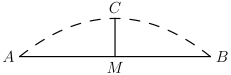
A parabolic arch has a height of inches and a span of inches. The height, in inches, of the arch at a point inches from the center is:
Respuesta: B
Pista pequeña:
Coloca el centro en el origen y escribe la parábola como
Place the center at the origin and write the parabola as
Pista grande:
Usa el extremo para hallar y luego sustituye
Use the endpoint to find , then substitute
Solución:
Coloca en el origen con la base sobre el eje . El arco tiene ecuación Como pertenece a él, así que Para
Por lo tanto, la respuesta correcta es B.
Place at the origin with the span on the -axis. The arch has equation Since lies on it, so At
Therefore, the correct answer is B.
27.
Una partícula se mueve de modo que, durante la segunda milla y las siguientes, su rapidez varía inversamente con el número entero de millas ya recorridas. Durante cada una de esas millas la rapidez es constante. Si la segunda milla se recorre en horas, el tiempo, en horas, necesario para recorrer la -ésima milla es:
A particle moves so that its speed for the second and subsequent miles varies inversely as the integral number of miles already traveled. For each subsequent mile the speed is constant. If the second mile is traversed in hours, then the time, in hours, needed to traverse the th mile is:
Respuesta: E
Pista pequeña:
Durante la -ésima milla, el número de millas ya recorridas es
During the th mile, the number of miles already traveled is
Pista grande:
El tiempo para una distancia fija de una milla varía directamente con
Time for a fixed one-mile distance varies directly as
Solución:
Para la -ésima milla, Como la distancia es una milla, el tiempo es La condición da Por lo tanto,
Por lo tanto, la respuesta correcta es E.
For the th mile, Since the distance is one mile, the time is The condition gives Therefore
Therefore, the correct answer is E.
28.
Sea el número de puntos interiores a un círculo de radio tales que la suma de los cuadrados de las distancias de a los extremos de un diámetro dado es Entonces, es:
Let be the number of points interior to the region bounded by a circle with radius such that the sum of the squares of the distances from to the endpoints of a given diameter is Then is:
infinito
infinite
Respuesta: E
Pista pequeña:
Coloca el círculo con centro en el origen y extremos del diámetro y
Place the circle at the origin with diameter endpoints and
Pista grande:
Simplifica la suma de las dos distancias al cuadrado
Simplify the sum of the two squared distances
Solución:
Sea y toma como extremos del diámetro y La condición se convierte en Así, Esta es una circunferencia completa de radio situada dentro del círculo unitario dado. Contiene infinitos puntos.
Por lo tanto, la respuesta correcta es E.
Let and take the diameter endpoints as and The condition becomes Thus This is an entire circle of radius lying inside the given unit circle. It contains infinitely many points.
Therefore, the correct answer is E.
29.
Si y con y una relación entre y es:
If and a relation between and is:
ninguna de las anteriores
none of these
Respuesta: C
Pista pequeña:
Divide entre para expresar en términos de e
Divide by to express in terms of and
Pista grande:
Observa también que y elimina
Also observe that , then eliminate
Solución:
Al dividir las definiciones se obtiene Además, Al sustituir , resulta Al elevar ambos lados a la potencia , se obtiene
Por lo tanto, la respuesta correcta es C.
Dividing the definitions gives Also, Substituting gives Raising both sides to the power yields
Therefore, the correct answer is C.
30.
Sea un punto de la hipotenusa (o de su prolongación) del triángulo rectángulo isósceles Sea Entonces:
Let be a point of hypotenuse (or its extension) of isosceles right triangle Let Then:
para un número finito de posiciones de
for a finite number of positions of
para un número infinito de posiciones de
for an infinite number of positions of
solo si es el punto medio de o un extremo de
only if is the midpoint of or an endpoint of
siempre
always
si es un punto de trisección de
if is a trisection point of
Respuesta: D
Pista pequeña:
Coloca el punto medio de en el origen y sobre el eje
Put the midpoint of at the origin and on the -axis
Pista grande:
Usa y
Use and
Solución:
Toma y Esto describe todos los puntos de la recta que contiene la hipotenusa. Entonces, Por lo tanto, para toda posición de
Por lo tanto, la respuesta correcta es D.
Take and This describes every point on the hypotenuse line. Then Thus for every position of
Therefore, the correct answer is D.
31.
Sea un cuadrado unitario en el plano , con y Sean y las ecuaciones que definen una transformación del plano al plano . La transformada (o imagen) del cuadrado es:
Let be a unit square in the -plane with and Let and define a transformation of the -plane into the -plane. The transform (or image) of the square is:
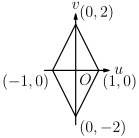
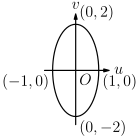
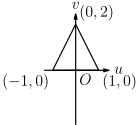
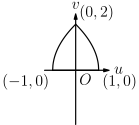
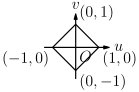
Respuesta: D
Pista pequeña:
Halla la imagen de los cuatro vértices y luego transforma cada lado por separado
Map the four vertices and then transform each side separately
Pista grande:
Los lados horizontales y verticales se convierten en dos segmentos y dos arcos parabólicos
The horizontal sides and vertical sides become two line segments and two parabolic arcs
Solución:
Los vértices se transforman así: El lado se transforma en el segmento de a y en el segmento de a En por lo que en por lo que Estos son los dos arcos parabólicos superiores que unen con
Por lo tanto, la respuesta correcta es D.
The vertices map as Side maps to the segment from to and maps to the segment from to On so on so These are the two upper parabolic arcs joining to
Therefore, the correct answer is D.
32.
Sea una sucesión definida por y la relación para Si se expresa como un polinomio en la suma algebraica de sus coeficientes es:
Let a sequence be defined by and the relation If is expressed as a polynomial in the algebraic sum of its coefficients is:
Respuesta: C
Pista pequeña:
La suma de los coeficientes de un polinomio es su valor en
The sum of a polynomial’s coefficients is its value at
Pista grande:
El problema ya da
The problem already gives
Solución:
Para cualquier polinomio la suma de sus coeficientes es Aquí el polinomio representa y la condición inicial da Por lo tanto, la suma de los coeficientes es
Por lo tanto, la respuesta correcta es C.
For any polynomial the sum of its coefficients is Here the polynomial represents and the initial condition gives Therefore the coefficient sum is
Therefore, the correct answer is C.
33.
Sean y las respectivas sumas de los primeros términos de dos sucesiones aritméticas. Si para todo la razón entre el undécimo término de la primera sucesión y el undécimo término de la segunda es:
Let and be the respective sums of the first terms of two arithmetic series. If for all the ratio of the eleventh term of the first series to the eleventh term of the second series is:
indeterminada
undetermined
Respuesta: A
Pista pequeña:
En una sucesión aritmética, el término central de los primeros términos es igual a su promedio
In an arithmetic sequence, the middle term of the first terms equals their average
Pista grande:
Expresa cada undécimo término como la suma correspondiente de términos dividida entre
Express each eleventh term as its corresponding -term sum divided by
Solución:
En una sucesión aritmética, el undécimo término es el promedio de los primeros términos. Así, los respectivos undécimos términos son y Su razón es
Por lo tanto, la respuesta correcta es A.
For an arithmetic sequence, the eleventh term is the average of the first terms. Thus the respective eleventh terms are and Their ratio is
Therefore, the correct answer is A.
34.
El residuo que se obtiene al dividir entre es un polinomio de grado menor que Entonces, puede escribirse como:
The remainder obtained by dividing by is a polynomial of degree less than Then may be written as:
Respuesta: B
Pista pequeña:
Escribe y usa
Write and use
Pista grande:
Evalúa la identidad de la división en y
Evaluate the division identity at and
Solución:
Escribe Como el divisor es al evaluar la identidad de la división en sus raíces se obtiene Por lo tanto,
Por lo tanto, la respuesta correcta es B.
Write Since the divisor is evaluating the division identity at its roots gives Therefore
Therefore, the correct answer is B.
35.
Sea la coordenada del punto izquierdo de intersección de las gráficas de y donde Sea Entonces, al hacer arbitrariamente cercano a cero, el valor de es:
Let be the -coordinate of the left endpoint of the intersection of the graphs of and where Let Then, as is made arbitrarily close to zero, the value of is:
arbitrariamente cercano a cero
arbitrarily close to zero
arbitrariamente cercano a
arbitrarily close to
arbitrariamente cercano a
arbitrarily close to
arbitrariamente grande
arbitrarily large
indeterminado
undetermined
Respuesta: B
Pista pequeña:
La coordenada de la intersección izquierda es
The left intersection coordinate is
Pista grande:
Sustituye en y racionaliza el numerador
Substitute into and rationalize the numerator
Solución:
La intersección izquierda satisface Por lo tanto, Cuando se aproxima a esto se aproxima a
Por lo tanto, la respuesta correcta es B.
The left intersection satisfies Hence As approaches this approaches
Therefore, the correct answer is B.