
Problemas del 2004 AMC 10B
¡Desplázate hacia abajo y presiona Iniciar para intentar el examen! O ve al PDF imprimible, la clave de respuestas, o las soluciones profesionales preparadas por LIVE by Po-Shen Loh.
Todos los problemas se usan con el permiso legal oficial de la Mathematical Association of America (MAA).
O salta directamente a un solo problema con su solución: 1 · 2 · 3 · 4 · 5 · 6 · 7 · 8 · 9 · 10 · 11 · 12 · 13 · 14 · 15 · 16 · 17 · 18 · 19 · 20 · 21 · 22 · 23 · 24 · 25
¿Quieres aprender de forma profesional con clases interactivas en video?
Con tiempo
1:15:00
1.
Cada fila del Misty Moon Amphitheater tiene asientos. Las filas a la están reservadas para un club juvenil. ¿Cuántos asientos están reservados para este club?
Each row of the Misty Moon Amphitheater has seats. Rows through are reserved for a youth club. How many seats are reserved for this club?
Respuesta: C
Pista pequeña:
Cuenta cuántas filas van desde la hasta la , ambas incluidas.
Count how many rows run from through inclusive
Pista grande:
Multiplica el número de filas por .
Multiply the number of rows by
Solución:
Las filas a la , ambas incluidas, forman filas.
Cada fila tiene asientos, así que el total es
Por lo tanto, la respuesta correcta es C.
Rows through inclusive make up rows.
Each row has seats, so the total is
Thus, the correct answer is C.
2.
¿Cuántos enteros positivos de dos dígitos tienen al menos un como dígito?
How many two-digit positive integers have at least one as a digit?
Respuesta: B
Pista pequeña:
Cuenta por separado los números con un en las decenas y los que tienen un en las unidades.
Count the numbers with in the tens place and those with in the units place separately
Pista grande:
El número pertenece a ambos grupos.
The number belongs to both groups
Solución:
Los números a dan con un en las decenas.
Los números dan con un en las unidades.
Como se cuenta dos veces, el total es
Por lo tanto, la respuesta correcta es B.
The numbers through give with a in the tens place.
The numbers give with a in the units place.
Since is counted twice, the total is
Thus, the correct answer is B.
3.
En cada entrenamiento de baloncesto de la semana pasada, Jenny encestó el doble de tiros libres que en el entrenamiento anterior. En su quinto entrenamiento encestó tiros libres. ¿Cuántos tiros libres encestó en el primer entrenamiento?
At each basketball practice last week, Jenny made twice as many free throws as she made at the previous practice. At her fifth practice she made free throws. How many free throws did she make at the first practice?
Respuesta: A
Pista pequeña:
Cada cantidad es el doble de la anterior, así que trabaja hacia atrás dividiendo entre dos.
Each practice count is twice the previous one, so work backward by halving
Pista grande:
Divide entre dos repetidamente hasta llegar al primer entrenamiento.
Halve repeatedly to reach the first practice
Solución:
Trabajando hacia atrás desde el quinto entrenamiento, las cantidades son y en el cuarto, tercero, segundo y primer entrenamiento.
Por lo tanto, la respuesta correcta es A.
Working backward from the fifth practice, the counts are and at the fourth, third, second, and first practices.
Thus, the correct answer is A.
4.
Se lanza un dado estándar de seis caras y es el producto de los cinco números visibles. ¿Cuál es el mayor número que con certeza divide a ?
A standard six-sided die is rolled, and is the product of the five numbers that are visible. What is the largest number that is certain to divide
Respuesta: B
Pista pequeña:
El producto de las seis caras es ; exactamente una cara queda oculta.
The product of all six faces is ; exactly one face is hidden
Pista grande:
Para cada primo, halla cuántas copias deben permanecer sin importar qué cara quede oculta.
For each prime, find how many copies must remain no matter which face is hidden
Solución:
Como el producto visible usa solo los primos y
Ocultar deja la menor cantidad de factores , a saber Ocultar o deja la menor cantidad de factores , a saber uno. Ocultar no deja ningún factor de
Por lo tanto siempre es divisible por pero no necesariamente por un número mayor.
Por lo tanto, la respuesta correcta es B.
Since the visible product uses only the primes and
Hiding leaves the fewest ’s, namely Hiding or leaves the fewest ’s, namely one. Hiding leaves no factor of
Therefore is always divisible by but not necessarily by any larger number.
Thus, the correct answer is B.
5.
En la expresión los valores de y son y aunque no necesariamente en ese orden. ¿Cuál es el máximo valor posible del resultado?
In the expression the values of and are and although not necessarily in that order. What is the maximum possible value of the result?
Respuesta: D
Pista pequeña:
Para maximizar el resultado, haz que el valor restado sea .
To maximize the result, make the subtracted value
Pista grande:
Con restantes, compara para las asignaciones razonables.
With remaining, compare for the sensible assignments
Solución:
Al tomar se elimina la resta, así que maximizamos usando
Tomando se obtiene La alternativa es menor, y cualquier asignación con fuerza una potencia menor. El máximo es
Por lo tanto, la respuesta correcta es D.
Setting removes the subtraction, so we maximize using
Taking gives The alternative is smaller, and any assignment with forces a smaller power. The maximum is
Thus, the correct answer is D.
6.
¿Cuál de los siguientes números es un cuadrado perfecto?
Which of the following numbers is a perfect square?
Respuesta: C
Pista pequeña:
Para escribe como .
For write as
Pista grande:
El producto es un cuadrado perfecto exactamente cuando lo es.
The product is a perfect square exactly when is
Solución:
Para es igual a que es un cuadrado perfecto precisamente cuando es un cuadrado perfecto.
Para las cinco opciones este factor sobrante es y Solo es un cuadrado perfecto.
Por lo tanto es el cuadrado perfecto.
Por lo tanto, la respuesta correcta es C.
For equals which is a perfect square precisely when is a perfect square.
For the five choices this leftover factor is and Only is a perfect square.
Therefore is the perfect square.
Thus, the correct answer is C.
7.
En un viaje de Estados Unidos a Canadá, Isabella llevó dólares estadounidenses. En la frontera los cambió todos, recibiendo dólares canadienses por cada dólares estadounidenses. Después de gastar dólares canadienses, le quedaron dólares canadienses. ¿Cuál es la suma de los dígitos de ?
On a trip from the United States to Canada, Isabella took U.S. dollars. At the border she exchanged them all, receiving Canadian dollars for every U.S. dollars. After spending Canadian dollars, she had Canadian dollars left. What is the sum of the digits of
Respuesta: A
Pista pequeña:
Cambiar dólares estadounidenses da dólares canadienses.
Exchanging U.S. dollars gives Canadian dollars
Pista grande:
Plantea y despeja .
Set and solve for
Solución:
Isabella recibió dólares canadienses y gastó quedándole Así que
Entonces así que La suma de sus dígitos es
Por lo tanto, la respuesta correcta es A.
Isabella received Canadian dollars and spent leaving So
Then so The sum of its digits is
Thus, the correct answer is A.
8.
El Minneapolis-St. Paul International Airport está a millas al suroeste del centro de St. Paul y a millas al sureste del centro de Minneapolis. ¿Cuál de los siguientes valores es el más cercano al número de millas entre el centro de St. Paul y el centro de Minneapolis?
Minneapolis-St. Paul International Airport is miles southwest of downtown St. Paul and miles southeast of downtown Minneapolis. Which of the following is closest to the number of miles between downtown St. Paul and downtown Minneapolis?
Respuesta: A
Pista pequeña:
El suroeste y el sureste son direcciones perpendiculares.
Southwest and southeast are perpendicular directions
Pista grande:
La distancia es ; estima el entero más cercano.
The distance is ; estimate the nearest whole number
Solución:
Las dos direcciones dadas son perpendiculares, así que el aeropuerto se ubica en el ángulo recto de un triángulo rectángulo con catetos y
La distancia entre los dos centros es que es lo más cercano a
Por lo tanto, la respuesta correcta es A.
The two given directions are perpendicular, so the airport sits at the right angle of a right triangle with legs and
The distance between the downtowns is which is closest to
Thus, the correct answer is A.
9.
Un cuadrado tiene lados de longitud y un círculo centrado en uno de sus vértices tiene radio ¿Cuál es el área de la unión de las regiones encerradas por el cuadrado y el círculo?
A square has sides of length and a circle centered at one of its vertices has radius What is the area of the union of the regions enclosed by the square and the circle?
Respuesta: B
Pista pequeña:
Suma las áreas del cuadrado y del círculo, luego resta la parte que se traslapa.
Add the areas of the square and the circle, then subtract the overlap
Pista grande:
El traslape es el cuarto del círculo que queda dentro del cuadrado.
The overlap is the quarter of the circle that lies inside the square
Solución:
El cuadrado tiene área y el círculo tiene área
Como el círculo está centrado en un vértice del cuadrado, exactamente un cuarto del círculo, de área queda dentro del cuadrado.
La unión tiene área
Por lo tanto, la respuesta correcta es B.
The square has area and the circle has area
Since the circle is centered at a vertex of the square, exactly one quarter of the circle, area lies inside the square.
The union has area
Thus, the correct answer is B.
10.
Un tendero hace una exhibición de latas en la que la fila superior tiene una lata y cada fila inferior tiene dos latas más que la fila de encima. Si la exhibición contiene latas, ¿cuántas filas tiene?
A grocer makes a display of cans in which the top row has one can and each lower row has two more cans than the row above it. If the display contains cans, how many rows does it contain?
Respuesta: D
Pista pequeña:
Las filas contienen latas.
The rows contain cans
Pista grande:
La suma de los primeros números impares es igual a .
The sum of the first odd numbers equals
Solución:
Las filas contienen latas, y la suma de los primeros números impares es
Al plantear se obtiene
Por lo tanto, la respuesta correcta es D.
The rows hold cans, and the sum of the first odd numbers is
Setting gives
Thus, the correct answer is D.
11.
Dos dados de ocho caras tienen cada uno las caras numeradas del al Al lanzar los dados, cada cara tiene la misma probabilidad de quedar arriba. ¿Cuál es la probabilidad de que el producto de los dos números de arriba sea mayor que su suma?
Two eight-sided dice each have faces numbered through When the dice are rolled, each face has an equal probability of appearing on the top. What is the probability that the product of the two top numbers is greater than their sum?
Respuesta: C
Pista pequeña:
La condición se reescribe como .
The condition rearranges to
Pista grande:
En su lugar, cuenta los pares ordenados donde .
Count the ordered pairs where instead
Solución:
Hay pares ordenados. La desigualdad equivale a
Esto falla solo cuando o lo que corresponde a pares.
La probabilidad es
Por lo tanto, la respuesta correcta es C.
There are ordered pairs. The inequality is equivalent to
This fails only when or which account for pairs.
The probability is
Thus, the correct answer is C.
12.
Una corona circular es la región entre dos círculos concéntricos. Los círculos concéntricos de la figura tienen radios y con Sea un radio del círculo mayor, sea tangente al círculo menor en y sea el radio del círculo mayor que contiene a Sean y ¿Cuál es el área de la corona circular?
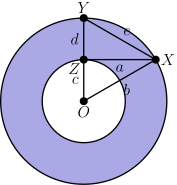
An annulus is the region between two concentric circles. The concentric circles in the figure have radii and with Let be a radius of the larger circle, let be tangent to the smaller circle at and let be the radius of the larger circle that contains Let and What is the area of the annulus?
Respuesta: A
Pista pequeña:
El área de la corona circular es .
The annulus area is
Pista grande:
Como es tangente en el triángulo es rectángulo, lo que da .
Since is tangent at triangle is right-angled, giving
Solución:
La corona circular es la diferencia de las dos áreas circulares,
Como es tangente al círculo pequeño en es perpendicular al radio En el triángulo rectángulo con y obtenemos
Por lo tanto, el área de la corona circular es
Por lo tanto, la respuesta correcta es A.
The annulus is the difference of the two circular areas,
Because is tangent to the small circle at it is perpendicular to the radius In right triangle with and we get
Therefore the area of the annulus is
Thus, the correct answer is A.
13.
En Estados Unidos, las monedas tienen los siguientes grosores: la de un centavo, mm; la de cinco centavos, mm; la de diez centavos, mm; la de veinticinco centavos, mm. Si una pila de estas monedas mide exactamente mm de alto, ¿cuántas monedas hay en la pila?
In the United States, coins have the following thicknesses: penny, mm; nickel, mm; dime, mm; quarter, mm. If a stack of these coins is exactly mm high, how many coins are in the stack?
Respuesta: B
Pista pequeña:
El grosor de cada moneda termina en en las centésimas, así que considera los dos últimos dígitos decimales de la altura.
Every coin thickness ends in a in the hundredths place, so consider the height’s last two decimal digits
Pista grande:
Para que la altura sea un número entero de mm, la cantidad de monedas debe ser un múltiplo de .
For the height to be a whole number of mm, the number of coins must be a multiple of
Solución:
Midamos cada grosor en centésimas de milímetro. Los cuatro grosores posibles son todos congruentes con Si la pila tiene monedas y una altura entera, su total en centésimas es divisible entre así que es divisible entre Por tanto, debe ser múltiplo de
Una pila de monedas mide como máximo mm, y una de monedas mide al menos mm, así que solo monedas pueden sumar mm.
En efecto, monedas de veinticinco centavos dan mm.
Por lo tanto, la respuesta correcta es B.
Measure every thickness in hundredths of a millimeter. The four possible thicknesses are all congruent to If the stack has coins and an integer height, its total in hundredths is divisible by so is divisible by Therefore must be a multiple of
A stack of coins is at most mm, and a stack of coins is at least mm, so only coins can total mm.
Indeed, quarters give mm.
Thus, the correct answer is B.
14.
Una bolsa contiene inicialmente solo canicas rojas y azules, con más azules que rojas. Se agregan canicas rojas a la bolsa hasta que solo de las canicas de la bolsa son azules. Luego se agregan canicas amarillas a la bolsa hasta que solo de las canicas de la bolsa son azules. Finalmente, se duplica el número de canicas azules de la bolsa. ¿Qué fracción de las canicas que ahora hay en la bolsa son azules?
A bag initially contains red marbles and blue marbles only, with more blue than red. Red marbles are added to the bag until only of the marbles in the bag are blue. Then yellow marbles are added to the bag until only of the marbles in the bag are blue. Finally, the number of blue marbles in the bag is doubled. What fraction of the marbles now in the bag are blue?
Respuesta: C
Pista pequeña:
Sea el número de canicas azules y sigue el total en cada etapa.
Let be the number of blue marbles and track the total at each stage
Pista grande:
Justo antes de duplicar hay azules de un total de .
Just before doubling there are blue out of total
Solución:
Supongamos que hay canicas azules. Después de agregar canicas rojas el total es después de agregar canicas amarillas el total es todavía con azules.
Al duplicar las canicas azules se obtienen azules de un total de , lo que da
Por lo tanto, la respuesta correcta es C.
Let there be blue marbles. After adding red marbles the total is after adding yellow marbles the total is still with blue.
Doubling the blue marbles gives blue out of total, which is
Thus, the correct answer is C.
15.
Patty tiene monedas, todas de cinco o de diez centavos. Si sus monedas de cinco centavos fueran de diez y las de diez fueran de cinco, tendría centavos más. ¿Cuánto valen sus monedas?
Patty has coins consisting of nickels and dimes. If her nickels were dimes and her dimes were nickels, she would have cents more. How much are her coins worth?
Respuesta: A
Pista pequeña:
El intercambio aumenta el valor, así que tiene más monedas de cinco centavos que de diez.
Swapping raises the value, so she has more nickels than dimes
Pista grande:
Cambiar una moneda de cinco centavos por una de diez cambia el total en centavos.
Each nickel-for-dime swap changes the total by cents
Solución:
El intercambio aumenta el valor, así que Patty tiene más monedas de cinco centavos que de diez. Cada moneda intercambiada cambia el total en centavos, así que tiene monedas de cinco centavos más que de diez.
Con y tiene monedas de cinco centavos y de diez.
Sus monedas valen centavos, es decir
Por lo tanto, la respuesta correcta es A.
Swapping increases the value, so Patty has more nickels than dimes. Each swapped coin changes the total by cents, so she has more nickels than dimes.
With and she has nickels and dimes.
Her coins are worth cents, or
Thus, the correct answer is A.
16.
Tres círculos de radio son tangentes externamente entre sí y tangentes internamente a un círculo mayor. ¿Cuál es el radio del círculo grande?
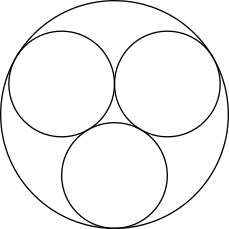
Three circles of radius are externally tangent to each other and internally tangent to a larger circle. What is the radius of the large circle?
Respuesta: D
Pista pequeña:
Los tres centros pequeños forman un triángulo equilátero de lado .
The three small centers form an equilateral triangle of side
Pista grande:
El radio grande es más la distancia del centro de ese triángulo a un vértice.
The large radius is plus the distance from that triangle’s center to a vertex
Solución:
Los centros de los tres círculos unitarios forman un triángulo equilátero de lado Su centro es el centro del círculo grande.
Para un triángulo equilátero de lado la distancia de su centro a un vértice es
Sumando el radio unitario, el radio grande es
Por lo tanto, la respuesta correcta es D.
The centers of the three unit circles form an equilateral triangle with side Its center is the center of the large circle.
For an equilateral triangle of side length the distance from its center to a vertex is
Adding the unit radius, the large radius is
Thus, the correct answer is D.
17.
Los dos dígitos de la edad de Jack son los mismos que los dígitos de la edad de Bill, pero en orden inverso. Dentro de cinco años Jack tendrá el doble de la edad que Bill tendrá entonces. ¿Cuál es la diferencia entre sus edades actuales?
The two digits in Jack’s age are the same as the digits in Bill’s age, but in reverse order. In five years Jack will be twice as old as Bill will be then. What is the difference in their current ages?
Respuesta: B
Pista pequeña:
Escribe la edad de Jack como y la de Bill como .
Write Jack’s age as and Bill’s as
Pista grande:
La condición se reduce a .
The condition reduces to
Solución:
Sea la edad de Jack y la de Bill Dentro de cinco años que se simplifica a
Como y son dígitos, la única solución es
Así que Jack tiene y Bill tiene una diferencia de
Por lo tanto, la respuesta correcta es B.
Let Jack’s age be and Bill’s be In five years which simplifies to
Since and are digits, the only solution is
So Jack is and Bill is a difference of
Thus, the correct answer is B.
18.
En el triángulo rectángulo tenemos y Los puntos y están ubicados en y respectivamente, de modo que y ¿Cuál es la razón entre el área de y la de ?
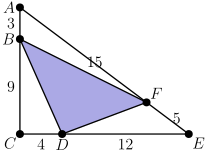
In right triangle we have and Points and are located on and respectively, so that and What is the ratio of the area of to that of
Respuesta: E
Pista pequeña:
El área de es .
The area of is
Pista grande:
Resta los tres triángulos de las esquinas; cada uno tiene una base y una altura que son fracciones conocidas de las del triángulo grande.
Subtract the three corner triangles; each has a base and height that are known fractions of the big triangle’s
Solución:
El área de es
Cada triángulo de esquina y tiene una base y una altura que son y de una base y altura correspondientes de Así que cada uno tiene área de
Por lo tanto
Por lo tanto, la respuesta correcta es E.
The area of is
Each corner triangle and has a base and an altitude that are and of a corresponding base and altitude of So each has area of
Hence
Thus, the correct answer is E.
19.
En la sucesión cada término después del tercero se obtiene restando el término anterior de la suma de los dos términos que preceden a ese término. Por ejemplo, el cuarto término es ¿Cuál es el término número de esta sucesión?
In the sequence each term after the third is found by subtracting the previous term from the sum of the two terms that precede that term. For example, the fourth term is What is the th term in this sequence?
Respuesta: C
Pista pequeña:
Escribe varios términos:
Write out several terms:
Pista grande:
Los términos en posición par disminuyen en cada vez.
The even-position terms decrease by each time
Solución:
La recurrencia da La sucesión comienza
Así que los términos en posición par forman la sucesión aritmética con diferencia común El término es su término número ,
Por lo tanto, la respuesta correcta es C.
The recurrence gives The sequence begins
So the even-position terms form the arithmetic sequence with common difference The th term is its nd term,
Thus, the correct answer is C.
20.
En los puntos y están en y respectivamente. Si y se intersecan en de modo que y ¿cuánto vale ?
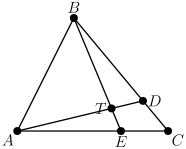
In points and lie on and respectively. If and intersect at so that and what is
Respuesta: D
Pista pequeña:
Traza la recta que pasa por paralela a que corta a en un punto .
Draw the line through parallel to meeting at a point
Pista grande:
Dos pares de triángulos semejantes dan que se convierte en .
Two pairs of similar triangles give which converts to
Solución:
Sea un punto en con y escribe
De así que
De
Por lo tanto
Por lo tanto, la respuesta correcta es D.
Let be on with and write
From so
From
Therefore
Thus, the correct answer is D.
21.
Sean y dos progresiones aritméticas. El conjunto es la unión de los primeros términos de cada sucesión. ¿Cuántos números distintos hay en ?
Let and be two arithmetic progressions. The set is the union of the first terms of each sequence. How many distinct numbers are in
Respuesta: A
Pista pequeña:
La primera sucesión tiene diferencia común y último término .
The first sequence has common difference and last term
Pista grande:
Los términos comunes empiezan en y están espaciados por cuenta los términos que no superan .
Common terms start at and are spaced by count the terms not exceeding
Solución:
La primera sucesión es con término mayor y la segunda es con un último término mucho mayor, así que el límite que restringe es
Un valor común tiene la forma (el primer término compartido es espaciado por ). Pedir da es decir números comunes.
El número de valores distintos es
Por lo tanto, la respuesta correcta es A.
The first sequence is with largest term and the second is with a much larger last term, so the binding limit is
A common value has the form (the first shared term is spaced by ). Requiring gives that is common numbers.
The number of distinct values is
Thus, the correct answer is A.
22.
Un triángulo con lados de y tiene tanto un círculo inscrito como uno circunscrito. ¿Cuál es la distancia entre los centros de esos círculos?
A triangle with sides of and has both an inscribed and a circumscribed circle. What is the distance between the centers of those circles?
Respuesta: D
Pista pequeña:
Coloca el triángulo rectángulo con vértices y .
Place the right triangle with vertices and
Pista grande:
El circuncentro es el punto medio de la hipotenusa; el inradio de un triángulo rectángulo es .
The circumcenter is the midpoint of the hypotenuse; a right triangle’s inradius is
Solución:
Como el triángulo es rectángulo. Colócalo en El circuncentro es el punto medio de la hipotenusa,
El inradio satisface así que y el incentro es
La distancia es
Por lo tanto, la respuesta correcta es D.
Since the triangle is right. Place it at The circumcenter is the midpoint of the hypotenuse,
The inradius satisfies so and the incenter is
The distance is
Thus, the correct answer is D.
23.
Cada cara de un cubo se pinta de rojo o de azul, cada color con probabilidad El color de cada cara se determina de forma independiente. ¿Cuál es la probabilidad de que el cubo pintado se pueda colocar sobre una superficie horizontal de modo que las cuatro caras verticales sean todas del mismo color?
Each face of a cube is painted either red or blue, each with probability The color of each face is determined independently. What is the probability that the painted cube can be placed on a horizontal surface so that the four vertical faces are all the same color?
Respuesta: B
Pista pequeña:
Fijando la orientación del cubo, hay coloraciones igualmente probables.
Fixing the cube’s orientation, there are equally likely colorings
Pista grande:
Las coloraciones que funcionan son: todas de un color, exactamente cinco de un color, o cuatro de un color con el par opuesto del otro.
The working colorings are: all one color, exactly five one color, or four of one color with the opposite pair the other
Solución:
Fijando la orientación, hay coloraciones.
Una coloración funciona si las seis caras coinciden ( formas), si exactamente cinco coinciden ( formas), o si cuatro caras comparten un color y el par restante son caras opuestas del otro color ( pares opuestos, colores, lo que da formas).
El total es así que la probabilidad es
Por lo tanto, la respuesta correcta es B.
Fixing the orientation, there are colorings.
A coloring works if all six faces match ( ways), exactly five match ( ways), or four faces share a color with the remaining pair being opposite faces of the other color ( opposite pairs, colors, giving ways).
The total is so the probability is
Thus, the correct answer is B.
24.
En tenemos y El punto está en el círculo circunscrito del triángulo de modo que biseca ¿Cuál es el valor de ?
In we have and Point is on the circumscribed circle of the triangle so that bisects What is the value of
Respuesta: B
Pista pequeña:
Sea el punto donde corta a los ángulos inscritos dan .
Let meet at inscribed angles give
Pista grande:
Los triángulos y son semejantes, así que halla con el teorema de la bisectriz.
Triangles and are similar, so find from the Angle Bisector Theorem
Solución:
Sea el punto donde corta a Como y subtienden el mismo arco, son iguales, y así que
Por lo tanto
Por el teorema de la bisectriz, así que
Por lo tanto
Por lo tanto, la respuesta correcta es B.
Let meet at Since and subtend the same arc, they are equal, and so
Hence
By the Angle Bisector Theorem, so
Therefore
Thus, the correct answer is B.
25.
Un círculo de radio es tangente internamente a dos círculos de radio en los puntos y donde es un diámetro del círculo menor. ¿Cuál es el área de la región, sombreada en la figura, que está fuera del círculo menor y dentro de cada uno de los dos círculos mayores?
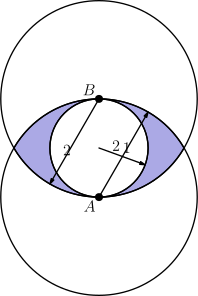
A circle of radius is internally tangent to two circles of radius at points and where is a diameter of the smaller circle. What is the area of the region, shaded in the figure, that is outside the smaller circle and inside each of the two larger circles?
Respuesta: B
Pista pequeña:
Por simetría, la región sombreada se divide en cuatro piezas congruentes; calcula un cuarto.
By symmetry the shaded region splits into four congruent pieces; compute one quarter
Pista grande:
Un cuarto es un sector de de un círculo grande menos un triángulo rectángulo menos un cuarto del círculo pequeño.
One quarter is a sector of a large circle minus a right triangle minus a quarter of the small circle
Solución:
Sean los centros de los círculos grandes y sea el centro del círculo pequeño, y sea un punto donde se encuentran los dos círculos grandes.
Entonces es rectángulo con y así que y su área es
Un cuarto de la región sombreada es igual al sector de del círculo de radio (área ) menos (área ) menos un cuarto del círculo pequeño (área ), lo que da
Multiplicando por el área sombreada es
Por lo tanto, la respuesta correcta es B.
Let the large circles have centers and let be the center of the small circle, and let be a point where the two large circles meet.
Then is right with and so and its area is
One quarter of the shaded region equals the sector of the radius- circle (area ) minus (area ) minus a quarter of the small circle (area ), giving
Multiplying by the shaded area is
Thus, the correct answer is B.