
2009 AIME I 第 15 题
先试着解答 2009 AIME I 第 15 题,然后核对你的答案与精心整理的解答,解答来自 LIVE by Po-Shen Loh。你也可以参加完整限时模拟考试、查看全部 2009 AIME I 解答,或核对答案。
所有题目均经美国数学协会(MAA)官方合法授权使用。
15.
在三角形 中,,,。令 为 内部的一点。令 和 分别表示三角形 和 的内心。三角形 和 的外接圆相交于两个不同的点 和 。 的最大可能面积可写成 的形式,其中 、 和 是正整数,且 不被任何质数的平方整除。求 。
In triangle and Let be a point in the interior of Let and denote the incenters of triangles and respectively. The circumcircles of triangles and meet at distinct points and The maximum possible area of can be expressed in the form where and are positive integers and is not divisible by the square of any prime. Find
答案:150
小提示:
使用 及其对应关系,并通过圆内接四边形把这些角转移到 。
Use and its mirror image, and transfer these angles to via the cyclic quadrilaterals
大提示:
与 无关,所以 在经过 和 的固定圆弧上;面积在圆弧中点处最大。
is independent of so lies on a fixed arc through and the area is maximized at the arc midpoint
解答:
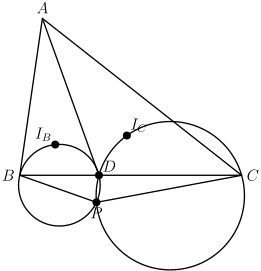
在三角形 中,内心满足 ,同理 ,所以这两个角之和为 。余弦定理给出 ,所以 ,角和为 。
第二个交点 位于 的与内心相反的一侧(若它在同侧,两个圆内接四边形会迫使 )。于是 和 是凸的圆内接四边形,所以 与 无关。因此 沿着经过 和 的一条固定圆弧移动。
三角形 的面积在圆弧中点处最大,此时 。余弦定理给出 ,所以 ,面积为 。因此 。
In triangle the incenter satisfies and likewise so these two angles sum to The law of cosines gives so and the sum is
The second intersection point lies on the opposite side of from the incenters (were it on the same side, the two cyclic quadrilaterals would force ). Then and are convex cyclic quadrilaterals, so independent of Hence moves along a fixed circular arc through and
The area of triangle is maximized at the midpoint of the arc, where The law of cosines gives so and the area is Thus
其他年份的第 15 题
1983 AIME · 1984 AIME · 1985 AIME · 1986 AIME · 1987 AIME · 1988 AIME · 1989 AIME · 1990 AIME · 1991 AIME · 1992 AIME · 1993 AIME · 1994 AIME · 1995 AIME · 1996 AIME · 1997 AIME · 1998 AIME · 1999 AIME · 2000 AIME I · 2000 AIME II · 2001 AIME I · 2001 AIME II · 2002 AIME I · 2002 AIME II · 2003 AIME I · 2003 AIME II · 2004 AIME I · 2004 AIME II · 2005 AIME I · 2005 AIME II · 2006 AIME I · 2006 AIME II · 2007 AIME I · 2007 AIME II · 2008 AIME I · 2008 AIME II · 2009 AIME II · 2010 AIME I · 2010 AIME II · 2011 AIME I · 2011 AIME II · 2012 AIME I · 2012 AIME II · 2013 AIME I · 2013 AIME II · 2014 AIME I · 2014 AIME II · 2015 AIME I · 2015 AIME II · 2016 AIME I · 2016 AIME II · 2017 AIME I · 2017 AIME II · 2018 AIME I · 2018 AIME II · 2019 AIME I · 2019 AIME II · 2020 AIME I · 2020 AIME II · 2021 AIME I · 2021 AIME II · 2022 AIME I · 2022 AIME II · 2023 AIME I · 2023 AIME II · 2024 AIME I · 2024 AIME II · 2025 AIME I · 2025 AIME II · 2026 AIME I · 2026 AIME II