
2008 AIME I 第 15 题
先试着解答 2008 AIME I 第 15 题,然后核对你的答案与精心整理的解答,解答来自 LIVE by Po-Shen Loh。你也可以参加完整限时模拟考试、查看全部 2008 AIME I 解答,或核对答案。
所有题目均经美国数学协会(MAA)官方合法授权使用。
15.
一张正方形纸片的边长为 。从每个角按如下方式剪去一个楔形:在每个角处,该楔形的两条剪线都从距离该角 的位置开始,并在对角线上以 的角相交(见下图)。然后沿连接相邻剪线端点的线将纸片向上折起。当一条剪口的两条边相遇时,将它们粘在一起。所得的是一个纸盘,其侧面与底面不成直角。纸盘的高度,也就是底面所在平面与上边缘形成的平面之间的垂直距离,可写成 的形式,其中 和 为正整数,,且 不被任何质数的 次方整除。求 。
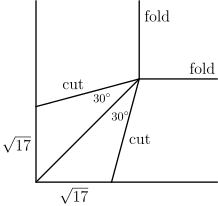
A square piece of paper has sides of length From each corner a wedge is cut in the following manner: at each corner, the two cuts for the wedge each start at distance from the corner, and they meet on the diagonal at an angle of (see the figure below). The paper is then folded up along the lines joining the vertices of adjacent cuts. When the two edges of a cut meet, they are taped together. The result is a paper tray whose sides are not at right angles to the base. The height of the tray, that is, the perpendicular distance between the plane of the base and the plane formed by the upper edges, can be written in the form where and are positive integers, and is not divisible by the th power of any prime. Find
小提示:
将角设为 ,剪线起点 ;剪线在对角线上交于 ,且 、
Set the corner at with cut start the cuts meet at on the diagonal with and
大提示:
折叠会使 绕过 的折线转到 的上方;高度为 ,其中 在 上方的折线上
Folding swings about the fold line through to a point above the height is with on the fold line above
解答:
将角放在原点 ,两条边沿正坐标轴,记 。底边上的剪线起点为 ,两条剪线交于点 ,它位于对角线 上,且两条剪线各自与对角线成 角。在三角形 中,,,所以正弦定理给出 。折线是过 的水平线和竖直线。令 为水平折线上正好位于 上方的点,令 为过 的竖直线与对角线的交点。因为 ,线段 与底边成 角,所以
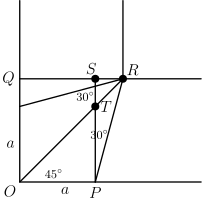
当底部纸条沿过 的水平线向上折起时,点 始终以 为转动半径、以 为转动圆心,并在过 、垂直于该折线的竖直平面内移动。由对称性,两条粘合的剪口边在对角线上方相遇,因此 最终落在点 ,它就在 的正上方,而 就是纸盘高度。由勾股定理,
所以高度为 ,故 。
Put the corner at the origin with the two sides along the positive axes, and write The cut on the bottom edge starts at and the two cuts meet at on the diagonal each making a angle with the diagonal. In triangle and so the Law of Sines gives The fold lines are the horizontal and vertical lines through Let be the point of the horizontal fold line directly above and the point where the vertical line through meets the diagonal. Since segment makes a angle with the bottom edge, so
When the bottom strip folds up along the horizontal line through point stays at distance from moving in the vertical plane through perpendicular to that fold line. By symmetry the two taped cut edges meet above the diagonal, so lands at a point directly above and is the height of the tray. By the Pythagorean theorem,
So the height is and
其他年份的第 15 题
1983 AIME · 1984 AIME · 1985 AIME · 1986 AIME · 1987 AIME · 1988 AIME · 1989 AIME · 1990 AIME · 1991 AIME · 1992 AIME · 1993 AIME · 1994 AIME · 1995 AIME · 1996 AIME · 1997 AIME · 1998 AIME · 1999 AIME · 2000 AIME I · 2000 AIME II · 2001 AIME I · 2001 AIME II · 2002 AIME I · 2002 AIME II · 2003 AIME I · 2003 AIME II · 2004 AIME I · 2004 AIME II · 2005 AIME I · 2005 AIME II · 2006 AIME I · 2006 AIME II · 2007 AIME I · 2007 AIME II · 2008 AIME II · 2009 AIME I · 2009 AIME II · 2010 AIME I · 2010 AIME II · 2011 AIME I · 2011 AIME II · 2012 AIME I · 2012 AIME II · 2013 AIME I · 2013 AIME II · 2014 AIME I · 2014 AIME II · 2015 AIME I · 2015 AIME II · 2016 AIME I · 2016 AIME II · 2017 AIME I · 2017 AIME II · 2018 AIME I · 2018 AIME II · 2019 AIME I · 2019 AIME II · 2020 AIME I · 2020 AIME II · 2021 AIME I · 2021 AIME II · 2022 AIME I · 2022 AIME II · 2023 AIME I · 2023 AIME II · 2024 AIME I · 2024 AIME II · 2025 AIME I · 2025 AIME II · 2026 AIME I · 2026 AIME II