
2003 AIME I 第 15 题
先试着解答 2003 AIME I 第 15 题,然后核对你的答案与精心整理的解答,解答来自 LIVE by Po-Shen Loh。你也可以参加完整限时模拟考试、查看全部 2003 AIME I 解答,或核对答案。
所有题目均经美国数学协会(MAA)官方合法授权使用。
15.
在 中,,,且 。设 为 的中点, 为 上使得 平分角 的点。设 为 上满足 的点。若 与 交于 ,比值 可写成 ,其中 和 是互质正整数。求 。
In and Let be the midpoint of and let be the point on such that bisects angle Let be the point on such that Suppose that meets at The ratio can be written in the form where and are relatively prime positive integers. Find
小提示:
将 过 延长,与射线 交于 。在三角形 中, 既是高又是角平分线,所以 。
Extend past to hit ray at In triangle is both an altitude and an angle bisector, so
大提示:
取 为 上的点,使 ;则由相似三角形,。
Take on with then by similar triangles
解答:
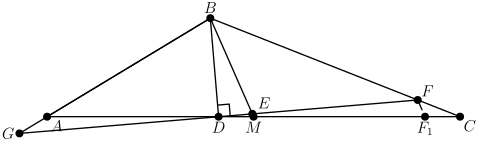
记 、、。将 过 延长,与射线 在 外侧交于 。在三角形 中,线段 既是角平分线又是高,所以 。角平分线还给出 ,因此将梅涅劳斯定理用于直线 与三角形 : 所以
现在取 为 上满足 的点。因为 在 上,有 ,所以三角形 与 相似,且 。角平分线比例给出 ,因此 。又 ,所以 ,并且 。
因此 所以 。
Write Extend beyond to meet ray beyond at In triangle segment is both an angle bisector and an altitude, so The bisector also gives so Menelaus’ theorem for line crossing triangle says so
Now let be the point on with Since lies on we have so triangles and are similar and The bisector ratio gives so Also so and
Therefore and
其他年份的第 15 题
1983 AIME · 1984 AIME · 1985 AIME · 1986 AIME · 1987 AIME · 1988 AIME · 1989 AIME · 1990 AIME · 1991 AIME · 1992 AIME · 1993 AIME · 1994 AIME · 1995 AIME · 1996 AIME · 1997 AIME · 1998 AIME · 1999 AIME · 2000 AIME I · 2000 AIME II · 2001 AIME I · 2001 AIME II · 2002 AIME I · 2002 AIME II · 2003 AIME II · 2004 AIME I · 2004 AIME II · 2005 AIME I · 2005 AIME II · 2006 AIME I · 2006 AIME II · 2007 AIME I · 2007 AIME II · 2008 AIME I · 2008 AIME II · 2009 AIME I · 2009 AIME II · 2010 AIME I · 2010 AIME II · 2011 AIME I · 2011 AIME II · 2012 AIME I · 2012 AIME II · 2013 AIME I · 2013 AIME II · 2014 AIME I · 2014 AIME II · 2015 AIME I · 2015 AIME II · 2016 AIME I · 2016 AIME II · 2017 AIME I · 2017 AIME II · 2018 AIME I · 2018 AIME II · 2019 AIME I · 2019 AIME II · 2020 AIME I · 2020 AIME II · 2021 AIME I · 2021 AIME II · 2022 AIME I · 2022 AIME II · 2023 AIME I · 2023 AIME II · 2024 AIME I · 2024 AIME II · 2025 AIME I · 2025 AIME II · 2026 AIME I · 2026 AIME II