
Problemas del 2025 AMC 12A
¡Desplázate hacia abajo y presiona Iniciar para intentar el examen! O ve al PDF imprimible, la clave de respuestas, o las soluciones profesionales preparadas por LIVE by Po-Shen Loh.
Todos los problemas se usan con el permiso legal oficial de la Mathematical Association of America (MAA).
O salta directamente a un solo problema con su solución: 1 · 2 · 3 · 4 · 5 · 6 · 7 · 8 · 9 · 10 · 11 · 12 · 13 · 14 · 15 · 16 · 17 · 18 · 19 · 20 · 21 · 22 · 23 · 24 · 25
¿Quieres aprender de forma profesional con clases interactivas en video?
Con tiempo
1:15:00
1.
Andy y Betsy viven ambos en Mathville. Andy sale de Mathville en su bicicleta a las viajando hacia el norte a una velocidad constante de millas por hora. Betsy sale en su bicicleta desde el mismo punto a las viajando hacia el este a una velocidad constante de millas por hora. ¿A qué hora estarán exactamente a la misma distancia de su punto de partida común?
Andy and Betsy both live in Mathville. Andy leaves Mathville on his bicycle at traveling due north at a steady miles per hour. Betsy leaves on her bicycle from the same point at traveling due east at a steady miles per hour. At what time will they be exactly the same distance from their common starting point?
Respuesta: E
Pista pequeña:
Mide el tiempo desde las ; Betsy ha estado montando una hora menos que Andy
Measure time from ; Betsy has been riding one hour less than Andy
Pista grande:
Si Andy ha montado horas, plantea
If Andy has ridden hours, set
Solución:
Sea el número de horas transcurridas desde las Andy ha viajado millas hacia el norte, y Betsy, que salió una hora más tarde, ha viajado millas hacia el este.
Igualando las distancias, así que y
Tres horas después de las son las
Por lo tanto, la respuesta correcta es E.
Let be the number of hours since Andy has traveled miles north, and Betsy, who started an hour later, has traveled miles east.
Setting the distances equal, so and
Three hours after is
Thus, the correct answer is E.
2.
Una caja contiene libras de una mezcla de frutos secos que es por ciento cacahuetes, por ciento anacardos y por ciento almendras. Se añade a la caja una segunda mezcla de frutos secos que contiene por ciento cacahuetes, por ciento anacardos y por ciento almendras, resultando en una nueva mezcla que es por ciento cacahuetes. ¿Cuántas libras de anacardos hay ahora en la caja?
A box contains pounds of a nut mix that is percent peanuts, percent cashews, and percent almonds. A second nut mix containing percent peanuts, percent cashews, and percent almonds is added to the box resulting in a new nut mix that is percent peanuts. How many pounds of cashews are now in the box?
Respuesta: B
Pista pequeña:
La primera caja contiene lb de cacahuetes, lb de anacardos y lb de almendras
The first box holds lb peanuts, lb cashews, and lb almonds
Pista grande:
Si se añaden libras de la segunda mezcla, resuelve
If pounds of the second mix are added, solve
Solución:
La primera caja tiene lb de cacahuetes, lb de anacardos y lb de almendras. Añadir libras de la segunda mezcla aporta lb de cacahuetes y lb de anacardos.
La nueva fracción de cacahuetes es así que Esto da así que
Ahora los anacardos suman libras.
Por lo tanto, la respuesta correcta es B.
The first box has lb peanuts, lb cashews, and lb almonds. Adding pounds of the second mix contributes lb peanuts and lb cashews.
The new peanut fraction is so This gives so
The cashews now total pounds.
Thus, the correct answer is B.
3.
Un equipo de estudiantes va a competir contra un equipo de profesores en un concurso de preguntas. El número total de estudiantes y profesores es Ash, primo de uno de los estudiantes, quiere unirse al concurso. Si Ash juega con los estudiantes, la edad promedio de ese equipo aumentará de a Si Ash juega con los profesores, la edad promedio de ese equipo disminuirá de a ¿Cuántos años tiene Ash?
A team of students is going to compete against a team of teachers in a trivia contest. The total number of students and teachers is Ash, a cousin of one of the students, wants to join the contest. If Ash plays with the students, the average age on that team will increase from to If Ash plays with the teachers, the average age on that team will decrease from to How old is Ash?
Respuesta: A
Pista pequeña:
Sea el número de estudiantes; sus edades suman
Let be the number of students; their ages total
Pista grande:
Al añadir a Ash se obtiene y
Adding Ash gives and
Solución:
Sea el número de estudiantes y la edad de Ash. Las edades de los estudiantes suman y al añadir a Ash se obtiene
Hay profesores cuyas edades suman y al añadir a Ash se obtiene
Igualando se obtiene así que
Por lo tanto, la respuesta correcta es A.
Let be the number of students and be Ash’s age. The students’ ages total and adding Ash gives
There are teachers with ages totaling and adding Ash gives
Setting gives so
Thus, the correct answer is A.
4.
Agnes escribe las siguientes cuatro afirmaciones en una hoja de papel en blanco.
• Al menos una de estas afirmaciones es verdadera.
• Al menos dos de estas afirmaciones son verdaderas.
• Al menos dos de estas afirmaciones son falsas.
• Al menos una de estas afirmaciones es falsa.
Cada afirmación es verdadera o falsa. ¿Cuántas afirmaciones falsas escribió Agnes en el papel?
Agnes writes the following four statements on a blank piece of paper.
• At least one of these statements is true.
• At least two of these statements are true.
• At least two of these statements are false.
• At least one of these statements is false.
Each statement is either true or false. How many false statements did Agnes write on the paper?
Respuesta: B
Pista pequeña:
Sea el número de afirmaciones verdaderas; las cuatro aseveraciones dicen
Let be the number of true statements; the four claims say
Pista grande:
Encuentra el valor de para el cual exactamente de las cuatro condiciones se cumplen
Find the value of for which exactly of the four conditions hold
Solución:
Sea el número de afirmaciones verdaderas. Las afirmaciones aseveran y respectivamente.
Al probar : las condiciones se cumplen (afirmaciones uno, dos y cuatro) y falla (afirmación tres). Exactamente afirmaciones son verdaderas, coincidiendo con
Para los números respectivos de condiciones verdaderas son así que ningún otro valor es autoconsistente. Por lo tanto, exactamente una afirmación es falsa.
Por lo tanto, la respuesta correcta es B.
Let be the number of true statements. The statements assert and respectively.
Testing : the conditions hold (statements one, two, four) and fails (statement three). Exactly statements are true, matching
For the respective numbers of true conditions are so no other value is self-consistent. Therefore exactly one statement is false.
Thus, the correct answer is B.
5.
En la figura de abajo, el cuadrado exterior contiene infinitos cuadrados, cada uno de ellos con el mismo centro y lados paralelos al cuadrado exterior. La razón entre la longitud del lado de un cuadrado y la longitud del lado del siguiente cuadrado interior es donde Los espacios entre los cuadrados están sombreados de forma alterna, como se muestra en la figura (que no está necesariamente dibujada a escala).

El área de la parte sombreada de la figura es el del área del cuadrado original. ¿Cuánto vale ?
In the figure below, the outside square contains infinitely many squares, each of them with the same center and sides parallel to the outside square. The ratio of the side length of a square to the side length of the next inner square is where The spaces between squares are alternately shaded, as shown in the figure (which is not necessarily drawn to scale).
The area of the shaded portion of the figure is of the area of the original square. What is
Respuesta: D
Pista pequeña:
Toma el cuadrado exterior con área ; los cuadrados tienen áreas
Take the outer square to have area ; the squares have areas
Pista grande:
Los anillos sombreados forman una serie geométrica que suma
The shaded rings form a geometric series that sums to
Solución:
Supongamos que el cuadrado exterior tiene área Los cuadrados anidados tienen áreas así que el anillo entre el -ésimo cuadrado y el -ésimo tiene área
Los anillos sombreados son los alternos con área total
Igualando se obtiene así que y
Por lo tanto, la respuesta correcta es D.
Let the outer square have area The nested squares have areas so the ring between the th and th squares has area
The shaded rings are the alternate ones with total area
Setting gives so and
Thus, the correct answer is D.
6.
Se colocan seis sillas alrededor de una mesa redonda. Dos estudiantes y dos profesores seleccionan al azar cuatro de las sillas para sentarse. ¿Cuál es la probabilidad de que los dos estudiantes se sienten en dos sillas adyacentes y los dos profesores también se sienten en dos sillas adyacentes?
Six chairs are arranged around a round table. Two students and two teachers randomly select four of the chairs to sit in. What is the probability that the two students will sit in two adjacent chairs and the two teachers will also sit in two adjacent chairs?
Respuesta: B
Pista pequeña:
Cuenta las maneras de dar a los estudiantes un par de sillas y a los profesores otro par
Count the ways to give the students one pair of chairs and the teachers another pair
Pista grande:
Hay pares adyacentes; tras fijar el par de los estudiantes, cuenta los pares adyacentes que quedan para los profesores
There are adjacent pairs; after fixing the students’ pair, count the adjacent pairs left for the teachers
Solución:
Elegir sillas para los estudiantes y para los profesores da resultados igualmente probables.
Una mesa redonda tiene pares de sillas adyacentes. Da a los estudiantes cualquier par adyacente; entre las sillas restantes hay exactamente pares adyacentes para los profesores. Eso da resultados favorables.
La probabilidad es
Por lo tanto, la respuesta correcta es B.
Choosing chairs for the students and for the teachers gives equally likely outcomes.
A round table has adjacent pairs of chairs. Give the students any adjacent pair; among the remaining chairs there are exactly adjacent pairs for the teachers. That is favorable outcomes.
The probability is
Thus, the correct answer is B.
7.
En cierto mundo alienígena, la velocidad máxima de carrera de un organismo depende de su número de dedos y su número de ojos La relación puede expresarse como centímetros por hora, donde y son constantes enteras. En una población donde todos los organismos tienen dedos, y en una población donde todos los organismos tienen ojos, donde los logaritmos son en base ¿Cuánto vale ?
In a certain alien world, the maximum running speed of an organism is dependent on its number of toes and number of eyes The relationship can be expressed as centimeters per hour, where and are integer constants. In a population where all organisms have toes, and in a population where all organisms have eyes, where the logarithms are base What is
Respuesta: C
Pista pequeña:
Toma logaritmos:
Take logs:
Pista grande:
Poniendo se obtiene y ; poniendo se obtiene
Setting gives and ; setting gives
Solución:
Tomando logaritmos,
Con esto se lee que coincide con así que y
Con se lee que coincide con así que y
Entonces así que Por lo tanto
Por lo tanto, la respuesta correcta es C.
Taking logarithms,
With this reads matching so and
With it reads matching so and
Then so Hence
Thus, the correct answer is C.
8.
El pentágono está inscrito en un círculo, y Sean y que se cortan en el punto y supongamos que y ¿Cuánto vale ?
Pentagon is inscribed in a circle, and Let and intersect at point and suppose that and What is
Respuesta: E
Pista pequeña:
y subtienden ambos arcos de , así que biseca
and both subtend arcs, so bisects
Pista grande:
Halla con la ley de cosenos en luego usa el teorema de la bisectriz del ángulo
Find with the Law of Cosines in then use the Angle Bisector Theorem
Solución:
El ángulo inscrito subtiende el arco así que que también subtiende el arco es igual a De igual modo
Por lo tanto biseca En así que
Como (a lo largo de ) biseca el teorema de la bisectriz del ángulo da Por lo tanto
Por lo tanto, la respuesta correcta es E.
The inscribed angle subtends arc so which also subtends arc equals Likewise
Thus bisects In so
Since (along ) bisects the Angle Bisector Theorem gives Hence
Thus, the correct answer is E.
9.
Sea el número complejo donde ¿Qué número real tiene la propiedad de que y son tres puntos colineales en el plano complejo?
Let be the complex number where What real number has the property that and are three collinear points in the complex plane?
Respuesta: E
Pista pequeña:
Calcula , y trata y como puntos en el plano
Compute and treat and as points in the plane
Pista grande:
Halla dónde la recta que pasa por y corta al eje real
Find where the line through and meets the real axis
Solución:
Al calcular los puntos son y
La recta que pasa por ellos tiene pendiente dando Poniendo resulta
Así que
Por lo tanto, la respuesta correcta es E.
Compute so the points are and
The line through them has slope giving Setting yields
So
Thus, the correct answer is E.
10.
En la figura mostrada abajo, el arco mayor y el arco menor tienen el mismo centro, Además, está entre y y está entre y El arco mayor el arco menor y cada uno de los dos segmentos y tienen longitud
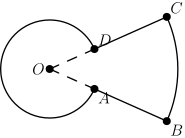
¿Cuál es la distancia de a ?
In the figure shown below, major arc and minor arc have the same center, Also, lies between and and lies between and Major arc minor arc and each of the two segments and have length
What is the distance from to
Respuesta: B
Pista pequeña:
Sean y ; los arcos dan y
Let and ; the arcs give and
Pista grande:
Los segmentos dan ; al eliminar los radios resulta
The segments give ; eliminating the radii yields
Solución:
Sean y y sea (los rayos coinciden). El arco menor tiene longitud y el arco mayor es el arco reflejo, así que
Cada segmento
De las dos primeras ecuaciones, y Sustituyendo en y dividiendo entre se obtiene que se simplifica a
La raíz mayor es mayor que así que no puede ser un ángulo de este arco menor. Por lo tanto Entonces tras racionalizar (el denominador multiplicado por es igual a ).
Por lo tanto, la respuesta correcta es B.
Let and and let (the rays coincide). The minor arc has length and the major arc is the reflex arc, so
Each segment
From the first two equations, and Substituting into and dividing by gives which simplifies to
The larger root is greater than so it cannot be an angle of this minor arc. Thus Then after rationalizing (the denominator times equals ).
Thus, the correct answer is B.
11.
El ortocentro de un triángulo es la intersección concurrente de las tres alturas (posiblemente extendidas). ¿Cuál es la suma de las coordenadas del ortocentro del triángulo cuyos vértices son y ?
The orthocenter of a triangle is the concurrent intersection of the three (possibly extended) altitudes. What is the sum of the coordinates of the orthocenter of the triangle whose vertices are and
Respuesta: A
Pista pequeña:
y comparten así que la altura desde es la recta vertical
and share so the altitude from is the vertical line
Pista grande:
La altura desde es perpendicular a ; intersécala con
The altitude from is perpendicular to ; intersect it with
Solución:
Como y tienen ambos el lado es horizontal y la altura desde es la recta vertical
El lado tiene pendiente así que la altura desde tiene pendiente :
En El ortocentro es con suma de coordenadas
Por lo tanto, la respuesta correcta es A.
Since and both have side is horizontal and the altitude from is the vertical line
Side has slope so the altitude from has slope :
At The orthocenter is with coordinate sum
Thus, the correct answer is A.
12.
La media armónica de una colección de números es el recíproco de la media aritmética de los recíprocos de los números de la colección. Por ejemplo, la media armónica de y es ¿Cuál es la media armónica de todas las raíces reales del polinomio de grado
The harmonic mean of a collection of numbers is the reciprocal of the arithmetic mean of the reciprocals of the numbers in the collection. For example, the harmonic mean of and is What is the harmonic mean of all the real roots of the th degree polynomial
Respuesta: B
Pista pequeña:
La media armónica es donde es el número de raíces
The harmonic mean is where is the number of roots
Pista grande:
Para las dos raíces tienen suma de recíprocos la misma para todo
For the two roots have reciprocal-sum the same for every
Solución:
Cada factor tiene discriminante así que tiene dos raíces reales; en total hay raíces.
Para las raíces de la suma de los recíprocos es independiente de
Sumando sobre los factores, La media armónica es
Por lo tanto, la respuesta correcta es B.
Each factor has discriminant so it has two real roots; there are roots in all.
For the roots of the sum of reciprocals is independent of
Summing over all factors, The harmonic mean is
Thus, the correct answer is B.
13.
Sea Sea el mayor entero tal que existe un subconjunto de con elementos que no contiene cinco enteros consecutivos. Supongamos que se eligen al azar enteros de sin reemplazo. ¿Cuál es la probabilidad de que los elementos elegidos no incluyan cinco enteros consecutivos?
Let Let be the greatest integer such that there exists a subset of with elements that does not contain five consecutive integers. Suppose integers are chosen at random from without replacement. What is the probability that the chosen elements do not include five consecutive integers?
Respuesta: D
Pista pequeña:
Eliminar dos elementos bien colocados rompe toda racha de cinco, así que
Removing two well-placed elements breaks every run of five, so
Pista grande:
Elegir equivale a eliminar ; cuenta las eliminaciones cuyos dos elementos alcanzan cada bloque de cinco enteros consecutivos
Choosing means removing ; count removals whose two elements hit every block of five consecutive integers
Solución:
Para evitar cinco enteros consecutivos, basta quitar dos elementos (por ejemplo, y ), y una sola eliminación no puede tocar ambos bloques disjuntos y Por tanto,
Elegir de elementos equivale a quitar lo que puede hacerse de maneras. El conjunto elegido evita cinco enteros consecutivos exactamente cuando los dos elementos eliminados juntos intersecan cada ventana para
Esto obliga a que un elemento eliminado esté en el otro en y ambos a distancia no mayor que . Las eliminaciones válidas son y para un total de .
La probabilidad es
Por lo tanto, la respuesta correcta es D.
To avoid five consecutive integers, it suffices to remove two elements (for example and ), and no single removal can hit both disjoint blocks and Thus
Choosing of elements is the same as removing which can be done in ways. The chosen set avoids five consecutive integers exactly when the two removed elements together intersect every window for
This forces one removed element in the other in and the two within of each other. The valid removals are and giving of them.
The probability is
Thus, the correct answer is D.
14.
Los puntos y son colineales con entre y La elipse con focos en y es internamente tangente a la elipse con focos en y como se muestra abajo.
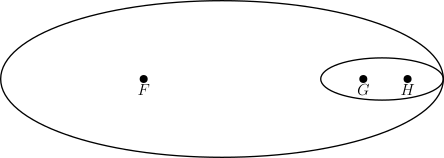
Las dos elipses tienen la misma excentricidad y la razón de sus áreas es (Recuerda que la excentricidad de una elipse es donde es la distancia del centro a un foco, y es la longitud del eje mayor.) ¿Cuánto vale ?
Points and are collinear with between and The ellipse with foci at and is internally tangent to the ellipse with foci at and as shown below.
The two ellipses have the same eccentricity and the ratio of their areas is (Recall that the eccentricity of an ellipse is where is the distance from the center to a focus, and is the length of the major axis.) What is
Respuesta: D
Pista pequeña:
La misma excentricidad hace que el área sea proporcional a así que
Equal eccentricity makes area proportional to so
Pista grande:
Las elipses comparten el foco ; iguala sus vértices derechos para obtener
The ellipses share focus ; equate their right vertices to get
Solución:
Con la misma excentricidad, así que el área La razón de áreas da donde son los semiejes mayores.
Ambas elipses comparten el foco En la elipse grande es el foco derecho, así que su vértice derecho está a la derecha de En la elipse pequeña es el foco izquierdo, así que su vértice derecho está a la derecha de La tangencia interna hace que estos coincidan:
Usando así que dando y
Por lo tanto, la respuesta correcta es D.
With the same eccentricity, so the area The area ratio gives where are the semi-major axes.
Both ellipses share focus On the large ellipse is the right focus, so its right vertex lies to the right of On the small ellipse is the left focus, so its right vertex lies to the right of Internal tangency makes these coincide:
Using so giving and
Thus, the correct answer is D.
15.
Un conjunto de números se llama libre de sumas si siempre que y son elementos (no necesariamente distintos) del conjunto, no es un elemento del conjunto. Por ejemplo, y el conjunto vacío son libres de sumas, pero no lo es. ¿Cuál es el mayor número posible de elementos de un subconjunto libre de sumas de ?
A set of numbers is called sum-free if whenever and are (not necessarily distinct) elements of the set, is not an element of the set. For example, and the empty set are sum-free, but is not. What is the greatest possible number of elements in a sum-free subset of
Respuesta: C
Pista pequeña:
El conjunto es libre de sumas
The set is sum-free
Pista grande:
Si están en las diferencias no están en lo que fuerza
If are in the differences are not in forcing
Solución:
El conjunto tiene elementos y es libre de sumas, ya que dos elementos cualesquiera suman al menos
Para la cota superior, sea un subconjunto libre de sumas. Cada diferencia para no puede estar en porque violaría la propiedad de ser libre de sumas.
Estas diferencias son distintas, están en y son disjuntas de los elementos de Así que dando
Por lo tanto, la respuesta correcta es C.
The set has elements and is sum-free, since any two elements sum to at least
For the upper bound, let be a sum-free subset. Each difference for cannot lie in because would violate sum-freeness.
These differences are distinct, lie in and are disjoint from the elements of So giving
Thus, the correct answer is C.
16.
El triángulo tiene lados y La bisectriz de y la altura al lado se cortan en el punto ¿Cuánto vale ?
Triangle has side lengths and The bisector of and the altitude to side intersect at point What is
Respuesta: D
Pista pequeña:
Pista grande:
El pie de la altura está a de a lo largo de y
The altitude’s foot is from along and
Solución:
Por la ley de cosenos,
La altura al lado se traza desde y su pie está a distancia de a lo largo de
A lo largo de la bisectriz desde la componente paralela a es que debe alcanzar el pie de la altura:
Como obtenemos
Por lo tanto, la respuesta correcta es D.
By the Law of Cosines,
The altitude to is drawn from and its foot is at distance from along
Along the bisector from the component parallel to is which must reach the altitude’s foot:
Since we get
Thus, the correct answer is D.
17.
El polinomio tiene tres raíces en el plano complejo, donde ¿Cuál es el área del triángulo formado por estas raíces?
The polynomial has three roots in the complex plane, where What is the area of the triangle formed by these roots?
Respuesta: A
Pista pequeña:
Traslada por el centroide: haz para centrar las raíces en el origen
Shift by the centroid: let to center the roots at the origin
Pista grande:
El polinomio se convierte en
The polynomial becomes
Solución:
La suma de las raíces es así que el centroide es Sustituyendo
Como es una raíz, dando las raíces y
Estos son los puntos La base entre y tiene longitud a distancia horizontal de así que el área es La traslación no cambia el área.
Por lo tanto, la respuesta correcta es A.
The sum of the roots is so the centroid is Substituting
Since is a root, giving roots and
These are the points The base between and has length at horizontal distance from so the area is Translation does not change the area.
Thus, the correct answer is A.
18.
¿Cuántas ternas ordenadas de enteros no negativos distintos y menores o iguales que satisfacen y ?
How many ordered triples of distinct nonnegative integers less than or equal to satisfy and
Respuesta: C
Pista pequeña:
Ninguno de puede ser ya que entonces algún producto es igual a y no puede superar un valor no negativo
None of can be since then some product equals and cannot exceed a nonnegative value
Pista grande:
Para distintos, la única condición vinculante es ; cuenta tales subconjuntos de elementos, luego multiplica por
For distinct the only binding condition is ; count such -subsets, then multiply by
Solución:
Si alguna variable es por ejemplo entonces es imposible. Así, son enteros positivos distintos.
Las condiciones son simétricas. Para valores distintos tenemos automáticamente y , así que la única restricción real es Cuando se cumple, funcionan los órdenes.
Para cada posible valor mínimo los números de pares que satisfacen son Para fijos, este conteo se obtiene eligiendo entre y Así, hay ternas no ordenadas, y funcionan los órdenes de cada una. La respuesta es
Por tanto, la respuesta correcta es C.
If any variable is say then is impossible. So are distinct positive integers.
The conditions are symmetric. For distinct values we have and automatically, so the only real constraint is When it holds, all orderings work.
For each possible smallest value the numbers of pairs satisfying are For fixed this count comes from choosing between and Thus there are unordered triples, and all orderings of each work. The answer is
Thus, the correct answer is C.
19.
Sean y las raíces del polinomio ¿Cuánto vale la suma
Let and be the roots of the polynomial What is the sum
Respuesta: E
Pista pequeña:
Por Vieta, y
By Vieta, and
Pista grande:
Agrupa como y reemplaza
Group as and replace
Solución:
Por las fórmulas de Vieta, y
Agrupa la suma como Como tenemos
Así que la suma es igual a
Por lo tanto, la respuesta correcta es E.
By Vieta’s formulas, and
Group the sum as Since we have
So the sum equals
Thus, the correct answer is E.
20.
La base del pentaedro mostrado abajo es un rectángulo , y sus caras laterales son dos triángulos isósceles con base de longitud y lados congruentes de longitud y dos trapecios isósceles con bases de longitudes y y lados no paralelos de longitud
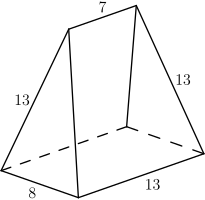
¿Cuál es el volumen del pentaedro?
The base of the pentahedron shown below is a rectangle, and its lateral faces are two isosceles triangles with base of length and congruent sides of length and two isosceles trapezoids with bases of lengths and and nonparallel sides of length
What is the volume of the pentahedron?
Respuesta: C
Pista pequeña:
Coloca la arista de longitud a la altura ; una arista inclinada da así que
Place the ridge of length at height ; a slant edge gives so
Pista grande:
La sección transversal a la altura es un rectángulo
The cross-section at height is a rectangle
Solución:
La parte superior es una arista de longitud centrada sobre la base a cierta altura Sus extremos están sobre y de la base . Una arista inclinada a una esquina de la base tiene longitud así que
A la altura la sección transversal horizontal es un rectángulo que mide por En su área es ; en es ; en la arista tiene área
Por la fórmula del prismatoide,
Por lo tanto, la respuesta correcta es C.
The top is a ridge of length centered above the base at some height Its endpoints sit above and of the base. A slant edge to a base corner has length so
At height the horizontal cross-section is a rectangle measuring by At its area is ; at it is ; at the ridge has area
By the prismatoid formula,
Thus, the correct answer is C.
21.
Existe una única terna ordenada de enteros no negativos tal que
¿Cuánto vale ?
There is a unique ordered triple of nonnegative integers such that
What is
Respuesta: A
Pista pequeña:
Suma ambas series geométricas y usa
Sum both geometric series and use
Pista grande:
La fracción restante es impar sobre impar, así que comparar las potencias de con obliga a que
The remaining fraction is odd over odd, so comparing powers of with forces
Solución:
Si o la razón original es simplemente que no puede ser Por tanto,
Al sumar las series geométricas, el numerador es y el denominador es Usando la razón se simplifica a
La fracción de la izquierda es impar sobre impar, así que su potencia de es Como debemos tener y Al reducir esta ecuación módulo , vemos que es divisible por así que Para las potencias requeridas de serían ninguna de las cuales es potencia de Para en cambio, así que y Esto también demuestra la unicidad.
Entonces
Por lo tanto, la respuesta correcta es A.
If or the original ratio is just which cannot equal Hence
Summing the geometric series, the numerator is and the denominator is Using the ratio simplifies to
The fraction on the left is odd over odd, so its power of is Since we must have and Reducing this equation modulo shows that is divisible by so For the required powers of would be none of which is a power of For however, so and This also proves uniqueness.
Then
Thus, the correct answer is A.
22.
Se eligen tres números reales de forma independiente y uniforme al azar entre y ¿Cuál es la probabilidad de que el mayor de estos tres números sea mayor que veces cada uno de los otros dos números? (En otras palabras, si los números elegidos son entonces )
Three real numbers are chosen independently and uniformly at random between and What is the probability that the greatest of these three numbers is greater than times each of the other two numbers? (In other words, if the chosen numbers are then )
Respuesta: E
Pista pequeña:
Con los estadísticos de orden la densidad conjunta es en la región
With order statistics the joint density is on the region
Pista grande:
Integra sobre y
Integrate over and
Solución:
Ordena los valores como ; la densidad conjunta de los estadísticos de orden es en esta región. El evento es
Integrar desde hasta aporta un factor de Entonces
Esto es igual a
Por lo tanto, la respuesta correcta es E.
Order the values as ; the joint density of the order statistics is on this region. The event is
Integrating from to contributes a factor of Then
This equals
Thus, the correct answer is E.
23.
Llamamos justo a un entero positivo si ningún dígito se usa más de una vez, no tiene s, y ningún dígito es adyacente a dos dígitos mayores. Por ejemplo, y son justos, pero y no lo son. ¿Cuántos enteros positivos justos hay?
Call a positive integer fair if no digit is used more than once, it has no s, and no digit is adjacent to two greater digits. For example, and are fair, but and are not fair. How many fair positive integers are there?
Respuesta: C
Pista pequeña:
Un número justo no tiene ningún dígito interior menor que ambos vecinos
A fair number has no interior digit smaller than both of its neighbors
Pista grande:
Construye una disposición válida de un conjunto de dígitos elegido colocando los dígitos de mayor a menor, cada uno en algún extremo: maneras para dígitos
Build a valid arrangement of a chosen digit set by placing digits largest-to-smallest, each at either end: ways for digits
Solución:
Los dígitos son distintos y se toman de y “ningún dígito adyacente a dos dígitos mayores” significa que ningún dígito interior es menor que ambos vecinos.
Para un conjunto fijo de dígitos, construye la disposición insertando los dígitos de mayor a menor; cada nuevo dígito (más pequeño) debe ir a uno de los dos extremos, dando disposiciones válidas.
Sumando sobre todos los subconjuntos de dígitos no vacíos,
Por lo tanto, la respuesta correcta es C.
The digits are distinct and drawn from and “no digit adjacent to two greater digits” means no interior digit is smaller than both neighbors.
For a fixed set of digits, build the arrangement by inserting digits from largest to smallest; each new (smaller) digit must go to one of the two ends, giving valid arrangements.
Summing over all nonempty digit subsets,
Thus, the correct answer is C.
24.
Un círculo de radio está rodeado por círculos de radio tangentes externamente al círculo central y tangentes secuencialmente entre sí, como se muestra. Entonces puede escribirse como donde y son enteros. ¿Cuánto vale ?
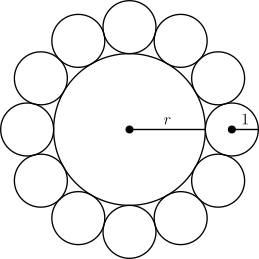
A circle of radius is surrounded by circles of radius externally tangent to the central circle and sequentially tangent to each other, as shown. Then can be written as where and are integers. What is
Respuesta: C
Pista pequeña:
Los centros exteriores forman un -ágono regular de circunradio con centros adyacentes a distancia
The outer centers form a regular -gon of circumradius with adjacent centers apart
Pista grande:
Así que y
So and
Solución:
Los centros de los círculos exteriores están en un círculo de radio formando un -ágono regular. Los centros adyacentes están a distancia (ambos círculos tienen radio ), y el ángulo central entre ellos es
Por lo tanto así que Como
Entonces así que
Por lo tanto, la respuesta correcta es C.
The centers of the outer circles lie on a circle of radius forming a regular -gon. Adjacent centers are apart (both circles have radius ), and the central angle between them is
Thus so Since
Then so
Thus, the correct answer is C.
25.
Los polinomios y tienen cada uno grado y coeficiente principal y sus raíces son todas elementos de La función tiene la propiedad de que existen números reales tales que el conjunto de todos los números reales tales que consta del intervalo cerrado junto con el intervalo abierto ¿Cuántas funciones son posibles?
Polynomials and each have degree and leading coefficient and their roots are all elements of The function has the property that there exist real numbers such that the set of all real numbers such that consists of the closed interval together with the open interval How many functions are possible?
Respuesta: E
Pista pequeña:
Los extremos cerrados deben ser ceros de y los extremos abiertos deben ser ceros de
The closed endpoints must be zeros of and the open endpoints must be zeros of
Pista grande:
Una vez fijados esos cuatro factores de los extremos, los factores restantes del numerador y del denominador deben cancelarse; cuenta funciones distintas, no pares de polinomios
After those four endpoint factors are fixed, the remaining numerator and denominator factors must cancel; count distinct functions, not polynomial pairs
Solución:
Este problema fue anulado: tal como está escrito, su respuesta no aparece entre las opciones. Este es el conteo.
Para los extremos del intervalo cerrado deben ser ceros de en los que mientras que deben ser polos. El patrón de signos requerido es, por tanto, el de El tercer factor no usado de debe coincidir con el tercer factor no usado de de lo contrario habría un cero, polo o cambio de signo adicional.
Si el factor común es el quinto valor que no está entre no puede crear un agujero dentro de ninguno de los intervalos. En la lista ordenada de cinco valores, puede estar antes de entre y o después de lo que da funciones.
Como alternativa, el factor común puede ser igual a o Para cada una de las elecciones de estos dos pares de polinomios se simplifican a la misma fórmula y tienen el mismo dominio (ambos omiten ), así que definen una sola función. Esto da funciones más, para un total literal de
Contar por separado los dos pares de polinomios en cada uno de los cinco últimos casos da la respuesta provisional (E), pero eso no responde a la pregunta formulada sobre funciones. Por tanto, ninguna opción impresa es correcta.
This problem was voided: as written, its answer is not among the choices. Here is the count.
For the endpoints of the closed interval must be zeros of at which while must be poles. The required sign pattern is therefore that of The unused third factor of must match the unused third factor of otherwise there would be an extra zero, pole, or sign change.
If the common factor is the fifth value not among it cannot make a hole inside either interval. In the ordered list of five values it may therefore occur before between and or after giving functions.
Alternatively, the common factor can equal or For each of the choices of these two polynomial pairs simplify to the same formula and have the same domain (both omit ), so they define only one function. This gives more functions, for a literal total of
Counting the two polynomial pairs separately in each of the last five cases gives the provisional answer (E), but that does not answer the stated question about functions. Thus none of the printed choices is correct.