
Problemas del 2006 AMC 12B
¡Desplázate hacia abajo y presiona Iniciar para intentar el examen! O ve al PDF imprimible, la clave de respuestas, o las soluciones profesionales preparadas por LIVE by Po-Shen Loh.
Todos los problemas se usan con el permiso legal oficial de la Mathematical Association of America (MAA).
O salta directamente a un solo problema con su solución: 1 · 2 · 3 · 4 · 5 · 6 · 7 · 8 · 9 · 10 · 11 · 12 · 13 · 14 · 15 · 16 · 17 · 18 · 19 · 20 · 21 · 22 · 23 · 24 · 25
¿Quieres aprender de forma profesional con clases interactivas en video?
Con tiempo
1:15:00
1.
¿Cuál es el valor de la siguiente suma?
What is
Respuesta: C
Pista pequeña:
es igual a cuando es par, y a cuando es impar.
equals when is even and when is odd
Pista grande:
Agrupa los términos en parejas consecutivas .
Group the terms into consecutive pairs
Solución:
Como cuando es impar y cuando es par, los términos se alternan .
Hay términos, que forman parejas, cada una igual a La suma total es
Por lo tanto, la respuesta correcta es C.
Since for odd and for even the terms alternate
There are terms, forming pairs, each equal to The total is
Thus, the correct answer is C.
2.
Para los números reales y , se define ¿Cuánto vale ?
For real numbers and define What is
Respuesta: A
Pista pequeña:
Observa que .
Note that
Pista grande:
Evalúa primero el interior , y luego aplica la operación de nuevo.
Evaluate the inner first, then apply the operation again
Solución:
Como el valor interior es
Entonces
Por lo tanto, la respuesta correcta es A.
Since the inner value is
Then
Thus, the correct answer is A.
3.
Se jugó un partido de fútbol americano entre dos equipos, los Cougars y los Panthers. Los dos equipos anotaron un total de puntos, y los Cougars ganaron por un margen de puntos. ¿Cuántos puntos anotaron los Panthers?
A football game was played between two teams, the Cougars and the Panthers. The two teams scored a total of points, and the Cougars won by a margin of points. How many points did the Panthers score?
Respuesta: A
Pista pequeña:
Sean y las dos puntuaciones, con y .
Let and be the two scores, with and
Pista grande:
Restar las dos ecuaciones despeja .
Subtracting the two equations isolates
Solución:
Sean y las puntuaciones de los Cougars y los Panthers. Entonces y
Al restar se obtiene así que
Por lo tanto, la respuesta correcta es A.
Let and be the Cougars’ and Panthers’ scores. Then and
Subtracting gives so
Thus, the correct answer is A.
4.
Mary está a punto de pagar cinco artículos en la tienda de comestibles. Los precios de los artículos son y Mary pagará con un billete de veinte dólares. ¿Cuál de las siguientes opciones se acerca más al porcentaje de los que recibirá de cambio?
Mary is about to pay for five items at the grocery store. The prices of the items are and Mary will pay with a twenty-dollar bill. Which of the following is closest to the percentage of the that she will receive in change?
Respuesta: A
Pista pequeña:
Redondea cada precio al dólar más cercano para estimar el total rápidamente.
Round each price to the nearest dollar to estimate the total quickly
Pista grande:
El cambio es menos el total; compáralo con como una fracción.
The change is minus the total; compare it to as a fraction
Solución:
Los precios suman así que el cambio es Como porcentaje de esto es El porcentaje más cercano de la lista es
Por lo tanto, la respuesta correcta es A.
The prices total so the change is As a percentage of this is The closest listed percentage is
Thus, the correct answer is A.
5.
John camina hacia el este a una velocidad de millas por hora, mientras que Bob también camina hacia el este, pero a una velocidad de millas por hora. Si Bob está ahora milla al oeste de John, ¿cuántos minutos tardará Bob en alcanzar a John?
John is walking east at a speed of miles per hour, while Bob is also walking east, but at a speed of miles per hour. If Bob is now mile west of John, how many minutes will it take for Bob to catch up to John?
Respuesta: A
Pista pequeña:
Bob acorta la distancia a la diferencia de las dos velocidades.
Bob gains ground at the difference of the two speeds
Pista grande:
Debe cerrar una brecha de milla a millas por hora.
He must close a -mile gap at miles per hour
Solución:
Bob acorta la distancia a una velocidad relativa de millas por hora. Cubrir la brecha de milla toma hora, es decir, minutos.
Por lo tanto, la respuesta correcta es A.
Bob closes the gap at a relative speed of miles per hour. To cover the -mile gap takes hour, or minutes.
Thus, the correct answer is A.
6.
Francesca usa gramos de jugo de limón, gramos de azúcar y gramos de agua para hacer limonada. Hay calorías en gramos de jugo de limón y calorías en gramos de azúcar. El agua no contiene calorías. ¿Cuántas calorías hay en gramos de su limonada?
Francesca uses grams of lemon juice, grams of sugar, and grams of water to make lemonade. There are calories in grams of lemon juice and calories in grams of sugar. Water contains no calories. How many calories are in grams of her lemonade?
Respuesta: B
Pista pequeña:
Primero halla las calorías totales y los gramos totales de todo el lote.
Find the total calories and total grams of the whole batch first
Pista grande:
gramos es un tercio del lote completo de gramos.
grams is one third of the full -gram batch
Solución:
Todo el lote pesa gramos y contiene calorías.
Como gramos es un tercio del lote, contiene calorías.
Por lo tanto, la respuesta correcta es B.
The full batch weighs grams and contains calories.
Since grams is one third of the batch, it has calories.
Thus, the correct answer is B.
7.
El señor y la señora Lopez tienen dos hijos. Cuando suben a su coche familiar, dos personas se sientan adelante y las otras dos se sientan atrás. El señor Lopez o la señora Lopez debe sentarse en el asiento del conductor. ¿Cuántas disposiciones de asientos son posibles?
Mr. and Mrs. Lopez have two children. When they get into their family car, two people sit in the front, and the other two sit in the back. Either Mr. Lopez or Mrs. Lopez must sit in the driver’s seat. How many seating arrangements are possible?
Respuesta: B
Pista pequeña:
Ocupa los asientos en orden: conductor, luego el pasajero delantero, y después los dos asientos traseros.
Fill the seats in order: driver, then front passenger, then the two back seats
Pista grande:
Hay opciones para el conductor y para el pasajero delantero, y luego órdenes en la parte de atrás.
There are choices for the driver and for the front passenger, then orders in back
Solución:
El conductor es uno de los dos padres: opciones.
Cualquiera de las personas restantes puede sentarse en el asiento del pasajero delantero, y las últimas personas ocupan la parte de atrás en órdenes.
El total es
Por lo tanto, la respuesta correcta es B.
The driver is one of the two parents: choices.
Any of the remaining people can sit in the front passenger seat, and the last people fill the back in orders.
The total is
Thus, the correct answer is B.
8.
Las rectas se cortan en el punto . ¿Cuánto vale ?
The lines intersect at the point What is
Respuesta: E
Pista pequeña:
Sustituye y en ambas ecuaciones.
Substitute and into both equations
Pista grande:
Despeja y por separado, y luego súmalos.
Solve each equation for and separately, then add
Solución:
Al sustituir se obtiene y
Por lo tanto,
Por lo tanto, la respuesta correcta es E.
Substituting gives and
Therefore
Thus, the correct answer is E.
9.
¿Cuántos enteros pares de tres dígitos tienen la propiedad de que sus dígitos, leídos de izquierda a derecha, están en orden estrictamente creciente?
How many even three-digit integers have the property that their digits, read left to right, are in strictly increasing order?
Respuesta: B
Pista pequeña:
El dígito de las unidades es par; los dos dígitos más pequeños deben ser ambos menores que él.
The units digit is even; the two smaller digits must both be less than it
Pista grande:
Para cada dígito de las unidades par cuenta las maneras de elegir dos dígitos crecientes menores que .
For each even units digit count the ways to choose two increasing digits below
Solución:
Sean los dígitos con par. Como ningún dígito es cero, y (no hay espacio para dos dígitos más pequeños distintos de cero).
Una vez fijado el dígito de las unidades , dos dígitos distintos cualesquiera menores que él pueden ordenarse de forma creciente de una única manera. Así, el conteo para cada es
Para esto da
Por lo tanto, la respuesta correcta es B.
Let the digits be with even. Since no digit is zero, and (there is no room for two smaller nonzero digits).
Once the units digit is fixed, any two distinct digits below it can be arranged in increasing order in exactly one way. So the count for each is
For this gives
Thus, the correct answer is B.
10.
En un triángulo con longitudes de lado enteras, un lado es tres veces más largo que un segundo lado, y la longitud del tercer lado es ¿Cuál es el mayor perímetro posible del triángulo?
In a triangle with integer side lengths, one side is three times as long as a second side, and the length of the third side is What is the greatest possible perimeter of the triangle?
Respuesta: A
Pista pequeña:
Sean los lados y y luego aplica la desigualdad triangular.
Let the sides be and then apply the triangle inequality
Pista grande:
La condición determinante es que limita cuán grande puede ser .
The binding condition is which caps how large can be
Solución:
Sean los lados y La desigualdad triangular exige así que y así que
El perímetro es máximo cuando lo que da
Así, la respuesta correcta es A.
Let the sides be and The triangle inequality requires so and so
The perimeter is largest when giving
Thus, the correct answer is A.
11.
Joe y JoAnn compraron cada uno onzas de café en una taza de onzas. Joe bebió onzas de su café y luego añadió onzas de crema. JoAnn añadió onzas de crema, revolvió bien el café y luego bebió onzas. ¿Cuál es la razón resultante entre la cantidad de crema en el café de Joe y la del café de JoAnn?
Joe and JoAnn each bought ounces of coffee in a -ounce cup. Joe drank ounces of his coffee and then added ounces of cream. JoAnn added ounces of cream, stirred the coffee well, and then drank ounces. What is the resulting ratio of the amount of cream in Joe’s coffee to that in JoAnn’s coffee?
Respuesta: E
Pista pequeña:
Joe añade la crema después de beber, así que se conservan todas sus onzas de crema.
Joe adds cream after drinking, so all ounces of his cream remain
Pista grande:
JoAnn bebe de una taza bien mezclada de onzas, quitando crema en proporción.
JoAnn drinks from a well-mixed -ounce cup, removing cream in proportion
Solución:
Joe añade la crema al final, así que su taza conserva las onzas completas de crema.
La taza de JoAnn tiene onzas de mezcla que contienen onzas de crema. Beber onzas quita una fracción de todo, dejando onzas de crema.
La razón es
Por lo tanto, la respuesta correcta es E.
Joe adds the cream last, so his cup holds all ounces of cream.
JoAnn’s cup has ounces of mixture containing ounces of cream. Drinking ounces removes a fraction of everything, leaving ounces of cream.
The ratio is
Thus, the correct answer is E.
12.
La parábola tiene vértice e intersección con el eje en donde ¿Cuánto vale ?
The parabola has vertex and -intercept where What is
Respuesta: D
Pista pequeña:
Escribe la parábola en forma canónica .
Write the parabola in vertex form
Pista grande:
Usa la intersección con el eje para hallar en términos de y luego lee el coeficiente de .
Use the -intercept to find in terms of then read off the coefficient of
Solución:
La forma canónica es
En así que y
Al desarrollar, así que
Por lo tanto, la respuesta correcta es D.
The vertex form is
At so and
Expanding, so
Thus, the correct answer is D.
13.
El rombo es semejante al rombo El área del rombo es y ¿Cuál es el área del rombo ?
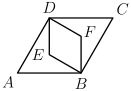
Rhombus is similar to rhombus The area of rhombus is and What is the area of rhombus
Respuesta: C
Pista pequeña:
Como el triángulo es equilátero, así que es igual a un lado.
Since triangle is equilateral, so equals a side
Pista grande:
Si las diagonales se cortan en entonces es un triángulo ––; compara las diagonales larga y corta
If the diagonals meet at then is a –– triangle; compare the long and short diagonals
Solución:
Sean el punto de intersección de las diagonales de Estas se bisecan perpendicularmente y, como el triángulo es un triángulo de --. Por tanto, las semidiagonales satisfacen
El segmento es la diagonal corta de y la diagonal larga del rombo semejante Así, la razón de longitudes del rombo menor al mayor es Las áreas se escalan con el cuadrado de esta razón, de modo que el área de es
Así, la respuesta correcta es C.
Let the diagonals of meet at They bisect each other at right angles, and since triangle is a –– triangle. Hence the half-diagonals satisfy
The segment is the short diagonal of and the long diagonal of the similar rhombus Thus the smaller-to-larger length ratio is Areas scale by the square of this ratio, so the area of is
Thus, the correct answer is C.
14.
Elmo hace sándwiches para una recaudación de fondos. Para cada sándwich usa porciones de mantequilla de maní a ¢ cada una, y porciones de mermelada a ¢ cada una. El costo de la mantequilla de maní y la mermelada para hacer todos los sándwiches es Supón que y son enteros positivos con ¿Cuál es el costo de la mermelada que Elmo usa para hacer los sándwiches?
Elmo makes sandwiches for a fundraiser. For each sandwich he uses globs of peanut butter at ¢ per glob and blobs of jam at ¢ per blob. The cost of the peanut butter and jam to make all the sandwiches is Assume that and are positive integers with What is the cost of the jam Elmo uses to make the sandwiches?
Respuesta: D
Pista pequeña:
El costo total es centavos; factoriza .
The total cost is cents; factor
Pista grande:
Prueba y luego determina los valores de y .
Test then determine the numbers of peanut-butter globs and jam blobs
Solución:
El costo total en centavos es Como el valor de es o
Si , entonces y si , entonces ninguna ecuación tiene una solución entera positiva.
Por lo tanto, y cuya única solución positiva es
La mermelada cuesta ¢ centavos, es decir,
Así, la respuesta correcta es D.
The total cost in cents is Since the value of is or
If then and if then neither has a positive integer solution.
So and whose only positive solution is
The jam costs ¢ cents, or
Thus, the correct answer is D.
15.
Dos círculos con centros y tienen radios y respectivamente, y son tangentes exteriormente. Los puntos y están sobre el círculo centrado en y los puntos y están sobre el círculo centrado en de modo que y son tangentes exteriores comunes a los círculos. ¿Cuál es el área del hexágono ?
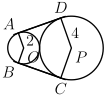
Circles with centers and have radii and respectively, and are externally tangent. Points and are on the circle centered at and points and are on the circle centered at such that and are common external tangents to the circles. What is the area of hexagon
Respuesta: B
Pista pequeña:
Los centros están a de distancia, y los radios a los puntos de tangencia son perpendiculares a la tangente.
The centers are apart, and the radii to the tangent points are perpendicular to the tangent
Pista grande:
es un trapecio rectángulo; halla su lado oblicuo con el teorema de Pitágoras, y luego duplica el área.
is a right trapezoid; find its slant side with the Pythagorean theorem, then double the area
Solución:
Los círculos son tangentes exteriormente, así que En el cuadrilátero tanto como son perpendiculares a la recta tangente lo que lo convierte en un trapecio rectángulo.
Al trazar por la recta paralela a se forma un triángulo rectángulo con hipotenusa y un cateto así que
El trapecio tiene área
Por simetría, el hexágono está formado por dos de estos trapecios, así que su área es
Por lo tanto, la respuesta correcta es B.
The circles are externally tangent, so In quadrilateral both and are perpendicular to the tangent line making it a right trapezoid.
Drawing the line through parallel to creates a right triangle with hypotenuse and one leg so
The trapezoid has area
By symmetry the hexagon is made of two such trapezoids, so its area is
Thus, the correct answer is B.
16.
El hexágono regular tiene los vértices y en y respectivamente. ¿Cuál es su área?
Regular hexagon has vertices and at and respectively. What is its area?
Respuesta: C
Pista pequeña:
y están separados por dos vértices, así que es una diagonal corta del hexágono.
and are two vertices apart, so is a short diagonal of the hexagon
Pista grande:
Para un lado de longitud la diagonal corta es el área es .
For side length the short diagonal is the area is
Solución:
La distancia es En un hexágono regular de lado la distancia entre vértices separados por dos es así que lo que da
El área del hexágono es
Por lo tanto, la respuesta correcta es C.
The distance is In a regular hexagon with side the distance between vertices two apart is so giving
The hexagon’s area is
Thus, the correct answer is C.
17.
Para un par peculiar de dados, las probabilidades de sacar y en cada dado están en la razón ¿Cuál es la probabilidad de sacar un total de con los dos dados?
For a particular peculiar pair of dice, the probabilities of rolling and on each die are in the ratio What is the probability of rolling a total of on the two dice?
Respuesta: C
Pista pequeña:
La probabilidad de sacar es .
The probability of rolling is
Pista grande:
Suma sobre las parejas que suman .
Sum over the pairs that total
Solución:
Como los pesos suman la probabilidad de sacar es
Un total de proviene de así que la probabilidad es
Por lo tanto, la respuesta correcta es C.
Since the weights sum to the probability of rolling is
A total of comes from so the probability is
Thus, the correct answer is C.
18.
Un objeto en el plano se mueve de un punto reticular a otro. En cada paso, el objeto puede moverse una unidad a la derecha, una unidad a la izquierda, una unidad hacia arriba o una unidad hacia abajo. Si el objeto parte del origen y recorre un camino de diez pasos, ¿cuántos puntos distintos podrían ser el punto final?
An object in the plane moves from one lattice point to another. At each step, the object may move one unit to the right, one unit to the left, one unit up, or one unit down. If the object starts at the origin and takes a ten-step path, how many different points could be the final point?
Respuesta: B
Pista pequeña:
Después de pasos, el punto final cumple con par.
After steps the endpoint satisfies with even
Pista grande:
Cuenta los puntos reticulares con suma de coordenadas par dentro del rombo .
Count lattice points with even coordinate sum inside the diamond
Solución:
Cada paso cambia la suma de coordenadas en así que después de pasos el punto final tiene par y Cualquier punto así es alcanzable: camina pasos hasta él, y luego usa el número par restante de pasos yendo y volviendo.
Los puntos alcanzables están sobre las rectas para Cada una de estas rectas corta al rombo en exactamente puntos reticulares.
Con rectas y puntos cada una, hay puntos.
Por lo tanto, la respuesta correcta es B.
Each step changes the coordinate sum by so after steps the endpoint has even, and Any such point is reachable: walk steps to it, then use the remaining even number of steps going out and back.
The reachable points lie on the lines for Each such line meets the diamond in exactly lattice points.
With lines and points each, there are points.
Thus, the correct answer is B.
19.
El señor Jones tiene ocho hijos de edades distintas. En un viaje familiar, su hija mayor, que tiene años, ve una matrícula con un número de dígitos en el que cada uno de dos dígitos aparece dos veces. «¡Mira, papá!», exclama. «¡Ese número es divisible exactamente entre la edad de cada uno de nosotros!» «Así es», responde el señor Jones, «y las dos últimas cifras resultan ser justo mi edad». ¿Cuál de las siguientes no es la edad de uno de los hijos del señor Jones?
Mr. Jones has eight children of different ages. On a family trip his oldest child, who is spots a license plate with a -digit number in which each of two digits appears two times. “Look, daddy!” she exclaims. “That number is evenly divisible by the age of each of us kids!” “That’s right,” replies Mr. Jones, “and the last two digits just happen to be my age.” Which of the following is not the age of one of Mr. Jones’s children?
Respuesta: B
Pista pequeña:
El hijo mayor tiene años, así que el número es divisible entre lo que obliga a que los dos dígitos sumen .
The oldest child is so the number is divisible by forcing the two digits to sum to
Pista grande:
Un número que termina en una edad de dos cifras no puede terminar en así que piensa qué edades pequeñas debe evitar.
A number ending in a two-digit age cannot end in so think about which small ages it must avoid
Solución:
El número tiene la forma o La divisibilidad entre significa que es múltiplo de así que
Las ocho edades distintas son ocho de los nueve enteros de a por lo que aparece al menos una de las edades y . Así, el número es divisible entre Las posibilidades son
Como las dos últimas cifras son la edad del señor Jones, es imposible, y ninguno de los demás es múltiplo de Por tanto, las edades de los hijos no pueden incluir En efecto, es divisible entre
Por lo tanto, la respuesta correcta es B.
The number has the form or Divisibility by means is a multiple of so
The eight distinct ages are eight of the nine integers from through so at least one of ages and occurs. Therefore the number is divisible by The possibilities become
Since the last two digits are Mr. Jones’s age, is impossible, and none of the others is a multiple of So the children’s ages cannot include Indeed is divisible by
Thus, the correct answer is B.
20.
Se elige al azar en el intervalo . ¿Cuál es la probabilidad de que Aquí denota el mayor entero que es menor o igual que .
Let be chosen at random from the interval What is the probability that Here denotes the greatest integer that is less than or equal to
Respuesta: C
Pista pequeña:
La condición dice que y tienen la misma magnitud en potencias de diez.
The condition says and have the same power-of-ten magnitude
Pista grande:
En cada intervalo la condición se cumple para .
On each interval the condition holds for
Solución:
La ecuación dice que es decir, y están en el mismo intervalo
Esto se cumple exactamente cuando y es decir,
Dentro de la fracción favorable es
Como esta fracción es la misma en cada uno de estos intervalos, la probabilidad total es
Por lo tanto, la respuesta correcta es C.
The equation says i.e. and lie in the same interval
This holds exactly when and that is
Within the favorable fraction is
Since this fraction is the same on every such interval, the overall probability is
Thus, the correct answer is C.
21.
El rectángulo tiene área Una elipse de área pasa por y y tiene sus focos en y ¿Cuál es el perímetro del rectángulo? (El área de una elipse es donde y son las longitudes de sus ejes.)
Rectangle has area An ellipse with area passes through and and has foci at and What is the perimeter of the rectangle? (The area of an ellipse is where and are the lengths of its axes.)
Respuesta: C
Pista pequeña:
En esta elipse, la suma de las distancias de a los focos es igual a la suma de dos lados adyacentes del rectángulo.
For the ellipse, the sum of distances from to the foci equals a rectangle diagonal plus a side
Pista grande:
Sean los lados entonces y la diagonal .
Let the sides be then and the diagonal
Solución:
Sean y los lados del rectángulo. El punto está en la elipse con focos y así que La distancia entre los focos es la diagonal, así que
Entonces así que El área da de donde
El área de la elipse da así que y
El perímetro del rectángulo es
Por lo tanto, la respuesta correcta es C.
Let the rectangle’s sides be and Point is on the ellipse with foci and so The distance between the foci is the diagonal, so
Then so The area gives hence
The ellipse area gives so and
The perimeter is
Thus, the correct answer is C.
22.
Supón que y son enteros positivos con y donde y son enteros y no es divisible entre ¿Cuál es el menor valor posible de ?
Suppose and are positive integers with and where and are integers and is not divisible by What is the smallest possible value of
Respuesta: B
Pista pequeña:
Los factores de son más escasos que los factores de así que cuenta los factores de en .
Factors of are scarcer than factors of so counts the factors of in
Pista grande:
Para cada potencia de , usa .
Use at each power of
Solución:
Los factores de son más abundantes que los factores de así que es igual al número de factores de en es decir,
Para cada Sumando sobre (ya que ) se obtiene
La igualdad es alcanzable, por ejemplo con y Así que el mínimo es
Por lo tanto, la respuesta correcta es B.
Since factors of are more plentiful than factors of equals the number of factors of in namely
For each Summing over (as ) gives
Equality is attainable, for example with and So the minimum is
Thus, the correct answer is B.
23.
El isósceles tiene un ángulo recto en El punto está dentro del de modo que y Los catetos y tienen longitud donde y son enteros positivos. ¿Cuánto vale ?

Isosceles has a right angle at Point is inside such that and Legs and have length where and are positive integers. What is
Respuesta: E
Pista pequeña:
Rota el alrededor de de modo que se transforme en .
Rotate by about so that maps onto
Pista grande:
La imagen de forma un triángulo rectángulo isósceles con lo que fija .
The image of forms an isosceles right triangle with which pins down
Solución:
Rota el alrededor de enviando a y a Entonces y así que es un triángulo rectángulo isósceles con
Además Como el triángulo tiene un ángulo recto en Por lo tanto,
Por la ley de cosenos en
Así que lo que da y por lo tanto
Por lo tanto, la respuesta correcta es E.
Rotate by about sending to and to Then and so is an isosceles right triangle with
Also Since triangle has a right angle at Hence
By the Law of Cosines in
So giving and
Thus, the correct answer is E.
24.
Sea el conjunto de todos los puntos del plano coordenado tales que y ¿Cuál es el área del subconjunto de para el cual
Let be the set of all points in the coordinate plane such that and What is the area of the subset of for which
Respuesta: C
Pista pequeña:
Trata la expresión como una cuadrática en y halla dónde es igual a .
Treat the expression as a quadratic in and find where it equals
Pista grande:
La frontera se reduce a lo que da rectas en .
The boundary reduces to giving straight lines in
Solución:
Fijado resolvemos como una ecuación cuadrática en
Dentro de la ecuación da la recta mientras que da para y para
Estas rectas dividen en regiones; al probar los vértices se observa que la desigualdad solo se cumple en la banda central. Su área es
Así, la respuesta correcta es C.
Fixing solve as a quadratic in
Within gives the line while gives for and for
These lines split into regions; testing the corners shows the inequality holds only in the middle band. Its area is
Thus, the correct answer is C.
25.
Una sucesión de enteros no negativos se define por la regla para Si y ¿cuántos valores distintos de son posibles?
A sequence of non-negative integers is defined by the rule for If and how many different values of are possible?
Respuesta: B
Pista pequeña:
Los términos y siempre tienen la misma paridad; usa esto junto con .
The terms and always share the same parity; use this with
Pista grande:
Cada término es un múltiplo de así que nota que .
Every term is a multiple of so note
Solución:
La regla da así que tiene la misma paridad que por tanto, es impar.
Cada término es múltiplo de y obliga a que Como necesitamos que no sea divisible entre ni
Entre los enteros impares de hay quitando los múltiplos de y los múltiplos de y añadiendo de nuevo los múltiplos de quedan
Cada uno de estos valores de funciona. Para términos positivos consecutivos la actualización reduce su máximo en a lo sumo dos pasos. Como ambos términos iniciales son a lo sumo aparece algún con
El máximo común divisor de cada pareja consecutiva es invariante, así que los términos iguales justo antes de ese cero son ambos La sucesión entra entonces en el ciclo Finalmente, así que tiene la misma paridad impar que dentro de este ciclo, debe ser
Por lo tanto, la respuesta correcta es B.
The rule gives so has the same parity as thus is odd.
Every term is a multiple of and forces Since we need not divisible by or
Among the odd integers in there are removing the multiples of and multiples of then adding back the multiples of leaves
Each such works. For consecutive positive terms the update reduces their maximum within at most two steps. Since both initial terms are at most some occurs by
The gcd of each consecutive pair is invariant, so the equal terms immediately before that zero both equal The sequence then cycles through Finally, so has the same odd parity as in this cycle it must therefore be
Thus, the correct answer is B.