
Problemas del 2007 AMC 12A
¡Desplázate hacia abajo y presiona Iniciar para intentar el examen! O ve al PDF imprimible, la clave de respuestas, o las soluciones profesionales preparadas por LIVE by Po-Shen Loh.
Todos los problemas se usan con el permiso legal oficial de la Mathematical Association of America (MAA).
O salta directamente a un solo problema con su solución: 1 · 2 · 3 · 4 · 5 · 6 · 7 · 8 · 9 · 10 · 11 · 12 · 13 · 14 · 15 · 16 · 17 · 18 · 19 · 20 · 21 · 22 · 23 · 24 · 25
¿Quieres aprender de forma profesional con clases interactivas en video?
Con tiempo
1:15:00
1.
Una entrada para un espectáculo cuesta a precio completo. Susan compra entradas usando un cupón que le da un de descuento. Pam compra entradas usando un cupón que le da un de descuento. ¿Cuántos dólares más paga Pam que Susan?
One ticket to a show costs at full price. Susan buys tickets using a coupon that gives her a discount. Pam buys tickets using a coupon that gives her a discount. How many more dollars does Pam pay than Susan?
Respuesta: C
Pista pequeña:
Un descuento del significa pagar el del precio completo, y un descuento del significa pagar el .
A discount means paying of full price, and a discount means paying
Pista grande:
Susan paga y Pam paga .
Susan pays and Pam pays
Solución:
Susan paga dólares.
Pam paga dólares.
Así que Pam paga dólares más que Susan.
Por lo tanto, la respuesta correcta es C.
Susan pays dollars.
Pam pays dollars.
So Pam pays more dollars than Susan.
Thus, the correct answer is C.
2.
Un acuario tiene una base rectangular que mide cm por cm y una altura de cm. Está lleno de agua hasta una altura de cm. Se coloca en el acuario un ladrillo con base rectangular que mide cm por cm y una altura de cm. ¿Cuántos centímetros sube el agua?
An aquarium has a rectangular base that measures cm by cm and has a height of cm. It is filled with water to a height of cm. A brick with a rectangular base that measures cm by cm and a height of cm is placed in the aquarium. By how many centimeters does the water rise?
Respuesta: D
Pista pequeña:
El ladrillo sumergido desplaza su propio volumen de agua.
The submerged brick displaces its own volume of water
Pista grande:
La subida es igual al volumen del ladrillo dividido entre el área de la base del acuario.
The rise equals the brick’s volume divided by the aquarium’s base area
Solución:
El ladrillo tiene un volumen de centímetros cúbicos.
Si el agua sube centímetros, el volumen añadido es centímetros cúbicos.
Igualando esto al volumen del ladrillo se obtiene así que
Por lo tanto, la respuesta correcta es D.
The brick has a volume of cubic centimeters.
If the water rises by centimeters, the added volume is cubic centimeters.
Setting this equal to the brick’s volume gives so
Thus, the correct answer is D.
3.
El mayor de dos enteros impares consecutivos es tres veces el menor. ¿Cuál es su suma?
The larger of two consecutive odd integers is three times the smaller. What is their sum?
Respuesta: A
Pista pequeña:
Sea el entero impar menor igual a de modo que el mayor sea .
Let the smaller odd integer be so the larger is
Pista grande:
Resuelve luego suma los dos enteros.
Solve then add the two integers
Solución:
Sea el entero menor igual a Entonces el mayor es
Así que lo que da
Los dos enteros son y y su suma es
Por lo tanto, la respuesta correcta es A.
Let the smaller integer be Then the larger is
So which gives
The two integers are and and their sum is
Thus, the correct answer is A.
4.
Kate anduvo en bicicleta durante minutos a una velocidad de mph, luego caminó durante minutos a una velocidad de mph. ¿Cuál fue su velocidad promedio total en millas por hora?
Kate rode her bicycle for minutes at a speed of mph, then walked for minutes at a speed of mph. What was her overall average speed in miles per hour?
Respuesta: A
Pista pequeña:
La velocidad promedio es la distancia total dividida entre el tiempo total, no el promedio de las dos velocidades.
Average speed is total distance divided by total time, not the average of the two speeds
Pista grande:
Recorre millas en bicicleta y camina millas en un total de horas.
She rides miles and walks miles over a total of hours
Solución:
Kate anduvo en bicicleta durante hora a mph, recorriendo millas.
Caminó durante horas a mph, recorriendo millas.
Recorrió millas en horas, así que su velocidad promedio fue de mph.
Por lo tanto, la respuesta correcta es A.
Kate rode for hour at mph, covering miles.
She walked for hours at mph, covering miles.
She covered miles in hours, so her average speed was mph.
Thus, the correct answer is A.
5.
El año pasado el Sr. John Q. Public recibió una herencia. Pagó en impuestos federales sobre la herencia, y pagó de lo que le quedaba en impuestos estatales. Pagó un total de por ambos impuestos. ¿De cuántos dólares fue la herencia?
Last year Mr. John Q. Public received an inheritance. He paid in federal taxes on the inheritance, and paid of what he had left in state taxes. He paid a total of for both taxes. How many dollars was the inheritance?
Respuesta: D
Pista pequeña:
Después del impuesto federal del , queda el ; el impuesto estatal es el de eso.
After the federal tax, remains; the state tax is of that
Pista grande:
Los dos impuestos juntos son el de la herencia.
The two taxes together are of the inheritance
Solución:
Después de los impuestos federales, el Sr. Public conserva el de su herencia.
Paga el de eso en impuestos estatales, que es el de la herencia.
Su impuesto total es el de la herencia, así que la herencia es
Por lo tanto, la respuesta correcta es D.
After federal taxes, Mr. Public keeps of his inheritance.
He pays of that in state taxes, which is of the inheritance.
His total tax is of the inheritance, so the inheritance is
Thus, the correct answer is D.
6.
Los triángulos y son isósceles con y El punto está dentro del y ¿Cuál es la medida en grados del ?
Triangles and are isosceles with and Point is inside and What is the degree measure of
Respuesta: D
Pista pequeña:
En cada triángulo isósceles los dos ángulos de la base son iguales.
In each isosceles triangle the two base angles are equal
Pista grande:
y ; resta.
and ; subtract
Solución:
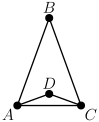
Como el es isósceles,
Como el es isósceles,
Por lo tanto
Por lo tanto, la respuesta correcta es D.
Since is isosceles,
Since is isosceles,
Therefore
Thus, the correct answer is D.
7.
Sean y cinco términos consecutivos de una progresión aritmética, y supongamos que ¿Cuál de las siguientes se puede determinar?
Let and be five consecutive terms in an arithmetic sequence, and suppose that Which of the following can be found?
Respuesta: C
Pista pequeña:
Escribe los cinco términos como para una diferencia común .
Write the five terms as for a common difference
Pista grande:
La suma se reduce a mientras que los términos externos siguen dependiendo de la incógnita .
The sum collapses to while the outer terms still depend on the unknown
Solución:
Sea la diferencia común. Entonces y así que
Así que lo que da
Los demás términos no pueden determinarse: las sucesiones y satisfacen ambas las condiciones pero difieren en todos los términos salvo el del medio.
Por lo tanto, la respuesta correcta es C.
Let be the common difference. Then and so
Thus giving
The other terms cannot be determined: the sequences and both satisfy the conditions but differ in every term except the middle one.
Thus, the correct answer is C.
8.
Se dibuja un polígono estrellado sobre la esfera de un reloj trazando una cuerda desde cada número hasta el quinto número contado en sentido horario a partir de ese número. Es decir, se trazan cuerdas desde hasta desde hasta desde hasta y así sucesivamente, terminando de nuevo en ¿Cuál es la medida en grados del ángulo en cada vértice del polígono estrellado?
A star-polygon is drawn on a clock face by drawing a chord from each number to the fifth number counted clockwise from that number. That is, chords are drawn from to from to from to and so on, ending back at What is the degree measure of the angle at each vertex in the star-polygon?
Respuesta: C
Pista pequeña:
Cada ángulo de vértice es un ángulo inscrito en el círculo que pasa por los números del reloj.
Each vertex angle is an inscribed angle in the circle through the clock numbers
Pista grande:
Las dos cuerdas que se encuentran en un vértice recortan un arco que abarca dos marcas horarias, o .
The two chords meeting at a vertex cut off an arc spanning two hour-marks, or
Solución:
Considera las dos cuerdas que se encuentran en el número Van hacia y hacia así que el arco que subtienden se extiende desde hasta
Ese arco abarca dos de las doce marcas horarias, así que su medida es
Por el Teorema del Ángulo Inscrito, el ángulo del vértice es la mitad del arco, o Por simetría, cada ángulo de vértice es igual a
Por lo tanto, la respuesta correcta es C.
Consider the two chords meeting at the number They run to and to so the arc they subtend extends from to
That arc spans two of the twelve hour-marks, so its measure is
By the Inscribed Angle Theorem, the vertex angle is half the arc, or By symmetry every vertex angle equals
Thus, the correct answer is C.
9.
Yan está en algún lugar entre su casa y el estadio. Para llegar al estadio puede caminar directamente hasta el estadio, o bien puede caminar a casa y luego ir en bicicleta al estadio. Va en bicicleta veces más rápido de lo que camina, y ambas opciones requieren la misma cantidad de tiempo. ¿Cuál es la razón entre la distancia de Yan a su casa y su distancia al estadio?
Yan is somewhere between his home and the stadium. To get to the stadium he can walk directly to the stadium, or else he can walk home and then ride his bicycle to the stadium. He rides times as fast as he walks, and both choices require the same amount of time. What is the ratio of Yan’s distance from his home to his distance from the stadium?
Respuesta: B
Pista pequeña:
Sea la velocidad al caminar igual a y sean y las distancias a la casa y al estadio.
Let the walking speed be and let and be the distances to home and to the stadium
Pista grande:
Iguala los dos tiempos: .
Equate the two times:
Solución:
Sea la velocidad al caminar y sean y las distancias de Yan a su casa y al estadio.
Caminar al estadio toma Caminar a casa y luego ir en bicicleta toma
Igualando estos se obtiene así que y
Por lo tanto, la respuesta correcta es B.
Let be the walking speed and let and be Yan’s distances from home and from the stadium.
Walking to the stadium takes Walking home then biking takes
Setting these equal gives so and
Thus, the correct answer is B.
10.
Un triángulo con longitudes de lados en la razón está inscrito en un círculo de radio ¿Cuál es el área del triángulo?
A triangle with side lengths in the ratio is inscribed in a circle of radius What is the area of the triangle?
Respuesta: A
Pista pequeña:
Un triángulo es rectángulo, así que su hipotenusa es un diámetro del círculo.
A triangle is right-angled, so its hypotenuse is a diameter of the circle
Pista grande:
La hipotenusa es igual al diámetro luego el área es .
The hypotenuse equals the diameter then the area is
Solución:
Sean los lados y El triángulo es rectángulo, así que su hipotenusa es un diámetro.
Así que lo que da
El área es
Por lo tanto, la respuesta correcta es A.
Let the sides be and The triangle is right, so its hypotenuse is a diameter.
Thus giving
The area is
Thus, the correct answer is A.
11.
Una sucesión finita de enteros de tres dígitos tiene la propiedad de que las cifras de las decenas y de las unidades de cada término son, respectivamente, las cifras de las centenas y de las decenas del término siguiente, y las cifras de las decenas y de las unidades del último término son, respectivamente, las cifras de las centenas y de las decenas del primer término. Por ejemplo, tal sucesión podría comenzar con los términos y y terminar con el término Sea la suma de todos los términos de la sucesión. ¿Cuál es el mayor número primo que siempre divide a ?
A finite sequence of three-digit integers has the property that the tens and units digits of each term are, respectively, the hundreds and tens digits of the next term, and the tens and units digits of the last term are, respectively, the hundreds and tens digits of the first term. For example, such a sequence might begin with terms and and end with the term Let be the sum of all the terms in the sequence. What is the largest prime number that always divides
Respuesta: D
Pista pequeña:
A lo largo de todo el ciclo, cada dígito actúa una vez como cifra de las centenas, una vez como cifra de las decenas, y una vez como cifra de las unidades.
Across the whole cycle, each digit serves once as a hundreds digit, once as a tens digit, and once as a units digit
Pista grande:
La suma es veces el total de las cifras de las unidades, y .
The sum is times the total of the units digits, and
Solución:
Debido a la propiedad cíclica, cada dígito que aparece se usa el mismo número de veces en las posiciones de las centenas, las decenas y las unidades.
Sea la suma de las cifras de las unidades sobre todos los términos. Entonces
Así que siempre es divisible entre No tiene por qué ser divisible entre nada mayor: la sucesión da
Por lo tanto, la respuesta correcta es D.
Because of the cycling property, each digit that appears is used the same number of times in the hundreds, tens, and units places.
Let be the sum of the units digits over all terms. Then
So is always divisible by It need not be divisible by anything larger: the sequence gives
Thus, the correct answer is D.
12.
Los enteros y no necesariamente distintos, se eligen de forma independiente y al azar desde hasta inclusive. ¿Cuál es la probabilidad de que sea par?
Integers and not necessarily distinct, are chosen independently and at random from to inclusive. What is the probability that is even?
Respuesta: E
Pista pequeña:
es par exactamente cuando y tienen la misma paridad.
is even exactly when and have the same parity
Pista grande:
Un producto como es impar con probabilidad y par con probabilidad .
A product like is odd with probability and even with probability
Solución:
Exactamente la mitad de los enteros desde hasta son impares.
Un producto es impar solo cuando ambos factores son impares, con probabilidad y par con probabilidad Lo mismo vale para
Entonces es par cuando ambos productos son impares o ambos son pares:
Por lo tanto, la respuesta correcta es E.
Exactly half of the integers from to are odd.
A product is odd only when both factors are odd, with probability and even with probability The same holds for
Then is even when both products are odd or both are even:
Thus, the correct answer is E.
13.
Un trozo de queso está ubicado en en un plano de coordenadas. Un ratón está en y corre subiendo por la recta En el punto el ratón comienza a alejarse del queso en lugar de acercarse. ¿Cuánto vale ?
A piece of cheese is located at in a coordinate plane. A mouse is at and is running up the line At the point the mouse starts getting farther from the cheese rather than closer to it. What is
Respuesta: B
Pista pequeña:
El punto más cercano en la recta es el pie de la perpendicular trazada desde el queso.
The closest point on the line is the foot of the perpendicular from the cheese
Pista grande:
La perpendicular que pasa por tiene pendiente ; interséctala con .
The perpendicular through has slope ; intersect it with
Solución:
El ratón está más cerca del queso en el pie de la perpendicular trazada desde hasta la recta.
Esta perpendicular tiene pendiente así que su ecuación es
Igualando se obtiene y Así que y
Por lo tanto, la respuesta correcta es B.
The mouse is closest to the cheese at the foot of the perpendicular from to the line.
This perpendicular has slope so its equation is
Setting gives and Thus and
Thus, the correct answer is B.
14.
Sean y enteros distintos tales que
¿Cuánto vale ?
Let and be distinct integers such that
What is
Respuesta: C
Pista pequeña:
Los cinco factores son enteros distintos cuyo producto es .
The five factors are distinct integers whose product is
Pista grande:
Verifica los divisores positivos y negativos de ; solo da cinco factores distintos.
Check the positive and negative divisors of ; only gives five distinct factors
Solución:
Los cinco factores son enteros distintos no nulos con producto así que cada uno es un divisor positivo o negativo de Verificando solo el conjunto de cinco elementos tiene producto
Entonces son en algún orden, y su suma es
Por lo tanto, la respuesta correcta es C.
The five factors are distinct nonzero integers with product so each is a positive or negative divisor of Checking only the five-element set has product
Then are in some order, and their sum is
Thus, the correct answer is C.
15.
Al conjunto se le agrega un quinto elemento que no es igual a ninguno de los otros cuatro. La mediana del conjunto resultante es igual a su media. ¿Cuál es la suma de todos los valores posibles de ?
The set is augmented by a fifth element not equal to any of the other four. The median of the resulting set is equal to its mean. What is the sum of all possible values of
Respuesta: E
Pista pequeña:
La media de los cinco números es .
The mean of the five numbers is
Pista grande:
Divide en casos: la mediana es cuando es cuando y cuando .
Split into cases: the median is when it is when and when
Solución:
La media es
Si la mediana es así que y
Si la mediana es así que y
Si la mediana es así que y
La suma de todos los valores posibles es
Por lo tanto, la respuesta correcta es E.
The mean is
If the median is so and
If the median is so and
If the median is so and
The sum of all possible values is
Thus, the correct answer is E.
16.
¿Cuántos números de tres dígitos están compuestos por tres dígitos distintos tales que uno de los dígitos es el promedio de los otros dos?
How many three-digit numbers are composed of three distinct digits such that one digit is the average of the other two?
Respuesta: C
Pista pequeña:
Los tres dígitos deben formar una progresión aritmética en algún orden.
The three digits must form an arithmetic progression in some order
Pista grande:
Cuenta las progresiones por diferencia común, luego ordena cada conjunto, dando menos ordenamientos para los conjuntos que contienen .
Count the progressions by common difference, then arrange each set, giving fewer arrangements for sets containing
Solución:
Los tres dígitos distintos forman una progresión aritmética creciente. Contando por diferencia común: con diferencia con diferencia con diferencia y con diferencia para conjuntos.
De estos, conjuntos contienen (a saber ); cada uno produce números válidos, ya que no puede ir al inicio.
Los otros conjuntos producen cada uno números. El total es
Por lo tanto, la respuesta correcta es C.
The three distinct digits form an increasing arithmetic progression. Counting by common difference: with difference with difference with difference and with difference for sets.
Of these, sets contain (namely ); each yields valid numbers since cannot lead.
The other sets each yield numbers. The total is
Thus, the correct answer is C.
17.
Supongamos que y ¿Cuánto vale ?
Suppose that and What is
Respuesta: B
Pista pequeña:
Eleva al cuadrado ambas ecuaciones dadas y súmalas.
Square both given equations and add them
Pista grande:
Usa para despejar .
Use to isolate
Solución:
Al elevar al cuadrado ambas ecuaciones se obtiene y
Sumando y usando dos veces,
Así que
Por lo tanto, la respuesta correcta es B.
Squaring both equations gives and
Adding and using twice,
So
Thus, the correct answer is B.
18.
El polinomio tiene coeficientes reales, y ¿Cuánto vale ?
The polynomial has real coefficients, and What is
Respuesta: D
Pista pequeña:
Los coeficientes reales obligan a que los conjugados y también sean raíces.
Real coefficients force the conjugates and to be roots as well
Pista grande:
; la suma es igual a .
; the sum equals
Solución:
Como tiene coeficientes reales, los conjugados y también son raíces. Por lo tanto
Entonces De forma equivalente,
Por lo tanto, la respuesta correcta es D.
Since has real coefficients, the conjugates and are also roots. Thus
Then Equivalently,
Thus, the correct answer is D.
19.
Los triángulos y tienen áreas y respectivamente, con y ¿Cuál es la suma de todas las posibles coordenadas de ?
Triangles and have areas and respectively, with and What is the sum of all possible -coordinates of
Respuesta: E
Pista pequeña:
El área del fija la altura desde hasta así que está sobre o .
The area of fixes the altitude from to so lies on or
Pista grande:
Del mismo modo, está sobre una de dos rectas paralelas a ; los cuatro puntos de intersección promedian el centro de un paralelogramo.
Likewise lies on one of two lines parallel to ; the four intersection points average to the center of a parallelogram
Solución:
La altura desde en el satisface así que Por lo tanto está sobre o
La recta tiene ecuación La condición sobre el coloca de forma análoga a sobre una de dos rectas paralelas a
Las cuatro posibles posiciones de son los vértices de un paralelogramo cuyo centro es la intersección de con la recta a saber Por lo tanto, la suma de las cuatro coordenadas es
Por lo tanto, la respuesta correcta es E.
The altitude from in satisfies so Thus lies on or
Line has equation The condition on similarly places on one of two lines parallel to
The four possible positions of are the vertices of a parallelogram whose center is the intersection of with line namely Hence the sum of the four -coordinates is
Thus, the correct answer is E.
20.
Se cortan las esquinas de un cubo unitario de modo que cada una de las seis caras se convierte en un octágono regular. ¿Cuál es el volumen total de los tetraedros retirados?
Corners are sliced off a unit cube so that the six faces each become regular octagons. What is the total volume of the removed tetrahedra?
Respuesta: B
Pista pequeña:
Cortar una longitud de cada extremo de una arista deja un lado del octágono de .
Cutting length from each end of an edge leaves an octagon side of
Pista grande:
A partir de halla ; cada tetraedro de esquina tiene volumen .
From find ; each corner tetrahedron has volume
Solución:
El corte retira dos segmentos iguales de longitud de cada arista. Cada octágono tiene entonces lado de longitud y la arista satisface así que
Cada esquina retirada es un tetraedro con tres catetos mutuamente perpendiculares de longitud así que su volumen es Hay esquinas, lo que da un volumen total
Por lo tanto, la respuesta correcta es B.
Slicing removes two equal segments of length from each edge. Each octagon then has side length and the edge satisfies so
Each removed corner is a tetrahedron with three mutually perpendicular legs of length so its volume is There are corners, giving total volume
Thus, the correct answer is B.
21.
La suma de los ceros, el producto de los ceros, y la suma de los coeficientes de la función son iguales. ¿Cuál de los siguientes también debe ser su valor común?
The sum of the zeros, the product of the zeros, and the sum of the coefficients of the function are equal. Their common value must also be which of the following?
el coeficiente de
the coefficient of
el coeficiente de
the coefficient of
la intersección con el eje de la gráfica de
the -intercept of the graph of
una de las intersecciones con el eje de la gráfica de
one of the -intercepts of the graph of
el promedio de las intersecciones con el eje de la
gráfica de
the mean of the -intercepts of the graph of
Respuesta: A
Pista pequeña:
Para la suma de los ceros es y el producto es .
For the sum of zeros is and the product is
Pista grande:
Al igualar estos se obtiene así que la suma de los coeficientes se simplifica.
Setting these equal gives so the sum of coefficients simplifies
Solución:
El producto de los ceros es y la suma de los ceros es Igualándolos se obtiene
Entonces la suma de los coeficientes es que es el coeficiente de
Las otras opciones fallan en general: para el valor común es pero el coeficiente de es la intersección con el eje es las intersecciones con el eje son y su promedio es
Por lo tanto, la respuesta correcta es A.
The product of the zeros is and the sum of the zeros is Equating them gives
Then the sum of the coefficients is which is the coefficient of
The other choices fail in general: for the common value is but the coefficient of is the -intercept is the -intercepts are and their mean is
Thus, the correct answer is A.
22.
Para cada entero positivo sea la suma de las cifras de ¿Para cuántos valores de se cumple ?
For each positive integer let denote the sum of the digits of For how many values of is
Respuesta: D
Pista pequeña:
Los tres, y dejan el mismo residuo módulo .
All three of and leave the same remainder modulo
Pista grande:
Como es múltiplo de cada uno es múltiplo de ; además .
Since is a multiple of each is a multiple of ; also
Solución:
Para y luego Así que cualquier solución cumple
Además y son congruentes módulo y es múltiplo de así que los tres deben ser múltiplos de
Revisando los múltiplos de entre y (muchos se eliminan porque ya supera ) quedan y Eso da valores.
Por lo tanto, la respuesta correcta es D.
For and then So any solution has
Also and are congruent modulo and is a multiple of so all three must be multiples of
Checking the multiples of between and (many are eliminated because already exceeds ) leaves and That is values.
Thus, the correct answer is D.
23.
El cuadrado tiene área y es paralelo al eje . Los vértices y están sobre las gráficas de y respectivamente. ¿Cuánto vale ?
Square has area and is parallel to the -axis. Vertices and are on the graphs of and respectively. What is
Respuesta: A
Pista pequeña:
Como es horizontal con longitud plantea lo que da .
Since is horizontal with length set giving
Pista grande:
Resuelve para luego usa .
Solve for then use
Solución:
Sea y Como es horizontal, así que
La longitud del lado es cuya única solución positiva es
Como el lado vertical da Así que por lo que
Por lo tanto, la respuesta correcta es A.
Let and Since is horizontal, so
The side length is whose only positive solution is
Since the vertical side gives Thus so
Thus, the correct answer is A.
24.
Para cada entero sea el número de soluciones de la ecuación en el intervalo ¿Cuánto vale ?
For each integer let be the number of solutions of the equation on the interval What is
Respuesta: D
Pista pequeña:
cuenta las intersecciones de y en usualmente dos por cada joroba de .
counts intersections of and on usually two per hump of
Pista grande:
excepto cuando donde un máximo compartido lo reduce a .
except when where a shared maximum drops it to
Solución:
En cada intervalo donde , las gráficas de y se encuentran dos veces, a menos que compartan allí el valor , en cuyo caso se encuentran una vez. Contando las jorobas y el extremo en se obtiene lo siguiente.
cuando es par o y cuando
Por lo tanto La primera suma es y hay valores en el rango, lo que da
Por lo tanto, la respuesta correcta es D.
On each interval where the graphs of and meet twice, unless they share the value there, in which case they meet once. Counting the humps and the endpoint at gives
when is even or and when
Thus The first sum is and there are values in the range, giving
Thus, the correct answer is D.
25.
Llamamos espaciado a un conjunto de enteros si contiene no más de uno de cada tres enteros consecutivos. ¿Cuántos subconjuntos de incluido el conjunto vacío, son espaciados?
Call a set of integers spacy if it contains no more than one out of any three consecutive integers. How many subsets of including the empty set, are spacy?
Respuesta: E
Pista pequeña:
Sea el número de subconjuntos espaciados de ; condiciona según si está incluido.
Let count the spacy subsets of ; condition on whether is included
Pista grande:
Excluir da ; incluirlo prohíbe dando así que .
Excluding gives ; including it forbids giving so
Solución:
Sea el número de subconjuntos espaciados de Un subconjunto espaciado o bien omite (hay de estos) o bien contiene en cuyo caso omite y (hay de estos).
Por lo tanto con
La sucesión continúa así que
Por lo tanto, la respuesta correcta es E.
Let be the number of spacy subsets of A spacy subset either omits (there are of these) or contains in which case it omits and (there are of these).
Hence with
The sequence continues so
Thus, the correct answer is E.