
Problemas del 2005 AMC 10B
¡Desplázate hacia abajo y presiona Iniciar para intentar el examen! O ve al PDF imprimible, la clave de respuestas, o las soluciones profesionales preparadas por LIVE by Po-Shen Loh.
Todos los problemas se usan con el permiso legal oficial de la Mathematical Association of America (MAA).
O salta directamente a un solo problema con su solución: 1 · 2 · 3 · 4 · 5 · 6 · 7 · 8 · 9 · 10 · 11 · 12 · 13 · 14 · 15 · 16 · 17 · 18 · 19 · 20 · 21 · 22 · 23 · 24 · 25
¿Quieres aprender de forma profesional con clases interactivas en video?
Con tiempo
1:15:00
1.
Una tropa de scouts compra barras de dulce a un precio de cinco por Venden todas las barras a un precio de dos por ¿Cuál fue su ganancia, en dólares?
A scout troop buys candy bars at a price of five for They sell all the candy bars at a price of two for What was their profit, in dollars?
Respuesta: A
Pista pequeña:
Halla por separado el costo total y el ingreso total.
Find the total cost and the total revenue separately
Pista grande:
Las barras forman grupos de cinco y pares.
The bars come in groups of five and pairs
Solución:
La tropa compra grupos de cinco barras, con un costo de dólares.
Venden pares de barras, con un ingreso de dólares.
La ganancia es
Por lo tanto, A es la respuesta correcta.
The troop buys groups of five bars, costing dollars.
They sell pairs of bars, earning dollars.
The profit is
Thus, A is the correct answer.
2.
Un número positivo tiene la propiedad de que el de es ¿Cuánto vale ?
A positive number has the property that of is What is
Respuesta: D
Pista pequeña:
significa .
means
Pista grande:
Plantea y despeja .
Set up and solve for
Solución:
El enunciado se traduce en así que
Como es positivo,
Por lo tanto, D es la respuesta correcta.
The statement translates to so
Since is positive,
Thus, D is the correct answer.
3.
Se usa un galón de pintura para pintar una habitación. El primer día se usa un tercio de la pintura. El segundo día se usa un tercio de la pintura restante. ¿Qué fracción de la cantidad original de pintura queda disponible para usar el tercer día?
A gallon of paint is used to paint a room. One third of the paint is used on the first day. On the second day, one third of the remaining paint is used. What fraction of the original amount of paint is available to use on the third day?
Respuesta: D
Pista pequeña:
Después del primer día, queda de la pintura.
After day one, of the paint remains
Pista grande:
El segundo día se usa de ese .
On day two, of that is used
Solución:
Después del primer día, queda de la pintura.
El segundo día se usa de la cantidad original.
La fracción disponible el tercer día es
Por lo tanto, D es la respuesta correcta.
After the first day, of the paint remains.
On the second day, of the original amount is used.
The fraction available on the third day is
Thus, D is the correct answer.
4.
Para los números reales y se define ¿Cuál es el valor de
For real numbers and define What is the value of
Respuesta: D
Pista pequeña:
Evalúa primero las dos operaciones internas.
Evaluate the two inner operations first
Pista grande:
Tanto como valen .
Both and equal
Solución:
La primera expresión interna se evalúa como y, de forma análoga,
Entonces
Por lo tanto, D es la respuesta correcta.
Each inner expression evaluates to and similarly
Then
Thus, D is the correct answer.
5.
Brianna usa parte del dinero que ganó en su trabajo de fin de semana para comprar varios CD que cuestan lo mismo. Usó un quinto de su dinero para comprar un tercio de los CD. ¿Qué fracción de su dinero le quedará después de comprar todos los CD?
Brianna is using part of the money she earned on her weekend job to buy several equally-priced CDs. She used one fifth of her money to buy one third of the CDs. What fraction of her money will she have left after she buys all the CDs?
Respuesta: C
Pista pequeña:
Comprar todos los CD cuesta tres veces lo que cuesta comprar un tercio de ellos.
Buying all the CDs costs three times as much as buying one third of them
Pista grande:
Todos los CD cuestan de su dinero.
All the CDs cost of her money
Solución:
Comprar todos los CD cuesta tres veces lo que cuesta comprar un tercio de ellos, es decir de su dinero.
La fracción que le queda es
Por lo tanto, C es la respuesta correcta.
Buying all the CDs costs three times as much as buying one third of them, namely of her money.
The fraction left over is
Thus, C is the correct answer.
6.
Al comienzo del año escolar, la meta de Lisa era sacar una A en al menos el de sus exámenes cortos del año. Sacó una A en de los primeros exámenes cortos. Si quiere cumplir su meta, ¿en cuántos de los exámenes cortos restantes puede a lo sumo sacar una nota menor que A?
At the beginning of the school year, Lisa’s goal was to earn an A on at least of her quizzes for the year. She earned an A on of the first quizzes. If she is to achieve her goal, on at most how many of the remaining quizzes can she earn a grade lower than an A?
Respuesta: B
Pista pequeña:
Halla cuántas A necesita en total.
Find how many A’s she needs in total
Pista grande:
Necesita A, y quedan exámenes cortos.
She needs A’s, and quizzes remain
Solución:
Lisa necesita una A en al menos exámenes cortos.
Ya tiene así que necesita A entre los exámenes cortos restantes.
Eso deja a lo sumo exámenes cortos con una nota menor que A.
Por lo tanto, B es la respuesta correcta.
Lisa needs an A on at least quizzes.
She already has so she needs A’s among the remaining quizzes.
That leaves at most quizzes with a grade lower than an A.
Thus, B is the correct answer.
7.
Se inscribe un círculo en un cuadrado, luego se inscribe un cuadrado en ese círculo y, por último, se inscribe un círculo en ese cuadrado. ¿Cuál es la razón entre el área del círculo menor y el área del cuadrado mayor?
A circle is inscribed in a square, then a square is inscribed in this circle, and finally, a circle is inscribed in this square. What is the ratio of the area of the smaller circle to the area of the larger square?
Respuesta: B
Pista pequeña:
Sea el radio del círculo menor y avanza hacia afuera.
Let the smaller circle have radius and work outward
Pista grande:
El radio del círculo mayor es la mitad de la diagonal del cuadrado menor, .
The larger circle’s radius is half the diagonal of the smaller square,
Solución:
El círculo menor tiene radio así que su área es
El cuadrado menor, que circunscribe este círculo, tiene lado y su diagonal es el diámetro del círculo mayor. Así, el círculo mayor tiene radio
El cuadrado mayor circunscribe el círculo mayor, así que tiene lado y área
La razón buscada es
Por lo tanto, B es la respuesta correcta.
Let the smaller circle have radius so its area is
The smaller square, which circumscribes this circle, has side and its diagonal is the diameter of the larger circle. So the larger circle has radius
The larger square circumscribes the larger circle, so it has side and area
The desired ratio is
Thus, B is the correct answer.
8.
Un piso de pies por pies está cubierto con baldosas cuadradas de pie por pie. Cada baldosa tiene un patrón formado por cuatro cuartos de círculo blancos de radio pie centrados en cada esquina de la baldosa. La parte restante de la baldosa está sombreada. ¿Cuántos pies cuadrados del piso están sombreados?

An -foot by -foot floor is tiled with square tiles of size foot by foot. Each tile has a pattern consisting of four white quarter circles of radius foot centered at each corner of the tile. The remaining portion of the tile is shaded. How many square feet of the floor are shaded?
Respuesta: A
Pista pequeña:
Los cuatro cuartos de círculo de una baldosa se combinan en un círculo completo.
The four quarter circles on one tile combine into one full circle
Pista grande:
Cada baldosa tiene área sombreada y hay baldosas.
Each tile has shaded area and there are tiles
Solución:
Los cuatro cuartos de círculo de una baldosa forman juntos un círculo completo de radio con área
Así, cada baldosa tiene un área sombreada de pies cuadrados.
Hay baldosas, así que el área sombreada total es
Por lo tanto, A es la respuesta correcta.
The four quarter circles on a tile together make one full circle of radius with area
So each tile has shaded area square feet.
There are tiles, so the total shaded area is
Thus, A is the correct answer.
9.
Un dado justo tiene caras y otro tiene caras Se lanzan los dados y se suman los números de las caras superiores. ¿Cuál es la probabilidad de que la suma sea impar?
One fair die has faces and another has faces The dice are rolled and the numbers on the top faces are added. What is the probability that the sum will be odd?
Respuesta: D
Pista pequeña:
Una suma es impar exactamente cuando un dado es par y el otro es impar.
A sum is odd exactly when one die is even and the other is odd
Pista grande:
El primer dado da un número impar con probabilidad el segundo, con probabilidad .
The first die is odd with probability the second is odd with probability
Solución:
El primer dado es impar (un o ) con probabilidad y par con probabilidad El segundo dado es impar (un ) con probabilidad y par con probabilidad
La suma es impar cuando las dos paridades difieren:
Por lo tanto, D es la respuesta correcta.
The first die is odd (a or ) with probability and even with probability The second die is odd (a ) with probability and even with probability
The sum is odd when the two parities differ:
Thus, D is the correct answer.
10.
En el tenemos y Supón que es un punto en la recta tal que está entre y y ¿Cuánto vale ?
In we have and Suppose that is a point on line such that lies between and and What is
Respuesta: A
Pista pequeña:
Traza la altura desde a la recta su pie es el punto medio de .
Drop the altitude from to line its foot is the midpoint of
Pista grande:
La altura tiene longitud compartida por los triángulos rectángulos y .
The altitude has length shared by right triangles and
Solución:
Sea el pie de la altura desde a la recta Como es el punto medio de así que y
Al aplicar el teorema de Pitágoras en el donde se obtiene así que
Entonces así que
Por lo tanto, A es la respuesta correcta.
Let be the foot of the altitude from to line Since is the midpoint of so and
Applying the Pythagorean theorem in where gives so
Then so
Thus, A is the correct answer.
11.
El primer término de una sucesión es Cada término siguiente es la suma de los cubos de los dígitos del término anterior. ¿Cuál es el término de la sucesión?
The first term of a sequence is Each succeeding term is the sum of the cubes of the digits of the previous term. What is the th term of the sequence?
Respuesta: E
Pista pequeña:
Calcula los primeros términos hasta que los valores empiecen a repetirse.
Compute the first several terms until the values start repeating
Pista grande:
Una vez hallado el ciclo, reduce módulo su longitud el número de pasos posteriores al primer término.
Once you find the repeating cycle, reduce the number of steps after the first term modulo its length
Solución:
La sucesión comienza así que después del primer término repite el ciclo de longitud
Los términos y son la primera, segunda y tercera entradas del ciclo. Como deja residuo al dividirse entre el término coincide con la tercera entrada,
Por lo tanto, E es la respuesta correcta.
The sequence begins so after the first term it repeats the cycle of length
Terms and are the first, second, and third entries of this cycle. Because leaves remainder upon division by the th term matches the third entry,
Thus, E is the correct answer.
12.
Se lanzan doce dados justos. ¿Cuál es la probabilidad de que el producto de los números de las caras superiores sea primo?
Twelve fair dice are rolled. What is the probability that the product of the numbers on the top faces is prime?
Respuesta: E
Pista pequeña:
Un producto de enteros positivos es primo solo cuando un factor es primo y los demás son .
A product of positive integers is prime only when one factor is a prime and the rest are
Pista grande:
Elige qué dado muestra el primo, y cuál primo; los otros dados deben mostrar .
Choose which die shows the prime, and which prime; the other dice must show
Solución:
El producto es primo exactamente cuando un dado muestra un primo ( o ) y los otros once muestran todos
La probabilidad de que un dado cualquiera sea el que muestra el primo es y cada uno de los otros once muestra con probabilidad Teniendo en cuenta cuál de los doce dados es el primo, la probabilidad es
Por lo tanto, E es la respuesta correcta.
The product is prime exactly when one die shows a prime ( or ) and the other eleven all show
The probability that any single die is the prime one is and each of the other eleven shows with probability Accounting for which of the twelve dice is prime, the probability is
Thus, E is the correct answer.
13.
¿Cuántos números entre y son múltiplos enteros de o pero no de ?
How many numbers between and are integer multiples of or but not
Respuesta: C
Pista pequeña:
Cuenta por separado los múltiplos de y de , notando que los múltiplos de son la parte común.
Count multiples of and of separately, noting that multiples of are the overlap
Pista grande:
De los múltiplos de y de los múltiplos de , quita los múltiplos de .
From each of the -multiples and -multiples, remove the -multiples
Solución:
Entre y hay múltiplos de múltiplos de y múltiplos de
Todo múltiplo de es a la vez múltiplo de y de así que quitarlos de cada grupo da números que son múltiplos de o pero no de
Por lo tanto, C es la respuesta correcta.
Between and there are multiples of multiples of and multiples of
Every multiple of is both a multiple of and of so removing them from each group gives numbers that are multiples of or but not
Thus, C is the correct answer.
14.
El equilátero tiene lado es el punto medio de y es el punto medio de ¿Cuál es el área del ?
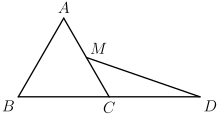
Equilateral has side length is the midpoint of and is the midpoint of What is the area of
Respuesta: C
Pista pequeña:
Toma como base; tiene longitud .
Take as the base; it has length
Pista grande:
La altura desde a la recta es la mitad de la altura del .
The height from to line is half the height of
Solución:
Toma como base. Como es el punto medio de y tenemos
La altura del es la distancia desde a la recta Como es el punto medio de esta distancia es la mitad de la altura del que es
El área es
Por lo tanto, C es la respuesta correcta.
Take as the base. Since is the midpoint of and we have
The height of is the distance from to line Because is the midpoint of this distance is half the height of which is
The area is
Thus, C is the correct answer.
15.
Un sobre contiene ocho billetes: de un dólar, de cinco, de diez y de veinte. Se sacan dos billetes al azar sin reemplazo. ¿Cuál es la probabilidad de que su suma sea o más?
An envelope contains eight bills: ones, fives, tens, and twenties. Two bills are drawn at random without replacement. What is the probability that their sum is or more?
Respuesta: D
Pista pequeña:
Hay pares de billetes igualmente probables.
There are equally likely pairs of bills
Pista grande:
Una suma de o más requiere los dos de diez, los dos de veinte, o un veinte con cualquier otro billete.
A sum of or more needs both tens, both twenties, or a twenty with any other bill
Solución:
Hay pares igualmente probables.
Una suma de al menos proviene de los dos de veinte ( forma), un veinte junto con cualquiera de los seis billetes menores ( formas), o los dos de diez ( forma).
La probabilidad es
Por lo tanto, D es la respuesta correcta.
There are equally likely pairs.
A sum of at least comes from both twenties ( way), a twenty paired with any of the six smaller bills ( ways), or both tens ( way).
The probability is
Thus, D is the correct answer.
16.
La ecuación cuadrática tiene raíces que son el doble de las de y ninguno de y es cero. ¿Cuál es el valor de ?
The quadratic equation has roots that are twice those of and none of and is zero. What is the value of
Respuesta: D
Pista pequeña:
Sean las raíces de iguales a y luego usa las fórmulas de Vieta en ambas ecuaciones.
Let the roots of be and then use Vieta’s formulas on both equations
Pista grande:
Expresa y en términos de y .
Express and in terms of and
Solución:
Sean y las raíces de así que y
Las raíces de son y así que y
Entonces y así que Por lo tanto
Por lo tanto, D es la respuesta correcta.
Let and be the roots of so and
The roots of are and so and
Then and so Therefore
Thus, D is the correct answer.
17.
Supón que y ¿Cuánto vale ?
Suppose that and What is
Respuesta: B
Pista pequeña:
Eleva a potencias las ecuaciones sucesivas para que los exponentes se multipliquen.
Raise successive equations to powers so the exponents multiply
Pista grande:
se reduce telescópicamente a escribe como potencia de .
telescopes down to write as a power of
Solución:
Encadenando las ecuaciones,
Como concluimos que
Por lo tanto, B es la respuesta correcta.
Chaining the equations,
Since we conclude
Thus, B is the correct answer.
18.
Todos los números de teléfono de David tienen la forma donde y son dígitos distintos y en orden creciente, y ninguno es ni ¿Cuántos números de teléfono distintos puede tener David?
All of David’s telephone numbers have the form where and are distinct digits and in increasing order, and none is either or How many different telephone numbers can David have?
Respuesta: D
Pista pequeña:
Los siete dígitos provienen de y su orden está determinado.
The seven digits come from and their order is forced
Pista grande:
Elegir los siete dígitos es lo mismo que elegir el único dígito que se deja fuera.
Once the omitted digit is chosen, every digit’s position in the phone number is determined
Solución:
Los siete dígitos se eligen de y una vez elegidos deben escribirse en orden creciente, así que solo importa la elección de los dígitos.
Elegir siete de estos ocho dígitos es lo mismo que elegir el único dígito que se deja fuera, lo cual puede hacerse de maneras.
Por lo tanto, D es la respuesta correcta.
The seven digits are chosen from and once chosen they must be written in increasing order, so only the choice of digits matters.
Choosing seven of these eight digits is the same as choosing the one digit to leave out, which can be done in ways.
Thus, D is the correct answer.
19.
En cierto examen de matemáticas, el de los estudiantes obtuvo puntos, el obtuvo puntos, el obtuvo puntos, el obtuvo puntos, y el resto obtuvo puntos. ¿Cuál es la diferencia entre la media y la mediana de las notas de este examen?
On a certain math exam, of the students got points, got points, got points, got points, and the rest got points. What is the difference between the mean and the median score on this exam?
Respuesta: B
Pista pequeña:
El porcentaje restante obtuvo hállalo primero.
The remaining percentage scored find it first
Pista grande:
Para la mediana, halla qué nota obtuvo el estudiante del medio usando los porcentajes acumulados.
For the median, find which score the middle student earned using the cumulative percentages
Solución:
El porcentaje que obtuvo es
La media es
Como el obtuvo menos de y el obtuvo más de el estudiante del medio obtuvo así que la mediana es
La diferencia es
Por lo tanto, B es la respuesta correcta.
The percentage scoring is
The mean is
Since scored below and scored above the middle student scored so the median is
The difference is
Thus, B is the correct answer.
20.
¿Cuál es el promedio (media) de todos los números de dígitos que se pueden formar usando cada uno de los dígitos y exactamente una vez?
What is the average (mean) of all -digit numbers that can be formed by using each of the digits and exactly once?
Respuesta: C
Pista pequeña:
Por simetría, cada dígito aparece con la misma frecuencia en cada posición.
By symmetry, each digit appears equally often in each place
Pista grande:
El dígito promedio en cada posición es luego multiplica por .
The average digit in each place is then multiply by
Solución:
Por simetría, cada uno de los cinco dígitos aparece con la misma frecuencia en cada posición, así que el dígito promedio en cada posición es
Por lo tanto, el número promedio es
Por lo tanto, C es la respuesta correcta.
By symmetry, each of the five digits appears equally often in each place, so the average digit in every place is
The average number is therefore
Thus, C is the correct answer.
21.
Se colocan cuarenta papeletas en un sombrero, cada una con un número o y cada número aparece en cuatro papeletas. Se sacan cuatro papeletas del sombrero al azar y sin reemplazo. Sea la probabilidad de que las cuatro papeletas tengan el mismo número. Sea la probabilidad de que dos de las papeletas tengan un número y las otras dos tengan un número ¿Cuál es el valor de ?
Forty slips are placed into a hat, each bearing a number or with each number entered on four slips. Four slips are drawn from the hat at random and without replacement. Let be the probability that all four slips bear the same number. Let be the probability that two of the slips bear a number and the other two bear a number What is the value of
Respuesta: A
Pista pequeña:
Ambas probabilidades comparten el denominador así que solo importan los conteos.
Both probabilities share the denominator so only the counts matter
Pista grande:
Cuenta las extracciones de cuatro iguales, luego las extracciones de la forma dos y dos .
Count four-of-a-kind draws, then draws of the form two ’s and two ’s
Solución:
Ambos eventos se extraen de selecciones igualmente probables, así que es la razón de sus conteos favorables.
Exactamente extracciones dan cuatro papeletas del mismo número, una por cada valor.
Para dos y dos , elige los dos valores de maneras, luego dos de las cuatro papeletas de y dos de las cuatro papeletas de :
Por lo tanto
Por lo tanto, A es la respuesta correcta.
Both events draw from equally likely selections, so is the ratio of their favorable counts.
Exactly draws give four slips of the same number, one for each value.
For two ’s and two ’s, choose the two values in ways, then two of the four -slips and two of the four -slips:
Therefore
Thus, A is the correct answer.
22.
¿Para cuántos enteros positivos menores o iguales que es divisible por ?
For how many positive integers less than or equal to is evenly divisible by
Respuesta: C
Pista pequeña:
Usa y simplifica .
Use and simplify
Pista grande:
La fracción reducida deja de ser un entero exactamente cuando es un primo impar.
The reduced fraction fails to be an integer exactly when is an odd prime
Solución:
Como la divisibilidad equivale a que sea un entero.
Sea Si es compuesto y no es un cuadrado, tiene dos factores propios distintos cuyo producto es ambos aparecen en Si con los factores y aparecen en ese factorial, que por tanto contiene un múltiplo de El caso compuesto restante, también divide a Así, la fracción es entera cuando es compuesto. Si es un primo impar, no divide ni a ni a por lo que la fracción no es entera. El primo par da que sí funciona.
Los primos impares menores o iguales que son que dan valores fallidos de Por tanto, funcionan valores.
Por lo tanto, C es la respuesta correcta.
Since divisibility is equivalent to being an integer.
Put If is composite and not a square, it has two distinct proper factors whose product is both occur in If with the factors and occur in that factorial, so it contains a multiple of The remaining composite case, also divides Thus the fraction is an integer whenever is composite. If is an odd prime, it divides neither nor so the fraction is not an integer. The even prime gives which works.
The odd primes at most are giving failing values of Hence values work.
Thus, C is the correct answer.
23.
En el trapecio tenemos paralelo a como punto medio de y como punto medio de El área de es el doble del área de ¿Cuánto vale ?
In trapezoid we have parallel to as the midpoint of and as the midpoint of The area of is twice the area of What is
Respuesta: C
Pista pequeña:
El segmento medio tiene longitud .
The midsegment has length
Pista grande:
Los dos trapecios menores comparten una altura, así que sus áreas se comparan como los promedios de sus lados paralelos.
The two smaller trapezoids share a height, so their areas compare like the averages of their parallel sides
Solución:
Sea y El segmento medio tiene longitud y y tienen la misma altura.
Sus áreas son proporcionales a los promedios de sus lados paralelos, así que
Entonces así que y
Por lo tanto, C es la respuesta correcta.
Let and The midsegment has length and and have the same height.
Their areas are proportional to the averages of their parallel sides, so
Then so and
Thus, C is the correct answer.
24.
Sean y enteros de dos dígitos tales que se obtiene invirtiendo los dígitos de Los enteros y satisfacen para algún entero positivo ¿Cuánto vale ?
Let and be two-digit integers such that is obtained by reversing the digits of The integers and satisfy for some positive integer What is
Respuesta: E
Pista pequeña:
Escribe y luego factoriza .
Write and then factor
Pista grande:
debe ser un cuadrado perfecto, lo que obliga a .
must be a perfect square, which forces
Solución:
Escribe y con Entonces
Como para que sea un cuadrado perfecto necesitamos que sea divisible por Como esto obliga a y entonces debe ser a su vez un cuadrado perfecto.
Con el único caso viable es que da Entonces y así que
Por lo tanto
Por lo tanto, E es la respuesta correcta.
Write and with Then
Since for to be a perfect square we need to be divisible by As this forces and then must itself be a perfect square.
With the only workable case is giving Then and so
Therefore
Thus, E is the correct answer.
25.
Un subconjunto del conjunto de enteros de a inclusive, tiene la propiedad de que no hay dos elementos de cuya suma sea ¿Cuál es el máximo número posible de elementos de ?
A subset of the set of integers from to inclusive, has the property that no two elements of sum to What is the maximum possible number of elements in
Respuesta: C
Pista pequeña:
¿Qué enteros pueden emparejarse con otro para sumar ?
Which integers can pair with another to sum to
Pista grande:
Separa los enteros que no tienen pareja posible de los pares disjuntos cuyos elementos suman .
Separate the integers with no possible partner from the disjoint pairs whose members sum to
Solución:
Los pares que suman son que son pares. De cada par, puede contener a lo sumo un elemento.
Los números del al no pueden emparejarse con nada dentro del rango para sumar así que los pueden incluirse.
Así, tiene a lo sumo elementos, y el conjunto lo alcanza.
Por lo tanto, C es la respuesta correcta.
The pairs summing to are which is pairs. From each pair, may contain at most one element.
The numbers through cannot pair with anything in range to sum to so all of them may be included.
Thus has at most elements, and the set achieves this.
Thus, C is the correct answer.