
Problemas del 2003 AMC 10B
¡Desplázate hacia abajo y presiona Iniciar para intentar el examen! O ve al PDF imprimible, la clave de respuestas, o las soluciones profesionales preparadas por LIVE by Po-Shen Loh.
Todos los problemas se usan con el permiso legal oficial de la Mathematical Association of America (MAA).
O salta directamente a un solo problema con su solución: 1 · 2 · 3 · 4 · 5 · 6 · 7 · 8 · 9 · 10 · 11 · 12 · 13 · 14 · 15 · 16 · 17 · 18 · 19 · 20 · 21 · 22 · 23 · 24 · 25
¿Quieres aprender de forma profesional con clases interactivas en video?
Con tiempo
1:15:00
1.
¿Cuál de las siguientes opciones es igual a
Which of the following is the same as
Respuesta: C
Pista pequeña:
Saca un factor del numerador y un factor del denominador.
Factor a out of the numerator and a out of the denominator
Pista grande:
Ambos comparten el factor .
Both share the factor
Solución:
Al factorizar se obtiene Las sumas alternantes idénticas del numerador y del denominador se cancelan, y queda
Por lo tanto, la respuesta correcta es C.
Factoring gives The identical alternating sums cancel, leaving
Thus, the correct answer is C.
2.
Al contrae la enfermedad algebritis y debe tomar una pastilla verde y una pastilla rosa cada día durante dos semanas. Una pastilla verde cuesta más que una pastilla rosa, y las pastillas de Al cuestan en total durante las dos semanas. ¿Cuánto cuesta una pastilla verde?
Al gets the disease algebritis and must take one green pill and one pink pill each day for two weeks. A green pill costs more than a pink pill, and Al’s pills cost a total of for the two weeks. How much does one green pill cost?
Respuesta: D
Pista pequeña:
Dos semanas son días, así que halla el costo de las pastillas de un solo día.
Two weeks is days, so find the cost of one day’s pills
Pista grande:
Si una pastilla rosa cuesta entonces la pastilla verde cuesta y .
If a pink pill costs then the green pill costs and
Solución:
Las pastillas de cada día cuestan dólares. Si es el costo de una pastilla verde, entonces la pastilla rosa cuesta así que Al resolver se obtiene
Por lo tanto, la respuesta correcta es D.
Each day’s pills cost dollars. If is the cost of a green pill, then the pink pill costs so Solving gives
Thus, the correct answer is D.
3.
La suma de enteros pares consecutivos es menos que la suma de los primeros números impares positivos consecutivos. ¿Cuál es el menor de esos enteros pares?
The sum of consecutive even integers is less than the sum of the first consecutive odd counting numbers. What is the smallest of the even integers?
Respuesta: B
Pista pequeña:
Los primeros números impares positivos suman .
The first odd counting numbers sum to
Pista grande:
Escribe los enteros pares como e iguala su suma a .
Write the even integers as and set their sum equal to
Solución:
Los primeros números impares positivos suman
Si es el menor entero par, por lo tanto
Por lo tanto, la respuesta correcta es B.
The first odd counting numbers sum to
Letting be the smallest even integer, so
Thus, the correct answer is B.
4.
Rose llena cada una de las regiones rectangulares de su cantero rectangular con un tipo distinto de flor. Las longitudes, en pies, de las regiones rectangulares de su cantero son las que se muestran en la figura. En cada región planta una flor por pie cuadrado. Los ásteres cuestan cada uno, las begonias cada una, las cañas de Indias cada una, las dalias cada una y los lirios de Pascua cada uno. ¿Cuál es el menor costo posible, en dólares, para su jardín?
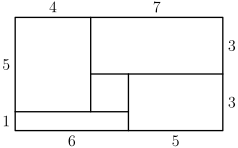
Rose fills each of the rectangular regions of her rectangular flower bed with a different type of flower. The lengths, in feet, of the rectangular regions in her flower bed are as shown in the figure. She plants one flower per square foot in each region. Asters cost each, begonias each, cannas each, dahlias each, and Easter lilies each. What is the least possible cost, in dollars, for her garden?
Respuesta: A
Pista pequeña:
Primero halla el área de cada una de las cinco regiones.
Find the area of each of the five regions first
Pista grande:
Para minimizar el costo, planta la flor más cara en la región más pequeña.
To minimize cost, plant the most expensive flower in the smallest region
Solución:
Las cinco regiones tienen áreas de y pies cuadrados.
El costo se minimiza colocando la flor más cara en la región más pequeña, de modo que el total es
Por lo tanto, la respuesta correcta es A.
The five regions have areas and square feet.
Cost is minimized by placing the most expensive flower in the smallest region, so the total is
Thus, the correct answer is A.
5.
Moe usa una cortadora para cortar su césped rectangular de pies por pies. La franja que corta tiene pulgadas de ancho, pero traslapa cada pasada pulgadas para asegurarse de no dejar césped sin cortar. Camina a una velocidad de pies por hora mientras empuja la cortadora. ¿Cuál de las siguientes opciones es la más cercana al número de horas que le tomará a Moe cortar su césped?
Moe uses a mower to cut his rectangular -foot by -foot lawn. The swath he cuts is inches wide, but he overlaps each cut by inches to make sure that no grass is missed. He walks at the rate of feet per hour while pushing the mower. Which of the following is closest to the number of hours it will take Moe to mow his lawn?
Respuesta: C
Pista pequeña:
El ancho efectivo de la franja es pulgadas, es decir pies.
The effective swath width is inches, which is feet
Pista grande:
Divide el área del césped entre el área que Moe corta por hora.
Divide the lawn’s area by the area Moe mows per hour
Solución:
El césped tiene un área de pies cuadrados.
Cada pie que Moe camina corta una franja efectiva de pies de ancho, así que corta pies cuadrados por hora. El tiempo necesario es horas.
Por lo tanto, la respuesta correcta es C.
The lawn has area square feet.
Each foot Moe walks mows an effective strip feet wide, so he mows square feet per hour. The time needed is hours.
Thus, the correct answer is C.
6.
Muchas pantallas de televisión son rectángulos que se miden por la longitud de sus diagonales. La razón entre la longitud horizontal y la altura de una pantalla de televisión estándar es ¿A cuál de las siguientes opciones se aproxima más, en pulgadas, la longitud horizontal de una pantalla de televisión de “ pulgadas”?
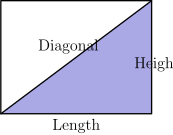
Many television screens are rectangles that are measured by the length of their diagonals. The ratio of the horizontal length to the height in a standard television screen is The horizontal length of a “-inch” television screen is closest, in inches, to which of the following?
Respuesta: D
Pista pequeña:
La longitud, la altura y la diagonal están en la razón .
The length, height, and diagonal are in the ratio
Pista grande:
La diagonal corresponde a partes y es igual a así que la longitud es de .
The diagonal corresponds to parts and equals so the length is of
Solución:
Como la longitud y la altura están en la razón la longitud, la altura y la diagonal forman un triángulo rectángulo La diagonal es así que la longitud horizontal es que es la más cercana a
Por lo tanto, la respuesta correcta es D.
Since the length and height are in ratio the length, height, and diagonal form a right triangle. The diagonal is so the horizontal length is which is closest to
Thus, the correct answer is D.
7.
El símbolo denota el mayor entero que no supera a Por ejemplo, y Calcula
The symbolism denotes the largest integer not exceeding For example, and Compute
Respuesta: B
Pista pequeña:
exactamente cuando .
exactly when
Pista grande:
Cuenta cuántos de a dan cada valor de la parte entera y .
Count how many of through give each floor value and
Solución:
El valor es para es para es para y es para La suma es
Por lo tanto, la respuesta correcta es B.
The value is for it is for it is for and it is for The sum is
Thus, the correct answer is B.
8.
El segundo y el cuarto términos de una sucesión geométrica son y ¿Cuál de las siguientes opciones es un posible primer término?
The second and fourth terms of a geometric sequence are and Which of the following is a possible first term?
Respuesta: B
Pista pequeña:
Al dividir el cuarto término entre el segundo término se obtiene .
Dividing the fourth term by the second term gives
Pista grande:
Con el primer término es y puede ser negativo.
With the first term is and may be negative
Solución:
Sean los términos con y Al dividir se obtiene así que
Entonces La opción corresponde al caso negativo.
Por lo tanto, la respuesta correcta es B.
Let the terms be with and Dividing gives so
Then The choice matches the negative case.
Thus, the correct answer is B.
9.
Halla el valor de que satisface la ecuación
Find the value of that satisfies the equation
Respuesta: B
Pista pequeña:
Reescribe cada término como una potencia de .
Rewrite every term as a power of
Pista grande:
El lado derecho se convierte en iguala el exponente a .
The right side becomes set the exponent equal to
Solución:
Al escribir todo en base el lado izquierdo es y el lado derecho es Al igualar los exponentes, así que
Por lo tanto, la respuesta correcta es B.
Writing everything base the left side is and the right side is Setting exponents equal, so
Thus, the correct answer is B.
10.
Nebraska, sede del AMC, cambió su esquema de matrículas. Cada matrícula antigua constaba de una letra seguida de cuatro dígitos. Cada matrícula nueva consta de tres letras seguidas de tres dígitos. ¿Por qué factor aumenta el número de matrículas posibles?
Nebraska, the home of the AMC, changed its license plate scheme. Each old license plate consisted of a letter followed by four digits. Each new license plate consists of three letters followed by three digits. By how many times is the number of possible license plates increased?
Respuesta: C
Pista pequeña:
Cuenta las matrículas de cada esquema usando el principio de multiplicación.
Count the plates in each scheme using the multiplication principle
Pista grande:
Divide el nuevo total entre el total antiguo .
Divide the new count by the old count
Solución:
El esquema antiguo permite matrículas y el nuevo esquema permite matrículas. El factor de aumento es
Por lo tanto, la respuesta correcta es C.
The old scheme allows plates and the new scheme allows plates. The increase factor is
Thus, the correct answer is C.
11.
Una recta con pendiente interseca a una recta con pendiente en el punto ¿Cuál es la distancia entre las intersecciones con el eje de estas dos rectas?
A line with slope intersects a line with slope at the point What is the distance between the -intercepts of these two lines?
Respuesta: A
Pista pequeña:
Escribe cada recta en forma punto-pendiente que pase por .
Write each line in point-slope form through
Pista grande:
Haz en cada ecuación para hallar dónde cruzan el eje .
Set in each equation to find where they cross the -axis
Solución:
Las rectas son y
Al hacer se obtienen las intersecciones con el eje : y La distancia entre y es
Por lo tanto, la respuesta correcta es A.
The lines are and
Setting gives -intercepts and The distance between and is
Thus, the correct answer is A.
12.
Al, Betty y Clare se reparten entre ellos para invertirlos de distintas maneras. Cada uno comienza con una cantidad diferente. Al cabo de un año tienen un total de Betty y Clare han duplicado su dinero, mientras que Al ha logrado perder ¿Cuál fue la porción original de Al?
Al, Betty, and Clare split among them to be invested in different ways. Each begins with a different amount. At the end of one year they have a total of Betty and Clare have both doubled their money, whereas Al has managed to lose What was Al’s original portion?
Respuesta: C
Pista pequeña:
Supón que Al, Betty y Clare comienzan con y respectivamente, de modo que .
Let Al, Betty, and Clare start with and so
Pista grande:
El total final es sustituye .
The final total is substitute
Solución:
Sean y las porciones originales. Entonces y
Al sustituir en la segunda ecuación, así que
Por lo tanto, la respuesta correcta es C.
Let and be the original portions. Then and
Substituting into the second equation, so
Thus, the correct answer is C.
13.
Sea la suma de los dígitos del entero positivo Por ejemplo, y ¿Para cuántos valores de dos dígitos se cumple ?
Let denote the sum of the digits of the positive integer For example, and For how many two-digit values of is
Respuesta: E
Pista pequeña:
Cuando tiene dos dígitos, la suma de dígitos es a lo sumo .
When has two digits, the digit sum is at most
Pista grande:
con obliga a o cuenta los en cada caso.
with forces or count for each
Solución:
Sea Como tenemos así que obliga a o
Los números de dos dígitos con suma de dígitos son y ( en total). Los que tienen suma de dígitos son y ( en total). En total hay
Por lo tanto, la respuesta correcta es E.
Let Since we have so forces or
The two-digit numbers with digit sum are and ( of them). Those with digit sum are and ( of them). In all there are
Thus, the correct answer is E.
14.
Dado que donde tanto como son enteros positivos, halla el menor valor posible de
Given that where both and are positive integers, find the smallest possible value for
Respuesta: D
Pista pequeña:
Como divide al número pero no, puede ser a lo sumo .
Since but not divides the number, can be at most
Pista grande:
Cuanto mayor es menor es ; prueba y escribe el número como un cuadrado perfecto.
The larger is, the smaller becomes; try and write the number as a perfect square
Solución:
Como debe ser divisible por y es divisible por pero no por necesitamos
Tomando se obtiene así que Este valor es menor que el obtenido con que da
Por lo tanto, la respuesta correcta es D.
Because must be divisible by and is divisible by but not we need
Taking gives so This beats which gives
Thus, the correct answer is D.
15.
Hay jugadores en un torneo de tenis individual. El torneo es de eliminación simple, lo que significa que un jugador que pierde un partido queda eliminado. En la primera ronda, los jugadores más fuertes reciben un pase directo, y los jugadores restantes se emparejan para jugar. Después de cada ronda, los jugadores restantes juegan en la siguiente ronda. La competencia continúa hasta que solo queda un jugador invicto. El número total de partidos jugados es
There are players in a singles tennis tournament. The tournament is single elimination, meaning that a player who loses a match is eliminated. In the first round, the strongest players are given a bye, and the remaining players are paired off to play. After each round, the remaining players play in the next round. The match continues until only one player remains unbeaten. The total number of matches played is
un número primo
a prime number
divisible por
divisible by
divisible por
divisible by
divisible por
divisible by
divisible por
divisible by
Respuesta: E
Pista pequeña:
Cada partido elimina exactamente a un jugador.
Each match eliminates exactly one player
Pista grande:
Todos menos el campeón son eliminados, así que cuenta el número de jugadores eliminados.
All but the champion are eliminated, so count the number of eliminated players
Solución:
Cada partido elimina exactamente a un jugador. Como comienzan jugadores y todos menos el campeón son eliminados, hay partidos.
Como es divisible por pero no cumple ninguna de las otras opciones.
Por lo tanto, la respuesta correcta es E.
Each match eliminates exactly one player. Since players start and all but the champion are eliminated, there are matches.
Because it is divisible by but satisfies none of the other options.
Thus, the correct answer is E.
16.
Un restaurante ofrece tres postres y exactamente el doble de entradas que de platos principales. Una cena consta de una entrada, un plato principal y un postre. ¿Cuál es el menor número de platos principales que el restaurante debería ofrecer para que un cliente pudiera tener una cena diferente cada noche del año ?
A restaurant offers three desserts, and exactly twice as many appetizers as main courses. A dinner consists of an appetizer, a main course, and a dessert. What is the least number of main courses that the restaurant should offer so that a customer could have a different dinner each night in the year
Respuesta: E
Pista pequeña:
Con platos principales hay entradas, lo que da cenas.
With main courses there are appetizers, giving dinners
Pista grande:
El año no es bisiesto, así que se requiere .
The year is not a leap year, so require
Solución:
Con platos principales, el número de cenas es Esto debe ser al menos
Entonces Como es demasiado pequeño pero funciona,
Por lo tanto, la respuesta correcta es E.
With main courses, the number of dinners is This must be at least
So Since is too small but works,
Thus, the correct answer is E.
17.
Un cono de helado consta de una esfera de helado de vainilla y un cono circular recto que tiene el mismo diámetro que la esfera. Si el helado se derrite, llenará exactamente el cono. Supón que el helado derretido ocupa el del volumen del helado congelado. ¿Cuál es la razón entre la altura del cono y su radio? (Nota: un cono con radio y altura tiene volumen y una esfera con radio tiene volumen )
An ice cream cone consists of a sphere of vanilla ice cream and a right circular cone that has the same diameter as the sphere. If the ice cream melts, it will exactly fill the cone. Assume that the melted ice cream occupies of the volume of the frozen ice cream. What is the ratio of the cone’s height to its radius? (Note: A cone with radius and height has volume and a sphere with radius has volume )
Pista pequeña:
El cono y la esfera comparten el mismo radio .
The cone and sphere share the same radius
Pista grande:
Iguala al volumen del cono .
Set equal to the cone volume
Solución:
El volumen derretido es igual al volumen del cono, así que
Al simplificar se obtiene así que La razón entre la altura y el radio es
Por lo tanto, la respuesta correcta es B.
The melted volume equals the cone’s volume, so
Simplifying gives so The ratio of height to radius is
Thus, the correct answer is B.
18.
¿Cuál es el mayor entero que es divisor de
para todos los enteros pares positivos ?
What is the largest integer that is a divisor of
for all positive even integers
Respuesta: D
Pista pequeña:
Cuando es par, los cinco factores son números impares consecutivos.
When is even, the five factors are consecutive odd numbers
Pista grande:
Entre cinco números impares consecutivos uno es múltiplo de y uno de verifica que ningún factor mayor funciona siempre.
Among five consecutive odd numbers one is a multiple of and one of check no larger factor always works
Solución:
Cuando es par, los factores son cinco números impares consecutivos. Entre cualesquiera cinco números impares consecutivos, al menos uno es divisible por y exactamente uno por así que el producto siempre es divisible por
Para demostrar que no se fuerza ningún divisor fijo mayor, comparamos tres casos: El máximo común divisor de estos tres productos es exactamente así que un divisor común a todos los casos no puede ser mayor.
Por lo tanto, la respuesta correcta es D.
When is even, the factors are five consecutive odd numbers. Among any five consecutive odd numbers, at least one is divisible by and exactly one by so the product is always divisible by
To prove that no larger fixed divisor is forced, compare three cases: The greatest common divisor of these three products is exactly so a divisor common to every case cannot be any larger.
Thus, the correct answer is D.
19.
Se construyen tres semicírculos de radio sobre el diámetro de un semicírculo de radio Los centros de los semicírculos pequeños dividen en cuatro segmentos de igual longitud, como se muestra. ¿Cuál es el área de la región sombreada que está dentro del semicírculo grande pero fuera de los semicírculos pequeños?
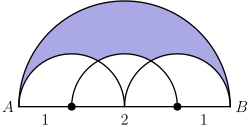
Three semicircles of radius are constructed on diameter of a semicircle of radius The centers of the small semicircles divide into four line segments of equal length, as shown. What is the area of the shaded region that lies within the large semicircle but outside the smaller semicircles?
Respuesta: E
Pista pequeña:
Comienza con el área del semicírculo grande .
Start with the large semicircle’s area
Pista grande:
Los traslapes de semicírculos pequeños adyacentes son sectores de más triángulos equiláteros.
The overlaps of adjacent small semicircles are sectors plus equilateral triangles
Solución:
El semicírculo grande tiene área
Al quitar los semicírculos pequeños se elimina una región igual a cinco sectores congruentes de y radio más dos triángulos equiláteros de lado Cada sector tiene área y cada triángulo tiene área
El área sombreada es
Por lo tanto, la respuesta correcta es E.
The large semicircle has area
Removing the small semicircles deletes a region equal to five congruent sectors of radius plus two equilateral triangles of side Each sector has area and each triangle has area
The shaded area is
Thus, the correct answer is E.
20.
En el rectángulo y Los puntos y están sobre de modo que y Las rectas y se intersecan en Halla el área de
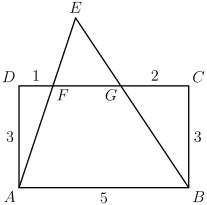
In rectangle and Points and are on so that and Lines and intersect at Find the area of
Respuesta: D
Pista pequeña:
Calcula .
Compute
Pista grande:
usa la razón para ubicar la altura de .
use the ratio to locate the height of
Solución:
Aquí Sea la distancia desde hasta la recta Como con razón tenemos así que
La altura de desde hasta es lo que da un área de
Por lo tanto, la respuesta correcta es D.
Here Let be the distance from down to line Since with ratio we have so
The height of from to is giving area
Thus, the correct answer is D.
21.
Una bolsa contiene dos cuentas rojas y dos cuentas verdes. Metes la mano en la bolsa y sacas una cuenta, reemplazándola por una cuenta roja sin importar el color que hayas sacado. ¿Cuál es la probabilidad de que todas las cuentas de la bolsa sean rojas después de tres reemplazos de este tipo?
A bag contains two red beads and two green beads. You reach into the bag and pull out a bead, replacing it with a red bead regardless of the color you pulled out. What is the probability that all beads in the bag are red after three such replacements?
Respuesta: C
Pista pequeña:
Todas las cuentas son rojas exactamente cuando ambas cuentas verdes se sacan durante las tres extracciones.
All beads are red exactly when both green beads are drawn during the three draws
Pista grande:
Suma las probabilidades de las secuencias de extracción GG, GRG y RGG, siguiendo cómo cambian las cantidades.
Add the probabilities of the draw sequences GG, GRG, and RGG, tracking how the counts change
Solución:
La bolsa siempre contiene cuentas. Todas son rojas al final precisamente cuando ambas verdes se sacan.
Sacar verde y luego verde tiene probabilidad Verde, roja, verde tiene probabilidad Roja, verde, verde tiene probabilidad
El total es
Por lo tanto, la respuesta correcta es C.
The bag always holds beads. All are red at the end precisely when both greens are drawn.
Drawing green then green has probability Green, red, green has probability Red, green, green has probability
The total is
Thus, the correct answer is C.
22.
Un reloj suena una vez a los minutos después de cada hora y suena en la hora en punto según la hora. Por ejemplo, a la PM suena una vez y al mediodía y a la medianoche suena doce veces. Comenzando a las AM del de febrero de ¿en qué fecha ocurrirá la campanada número ?
A clock chimes once at minutes past each hour and chimes on the hour according to the hour. For example, at PM there is one chime and at noon and midnight there are twelve chimes. Starting at AM on February on what date will the rd chime occur?
de marzo
March
de marzo
March
de marzo
March
de marzo
March
de marzo
March
Respuesta: B
Pista pequeña:
En cada período de horas hay campanadas de media hora y campanadas en las horas en punto.
In each -hour period there are half-hour chimes and hour chimes
Pista grande:
Un día completo tiene campanadas; cuenta cuántas ocurren después de las AM del de febrero y acumula por día.
A full day has chimes; count how many occur after AM on Feb and accumulate by day
Solución:
Cada período de horas tiene campanadas, así que cada día completo tiene
Después de las AM del de febrero, el resto de ese día tiene campanadas. Sumando por cada día completo siguiente, el conteo llega a al final del de marzo.
Las campanadas restantes caen el de marzo: la campanada número es la .ª campanada de ese día, que ocurre a las PM del de marzo.
Por lo tanto, la respuesta correcta es B.
Each -hour period has chimes, so each full day has
After AM on February the rest of that day has chimes. Adding for each following full day, the count reaches by the end of March
The remaining chimes fall on March the rd chime is the th chime of that day, occurring at PM on March
Thus, the correct answer is B.
23.
Un octágono regular tiene un área de una unidad cuadrada. ¿Cuál es el área del rectángulo ?
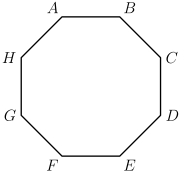
A regular octagon has an area of one square unit. What is the area of the rectangle
Respuesta: D
Pista pequeña:
Sea el centro del octágono, donde se cruzan las diagonales de .
Let be the center of the octagon, where the diagonals of meet
Pista grande:
El triángulo es uno de los ocho triángulos congruentes que forman el octágono.
Triangle is one of the eight congruent triangles making up the octagon
Solución:
Sea el centro. El octágono se divide en triángulos congruentes desde así que tiene área
Como es el punto medio de los triángulos y tienen igual área, así que tiene área El rectángulo es el doble de esto, es decir
Por lo tanto, la respuesta correcta es D.
Let be the center. The octagon splits into congruent triangles from so has area
Since is the midpoint of triangles and have equal area, so has area The rectangle is twice this, namely
Thus, the correct answer is D.
24.
Los primeros cuatro términos de una sucesión aritmética son y en ese orden. ¿Cuál es el quinto término?
The first four terms in an arithmetic sequence are and in that order. What is the fifth term?
Respuesta: E
Pista pequeña:
La diferencia común es .
The common difference is
Pista grande:
Así que el tercer y el cuarto términos son y iguala estos a y .
So the third and fourth terms are and set these equal to and
Solución:
La diferencia común es así que el tercer y el cuarto términos deben ser y Por lo tanto y
De obtenemos y al sustituir se obtiene Como y entonces
El quinto término es
Por lo tanto, la respuesta correcta es E.
The common difference is so the third and fourth terms must be and Thus and
From we get and substituting gives Since and then
The fifth term is
Thus, the correct answer is E.
25.
¿Cuántos números distintos de cuatro dígitos son divisibles por y tienen como sus dos últimos dígitos?
How many distinct four-digit numbers are divisible by and have as their last two digits?
Respuesta: B
Pista pequeña:
Un número es divisible por exactamente cuando su suma de dígitos es divisible por .
A number is divisible by exactly when its digit sum is divisible by
Pista grande:
Escribiendo el número como exige que sea divisible por así que .
Writing the number as require divisible by so
Solución:
Escribe el número como Es divisible por cuando es divisible por es decir, cuando
El prefijo de dos dígitos recorre los valores de a y exactamente un tercio de ellos cumple esto, lo que da
Por lo tanto, la respuesta correcta es B.
Write the number as It is divisible by when is divisible by that is, when
The two-digit prefix ranges over the values from to and exactly one third of them satisfy this, giving
Thus, the correct answer is B.