
2023 AIME I 第 14 题
先试着解答 2023 AIME I 第 14 题,然后核对你的答案与精心整理的解答,解答来自 LIVE by Po-Shen Loh。你也可以参加完整限时模拟考试、查看全部 2023 AIME I 解答,或核对答案。
所有题目均经美国数学协会(MAA)官方合法授权使用。
14.
下面的模拟时钟有两根指针,它们可以彼此独立地移动。
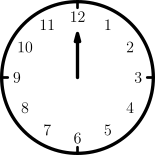
起初,两根指针都指向数字 。时钟执行一串指针移动,使得每一步移动中,两根指针中的一根顺时针移动到表盘上的下一个数字,另一根指针不动。
设 为这样的 步指针移动序列的个数:在整个序列中,每一种可能的两指针位置恰好出现一次,并且在 步移动结束时,两根指针回到初始位置。求 除以 的余数。
The following analog clock has two hands that can move independently of each other.
Initially, both hands point to the number The clock performs a sequence of hand movements so that on each movement, one of the two hands moves clockwise to the next number on the clock face while the other hand does not move.
Let be the number of sequences of hand movements such that during the sequence, every possible positioning of the hands appears exactly once, and at the end of the movements, the hands have returned to their initial position. Find the remainder when is divided by
小提示:
用 中的有序对记录两根指针的位置;按一根指针的值把 个位置分成若干行,并标出另一根指针在哪些位置移动。
Track the ordered pair of hand positions in sort the positions into rows by one hand’s value and mark where the other hand moves.
大提示:
每一行都恰好覆盖一次会迫使每一行的离开集合等于前一行的离开集合平移 ;当且仅当每行离开次数与 互质时,整条巡游是一个单循环。
Covering each row once forces each row’s exit set to be the previous row’s shifted by the tour is a single cycle exactly when the exits per row are coprime to
解答:
将两根指针记为有序对 ;每一步把 替换为 或 ,因此一个合法序列就是经过全部 个位置的闭合巡游,等价于在每个位置选择下一步移动哪根指针。按 把位置分成 行,并令 为巡游离开第 行时的 值集合(一次 -移动)。从第 行的一次 -移动会以同一个 值进入第 行,之后巡游沿连续的 值前进,直到下一次离开。为了让这些连续段恰好覆盖第 行一次,它们必须分割 ,这迫使每个进入点都正好在某个离开点之后一步:。特别地,每个 的大小相同,设为 ,并且 。
在第 行的第 个离开点(按循环顺序)离开,会导致一段在第 行的第 个离开点结束:每次 -移动都使行指标模 增加 ,并使离开点指标模 增加 。因此巡游会在 次 -移动后闭合,而完整巡游必须使用全部 个离开点,所以这条巡游恰好是经过全部 个位置的单循环,当且仅当 。反过来,每个满足 的 都从起点给出恰好一个合法移动序列。
因此 所以 除以 的余数为 。
Record the hands as an ordered pair each movement replaces by or so a valid sequence is a closed tour through all positions — equivalently, a choice, at each position, of which hand moves next. Sort the positions into rows according to and let be the set of -values at which the tour leaves row (a -move). A -move from row enters row at the same -value, and the tour then runs through consecutive -values until its next exit. For these runs to cover row exactly once they must partition which forces each entry point to sit one step past an exit: In particular every has the same size and
Leaving row at its -th exit (in cyclic order) leads to a run ending at the -st exit of row each -move advances the row index by modulo and the exit index by modulo The tour therefore closes after -moves, while a full tour must use all exits, so the tour is a single cycle through all positions precisely when Conversely, every choice of with yields exactly one valid movement sequence from the starting position.
Hence and the remainder when is divided by is
其他年份的第 14 题
1983 AIME · 1984 AIME · 1985 AIME · 1986 AIME · 1987 AIME · 1988 AIME · 1989 AIME · 1990 AIME · 1991 AIME · 1992 AIME · 1993 AIME · 1994 AIME · 1995 AIME · 1996 AIME · 1997 AIME · 1998 AIME · 1999 AIME · 2000 AIME I · 2000 AIME II · 2001 AIME I · 2001 AIME II · 2002 AIME I · 2002 AIME II · 2003 AIME I · 2003 AIME II · 2004 AIME I · 2004 AIME II · 2005 AIME I · 2005 AIME II · 2006 AIME I · 2006 AIME II · 2007 AIME I · 2007 AIME II · 2008 AIME I · 2008 AIME II · 2009 AIME I · 2009 AIME II · 2010 AIME I · 2010 AIME II · 2011 AIME I · 2011 AIME II · 2012 AIME I · 2012 AIME II · 2013 AIME I · 2013 AIME II · 2014 AIME I · 2014 AIME II · 2015 AIME I · 2015 AIME II · 2016 AIME I · 2016 AIME II · 2017 AIME I · 2017 AIME II · 2018 AIME I · 2018 AIME II · 2019 AIME I · 2019 AIME II · 2020 AIME I · 2020 AIME II · 2021 AIME I · 2021 AIME II · 2022 AIME I · 2022 AIME II · 2023 AIME II · 2024 AIME I · 2024 AIME II · 2025 AIME I · 2025 AIME II · 2026 AIME I · 2026 AIME II