
2023 AIME I 真题
计时
3:00:00
1.
五名男子和九名女子按相等间隔随机站在一个圆周上。每名男子都恰好站在一名女子正对面的概率为 ,其中 和 是互质的正整数。求 。
Five men and nine women stand equally spaced around a circle in random order. The probability that every man stands diametrically opposite a woman is where and are relatively prime positive integers. Find
小提示:
这 个位置分成 对直径相对的位置;只需要关心男子占据的是哪些位置。
The positions split into diametrically opposite pairs, and only the set of positions the men occupy matters.
大提示:
数出没有任何一对位置同时有两名男子的情形:选出 对中的 对放男子,再在每对中选一个位置;与 比较。
Count sets where no pair has two men: choose of the pairs to hold a man, then a position in each; compare with
解答:
这 个位置分成 对直径相对的位置。只需要看男子占据的位置集合,而所有 个五元素位置集合等可能。每名男子都与一名女子相对,等价于没有一对相对位置里有两名男子。因此先选出 对中的 对含有男子,有 种;再在每个选中的对里选出男子的位置,有 种,共有 个有利集合。
概率为 ,所以 。
The positions split into diametrically opposite pairs. Only the set of positions occupied by the men matters, and all five-element sets are equally likely. Every man stands opposite a woman exactly when no pair contains two men, so choose which of the pairs contain a man ( ways) and which position of each chosen pair the man occupies ( ways), for favorable sets.
The probability is so
2.
正实数 和 满足方程 以及 的值为 ,其中 和 是互质的正整数。求 。
Positive real numbers and satisfy the equations and The value of is where and are relatively prime positive integers. Find
小提示:
令 ,把两个方程都改写成关于 和 的式子。
Set and rewrite both equations in terms of and
大提示:
第一个方程迫使 ;舍去不满足第二个方程的根,而第二个方程为 。
The first equation forces discard the root that breaks the second equation, which reads
解答:
令 。第一个方程给出 ,所以 ,得到 或 。若 ,则 ,第二个方程会变成 ,矛盾;因此 。
第二个方程给出 ,所以 ,从而 。于是 这已经是最简分数,所以 。
Let The first equation says so giving or If then and the second equation would read impossible; so
The second equation says so and Then which is in lowest terms, so
3.
平面上有 条直线,其中任意 条都不平行。已知有 个点恰好有 条直线相交,有 个点恰好有 条直线相交,有 个点恰好有 条直线相交,有 个点恰好有 条直线相交,并且没有超过 条直线相交的点。求恰好有 条直线相交的点的个数。
A plane contains lines, no of which are parallel. Suppose that there are points where exactly lines intersect, points where exactly lines intersect, points where exactly lines intersect, points where exactly lines intersect, and no points where more than lines intersect. Find the number of points where exactly lines intersect.
小提示:
因为任意两条直线都不平行,每一对直线都恰好在一个交点相交。
Since no two lines are parallel, every pair of lines meets at exactly one intersection point.
大提示:
一个恰好有 条直线相交的点,对应 对直线中的 对。
A point where exactly lines cross accounts for of the pairs of lines.
解答:
因为这 条直线中任意两条都不平行,所以每两条直线相交,共有 对直线,并且每一对直线恰好对应一个交点。一个恰好有 条直线相交的点,恰好对应这些直线对中的 对。
已给出的交点共对应 对直线。剩下的每一对直线都在一个恰好有 条直线相交的点相交,每对给出一个这样的点,所以共有 个。
Since no two of the lines are parallel, every two lines cross, giving pairs of lines, and each pair meets at exactly one point. A point where exactly lines meet accounts for exactly of these pairs.
The given points account for pairs of lines. Each remaining pair meets at a point where exactly lines intersect, one point per pair, so there are such points.
4.
对所有使 为完全平方数的正整数 求和,所得结果可写成 ,其中 、、、、、 都是正整数。求 。
The sum of all positive integers such that is a perfect square can be written as where and are positive integers. Find
小提示:
分解 ,并判断 的各个质因数指数可以是什么。
Factor and decide which prime exponents can have.
大提示:
的每个指数必须与 中相应指数同奇偶,因此所有合法 的和可以分解成若干个等比和的乘积。
Each exponent of must match the parity of the corresponding exponent of so the sum of all valid factors as a product of geometric sums.
解答:
因为 ,合法的 必须使 中每个质因数的指数为偶数:、、,且 。
这些选择彼此独立,所以所有这样的 之和分解为 因为 、、,且 ,所以该和等于 ,从而 。
Since a valid must leave every exponent of even: and
The choices are independent, so the sum of all such factors as Since and the sum equals and
5.
设 是正方形 的外接圆上的一点,且满足 与 。求 的面积。
Let be a point on the circle circumscribing square that satisfies and Find the area of
小提示:
把圆心放在原点,令 、、、,并设 。
Put the center at the origin with and
大提示:
证明 ,且 ;一个勾股恒等式会把两个乘积联系起来。
Show and a Pythagorean identity links the two products.
解答:
设圆心为 、半径为 ,并取 、、、,以及 。则 ,,所以 。同理,。
两式平方后相加,得 ,所以 。正方形的对角线为 ,因此面积为 。
Let the circle have center and radius with and Then and so In the same way
Squaring and adding, so The square has diagonal hence area
6.
Alice 知道将有 张红牌和 张黑牌按随机顺序一张一张展示给她。每张牌展示前,Alice 必须猜它的颜色。如果 Alice 采用最优策略,她猜对牌数的期望为 ,其中 和 是互质的正整数。求 。
Alice knows that red cards and black cards will be revealed to her one at a time in random order. Before each card is revealed, Alice must guess its color. If Alice plays optimally, the expected number of cards she will guess correctly is where and are relatively prime positive integers. Find
小提示:
猜剩余张数更多的颜色是最优的;令 表示还剩 张红牌和 张黑牌时猜对张数的期望。
Guessing the color with more cards remaining is optimal; let be the expected number correct with red and black left.
大提示:
;从 开始向上计算。
build up from
解答:
无论 Alice 猜什么颜色,牌堆接下来的状态转移方式都一样;只有这一步猜中的概率取决于她的猜测,因此最优做法是猜剩余张数最多的颜色。令 表示还剩 张红牌和 张黑牌时,之后猜对张数的期望。则 、,且
由对称性 。向上计算:,,,,,最后 。
因此猜对张数的期望为 ,所以 。
Whatever Alice guesses, the deck evolves the same way; only the immediate success probability depends on her guess, so it is optimal to guess a color with the most cards remaining. Let be the expected number of correct guesses from a state with red and black cards left. Then and
By symmetry Computing upward: and finally
So the expected number of correct guesses is and
7.
如果正整数 除以 、、、、 所得的余数互不相同,则称 为 超互异。求小于 的超互异正整数的个数。
Call a positive integer extra-distinct if the remainders when is divided by and are distinct. Find the number of extra-distinct positive integers less than
小提示:
模 的余数由模 和模 的余数限制,模 的余数由模 的余数限制;能留下的模式很少。
The remainder mod is forced by the remainders mod and mod and the remainder mod by the one mod — few patterns survive.
大提示:
一切只取决于 ;恰有三个余数类可行,所以数出每一类中小于 的数。
Everything depends only on exactly three residues work, so count each class below
解答:
设 为 模 的余数,并注意到 、,且 。若 :则 是偶数且不能等于 ,所以 ;接着 是偶数且避开 ,所以 ,这给出 ;最后 避开 ,所以 。这些条件说明 对 分别成立,即 。
若 :类似地 ,然后 ,给出 ,而 避开 ,所以 。选择 时,,即 ;选择 时, 且 整除 ,即 。
小于 的正整数中,按模 计数,同余于 的有 个,同余于 的有 个,同余于 的有 个,因此总数为 。
Write for the remainder of modulo and note and If then is even and different from so then is even and avoids so which gives finally avoids so These say modulo each of i.e.
If similarly then giving and avoids so The choice gives i.e. the choice gives with dividing i.e.
Below there are integers congruent to congruent to and congruent to modulo for a total of
8.
菱形 满足 。在这个菱形的内切圆上有一点 ,使得 到直线 、、 的距离分别为 、、,求 的周长。
Rhombus has There is a point on the incircle of the rhombus such that the distances from to the lines and are and respectively. Find the perimeter of
答案:125
小提示:
从 到平行直线 和 的距离之和等于菱形的高,所以高为 。
The distances from to the parallel lines and add up to the height of the rhombus, so the height is
大提示:
把内切圆圆心放在原点:,而到切线 的距离为 会给出关于 的方程。
Center the incircle at the origin: and the distance- condition to the tangent line becomes an equation in
解答:
从内部一点到平行直线 和 的距离之和,等于这两条直线之间的距离,也就是菱形的高。因此高为 ,而与这两条直线相切的内切圆半径为 。以内切圆圆心为原点,设 、。则 的 坐标为 ,由 得 。
令 。直线 与内切圆相切,并与水平方向成角 ,所以在适当取向下,它的方程为 ,且内部点满足 。条件 给出 。若 ,左边大于 ,所以 ,方程变为 。
将 代入 ,得到 ,所以 或 。根 会使 为负,矛盾于 。因此 ,边长为 ,周长为 。
The distances from an interior point to the parallel lines and add up to the distance between them, the height of the rhombus. So the height is and the incircle, tangent to both lines, has radius Center the incircle at the origin with and Then has -coordinate and gives
Let Line is tangent to the incircle and makes angle with the horizontal, so (orienting the figure suitably) it is and interior points satisfy The condition reads For the left side exceeds so and the equation becomes
Substituting into yields so or The root makes negative, contradicting So the side length is and the perimeter is
9.
求三次多项式 的个数,其中 、、 都是 中的整数,并且存在唯一一个整数 满足 。
Find the number of cubic polynomials where and are integers in such that there is a unique integer with
小提示:
无关紧要:,其中二次式 的三项是 、 和 。
is irrelevant: where the three terms of the quadratic are and
大提示:
一个首项系数为一的整数二次式若有一个整数根,就有两个整数根,所以它的根集必须是 或重根 ,其中 。
A monic integer quadratic with one integer root has two, so its root set must be or a double root with
解答:
因为 与 无关,每个合法的 都对应 个多项式。分解得 所以二次因子 需要恰好有一个不同于 的整数根。若 有一个整数根,则另一个根也为整数(两根之和 是整数);若 没有整数根,则根本不存在这样的 。因此, 的根要么是 和 且 ,要么是重根 。
当根为 和 时,韦达定理给出 和 。限制 迫使 (此时 自动在范围内),排除 后留下 对。当重根为 时,有 和 ,且 迫使 ,这些 都合法,排除 后留下 对。
因此共有 对 ,从而有 个多项式。
Since does not involve each valid pair contributes polynomials. Factoring, so we need the quadratic factor to have exactly one integer root different from If has any integer root, its other root is also an integer (their sum is an integer); if has no integer root, then no exists at all. So either has roots and with or a double root
Roots and Vieta’s formulas give and The constraint forces (and then is automatically in range), so excluding leaves pairs. Double root here and and forces all valid for so excluding leaves pairs.
That is pairs hence polynomials.
10.
存在唯一的正整数 ,使得和 是一个严格介于 和 之间的整数。对这个唯一的 ,求 。
(注: 表示小于或等于 的最大整数。)
There exists a unique positive integer for which the sum is an integer strictly between and For that unique find
(Note that denotes the greatest integer that is less than or equal to )
小提示:
不考虑取整时,和为 ;存在一个整数 使它恰好为 。
Without the floor the sum is there is an integer making it exactly
大提示:
对这个 ,,而余数以 为周期重复。
For that and the residues repeat with period
解答:
先忽略取整, ,它恰好为零当且仅当 ,这是整数。对任何其他整数 ,原始和的绝对值至少为 ,而取整使总和改变小于 ,所以只有 可能让 严格介于 和 之间。
当 时,每一项等于 ,其中 ,所以 。因为 ,有 ,当 时余数分别为 ,每五项和为 。由于 ,剩余的 项贡献 ,所以 。
因此 ,确实严格介于 和 之间,并且 。
Ignoring the floors, vanishes exactly when an integer. For any other integer the raw sum has absolute value at least while taking floors changes the total by less than so only can put strictly between and
With each term is with so Since we have whose residues for are summing to per block of five. With the leftover terms contribute so
So which indeed lies strictly between and and
11.
求 的子集个数,使得子集中恰好有一对连续整数。这样的子集例子包括 和 。
Find the number of subsets of that contain exactly one pair of consecutive integers. Examples of such subsets are and
小提示:
从 个连续整数中选子集且不含相邻元素的个数,是斐波那契数 。
The number of subsets of consecutive integers with no two consecutive elements is the Fibonacci number
大提示:
若这对连续整数是 ,其他元素必须避开 和 ,并且在左右两个剩余区块内不相邻。
If the pair is the other elements must avoid and and be non-consecutive inside the two remaining blocks.
解答:
首先,一个由 个连续整数组成的区块中,不含两个连续元素的子集个数是斐波那契数 (其中 ):按最后一个元素是否被选来分类,会得到斐波那契递推,初始计数为 。
设唯一的连续整数对是 ,其中 。其余元素必须排除 和 (否则会产生第二对连续整数),并且在 与 ,这两个大小分别为 和 的区块中,不能包含连续整数。因此对此 的计数为 。
对 求和:
First, the number of subsets of a block of consecutive integers containing no two consecutive elements is the Fibonacci number (with ): conditioning on whether the last element is used gives the Fibonacci recursion, and the counts start
Suppose the unique consecutive pair is for some The remaining elements must exclude and (either would create a second consecutive pair) and must contain no consecutive pair within or within blocks of sizes and So the count for this is
Summing over
12.
设 是边长为 的等边三角形。点 、、 分别在 、、 上,且 、、。点 在 内部,并满足 求 。
Let be an equilateral triangle with side length Points and lie on and respectively, with and Point inside has the property that Find
小提示:
把从 、、 到 的每个向量分解成沿边方向的分量和到该边的距离;沿边分量等于距离乘以 。
Decompose each vector from to into a part along the side and the distance to that side; the along-part equals the distance times
大提示:
把三个关系相加:方向 、、 的单位向量和为零,而三个距离之和等于高(维维亚尼定理)。
Add the three relations: the unit directions sum to zero, and the three distances sum to the height (Viviani).
解答:
设 、、,则 、,且 。令公共角为 ,并令 分别为方向 、、 的单位向量,也就是从 指向 、从 指向 、从 指向 的方向。把 分解为沿 的分量和垂直于边 的分量,后者长度为 到直线 的距离 。角度条件给出 ;同理 ,且 。
现在把三个关系相加。因为 (三角形的有向边首尾相接), 项会消去;并且由 Viviani 定理, 等于高 。取 、、以及 可得 、,且 ,所以
因此 ,所以 。
Place so that and Let be the common angle and let be the unit vectors in the directions — the directions from toward from toward and from toward Splitting into its component along and its component perpendicular to side whose length is the distance from to line the angle condition gives similarly and
Now add all three relations. Since (the directed sides of a triangle close up), drops out, and by Viviani’s theorem equals the height With and we get and so
Hence so
13.
两个不全等的平行六面体,每个面都是菱形,且菱形两条对角线的长度为 和 。这两个多面体中较大体积与较小体积之比为 ,其中 和 是互质的正整数。求 。平行六面体是一个有六个平行四边形面的立体,如下图所示。
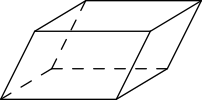
Each face of two noncongruent parallelepipeds is a rhombus whose diagonals have lengths and The ratio of the volume of the larger of the two polyhedra to the volume of the smaller is where and are relatively prime positive integers. Find A parallelepiped is a solid with six parallelogram faces such as the one shown below.
小提示:
每条棱长为 ,而由两条面对角线可知,每一对棱向量的点积为 。
Every edge has length and each pair of edge vectors has dot product from the two face diagonals.
大提示:
体积的平方是三个棱向量的格拉姆行列式;只有三个点积的乘积符号会影响结果。
The squared volume is the Gram determinant of the three edge vectors; only the sign of the product of the three dot products matters.
解答:
对角线为 与 的菱形边长为 ,所以三个棱向量 、、 的长度平方都为 。在由 和 张成的面中,对角线为 ,且 ;与 对应,可得 ,另外两对向量同理。
体积平方是格拉姆行列式 其中 。把一个棱向量取相反数会翻转 中两个的符号,所以只有 的符号重要:,从而 或 。
体积比为 ,已经是最简形式,所以 。
A rhombus with diagonals and has side so the three edge vectors all have squared length In the face spanned by and the diagonals are with matching gives and likewise for the other two pairs.
The squared volume is the Gram determinant with Negating an edge vector flips the signs of two of so only the sign of matters: giving or
The ratio of the volumes is already in lowest terms, so
14.
下面的模拟时钟有两根指针,它们可以彼此独立地移动。
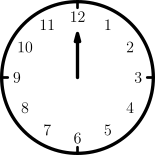
起初,两根指针都指向数字 。时钟执行一串指针移动,使得每一步移动中,两根指针中的一根顺时针移动到表盘上的下一个数字,另一根指针不动。
设 为这样的 步指针移动序列的个数:在整个序列中,每一种可能的两指针位置恰好出现一次,并且在 步移动结束时,两根指针回到初始位置。求 除以 的余数。
The following analog clock has two hands that can move independently of each other.
Initially, both hands point to the number The clock performs a sequence of hand movements so that on each movement, one of the two hands moves clockwise to the next number on the clock face while the other hand does not move.
Let be the number of sequences of hand movements such that during the sequence, every possible positioning of the hands appears exactly once, and at the end of the movements, the hands have returned to their initial position. Find the remainder when is divided by
小提示:
用 中的有序对记录两根指针的位置;按一根指针的值把 个位置分成若干行,并标出另一根指针在哪些位置移动。
Track the ordered pair of hand positions in sort the positions into rows by one hand’s value and mark where the other hand moves.
大提示:
每一行都恰好覆盖一次会迫使每一行的离开集合等于前一行的离开集合平移 ;当且仅当每行离开次数与 互质时,整条巡游是一个单循环。
Covering each row once forces each row’s exit set to be the previous row’s shifted by the tour is a single cycle exactly when the exits per row are coprime to
解答:
将两根指针记为有序对 ;每一步把 替换为 或 ,因此一个合法序列就是经过全部 个位置的闭合巡游,等价于在每个位置选择下一步移动哪根指针。按 把位置分成 行,并令 为巡游离开第 行时的 值集合(一次 -移动)。从第 行的一次 -移动会以同一个 值进入第 行,之后巡游沿连续的 值前进,直到下一次离开。为了让这些连续段恰好覆盖第 行一次,它们必须分割 ,这迫使每个进入点都正好在某个离开点之后一步:。特别地,每个 的大小相同,设为 ,并且 。
在第 行的第 个离开点(按循环顺序)离开,会导致一段在第 行的第 个离开点结束:每次 -移动都使行指标模 增加 ,并使离开点指标模 增加 。因此巡游会在 次 -移动后闭合,而完整巡游必须使用全部 个离开点,所以这条巡游恰好是经过全部 个位置的单循环,当且仅当 。反过来,每个满足 的 都从起点给出恰好一个合法移动序列。
因此 所以 除以 的余数为 。
Record the hands as an ordered pair each movement replaces by or so a valid sequence is a closed tour through all positions — equivalently, a choice, at each position, of which hand moves next. Sort the positions into rows according to and let be the set of -values at which the tour leaves row (a -move). A -move from row enters row at the same -value, and the tour then runs through consecutive -values until its next exit. For these runs to cover row exactly once they must partition which forces each entry point to sit one step past an exit: In particular every has the same size and
Leaving row at its -th exit (in cyclic order) leads to a run ending at the -st exit of row each -move advances the row index by modulo and the exit index by modulo The tour therefore closes after -moves, while a full tour must use all exits, so the tour is a single cycle through all positions precisely when Conversely, every choice of with yields exactly one valid movement sequence from the starting position.
Hence and the remainder when is divided by is
15.
求最大的素数 ,使得存在一个复数 满足
• 的实部和虚部都是整数;
• ,并且
• 存在一个三角形,它的三条边长分别为 、 的实部、以及 的虚部。
Find the largest prime number for which there exists a complex number satisfying
• the real and imaginary part of are both integers;
• and
• there exists a triangle whose three side lengths are the real part of and the imaginary part of
小提示:
写 ,其中 ;在改变符号和交换顺序后,三角形需要 。
Write with up to signs and swapping, the triangle needs
大提示:
,所以 必须在 的 范围内。
so must be within of
解答:
写 ,其中 。素数 确实可行:取 ,就有 ,但它不可能是最大答案。因此只需考虑奇素数 ,此时 ,而数对 唯一确定。把 替换为 、、 或 ,只会改变 实部与虚部的符号或交换两者,所以可设 。两个候选边长是 和 。展开 并因式分解,得 当且仅当 时,这三个长度能构成三角形;后两个量与上面两个表达式的绝对值一一对应。因为 导致 ,所以全部条件等价于 。
因为 ,所以必须有 。由 得 ;而且 ,因为 会迫使 ,从而 。把 代入 并检查这些有限范围内的整数,可得可能值的完整列表 其中只有四个值是素数,对应于 相应的 依次是 ,都小于 ,所以这四个值也都满足完整的三角形不等式。因此最大的可能素数是 。
确实,取 ,得 ,而 、、 能构成一个三角形。答案是 。
Write with The prime does qualify: for we have but it cannot be the largest answer. Hence consider an odd prime so and the pair is unique. Replacing by only changes the real and imaginary parts of by signs and swaps, so we may take and the two candidate side lengths are and Expanding and factoring, The triangle exists exactly when and those two quantities are, in some order, the absolute values above. Since forces the whole condition reduces to
Because this requires The bound gives moreover because would force and Substituting into and checking these bounded integers gives the complete list of possible values Only four values in this list are prime, at The corresponding values of are respectively, all below so all four also pass the full triangle inequality. Thus the largest possible prime is
Indeed for we get and the lengths form a valid triangle. The answer is