
2002 AIME I 第 15 题
先试着解答 2002 AIME I 第 15 题,然后核对你的答案与精心整理的解答,解答来自 LIVE by Po-Shen Loh。你也可以参加完整限时模拟考试、查看全部 2002 AIME I 解答,或核对答案。
所有题目均经美国数学协会(MAA)官方合法授权使用。
15.
多面体 有六个面。面 是正方形,且 ;面 是梯形,其中 平行于 ,,且 ;面 满足 。另外三个面是 、 和 。点 到面 的距离为 。已知 ,其中 、、 是正整数,且 不被任何质数的平方整除。求 。
Polyhedron has six faces. Face is a square with face is a trapezoid with parallel to and and face has The other three faces are and The distance from to face is Given that where and are positive integers and is not divisible by the square of any prime, find
小提示:
建立坐标系,使正方形 位于 -平面;已知长度可确定 。
Set up coordinates with square in the -plane; the given lengths place
大提示:
面 位于同一平面内,所以 在经过 、、 的平面 上;由等腰梯形的对称性得 ,再用 求出 。
Face is planar, so lies on the plane through trapezoid symmetry gives and determines
解答:
取 、、、。由 到面 的距离可令 。由 得 ,再由 得 ,所以 ,。
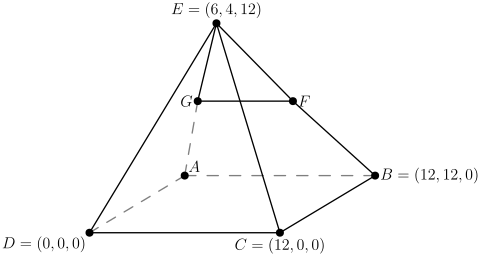
在梯形 中, 平行于 ,且 、,所以 和 关于平面 对称:、。由于面 位于同一平面内,而经过 、、 的平面包含整个 -轴方向( 和 都满足 ),所以它是平面 ,并且确实包含 。因此 。现在由 得 ,所以 。
于是 题目给出的形式 对应 。因此
Place and using the given distance from to face From we get and then gives so and
In trapezoid is parallel to with and so and are symmetric about the plane and Face is planar, and the plane through contains the entire -axis direction (both and have ), so it is the plane which indeed contains Hence Now gives so
Then and the stated form corresponds to Thus
其他年份的第 15 题
1983 AIME · 1984 AIME · 1985 AIME · 1986 AIME · 1987 AIME · 1988 AIME · 1989 AIME · 1990 AIME · 1991 AIME · 1992 AIME · 1993 AIME · 1994 AIME · 1995 AIME · 1996 AIME · 1997 AIME · 1998 AIME · 1999 AIME · 2000 AIME I · 2000 AIME II · 2001 AIME I · 2001 AIME II · 2002 AIME II · 2003 AIME I · 2003 AIME II · 2004 AIME I · 2004 AIME II · 2005 AIME I · 2005 AIME II · 2006 AIME I · 2006 AIME II · 2007 AIME I · 2007 AIME II · 2008 AIME I · 2008 AIME II · 2009 AIME I · 2009 AIME II · 2010 AIME I · 2010 AIME II · 2011 AIME I · 2011 AIME II · 2012 AIME I · 2012 AIME II · 2013 AIME I · 2013 AIME II · 2014 AIME I · 2014 AIME II · 2015 AIME I · 2015 AIME II · 2016 AIME I · 2016 AIME II · 2017 AIME I · 2017 AIME II · 2018 AIME I · 2018 AIME II · 2019 AIME I · 2019 AIME II · 2020 AIME I · 2020 AIME II · 2021 AIME I · 2021 AIME II · 2022 AIME I · 2022 AIME II · 2023 AIME I · 2023 AIME II · 2024 AIME I · 2024 AIME II · 2025 AIME I · 2025 AIME II · 2026 AIME I · 2026 AIME II