
2002 AIME I 真题
计时
3:00:00
1.
许多州的标准车牌格式是三个字母后接三个数字。假设每一种三字母三数字的排列等可能出现,这种车牌至少含有一个回文(三个字母的排列或三个数字的排列从左到右读和从右到左读相同)的概率为 ,其中 和 是互质正整数。求 。
Many states use a sequence of three letters followed by a sequence of three digits as their standard license-plate pattern. Given that each three-letter three-digit arrangement is equally likely, the probability that such a license plate will contain at least one palindrome (a three-letter arrangement or a three-digit arrangement that reads the same left-to-right as it does right-to-left) is where and are relatively prime positive integers. Find
小提示:
三个字母的排列是回文,当且仅当第三个字母等于第一个字母,所以其概率为 。
A three-letter arrangement is a palindrome exactly when the third letter equals the first, so that probability is
大提示:
用容斥合并字母事件和数字事件:。
Combine the letter and digit events by inclusion-exclusion:
解答:
三个字母的排列是回文,当且仅当第三个字母与第一个字母相同,所以字母部分为回文的概率是 。同理,数字部分为回文的概率是 ,且这两个事件相互独立。
由容斥原理,至少含有一个回文的概率为 因此 。
A three-letter arrangement is a palindrome exactly when the third letter matches the first, so the probability of a letter palindrome is Similarly, the probability of a digit palindrome is and the two events are independent.
By inclusion-exclusion, the probability of at least one palindrome is Thus
2.
图中二十个全等圆排成三行,并被一个长方形围住。这些圆彼此相切,并且如图所示与长方形的边相切。长方形较长边与较短边的比可以写成 ,其中 和 是正整数。求 。
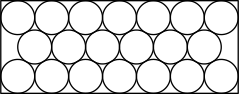
The diagram shows twenty congruent circles arranged in three rows and enclosed in a rectangle. The circles are tangent to one another and to the sides of the rectangle as shown in the diagram. The ratio of the longer dimension of the rectangle to the shorter dimension can be written as where and are positive integers. Find
小提示:
设圆的半径为 ,较长边为 。要求较短边,连接三个两两相切圆的圆心。
With circle radius the longer side is For the shorter side, connect the centers of three mutually tangent circles.
大提示:
相邻两行圆心的距离为 ,所以较短边为 ;将 有理化。
Adjacent rows of centers are apart, so the shorter side is rationalize
解答:
设公共半径为 。较长边容纳一行七个圆,所以长为 。相邻行中三个两两相切圆的圆心构成边长 的等边三角形,其高为 。两段相邻行圆心间距合计贡献 ,所以较短边为 。
所求比值为 所以 ,,。
Let be the common radius. The longer side holds a row of seven circles, so it equals The centers of three mutually tangent circles in adjacent rows form an equilateral triangle with side whose height is so the two gaps between rows of centers contribute and the shorter side is
The ratio is so and
3.
Jane 今年 岁。Dick 比 Jane 年长。再过 年,其中 是正整数,Dick 和 Jane 的年龄都将是两位数,并且 Jane 的年龄可以由 Dick 的年龄交换两个数字得到。令 为 Dick 现在的年龄。有多少个正整数有序对 是可能的?
Jane is years old. Dick is older than Jane. In years, where is a positive integer, Dick’s age and Jane’s age will both be two-digit numbers and will have the property that Jane’s age is obtained by interchanging the digits of Dick’s age. Let be Dick’s present age. How many ordered pairs of positive integers are possible?
小提示:
关注未来的年龄:Jane 的年龄是一个两位数,其数字反转后是 Dick 的年龄,而且 Dick 的年龄更大。
Focus on the future ages: Jane’s is a two-digit number whose digit reversal, Dick’s age, is larger
大提示:
数出 Jane 未来年龄的可能值:它至少足够大,且十位数字小于个位数字。每个这样的值确定一个 。
Count the possible values of Jane’s future age: two-digit numbers old enough for Jane whose tens digit is smaller than the units digit. Each determines
解答:
再过 年,Jane 的年龄为 ,Dick 的年龄是它的数字反转。若 Jane 未来的年龄为 ,则 Dick 的年龄为 ,它更大当且仅当 。反过来,只要两位数 的十位数字小于个位数字,就会给出唯一有效的有序对:,且 所以 Dick 现在确实比 Jane 年长。
因此只需数不小于 、且十位数字小于个位数字的两位数:有 个以 开头(即 到 ),然后分别有 、、、、、 个以 到 开头。总数为 。
In years Jane’s age is and Dick’s age is its digit reversal. If Jane’s future age is Dick’s is which is larger exactly when Conversely, every two-digit value of with tens digit less than units digit yields exactly one valid pair: and so Dick is indeed older than Jane now.
So we count two-digit numbers that are at least and have tens digit less than units digit: starting with (namely through ), then starting with through The total is
4.
考虑由 ()定义的数列。已知 ,其中正整数 和 满足 。求 。
Consider the sequence defined by for Given that for positive integers and with find
小提示:
,所以和会裂项相消为 。
so the sum telescopes to
大提示:
清分母并因式分解:,再利用 是质数。
Clear denominators and factor: then use that is prime
解答:
因为 ,所以该和裂项相消:
两边乘以 ,得 ,整理为 。由于 是质数且 ,在 为正整数时唯一的分解是 、,所以 、。
因此 。
Since the sum telescopes:
Multiplying through by gives which rearranges to Since is prime and the only factorization with a positive integer is and so and
Therefore
5.
设 、、、、 是正十二边形的顶点。在该十二边形所在的平面内,有多少个不同的正方形至少有两个顶点属于集合 ?
Let be the vertices of a regular dodecagon. How many distinct squares in the plane of the dodecagon have at least two vertices in the set
小提示:
每一对顶点确定三个正方形:两个以这对点为边,一个以这对点为对角线。
Each pair of vertices determines three squares: two having the pair as a side and one having it as a diagonal
大提示:
只有四个顶点全在 中的正方形会被重复计算;每个这样的正方形由它的 对顶点产生。
Only squares with all four vertices among the are overcounted, and each such square arises from of its vertex pairs
解答:
对顶点中的每一对都恰好确定三个正方形:两个以这对点为边(线段两侧各一个),一个以这对点为对角线。这样共计 个正方形。
只有当一个正方形有多于两个顶点属于 时才会重复计算。若一个正方形的三个顶点在该外接圆上,则正方形自己的外接圆与它共有三点,因此两圆重合;而内接正方形的顶点相隔 ,也就是十二边形的三步,所以第四个顶点也必为某个 。完全内接的正方形正好是 、、。每个都由 对顶点产生,所以每个被数了 次而不是一次。
不同正方形的个数为 。
Each of the pairs of vertices determines exactly three squares: two having the pair as a side (one on each side of the segment) and one having it as a diagonal. That counts squares.
A square is overcounted only if it has more than two vertices among the If three vertices of a square lie on the circumcircle, the square’s own circumcircle shares three points with it and hence coincides with it, and an inscribed square’s vertices are spaced apart — three steps of the dodecagon — so the fourth vertex is also an The fully inscribed squares are exactly and and each is generated by all of its vertex pairs, so each is counted times instead of once.
The number of distinct squares is
6.
方程组 的两个解为 和 。求 。
The solutions to the system of equations are and Find
小提示:
设 、,并使用 和 。
Set and using and
大提示:
你只需要 和 ,因为 ;从 用韦达定理求出它们。
You only need and since get them from by Vieta
解答:
设 、,则 且 。方程组变为 和 。将 代入第二个方程并清分母,得到 ,即 。
原方程组的两个解对应这个二次方程的两个根,所以由韦达定理 ,进而 。于是 所以 。
Let and so and The system becomes and Substituting into the second equation and clearing denominators gives that is,
The two solutions of the system correspond to the two roots of this quadratic, so by Vieta’s formulas and then Hence so
7.
二项式展开也适用于非整数指数。也就是说,对所有实数 、 和 ,若 ,则有 的十进制表示中,小数点右边的前三个数字是什么?
The Binomial Expansion is valid for exponents that are not integers. That is, for all real numbers and with What are the first three digits to the right of the decimal point in the decimal representation of
小提示:
在展开式中取 、、。第一项是整数,第三项及以后都小到可以忽略。
Expand with the first term is an integer and the third term onward is negligibly small
大提示:
所求数字来自 的小数部分;利用循环节长度为 的 的小数展开。
The requested digits form the fractional part of use the period- repeating decimal of
解答:
在展开式中取 、、,得到 第一项是整数,第三项及之后的项远小于 ,不会影响最前面的几个小数位。因此这些数字来自 的小数部分。
该小数部分为 。由于 且 ,得到 ,所以小数部分为 。
小数点右边的前三个数字是 。
Apply the expansion with and The first term is an integer, and the third and later terms are far smaller than too small to affect the leading decimal digits. So those digits come from the fractional part of
That fractional part is Since and we get so the fractional part is
The first three digits to the right of the decimal point are
8.
求最小整数 ,使得下列条件
,,, 是一个非递减的正整数数列
对所有 都成立
能同时被不止一个数列满足。
Find the smallest integer for which the conditions
is a nondecreasing sequence of positive integers
for all
are satisfied by more than one sequence.
小提示:
反复使用递推式,把目标项表示成前两项:。
Iterate the recurrence to express the target in the first two terms:
大提示:
若 且 ,则 是 的倍数,迫使 和 至少为 。
If with then is a multiple of forcing and to be at least
解答:
反复使用递推式得 ,且数列非递减当且仅当 (之后的项会自动满足)。因此我们需要找最小的 ,使得 有两个满足 的解。
假设 且 。则 ,所以 是 的正倍数。因此 ,又因为 ,也有 ,从而 。
反过来, 确实可行: 和 分别给出数列 、、、、、、、、,以及 、、、、、、、、。所以答案是 。
Iterating the recurrence gives and the sequence is nondecreasing exactly when (all later terms then take care of themselves). So we need the smallest for which has two solutions with
Suppose with Then so is a positive multiple of Hence and since also giving
Conversely works: and give the sequences and The answer is
9.
Harold、Tanya 和 Ulysses 给一排很长的尖桩篱笆刷漆。
• Harold 从第一根尖桩开始,每逢第 根刷一根;
• Tanya 从第二根尖桩开始,每逢第 根刷一根;
• Ulysses 从第三根尖桩开始,每逢第 根刷一根。
把正整数 称为 可刷数,条件是正整数三元组 能使每根尖桩恰好被刷一次。求所有可刷数之和。
Harold, Tanya, and Ulysses paint a very long picket fence.
• Harold starts with the first picket and paints every th picket;
• Tanya starts with the second picket and paints every th picket; and
• Ulysses starts with the third picket and paints every th picket.
Call the positive integer paintable when the triple of positive integers results in every picket being painted exactly once. Find the sum of all the paintable integers.
小提示:
三个等差数列必须划分所有正整数;检查第 根尖桩由谁刷可知 必须为 或 。
The three arithmetic progressions must partition the positive integers; checking who paints picket shows must be or
大提示:
对每个 的取值,尚未覆盖的最小尖桩会依次迫使 和 的值,每种情况恰有一个有效三元组。
For each value of the smallest picket not yet covered forces and then giving exactly one valid triple each
解答:
三个等差数列 、、 必须恰好划分所有正整数。若 ,Harold 会刷每一根尖桩,与另外两人重复。若 ,Harold 会刷第 根,而 Ulysses 也会刷它,所以 。若 ,考虑第 根尖桩:Harold 的下一根是 ,Ulysses 也不可能刷它(否则 ,他会从第 根起刷每一根),所以必须由 Tanya 刷,迫使 。接着第 根若要被刷就必须有 ,但这样 Tanya 和 Ulysses 合起来会覆盖从第 根起的每一根尖桩,Harold 的第 根便会被刷两次。因此 或 。
若 ,Harold 刷 。Ulysses 不能刷第 根(那会使 ,并重复刷 ),所以 Tanya 刷它:,覆盖 。剩下的正好是 ,所以 ,得到 。若 ,Harold 刷 ;第 根再次迫使 ,剩余的尖桩 迫使 ,得到 。
所有可刷数之和为 。
The three progressions must partition the positive integers. If Harold paints every picket and overlaps the other two painters. If Harold paints picket which Ulysses also paints, so If consider picket Harold’s next picket is and Ulysses cannot paint it (that would need repainting everything from on), so Tanya must, forcing Then picket is unpainted unless but then Tanya and Ulysses together cover every picket from on, and Harold’s picket is painted twice. So or
If Harold paints Ulysses cannot paint picket (then and he would repaint ), so Tanya does: covering What remains is exactly so giving If Harold paints picket again forces and the leftover pickets force giving
The sum of the paintable integers is
10.
在下图中,角 是直角。点 在 上,且 平分角 。点 和 分别在 和 上,满足 、。已知 、,求最接近四边形 面积的整数。
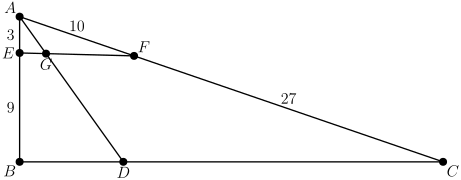
In the diagram below, angle is a right angle. Point is on and bisects angle Points and are on and respectively, so that and Given that and find the integer closest to the area of quadrilateral
小提示:
、,所以 且 。写成 。
and so and Write
大提示:
两次使用角平分线定理:用 处理三角形 ,再用 处理三角形 。
Apply the angle bisector ratio twice: in triangle and in triangle
解答:
这里 ,。角 为直角,所以 ,且 。这个四边形是从三角形 中去掉三角形 后剩下的部分,其中 是 与 的交点。
在三角形 中,由角平分线定理 ,所以 。在三角形 中,射线 平分同一个角,所以 ,从而 。另外,
因此 最接近的整数为 。
Here and angle is right, so and The quadrilateral is triangle with triangle removed, where is the intersection of and
By the angle bisector theorem in triangle so In triangle ray bisects the same angle, so and Also
Therefore and the closest integer is
11.
和 是一个立方体的两个面,且 。一束光从顶点 发出,在面 上的点 处反射。该点到 的距离为 ,到 的距离为 。光束继续在立方体的各个面上反射。从光束离开点 到它下一次到达立方体顶点为止,光路长度为 ,其中 和 是整数,且 不被任何质数的平方整除。求 。
Let and be two faces of a cube with A beam of light emanates from vertex and reflects off face at point which is units from and units from The beam continues to be reflected off the faces of the cube. The length of the light path from the time it leaves point until it next reaches a vertex of the cube is given by where and are integers and is not divisible by the square of any prime. Find
小提示:
每次反射时把立方体关于相应面翻折;这些翻折把光路拉直成从 经过 的一条射线。
Reflect the cube across a face at each bounce; the reflections straighten the light path into the single ray from through
大提示:
这条射线上的点为 ;三个坐标第一次同时被 整除发生在 。
The ray’s points are all three coordinates are first divisible by when
解答:
设 ,立方体为 ,且 在平面 上。每次反射时把立方体关于相关面翻折,可把反射光路拉直成从 经过 的一条射线:每穿过一个平面 、 或 就对应一次反射,而光束恰好在三个坐标同时为 的倍数时到达立方体顶点。
射线由点 组成。因为 和 都与 互质,坐标 与 第一次被 整除发生在 ,对应点为 。路径长度等于直线距离
由于 不含平方因子,。
Place with the cube and on the face Reflecting the cube across the relevant face at each bounce straightens the reflected path into the straight ray from through each crossing of a plane or corresponds to a bounce, and the beam reaches a vertex of the cube exactly when all three coordinates are simultaneously multiples of
The ray consists of the points Since and are relatively prime to the coordinates and are first divisible by when at the point The path length equals the straight-line distance
Since is squarefree,
12.
定义 ,其中复数 ;并令 ,其中 为正整数。已知 ,且 ,其中 和 都是实数。求 。
Let for all complex numbers and let for all positive integers Given that and where and are real numbers, find
小提示:
将映射与自身复合: 可化简为 。
Compose the map with itself: simplifies to
大提示:
,所以数列周期为 ;由于 ,只需计算 。
so the sequence has period since just compute
解答:
将映射与自身复合,得到 再应用一次 ,得到 所以数列 的周期为 。
因为 ,所以 。因此 。
Composing the map with itself, and applying once more gives so the sequence is periodic with period
Since we have Thus
13.
在三角形 中,中线 和 的长度分别为 和 ,且 。延长 ,使其与三角形 的外接圆交于 。三角形 的面积为 ,其中 和 是正整数,且 不被任何质数的平方整除。求 。
In triangle the medians and have lengths and respectively, and Extend to intersect the circumcircle of at The area of triangle is where and are positive integers and is not divisible by the square of any prime. Find
小提示:
是 的中点,所以点 的幂给出 。
is the midpoint of so the power of the point gives
大提示:
重心 将每条中线按二比一分割,所以三角形 的边长为 、 和 ;利用 与 在 上的共线底边比较它们。
The centroid divides each median two-to-one, so triangle has side lengths and compare triangles and using their collinear bases on
解答:
因为 是 的中点,所以 。设 为重心,它将每条中线按二比一分割:,且 。由点 关于外接圆的幂,,所以 。
三角形 为等腰三角形,,底边 。因此从 到 的高为 ,于是 。因为 和 都在直线 上,三角形 和 共享顶点 ,且底边共线,所以
最后,由于 是 的中点,,所以 。
Since is the midpoint of Let be the centroid, which divides each median in a two-to-one ratio: and By the power of the point with respect to the circumcircle, so
Triangle is isosceles with and base so the altitude from to is giving Since and both lie on line triangles and share the apex and have collinear bases, so
Finally, since is the midpoint of and
14.
一个由不同正整数组成的集合 具有如下性质:对每个整数 ,只要它属于 ,删去 后, 中剩余元素的算术平均数都是整数。已知 属于 ,且 是 的最大元素。集合 最多可以有多少个元素?
A set of distinct positive integers has the following property: for every integer in the arithmetic mean of the set of values obtained by deleting from is an integer. Given that belongs to and that is the largest element of what is the greatest number of elements that can have?
小提示:
若总和为 、元素个数为 ,则每个 都是整数,所以所有元素模 同余。
If is the sum and the size, every is an integer, so all elements are congruent mod
大提示:
由于 和 都在集合中, 整除 ;而 个不同的这样的元素还迫使 。
With and in the set, divides and distinct such elements force
解答:
设 有 个元素,总和为 。条件说明 对每个 都是整数,这意味着每个元素都与 模 同余。特别地,所有元素彼此同余;又因为 ,每个元素都是 加上 的某个倍数。
于是 ,所以 整除 。此外, 个不同元素从 到 之间,彼此间距是 的倍数,所以 ,从而 。 中不超过 的最大因数是 ,所以 。
三十个元素可以达到:取 个数 ,再加上 。它们全都 ,且 个数的总和 ,所以删去任一元素后的平均数都是整数。答案是 。
Let have elements with sum The condition says is an integer for every which means every element is congruent to modulo In particular all elements are congruent to each other, and since every element is more than a multiple of
Then so divides Moreover the distinct elements run from up to in steps that are multiples of so forcing The largest divisor of that is at most is so
Thirty is attainable: take the numbers together with All are and the sum of all is so every deleted mean is an integer. The answer is
15.
多面体 有六个面。面 是正方形,且 ;面 是梯形,其中 平行于 ,,且 ;面 满足 。另外三个面是 、 和 。点 到面 的距离为 。已知 ,其中 、、 是正整数,且 不被任何质数的平方整除。求 。
Polyhedron has six faces. Face is a square with face is a trapezoid with parallel to and and face has The other three faces are and The distance from to face is Given that where and are positive integers and is not divisible by the square of any prime, find
小提示:
建立坐标系,使正方形 位于 -平面;已知长度可确定 。
Set up coordinates with square in the -plane; the given lengths place
大提示:
面 位于同一平面内,所以 在经过 、、 的平面 上;由等腰梯形的对称性得 ,再用 求出 。
Face is planar, so lies on the plane through trapezoid symmetry gives and determines
解答:
取 、、、。由 到面 的距离可令 。由 得 ,再由 得 ,所以 ,。
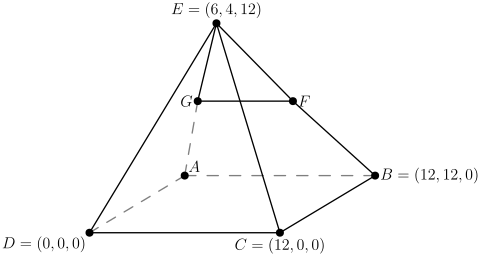
在梯形 中, 平行于 ,且 、,所以 和 关于平面 对称:、。由于面 位于同一平面内,而经过 、、 的平面包含整个 -轴方向( 和 都满足 ),所以它是平面 ,并且确实包含 。因此 。现在由 得 ,所以 。
于是 题目给出的形式 对应 。因此
Place and using the given distance from to face From we get and then gives so and
In trapezoid is parallel to with and so and are symmetric about the plane and Face is planar, and the plane through contains the entire -axis direction (both and have ), so it is the plane which indeed contains Hence Now gives so
Then and the stated form corresponds to Thus