
2002 AIME I 第 2 题
先试着解答 2002 AIME I 第 2 题,然后核对你的答案与精心整理的解答,解答来自 LIVE by Po-Shen Loh。你也可以参加完整限时模拟考试、查看全部 2002 AIME I 解答,或核对答案。
所有题目均经美国数学协会(MAA)官方合法授权使用。
2.
图中二十个全等圆排成三行,并被一个长方形围住。这些圆彼此相切,并且如图所示与长方形的边相切。长方形较长边与较短边的比可以写成 ,其中 和 是正整数。求 。
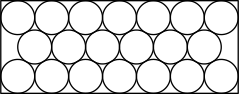
The diagram shows twenty congruent circles arranged in three rows and enclosed in a rectangle. The circles are tangent to one another and to the sides of the rectangle as shown in the diagram. The ratio of the longer dimension of the rectangle to the shorter dimension can be written as where and are positive integers. Find
小提示:
设圆的半径为 ,较长边为 。要求较短边,连接三个两两相切圆的圆心。
With circle radius the longer side is For the shorter side, connect the centers of three mutually tangent circles.
大提示:
相邻两行圆心的距离为 ,所以较短边为 ;将 有理化。
Adjacent rows of centers are apart, so the shorter side is rationalize
解答:
设公共半径为 。较长边容纳一行七个圆,所以长为 。相邻行中三个两两相切圆的圆心构成边长 的等边三角形,其高为 。两段相邻行圆心间距合计贡献 ,所以较短边为 。
所求比值为 所以 ,,。
Let be the common radius. The longer side holds a row of seven circles, so it equals The centers of three mutually tangent circles in adjacent rows form an equilateral triangle with side whose height is so the two gaps between rows of centers contribute and the shorter side is
The ratio is so and
其他年份的第 2 题
1983 AIME · 1984 AIME · 1985 AIME · 1986 AIME · 1987 AIME · 1988 AIME · 1989 AIME · 1990 AIME · 1991 AIME · 1992 AIME · 1993 AIME · 1994 AIME · 1995 AIME · 1996 AIME · 1997 AIME · 1998 AIME · 1999 AIME · 2000 AIME I · 2000 AIME II · 2001 AIME I · 2001 AIME II · 2002 AIME II · 2003 AIME I · 2003 AIME II · 2004 AIME I · 2004 AIME II · 2005 AIME I · 2005 AIME II · 2006 AIME I · 2006 AIME II · 2007 AIME I · 2007 AIME II · 2008 AIME I · 2008 AIME II · 2009 AIME I · 2009 AIME II · 2010 AIME I · 2010 AIME II · 2011 AIME I · 2011 AIME II · 2012 AIME I · 2012 AIME II · 2013 AIME I · 2013 AIME II · 2014 AIME I · 2014 AIME II · 2015 AIME I · 2015 AIME II · 2016 AIME I · 2016 AIME II · 2017 AIME I · 2017 AIME II · 2018 AIME I · 2018 AIME II · 2019 AIME I · 2019 AIME II · 2020 AIME I · 2020 AIME II · 2021 AIME I · 2021 AIME II · 2022 AIME I · 2022 AIME II · 2023 AIME I · 2023 AIME II · 2024 AIME I · 2024 AIME II · 2025 AIME I · 2025 AIME II · 2026 AIME I · 2026 AIME II