
Problemas del 2025 AMC 8
¡Desplázate hacia abajo y presiona Iniciar para intentar el examen! O ve al PDF imprimible, la clave de respuestas, o las soluciones profesionales en video y soluciones escritas preparadas por LIVE by Po-Shen Loh.
Todos los problemas se usan con el permiso legal oficial de la Mathematical Association of America (MAA).
O salta directamente a un solo problema con su solución y video: 1 · 2 · 3 · 4 · 5 · 6 · 7 · 8 · 9 · 10 · 11 · 12 · 13 · 14 · 15 · 16 · 17 · 18 · 19 · 20 · 21 · 22 · 23 · 24 · 25
¿Quieres aprender de forma profesional con clases interactivas en video?
Con tiempo
40:00
1.
La estrella de ocho puntas que se muestra en la figura de abajo es un patrón de acolchado muy popular. ¿Qué porcentaje de toda la cuadrícula de por cubre la estrella?
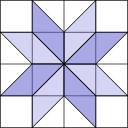
The eight-pointed star, shown in the figure below, is a popular quilting pattern. What percent of the entire -by- grid is covered by the star?
Pista pequeña:
Usa la simetría para concentrarte en un cuarto de la cuadrícula
Use symmetry to focus on one quarter of the grid
Pista grande:
Compara las áreas sombreadas y no sombreadas dentro de ese cuarto
Compare the shaded and unshaded areas inside that quarter
Solución en video:

Click to load, then click again to play
Solución escrita:
Hay simetría, así que la fracción del cuarto superior izquierdo que está sombreada es igual a la fracción de todo el cuadrado que está sombreada.
Concéntrate en el cuarto superior izquierdo. Considera mover un solo triángulo. El área sombreada del problema es exactamente igual al área sombreada de este diagrama (y el cuarto superior izquierdo está resaltado en negrita):
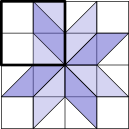
Entonces resulta evidente que exactamente la mitad del cuarto superior izquierdo está sombreada, así que la respuesta es que es la opción B.
There is symmetry, and so whatever fraction of the top-left quarter is shaded, is the same as the fraction of the entire square that is shaded.
Focus on the top-left quarter. Consider moving a single triangle. The shaded area in the problem is exactly the same as the shaded area in this diagram (and the top-left quarter is outlined in bold):
But then it is obvious that exactly half of the top-left quarter is shaded, and so the answer is which is choice B.
2.
La tabla de abajo muestra los jeroglíficos del antiguo Egipto que se usaban para representar distintos números.
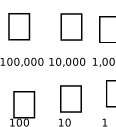
Por ejemplo, el número se representaba así:

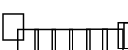
¿Qué número representa la siguiente combinación de jeroglíficos?
The table below shows the ancient Egyptian hieroglyphs that were used to represent different numbers.
For example, the number was represented by:
What number was represented by the following combination of hieroglyphs?
Respuesta: B
Pista pequeña:
Usa los valores posicionales por separado
Use place values separately
Pista grande:
Cuenta cuántos hay de cada tipo de símbolo, luego multiplica por su valor y suma
Count each kind of glyph, then multiply by its value and add
Solución en video:
Click to load, then click again to play
Solución escrita:
Solo tenemos que contar cuántos símbolos hay de cada tipo.
Hay símbolo que vale
Hay símbolos que valen cada uno.
Hay símbolos que valen cada uno.
Hay símbolos que valen cada uno.
Así que la respuesta es que es la opción B.
We just need to count how many of each type of glyph there are.
There is glyph worth
There are glyphs worth each.
There are glyphs worth each.
There are glyphs worth each.
So, the answer is which is choice B.
3.
Buffalo Shuffle-o es un juego de cartas en el que todas las cartas se reparten de forma equitativa entre todos los jugadores al comienzo del juego. Cuando Annika y de sus amigos juegan Buffalo Shuffle-o, a cada jugador le reparten cartas. Supón que amigos más se unen en la siguiente partida. ¿Cuántas cartas le repartirán a cada jugador?
Buffalo Shuffle-o is a card game in which all the cards are distributed evenly among all players at the start of the game. When Annika and of her friends play Buffalo Shuffle-o, each player is dealt cards. Suppose more friends join the next game. How many cards will be dealt to each player?
Respuesta: C
Pista pequeña:
Primero halla el número total de cartas de la baraja
First find the total number of cards in the deck
Pista grande:
La primera partida tiene jugadores y la segunda tiene
The first game has players and the second game has
Solución en video:
Click to load, then click again to play
Solución escrita:
Al principio hay personas en total (Annika más amigos), cada una con cartas, así que hay cartas en total. Si se unen amigos más, habrá personas en total, así que a cada una le tocan cartas, que es la opción C.
At the start, there are total people (Annika plus friends), each with cards, so there are cards in total. If more friends join, there will be people in total, and so each should get cards, which is choice C.
4.
Lucius cuenta hacia atrás restando cada vez. Sus primeros tres números son y ¿Cuál es su .º número?
Lucius is counting backward by s. His first three numbers are and What is his th number?
Respuesta: B
Pista pequeña:
El número está pasos después del número
The th number is steps after the st
Pista grande:
Resta siete nueve veces del primer término
Subtract nine 7s from the first term
Solución en video:
Click to load, then click again to play
Solución escrita:
Hay intervalos entre su primer número y su .º número. Cada intervalo tiene tamaño
Así que restará en total a y queda una respuesta de que es la opción B.
There will be gaps between his first number and his th number. Each gap has size
So, he will subtract a total of from leaving an answer of which is choice B.
5.
Betty conduce un camión para entregar paquetes en un vecindario cuyo mapa de calles se muestra abajo. Betty parte de la fábrica (marcada con ) y conduce hasta el punto luego luego antes de regresar a ¿Cuál es la distancia más corta, en cuadras, que puede recorrer para completar la ruta?
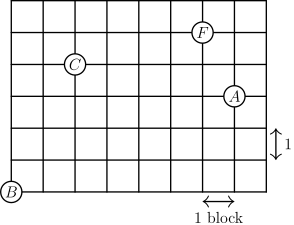
Betty drives a truck to deliver packages in a neighborhood whose street map is shown below. Betty starts at the factory (labeled ) and drives to location then then before returning to What is the shortest distance, in blocks, she can drive to complete the route?
Respuesta: C
Pista pequeña:
Divide la ruta en cuatro trayectos mínimos por la cuadrícula
Break the route into four shortest grid trips
Pista grande:
En una cuadrícula de calles, cuenta las cuadras horizontales más las cuadras verticales
On a street grid, count horizontal blocks plus vertical blocks
Solución en video:
Click to load, then click again to play
Solución escrita:
La idea clave es que, si se conduce de las coordenadas a la distancia más corta es A menudo se le llama distancia de Manhattan. También es igual al número de cuadras horizontales entre los puntos, más el número de cuadras verticales entre los puntos.
La distancia más corta de a es entonces
La distancia más corta de a es
La distancia más corta de a es
La distancia más corta de a es
Sumando todos estos números, obtenemos que es la opción C.
Un pequeño atajo posible es notar que, al ir de a y luego a la visita a queda convenientemente sobre una ruta más corta de a de todos modos, así que incluso podemos quitar del problema la exigencia de parar en .
The key idea is that if driving from coordinates to then the shortest distance is This is often called the Manhattan distance. It is also equal to the number of horizontal blocks between the locations, plus the number of vertical blocks between the locations.
The shortest distance from to is then
The shortest distance from to is
The shortest distance from to is
The shortest distance from to is
Adding up all of these numbers, we get which is choice C.
One small possible shortcut for the solution is to notice that when going from to to the visit to is conveniently along a shortest path from to anyway, so we can even remove the requirement to stop at from the problem.
6.
Sekou escribe los números Después de borrar uno de los números, la suma de los cuatro números restantes es un múltiplo de ¿Qué número borró?
Sekou writes the numbers After he erases one of the numbers, the sum of the remaining four numbers is a multiple of Which number did he erase?
Respuesta: C
Pista pequeña:
Compara la suma total módulo antes y después de borrar
Compare the total sum modulo before and after erasing
Pista grande:
El número borrado debe tener el mismo residuo que la suma original módulo cuatro
The erased number must have the same remainder as the original total
Solución en video:
Click to load, then click again to play
Solución escrita:
Los residuos de los cinco números al dividir entre son: y Así que la suma de los cinco números módulo es igual a que tiene residuo módulo Por lo tanto, para borrar un solo número y obtener una suma que sea módulo debemos borrar el número que era módulo que era Por lo tanto, la respuesta es C.
The remainders of the five numbers after dividing by are: and So, the sum of all five numbers modulo is the same as which has remainder modulo Therefore, in order to erase a single number and get a sum that is modulo we must erase the number which was modulo which was Therefore, the answer is C.
7.
En el examen más reciente de la clase del profesor Xochi:
• estudiantes obtuvieron una calificación de al menos
• estudiantes obtuvieron una calificación de al menos
• estudiantes obtuvieron una calificación de al menos y
• estudiantes obtuvieron una calificación de al menos
¿Cuántos estudiantes obtuvieron una calificación de al menos y menos de ?
On the most recent exam in Prof. Xochi’s class,
• students earned a score of at least
• students earned a score of at least
• students earned a score of at least and
• students earned a score of at least
How many students earned a score of at least and less than
Respuesta: D
Pista pequeña:
Los grupos de calificaciones están anidados
The score groups are nested
Pista grande:
Resta del número de estudiantes con calificación de al menos el número de los que obtuvieron al menos
Subtract the students with scores at least from those at least
Solución en video:
Click to load, then click again to play
Solución escrita:
Observa que la cantidad de estudiantes en cada categoría sigue aumentando, lo cual tiene sentido porque las categorías se vuelven más amplias.
Queremos incluir a los estudiantes que obtuvieron una calificación de al menos pero excluir a los estudiantes que obtuvieron una calificación de al menos Así que la respuesta es que es la opción D.
Notice that the numbers of students in each category keep increasing, which makes sense because the categories are getting broader.
We want to include all of the students who earned a score of at least but exclude all of the students who earned a score of at least So, the answer is which is choice D.
8.
Isaiah corta una caja cúbica de cartón por algunas de sus aristas para formar la figura plana que se muestra, que tiene un área de centímetros cuadrados. ¿Cuál era el volumen del cubo en centímetros cúbicos?

Isaiah cuts open a cardboard cube along some of its edges to form the flat shape shown, which has an area of square centimeters. What was the volume of the cube in cubic centimeters?
Respuesta: A
Pista pequeña:
El desarrollo de un cubo tiene caras cuadradas congruentes
A cube net has congruent square faces
Pista grande:
Divide el área del desarrollo entre para obtener el área de una cara
Divide the net area by to get one face area
Solución en video:
Click to load, then click again to play
Solución escrita:
Hay cuadrados, así que cada uno tiene área Entonces la longitud del lado del cubo es El volumen es que es la opción A.
There are squares, so each has area Then the side length of the cube is The volume is which is choice A.
9.
Ningli mira los pares de números que están directamente enfrentados en un reloj. Calcula el promedio de cada par de números. ¿Cuál es el promedio de los números resultantes?
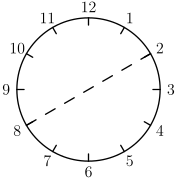
Ningli looks at the pairs of numbers directly across from each other on a clock. She takes the average of each pair of numbers. What is the average of the resulting numbers?
Respuesta: B
Pista pequeña:
El promedio de los promedios de pares es igual al promedio de los números
The average of pair-averages equals the average of all numbers
Pista grande:
El promedio del al está a medio camino entre los extremos
The average of through is halfway between the endpoints
Solución en video:
Click to load, then click again to play
Solución escrita:
La respuesta es igual al promedio de los números. Para entender por qué, en realidad es cierto en general que si un montón de números se divide en pares, se promedia cada par y luego se promedian todos esos promedios de pares, el resultado es el promedio de todos los números.
Para ver por qué, considera un ejemplo más pequeño de números y El promedio de los promedios de pares es y esto equivale a El mismo tipo de simplificación ocurre con números.
Como los números están igualmente espaciados (en progresión aritmética), la respuesta es igual al promedio del primer y el último número, que es o sea, la opción B.
The answer is the same as the average of all numbers. To understand why this is the case, it is actually generally true that if a whole bunch of numbers is split up into pairs, and each pair is averaged, and then all those pair-averages are averaged, the answer is the average of all the numbers.
To see why this is true, consider a smaller example of numbers and The average of the pair-averages is: and that is equal to The same type of simplification happens with numbers.
Since the numbers are equally spaced (in an arithmetic progression), the answer is the same as the average of the first and last number, which is or choice B.
10.
En la figura de abajo, es un rectángulo con lados de longitud pulgadas y pulgadas. El rectángulo se gira en el sentido de las manecillas del reloj alrededor del punto medio del lado para obtener un segundo rectángulo. ¿Cuál es el área total, en pulgadas cuadradas, cubierta por los dos rectángulos superpuestos?
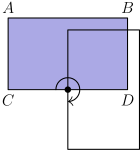
In the figure below, is a rectangle with sides of length inches and inches. Rectangle is rotated clockwise around the midpoint of side to give a second rectangle. What is the total area, in square inches, covered by the two overlapping rectangles?
Respuesta: D
Pista pequeña:
Suma las áreas de los dos rectángulos y resta la superposición
Add the two rectangle areas and subtract the overlap
Pista grande:
La superposición es un cuadrado cuyo lado es la mitad del lado de pulgadas
The overlap is a square whose side is half of the -inch side
Solución en video:
Click to load, then click again to play
Solución escrita:
La forma más fácil de resolver este problema es usando la fórmula de inclusión-exclusión. Es decir: suma las áreas de los dos rectángulos y luego resta el área superpuesta (cuadrada).
Cada rectángulo tiene área
Su superposición es un cuadrado que tiene longitud de lado así que su área es
Por lo tanto, el área total es que es la opción D.
The easiest way to solve this problem is using the Inclusion-Exclusion formula. That is: add the areas of the two rectangles, and then subtract the overlapping (square) area.
Each rectangle has area
Their overlap is a square that has side length and so its area is
Therefore, the total area is which is choice D.
11.
Un tetrominó consiste en cuatro cuadrados conectados por sus aristas. Hay cinco formas posibles de tetrominó: , , , y , que se muestran abajo y que se pueden rotar o voltear. Se usan tres tetrominós para cubrir por completo un rectángulo de . Al menos una de las piezas es una pieza . ¿Cuáles son las otras dos piezas?
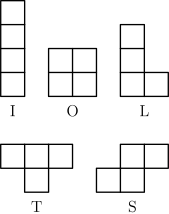
A tetromino consists of four squares connected along their edges. There are five possible tetromino shapes, , , , , and , shown below, which can be rotated or flipped over. Three tetrominoes are used to completely cover a rectangle. At least one of the tiles is an tile. What are the other two tiles?
y
and
y
and
y
and
y
and
y
and
Respuesta: C
Pista pequeña:
Intenta colocar la pieza de modo que la región restante se separe con claridad
Try placing the tile so the leftover region separates cleanly
Pista grande:
Después de colocar una pieza , verifica qué par puede cubrir el resto
After one tile is placed, check which pair can tile the rest
Solución en video:
Click to load, then click again to play
Solución escrita:
Un poco de ensayo y error sugiere colocar el tetrominó de una manera que no bloquee demasiado, así:

Entonces es fácil ver que el resto se puede dividir en dos tetrominós , así que la respuesta es C.
A little trial-and-error suggests placing the tetromino in a way that does not block too much, like this:
It is then easy to see that the remainder can be partitioned into two tetrominoes, and so the answer is C.
12.
La región que se muestra abajo consta de cuadrados, cada uno con longitud de lado centímetro. ¿Cuál es el área, en centímetros cuadrados, del círculo más grande que cabe dentro de la región, tocando posiblemente los bordes?

The region shown below consists of squares, each with side length centimeter. What is the area, in square centimeters, of the largest circle that can fit inside the region, possibly touching the boundaries?
Respuesta: C
Pista pequeña:
El círculo más grande está centrado en el centro de la región
The largest circle is centered at the center of the region
Pista grande:
Halla la distancia del centro a las esquinas cóncavas más cercanas
Find the distance from the center to the nearest concave corners
Solución en video:
Click to load, then click again to play
Solución escrita:
Las esquinas de la región que están más cerca del centro son los puntos que se encuentran sobre este círculo:

Por el teorema de Pitágoras, cada uno de estos puntos está a esta distancia del centro: Entonces el área del círculo es que es la opción C.
The corners of the region which are closest to the center are the points which lie on this circle:
By the Pythagorean Theorem, each of these points has this distance from the center: The area of the circle is then which is choice C.
13.
Cada uno de los números pares se divide entre Se anotan los residuos. ¿Qué histograma muestra el número de veces que aparece cada residuo?
Each of the even numbers is divided by The remainders are recorded. Which histogram displays the number of times each remainder occurs?
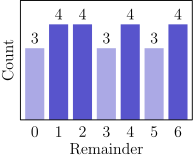
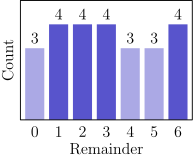
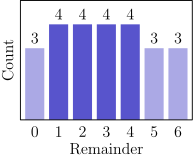
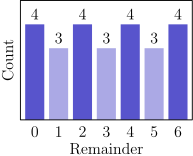
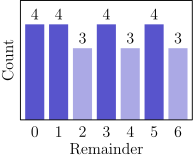
Respuesta: A
Pista pequeña:
Los residuos de los números pares módulo aumentan cada vez
The remainders of even numbers modulo cycle by adding
Pista grande:
Fíjate en qué cuatro residuos aparecen una vez más
Track which four remainders appear one extra time
Solución en video:
Click to load, then click again to play
Solución escrita:
Los residuos van en orden y luego se repiten.
Todas las opciones de respuesta tienen barras de altura y barras de altura
Así que debemos elegir la opción donde las barras más altas están sobre los primeros residuos que aparecen en nuestro orden, que son y Esa es la opción A.
The remainders go in order and then repeat.
All of the answer choices have bars of height and bars of height
So, we should pick the answer choice where the taller bars are on the first remainders to appear in our order, which are and That is option A.
14.
Se inserta un número en la lista Ahora la media es el doble de la mediana. ¿Cuánto vale ?
A number is inserted into the list The mean is now twice as great as the median. What is
Respuesta: E
Pista pequeña:
Como cada opción es al menos , la mediana no cambia
Since every choice is at least the median stays fixed
Pista grande:
Haz que la suma total sea igual a veces el doble de la mediana
Make the total sum equal to times twice the median
Solución en video:
Click to load, then click again to play
Solución escrita:
Después de insertar en la lista, habrá números en total. Eso es par, así que la mediana será el promedio de los dos números centrales.
Todas las opciones de respuesta son al menos así que, cuando se insertan en la lista, los dos números centrales serán y Es conveniente que la mediana siempre sea sin importar qué opción se elija.
La media pasa a ser el doble de la mediana, que es
Para tener un total de números con media su suma debe llegar a ser
La suma de los números originales es así que la respuesta es que es la opción E.
After inserting into the list, there will be total numbers. That is even, so the median will be the average of the middle two numbers.
All of the answer choices are at least so when they are inserted into the list, the middle two numbers will be and It is convenient that the median will always be no matter which answer choice is picked.
The mean becomes twice the median, which is
To have a total of numbers with mean their sum must become
The sum of the original numbers is so the answer is which is choice E.
15.
Kei dibuja una cuadrícula de por . Colorea de los cuadrados unitarios de plateado y los cuadrados restantes de dorado. Luego Kei dobla la cuadrícula por la mitad verticalmente, formando pares de cuadrados unitarios superpuestos. Sean y el menor y el mayor número posible de pares dorado-con-dorado, respectivamente. ¿Cuál es el valor de ?
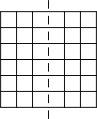
Kei draws a -by- grid. He colors of the unit squares silver and the remaining squares gold. Kei then folds the grid in half vertically, forming pairs of overlapping unit squares. Let and equal the least and greatest possible number of gold-on-gold pairs, respectively. What is the value of
Respuesta: C
Pista pequeña:
El doblez forma pares superpuestos
The fold makes overlapping pairs
Pista grande:
Para minimizar los pares doble-dorado, primero reparte los cuadrados dorados entre los pares
To minimize double-gold pairs, spread gold squares among pairs first
Solución en video:
Click to load, then click again to play
Solución escrita:
El número de cuadrados dorados es Los cuadrados en total se superponen en pares.
Para minimizar el número de pares con dos cuadrados dorados, primero se deben repartir los cuadrados dorados entre todos los pares. Eso usa de ellos. Los cuadrados dorados restantes se emparejan y crean un total de pares dorado-con-dorado.
Para maximizar el número de pares con dos cuadrados dorados, primero se deben emparejar tanto como sea posible los cuadrados dorados. Eso se puede hacer para crear pares, con cuadrado dorado sobrante, porque es con residuo
La respuesta es que es la opción C.
The number of gold squares is The total squares overlap as pairs.
To minimize the number of pairs with two gold squares, the gold squares should first be spread out across all pairs. That uses up of them. The remaining gold squares double-up and create a total of gold-on-gold pairs.
To maximize the number of pairs with two gold squares, the gold squares should first be paired up as much as possible. That can be done to create pairs, with gold square left over, because is with a remainder of
The answer is which is choice C.
16.
Se eligen cinco enteros distintos del al , y cinco enteros distintos del al . No hay dos números que difieran en exactamente ¿Cuál es la suma de los diez números elegidos?
Five distinct integers from to are chosen, and five distinct integers from to are chosen. No two numbers differ by exactly What is the sum of the ten chosen numbers?
Respuesta: C
Pista pequeña:
Empareja cada número del al con el número unidades mayor
Pair each number from to with the number larger
Pista grande:
Los números superiores elegidos corresponden a los números inferiores no elegidos
The chosen upper numbers correspond to the unchosen lower numbers
Solución en video:
Click to load, then click again to play
Solución escrita:
Llama rango inferior a los enteros del al inclusive, y llama rango superior a los enteros del al inclusive.
Cada uno de los números distintos elegidos del rango inferior bloquea el número del rango superior que es exactamente mayor que él. Solo hay números en el rango superior, así que solo quedan números aún no bloqueados.
Necesitamos elegir números distintos del rango superior, así que los números elegidos del rango superior son precisamente los que aún no están bloqueados. Cada uno de ellos es exactamente mayor que un número no elegido del rango inferior.
Así que la suma de los números distintos elegidos del rango superior es exactamente mayor que la suma de los números no elegidos del rango inferior.
Por lo tanto, la suma de los números elegidos es igual a más la suma de todos los números elegidos y no elegidos del rango inferior
La suma de los números del al es así que la respuesta es o la opción C.
Call the integers from to inclusive the lower range, and call the integers from to inclusive the higher range.
Each of the distinct numbers chosen from the lower range blocks out the number in the higher range that is exactly more than itself. There are only numbers in the higher range, so there are only numbers not yet blocked.
We need to choose distinct numbers from the higher range, so the numbers chosen from the higher range are precisely those which are not yet blocked. They are each exactly more than a not-chosen number in the lower range.
So, the sum of the distinct numbers chosen from the higher range is exactly more than the sum of the not-chosen numbers in the lower range.
The sum of all chosen numbers is therefore equal to plus the sum of all chosen and not-chosen numbers in the lower range
The sum of the numbers from to is so the answer is or choice C.
17.
En la tierra de Markovia, hay tres ciudades: y Hay personas que viven en que viven en y que viven en Todos trabajan en una de las tres ciudades, y una persona puede trabajar en la misma ciudad donde vive. En la figura de abajo, una flecha que apunta de una ciudad a otra está etiquetada con la fracción de personas que viven en la primera ciudad y trabajan en la segunda. (Por ejemplo, de las personas que viven en trabajan en ) ¿Cuántas personas trabajan en ?
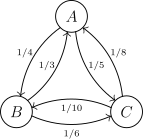
In the land of Markovia, there are three cities: and There are people who live in who live in and who live in Everyone works in one of the three cities, and a person may work in the same city where they live. In the figure below, an arrow pointing from one city to another is labeled with the fraction of people living in the first city who work in the second city. (For example, of the people who live in work in ) How many people work in
Respuesta: D
Pista pequeña:
Suma las personas que trabajan en provenientes de cada ciudad de residencia
Add the people working in from each home city
Pista grande:
Para los residentes de la ciudad , resta las fracciones que van a y a
For city residents, subtract the fractions going to and
Solución en video:
Click to load, then click again to play
Solución escrita:
El número de personas que viven en y trabajan en es que equivale a El número de personas que viven en y trabajan en es El número de personas que viven en y trabajan en es Por tanto, la respuesta es que corresponde a la opción D.
The number of people who live in and work in is which is The number of people who live in and work in is The number of people who live in and work in is So, the answer is which is choice D.
18.
El círculo que se muestra abajo a la izquierda tiene un radio de unidad. La región entre el círculo y el cuadrado inscrito está sombreada. En el círculo que se muestra a la derecha, una cuarta parte de la región entre el círculo y el cuadrado inscrito está sombreada. Las regiones sombreadas de los dos círculos tienen la misma área. ¿Cuál es el radio en unidades, del círculo de la derecha?
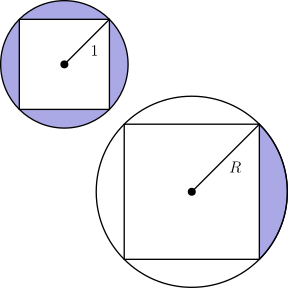
The circle shown below on the left has a radius of unit. The region between the circle and the inscribed square is shaded. In the circle shown on the right, one quarter of the region between the circle and the inscribed square is shaded. The shaded regions in the two circles have the same area. What is the radius in units, of the circle on the right?
Respuesta: B
Pista pequeña:
Compara las áreas de las coronas sombreadas pensando en la escala
Match the shaded gap areas by thinking about scaling
Pista grande:
Las áreas escalan como el cuadrado del factor de escala de longitud
Areas scale as the square of the length scale factor
Solución en video:
Click to load, then click again to play
Solución escrita:
En el círculo de la derecha, solo una cuarta parte de la región entre el círculo y el cuadrado está sombreada. Para que esa área sombreada sea igual a toda la región de la izquierda, la región completa de la derecha debe tener veces el área de la región de la izquierda.
Las dos figuras formadas por un círculo y su cuadrado inscrito son semejantes, y sus áreas escalan como el cuadrado de sus radios. Así de donde que es la opción B.
Only one quarter of the gap between the circle and square is shaded on the right. For that shaded area to equal the whole gap on the left, the entire gap on the right must have times the area of the gap on the left.
The two circle-and-square figures are similar, and their areas scale as the square of their radii. Thus so which is choice B.
19.
Dos pueblos, y están conectados por una carretera recta de millas de largo. Al viajar del pueblo al pueblo el límite de velocidad cambia cada millas: de a y a millas por hora (mph). Dos autos, uno en el pueblo y otro en el pueblo empiezan a moverse uno hacia el otro al mismo tiempo. Conducen exactamente al límite de velocidad en cada tramo de la carretera. ¿A qué distancia del pueblo en millas, se encontrarán los dos autos?
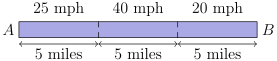
Two towns, and are connected by a straight road, miles long. Traveling from town to town the speed limit changes every miles: from to to miles per hour (mph). Two cars, one at town and one at town start moving toward each other at the same time. They drive at exactly the speed limit in each portion of the road. How far from town in miles, will the two cars meet?
Respuesta: D
Pista pequeña:
Halla cuándo llega cada auto al tramo central de millas
Find when each car reaches the middle -mile section
Pista grande:
Una vez que ambos autos están en el tramo central, sus velocidades son iguales
Once both cars are in the middle section, their speeds are equal
Solución en video:
Click to load, then click again to play
Solución escrita:
Piensa en la carretera como si tuviera tres tramos: izquierdo, central y derecho. Cada tramo mide millas de largo.
El auto que sale de llega al tramo central en horas.
El auto que sale de llega al tramo central en horas. Para entonces, el auto que sale de ya ha recorrido el tramo central durante horas. Durante este tiempo, ese auto que sale de ha recorrido millas en el tramo central.
Eso deja millas entre los dos autos en el tramo central.
En ese momento, el auto que sale de está a millas de
Como los autos conducen a la misma velocidad de mph en el tramo central, se encuentran después de que cada uno recorre millas más. Esto lleva al auto que sale de una distancia total de millas, que es la opción D.
Think of the road as having three sections: left, middle, and right. Each section is miles long.
The car from reaches the middle section in hours.
The car from reaches the middle section in hours. By that time, the car from has already driven in the middle section for hours. During this time, that car from has traveled miles in the middle section.
That leaves miles between the two cars in the middle section.
At that moment, the car from is miles from
Since the cars drive at the same speed of mph in the middle section, they meet after each driving more miles. This takes the car from a total distance of miles, which is choice D.
20.
Sarika, Dev y Rajiv comparten un bloque grande de queso. Se turnan para cortar la mitad de lo que queda y comérsela: primero Sarika come la mitad del queso, luego Dev come la mitad de la mitad restante, luego Rajiv come la mitad de lo que queda, luego le toca de nuevo a Sarika, y así sucesivamente. Se detienen cuando el queso es demasiado pequeño para verse. ¿Aproximadamente qué fracción del bloque original de queso come Sarika en total?
Sarika, Dev, and Rajiv are sharing a large block of cheese. They take turns cutting off half of what remains and eating it: first Sarika eats half of the cheese, then Dev eats half of the remaining half, then Rajiv eats half of what remains, then back to Sarika, and so on. They stop when the cheese is too small to see. About what fraction of the original block of cheese does Sarika eat in total?
Respuesta: A
Pista pequeña:
Sarika come cada tercer término de la sucesión de mitades
Sarika eats every third term of the halving sequence
Pista grande:
Sus porciones forman una serie geométrica de razón
Her shares form a geometric series with ratio
Solución en video:
Click to load, then click again to play
Solución escrita:
Sarika obtiene del queso en el primer paso.
Luego Dev obtiene del queso.
Luego Rajiv obtiene del queso.
Después Sarika obtiene otro del queso.
Este patrón continúa. Al final, Sarika obtiene del queso original, que es la suma de una serie geométrica infinita con primer término y razón común Esa suma es que es la opción A.
Sarika gets of the cheese in the first step.
Then Dev gets of the cheese.
Then Rajiv gets of the cheese.
Sarika then gets another of the cheese.
This pattern continues. Ultimately, Sarika gets which is the sum of an infinite geometric series with first term and common ratio That sum is which is choice A.
21.
La escuela Konigsberg ha asignado los grados al a las cápsulas a un grado por cápsula. Algunas de las cápsulas están conectadas por pasillos, como se muestra en la figura de abajo. La escuela notó que cada par de cápsulas conectadas tiene asignados grados que difieren en o más niveles de grado. (Por ejemplo, los grados y no estarán en cápsulas conectadas directamente por un pasillo.) ¿Cuál es la suma de los niveles de grado asignados a las cápsulas y ?
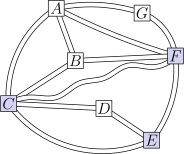
The Konigsberg School has assigned grades through to pods through one grade per pod. Some of the pods are connected by walkways, as shown in the figure below. The school noticed that each pair of connected pods has been assigned grades differing by or more grade levels. (For example, grades and will not be in pods directly connected by a walkway.) What is the sum of the grade levels assigned to pods and
Respuesta: A
Pista pequeña:
Las cuatro cápsulas conectadas entre sí deben recibir los grados , , y
The four mutually connected pods must get grades and
Pista grande:
Usa la cápsula para determinar dónde pueden ir los grados pequeños y grandes
Use pod to force where small and large grades can go
Solución en video:
Click to load, then click again to play
Solución escrita:
Las cápsulas y están todas conectadas entre sí por pares. Cuatro números del al que estén todos separados por al menos deben ser . Por lo tanto y reciben los grados pares .
La cápsula está conectada con y . Si , entonces y tendrían que ser y , dejando y como y . Pero entonces , que está conectada con y , no puede ser ninguno de los grados pares restantes sin quedar a solo de distancia de alguno de ellos. Así que no puede ser .
Si , entonces y deben ser y . Si , entonces no puede ser ni , así que . Además, no puede ser , porque entonces tampoco podría ser ni . Por lo tanto y , lo que da .
El caso es simétrico, y da y . La misma suma es .
Por lo tanto, A es la respuesta correcta.
Pods and are all pairwise connected. Four numbers from through that are all at least apart must be . Thus and get the even grades .
Pod is connected to and . If , then and would have to be and , leaving and as and . But then , which is connected to and , cannot be either remaining even grade without being only away from one of them. So cannot be .
If , then and must be and . If , then cannot be or , so . Also, cannot be , since then again cannot be or . Therefore and , giving .
The case is symmetric, giving and . The same sum is .
Thus, A is the correct answer.
22.
Un salón de clases tiene una fila de ganchos para abrigos. A Paulina le gusta que los abrigos estén igualmente espaciados, de modo que haya el mismo número de ganchos vacíos antes del primer abrigo, después del último abrigo y entre cada abrigo y el siguiente. Supón que hay al menos abrigo y al menos gancho vacío. ¿Cuántos números diferentes de abrigos pueden satisfacer el patrón de Paulina?
A classroom has a row of coat hooks. Paulina likes coats to be equally spaced, so that there is the same number of empty hooks before the first coat, after the last coat, and between every coat and the next one. Suppose there is at least coat and at least empty hook. How many different numbers of coats can satisfy Paulina’s pattern?
Respuesta: D
Pista pequeña:
Imagina agregar un último abrigo imaginario para formar bloques iguales
Add one imaginary final coat to make equal blocks
Pista grande:
El tamaño del bloque y el número de bloques deben multiplicarse para dar
The block size and number of blocks must multiply to
Solución en video:
Click to load, then click again to play
Solución escrita:
Imagina agregar un gancho adicional con un abrigo después del último abrigo. Ahora habrá ganchos para abrigos, y un patrón que se repite, donde cada bloque del patrón tiene un montón de ganchos vacíos seguidos de un abrigo. Sea el número de elementos de cada bloque. Sea el número de bloques. Observa que es exactamente uno más que el número de abrigos, porque agregamos un abrigo adicional al final.
Entonces tenemos
La restricción sobre es que , porque cada bloque tiene al menos un gancho vacío y termina con un abrigo.
La restricción sobre es que , porque antes había al menos un abrigo y agregamos un abrigo adicional al final.
Así que solo tenemos que averiguar de cuántas maneras se puede factorizar como producto de dos enteros que sean al menos
El número de maneras de factorizar como producto de dos enteros positivos es exactamente igual al número de divisores de Hay una fórmula para eso: como , el número de divisores de es
De estas factorizaciones, exactamente dos quedan descalificadas: y Así que la respuesta es que es la opción D.
Imagine adding an extra coat hook with a coat on it after the last coat. Now, there will be coat hooks, and a repeating pattern, where each block of the pattern has a bunch of empty hooks followed by a coat. Let be the number of items in each block. Let be the number of blocks. Note that is exactly one more than the number of coats, because we added an extra coat at the end.
We then have
The constraint on is that because each block has at least one empty hook, and ends with a coat.
The constraint on is that because there was at least one coat before, and we added one extra coat at the end.
So, we just need to find out how many ways there are to factorize into the product of two integers that are at least
The number of ways to factorize into the product of two positive integers is exactly equal to the number of factors of There is a formula for that: since , the number of factors of is
Out of these factorizations, exactly two are disqualified: and So, the answer is which is choice D.
23.
¿Cuántos números de cuatro dígitos tienen las tres propiedades siguientes?
(I) El dígito de las decenas y el dígito de las unidades son ambos
(II) El número es menos que un cuadrado perfecto.
(III) El número es el producto de exactamente dos números primos.
How many four-digit numbers have all three of the following properties?
(I) The tens digit and ones digit are both
(II) The number is less than a perfect square.
(III) The number is the product of exactly two prime numbers.
Respuesta: B
Pista pequeña:
El cuadrado que es uno más grande debe terminar en
The square one larger must end in
Pista grande:
Revisa los múltiplos de cuyos dos vecinos son primos
Check multiples of whose two neighbors are prime
Solución en video:
Click to load, then click again to play
Solución escrita:
El número tiene la forma así que el cuadrado perfecto que es mayor termina en por lo que es el cuadrado de un número que termina en Supón que ese cuadrado es
Para que sea un número de dígitos que termina en , las únicas posibilidades para son
Como también necesitamos que tanto como sean primos. Entonces buscamos pares de números primos que estén justo alrededor de
Revisando todas las posibilidades, las únicas que funcionan son y , así que hay exactamente forma de hacerlo. La respuesta es B.
The number has the form and so the perfect square that is more ends in and so it is the square of a number ending in Suppose that square is
In order for to be a -digit number ending in , the only possibilities for are
Since we also need both and to be prime. We are then looking for pairs of prime numbers that are right around
Going through all the possibilities, the only ones that work are and , and so there is exactly way to do this. The answer is B.
24.
En el trapecio los ángulos y miden y Todas las longitudes de los lados son enteros positivos y el perímetro de es unidades. ¿Cuántos trapecios no congruentes satisfacen todas estas condiciones?
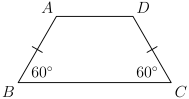
In trapezoid angles and measure and The side lengths are all positive integers and the perimeter of is units. How many non-congruent trapezoids satisfy all of these conditions?
Respuesta: E
Pista pequeña:
Traza una recta que pase por y sea paralela a
Draw a line through parallel to
Pista grande:
El perímetro se convierte en para enteros positivos
The perimeter becomes for positive integers
Solución en video:
Click to load, then click again to play
Solución escrita:
Traza una recta que pase por y sea paralela a la recta y observa que algunas longitudes son automáticamente iguales entre sí:
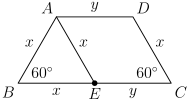
Eso se debe a que así que el triángulo es equilátero. Todas las longitudes marcadas con siempre son iguales.
Además, es un paralelogramo (no necesariamente un rombo), así que las longitudes restantes marcadas con siempre son iguales entre sí, pero no necesariamente iguales a
El perímetro es pero también se supone que es
El problema entonces se reduce a contar cuántas soluciones en enteros positivos tiene la ecuación
Al considerar enteros positivos para observa que precisamente los enteros pares dan una solución entera para porque es el número par
Y, una vez que llegamos a el que satisface la ecuación es que no es un entero positivo.
Así que los valores que funcionan para son los enteros pares positivos menores que o Hay opciones, lo que da la respuesta E.
Draw a line through parallel to line and observe that some lengths are automatically equal to each other:
That is because and so triangle is equilateral. All lengths labeled are always equal.
Also, is a parallelogram (not necessarily a rhombus), so the remaining lengths labeled are always equal to each other, but not necessarily equal to
The perimeter is but it is also supposed to be
The problem then amounts to counting how many positive integer solutions there are to the equation
As we consider positive integers for observe that it is precisely the even integers which give an integer solution for because is the even number
And, once we get to the that satisfies the equation is which is not a positive integer.
So, the values that work for are the positive even integers less than or There are options, which gives the answer of E.
25.
Makayla encuentra todas las maneras posibles de trazar un camino en una cuadrícula con forma de rombo de . Cada camino empieza en la parte inferior de la cuadrícula y termina en la parte superior, moviéndose siempre una unidad hacia el noreste o el noroeste. Ella calcula el área de la región entre cada camino y el lado derecho de la cuadrícula. En las figuras de abajo se muestran dos ejemplos. ¿Cuál es la suma de las áreas determinadas por todos los caminos posibles?
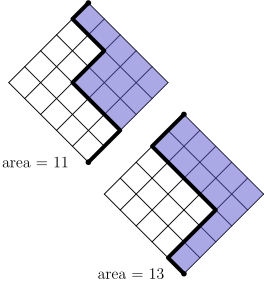
Makayla finds all the possible ways to draw a path in a diamond-shaped grid. Each path starts at the bottom of the grid and ends at the top, always moving one unit northeast or northwest. She computes the area of the region between each path and the right side of the grid. Two examples are shown in the figures below. What is the sum of the areas determined by all possible paths?
Respuesta: B
Pista pequeña:
Empareja cada camino con su imagen especular
Pair every path with its mirror image
Pista grande:
Para un camino y su espejo, las dos regiones llenan todo el rombo
For a path and its mirror, the two regions fill the whole diamond
Solución en video:
Click to load, then click again to play
Solución escrita:
Sea la respuesta.
Por simetría, si la pregunta pidiera la suma de las áreas entre cada camino y el lado izquierdo de la cuadrícula, la respuesta sería exactamente la misma
Pero si esa respuesta se suma a la respuesta original, eso es exactamente lo mismo que la suma, sobre todos los caminos, de la suma de las áreas a la izquierda y a la derecha.
Para cada camino, esa suma de áreas es exactamente
El número de caminos es igual al número de maneras de reordenar donde representa izquierda y representa derecha, a medida que el camino sube. El número de reordenamientos es sobre denotado
Así que Dividiendo entre obtenemos que es igual a que es o la opción B.
Let be the answer.
By symmetry, if the question asked for the sum of areas between each path and the left side of the grid, then the answer would be exactly the same
But if that answer is added to the original answer, that is exactly the same as the sum over all paths, of the sum of areas to the left and to the right.
For each path, that sum of areas is exactly
The number of paths is equal to the number of ways to rearrange where stands for left and stands for right, as the path walks up. The number of rearrangements is choose denoted
So, Dividing by we get that equals which is or choice B.