
Problemas del 2019 AMC 8
¡Desplázate hacia abajo y presiona Iniciar para intentar el examen! O ve al PDF imprimible, la clave de respuestas, o las soluciones profesionales en video y soluciones escritas preparadas por LIVE by Po-Shen Loh.
Todos los problemas se usan con el permiso legal oficial de la Mathematical Association of America (MAA).
O salta directamente a un solo problema con su solución y video: 1 · 2 · 3 · 4 · 5 · 6 · 7 · 8 · 9 · 10 · 11 · 12 · 13 · 14 · 15 · 16 · 17 · 18 · 19 · 20 · 21 · 22 · 23 · 24 · 25
¿Quieres aprender de forma profesional con clases interactivas en video?
Con tiempo
40:00
1.
Ike y Mike entran en una tienda de sándwiches con un total de para gastar. Los sándwiches cuestan cada uno y los refrescos cuestan cada uno. Ike y Mike planean comprar tantos sándwiches como puedan y usar el dinero restante para comprar refrescos. Contando tanto los refrescos como los sándwiches, ¿cuántos artículos comprarán?
Ike and Mike go into a sandwich shop with a total of to spend. Sandwiches cost each and soft drinks cost each. Ike and Mike plan to buy as many sandwiches as they can, and use any remaining money to buy soft drinks. Counting both soft drinks and sandwiches, how many items will they buy?
Respuesta: D
Pista pequeña:
Primero halla la mayor cantidad entera de sándwiches
Find the greatest whole number of sandwiches first
Pista grande:
Gasta el dinero restante en bebidas de
Spend the remaining money on drinks
Solución en video:

Click to load, then click again to play
Solución escrita:
Si compran sándwiches, gastarían dólares. Esto significa que ya no podrían comprar ningún sándwich más.
Entonces les quedarían dólares. Con esto, podrían comprar refrescos. Por lo tanto, comprarían en total artículos.
Así, la respuesta correcta es D.
If they buy sandwiches, they would spend dollars. This means that they would not be able to buy any more sandwiches.
They would then have dollars left. With this, they could buy sodas. They would therefore buy a total of items.
Thus, the correct answer is D.
2.
Tres rectángulos idénticos se juntan para formar el rectángulo como se muestra en la figura de abajo. Dado que el lado más corto de cada uno de los rectángulos pequeños mide pies, ¿cuál es el área en pies cuadrados del rectángulo ?
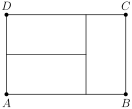
Three identical rectangles are put together to form rectangle as shown in the figure below. Given that the length of the shorter side of each of the smaller rectangles is feet, what is the area in square feet of rectangle
Respuesta: E
Pista pequeña:
El lado largo de cada rectángulo pequeño equivale a dos lados cortos
The long side of each small rectangle is two short sides
Pista grande:
El rectángulo grande mide pies por pies
The big rectangle is feet by feet
Solución en video:
Click to load, then click again to play
Solución escrita:
En la figura podemos ver que el lado más largo tiene la misma longitud que dos de los lados cortos. Esto lo hace de pies de largo.
Esto nos dice que pies y pies. Por lo tanto, el área es pies cuadrados.
Así, la respuesta correcta es E.
From the figure, we can see that the longer side has the same length as two of the shorter sides. This makes it feet long.
This tells us that feet and feet. Therefore, the area is square feet.
Thus, the correct answer is E.
3.
¿Cuál de las siguientes es la ordenación correcta de las fracciones y de menor a mayor?
Which of the following is the correct order of the fractions and from least to greatest?
Respuesta: E
Pista pequeña:
Resta a cada fracción
Subtract from each fraction
Pista grande:
Compara y
Compare and
Solución en video:
Click to load, then click again to play
Solución escrita:
Podemos reescribir cada fracción de la siguiente manera:
Recuerda que si dos fracciones tienen el mismo numerador, entonces la fracción con el denominador mayor es la menor.
Usando este hecho, podemos ver que la ordenación correcta es
Así, la respuesta correcta es E.
We can rewrite the fraction as follows:
Recall that if two fractions have the same numerator, then the fraction with the larger denominator is smaller.
Using this fact, we can see that the correct ordering is
Thus, the correct answer is E.
4.
El cuadrilátero es un rombo con perímetro metros. La longitud de la diagonal es metros. ¿Cuál es el área en metros cuadrados del rombo ?
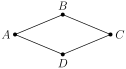
Quadrilateral is a rhombus with perimeter meters. The length of diagonal is meters. What is the area in square meters of rhombus
Respuesta: D
Pista pequeña:
Cada lado del rombo mide
Each rhombus side is
Pista grande:
Las diagonales de un rombo son perpendiculares y se bisecan mutuamente
The diagonals of a rhombus are perpendicular and bisect each other
Solución en video:
Click to load, then click again to play
Solución escrita:
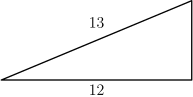
Podemos dividir el rombo en triángulos, cada uno de los cuales se ve así.
Sabemos que este es un triángulo rectángulo, ya que las diagonales de un rombo son perpendiculares, y sabemos que la hipotenusa es
Usando el teorema de Pitágoras, obtenemos que el otro cateto es
Esto significa que el área del rombo es Así, la respuesta correcta es D.
We can split the rhombus up into triangles, each of which looks like this.
We know that this is a right triangle, since the diagonals of a rhombus are perpendicular, and we know the hypotenuse is
Using the Pythagorean theorem, we get the other leg to be
This means that the area of the rhombus is Thus, the correct answer is D.
5.
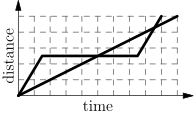
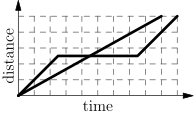
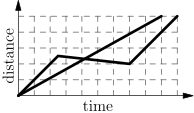
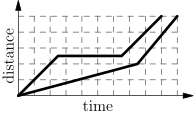
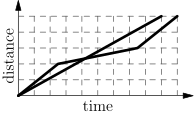
Una tortuga desafía a una liebre a una carrera. La liebre acepta con entusiasmo y corre rápidamente hacia adelante, dejando atrás a la lenta tortuga. Confiada en que ganará, la liebre se detiene a tomar una siesta. Mientras tanto, la tortuga camina a un paso lento y constante durante toda la carrera. La liebre se despierta y corre hacia la meta, solo para encontrar a la tortuga ya allí. ¿Cuál de las siguientes gráficas coincide con la descripción de la carrera, mostrando la distancia recorrida por los dos animales a lo largo del tiempo desde el inicio hasta el final?
A tortoise challenges a hare to a race. The hare eagerly agrees and quickly runs ahead, leaving the slow-moving tortoise behind. Confident that he will win, the hare stops to take a nap. Meanwhile, the tortoise walks at a slow steady pace for the entire race. The hare awakes and runs to the finish line, only to find the tortoise already there. Which of the following graphs matches the description of the race, showing the distance traveled by the two animals over time from start to finish?
Respuesta: B
Pista pequeña:
La gráfica de la tortuga es una sola línea recta
The tortoise’s graph is one straight line
Pista grande:
La gráfica de la liebre tiene una parte plana durante la siesta
The hare’s graph has a flat part during the nap
Solución en video:
Click to load, then click again to play
Solución escrita:
La trayectoria de la liebre es la que tiene la línea horizontal en el medio, que representa el periodo en que la liebre tomó una siesta.
También sabemos que el tiempo que le toma a la liebre llegar a la meta es mayor que el tiempo que le tomó a la tortuga.
Esto significa que el final de la trayectoria de la liebre debe tener un valor de mayor. Esto es exactamente la gráfica
Así, la respuesta correcta es B.
The hare’s path is the one with the horizontal line in the middle, which represents the period when the hare took a nap.
We also know that the time it takes the hare to reach the finish line is longer than the time it took the tortoise.
This means that the end of the hare’s path should have a larger -value. This is exactly graph
Thus, the correct answer is B.
6.
Hay puntos de una cuadrícula (uniformemente espaciados) en el cuadrado que se muestra en el diagrama de abajo, incluidos los puntos en los bordes. El punto está en el centro del cuadrado. Dado que el punto se elige al azar entre los otros puntos, ¿cuál es la probabilidad de que la recta sea un eje de simetría del cuadrado?
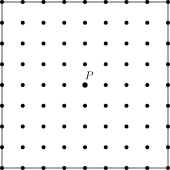
There are grid points (uniformly spaced) in the square shown in the diagram below, including the points on the edges. Point is in the center of the square. Given that point is randomly chosen among the other points, what is the probability that the line is a line of symmetry for the square?
Respuesta: C
Pista pequeña:
Un cuadrado tiene ejes de simetría
A square has symmetry lines
Pista grande:
Cada eje de simetría tiene puntos posibles además de
Each symmetry line has possible points besides
Solución en video:
Click to load, then click again to play
Solución escrita:
Los únicos ejes de simetría de un cuadrado son sus dos diagonales y las dos rectas que unen puntos medios opuestos.
En cada eje de simetría hay puntos de la cuadrícula distintos de Los cuatro ejes solo se cortan en que no se puede elegir, así que hay opciones distintas para
Por tanto, la probabilidad es
Así, la respuesta correcta es C.
Note the only lines of symmetry for a square are the two diagonals and the two lines connecting opposite midpoints.
On each symmetry line there are grid points other than The four lines intersect only at which is not eligible, so these give distinct choices for
The probability is therefore
Thus, the correct answer is C.
7.
Shauna hace cinco exámenes, cada uno con un máximo de puntos. Sus calificaciones en los tres primeros exámenes son y Para promediar en los cinco exámenes, ¿cuál es la calificación más baja que podría obtener en uno de los otros dos exámenes?
Shauna takes five tests, each worth a maximum of points. Her scores on the first three tests are and In order to average for all five tests, what is the lowest score she could earn on one of the other two tests?
Respuesta: A
Pista pequeña:
Las cinco calificaciones deben sumar
The five scores must total
Pista grande:
Haz que una de las calificaciones restantes sea lo más grande posible
Make one remaining score as large as possible
Solución en video:
Click to load, then click again to play
Solución escrita:
Para minimizar una de las calificaciones, tenemos que maximizar la otra. Supón que Shauna obtiene un en su cuarto examen.
La suma de los exámenes es entonces Para un promedio de las calificaciones de Shauna deben sumar Esto significa que necesita obtener un en su último examen.
Así, la respuesta correcta es A.
To minimize one of the scores, we have to maximize the other score. Assume that Shauna gets a on her fourth test.
The sum of the tests is then For an average of Shauna’s test scores must add to This means that she needs to get a on her last test.
Thus, the correct answer is A.
8.
Gilda tiene una bolsa de canicas. Le da el de ellas a su amigo Pedro. Luego Gilda le da el de lo que queda a otra amiga, Ebony. Finalmente, Gilda le da el de lo que ahora queda en la bolsa a su hermano Jimmy. ¿Qué porcentaje de su bolsa original de canicas le queda a Gilda para sí misma?
Gilda has a bag of marbles. She gives of them to her friend Pedro. Then Gilda gives of what is left to another friend, Ebony. Finally, Gilda gives of what is now left in the bag to her brother Jimmy. What percentage of her original bag of marbles does Gilda have left for herself?
Respuesta: E
Pista pequeña:
Empieza con canicas
Start with marbles
Pista grande:
Los sobrantes sucesivos son , luego , luego
Successive leftovers are , then , then
Solución en video:
Click to load, then click again to play
Solución escrita:
Supón que Gilda empieza con canicas. Después de darle canicas a Pedro, le quedan canicas.
Luego le da canicas a Ebony, quedándole canicas.
Finalmente, Gilda le da canicas a Jimmy. Le queda un total de canicas, que es el de su total original.
Así, la respuesta correcta es E.
Assume that Gilda starts off with marbles. After giving marbles to Pedro, she has marbles left.
She then gives marbles to Ebony, with her having marbles left.
Finally, Gilda gives marbles to Jimmy. She has a total of marbles left, which is of her original total.
Thus, the correct answer is E.
9.
Alex y Felicia tienen gatos como mascotas. Alex compra comida para gatos en latas cilíndricas que miden cm de diámetro y cm de alto. Felicia compra comida para gatos en latas cilíndricas que miden cm de diámetro y cm de alto. ¿Cuál es la razón entre el volumen de una de las latas de Alex y el volumen de una de las latas de Felicia?
Alex and Felicia each have cats as pets. Alex buys cat food in cylindrical cans that are cm in diameter and cm high. Felicia buys cat food in cylindrical cans that are cm in diameter and cm high. What is the ratio of the volume of one of Alex’s cans to the volume of one of Felicia’s cans?
Pista pequeña:
El volumen es
Volume is
Pista grande:
El radio de Felicia se duplica mientras su altura se reduce a la mitad
Felicia’s radius doubles while her height halves
Solución en video:
Click to load, then click again to play
Solución escrita:
El diámetro de Felicia es el doble que el de Alex, lo que significa que su radio también es el doble.
Recuerda que la fórmula para el área de un círculo es Si el radio se duplica, entonces el área se cuadruplica.
Esto significa que la base de la lata de Felicia tiene veces el área de la base de la lata de Alex.
También vemos que la lata de Alex es el doble de alta que la de Felicia. La fórmula para el volumen de una lata es base por altura.
Usando esta fórmula, vemos que la lata de Felicia tendrá el doble de volumen que la de Alex, ya que
Así, la respuesta correcta es B.
Felicia’s diameter is twice as much as Alex’s which means that her radius is also twice as much.
Recall that the formula for the area of a circle is If the radius is doubled, then the area is quadrupled.
This means that the base of Felicia’s can has times the area as the base of Alex’s can.
We also see that Alex’s can is twice as tall as Felicia’s can. The formula for the volume of a can is base times height.
Using this formula, we see that Felicia’s can will have twice the volume of Alex’s can since
Thus, the correct answer is B.
10.
El diagrama muestra el número de estudiantes en la práctica de fútbol cada día de la semana durante la semana pasada. Después de calcular la media y la mediana, el entrenador descubre que en realidad hubo participantes el miércoles. ¿Cuál de los siguientes enunciados describe el cambio en la media y la mediana después de hacer la corrección?
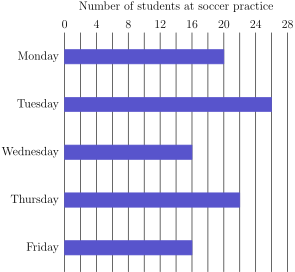
The diagram shows the number of students at soccer practice each weekday during last week. After computing the mean and median values, Coach discovers that there were actually participants on Wednesday. Which of the following statements describes the change in the mean and median after the correction is made?
La media aumenta en y la mediana no cambia.
The mean increases by and the median does not change.
La media aumenta en y la mediana aumenta en
The mean increases by and the median increases by
La media aumenta en y la mediana aumenta en
The mean increases by and the median increases by
La media aumenta en y la mediana aumenta en
The mean increases by and the median increases by
La media aumenta en y la mediana aumenta en
The mean increases by and the median increases by
Respuesta: B
Pista pequeña:
La corrección añade estudiantes en total
The correction adds students total
Pista grande:
Compara las listas ordenadas antes y después de reemplazar el valor del miércoles
Compare the ordered lists before and after replacing Wednesday’s value
Solución en video:
Click to load, then click again to play
Solución escrita:
Hay participantes más, lo que significa que la media aumenta en
En este momento, podemos ver que la mediana es Si se reemplaza por entonces la mediana se convierte en
Esto muestra que la mediana también aumenta en
Así, la respuesta correcta es B.
There are more participants, which means the mean is increased by
Right now, we can see that the median is If gets replaced with then the median becomes
This shows that the median is also increased by
Thus, the correct answer is B.
11.
La clase de octavo grado de la Escuela Secundaria Lincoln tiene estudiantes. Cada estudiante toma una clase de matemáticas o una clase de idioma extranjero, o ambas. Hay estudiantes de octavo grado que toman una clase de matemáticas, y hay estudiantes de octavo grado que toman una clase de idioma extranjero. ¿Cuántos estudiantes de octavo grado toman solo una clase de matemáticas y no una clase de idioma extranjero?
The eighth grade class at Lincoln Middle School has students. Each student takes a math class or a foreign language class or both. There are eighth graders taking a math class, and there are eighth graders taking a foreign language class. How many eighth graders take only a math class and not a foreign language class?
Respuesta: D
Pista pequeña:
Primero halla cuántos estudiantes se cuentan dos veces
First find how many students are counted twice
Pista grande:
Solo matemáticas = total de matemáticas menos ambas clases
Only math = math total minus both classes
Solución en video:
Click to load, then click again to play
Solución escrita:
El número de estudiantes que toman ambas clases es Restar este número del total de estudiantes que toman matemáticas nos da la cantidad que toma solo matemáticas.
El número buscado es
Así, la respuesta correcta es D.
The number of kids that are taking both classes is Subtracting this from the number of kids taking a math class will give us the number of kids taking only a math class.
The desired number is
Thus, the correct answer is D.
12.
Las caras de un cubo están pintadas de seis colores diferentes: rojo (), blanco (), verde (), marrón (), aguamarina () y morado (). A continuación se muestran tres vistas del cubo. ¿De qué color es la cara opuesta a la cara aguamarina?

The faces of a cube are painted in six different colors: red (), white (), green (), brown (), aqua (), and purple (). Three views of the cube are shown below. What is the color of the face opposite the aqua face?
rojo
red
blanco
white
verde
green
marrón
brown
morado
purple
Respuesta: A
Pista pequeña:
Encuentra dos pares opuestos a partir de las caras adyacentes compartidas
Find two opposite pairs from the shared adjacent faces
Pista grande:
Una vez conocidos dos pares opuestos, los dos colores restantes son opuestos
After two opposite pairs are known, the remaining two colors are opposite
Solución en video:
Click to load, then click again to play
Solución escrita:
Usando el primer y el tercer cubo, podemos ver que el marrón es opuesto al morado.
De manera similar, con el primer y el segundo cubo, vemos que el verde y el blanco son opuestos.
El único color que queda para emparejar con el aguamarina es el rojo, así que el aguamarina y el rojo son caras opuestas.
Así, la respuesta correcta es A.
Using the first and third cubes, we can see that brown is opposite purple.
Similarly, with the first and second cubes, we see that green and white are opposites.
The only color left to pair with aqua is red, so aqua and red are opposite faces.
Thus, the correct answer is A.
13.
Un palíndromo es un número que tiene el mismo valor cuando se lee de izquierda a derecha o de derecha a izquierda. (Por ejemplo, es un palíndromo.) Sea el menor entero de tres cifras que no es un palíndromo pero que es la suma de tres palíndromos distintos de dos cifras. ¿Cuál es la suma de las cifras de ?
A palindrome is a number that has the same value when read from left to right or from right to left. (For example, is a palindrome.) Let be the least three-digit integer which is not a palindrome but which is the sum of three distinct two-digit palindromes. What is the sum of the digits of
Respuesta: A
Pista pequeña:
Todo palíndromo de dos cifras es un múltiplo de
Every two-digit palindrome is a multiple of
Pista grande:
Revisa el primer múltiplo de de tres cifras que no sea un palíndromo
Check the first three-digit multiple of that is not a palindrome
Solución en video:
Click to load, then click again to play
Solución escrita:
Nota que los palíndromos de cifras tienen la cifra de las decenas y la de las unidades iguales. Esto significa que todos son múltiplos de
Si un número de cifras es la suma de palíndromos de cifras, entonces él mismo también debe ser un múltiplo de
El menor número de cifras que es múltiplo de y no es palíndromo es Esto se puede lograr sumando
Por lo tanto, La suma de sus cifras es
Así, la respuesta correcta es A.
Note that -digit palindromes have the tens and units digits the same. This means that they are all multiples of
If a -digit number is the sum of -digit palindromes, then it itself must also be a multiple of
The smallest -digit multiple of that is not a palindrome is This can be achieved by adding
Therefore, The sum of its digits is
Thus, the correct answer is A.
14.
Isabella tiene cupones que se pueden canjear por conos de helado gratis en Pete’s Sweet Treats. Para hacer que los cupones duren, decide que canjeará uno cada días hasta usarlos todos. Sabe que Pete’s cierra los domingos, pero al marcar con un círculo las fechas en su calendario, se da cuenta de que ninguna fecha marcada cae en domingo. ¿En qué día de la semana canjea Isabella su primer cupón?
Isabella has coupons that can be redeemed for free ice cream cones at Pete’s Sweet Treats. In order to make the coupons last, she decides that she will redeem one every days until she has used them all. She knows that Pete’s is closed on Sundays, but as she circles the dates on her calendar, she realizes that no circled date falls on a Sunday. On what day of the week does Isabella redeem her first coupon?
lunes
Monday
martes
Tuesday
miércoles
Wednesday
jueves
Thursday
viernes
Friday
Respuesta: C
Pista pequeña:
Cada días el día de la semana avanza
Every days advances the weekday by
Pista grande:
Los seis días abarcan todos los días de la semana excepto uno
The six days hit every weekday except one
Solución en video:
Click to load, then click again to play
Solución escrita:
Repasemos las opciones de respuesta.
Cada canje es días después, lo que avanza el día de la semana en días.
Comenzando en el día los seis días de canje son y módulo
El único día de la semana que falta es así que el domingo debe caer cuatro días después del primer día de canje. Cuatro días antes del domingo es el miércoles.
Así, la respuesta correcta es C.
Let us go through the answer choices.
Each redemption is days later, which advances the weekday by days.
Starting on day the six redemption days are and modulo
The only missed weekday is so Sunday must be four days after the first redemption day. Four days before Sunday is Wednesday.
Thus, the correct answer is C.
15.
En una playa personas llevan gafas de sol y personas llevan gorras. Algunas personas llevan tanto gafas de sol como gorra. Si se selecciona al azar a una de las personas que llevan gorra, la probabilidad de que esa persona también lleve gafas de sol es Si en cambio se selecciona al azar a alguien que lleva gafas de sol, ¿cuál es la probabilidad de que esa persona también lleve gorra?
On a beach people are wearing sunglasses and people are wearing caps. Some people are wearing both sunglasses and caps. If one of the people wearing a cap is selected at random, the probability that this person is also wearing sunglasses is If instead, someone wearing sunglasses is selected at random, what is the probability that this person is also wearing a cap?
Respuesta: B
Pista pequeña:
Usa el grupo de las gorras para hallar el número de quienes llevan ambas
Use the cap group to find the number wearing both
Pista grande:
Luego divide esa misma intersección entre el número de quienes llevan gafas de sol
Then divide that same overlap by the number wearing sunglasses
Solución en video:
Click to load, then click again to play
Solución escrita:
Si la probabilidad es eso significa que de las personas que llevan gorra también llevan gafas de sol.
Esto significa que personas llevan tanto gorra como gafas de sol.
La probabilidad de que una persona que lleva gafas de sol también lleve gorra es
Así, la respuesta correcta es B.
If the probability is that means of the people wearing caps are also wearing sunglasses.
This means that people are wearing both caps and sunglasses.
The probability of a person wearing sunglasses also wearing a cap is
Thus, the correct answer is B.
16.
Qiang conduce millas a una velocidad promedio de millas por hora. ¿Cuántas millas adicionales tendrá que conducir a millas por hora para promediar millas por hora en todo el viaje?
Qiang drives miles at an average speed of miles per hour. How many additional miles will he have to drive at miles per hour to average miles per hour for the entire trip?
Respuesta: D
Pista pequeña:
Las primeras millas tomaron hora
The first miles took hour
Pista grande:
Iguala el tiempo total a la distancia total dividida entre
Set total time equal to total distance divided by
Solución en video:
Click to load, then click again to play
Solución escrita:
Para las primeras millas, Qiang condujo durante hora.
Sea la distancia que Qiang debe conducir para satisfacer la condición. Le tomará horas conducir esta distancia.
El viaje total es ahora millas. Sabemos que la velocidad promedio es millas por hora, así que esto le tomará horas.
Igualando los dos tiempos, obtenemos
Multiplicando en cruz y simplificando se obtiene
Así, la respuesta correcta es D.
For the first miles, Qiang drove for an hour.
Let be the distance that Qiang must drive to satisfy the condition. It will take him hours to drive this distance.
The total trip is now miles. We know the average speed is miles per hour, so this will take him hours.
Setting the two times equal to each other, we get
Cross-multiplying and simplifying yields
Thus, the correct answer is D.
17.
¿Cuál es el valor del producto de abajo?
What is the value of the product below?
Respuesta: B
Pista pequeña:
Reescribe cada factor para alinear las cancelaciones
Rewrite each factor to line up cancellations
Pista grande:
Solo quedan el primer y el último
Only the first and the last remain
Solución en video:
Click to load, then click again to play
Solución escrita:
Podemos reagrupar todos los factores de la siguiente manera.
A partir de esta representación, podemos ver que todos los términos intermedios se cancelan y queda solo
Así, la respuesta correcta es B.
We can regroup all the factors as follows.
From this representation, we can see that all the middle terms cancel leaving only
Thus, the correct answer is B.
18.
Las caras de cada uno de dos dados equilibrados están numeradas y Cuando se lanzan los dos dados, ¿cuál es la probabilidad de que su suma sea un número par?
The faces of each of two fair dice are numbered and When the two dice are tossed, what is the probability that their sum will be an even number?
Respuesta: C
Pista pequeña:
Una suma par significa que ambos dados tienen la misma paridad
An even sum means both dice have the same parity
Pista grande:
Cada dado tiene caras pares y caras impares
Each die has even faces and odd faces
Solución en video:
Click to load, then click again to play
Solución escrita:
Las únicas dos formas en que la suma puede ser par son que ambos lanzamientos sean pares o que ambos sean impares.
La probabilidad de que un lanzamiento sea par es y la probabilidad de que sea impar es
Por lo tanto, la probabilidad buscada es
Así, la respuesta correcta es C.
The only two ways that the sum can be even is if both rolls are even or both are odd.
The probability that a roll is even is and the probability that it is odd is
Therefore, the desired probability is
Thus, the correct answer is C.
19.
En un torneo hay seis equipos que se enfrentan entre sí dos veces. Un equipo gana puntos por una victoria, punto por un empate y puntos por una derrota. Después de haberse jugado todos los partidos, resulta que los tres mejores equipos obtuvieron el mismo número total de puntos. ¿Cuál es el mayor número posible de puntos totales para cada uno de los tres mejores equipos?
In a tournament there are six teams that play each other twice. A team earns points for a win, point for a draw, and points for a loss. After all the games have been played it turns out that the top three teams earned the same number of total points. What is the greatest possible number of total points for each of the top three teams?
Respuesta: C
Pista pequeña:
Los tres mejores deben ganar todos los partidos contra los tres peores
The top three should win all games against the bottom three
Pista grande:
Entre los tres mejores, reparte equitativamente los puntos de cada par de partidos
Among the top three, keep all points while splitting each pair evenly
Solución en video:
Click to load, then click again to play
Solución escrita:
Cada uno de los tres mejores equipos juega partidos contra los tres últimos, por lo que puede obtener como máximo puntos de esos partidos.
Entre los tres mejores equipos hay pares y, por tanto, partidos. Cada partido reparte como máximo puntos en total, así que esos partidos reparten como máximo puntos entre los tres equipos. Si sus puntuaciones finales son iguales, cada uno puede recibir como máximo de esos puntos.
Así, cada equipo de los tres primeros tiene como máximo puntos. La cota se alcanza si todos vencen a los tres últimos y, en cada pareja de los tres primeros, cada equipo gana uno de sus dos partidos. Entonces cada uno obtiene puntos.
Por lo tanto, la respuesta correcta es C.
Each top team plays games against the bottom three teams, so it can earn at most points from those games.
Among the top three teams, there are pairs and hence games. Each game awards at most points total, so these games award at most points among the three teams. If their final scores are equal, each can therefore receive at most of those points.
Thus each top team has at most points. This bound is attainable: let every top team win all its games against the bottom teams, and for each pair of top teams let each team win one of their two games. Then each top team earns points.
Thus, the correct answer is C.
20.
¿Cuántos números reales diferentes satisfacen la ecuación
How many different real numbers satisfy the equation
Respuesta: D
Pista pequeña:
Considera como la cantidad que se eleva al cuadrado
Let be the quantity being squared
Pista grande:
Resuelve por separado y
Solve and
Solución en video:
Click to load, then click again to play
Solución escrita:
Recuerda que Podemos hacer el siguiente reordenamiento.
De esto podemos ver que hay valores posibles para
Así, la respuesta correcta es D.
Recall that We can do the following rearrangement.
From this we can see that there are possible values for
Thus, the correct answer is D.
21.
¿Cuál es el área del triángulo formado por las rectas y ?
What is the area of the triangle formed by the lines and
Respuesta: E
Pista pequeña:
Halla las tres intersecciones por pares
Find the three pairwise intersections
Pista grande:
Usa el lado horizontal sobre como la base
Use the horizontal side on as the base
Solución en video:
Click to load, then click again to play
Solución escrita:
Primero, hallemos los vértices del triángulo. Las intersecciones entre y las otras dos rectas son y .
Para hallar la tercera intersección, podemos igualar las dos ecuaciones para obtener
Esto nos da el punto
Nota que los dos primeros puntos de intersección son simétricos respecto al eje . Esto nos dice que el triángulo es isósceles.
Por lo tanto, la base es y la altura es Así, el área del triángulo es
Así, la respuesta correcta es E.
First, let us find the vertices of the triangle. The intersections between and the other two lines are and .
To find the third intersection, we can equate the two equations to get
This gives us the point
Note that the first two intersection points are mirrored across the -axis. This tells us that the triangle is isosceles.
The base is therefore and the height is The area of the triangle is therefore
Thus, the correct answer is E.
22.
Una tienda aumentó el precio original de una camisa en cierto porcentaje y luego disminuyó el nuevo precio en el mismo porcentaje. Dado que el precio resultante fue el del precio original, ¿en qué porcentaje se aumentó y se disminuyó el precio?
A store increased the original price of a shirt by a certain percent and then decreased the new price by the same percent. Given that the resulting price was of the original price, by what percent was the price increased and decreased?
Respuesta: E
Pista pequeña:
Un aumento de seguido de una disminución de multiplica el precio por
An increase by and decrease by multiplies by
Pista grande:
Plantea
Set
Solución en video:
Click to load, then click again to play
Solución escrita:
Sea el porcentaje convertido en un número real. Entonces el aumento porcentual multiplicaría el original por
La disminución porcentual multiplicaría el nuevo precio por El precio final será entonces el precio original multiplicado por
Esto nos dice que
Esto nos dice que el porcentaje sería
Así, la respuesta correcta es E.
Let be the percent converted to a real number. Then the percent increase would multiply the original by
The percent decrease would multiply the new price by The final price will then be the original price multiplied by
This tells us that
This tells us that the percent would be
Thus, the correct answer is E.
23.
Después del último partido de baloncesto de la Escuela Secundaria Euclid, se determinó que de los puntos del equipo fueron anotados por Alexa y fueron anotados por Brittany. Chelsea anotó puntos. Ninguno de los otros miembros del equipo anotó más de puntos. ¿Cuál fue el número total de puntos anotados por los otros miembros del equipo?
After Euclid High School’s last basketball game, it was determined that of the team’s points were scored by Alexa and were scored by Brittany. Chelsea scored points. None of the other team members scored more than points. What was the total number of points scored by the other team members?
Respuesta: B
Pista pequeña:
El puntaje total debe ser un múltiplo de
The total score must be a multiple of
Pista grande:
Los otros siete jugadores juntos anotaron a lo sumo
The other seven players together scored at most
Solución en video:
Click to load, then click again to play
Solución escrita:
Sea el número total de puntos y la respuesta buscada.
Del enunciado se obtiene
Al simplificar,
Sabemos que , pues ninguno de los integrantes anotó más de puntos.
También debe ser múltiplo de Si entonces lo cual no está permitido.
Si entonces lo cual funciona.
El siguiente total posible es que daría Todo múltiplo mayor de hace que sea aún mayor, así que es el único valor posible.
Por lo tanto, la respuesta correcta es B.
Let be the total number of points and be the desired answer.
Then from the problem statement we get that
Simplifying yields
We know that since none of the team members scored more than points.
We also know that must be a multiple of If then we get that which is not allowed.
If then we have that which works.
The next possible total is which would give Every larger multiple of makes still larger, so is the only possible value.
Thus, the correct answer is B.
24.
En el triángulo el punto divide el lado de modo que Sea el punto medio de y sea el punto de intersección de la recta y la recta Dado que el área de es ¿cuál es el área de ?
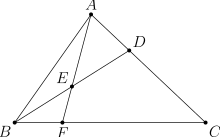
In triangle point divides side so that Let be the midpoint of and let be the point of intersection of line and line Given that the area of is what is the area of
Respuesta: B
Pista pequeña:
Usa razones de áreas a partir de bases sobre la misma recta
Use area ratios from bases on the same line
Pista grande:
Sea y usa
Let and use
Solución en video:
Click to load, then click again to play
Solución escrita:
Como los triángulos y tienen áreas en la razón Así, y
Como es el punto medio de los triángulos y tienen cada uno área Sea Entonces también, ya que y ambos triángulos tienen su tercer vértice sobre la recta
El segmento divide así que Además, y tienen las bases y sobre la misma recta, por lo que sus áreas están en la razón
Por lo tanto, Al resolver se obtiene así que
Así, la respuesta correcta es B.
Since triangles and have areas in the ratio Thus and
Because is the midpoint of triangles and each have area Let Then as well, since and both triangles have their third vertex on line
Segment splits so Also, and have bases and on the same line, so their areas are in the ratio
Therefore Solving gives so
Thus, the correct answer is B.
25.
Alice tiene manzanas. ¿De cuántas maneras puede repartirlas entre Becky, Chris y ella misma, de modo que cada una de las tres personas tenga al menos dos manzanas?
Alice has apples. In how many ways can she share them with Becky and Chris so that each of the three people has at least two apples?
Respuesta: C
Pista pequeña:
Primero dale manzanas a cada persona
Give each person apples first
Pista grande:
Distribuye las manzanas restantes con dos separadores
Distribute the remaining apples with two dividers
Solución en video:
Click to load, then click again to play
Solución escrita:
Asignemos a todos manzanas. Esto nos deja con manzanas.
Luego queremos resolver donde y son las cantidades adicionales de manzanas que reciben Alice, Becky y Chris.
Nota que todas estas son no negativas, ya que la única condición que necesitábamos ya está satisfecha.
Podemos usar el método de estrellas y barras para obtener el número de soluciones como
Así, la respuesta correcta es C.
Let us assign everybody apples. This leaves us with apples.
Then, we want to solve where and are the additional apples given to Alice, Becky, and Chris.
Note that these are all nonnegative, since we already satisfied the only condition we needed to.
We can use stars and bars to get the number of solutions as
Thus, the correct answer is C.