
Problemas del 2012 AMC 12B
¡Desplázate hacia abajo y presiona Iniciar para intentar el examen! O ve al PDF imprimible, la clave de respuestas, o las soluciones profesionales preparadas por LIVE by Po-Shen Loh.
Todos los problemas se usan con el permiso legal oficial de la Mathematical Association of America (MAA).
O salta directamente a un solo problema con su solución: 1 · 2 · 3 · 4 · 5 · 6 · 7 · 8 · 9 · 10 · 11 · 12 · 13 · 14 · 15 · 16 · 17 · 18 · 19 · 20 · 21 · 22 · 23 · 24 · 25
¿Quieres aprender de forma profesional con clases interactivas en video?
Con tiempo
1:15:00
1.
Cada aula de tercer grado de la escuela primaria Pearl Creek tiene estudiantes y conejos de mascota. ¿Cuántos estudiantes más que conejos hay en total en las aulas de tercer grado?
Each third-grade classroom at Pearl Creek Elementary has students and pet rabbits. How many more students than rabbits are there in all of the third-grade classrooms?
Respuesta: C
Pista pequeña:
Cada aula tiene estudiantes más que conejos
Each classroom has more students than rabbits
Pista grande:
Multiplica la diferencia por aula por
Multiply the per-classroom difference by
Solución:
Cada aula tiene estudiantes más que conejos.
En las aulas hay estudiantes más que conejos.
Por lo tanto, la respuesta correcta es C.
Each classroom has more students than rabbits.
Across all classrooms there are more students than rabbits.
Thus, the correct answer is C.
2.
Un círculo de radio está inscrito en un rectángulo como se muestra. La razón entre el largo del rectángulo y su ancho es ¿Cuál es el área del rectángulo?

A circle of radius is inscribed in a rectangle as shown. The ratio of the length of the rectangle to its width is What is the area of the rectangle?
Respuesta: E
Pista pequeña:
El ancho del rectángulo es igual al diámetro del círculo
The width of the rectangle equals the diameter of the circle
Pista grande:
El largo es el doble del ancho
The length is twice the width
Solución:
El círculo está inscrito, así que el ancho del rectángulo es igual al diámetro,
El largo es entonces de modo que el área es
Por lo tanto, la respuesta correcta es E.
The circle is inscribed, so the width of the rectangle equals the diameter,
The length is then so the area is
Thus, the correct answer is E.
3.
Para un proyecto de ciencias, Sammy observó a una ardilla listada y a una ardilla guardando bellotas en agujeros. La ardilla listada escondió bellotas en cada uno de los agujeros que cavó. La ardilla escondió bellotas en cada uno de los agujeros que cavó. Cada una escondió la misma cantidad de bellotas, aunque la ardilla necesitó agujeros menos. ¿Cuántas bellotas escondió la ardilla listada?
For a science project, Sammy observed a chipmunk and a squirrel stashing acorns in holes. The chipmunk hid acorns in each of the holes it dug. The squirrel hid acorns in each of the holes it dug. They each hid the same number of acorns, although the squirrel needed fewer holes. How many acorns did the chipmunk hide?
Respuesta: D
Pista pequeña:
Sea el número de agujeros que cavó la ardilla listada, de modo que la ardilla cavó
Let be the number of holes the chipmunk dug, so the squirrel dug
Pista grande:
Los totales iguales dan
The equal totals give
Solución:
Sea el número de agujeros que cavó la ardilla listada. La ardilla listada escondió bellotas y la ardilla escondió bellotas.
Como escondieron la misma cantidad, lo que da
La ardilla listada escondió bellotas.
Por lo tanto, la respuesta correcta es D.
Let be the number of holes the chipmunk dug. The chipmunk hid acorns and the squirrel hid acorns.
Since they hid the same number, which gives
The chipmunk hid acorns.
Thus, the correct answer is D.
4.
Supón que el euro vale dólares. Si Diana tiene dólares y Étienne tiene euros, ¿en qué porcentaje es el valor del dinero de Étienne mayor que el valor del dinero de Diana?
Suppose that the euro is worth dollars. If Diana has dollars and Étienne has euros, by what percent is the value of Étienne’s money greater than the value of Diana’s money?
Respuesta: B
Pista pequeña:
Primero convierte los euros de Étienne a dólares
Convert Étienne’s euros to dollars first
Pista grande:
El aumento porcentual es
The percent increase is
Solución:
El dinero de Étienne vale dólares, mientras que Diana tiene dólares.
El porcentaje en que el valor de Étienne supera al de Diana es
Por lo tanto, la respuesta correcta es B.
Étienne’s money is worth dollars, while Diana has dollars.
The percent by which Étienne’s value exceeds Diana’s is
Thus, the correct answer is B.
5.
Dos enteros tienen suma Cuando se agregan dos enteros más a los dos primeros, la suma es Finalmente, cuando se agregan dos enteros más a la suma de los cuatro enteros anteriores, la suma es ¿Cuál es el número mínimo de enteros pares entre los enteros?
Two integers have a sum of When two more integers are added to the first two integers the sum is Finally when two more integers are added to the sum of the previous four integers the sum is What is the minimum number of even integers among the integers?
Respuesta: A
Pista pequeña:
Observa la suma de cada nuevo par: y
Look at the sum of each new pair: and
Pista grande:
Un par tiene suma impar solo cuando exactamente uno de sus dos enteros es par
A pair has an odd sum only when exactly one of its two integers is even
Solución:
Los tres pares sucesivos tienen sumas y
Un par suma un número par cuando sus dos enteros tienen la misma paridad, y un número impar cuando exactamente uno es par. Solo el par central suma un número impar, así que debe contener al menos un entero par.
Los otros dos pares pueden ser todos impares, así que es posible tener tan solo entero par, por ejemplo
Por lo tanto, la respuesta correcta es A.
The three successive pairs have sums and
A pair sums to an even number when its two integers share parity, and to an odd number when exactly one is even. Only the middle pair sums to an odd number, so it must contain at least one even integer.
The other two pairs can be all odd, so as few as even integer is possible, for example
Thus, the correct answer is A.
6.
Para estimar el valor de donde y son números reales con Xiaoli redondeó hacia arriba una pequeña cantidad, redondeó hacia abajo la misma cantidad, y luego restó sus valores redondeados. ¿Cuál de las siguientes afirmaciones es necesariamente correcta?
In order to estimate the value of where and are real numbers with Xiaoli rounded up by a small amount, rounded down by the same amount, and then subtracted her rounded values. Which of the following statements is necessarily correct?
Su estimación es mayor que
Her estimate is larger than
Su estimación es menor que
Her estimate is smaller than
Su estimación es igual a
Her estimate equals
Su estimación es igual a
Her estimate equals
Su estimación es
Her estimate is
Respuesta: A
Pista pequeña:
Escribe los valores redondeados como y para un pequeño
Write the rounded values as and for a small
Pista grande:
Resta para comparar con
Subtract to compare with
Solución:
Sea la pequeña cantidad. Xiaoli calcula
Como su estimación supera el valor verdadero
Por lo tanto, la respuesta correcta es A.
Let be the small amount. Xiaoli computes
Since her estimate exceeds the true value
Thus, the correct answer is A.
7.
Se cuelgan lucecitas en una cuerda separadas pulgadas en el orden rojo, rojo, verde, verde, verde, rojo, rojo, verde, verde, verde, y así sucesivamente continuando este patrón de luces rojas seguidas de luces verdes. ¿Cuántos pies separan la ª luz roja de la ª luz roja?
Nota: pie es igual a pulgadas.
Small lights are hung on a string inches apart in the order red, red, green, green, green, red, red, green, green, green, and so on continuing this pattern of red lights followed by green lights. How many feet separate the rd red light and the st red light?
Note: foot is equal to inches.
Respuesta: E
Pista pequeña:
Agrupa las luces en bloques repetidos de (dos rojas, tres verdes)
Group the lights into repeating blocks of (two red, three green)
Pista grande:
La ª luz roja inicia el bloque y la ª luz roja inicia el bloque
The rd red light starts block and the st red light starts block
Solución:
Las luces se repiten en bloques de así que bloques consecutivos empiezan a pulgadas, o pies, de distancia.
Cada bloque comienza con una luz roja de número impar. La ª luz roja comienza el º bloque y la ª luz roja comienza el º bloque.
La distancia entre ellas es pies.
Por lo tanto, la respuesta correcta es E.
The lights repeat in blocks of so consecutive blocks start inches, or feet, apart.
Each block has one odd-numbered red light beginning it. The rd red light begins the nd block and the st red light begins the th block.
The distance between them is feet.
Thus, the correct answer is E.
8.
Un chef de postres prepara el postre para cada día de una semana que comienza el domingo. El postre de cada día es pastel, tarta, helado o pudín. El mismo postre no puede servirse dos días seguidos. Debe haber pastel el viernes por un cumpleaños. ¿Cuántos menús de postres diferentes son posibles para la semana?
A dessert chef prepares the dessert for every day of a week starting with Sunday. The dessert each day is either cake, pie, ice cream, or pudding. The same dessert may not be served two days in a row. There must be cake on Friday because of a birthday. How many different dessert menus for the week are possible?
Respuesta: A
Pista pequeña:
Fija el viernes como pastel, luego cuenta los otros seis días
Fix Friday as cake, then count the other six days
Pista grande:
Cada día restante tiene opciones, cualquiera excepto el postre servido el día siguiente
Each remaining day has choices, anything except the dessert served the following day
Solución:
El viernes está fijado como pastel. Trabaja hacia afuera desde el viernes.
Cada uno de los otros seis días (sábado, luego jueves, miércoles, martes, lunes, domingo) puede ser cualquier postre excepto el servido el día vecino ya elegido, lo que da opciones cada uno.
El número de menús es
Por lo tanto, la respuesta correcta es A.
Friday is fixed as cake. Work outward from Friday.
Each of the other six days (Saturday, then Thursday, Wednesday, Tuesday, Monday, Sunday) can be any dessert except the one served on the neighboring already-chosen day, giving choices each.
The number of menus is
Thus, the correct answer is A.
9.
Clea tarda segundos en bajar caminando por una escalera mecánica cuando no está funcionando, y solo segundos en bajar caminando cuando sí está funcionando. ¿Cuántos segundos tarda Clea en bajar en la escalera mecánica en funcionamiento cuando solo se queda parada sobre ella?
It takes Clea seconds to walk down an escalator when it is not operating, and only seconds to walk down the escalator when it is operating. How many seconds does it take Clea to ride down the operating escalator when she just stands on it?
Respuesta: B
Pista pequeña:
Fija la longitud de la escalera mecánica y escribe la velocidad de caminata de Clea y la velocidad de la escalera
Let the escalator length be fixed and write Clea’s walking rate and the escalator’s rate
Pista grande:
De halla en términos de y luego usa
From find in terms of then use
Solución:
Sea la velocidad de caminata de Clea y la velocidad de la escalera, con la longitud igual a Caminar sobre la escalera en movimiento da así que
Quedarse parada toma un tiempo con así que y segundos.
Por lo tanto, la respuesta correcta es B.
Let be Clea’s walking rate and the escalator’s rate, with the length equal to Walking on the moving escalator gives so
Standing takes time with so and seconds.
Thus, the correct answer is B.
10.
¿Cuál es el área del polígono cuyos vértices son los puntos de intersección de las curvas y ?
What is the area of the polygon whose vertices are the points of intersection of the curves and
Respuesta: B
Pista pequeña:
Despeja de la primera ecuación y sustitúyelo en la segunda
Solve the first equation for and substitute into the second
Pista grande:
Los tres puntos de intersección forman un triángulo; usa un lado vertical como base
The three intersection points form a triangle; use one vertical side as the base
Solución:
De obtenemos Sustituyendo en da así que o
Los puntos de intersección son y
El lado vertical de a tiene longitud y la distancia horizontal a es de modo que el área es
Por lo tanto, la respuesta correcta es B.
From we get Substituting into gives so or
The intersection points are and
The vertical side from to has length and the horizontal distance to is so the area is
Thus, the correct answer is B.
11.
En la ecuación de abajo, y son enteros positivos consecutivos, y y representan bases numéricas: ¿Cuánto vale ?
In the equation below, and are consecutive positive integers, and and represent number bases: What is
Respuesta: C
Pista pequeña:
Reescribe cada numeral en términos de su base, por ejemplo
Rewrite each numeral in terms of its base, e.g.
Pista grande:
Prueba tanto como y resuelve la ecuación cuadrática resultante en
Try both and and solve the resulting quadratic in
Solución:
Escribiendo los numerales, y
Con la ecuación se convierte en que se simplifica a La solución positiva es así que
(El caso da que no tiene solución entera.)
Por lo tanto
Por lo tanto, la respuesta correcta es C.
Writing the numerals out, and
With the equation becomes which simplifies to The positive solution is so
(The case gives which has no integer solution.)
Therefore
Thus, the correct answer is C.
12.
¿Cuántas sucesiones de ceros y/o unos de longitud tienen todos los ceros consecutivos, o todos los unos consecutivos, o ambas cosas?
How many sequences of zeros and/or ones of length have all the zeros consecutive, or all the ones consecutive, or both?
Respuesta: E
Pista pequeña:
Sea el conjunto de sucesiones con todos los ceros juntos y las de todos los unos juntos, luego usa .
Let be the sequences with all zeros together and those with all ones together, then use
Pista grande:
Una sucesión con los ceros juntos queda determinada al elegir la posición del primer y del último cero, lo que da de ellas.
A sequence with the zeros together is fixed by choosing the first and last zero positions, giving of them
Solución:
Sea el conjunto de sucesiones en las que todos los ceros son consecutivos y aquellas en las que todos los unos son consecutivos.
Para hay una sucesión con todos unos, sucesiones con exactamente un cero, y sucesiones con dos o más ceros (se elige la posición del primer y del último cero). Así que y por simetría
Una sucesión en es un bloque de ceros seguido de un bloque de unos, o al revés; hay de estas.
Por lo tanto
Por lo tanto, la respuesta correcta es E.
Let be the sequences in which all zeros are consecutive and those in which all ones are consecutive.
For there is one all-ones sequence, sequences with exactly one zero, and sequences with two or more zeros (choose the first and last zero position). So and by symmetry
A sequence in is a block of zeros followed by a block of ones, or the reverse; there are of these.
Therefore
Thus, the correct answer is E.
13.
Dos parábolas tienen ecuaciones y donde y son enteros (no necesariamente distintos), cada uno elegido independientemente lanzando un dado justo de seis caras. ¿Cuál es la probabilidad de que las parábolas tengan al menos un punto en común?
Two parabolas have equations and where and are integers (not necessarily different), each chosen independently by rolling a fair six-sided die. What is the probability that the parabolas have at least one point in common?
Respuesta: D
Pista pequeña:
Al igualar los dos lados derechos, los términos se cancelan, dejando
Setting the two right sides equal, the terms cancel, leaving
Pista grande:
No hay punto común exactamente cuando y halla esa probabilidad y réstala de
There is no common point exactly when and find that probability and subtract from
Solución:
Las parábolas se cortan donde es decir Esto no tiene solución exactamente cuando las rectas son paralelas y distintas: y
La probabilidad de que es y la probabilidad de que es así que la probabilidad de que no haya punto común es
La probabilidad de al menos un punto común es
Por lo tanto, la respuesta correcta es D.
The parabolas meet where i.e. This has no solution exactly when the lines are parallel and distinct: and
The probability that is and the probability that is so the probability of no common point is
The probability of at least one common point is
Thus, the correct answer is D.
14.
Bernardo y Silvia juegan al siguiente juego. Se selecciona un entero entre y inclusive, y se le da a Bernardo. Cada vez que Bernardo recibe un número, lo duplica y pasa el resultado a Silvia. Cada vez que Silvia recibe un número, le suma y pasa el resultado a Bernardo. El ganador es la última persona que produce un número menor que Sea el menor número inicial que resulta en una victoria para Bernardo. ¿Cuál es la suma de los dígitos de ?
Bernardo and Silvia play the following game. An integer between and inclusive, is selected and given to Bernardo. Whenever Bernardo receives a number, he doubles it and passes the result to Silvia. Whenever Silvia receives a number, she adds to it and passes the result to Bernardo. The winner is the last person who produces a number less than Let be the smallest initial number that results in a win for Bernardo. What is the sum of the digits of
Respuesta: A
Pista pequeña:
Bernardo gana en un turno cuando su resultado duplicado alcanza obligando a que el siguiente número de Silvia sea al menos
Bernardo wins on a turn when his doubled result reaches forcing Silvia’s next number to be at least
Pista grande:
Trabaja hacia atrás: halla el menor inicio que primero alcanza tras la jugada de Bernardo, en una, dos, tres o cuatro rondas
Work backwards: find the smallest start that first reaches after Bernardo’s move, over one, two, three, or four rounds
Solución:
Bernardo gana tras una ronda cuando su número duplicado pero los números anteriores se mantuvieron por debajo de El menor con es
Trabajando hacia atrás, los menores valores iniciales que llevan a una victoria tras dos, tres y cuatro rondas son los menores enteros con y a saber y Ningún inicio gana tras más de cuatro rondas.
Así que y la suma de sus dígitos es
Por lo tanto, la respuesta correcta es A.
Bernardo wins after a round when his doubled number but the previous numbers stayed below The smallest with is
Working backwards, the smallest starting values that lead to a win after two, three, and four rounds are the smallest integers with and namely and No start wins after more than four rounds.
So and the sum of its digits is
Thus, the correct answer is A.
15.
Jesse corta un disco circular de papel de radio a lo largo de dos radios para formar dos sectores, el más pequeño con un ángulo central de grados. Hace dos conos circulares, usando cada sector para formar la superficie lateral de un cono. ¿Cuál es la razón entre el volumen del cono más pequeño y el del más grande?
Jesse cuts a circular paper disk of radius along two radii to form two sectors, the smaller having a central angle of degrees. He makes two circular cones, using each sector to form the lateral surface of a cone. What is the ratio of the volume of the smaller cone to that of the larger?
Respuesta: C
Pista pequeña:
La longitud de arco de cada sector se convierte en la circunferencia de la base de ese cono, lo que da su radio de base
The arc length of each sector becomes the circumference of that cone’s base, giving its base radius
Pista grande:
Cada cono tiene generatriz así que halla cada altura con el teorema de Pitágoras antes de comparar
Each cone has slant height so find each height with the Pythagorean theorem before comparing
Solución:
Cada sector forma un cono con generatriz La longitud de arco del sector más pequeño es así que su radio de base es y su altura es
El sector más grande (ángulo central ) tiene longitud de arco radio de base y altura
La razón de volúmenes es
Por lo tanto, la respuesta correcta es C.
Each sector forms a cone with slant height The smaller sector’s arc length is so its base radius is and its height is
The larger sector (central angle ) has arc length base radius and height
The ratio of volumes is
Thus, the correct answer is C.
16.
Amy, Beth y Jo escuchan cuatro canciones diferentes y comentan cuáles les gustan. Ninguna canción les gusta a las tres. Además, para cada uno de los tres pares de chicas, hay al menos una canción que les gusta a esas dos chicas pero no a la tercera. ¿De cuántas maneras diferentes es esto posible?
Amy, Beth, and Jo listen to four different songs and discuss which ones they like. No song is liked by all three. Furthermore, for each of the three pairs of the girls, there is at least one song liked by those two girls but disliked by the third. In how many different ways is this possible?
Respuesta: B
Pista pequeña:
Cada canción le gusta a uno de los pares a una sola chica, o a nadie; los tres pares deben aparecer
Each song is liked by one of the pairs by a single girl, or by no one; all three pairs must appear
Pista grande:
Divide en el caso donde las cuatro canciones van a pares y el caso donde exactamente tres canciones cubren los tres pares
Split into the case where all four songs go to pairs and the case where exactly three songs cover the three pairs
Solución:
Cada canción le gusta a exactamente uno de los tres pares, a una sola chica, o a nadie. Cada par debe estar representado.
Caso cada canción le gusta a un par. Un par recibe dos de las cuatro canciones ( maneras, y opciones para cuál par), y los otros dos pares reciben una canción cada uno ( maneras). Esto da
Caso tres canciones van a los tres pares (una cada uno) y la cuarta canción le gusta a una sola chica o a nadie. Asignar las cuatro canciones a estos cuatro roles da maneras, y el rol sobrante tiene opciones (Amy, Beth, Jo o nadie):
El total es
Por lo tanto, la respuesta correcta es B.
Each song is liked by exactly one of the three pairs, by a single girl, or by no one. Every pair must be represented.
Case every song is liked by a pair. One pair gets two of the four songs ( ways, and choices for which pair), and the other two pairs get one song each ( ways). This gives
Case three songs go to the three pairs (one each) and the fourth song is liked by a single girl or no one. Assigning the four songs to these four roles gives ways, and the leftover role has options (Amy, Beth, Jo, or no one):
The total is
Thus, the correct answer is B.
17.
El cuadrado está en el primer cuadrante. Los puntos y están en las rectas y respectivamente. ¿Cuál es la suma de las coordenadas del centro del cuadrado ?
Square lies in the first quadrant. Points and lie on lines and respectively. What is the sum of the coordinates of the center of the square
Respuesta: C
Pista pequeña:
Sea el ángulo que la recta forma con el eje ; la condición del cuadrado relaciona las proyecciones de los segmentos dados
Let be the angle line makes with the -axis; the square condition relates the projections of the given segments
Pista grande:
De obtén luego interseca las dos rectas que pasan por los puntos medios y
From get then intersect the two lines through the midpoints and
Solución:
Sea el ángulo agudo que la recta forma con el eje . Los lados cubren el segmento de a como mientras que cubren el segmento de a como
Como el cuadrado tiene lados iguales, así que Por lo tanto las rectas tienen pendiente y las rectas tienen pendiente
El centro está sobre la recta que pasa por con pendiente y sobre la recta que pasa por con pendiente Estas se cortan en
La suma de las coordenadas es
Por lo tanto, la respuesta correcta es C.
Let be the acute angle line makes with the -axis. Sides span the segment from to as while span the segment from to as
Since the square has equal sides, so Thus lines have slope and lines have slope
The center lies on the line through with slope and the line through with slope These meet at
The sum of the coordinates is
Thus, the correct answer is C.
18.
Sea una lista de los primeros enteros positivos tal que para cada o bien o o ambos aparecen en algún lugar antes de en la lista. ¿Cuántas listas de este tipo hay?
Let be a list of the first positive integers such that for each either or or both appear somewhere before in the list. How many such lists are there?
Respuesta: B
Pista pequeña:
Los números mayores o iguales que deben aparecer en orden creciente, y los menores que en orden decreciente
The numbers greater than or equal to must appear in increasing order, and those less than in decreasing order
Pista grande:
Elegir qué posiciones contienen los números pequeños determina la lista, lo que da
Choosing which positions hold the small numbers determines the list, giving
Solución:
Una vez fijado , los números deben aparecer de izquierda a derecha en orden creciente, y los números deben aparecer de derecha a izquierda en orden creciente (para que cada nuevo número pequeño tenga su sucesor ya colocado).
Para cada la lista queda determinada al elegir cuáles de las posiciones después de la primera contienen los números menores que lo que da listas.
Sumando,
Por lo tanto, la respuesta correcta es B.
Once is fixed, the numbers must appear left to right in increasing order, and the numbers must appear from right to left in increasing order (so each new small number has its successor already placed).
For each the list is determined by choosing which of the positions after the first hold the numbers below giving lists.
Summing,
Thus, the correct answer is B.
19.
Un cubo unitario tiene vértices y Los vértices y son adyacentes a y para los vértices y son opuestos entre sí. Un octaedro regular tiene un vértice en cada uno de los segmentos y ¿Cuál es la longitud de lado del octaedro?
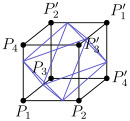
A unit cube has vertices and Vertices and are adjacent to and for vertices and are opposite to each other. A regular octahedron has one vertex in each of the segments and What is the octahedron’s side length?
Respuesta: A
Pista pequeña:
Por simetría, cada vértice del octaedro está a la misma distancia de (o ) a lo largo de su arista
By symmetry each octahedron vertex is the same distance from (or ) along its edge
Pista grande:
Iguala la distancia al cuadrado entre dos vértices que comparten con la distancia al cuadrado que la cruza, y despeja
Set the squared distance between two vertices sharing equal to the squared distance across, and solve for
Solución:
Coloca en el origen con las aristas a lo largo de los ejes, y sea cada uno de los tres vértices del octaedro cercanos a una distancia de por simetría los tres cercanos a también están a una distancia de
Dos vértices que comparten como y están a una distancia . Un vértice cercano a digamos y el vértice apropiado cercano a digamos deben estar a la misma distancia.
Igualar las dos longitudes de lado al cuadrado y usar las aristas unitarias del cubo da así que la longitud de lado es
Por lo tanto, la respuesta correcta es A.
Place at the origin with edges along the axes, and let each of the three octahedron vertices near be a distance from by symmetry the three near are also a distance from
Two vertices sharing such as and are a distance apart. A vertex near say and the appropriate vertex near say must be the same distance apart.
Setting the two squared side lengths equal and using the cube’s unit edges yields so the side length is
Thus, the correct answer is A.
20.
Un trapecio tiene lados de longitudes y La suma de todas las áreas posibles del trapecio puede escribirse en la forma donde y son números racionales y y son enteros positivos no divisibles por el cuadrado de un primo. ¿Cuál es el mayor entero menor o igual que
A trapezoid has side lengths and The sum of all the possible areas of the trapezoid can be written in the form of where and are rational numbers and and are positive integers not divisible by the square of a prime. What is the greatest integer less than or equal to
Respuesta: D
Pista pequeña:
Traslada un lado paralelo: un trapecio con lados paralelos y lados oblicuos da un triángulo con lados
Slide one parallel side over: a trapezoid with parallel sides and legs gives a triangle with sides
Pista grande:
La desigualdad triangular obliga a que el lado paralelo más largo sea aplica la fórmula de Herón en los casos
The triangle inequality forces the longer parallel side to be apply Heron’s formula in the cases
Solución:
Para un trapecio con lados paralelos y lados oblicuos trasladar un lado oblicuo forma un triángulo con lados y La desigualdad triangular obliga a que el lado paralelo más largo sea
Si el triángulo tiene lados con área y el trapecio tiene área Si el triángulo tiene lados con área lo que da un área del trapecio de Si el triángulo tiene lados un triángulo rectángulo, lo que da un área del trapecio de
El total es así que
El mayor entero menor o igual que este valor es
Por lo tanto, la respuesta correcta es D.
For a trapezoid with parallel sides and legs translating a leg forms a triangle with sides and The triangle inequality forces the longer parallel side to be
If the triangle has sides with area and the trapezoid has area If the triangle has sides with area giving trapezoid area If the triangle has sides a right triangle, giving trapezoid area
The total is so
The greatest integer at most this value is
Thus, the correct answer is D.
21.
El cuadrado está inscrito en el hexágono equiangular con en en y en Supón que y ¿Cuál es la longitud de lado del cuadrado?
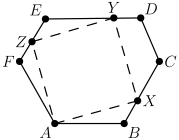
Square is inscribed in equiangular hexagon with on on and on Suppose that and What is the side-length of the square?
Respuesta: A
Pista pequeña:
Baja el vértice del cuadrado a una recta que pasa por perpendicular a los lados paralelos y
Drop the square’s vertex onto a line through perpendicular to the parallel sides and
Pista grande:
Sea los ángulos equiangulares de dan triángulos de esquina congruentes, así que expresa en términos de y despeja el lado
Let the equiangular angles give congruent corner triangles, so express in terms of and solve for the side
Solución:
Extiende y hasta una recta que pasa por perpendicular a ambas, cortándolas en y Como tenemos y Con el teorema de Pitágoras da
Los ángulos equiangulares hacen que los cuatro triángulos de esquina sean congruentes, y siguiendo los segmentos iguales a lo largo de se obtiene así que
Como obtenemos lo que da
Por lo tanto, la respuesta correcta es A.
Extend and to a line through perpendicular to both, meeting them at and Since we have and With the Pythagorean theorem gives
The equiangular angles make the four corner triangles congruent, and chasing the equal segments along yields so
Since we get giving
Thus, the correct answer is A.
22.
Un insecto viaja de a a lo largo de los segmentos de la retícula hexagonal que se muestra abajo. Los segmentos marcados con una flecha solo pueden recorrerse en la dirección de la flecha, y el insecto nunca recorre el mismo segmento más de una vez. ¿Cuántos caminos diferentes hay?
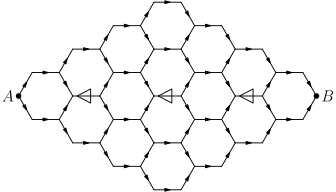
A bug travels from to along the segments in the hexagonal lattice pictured below. The segments marked with an arrow can be traveled only in the direction of the arrow, and the bug never travels the same segment more than once. How many different paths are there?
Respuesta: E
Pista pequeña:
Hay tres segmentos “de retroceso” que apuntan a la izquierda; divide en casos según qué subconjunto de ellos usa el camino
There are three left-pointing “back” segments; split into cases by which subset of them the path uses
Pista grande:
Sin usar ningún segmento de retroceso, el camino elige un segmento hacia adelante por columna, lo que da
With no back segment used, the path picks one forward segment per column, giving
Solución:
Etiqueta las siete columnas de segmentos hacia adelante (hacia la derecha); un camino sin segmento de retroceso simplemente elige un segmento hacia adelante en cada columna. Los números de opciones son lo que da caminos.
Sean los tres segmentos de retroceso que apuntan a la izquierda (en las columnas ). Analizar qué columnas quedan forzadas una vez que se recorre un segmento de retroceso da caminos para cada uno de y para para para cada uno de y y para
Sumando,
Por lo tanto, la respuesta correcta es E.
Label the seven columns of forward (rightward) segments; a path with no back segment simply chooses one forward segment in each column. The numbers of choices are giving paths.
Let be the three left-pointing back segments (in columns ). Analyzing which columns become forced once a back segment is traversed gives paths for each of and for for for each of and and for
Adding,
Thus, the correct answer is E.
23.
Considera todos los polinomios de una variable compleja, donde y son enteros, y el polinomio tiene un cero con ¿Cuál es la suma de todos los valores sobre todos los polinomios con estas propiedades?
Consider all polynomials of a complex variable, where and are integers, and the polynomial has a zero with What is the sum of all values over all the polynomials with these properties?
Respuesta: B
Pista pequeña:
Aplica la desigualdad triangular a la igualdad obliga a que los saltos de coeficientes se concentren
Apply the triangle inequality to equality forces the coefficient jumps to concentrate
Pista grande:
Trata primero los casos en que para algún en caso contrario, la igualdad en la desigualdad triangular permite solo un salto de coeficiente no nulo
First handle the cases where for some otherwise equality in the triangle inequality permits only one nonzero coefficient jump
Solución:
Como al aplicar la desigualdad triangular a la identidad el lado izquierdo tiene valor absoluto Los saltos no negativos de los coeficientes del lado derecho también suman así que hay igualdad y todos sus sumandos complejos no nulos apuntan en la misma dirección.
Si dos saltos son no nulos, su cociente muestra que es real positivo para algún Como esto significa que Los casos dan, respectivamente, y un polinomio que ya pertenece a la primera familia. Si no existe tal potencia, la igualdad obliga a que haya exactamente un salto no nulo. El salto constante da cualquier otro salto vuelve a forzar y conduce a los casos anteriores. Por tanto, los polinomios son exactamente para junto con y
Sus valores en son y al sumarlos se obtiene
Por lo tanto, la respuesta correcta es B.
Because applying the triangle inequality to the identity has left side of absolute value The nonnegative coefficient jumps on the right sum to so the triangle inequality is an equality and all its nonzero complex summands point in the same direction.
If two jumps are nonzero, their quotient shows that is a positive real for some Since this means The cases give, respectively, and a polynomial already in the first family. If no such power exists, equality forces exactly one nonzero jump. The constant jump gives any other jump again forces and returns to the cases just listed. Hence the polynomials are exactly for together with and
Their values at are and summing gives
Thus, the correct answer is B.
24.
Define la función en los enteros positivos poniendo y, si es la factorización en primos de entonces Para cada sea ¿Para cuántos en el rango la sucesión es no acotada? Nota: una sucesión de números positivos es no acotada si para cada entero hay un miembro de la sucesión mayor que
Define the function on the positive integers by setting and if is the prime factorization of then For every let For how many in the range is the sequence unbounded? Note: a sequence of positive numbers is unbounded if for every integer there is a member of the sequence greater than
Respuesta: D
Pista pequeña:
Si es múltiplo de entonces es múltiplo de así que la no acotación la heredan los múltiplos; halla el “esencial” mínimo
If is a multiple of then is a multiple of so unboundedness is inherited by multiples; find the minimal “essential”
Pista grande:
Un esencial tiene todos los exponentes al menos y a lo sumo dos factores primos; analiza primero las potencias de , y luego las pocas potencias de primos y parejas de primos restantes por debajo de
An essential has every exponent at least and at most two prime factors; analyze powers of first, then the few remaining prime powers and prime pairs below
Solución:
Si es múltiplo de , entonces es múltiplo de así que si es no acotado, también lo es Llamemos esencial a si es no acotado pero ningún divisor propio lo es. Un esencial debe tener todos los exponentes al menos y obliga a que haya a lo sumo dos primos.
Para dos iteraciones llevan el par de exponentes a Por tanto, la órbita es no acotada exactamente cuando o lo que produce los valores esenciales y Para un solo primo distinto, la cota deja únicamente al aplicar directamente , solo queda esencial. Con dos primos, deja los pares además de Al aplicar a sus posibles productos potentes, solo queda
Sus múltiplos hasta son y sin intersecciones, para un total de
Por lo tanto, la respuesta correcta es D.
If is a multiple of then is a multiple of so if is unbounded so is Call essential if it is unbounded but no proper divisor is. An essential must have all exponents at least and forces at most two primes.
For two iterations send the exponent pair to Thus the orbit is unbounded exactly when or producing the essential values and For a single other prime, the bound leaves only direct application of leaves only essential. With two primes, leaves the pairs besides Applying to their possible squareful products leaves only
Their multiples up to number and with no overlaps, for a total of
Thus, the correct answer is D.
25.
Sea y Sea el conjunto de todos los triángulos rectángulos cuyos vértices están en Para cada triángulo rectángulo con vértices y en orden antihorario y ángulo recto en sea ¿Cuánto vale
Let and Let be the set of all right triangles whose vertices are in For every right triangle with vertices and in counter-clockwise order and right angle at let What is
Respuesta: B
Pista pequeña:
Emparejar un triángulo con su reflexión intercambia con cuyo producto es
Pairing a triangle with its reflection swaps with whose product is
Pista grande:
Las reflexiones reducen todo el producto a un puñado de triángulos que pasan por el origen, y solo seis sobreviven
Reflections collapse the whole product down to a handful of triangles through the origin, and only six survive
Solución:
Los triángulos rectángulos isósceles contribuyen Para un triángulo rectángulo escaleno, reflejarlo respecto de una recta adecuada lo empareja con un triángulo de modo que
Reflexiones sucesivas (respecto de luego luego ) reducen el producto al recíproco del producto sobre solo seis triángulos de la forma con en la fila superior.
Esos seis dan así que el producto pedido es su recíproco,
Por lo tanto, la respuesta correcta es B.
Isosceles right triangles contribute For a scalene right triangle, reflecting across a suitable line pairs it with a triangle so that
Successive reflections (across then then ) reduce the product to the reciprocal of the product over just six triangles of the form with on the top row.
Those six give so the required product is its reciprocal,
Thus, the correct answer is B.