
Problemas del 2009 AMC 12B
¡Desplázate hacia abajo y presiona Iniciar para intentar el examen! O ve al PDF imprimible, la clave de respuestas, o las soluciones profesionales preparadas por LIVE by Po-Shen Loh.
Todos los problemas se usan con el permiso legal oficial de la Mathematical Association of America (MAA).
O salta directamente a un solo problema con su solución: 1 · 2 · 3 · 4 · 5 · 6 · 7 · 8 · 9 · 10 · 11 · 12 · 13 · 14 · 15 · 16 · 17 · 18 · 19 · 20 · 21 · 22 · 23 · 24 · 25
¿Quieres aprender de forma profesional con clases interactivas en video?
Con tiempo
1:15:00
1.
Cada mañana de su semana laboral de cinco días, Jane compró o bien un panecillo de centavos o bien un bagel de centavos. Su costo total de la semana fue un número entero de dólares. ¿Cuántos bagels compró?
Each morning of her five-day workweek, Jane bought either a -cent muffin or a -cent bagel. Her total cost for the week was a whole number of dollars. How many bagels did she buy?
Respuesta: B
Pista pequeña:
Compra artículos en total, así que los panecillos y los bagels juntos suman .
She buys items total, so muffins and bagels together number
Pista grande:
El total de centavos debe ser un múltiplo de reduce el costo módulo .
The total cents must be a multiple of reduce the cost modulo
Solución:
Con bagels compra panecillos, con un costo de centavos. Para que sea un número entero de dólares, esto debe ser un múltiplo de Así o bien Como el único valor que funciona es , lo que da centavos
Por lo tanto, la respuesta correcta es B.
With bagels she buys muffins, costing cents. For a whole number of dollars this must be a multiple of Thus or Since only works, giving cents
Thus, the correct answer is B.
2.
Paula la pintora tenía justo suficiente pintura para habitaciones de igual tamaño. Desafortunadamente, camino al trabajo, tres latas de pintura se cayeron de su camión, así que solo le quedó suficiente pintura para habitaciones. ¿Cuántas latas de pintura usó para las habitaciones?
Paula the painter had just enough paint for identically sized rooms. Unfortunately, on the way to work, three cans of paint fell off her truck, so she had only enough paint for rooms. How many cans of paint did she use for the rooms?
Respuesta: C
Pista pequeña:
Las latas perdidas corresponden a las habitaciones que ya no puede pintar.
The lost cans account for the rooms she can no longer paint
Pista grande:
La razón entre latas y habitaciones es .
The ratio of cans to rooms is
Solución:
Perder latas le costó habitaciones, así que latas pintan habitaciones y cada habitación necesita de una lata.
Para habitaciones usó latas.
Por lo tanto, la respuesta correcta es C.
Losing cans cost her rooms, so cans paint rooms and each room needs of a can.
For rooms she used cans.
Thus, the correct answer is C.
3.
¿Veinte por ciento menos que es un tercio más que qué número?
Twenty percent less than is one-third more than what number?
Respuesta: D
Pista pequeña:
Veinte por ciento menos que es .
Twenty percent less than is
Pista grande:
Un tercio más que un número es .
One-third more than a number is
Solución:
Veinte por ciento menos que es
Un tercio más que es así que da
Por lo tanto, la respuesta correcta es D.
Twenty percent less than is
One-third more than is so gives
Thus, the correct answer is D.
4.
Un jardín rectangular contiene dos parterres de flores con forma de triángulos rectángulos isósceles congruentes. El resto del jardín tiene forma de trapecio, como se muestra. Los lados paralelos del trapecio miden y metros. ¿Qué fracción del jardín ocupan los parterres?

A rectangular yard contains two flower beds in the shape of congruent isosceles right triangles. The remainder of the yard has a trapezoidal shape, as shown. The parallel sides of the trapezoid have lengths and meters. What fraction of the yard is occupied by the flower beds?
Respuesta: C
Pista pequeña:
Los dos catetos de cada triángulo son iguales a la mitad de la diferencia de los lados paralelos.
The two triangle legs equal half the difference of the parallel sides
Pista grande:
Cada triángulo rectángulo isósceles tiene catetos .
Each isosceles right triangle has legs
Solución:
Los lados paralelos difieren en así que cada triángulo tiene catetos y área Los dos parterres suman
El rectángulo mide por así que su área es y la fracción ocupada es
Por lo tanto, la respuesta correcta es C.
The parallel sides differ by so each triangle has legs and area The two beds total
The rectangle measures by so its area is and the fraction occupied is
Thus, the correct answer is C.
5.
Kiana tiene dos hermanos mayores que son gemelos. El producto de las tres edades es ¿Cuál es la suma de las tres edades?
Kiana has two older twin brothers. The product of their three ages is What is the sum of their three ages?
Respuesta: D
Pista pequeña:
así que cada edad es una potencia de .
so every age is a power of
Pista grande:
Si cada gemelo tiene años, entonces por la edad de Kiana es y Kiana es menor.
If each twin is years old, then times Kiana’s age is and Kiana is younger
Solución:
Como cada edad es una potencia de Los gemelos comparten una edad así que la edad de Kiana es
Tomando resulta que Kiana tiene que es menor que los gemelos. (Gemelos más jóvenes harían a Kiana mayor, lo cual no está permitido.) La suma es
Por lo tanto, la respuesta correcta es D.
Since each age is a power of The twins share an age so Kiana’s age is
Taking gives Kiana who is younger than the twins. (Smaller twins would make Kiana older, which is not allowed.) The sum is
Thus, the correct answer is D.
6.
Al insertar paréntesis, es posible dar a la expresión varios valores. ¿Cuántos valores diferentes se pueden obtener?
By inserting parentheses, it is possible to give the expression several values. How many different values can be obtained?
Respuesta: C
Pista pequeña:
El resultado depende de cuándo se realiza la suma en relación con las dos multiplicaciones.
The result depends on when the addition is performed relative to the two multiplications
Pista grande:
Enumera las agrupaciones distintas; varias formas de poner paréntesis se reducen al mismo valor.
Enumerate the distinct groupings; several parenthesizations collapse to the same value
Solución:
Las agrupaciones genuinamente distintas dan lo siguiente.
Estas agrupaciones dan y
Todas son distintas, así que se pueden obtener valores.
Por lo tanto, la respuesta correcta es C.
The genuinely different groupings give
and
These are all distinct, so values can be obtained.
Thus, the correct answer is C.
7.
En cierto año el precio de la gasolina subió un durante enero, bajó un durante febrero, subió un durante marzo y bajó un durante abril. El precio de la gasolina al final de abril fue el mismo que al comienzo de enero. Redondeando al entero más cercano, ¿cuánto vale ?
In a certain year the price of gasoline rose by during January, fell by during February, rose by during March, and fell by during April. The price of gasoline at the end of April was the same as it had been at the beginning of January. To the nearest integer, what is
Respuesta: B
Pista pequeña:
Multiplica los factores sucesivos y .
Multiply the successive factors and
Pista grande:
Después de tres meses el precio es veces el inicial, así que abril debe deshacer ese factor.
After three months the price is times the start, so April must undo that factor
Solución:
Después de enero a marzo, el precio es veces el original.
Para volver al original, abril debe multiplicar por una disminución de Redondeando al entero más cercano,
Por lo tanto, la respuesta correcta es B.
After January through March the price is times the original.
To return to the original, April must multiply by a decrease of To the nearest integer,
Thus, the correct answer is B.
8.
Cuando un cubo está lleno de agua hasta dos tercios, el cubo y el agua pesan kilogramos. Cuando el cubo está lleno hasta la mitad, el peso total es de kilogramos. En términos de y ¿cuál es el peso total en kilogramos cuando el cubo está lleno de agua?
When a bucket is two-thirds full of water, the bucket and water weigh kilograms. When the bucket is one-half full of water the total weight is kilograms. In terms of and what is the total weight in kilograms when the bucket is full of water?
Respuesta: E
Pista pequeña:
Sea el peso del cubo vacío y el peso de una carga completa de agua, de modo que y .
Let the empty bucket weigh and a full load of water weigh so and
Pista grande:
Resta las dos ecuaciones para hallar luego calcula .
Subtract the two equations to find then compute
Solución:
Sea el peso del cubo y el peso de un cubo lleno de agua. Entonces y
Al restar se obtiene así que y El peso lleno es
Por lo tanto, la respuesta correcta es E.
Let be the bucket’s weight and the weight of a full bucket of water. Then and
Subtracting gives so and The full weight is
Thus, the correct answer is E.
9.
El triángulo tiene vértices y donde está sobre la recta ¿Cuál es el área de ?
Triangle has vertices and where is on the line What is the area of
Respuesta: A
Pista pequeña:
La recta es que es paralela a .
Line is which is parallel to
Pista grande:
Como se desliza a lo largo de una recta paralela a el área es fija; elige un conveniente.
Since slides along a line parallel to the area is fixed; pick a convenient
Solución:
La recta tiene ecuación que es paralela a así que el área no depende de dónde esté sobre esa recta.
Toma Entonces la base está sobre el eje , con altura lo que da un área de
Por lo tanto, la respuesta correcta es A.
Line has equation which is parallel to so the area is independent of where lies on that line.
Take Then the base lies on the -axis with height giving area
Thus, the correct answer is A.
10.
Un reloj digital particular de horas muestra la hora y el minuto del día. Desafortunadamente, cada vez que debería mostrar un muestra por error un Por ejemplo, cuando es la pm el reloj muestra incorrectamente pm. ¿Qué fracción del día mostrará el reloj la hora correcta?
A particular -hour digital clock displays the hour and minute of a day. Unfortunately, whenever it is supposed to display a it mistakenly displays a For example, when it is pm the clock incorrectly shows pm. What fraction of the day will the clock show the correct time?
Respuesta: A
Pista pequeña:
La hora se muestra correctamente a menos que contenga un es decir, las horas .
The hour is shown correctly unless it contains a namely hours
Pista grande:
Un minuto es correcto solo cuando ninguno de sus dígitos es un ; cuenta los minutos incorrectos de entre .
A minute is correct only when neither of its digits is a ; count the bad minutes out of
Solución:
Las horas que contienen un son así que de las horas se muestran correctamente, una fracción de
Un minuto es incorrecto si cualquiera de sus dígitos es : el dígito de las decenas da ( minutos), y el dígito de las unidades añade ( más), en total. Así que de los minutos son correctos.
La fracción del día es
Por lo tanto, la respuesta correcta es A.
The hours containing a are so of the hours display correctly, a fraction
A minute is wrong if either digit is : the tens digit gives ( minutes), and the ones digit adds ( more), in all. So of minutes are correct.
The fraction of the day is
Thus, the correct answer is A.
11.
El lunes, Millie pone en un comedero para pájaros un cuarto de galón de semillas, de las cuales el es mijo. Cada día siguiente añade otro cuarto de galón de la misma mezcla de semillas sin retirar las semillas que quedan. Cada día los pájaros comen solo el del mijo del comedero, pero se comen todas las demás semillas. ¿En qué día, justo después de que Millie haya puesto las semillas, encontrarán los pájaros que más de la mitad de las semillas del comedero es mijo?
On Monday, Millie puts a quart of seeds, of which are millet, into a bird feeder. On each successive day she adds another quart of the same mix of seeds without removing any seeds that are left. Each day the birds eat only of the millet in the feeder, but they eat all of the other seeds. On which day, just after Millie has placed the seeds, will the birds find that more than half the seeds in the feeder are millet?
martes
Tuesday
miércoles
Wednesday
jueves
Thursday
viernes
Friday
sábado
Saturday
Respuesta: D
Pista pequeña:
Cada mañana permanece del mijo anterior y se añade de cuarto de galón de mijo nuevo, mientras que las demás semillas siempre suman de cuarto de galón.
Each morning of the previous millet remains and quart of new millet is added, while the other seeds always total quart
Pista grande:
Después de días el mijo es de cuarto de galón; exige que esto supere .
After days the millet is quart; require this to exceed
Solución:
Cada día los pájaros dejan del mijo y Millie añade de cuarto de galón de mijo nuevo, así que después de días el mijo es de cuarto de galón.
Las semillas que no son mijo siempre suman de cuarto de galón, así que el mijo supera la mitad cuando es decir,
Como y esto ocurre por primera vez el día que es viernes.
Por lo tanto, la respuesta correcta es D.
Each day the birds leave of the millet and Millie adds quart of new millet, so after days the millet is quart.
The non-millet seeds always total quart, so millet exceeds half when that is,
Since and this first happens on day which is Friday.
Thus, the correct answer is D.
12.
El quinto y el octavo término de una sucesión geométrica de números reales son y respectivamente. ¿Cuál es el primer término?
The fifth and eighth terms of a geometric sequence of real numbers are and respectively. What is the first term?
Respuesta: E
Pista pequeña:
La razón entre el octavo término y el quinto término es .
The ratio of the eighth term to the fifth term is
Pista grande:
así que ; luego divide entre .
so ; then divide by
Solución:
El octavo término dividido entre el quinto término es así que
El quinto término es así que
Por lo tanto, la respuesta correcta es E.
The eighth term divided by the fifth term is so
The fifth term is so
Thus, the correct answer is E.
13.
El triángulo tiene y y la altura sobre mide ¿Cuál es la suma de los dos valores posibles de ?
Triangle has and and the altitude to has length What is the sum of the two possible values of
Respuesta: D
Pista pequeña:
El pie de la altura divide ; usa el teorema de Pitágoras en los dos triángulos rectángulos.
The foot of the altitude splits ; use the Pythagorean theorem in the two right triangles
Pista grande:
Las distancias del pie son y ; es su suma o su diferencia.
The foot distances are and ; is their sum or difference
Solución:
Sea el pie de la altura desde Entonces y
Si está entre y entonces ; si el triángulo es obtuso, La suma es
Por lo tanto, la respuesta correcta es D.
Let be the foot of the altitude from Then and
If lies between and then ; if the triangle is obtuse, The sum is
Thus, the correct answer is D.
14.
Cinco cuadrados unitarios están dispuestos en el plano coordenado como se muestra, con la esquina inferior izquierda en el origen. La recta inclinada, que va de a divide toda la región en dos regiones de igual área. ¿Cuánto vale ?
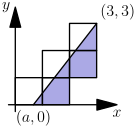
Five unit squares are arranged in the coordinate plane as shown, with the lower left corner at the origin. The slanted line, extending from to divides the entire region into two regions of equal area. What is
Respuesta: C
Pista pequeña:
El área total es así que cada región debe ser .
The total area is so each region must be
Pista grande:
La región del lado inferior derecho de la recta es un triángulo de base y altura menos un cuadrado unitario.
The region on the lower-right side of the line is a triangle of base and height minus one unit square
Solución:
Los cinco cuadrados tienen área total así que cada región debe tener área
La recta de a junto con los ejes delimita un triángulo de base y altura ; la región del lado inferior derecho de la recta es este triángulo al que se le quita un cuadrado unitario. Al plantear se obtiene así que
Por lo tanto, la respuesta correcta es C.
The five squares have total area so each region must have area
The line from to together with the axes bounds a triangle of base and height ; the region on the lower-right side of the line is this triangle with one unit square removed. Setting gives so
Thus, the correct answer is C.
15.
Supón que A continuación hay cinco ecuaciones para ¿Qué ecuación tiene la mayor solución ?
Assume Below are five equations for Which equation has the largest solution
Respuesta: B
Pista pequeña:
Al resolver cada una se obtiene ; una base menor hace más grande.
Solving each gives ; a smaller base makes larger
Pista grande:
Compara los valores para y halla el menor.
Compare the values for and find the smallest
Solución:
Cada ecuación da que es mayor cuando la cantidad positiva es menor.
Para tenemos y porque Además, así que Por tanto, es la menor de las cinco cantidades, y la ecuación (B) tiene la mayor solución.
Por lo tanto, la respuesta correcta es B.
Each equation gives which is largest when the positive quantity is smallest.
For we have and because Also so Thus is the smallest of the five quantities, and equation (B) has the largest solution.
Thus, the correct answer is B.
16.
El trapecio tiene y La razón es ¿Cuánto vale ?
Trapezoid has and The ratio is What is
Respuesta: B
Pista pequeña:
Traza la recta que pasa por paralela a que corta a en ; entonces .
Draw the line through parallel to meeting at ; then
Pista grande:
Demuestra que biseca luego aplica el teorema de la bisectriz en .
Show bisects then apply the angle bisector theorem in
Solución:
Traza la recta que pasa por paralela a que corta a en de modo que es un paralelogramo con Entonces y como el segmento biseca
Por el teorema de la bisectriz en así que
Por lo tanto, la respuesta correcta es B.
Draw the line through parallel to meeting at so is a parallelogram with Then and since segment bisects
By the angle bisector theorem in so
Thus, the correct answer is B.
17.
A cada cara de un cubo se le pinta una única franja estrecha desde el centro de una arista hasta el centro de la arista opuesta. La elección del par de aristas se hace al azar e independientemente para cada cara. ¿Cuál es la probabilidad de que haya una franja continua que rodee el cubo?
Each face of a cube is given a single narrow stripe painted from the center of one edge to the center of its opposite edge. The choice of the edge pairing is made at random and independently for each face. What is the probability that there is a continuous stripe encircling the cube?
Respuesta: B
Pista pequeña:
La franja de cada cara tiene orientaciones, lo que da configuraciones igualmente probables.
Each face’s stripe has orientations, giving equally likely configurations
Pista grande:
Una franja que rodea el cubo recorre uno de pares de caras opuestas; cuenta las configuraciones que forman un lazo.
An encircling stripe runs around one of pairs of opposite faces; count the configurations forming a loop
Solución:
Cada una de las caras tiene orientaciones de franja igualmente probables, lo que da configuraciones.
Una franja que rodea el cubo recorre uno de los pares de caras opuestas. Al fijar tal banda, las cuatro caras por las que pasa deben estar alineadas, con probabilidad mientras que las dos caras restantes son libres. Las bandas posibles son eventos disjuntos, así que la probabilidad es
Por lo tanto, la respuesta correcta es B.
Each of the faces has equally likely stripe orientations, for configurations.
An encircling stripe runs around one of the pairs of opposite faces. Fixing such a band, the four faces it passes through must be aligned, with probability while the two remaining faces are free. The possible bands are disjoint events, so the probability is
Thus, the correct answer is B.
18.
Rachel y Robert corren en una pista circular. Rachel corre en sentido antihorario y completa una vuelta cada segundos, y Robert corre en sentido horario y completa una vuelta cada segundos. Ambos parten de la línea de salida al mismo tiempo. En algún instante aleatorio entre los minutos y los minutos después de comenzar a correr, un fotógrafo que está dentro de la pista toma una foto que muestra un cuarto de la pista, centrada en la línea de salida. ¿Cuál es la probabilidad de que Rachel y Robert estén ambos en la foto?
Rachel and Robert run on a circular track. Rachel runs counterclockwise and completes a lap every seconds, and Robert runs clockwise and completes a lap every seconds. Both start from the start line at the same time. At some random time between minutes and minutes after they begin to run, a photographer standing inside the track takes a picture that shows one-fourth of the track, centered on the starting line. What is the probability that both Rachel and Robert are in the picture?
Respuesta: C
Pista pequeña:
La foto abarca de vuelta a cada lado de la salida; halla cuándo cada corredor está dentro de ese arco durante el minuto .
The picture spans lap on each side of the start; find when each runner is within that arc during the th minute
Pista grande:
Rachel está a la vista durante s y Robert durante s; toma el solapamiento sobre s.
Rachel is in view for s and Robert for s; take the overlap over s
Solución:
La foto cubre el arco que dista a lo sumo de vuelta de la salida a cada lado. En s Rachel ha corrido vueltas, a s de la línea; un cuarto de vuelta le toma s, así que está a la vista entre s y s del minuto .
En s Robert está a s de la línea; un cuarto de vuelta toma s, así que está a la vista entre y s. Ambos aparecen entre y s, una ventana de s de entre lo que da una probabilidad de
Por lo tanto, la respuesta correcta es C.
The picture covers the arc within lap of the start on each side. At s Rachel has run laps, s short of the line; a quarter lap takes her s, so she is in view between s and s of the th minute.
At s Robert is s from the line; a quarter lap takes s, so he is in view between and s. Both appear between and s, a window of s out of giving probability
Thus, the correct answer is C.
19.
Para cada entero positivo sea ¿Cuál es la suma de todos los valores de que son números primos?
For each positive integer let What is the sum of all values of that are prime numbers?
Respuesta: E
Pista pequeña:
Reescríbelo como una diferencia de cuadrados: .
Rewrite as a difference of squares:
Pista grande:
Factorízalo; para que el producto sea primo, el factor menor debe ser igual a .
Factor it; for the product to be prime, the smaller factor must equal
Solución:
Escribe
Para que sea primo, el factor menor debe ser : al resolver se obtiene así que o
Entonces y son ambos primos, y suman
Por lo tanto, la respuesta correcta es E.
Write
For to be prime the smaller factor must be : solving gives so or
Then and are both prime, summing to
Thus, the correct answer is E.
20.
Un poliedro convexo tiene vértices y aristas. El poliedro se corta mediante planos de modo que el plano corta únicamente las aristas que concurren en el vértice Además, ningún par de planos se corta dentro o sobre Los cortes producen pirámides y un nuevo poliedro ¿Cuántas aristas tiene ?
A convex polyhedron has vertices and edges. The polyhedron is cut by planes in such a way that plane cuts only those edges that meet at vertex In addition, no two planes intersect inside or on The cuts produce pyramids and a new polyhedron How many edges does have?
Respuesta: C
Pista pequeña:
Cada arista original se corta una vez cerca de cada uno de sus dos extremos, creando nuevos vértices.
Each original edge is cut once near each of its two endpoints, creating new vertices
Pista grande:
Cuenta las nuevas aristas (una por cada extremo de arista) más la porción central que sobrevive de cada arista original.
Count the new edges (one per edge-endpoint) plus the surviving middle portion of each original edge
Solución:
Cada una de las aristas se corta una vez cerca de cada extremo, así que tiene vértices.
El corte en el vértice crea un pequeño polígono cuyo número de aristas es igual al grado de ; sumado sobre todos los vértices esto da el número total de extremos de aristas. La porción central de cada arista original también sobrevive, y añade aristas. Así que tiene aristas.
Por lo tanto, la respuesta correcta es C.
Each of the edges is cut once near each endpoint, so has vertices.
The cut at vertex creates a small polygon whose number of edges equals the degree of ; summed over all vertices this is the total number of edge-endpoints. The middle portion of each original edge also survives, adding edges. So has edges.
Thus, the correct answer is C.
21.
Diez mujeres se sientan en asientos en fila. Las se levantan y luego se vuelven a sentar usando los asientos, cada una en el asiento en el que estaba antes o en un asiento contiguo al que ocupaba antes. ¿De cuántas maneras pueden volver a sentarse las mujeres?
Ten women sit in seats in a line. All of the get up and then reseat themselves using all seats, each sitting in the seat she was in before or a seat next to the one she occupied before. In how many ways can the women be reseated?
Pista pequeña:
Sea el número de reacomodos válidos de mujeres; considera la elección de la mujer más a la derecha.
Let count the valid reseatings of women; consider the rightmost woman’s choice
Pista grande:
Si se queda, deja maneras; si se mueve a la izquierda se fuerza un intercambio, y quedan maneras, así que .
If she stays she leaves ways; if she moves left a swap is forced, leaving — so
Solución:
Sea el número de reacomodos válidos de mujeres. La mujer más a la derecha o bien conserva su asiento, dejando maneras para las demás, o bien intercambia con su vecina de la izquierda, la única otra forma de ocupar el asiento del extremo, dejando maneras.
Así con y lo que da los valores de Fibonacci Por lo tanto
Por lo tanto, la respuesta correcta es A.
Let be the number of valid reseatings of women. The rightmost woman either keeps her seat, leaving ways for the rest, or swaps with her left neighbor — the only other way to fill the end seat — leaving ways.
Thus with and giving the Fibonacci values So
Thus, the correct answer is A.
22.
El paralelogramo tiene área El vértice está en y todos los demás vértices están en el primer cuadrante. Los vértices y son puntos de red sobre las rectas y para algún entero respectivamente. ¿Cuántos paralelogramos de este tipo hay?
Parallelogram has area Vertex is at and all other vertices are in the first quadrant. Vertices and are lattice points on the lines and for some integer respectively. How many such parallelograms are there?
Respuesta: C
Pista pequeña:
Con y el área del paralelogramo es .
With and the area of the parallelogram is
Pista grande:
Necesitas ; cuenta las factorizaciones ordenadas en tres enteros positivos.
You need ; count ordered factorizations into three positive integers
Solución:
Sea y con enteros positivos y El área es
Cada paralelogramo corresponde a una terna ordenada de enteros positivos con producto Los seis se reparten entre los tres factores de maneras, y del mismo modo los seis de maneras, lo que da
Por lo tanto, la respuesta correcta es C.
Let and with positive integers and The area is
Each parallelogram corresponds to an ordered triple of positive integers with product The six ’s distribute among the three factors in ways, and likewise the six ’s in ways, giving
Thus, the correct answer is C.
23.
Una región en el plano complejo se define por
Un número complejo se elige de manera uniforme al azar de ¿Cuál es la probabilidad de que también esté en ?
A region in the complex plane is defined by
A complex number is chosen uniformly at random from What is the probability that is also in
Respuesta: D
Pista pequeña:
Al multiplicar se obtiene parte real y parte imaginaria ; ambas deben estar en .
Multiplying gives real part and imaginary part ; both must lie in
Pista grande:
Estas condiciones son y ; halla el área de que las satisface.
These conditions are and ; find the area of satisfying them
Solución:
Al desarrollar, Ambas partes están en si y solo si y
Dentro del cuadrado (área ) estas fallan solo en cuatro triángulos de las esquinas. Cerca de la recta recorta un triángulo rectángulo de catetos con área
Las cuatro esquinas quitan dejando La probabilidad es
Por lo tanto, la respuesta correcta es D.
Expanding, Both parts lie in iff and
Within the square (area ) these fail only in four corner triangles. Near the line cuts off a right triangle with legs area
The four corners remove leaving The probability is
Thus, the correct answer is D.
24.
¿Para cuántos valores de en se cumple ?
Nota: Las funciones y denotan funciones trigonométricas inversas.
For how many values of in is
Note: The functions and denote inverse trigonometric functions.
Respuesta: B
Pista pequeña:
En y el lado izquierdo está en así que toda solución requiere .
On and the left side lies in so any solution needs
Pista grande:
Como es inyectiva en la ecuación se reduce a en .
Since is one-to-one on the equation reduces to on
Solución:
En Como toma valores en toda solución requiere donde la ecuación se convierte en
La ecuación se cumple exactamente cuando para algún entero
La primera familia da aportando y La segunda da aportando y Por tanto, hay soluciones en
Por lo tanto, la respuesta correcta es B.
On Since takes values in any solution requires where the equation becomes
The equation holds exactly when for some integer
The first family gives contributing and The second gives contributing and Hence there are solutions in
Thus, the correct answer is B.
25.
El conjunto está definido por los puntos de coordenadas enteras con y ¿Cuántos cuadrados de lado al menos tienen sus cuatro vértices en ?
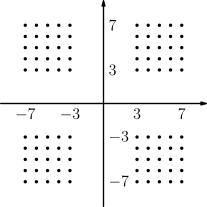
The set is defined by the points with integer coordinates, and How many squares of side at least have their four vertices in
Respuesta: E
Pista pequeña:
se divide en cuatro bloques , uno por cuadrante; un cuadrado de lado toma exactamente un vértice de cada bloque.
splits into four blocks, one per quadrant; a side- square takes exactly one vertex from each block
Pista grande:
Desliza los cuatro bloques juntándolos en una sola cuadrícula cada cuadrado válido se corresponde con un punto de o con un cuadrado en .
Slide the four blocks together onto a single grid each valid square maps to a point of or a square in
Solución:
El conjunto consta de cuatro bloques , uno en cada cuadrante. Todo cuadrado de lado usa exactamente un vértice de cada bloque, pues dos puntos de un mismo bloque están a menos de unidades, mientras que los puntos de bloques distintos están separados por al menos unidades.
Al trasladar cada bloque hacia el origen mediante , los cuatro se superponen en una cuadrícula , , formada por los puntos con . Cada uno de los cuadrados buscados se transforma en un solo punto de o en un cuadrado de Por tanto, el número buscado es el número de puntos de más veces el número de cuadrados con vértices en
La cuadrícula contiene cuadrados con lados paralelos a los ejes. Para un cuadrado inclinado, supongamos que uno de sus lados avanza unidades horizontalmente y unidades verticalmente, donde y Para cada par ordenado hay posiciones. Los totales para son respectivamente, lo que da cuadrados inclinados y cuadrados en total. Por consiguiente, la cantidad pedida es
Así, la respuesta correcta es E.
consists of four blocks one in each quadrant. Any square of side uses exactly one vertex in each block, since two points in one block are less than apart while points in different blocks are at least apart.
Sliding each block inward by superimposes them on one grid (points with ). Each such square maps to either a single point of or a square in So the count equals the number of points of plus times the number of squares with vertices in
The grid has axis-parallel squares. For a tilted square, let one side move units horizontally and units vertically, where and For each ordered pair there are placements. The totals for are respectively, giving tilted squares and squares altogether. Therefore the required count is
Thus, the correct answer is E.