
Problemas del 1972 AMC 12
¡Desplázate hacia abajo y presiona Iniciar para intentar el examen! O ve al PDF imprimible, la clave de respuestas, o las soluciones profesionales preparadas por LIVE by Po-Shen Loh.
Todos los problemas se usan con el permiso legal oficial de la Mathematical Association of America (MAA).
O salta directamente a un solo problema con su solución: 1 · 2 · 3 · 4 · 5 · 6 · 7 · 8 · 9 · 10 · 11 · 12 · 13 · 14 · 15 · 16 · 17 · 18 · 19 · 20 · 21 · 22 · 23 · 24 · 25 · 26 · 27 · 28 · 29 · 30 · 31 · 32 · 33 · 34 · 35
¿Quieres aprender de forma profesional con clases interactivas en video?
Con tiempo
1:15:00
1.
Las longitudes, en pulgadas, de los tres lados de cada uno de cuatro triángulos y son las siguientes: De estos cuatro triángulos, los únicos que son rectángulos son:
The lengths in inches of the three sides of each of four triangles and are as follows: Of these four given triangles, the only right triangles are:
y
and
y
and
y
and
y
and
y
and
Respuesta: D
Pista pequeña:
Compara el cuadrado del lado más largo de cada triángulo con la suma de los cuadrados de los otros dos lados
Compare the square of each longest side with the sum of the squares of the other two sides
Pista grande:
Elimina las fracciones de las longitudes de los triángulos y antes de comparar
Clear the halves in triangles and before comparing
Solución:
Para los triángulos y las igualdades pertinentes son Para Estos valores no son iguales. Por lo tanto, exactamente y son triángulos rectángulos.
Por lo tanto, la respuesta correcta es D.
For triangles and the relevant equalities are For These values are unequal. Thus precisely and are right triangles.
Therefore, the correct answer is D.
2.
Si un comerciante pudiera adquirir sus productos por un menos sin cambiar el precio de venta, su ganancia, calculada sobre el costo, aumentaría de la tasa actual de a . La tasa actual es:
If a dealer could get his goods for less while keeping his selling price fixed, his profit, based on cost, would be increased to from his present profit of which is:
Respuesta: B
Pista pequeña:
Sea el costo actual y expresa el mismo precio de venta de dos maneras
Let the present cost be and express the same selling price in two ways
Pista grande:
El costo reducido es y su tasa de ganancia es
The reduced cost is and its profit rate is
Solución:
El precio de venta fijo da Al simplificar se obtiene así que y
Por lo tanto, la respuesta correcta es B.
The fixed selling price gives Simplifying yields so and
Therefore, the correct answer is B.
3.
Si donde entonces es igual a:
If where then is equal to:
Respuesta: B
Pista pequeña:
Calcula antes de tomar el recíproco
Compute before taking the reciprocal
Pista grande:
El número satisface
The number satisfies
Solución:
Directamente, Por lo tanto, su recíproco también es
Por lo tanto, la respuesta correcta es B.
Directly, Its reciprocal is therefore also
Therefore, the correct answer is B.
4.
Si es un subconjunto de el número de soluciones de es:
The number of solutions to where is a subset of is:
Ninguna de estas
None of these
Respuesta: D
Pista pequeña:
Los elementos y son obligatorios
The elements and are forced
Pista grande:
Cada uno de puede incluirse u omitirse de manera independiente
Each of may independently be included or omitted
Solución:
Todo válido contiene mientras que cada elemento de puede elegirse de manera independiente. Por consiguiente, hay conjuntos posibles.
Por lo tanto, la respuesta correcta es D.
Every valid contains while each of may be chosen independently. Hence there are possible sets.
Therefore, the correct answer is D.
5.
Entre los que tienen el mayor y el segundo mayor valor, respectivamente, son:
From among those which have the greatest and the next to the greatest values, in that order, are:
Ninguna de estas
None of these
Respuesta: A
Pista pequeña:
Compara dos raíces elevando ambos números positivos a una potencia común
Compare two roots by raising both positive numbers to a common power
Pista grande:
Primero compara con , y luego compara con cada número restante
First compare with , then compare with each remaining number
Solución:
Al elevar a potencias comunes convenientes se obtiene y Así, es el mayor y es el siguiente.
Por lo tanto, la respuesta correcta es A.
Raising to convenient common powers gives and Thus is greatest and is next.
Therefore, the correct answer is A.
6.
Si entonces el valor de es:
If then the value of is:
solo
only
solo
only
o
or
Respuesta: C
Pista pequeña:
Haz
Set
Pista grande:
Factoriza y convierte cada raíz positiva de nuevo en un valor de
Factor and convert each positive root back to
Solución:
Sea Entonces Así, o por lo que es o respectivamente.
Por lo tanto, la respuesta correcta es C.
Let Then Thus or so is respectively or
Therefore, the correct answer is C.
7.
Si entonces es igual a:
If then is equal to:
Respuesta: E
Pista pequeña:
Simplifica el cociente de las dos fracciones de la razón pedida
Simplify the quotient of the two fractions in the requested ratio
Pista grande:
A partir de , obtén
From , obtain
Solución:
La razón pedida tiene como cociente Además, así que Por lo tanto,
Por lo tanto, la respuesta correcta es E.
The requested ratio has quotient Also so Therefore
Therefore, the correct answer is E.
8.
Si donde y son reales, entonces:
If where and are real, then:
y
and
Ninguna de estas
None of these
Respuesta: D
Pista pequeña:
Separa los casos y
Separate the cases and
Pista grande:
Un caso obliga a que , mientras que el otro obliga a que
One case forces , while the other forces
Solución:
Si la ecuación da y por tanto Si da Así, toda solución satisface o lo cual se expresa mediante
Por lo tanto, la respuesta correcta es D.
If the equation gives hence If it gives Therefore every solution satisfies either or which is expressed by
Therefore, the correct answer is D.
9.
Ann y Sue compraron cajas de papelería idénticas. Ann usó la suya para escribir cartas de hoja y Sue usó la suya para escribir cartas de hojas. Ann usó todos los sobres y le sobraron hojas de papel, mientras que Sue usó todas las hojas y le sobraron sobres. El número de hojas de papel que había en cada caja era:
Ann and Sue bought identical boxes of stationery. Ann used hers to write -sheet letters and Sue used hers to write -sheet letters. Ann used all the envelopes and had sheets of paper left, while Sue used all of the sheets of paper and had envelopes left. The number of sheets of paper in each box was:
Respuesta: A
Pista pequeña:
Sean y las cantidades de hojas y sobres de una caja
Let and be the numbers of sheets and envelopes in a box
Pista grande:
La situación de Ann da , mientras que la de Sue da
Ann gives , while Sue gives
Solución:
Sean y las cantidades de hojas y sobres por caja. Las dos situaciones dan y Al sumar se obtiene así que
Por lo tanto, la respuesta correcta es A.
Let and denote sheets and envelopes per box. The two accounts give and Adding yields so
Therefore, the correct answer is A.
10.
Para real, la desigualdad equivale a:
For real, the inequality is equivalent to:
o
or
o
or
o
or
Respuesta: D
Pista pequeña:
La cota superior sitúa a a no más de unidades de
The upper bound places within units of
Pista grande:
La cota inferior elimina el intervalo abierto de puntos que están a menos de unidad de
The lower bound removes the open interval of points less than unit from
Solución:
La condición da La condición da o Su intersección es
Por lo tanto, la respuesta correcta es D.
The condition gives The condition gives or Their intersection is
Therefore, the correct answer is D.
11.
Los valores de para los cuales el siguiente par de ecuaciones puede tener una solución real común son:
The value(s) of for which the following pair of equations may have a real common solution, are:
solo
only
ningún
no
todo
all
Respuesta: A
Pista pequeña:
Elimina entre las dos ecuaciones
Eliminate between the equations
Pista grande:
Después de hallar los dos valores candidatos de , comprueba si el correspondiente es no negativo
After finding the two candidate -values, check whether the corresponding is nonnegative
Solución:
De la segunda ecuación, Al sustituir en la primera se obtiene Si entonces Si entonces por lo que no existe un real. Así, solo es posible.
Por lo tanto, la respuesta correcta es A.
From the second equation, Substitution into the first gives If then If then so no real exists. Thus only is possible.
Therefore, the correct answer is A.
12.
El valor numérico del volumen de un cubo en pies cúbicos es igual al valor numérico de su área superficial en pulgadas cuadradas. La longitud de la arista, expresada en pies, es:
The number of cubic feet in the volume of a cube is the same as the number of square inches in its surface area. The length of the edge expressed as a number of feet is:
Respuesta: B
Pista pequeña:
Si la arista mide pies, su longitud en pulgadas es
If the edge is feet, its length in inches is
Pista grande:
Iguala los valores numéricos y
Equate the numerical values and
Solución:
Sea pies la longitud de la arista, es decir, pulgadas. La igualdad numérica indicada es Como al dividir entre se obtiene
Por lo tanto, la respuesta correcta es B.
Let the edge length be feet, or inches. The stated numerical equality is Since division by gives
Therefore, the correct answer is B.
13.
En el cuadrado , cuyos lados miden pulgadas, se traza el segmento , donde es el punto de que está a pulgadas de Se traza la mediatriz de , la cual corta a y en los puntos y respectivamente. La razón entre los segmentos y es:
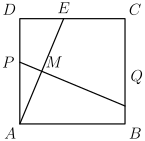
Inside square with sides of length inches, segment is drawn, where is the point on which is inches from The perpendicular bisector of is drawn and intersects and at points and respectively. The ratio of segment to is:
Respuesta: C
Pista pequeña:
Traza por una recta paralela a
Draw through a line parallel to
Pista grande:
Las distancias horizontales de a y son y
The horizontal distances from to and are and
Solución:
Como es el punto medio de su distancia horizontal a es Su distancia a es Los dos triángulos rectángulos que la horizontal por determina sobre la recta son semejantes, de modo que sus hipotenusas están en la razón de estos catetos horizontales:
Por lo tanto, la respuesta correcta es C.
Because is the midpoint of its horizontal distance from is Its distance from is The two right triangles cut from line by the horizontal through are similar, so their hypotenuses are in the ratio of these horizontal legs:
Therefore, the correct answer is C.
14.
Un triángulo tiene ángulos de y Si el lado opuesto al ángulo de mide entonces el lado opuesto al ángulo de mide:
A triangle has angles of and If the side opposite the angle has length then the side opposite the angle has length:
Respuesta: B
Pista pequeña:
Relaciona los dos lados mediante la ley de los senos
Relate the two sides with the Law of Sines
Pista grande:
Usa y
Use and
Solución:
Si es el lado opuesto a la ley de los senos da Por lo tanto,
Por lo tanto, la respuesta correcta es B.
If is the side opposite the Law of Sines gives Therefore
Therefore, the correct answer is B.
15.
Un contratista estimó que uno de sus dos albañiles tardaría horas en construir cierta pared y el otro horas. Sin embargo, sabía por experiencia que, cuando trabajaban juntos, su producción conjunta disminuía en ladrillos por hora. Como tenía prisa, puso a ambos en el trabajo y comprobó que tardaron exactamente horas en construir la pared. El número de ladrillos de la pared era:
A contractor estimated that one of his two bricklayers would take hours to build a certain wall and the other hours. However, he knew from experience that when they worked together, their combined output fell by bricks per hour. Being in a hurry, he put both men on the job and found that it took exactly hours to build the wall. The number of bricks in the wall was:
Respuesta: C
Pista pequeña:
Sea el número de ladrillos de la pared
Let be the number of bricks in the wall
Pista grande:
Su tasa horaria conjunta real es
Their actual combined hourly rate is
Solución:
Si la pared contiene ladrillos, las tasas individuales son y Por lo tanto, Al multiplicar por y simplificar se obtiene de donde
Por lo tanto, la respuesta correcta es C.
If the wall contains bricks, the individual rates are and Thus Multiplying by and simplifying gives hence
Therefore, the correct answer is C.
16.
Se pueden insertar dos números positivos entre y de modo que los tres primeros estén en progresión geométrica y los tres últimos en progresión aritmética. La suma de esos dos números positivos es:
There are two positive numbers that may be inserted between and such that the first three are in geometric progression while the last three are in arithmetic progression. The sum of those two positive numbers is:
Respuesta: B
Pista pequeña:
Llama y a los números insertados, en ese orden
Call the inserted numbers and in that order
Pista grande:
Usa y
Use and
Solución:
Las condiciones de las progresiones dan y Al eliminar se obtiene La positividad da y luego Su suma es
Por lo tanto, la respuesta correcta es B.
The progression conditions give and Eliminating yields Positivity gives and then Their sum is
Therefore, the correct answer is B.
17.
Se corta un cordel en dos por un punto elegido al azar. La probabilidad de que el trozo más largo sea al menos veces el más corto es:
A piece of string is cut in two at a point selected at random. The probability that the longer piece is at least times as large as the shorter piece is:
Respuesta: E
Pista pequeña:
Normaliza la longitud del cordel a y sitúa el corte a unidades de un extremo
Normalize the string length to and let the cut be units from one end
Pista grande:
Cerca de cualquiera de los extremos, resuelve
Near either endpoint, solve
Solución:
Toma el cordel de longitud Cerca de un extremo, la condición es por lo que En el otro extremo aparece un intervalo igual. La longitud total de ambos, y por tanto la probabilidad, es
Por lo tanto, la respuesta correcta es E.
Take the string to have length Near one endpoint, the condition is so The same interval occurs at the other endpoint. Their total length, hence the probability, is
Therefore, the correct answer is E.
18.
Sea un trapecio cuya base mide el doble que la base y sea el punto de intersección de las diagonales. Si la diagonal mide entonces el segmento mide:
Let be a trapezoid with the measure of base twice that of base and let be the point of intersection of the diagonals. If the measure of diagonal is then that of segment is equal to:
Respuesta: A
Pista pequeña:
Los triángulos y son semejantes
Triangles and are similar
Pista grande:
La razón de las bases también es igual a
The base ratio also equals
Solución:
Como los triángulos y son semejantes. Por ello, Así, de modo que
Por lo tanto, la respuesta correcta es A.
Since triangles and are similar. Hence Thus so
Therefore, the correct answer is A.
19.
La suma de los primeros términos de la sucesión expresada en función de es:
The sum of the first terms of the sequence in terms of is:
Respuesta: D
Pista pequeña:
La suma entre paréntesis que ocupa el lugar es
The -th parenthesized sum is
Pista grande:
Suma y
Sum and
Solución:
El término de lugar es la suma geométrica Por tanto, la suma pedida es
Por lo tanto, la respuesta correcta es D.
The -th term is the geometric sum Therefore the desired total is
Therefore, the correct answer is D.
20.
Si donde y entonces es igual a:
If where and then is equal to:
Respuesta: E
Pista pequeña:
Representa la tangente como la razón de catetos y
Model the tangent as the ratio of legs and
Pista grande:
La hipotenusa correspondiente se simplifica porque
The corresponding hypotenuse simplifies because
Solución:
Usa un triángulo rectángulo con cateto opuesto y cateto adyacente Su hipotenusa es Por tanto,
Por lo tanto, la respuesta correcta es E.
Use a right triangle with opposite leg and adjacent leg Its hypotenuse is Hence
Therefore, the correct answer is E.
21.
Si la suma de las medidas en grados de los ángulos y de la figura es entonces es igual a:
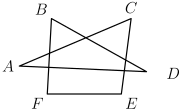
If the sum of the measures in degrees of angles and in the figure is then is equal to:
Respuesta: C
Pista pequeña:
Nombra las dos intersecciones de con y
Name the two intersections of with and
Pista grande:
Combina las sumas de ángulos del cuadrilátero central y de los dos triángulos unidos a él
Combine the angle sums of the central quadrilateral and the two triangles attached to it
Solución:
Sean y En el cuadrilátero Los triángulos y dan y al usar los ángulos suplementarios en y Al sumar se obtiene Así,
Por lo tanto, la respuesta correcta es C.
Let and In quadrilateral The triangles and give and using the supplementary angles at and Adding yields Thus
Therefore, the correct answer is C.
22.
Si son raíces imaginarias de la ecuación donde y son números reales, entonces en función de y es:
If are imaginary roots of the equation where and are real numbers, then in terms of and is:
Respuesta: E
Pista pequeña:
El conjugado es otra raíz
The conjugate is another root
Pista grande:
Como el coeficiente de es cero, determina la tercera raíz y luego usa la suma de los productos por pares
Because the coefficient is zero, determine the third root and then use the sum of pairwise products
Solución:
La raíz conjugada es Como la suma de las tres raíces es la tercera raíz es Por las fórmulas de Vieta,
Por lo tanto, la respuesta correcta es E.
The conjugate root is Since the sum of the three roots is the third root is By Vieta’s formulas,
Therefore, the correct answer is E.
23.
El radio del círculo más pequeño que contiene la figura simétrica mostrada, compuesta por cuadrados unitarios, es:
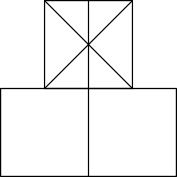
The radius of the smallest circle containing the symmetric figure composed of unit squares shown is:
Ninguna de estas
None of these
Respuesta: D
Pista pequeña:
Por simetría, sitúa el centro del círculo sobre el eje vertical de la figura
By symmetry, place the circle’s center on the vertical axis of the figure
Pista grande:
Iguala sus distancias a un vértice exterior inferior y a uno exterior superior
Equate its distances to a lower outer corner and an upper outer corner
Solución:
Sitúa el punto medio del lado inferior en Un vértice exterior inferior es y uno exterior superior es Por simetría, el centro del círculo envolvente mínimo es En la posición óptima, ambos tipos de vértice exterior están en el círculo, de modo que Esto da Por lo tanto,
Por lo tanto, la respuesta correcta es D.
Put the midpoint of the bottom edge at A lower outer corner is and an upper outer corner is By symmetry the center of the smallest enclosing circle is At the optimum both types of outer corner lie on the circle, so This gives Hence
Therefore, the correct answer is D.
24.
Un hombre recorrió cierta distancia a velocidad constante. Si hubiera avanzado milla por hora más rápido, habría recorrido la distancia en cuatro quintos del tiempo; si hubiera avanzado milla por hora más despacio, habría tardado horas más. La distancia que caminó, en millas, fue:
A man walked a certain distance at a constant rate. If he had gone mile per hour faster, he would have walked the distance in four-fifths of the time; if he had gone mile per hour slower, he would have been hours longer on the road. The distance in miles he walked was:
Respuesta: B
Pista pequeña:
Sean y la velocidad y el tiempo reales
Let the actual speed and time be and
Pista grande:
Usa primero para determinar
First use to determine
Solución:
Sean y la velocidad y el tiempo reales. El caso más rápido da por lo que El caso más lento da entonces de donde La distancia fue
Por lo tanto, la respuesta correcta es B.
Let the actual speed and time be and The faster case gives so The slower case then gives whence The distance was
Therefore, the correct answer is B.
25.
En un círculo está inscrito un cuadrilátero cuyos lados consecutivos miden y . El diámetro de este círculo mide:
Inscribed in a circle is a quadrilateral having sides of lengths and taken consecutively. The diameter of this circle has length:
Respuesta: C
Pista pequeña:
Observa dos ternas pitagóricas escaladas entre las cuatro longitudes
Notice two scaled Pythagorean triples among the four side lengths
Pista grande:
El par y el par comparten la misma hipotenusa posible
The pair and the pair share the same possible hypotenuse
Solución:
Los lados consecutivos pueden rotularse Como los triángulos y son rectángulos y tienen hipotenusa común Su unión es el cuadrilátero cíclico, y la hipotenusa de un triángulo rectángulo es un diámetro de su circunferencia circunscrita. Así, el diámetro es
Por lo tanto, la respuesta correcta es C.
The consecutive sides may be labeled Since triangles and are right triangles with common hypotenuse Their union is the cyclic quadrilateral, and a right triangle’s hypotenuse is a diameter of its circumcircle. Thus the diameter is
Therefore, the correct answer is C.
26.
En el círculo mostrado, es el punto medio del arco y el segmento es perpendicular a la cuerda en Si la cuerda mide y el segmento mide entonces el segmento mide:
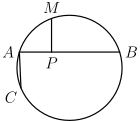
In the circle shown, is the midpoint of arc and segment is perpendicular to chord at If the measure of chord is and that of segment is then segment has measure equal to:
Respuesta: E
Pista pequeña:
Copia el arco como un arco que termine en un punto nuevo entre y
Copy arc to an arc ending at a new point between and
Pista grande:
Traza ; usa los arcos iguales para identificar un rectángulo y segmentos horizontales extremos iguales
Drop ; use equal arcs to identify a rectangle and equal horizontal end segments
Solución:
Elige en el arco de modo que los arcos y sean iguales, y traza Entonces Los arcos iguales restantes y dan proyecciones correspondientes iguales sobre la cuerda, por lo que Además, es un rectángulo, así que Por lo tanto,
Por lo tanto, la respuesta correcta es E.
Choose on arc so that arcs and are equal, and drop Then The remaining equal arcs and give equal corresponding chord projections, so Also is a rectangle, hence Therefore
Therefore, the correct answer is E.
27.
Si el área de es unidades cuadradas y la media geométrica (media proporcional) entre los lados y es pulgadas, entonces es igual a:
If the area of is square units and the geometric mean (mean proportional) between sides and is inches, then is equal to:
Respuesta: D
Pista pequeña:
La condición de la media geométrica determina el producto
The geometric-mean condition determines the product
Pista grande:
Usa
Use
Solución:
La condición de la media geométrica dice Por lo tanto, así que
Por lo tanto, la respuesta correcta es D.
The geometric-mean condition says Therefore so
Therefore, the correct answer is D.
28.
Se coloca un disco circular de diámetro sobre un tablero de y ancho , de modo que sus centros coincidan. El número de casillas completamente cubiertas por el disco es:
A circular disc with diameter is placed on an checkerboard with width so that the centers coincide. The number of checkerboard squares which are completely covered by the disc is:
Respuesta: E
Pista pequeña:
Ninguna casilla que toque el borde exterior puede quedar completamente cubierta
No square touching the outside border can be completely covered
Pista grande:
Entre las casillas interiores, examina por separado las cuatro casillas de las esquinas
Among the interior squares, test the four corner squares separately
Solución:
Las casillas del borde no están completamente cubiertas. Considera la cuadrícula interior restante de y mide las distancias en unidades del lado de una casilla, de modo que el radio del disco es Las cuatro esquinas exteriores de esta cuadrícula interior están a distancia del centro, por lo que esas cuatro casillas de esquina no están completamente cubiertas. Todas las demás casillas interiores quedan dentro del disco: su esquina más alejada posible está a una distancia máxima de Por consiguiente, casillas quedan completamente cubiertas.
Por lo tanto, la respuesta correcta es E.
The border squares are not fully covered. Consider the remaining interior grid and measure distances in square side lengths, so the disc has radius The four outer corners of this interior grid are at distance from the center, so those four corner squares are not fully covered. Every other interior square lies within the disc: its farthest possible corner is at distance at most Hence squares are completely covered.
Therefore, the correct answer is E.
29.
Si para entonces , expresado en función de , es:
If for then in terms of is:
Respuesta: C
Pista pequeña:
Sustituye la expresión racional en
Substitute the rational expression into
Pista grande:
Su numerador y su denominador se factorizan como y
Its numerator and denominator factor as and
Solución:
Sea Entonces Por consiguiente,
Por lo tanto, la respuesta correcta es C.
Let Then Consequently
Therefore, the correct answer is C.
30.
Una hoja rectangular de papel de pulgadas de ancho se dobla como en el diagrama, de modo que una esquina toque el lado opuesto. La longitud en pulgadas del pliegue , en función del ángulo , es:
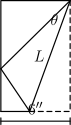
A rectangular piece of paper inches wide is folded as in the diagram so that one corner touches the opposite side. The length in inches of the crease in terms of angle is:
Ninguna de estas
None of these
Respuesta: A
Pista pequeña:
Sea la altura de la hoja rectangular y usa las longitudes iguales creadas por el pliegue
Let be the height of the rectangular sheet and use the equal lengths created by the fold
Pista grande:
El diagrama da y
The diagram gives and
Solución:
Sea la altura de la hoja. Los triángulos rectángulos congruentes creados al reflejar la esquina doblada respecto del pliegue dan así que También dan Por lo tanto,
Por lo tanto, la respuesta correcta es A.
Let be the sheet’s height. The congruent right triangles created by reflecting the folded corner across the crease give so They also give Hence
Therefore, the correct answer is A.
31.
Al dividir el número entre el residuo es:
When the number is divided by the remainder in the division is:
Respuesta: C
Pista pequeña:
Usa
Use
Pista grande:
Escribe
Write
Solución:
Como
Por lo tanto, la respuesta correcta es C.
Since
Therefore, the correct answer is C.
32.
Las cuerdas y del círculo mostrado se cortan perpendicularmente en . Si los segmentos y miden y , respectivamente, entonces el diámetro del círculo mide:
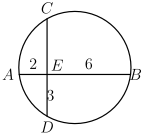
Chords and in the circle shown intersect at and are perpendicular to each other. If segments and have measures and respectively, then the length of the diameter of the circle is:
Respuesta: B
Pista pequeña:
Usa primero
First use
Pista grande:
Sitúa en el origen; el centro está en la intersección de las mediatrices de las dos cuerdas
Place at the origin; the center is at the intersection of the two chord perpendicular bisectors
Solución:
El teorema de las cuerdas que se cortan da por lo que Sitúa y Las mediatrices de y se cortan en Así, y el diámetro es
Por lo tanto, la respuesta correcta es B.
The intersecting-chords theorem gives so Put and The perpendicular bisectors of and meet at Thus and the diameter is
Therefore, the correct answer is B.
33.
El valor mínimo del cociente entre un número decimal de tres cifras distintas y no nulas y la suma de sus cifras es:
The minimum value of the quotient of a (base ten) number of three different nonzero digits divided by the sum of its digits is:
Respuesta: C
Pista pequeña:
Sean y las cifras de centenas, decenas y unidades, y considera qué posición debe contener la cifra mayor
Let the hundreds, tens, and units digits be and and consider which position should contain the largest digit
Pista grande:
En el mínimo, ; luego maximiza y minimiza con cifras distintas y no nulas
At a minimum ; then maximize and minimize subject to distinct nonzero digits
Solución:
Sea el cociente. Entonces Intercambiar con una cifra mayor situada en alguna posición anterior reduce el cociente, así que la cifra de unidades debe ser la mayor. Aumentar esa cifra de unidades reduce un cociente mayor que por lo que Entonces Esto se minimiza tomando la mayor cifra disponible y después la menor El número es y
Por lo tanto, la respuesta correcta es C.
Let denote the quotient. Then Interchanging with a larger digit in either earlier position decreases the quotient, so the units digit must be the largest. Increasing that units digit lowers a quotient greater than so Then This is minimized by taking the largest available and then the smallest The number is and
Therefore, the correct answer is C.
34.
Tres veces la edad de Dick más la edad de Tom es igual al doble de la edad de Harry. El doble del cubo de la edad de Harry es igual a tres veces el cubo de la edad de Dick más el cubo de la edad de Tom. Sus respectivas edades son coprimas dos a dos. La suma de los cuadrados de sus edades es:
Three times Dick’s age plus Tom’s age equals twice Harry’s age. Double the cube of Harry’s age is equal to three times the cube of Dick’s age added to the cube of Tom’s age. Their respective ages are relatively prime to each other. The sum of the squares of their ages is:
Respuesta: A
Pista pequeña:
Sean y las edades y reescribe la ecuación lineal como
Let the ages be and and rewrite the linear equation as
Pista grande:
Factoriza ambas diferencias de cubos después de reescribir la ecuación cúbica
Factor both differences of cubes after rewriting the cubic equation
Solución:
Las ecuaciones son Se reescriben como y Al cancelar los factores positivos iguales se obtiene por lo que La ecuación lineal da entonces y el hecho de que sean coprimas dos a dos obliga a La suma pedida es
Por lo tanto, la respuesta correcta es A.
The equations are Rewrite them as and Canceling the equal positive factors gives so The linear equation then gives and pairwise relative primality forces The requested sum is
Therefore, the correct answer is A.
35.
El triángulo equilátero , cuyo lado mide pulgadas, se coloca dentro del cuadrado , de lado pulgadas, de modo que esté sobre el lado El triángulo gira en sentido horario primero alrededor de luego de y así sucesivamente a lo largo de los lados del cuadrado hasta que y regresen a sus posiciones originales. La longitud en pulgadas del camino recorrido por el vértice es:
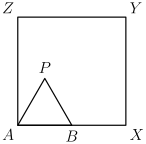
Equilateral triangle with side of length inches is placed inside square with side of length inches so that is on side The triangle is rotated clockwise about then and so on along the sides of the square until and all return to their original positions. The length of the path in inches traversed by vertex is equal to:
Respuesta: D
Pista pequeña:
Sigue la orientación después de un circuito del cuadrado de ocho pivotes
Track the orientation after one eight-pivot circuit of the square
Pista grande:
Se necesitan tres circuitos; clasifica los pivotes según si queda fijo o recorre un arco de o de
Three circuits are needed; classify the pivots according to whether is fixed or moves through a or arc
Solución:
Un circuito del cuadrado usa pivotes y cambia la orientación del triángulo en de una vuelta completa. Por lo tanto, se requieren circuitos, o pivotes, para devolver todo el triángulo a su posición inicial. En de esos pivotes la rotación es alrededor de de modo que no se mueve. En los otros ocho arcos abarcan y ocho abarcan todos con radio Por consiguiente, la longitud total del camino es
Por lo tanto, la respuesta correcta es D.
One circuit of the square uses pivots and changes the triangle’s orientation by of a full turn. Therefore circuits, or pivots, are required to restore the entire triangle. In of those pivots the rotation is about so does not move. In the other eight arcs subtend and eight subtend all with radius Hence the total path length is
Therefore, the correct answer is D.