
Problemas del 1964 AMC 12
¡Desplázate hacia abajo y presiona Iniciar para intentar el examen! O ve al PDF imprimible, la clave de respuestas, o las soluciones profesionales preparadas por LIVE by Po-Shen Loh.
Todos los problemas se usan con el permiso legal oficial de la Mathematical Association of America (MAA).
O salta directamente a un solo problema con su solución: 1 · 2 · 3 · 4 · 5 · 6 · 7 · 8 · 9 · 10 · 11 · 12 · 13 · 14 · 15 · 16 · 17 · 18 · 19 · 20 · 21 · 22 · 23 · 24 · 25 · 26 · 27 · 28 · 29 · 30 · 31 · 32 · 33 · 34 · 35 · 36 · 37 · 38 · 39 · 40
¿Quieres aprender de forma profesional con clases interactivas en video?
Con tiempo
1:15:00
1.
¿Cuál es el valor de ?
What is the value of
Respuesta: E
Pista pequeña:
Evalúa primero el logaritmo interior
Evaluate the inner logarithm first
Pista grande:
Después de multiplicar por toma el logaritmo en base y luego eleva al cuadrado
After multiplying by take the base- logarithm and then square
Solución:
Como la expresión entre corchetes es Su cuadrado es
Por lo tanto, la respuesta correcta es E.
Since the expression inside the square brackets is Its square is
Therefore, the correct answer is E.
2.
La gráfica de es:
The graph of is:
una parábola
a parabola
una elipse
an ellipse
un par de rectas
a pair of straight lines
un punto
a point
ninguna de estas
none of these
Respuesta: C
Pista pequeña:
Factoriza el lado izquierdo como una diferencia de cuadrados
Factor the left side as a difference of squares
Pista grande:
Iguala a cero cada factor lineal
Set each linear factor equal to zero
Solución:
Al factorizar se obtiene Por tanto, cada punto está sobre o que forman un par de rectas.
Por lo tanto, la respuesta correcta es C.
Factoring gives Thus every point lies on or a pair of straight lines.
Therefore, the correct answer is C.
3.
Cuando un entero positivo se divide entre un entero positivo el cociente es y el residuo es donde y son enteros. ¿Cuál es el residuo al dividir entre ?
When a positive integer is divided by a positive integer the quotient is and the remainder is where and are integers. What is the remainder when is divided by
Respuesta: D
Pista pequeña:
Escribe
Write
Pista grande:
Sumar un múltiplo de no cambia el residuo al dividir entre
Adding a multiple of does not change the remainder upon division by
Solución:
El algoritmo de la división da Por tanto, El primer término es divisible entre así que el residuo es
Por lo tanto, la respuesta correcta es D.
The division algorithm gives Hence The first term is divisible by so the remainder is
Therefore, the correct answer is D.
4.
La expresión
donde y equivale a:
The expression
where and is equivalent to:
Respuesta: A
Pista pequeña:
Sustituye primero y
First substitute and
Pista grande:
Simplifica con un denominador común
Simplify using a common denominator
Solución:
Como y la expresión se convierte en
Por lo tanto, la respuesta correcta es A.
Since and the expression becomes
Therefore, the correct answer is A.
5.
Si varía directamente con y si cuando el valor de cuando es:
If varies directly as and if when the value of when is:
Respuesta: A
Pista pequeña:
Escribe la variación directa como
Write direct variation as
Pista grande:
Usa el primer par para hallar
Use the first pair to find
Solución:
La variación directa da De se obtiene Por tanto, cuando
Por lo tanto, la respuesta correcta es A.
Direct variation gives From Therefore, when
Thus, the correct answer is A.
6.
Si están en progresión geométrica, el cuarto término es:
If are in geometric progression, the fourth term is:
Respuesta: B
Pista pequeña:
En tres términos no nulos consecutivos, el cuadrado del término central es el producto de sus vecinos
For three consecutive nonzero terms, the middle term squared equals the product of its neighbors
Pista grande:
Después de hallar multiplica el tercer término por la razón común
After finding multiply the third term by the common ratio
Solución:
La relación de media geométrica da Según la convención del examen para la razón de una progresión geométrica, las razones consecutivas deben estar definidas, así que Al dividir entre se obtiene y Los tres primeros términos son con razón El cuarto es
Por lo tanto, la respuesta correcta es B.
The geometric-mean relation gives Under the examination’s ratio convention for a geometric progression, the consecutive ratios must be defined, so Dividing by yields and The first three terms are with ratio The fourth is
Therefore, the correct answer is B.
7.
Sea el número de valores reales de para los cuales las raíces de
son iguales. Entonces es:
Let be the number of real values of for which the roots of
are equal. Then equals:
un número finito mayor que
a finite number greater than
un número infinitamente grande
an infinitely large number
Respuesta: C
Pista pequeña:
Las raíces iguales hacen que el discriminante sea cero
Equal roots make the discriminant zero
Pista grande:
Resuelve
Solve
Solución:
Las raíces iguales requieren Así, o lo que da dos valores reales.
Por lo tanto, la respuesta correcta es C.
Equal roots require Thus or giving two real values.
Therefore, the correct answer is C.
8.
La raíz menor de la ecuación
es:
The smaller root of the equation
is:
Respuesta: C
Pista pequeña:
Extrae el factor común
Factor out the common expression
Pista grande:
El factor lineal restante es
The remaining linear factor is
Solución:
Al combinar los dos términos y factorizar se obtiene Por tanto, las raíces son y de las cuales es la menor.
Por lo tanto, la respuesta correcta es C.
Combining the two terms and factoring gives Hence the roots are and of which is smaller.
Therefore, the correct answer is C.
9.
Un mayorista compra un artículo a un precio de con un descuento de Luego desea venderlo con una ganancia de sobre su costo después de conceder un descuento de sobre el precio marcado. ¿Qué precio, en dólares, debe marcar en el artículo?
A jobber buys an article at less He then wishes to sell the article at a gain of of his cost after allowing a discount on his marked price. At what price, in dollars, should the article be marked?
ninguno de estos
none of these
Respuesta: E
Pista pequeña:
Calcula primero el costo con descuento y luego auméntalo en un tercio
Compute the discounted cost first, then increase it by one third
Pista grande:
El precio de venta es el del precio marcado
The selling price is of the marked price
Solución:
El costo es dólares. Una ganancia de un tercio produce un precio de venta deseado de dólares. Si es el precio marcado, entonces por lo que Este valor no aparece.
Por lo tanto, la respuesta correcta es E.
The cost is dollars. A gain of one third makes the desired selling price dollars. If is the marked price, then so This is not listed.
Thus, the correct answer is E.
10.
Se da un cuadrado de lado Sobre una diagonal como base se construye un triángulo de tres lados desiguales cuya área es igual a la del cuadrado. La longitud de la altura trazada a la base es:
Given a square with side of length On a diagonal as base a triangle with three unequal sides is constructed so that its area equals that of the square. The length of the altitude drawn to the base is:
Respuesta: A
Pista pequeña:
La diagonal del cuadrado mide
The square’s diagonal has length
Pista grande:
Plantea
Set
Solución:
La base del triángulo es la diagonal del cuadrado, Si su altura es la igualdad de áreas da de modo que
Por lo tanto, la respuesta correcta es A.
The triangle’s base is the square’s diagonal, If its altitude is equality of areas gives so
Therefore, the correct answer is A.
11.
Dados y halla el valor de
Given and find the value of
Respuesta: D
Pista pequeña:
Reescribe como y como
Rewrite as and as
Pista grande:
Iguala los exponentes para obtener dos ecuaciones lineales en y
Equate exponents to obtain two linear equations in and
Solución:
Al escribir ambas ecuaciones con bases comunes se obtiene La sustitución da y por lo que
Por lo tanto, la respuesta correcta es D.
Writing both equations with common bases gives Substitution yields and so
Therefore, the correct answer is D.
12.
¿Cuál de las siguientes es la negación del enunciado: para todo de cierto conjunto, ?
Which of the following is the negation of the statement: For all of a certain set,
Para todo
For all
Para todo
For all
Para ningún
For no
Para algún
For some
Para algún
For some
Respuesta: E
Pista pequeña:
La negación de «para todo» comienza con «para algún»
The negation of “for all” begins with “for some”
Pista grande:
La negación de es
Negating gives
Solución:
La negación de un enunciado universal es un enunciado existencial, y la negación de es Por tanto, la negación es: para algún
Por lo tanto, la respuesta correcta es E.
The negation of a universal statement is an existential statement, and the negation of is Thus the negation is: for some
Therefore, the correct answer is E.
13.
Una circunferencia está inscrita en un triángulo cuyos lados miden y Sean y los segmentos en que el punto de tangencia divide el lado de longitud con ¿Cuál es la razón ?
A circle is inscribed in a triangle with side lengths and Let the segments of the side of length made by a point of tangency, be and with What is the ratio
Respuesta: A
Pista pequeña:
Calcula el semiperímetro del triángulo
Compute the semiperimeter of the triangle
Pista grande:
Un segmento tangente adyacente a un vértice es igual al semiperímetro menos el lado opuesto
A tangency segment adjacent to a vertex equals the semiperimeter minus the opposite side
Solución:
El semiperímetro es En los extremos del lado de longitud las longitudes tangentes son y Así,
Por lo tanto, la respuesta correcta es A.
The semiperimeter is At the endpoints of the side of length the tangent lengths are and Thus
Therefore, the correct answer is A.
14.
Un granjero compró ovejas. Vendió de ellas por el precio que había pagado por las ovejas. Las restantes se vendieron al mismo precio por cabeza que las otras Con respecto al costo, el porcentaje de ganancia de toda la transacción es:
A farmer bought sheep. He sold of them for the price paid for the sheep. The remaining sheep were sold at the same price per head as the other Based on the cost, the percent gain on the entire transaction is:
Respuesta: C
Pista pequeña:
Sea el costo total de compra
Let the total purchase cost be
Pista grande:
El precio de venta por oveja es
The selling price per sheep is
Solución:
Sea el costo total. Como las primeras ovejas se venden por cada una se vende por Por tanto, el ingreso total es una ganancia de
Por lo tanto, la respuesta correcta es C.
Let the total cost be Since the first sheep sell for each sheep sells for Total revenue is therefore a gain.
Thus, the correct answer is C.
15.
Una recta que pasa por el punto delimita en el segundo cuadrante una región triangular de área La ecuación de la recta es:
A line through the point cuts from the second quadrant a triangular region with area The equation of the line is:
ninguna de estas
none of these
Respuesta: B
Pista pequeña:
Si la intersección positiva con el eje es entonces
If the positive -intercept is then
Pista grande:
Usa la forma de intersecciones
Use the intercept form
Solución:
Sea la intersección con el eje El triángulo del segundo cuadrante tiene área así que La forma de intersecciones es Al eliminar denominadores se obtiene
Por lo tanto, la respuesta correcta es B.
Let the -intercept be The second-quadrant triangle has area so The intercept form is Clearing denominators gives
Therefore, the correct answer is B.
16.
Sea y sea el conjunto de enteros El número de elementos de tales que deja residuo cero al dividirse entre es:
Let and let be the set of integers The number of members of such that has remainder zero when divided by is:
Respuesta: E
Pista pequeña:
Factoriza como
Factor as
Pista grande:
El producto siempre es par; determina qué residuo de módulo falla
The product is always even; determine which residue of modulo fails
Solución:
Tenemos un producto de enteros consecutivos, por lo que siempre es par. Es divisible entre salvo cuando Entre nueve valores son múltiplos de Así, funcionan valores.
Por lo tanto, la respuesta correcta es E.
We have a product of consecutive integers, so it is always even. It is divisible by unless Among nine values are multiples of Thus values work.
Therefore, the correct answer is E.
17.
Se dan los puntos distintos y Se trazan segmentos que conectan estos puntos entre sí y con el origen De las tres posibilidades: paralelogramo, recta, trapecio, la figura según la ubicación de los puntos y puede ser:
Given the distinct points and Line segments are drawn connecting these points to each other and to the origin Of the three possibilities: parallelogram, straight line, trapezoid, figure depending upon the location of the points and can be:
solo
only
solo
only
solo
only
solo o
or only
las tres
all three
Respuesta: D
Pista pequeña:
Interpreta los vectores de posición como
Interpret the position vectors as
Pista grande:
Separa los casos en que los vectores y son independientes o dependientes
Separate the cases in which the vectors and are independent or dependent
Solución:
La relación hace que los lados opuestos de sean paralelos e iguales cuando y no son colineales, de modo que la figura es un paralelogramo. Si los dos vectores son dependientes, los cuatro puntos están en una recta. No puede ser un trapecio genuino.
Por lo tanto, la respuesta correcta es D.
The relation makes opposite sides of parallel and equal whenever and are not collinear, so the figure is a parallelogram. If the two vectors are dependent, all four points lie on a straight line. It cannot be a genuine trapezoid.
Thus, the correct answer is D.
18.
Sea el número de pares de valores de y tales que y tienen la misma gráfica. Entonces es:
Let be the number of pairs of values of and such that and have the same graph. Then is:
finito, pero mayor que
finite but more than
mayor que cualquier número finito
greater than any finite number
Respuesta: C
Pista pequeña:
Las ecuaciones de rectas coincidentes tienen ternas de coeficientes proporcionales
Coincident line equations have proportional coefficient triples
Pista grande:
Plantea y usa las coordenadas primera y tercera
Set and use the first and third coordinates
Solución:
Para que tengan la misma gráfica, Así, y por lo que Cada valor determina un par mediante y Por tanto, hay dos pares.
Por lo tanto, la respuesta correcta es C.
For the same graph, Thus and so Each value determines one pair through and Hence there are two pairs.
Therefore, the correct answer is C.
19.
Si y con el valor numérico de es:
If and the numerical value of is:
Respuesta: A
Pista pequeña:
Resuelve ambas ecuaciones lineales para expresar y en función de
Solve both linear equations for and in terms of
Pista grande:
Las ecuaciones dan y
The equations give and
Solución:
Al resolver las ecuaciones se obtiene y Por tanto,
Por lo tanto, la respuesta correcta es A.
Solving the equations gives and Therefore
Thus, the correct answer is A.
20.
La suma de los coeficientes numéricos de todos los términos de la expansión de es:
The sum of the numerical coefficients of all the terms in the expansion of is:
Respuesta: B
Pista pequeña:
La suma de coeficientes de un polinomio se obtiene igualando cada variable a
A polynomial’s coefficient sum is found by setting every variable equal to
Pista grande:
Evalúa
Evaluate
Solución:
Haz La suma de todos los coeficientes numéricos es entonces
Por lo tanto, la respuesta correcta es B.
Set The sum of all numerical coefficients is then
Therefore, the correct answer is B.
21.
Si donde y entonces es igual a:
If where and then equals:
Respuesta: D
Pista pequeña:
Sea
Let
Pista grande:
La ecuación se convierte en
The equation becomes
Solución:
Sea Entonces y Así, por lo que y Por tanto,
Por lo tanto, la respuesta correcta es D.
Let Then and Thus so and Hence
Therefore, the correct answer is D.
22.
Se da el paralelogramo con como punto medio de la diagonal Se conecta con un punto de de modo que ¿Cuál es la razón entre el área del triángulo y la del cuadrilátero ?
Given parallelogram with the midpoint of diagonal Point is connected to a point in so that What is the ratio of the area of triangle to the area of quadrilateral
Respuesta: C
Pista pequeña:
Usa vectores y
Use vectors and
Pista grande:
Entonces y ; calcula ambas áreas como fracciones del paralelogramo
Then and ; compute both areas as fractions of the parallelogram
Solución:
Sea el área del paralelogramo con y Entonces y Los determinantes dan Para el cuadrilátero las dos contribuciones dan La razón pedida es
Por lo tanto, la respuesta correcta es C.
Let the parallelogram’s area be with and Then and Determinants give For quadrilateral the two determinant contributions give The desired ratio is
Therefore, the correct answer is C.
23.
Dos números tienen diferencia, suma y producto en la razón El producto de los dos números es:
Two numbers are such that their difference, their sum, and their product are to one another as The product of the two numbers is:
Respuesta: D
Pista pequeña:
Representa la diferencia, la suma y el producto por y
Represent the difference, sum, and product by and
Pista grande:
Los dos números son y
The two numbers are and
Solución:
Sea la diferencia y la suma Los números son y así que su producto es Pero la razón también indica que el producto es Como los números son distintos, por lo que y el producto es
Por lo tanto, la respuesta correcta es D.
Let the difference be and the sum be The numbers are and so their product is But the ratio also says the product is For distinct numbers so and the product is
Therefore, the correct answer is D.
24.
Sea donde son constantes. ¿Para qué valor de es mínimo ?
Let constants. For what value of is a minimum?
Respuesta: A
Pista pequeña:
Expande y agrupa los términos en
Expand and collect the terms in
Pista grande:
Completa el cuadrado o usa la fórmula del vértice
Complete the square or use the vertex formula
Solución:
Al expandir y completar el cuadrado se obtiene El término cuadrático se minimiza en
Por lo tanto, la respuesta correcta es A.
Expanding and completing the square gives The squared term is minimized at
Therefore, the correct answer is A.
25.
El conjunto de valores de para los cuales tiene dos factores de coeficientes enteros, lineales en y es exactamente:
The set of values of for which has two factors, with integer coefficients, which are linear in and is precisely:
Respuesta: B
Pista pequeña:
Escribe los factores como
Write the factors as
Pista grande:
La ausencia del término y el término obligan a que
The missing -term and the -term force
Solución:
Escribe la factorización como Al comparar los coeficientes de y se obtiene y así que toma Los otros coeficientes dan Por tanto, Si entonces en caso contrario, y Ambos valores producen factorizaciones enteras válidas.
Por lo tanto, la respuesta correcta es B.
Write the factorization as Comparing the and coefficients gives and so take The other coefficients give Hence If then otherwise and Both values produce valid integer factorizations.
Therefore, the correct answer is B.
26.
En una carrera de diez millas, el primero vence al segundo por millas y al tercero por millas. Si mantienen velocidades constantes, ¿por cuántas millas vence el segundo al tercero?
In a ten-mile race First beats Second by miles and First beats Third by miles. If the runners maintain constant speeds throughout the race, by how many miles does Second beat Third?
Respuesta: C
Pista pequeña:
Cuando termina el primero, el segundo y el tercero han recorrido y millas
When First finishes, Second and Third have run and miles
Pista grande:
Compara la distancia del tercero cuando el segundo completa millas
Compare Third’s distance when Second completes miles
Solución:
Respecto a la velocidad del primero, la del segundo es y la del tercero es Así, el tercero corre a de la velocidad del segundo. Cuando el segundo termina millas, el tercero ha recorrido millas, por lo que el segundo gana por millas.
Por lo tanto, la respuesta correcta es C.
Relative to First’s speed, Second’s speed is and Third’s is Thus Third runs as fast as Second. When Second finishes miles, Third has run miles, so Second wins by miles.
Therefore, the correct answer is C.
27.
Si es real y donde entonces:
If is a real number and where then:
Respuesta: E
Pista pequeña:
Interpreta la suma como las distancias de a y
Interpret the sum as the distances from to and
Pista grande:
Halla su mínimo para , recordando que la desigualdad es estricta
Find its minimum for , remembering the inequality is strict
Solución:
Por la desigualdad triangular, La igualdad se cumple para todo entre y Por tanto, la desigualdad estricta tiene una solución real exactamente cuando
Por lo tanto, la respuesta correcta es E.
By the triangle inequality, Equality holds for every between and Therefore the strict inequality has a real solution exactly when
Thus, the correct answer is E.
28.
La suma de términos de una progresión aritmética es y la diferencia común es Si el primer término es entero y el número de valores posibles de es:
The sum of terms of an arithmetic progression is and the common difference is If the first term is an integer, and then the number of possible values for is:
Respuesta: D
Pista pequeña:
Si el primer término es la suma es
If the first term is the sum is
Pista grande:
Enumera los divisores de mayores que
List the divisors of that exceed
Solución:
La fórmula de la serie aritmética se simplifica a Así, debe dividir a y cada así da un entero Los divisores mayores que son y por lo que hay cinco posibilidades.
Por lo tanto, la respuesta correcta es D.
The arithmetic-series formula simplifies to Thus must divide and every such gives an integer The divisors greater than are and so there are five possibilities.
Therefore, the correct answer is D.
29.
En esta figura, pulgadas, pulgadas, pulgadas y pulgadas. La longitud de en pulgadas, es:
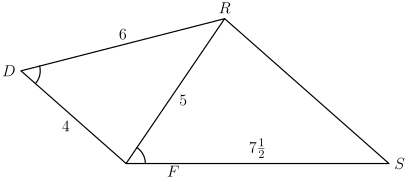
In this figure inches, inches, inches, and inches. The length of in inches, is:
indeterminada
undetermined
Respuesta: E
Pista pequeña:
Compara los triángulos y usando los ángulos incluidos que están marcados como iguales
Compare triangles and around the marked equal angles
Pista grande:
Las razones de los lados adyacentes son
The adjacent side ratios are
Solución:
En torno a los ángulos incluidos iguales, Así, por LAL. El lado corresponde a de modo que
Por lo tanto, la respuesta correcta es E.
At the equal included angles, Thus by SAS. Side corresponds to so
Therefore, the correct answer is E.
30.
Si
la raíz mayor menos la raíz menor es:
If
the larger root minus the smaller root is:
Respuesta: D
Pista pequeña:
Observa que
Notice that
Pista grande:
Para la diferencia de raíces es
For the root difference is
Solución:
Sea y El discriminante es Por tanto, la diferencia de raíces es
Por lo tanto, la respuesta correcta es D.
Let and The discriminant is Hence the root difference is
Therefore, the correct answer is D.
31.
Sea
Entonces expresado en función de es igual a:
Let
Then expressed in terms of equals:
Pista pequeña:
Llama y a las dos bases exponenciales
Call the two exponential bases and
Pista grande:
Ambas raíces de satisfacen
Both roots of satisfy
Solución:
Cada base satisface por lo que Entonces Al aplicar esta identidad término a término a la combinación lineal que define la función se obtiene
Por lo tanto, la respuesta correcta es B.
Each base satisfies so Therefore Applying this identity term by term to the defining linear combination gives
Thus, the correct answer is B.
32.
Si entonces:
If then:
debe ser igual a
must equal
debe ser igual a cero
must equal zero
o o ambas
either or or both
si
if
Respuesta: C
Pista pequeña:
Multiplica en cruz las dos fracciones
Cross-multiply the two fractions
Pista grande:
Pasa todos los términos a un lado y extrae el factor
Move all terms to one side and factor out
Solución:
La multiplicación cruzada da Al restar el lado derecho y factorizar se obtiene Por tanto, o la suma es cero, y ambas pueden ocurrir.
Por lo tanto, la respuesta correcta es C.
Cross-multiplication gives Subtracting the right side and factoring yields Hence either or the sum is zero, and both may occur.
Therefore, the correct answer is C.
33.
es un punto interior del rectángulo tal que pulgadas, pulgadas y pulgadas. Entonces en pulgadas, es:
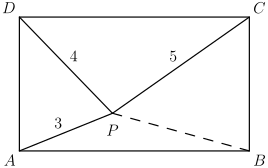
is a point interior to rectangle and such that inches, inches, and inches. Then in inches, equals:
Respuesta: B
Pista pequeña:
Usa la identidad del rectángulo
Use the rectangle identity
Pista grande:
Sustituye las tres distancias conocidas y despeja
Substitute the three known distances and solve for
Solución:
Para cualquier punto de un rectángulo, el teorema de la bandera británica da Así, por lo que y
Por lo tanto, la respuesta correcta es B.
For any point in a rectangle, the British flag theorem gives Thus so and
Therefore, the correct answer is B.
34.
Si es múltiplo de la suma
donde es igual a:
If is a multiple of the sum
where equals:
Respuesta: C
Pista pequeña:
Agrupa los términos en bloques de cuatro potencias de
Group the terms in blocks of four powers of
Pista grande:
Cada bloque completo que comienza con el coeficiente suma
Each complete block beginning with coefficient sums to
Solución:
Escribe Para los cuatro términos con exponentes de a suman El término final es Por tanto,
Por lo tanto, la respuesta correcta es C.
Write For the four terms with exponents through sum to The final term is Therefore
Thus, the correct answer is C.
35.
Los lados de un triángulo tienen longitudes y Las alturas del triángulo se cortan en el punto Si es la altura correspondiente al lado de longitud ¿cuál es la razón ?
The sides of a triangle are of lengths and The altitudes of the triangle meet at point If is the altitude to the side of length what is the ratio
Respuesta: B
Pista pequeña:
El triángulo de lados -- tiene área , así que la altura al lado es
The -- triangle has area , so the altitude to side is
Pista grande:
El pie de la altura divide el lado de longitud en segmentos de longitudes y ; usa coordenadas para ubicar
The altitude foot divides the side of length into segments and ; use coordinates to locate
Solución:
La fórmula de Herón da un área de así que La proyección del lado adyacente de longitud es lo que deja en la base. Tomemos La recta tiene pendiente por lo que la altura que pasa por tiene pendiente y corta a a una altura de Por tanto, lo que da
Por lo tanto, la respuesta correcta es B.
Heron’s formula gives area so The adjacent -side has projection leaving on the base. Put Line has slope so the altitude through has slope and meets at height Thus giving
Therefore, the correct answer is B.
36.
En esta figura, el radio del círculo es igual a la altura del triángulo equilátero Se hace rodar el círculo a lo largo del lado manteniéndolo tangente a este en un punto variable y haciendo que corte las rectas y en los puntos variables y respectivamente. Sea el número de grados del arco Entonces, para todas las posiciones permitidas del círculo, :
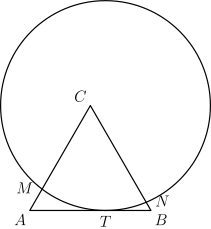
In this figure the radius of the circle is equal to the altitude of the equilateral triangle The circle is made to roll along the side remaining tangent to it at a variable point and intersecting lines and in variable points and respectively. Let be the number of degrees in arc Then for all permissible positions of the circle:
varía de a
varies from to
varía de a
varies from to
varía de a
varies from to
permanece constante en
remains constant at
permanece constante en
remains constant at
Respuesta: E
Pista pequeña:
El centro del círculo y el vértice están a la misma distancia de , así que
The circle’s center and vertex are the same distance above , so
Pista grande:
Prolonga más allá de hasta que vuelva a cortar el círculo en , y luego usa la reflexión respecto de la recta
Extend through to meet the circle again at , then use reflection across line
Solución:
Sea el centro del círculo. Tanto como están a una distancia de igual a la altura del triángulo, así que Prolonga más allá de hasta que vuelva a cortar el círculo en Como tiene dirección opuesta a La recta paralela a biseca este ángulo. La reflexión respecto de deja fijo el círculo e intercambia los rayos y por lo que intercambia y Por tanto, y el triángulo isósceles tiene ángulos de la base de
Como son colineales, Este ángulo inscrito subtiende el arco cuya medida es, por tanto, para toda posición permitida del círculo.
Por lo tanto, la respuesta correcta es E.
Let be the circle’s center. Both and are one triangle altitude above so Extend through to meet the circle again at Since is opposite to The line parallel to bisects this angle. Reflection across fixes the circle and interchanges rays and so it interchanges and Hence and isosceles triangle has base angles
Because are collinear, This inscribed angle subtends arc whose measure is therefore for every permissible circle position.
Thus, the correct answer is E.
37.
Dados dos números positivos tales que Sea A.M. su media aritmética y sea G.M. su media geométrica positiva. Entonces A.M. menos G.M. siempre es menor que:
Given two positive numbers such that Let A.M. be their arithmetic mean and let G.M. be their positive geometric mean. Then A.M. minus G.M. is always less than:
Respuesta: D
Pista pequeña:
Reescribe usando
Rewrite using
Pista grande:
Factoriza para comparar con la opción D
Factor to compare with choice D
Solución:
Tenemos Tras cancelar el factor positivo la comparación con la opción D se reduce a Esto es cierto porque Por tanto, A.M. menos G.M. siempre es menor que la expresión de la opción D.
Por lo tanto, la respuesta correcta es D.
We have After canceling the positive factor comparison with choice D reduces to This is true because Thus A.M. minus G.M. is always less than the expression in choice D.
Therefore, the correct answer is D.
38.
Los lados y del triángulo miden, respectivamente, pulgadas y pulgadas. La mediana mide pulgadas. Entonces en pulgadas, mide:
The sides and of triangle are respectively of lengths inches and inches. The median is inches. Then in inches, is:
Respuesta: D
Pista pequeña:
Usa el teorema de Apolonio para la mediana correspondiente a
Use Apollonius’s theorem for the median to
Pista grande:
Sustituye
Substitute
Solución:
El teorema de Apolonio da Por lo tanto,
Así, la respuesta correcta es D.
Apollonius’s theorem gives Therefore
Thus, the correct answer is D.
39.
Las longitudes de los lados del triángulo son como se muestra, con Se trazan rectas que pasan por el punto interior y por los vértices y que cortan los lados opuestos en respectivamente. Sea Entonces, para toda posición del punto es menor que:
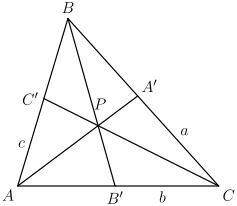
The magnitudes of the sides of triangle are as shown, with Through interior point and the vertices lines are drawn meeting the opposite sides in respectively. Let Then, for all positions of point is less than:
Respuesta: A
Pista pequeña:
Un punto de un segmento está más cerca de un vértice fijo que el extremo más lejano de ese segmento
A point on a segment is closer to a fixed vertex than the farther endpoint of that segment
Pista grande:
Acota , y por separado usando las longitudes de sus lados adyacentes
Bound , , and separately using their adjacent side lengths
Solución:
Para un vértice fijo, la distancia al cuadrado es una función convexa a lo largo del lado opuesto, por lo que su máximo se alcanza en un extremo. Como el extremo de cada ceviana está en el interior de su lado, Al sumar se obtiene
Por lo tanto, la respuesta correcta es A.
For a fixed vertex, squared distance is a convex function along the opposite side, so its maximum occurs at an endpoint. Since each cevian endpoint is interior to its side, Adding gives
Therefore, the correct answer is A.
40.
Un reloj se atrasa minutos por día. Se ajusta correctamente a la p. m. en marzo, el día Sea la corrección positiva, en minutos, que debe sumarse a la hora indicada por el reloj en un momento dado. Cuando el reloj indica las a. m. en marzo, el día es igual a:
A watch loses minutes per day. It is set right at P.M. on March Let be the positive correction, in minutes, to be added to the time shown by the watch at a given time. When the watch shows A.M. on March equals:
Respuesta: A
Pista pequeña:
El reloj avanza a de la velocidad del tiempo real
The watch advances as fast as real time
Pista grande:
Desde la p. m. indicada el de marzo hasta las a. m. indicadas el de marzo transcurren minutos indicados
From the displayed P.M. on March to A.M. on March is displayed minutes
Solución:
El reloj avanza a de la velocidad correcta. El tiempo transcurrido que muestra es de días y horas, es decir, minutos. Por tanto, el tiempo real transcurrido es y la corrección es
Por lo tanto, la respuesta correcta es A.
The watch runs at of the correct rate. The displayed elapsed time is days hours, or minutes. Thus the real elapsed time is and the correction is
Therefore, the correct answer is A.