
Problemas del 2003 AMC 10A
¡Desplázate hacia abajo y presiona Iniciar para intentar el examen! O ve al PDF imprimible, la clave de respuestas, o las soluciones profesionales preparadas por LIVE by Po-Shen Loh.
Todos los problemas se usan con el permiso legal oficial de la Mathematical Association of America (MAA).
O salta directamente a un solo problema con su solución: 1 · 2 · 3 · 4 · 5 · 6 · 7 · 8 · 9 · 10 · 11 · 12 · 13 · 14 · 15 · 16 · 17 · 18 · 19 · 20 · 21 · 22 · 23 · 24 · 25
¿Quieres aprender de forma profesional con clases interactivas en video?
Con tiempo
1:15:00
1.
¿Cuál es la diferencia entre la suma de los primeros números pares y la suma de los primeros números impares?
What is the difference between the sum of the first even counting numbers and the sum of the first odd counting numbers?
Respuesta: D
Pista pequeña:
Empareja cada número par con el número impar inmediatamente anterior.
Pair each even number with the odd number just below it
Pista grande:
Cada uno de los pares aporta una diferencia de .
Each of the pairs contributes a difference of
Solución:
El -ésimo número par es exactamente más que el -ésimo número impar
Al sumar esta diferencia sobre los pares se obtiene
Por lo tanto, la respuesta correcta es D.
The th even number is exactly more than the th odd number
Summing this difference over all pairs gives
Thus, the correct answer is D.
2.
Los miembros de la Rockham Soccer League compran calcetines y camisetas. Los calcetines cuestan por par y cada camiseta cuesta más que un par de calcetines. Cada miembro necesita un par de calcetines y una camiseta para los partidos de local y otro par de calcetines y otra camiseta para los partidos de visitante. Si el costo total es ¿cuántos miembros hay en la liga?
Members of the Rockham Soccer League buy socks and T-shirts. Socks cost per pair and each T-shirt costs more than a pair of socks. Each member needs one pair of socks and a shirt for home games and another pair of socks and a shirt for away games. If the total cost is how many members are in the League?
Respuesta: B
Pista pequeña:
Una camiseta cuesta .
A T-shirt costs
Pista grande:
Cada miembro necesita dos pares de calcetines y dos camisetas.
Each member needs two pairs of socks and two shirts
Solución:
Cada camiseta cuesta
Cada miembro necesita dos pares de calcetines y dos camisetas, con un costo de
El número de miembros es
Por lo tanto, la respuesta correcta es B.
Each T-shirt costs
Each member needs two pairs of socks and two shirts, costing
The number of members is
Thus, the correct answer is B.
3.
Una caja sólida mide cm por cm por cm. Se forma un nuevo sólido quitando de cada esquina de esta caja un cubo de cm de lado. ¿Qué porcentaje del volumen original se elimina?
A solid box is cm by cm by cm. A new solid is formed by removing a cube cm on a side from each corner of this box. What percent of the original volume is removed?
Respuesta: D
Pista pequeña:
Cada cubo eliminado tiene volumen .
Each removed cube has volume
Pista grande:
Hay esquinas, y el volumen original es .
There are corners, and the original volume is
Solución:
Los ocho cubos eliminados tienen un volumen total de centímetros cúbicos.
La caja original tiene un volumen de centímetros cúbicos.
El porcentaje eliminado es
Por lo tanto, la respuesta correcta es D.
The eight removed cubes have total volume cubic centimeters.
The original box has volume cubic centimeters.
The percent removed is
Thus, the correct answer is D.
4.
Mary tarda minutos en subir caminando km desde su casa hasta la escuela, pero solo tarda minutos en caminar de la escuela a casa por la misma ruta. ¿Cuál es su velocidad promedio, en km/hr, para el viaje de ida y vuelta?
It takes Mary minutes to walk uphill km from her home to school, but it takes her only minutes to walk from school to home along the same route. What is her average speed, in km/hr, for the round trip?
Respuesta: A
Pista pequeña:
La velocidad promedio es la distancia total dividida entre el tiempo total, no el promedio de las dos velocidades.
Average speed is total distance divided by total time, not the average of the two speeds
Pista grande:
Recorre km en minutos.
She covers km in minutes
Solución:
Mary camina un total de km en minutos.
Como minutos son de hora, su velocidad promedio es km/hr.
Por lo tanto, la respuesta correcta es A.
Mary walks a total of km in minutes.
Since minutes is hour, her average speed is km/hr.
Thus, the correct answer is A.
5.
Sean y las soluciones de ¿Cuál es el valor de ?
Let and denote the solutions of What is the value of
Respuesta: B
Pista pequeña:
Desarrolla en términos de y
Expand in terms of and
Pista grande:
Usa las fórmulas de Vieta para hallar y sin resolver las raíces
Use Vieta’s formulas to find and without solving for the roots
Solución:
Al factorizar se obtiene así que las raíces son y
Como una raíz es igual a uno de los dos factores y es igual a lo que hace que el producto sea
Por lo tanto, la respuesta correcta es B.
Factoring gives so the roots are and
Since one root equals one of the two factors and equals making the product
Thus, the correct answer is B.
6.
Define como para todos los números reales y ¿Cuál de las siguientes afirmaciones no es verdadera?
Define to be for all real numbers and Which of the following statements is not true?
para todo y
for all and
para todo y
for all and
para todo
for all
para todo
for all
si
if
Respuesta: C
Pista pequeña:
Reescribe cada afirmación usando .
Rewrite each statement using
Pista grande:
Presta especial atención cuando una entrada es y la otra es negativa.
Pay special attention when one input is and the other is negative
Solución:
La afirmación (C) sostiene que pero lo cual falla para valores negativos de Por ejemplo,
Las demás afirmaciones se deducen directamente de las propiedades del valor absoluto.
Por lo tanto, la respuesta correcta es C.
Statement (C) claims but which fails for negative For example,
The remaining statements all follow directly from the properties of absolute value.
Thus, the correct answer is C.
7.
¿Cuántos triángulos no congruentes con perímetro tienen longitudes de lado enteras?
How many non-congruent triangles with perimeter have integer side lengths?
Respuesta: B
Pista pequeña:
Los tres lados son enteros positivos cuya suma es .
The three sides are positive integers summing to
Pista grande:
El lado más largo debe ser menor que por lo que es a lo sumo .
The longest side must be less than so it is at most
Solución:
El lado más largo no puede exceder pues de lo contrario los otros dos lados no podrían alcanzarlo.
Las únicas posibilidades son lados y lo que da triángulos.
Por lo tanto, la respuesta correcta es B.
The longest side cannot exceed since otherwise the other two sides could not reach it.
The only possibilities are side lengths and giving triangles.
Thus, the correct answer is B.
8.
¿Cuál es la probabilidad de que un factor positivo de elegido al azar sea menor que ?
What is the probability that a randomly drawn positive factor of is less than
Respuesta: E
Pista pequeña:
Enumera todos los divisores positivos de .
List all positive divisors of
Pista grande:
Cuenta cuántos de los divisores son menores que .
Count how many of the divisors are less than
Solución:
Los factores de son y
Seis de estos doce factores son menores que así que la probabilidad es
Por lo tanto, la respuesta correcta es E.
The factors of are and
Six of these twelve factors are less than so the probability is
Thus, the correct answer is E.
9.
Simplifica
Simplify
Pista pequeña:
Reescribe cada radical usando exponentes fraccionarios, trabajando de adentro hacia afuera.
Rewrite each radical using fractional exponents, working from the inside out
Pista grande:
La parte más interna y cada raíz cúbica divide el exponente entre .
The innermost and each cube root divides the exponent by
Solución:
Trabajando hacia afuera, y su raíz cúbica es
Luego cuya raíz cúbica es de nuevo
Repitiendo una vez más, cuya raíz cúbica es
Por lo tanto, la respuesta correcta es A.
Working outward, and its cube root is
Then whose cube root is again
Repeating once more, whose cube root is
Thus, the correct answer is A.
10.
El polígono encerrado por las líneas continuas en la figura consta de cuadrados congruentes unidos borde con borde. Se adjunta un cuadrado congruente más a un borde en una de las nueve posiciones indicadas. ¿Cuántos de los nueve polígonos resultantes se pueden plegar para formar un cubo al que le falta una cara?
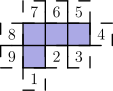
The polygon enclosed by the solid lines in the figure consists of congruent squares joined edge-to-edge. One more congruent square is attached to an edge at one of the nine positions indicated. How many of the nine resulting polygons can be folded to form a cube with one face missing?
Respuesta: E
Pista pequeña:
Los cuatro cuadrados ya se envuelven formando las cuatro caras laterales de un cubo.
The four squares already wrap into four side faces of a cube
Pista grande:
El quinto cuadrado debe plegarse como una de las dos caras restantes sin caer sobre una cara ya cubierta.
The fifth square must fold up as one of the two remaining faces without landing on a face already covered
Solución:
Primero se pliegan los cuatro cuadrados sombreados. Ocupan cuatro caras distintas del cubo y dejan dos caras libres.
Al revisar las posiciones numeradas, y pliegan el cuadrado nuevo sobre una cara ya ocupada por un cuadrado sombreado. Las posiciones y lo pliegan sobre una de las dos caras libres. Por tanto, exactamente de los polígonos funcionan.
Por lo tanto, la respuesta correcta es E.
Fold the four shaded squares first. They occupy four distinct faces of the cube, leaving two faces open.
Checking the numbered attachments, positions and fold the new square onto a face already occupied by one of the shaded squares. Positions and fold it onto one of the two open faces. Therefore exactly of the polygons work.
Thus, the correct answer is E.
11.
La suma de los dos números de cifras y es ¿Cuánto vale ?
The sum of the two -digit numbers and is What is
Respuesta: E
Pista pequeña:
Escribe cada número como más sus dos últimas cifras.
Write each number as plus its last two digits
Pista grande:
Su suma es .
Their sum is
Solución:
Los dos números son y así que su suma es
Entonces así que
Por lo tanto
Por lo tanto, la respuesta correcta es E.
The two numbers equal and so their sum is
Then so
Therefore
Thus, the correct answer is E.
12.
Se elige al azar un punto dentro del rectángulo con vértices y ¿Cuál es la probabilidad de que ?
A point is randomly picked from inside the rectangle with vertices and What is the probability that
Respuesta: A
Pista pequeña:
La región favorable está por encima de la recta .
The favorable region lies above the line
Pista grande:
Dentro del rectángulo, esa región es un triángulo con catetos de longitud .
Within the rectangle, that region is a triangle with legs of length
Solución:
La condición se cumple en el triángulo delimitado por y que tiene vértices y
Este triángulo tiene área mientras que el rectángulo tiene área
La probabilidad es
Por lo tanto, la respuesta correcta es A.
The condition holds in the triangle bounded by and which has vertices and
This triangle has area while the rectangle has area
The probability is
Thus, the correct answer is A.
13.
La suma de tres números es El primero es veces la suma de los otros dos. El segundo es siete veces el tercero. ¿Cuál es el producto de los tres?
The sum of three numbers is The first is times the sum of the other two. The second is seven times the third. What is the product of all three?
Respuesta: A
Pista pequeña:
Sea el tercer número entonces el segundo es .
Let the third number be then the second is
Pista grande:
El primer número es igual a así que .
The first number equals so
Solución:
Sean los números Como obtenemos así que y
Con tenemos así que y
El producto es
Por lo tanto, la respuesta correcta es A.
Let the numbers be Since we get so and
With we have so and
The product is
Thus, the correct answer is A.
14.
Sea el mayor entero que es el producto de exactamente números primos distintos, y donde y son cifras. ¿Cuál es la suma de las cifras de ?
Let be the largest integer that is the product of exactly distinct prime numbers, and where and are single digits. What is the sum of the digits of
Respuesta: A
Pista pequeña:
Los primos de una cifra son y también debe ser primo.
The single-digit primes are and must also be prime
Pista grande:
Prueba los pares candidatos en orden descendente de descartando aquellos para los que sea compuesto.
Test candidate pairs in descending order of discarding any pair for which is composite
Solución:
Tanto como son elementos distintos de y también debe ser primo.
Empecemos con la mayor cifra de las decenas. Para las opciones y dan los compuestos y mientras que da el primo Esto produce
Para las opciones y dan los compuestos y mientras que solo da Todo caso con es a lo sumo Por tanto, es el mayor valor válido.
La suma de sus cifras es
Por lo tanto, la respuesta correcta es A.
Both and are distinct members of and must also be prime.
Start with the largest possible tens digit. For the choices and give the composite numbers and while gives the prime This produces
For the choices and give the composite numbers and while gives only Every case with is at most Hence is the largest valid value.
The sum of its digits is
Thus, the correct answer is A.
15.
¿Cuál es la probabilidad de que un entero del conjunto sea divisible entre y no divisible entre ?
What is the probability that an integer in the set is divisible by and not divisible by
Respuesta: C
Pista pequeña:
Cuenta los múltiplos de luego quita los que también son divisibles entre .
Count the multiples of then remove those also divisible by
Pista grande:
Hay números pares y múltiplos de .
There are even numbers and multiples of
Solución:
De los enteros, son divisibles entre
Entre esos, los que también son divisibles entre son los múltiplos de de los cuales hay
Así que cumplen, lo que da una probabilidad de
Por lo tanto, la respuesta correcta es C.
Of the integers, are divisible by
Among those, the ones also divisible by are the multiples of of which there are
So qualify, giving probability
Thus, the correct answer is C.
16.
¿Cuál es la cifra de las unidades de ?
What is the units digit of
Respuesta: C
Pista pequeña:
La cifra de las unidades de es igual a la cifra de las unidades de .
The units digit of equals the units digit of
Pista grande:
Las cifras de las unidades de las potencias de se repiten en el ciclo con periodo .
Units digits of powers of cycle with period
Solución:
La cifra de las unidades de coincide con la de
Las potencias de tienen cifras de las unidades que se repiten en el ciclo con periodo
Como la cifra de las unidades es la tercera del ciclo, que es
Por lo tanto, la respuesta correcta es C.
The units digit of matches that of
Powers of have units digits cycling with period
Since the units digit is the third in the cycle, which is
Thus, the correct answer is C.
17.
El número de pulgadas del perímetro de un triángulo equilátero es igual al número de pulgadas cuadradas del área de su círculo circunscrito. ¿Cuál es el radio, en pulgadas, del círculo?
The number of inches in the perimeter of an equilateral triangle equals the number of square inches in the area of its circumscribed circle. What is the radius, in inches, of the circle?
Respuesta: B
Pista pequeña:
Para un triángulo equilátero de lado el circunradio es .
For an equilateral triangle of side the circumradius is
Pista grande:
Iguala el perímetro al área luego sustituye .
Set the perimeter equal to the area then substitute
Solución:
Sea la longitud del lado y el circunradio A partir de un triángulo -- formado por el centro y un lado, así que
El perímetro es y el área del círculo es
Al igualarlos, así que
Por lo tanto, la respuesta correcta es B.
Let the side length be and the circumradius be From a -- triangle formed by the center and a side, so
The perimeter is and the circle’s area is
Setting them equal, so
Thus, the correct answer is B.
18.
¿Cuál es la suma de los recíprocos de las raíces de la ecuación
What is the sum of the reciprocals of the roots of the equation
Respuesta: B
Pista pequeña:
Multiplica todo por para obtener una ecuación cuadrática con .
Multiply through by to get a quadratic with
Pista grande:
Si las raíces son y su suma de recíprocos es y por Vieta .
If the roots are and their reciprocal sum is and by Vieta
Solución:
Sea Multiplicar la ecuación por da
Si las raíces son y entonces por las fórmulas de Vieta y
La suma de los recíprocos es
Por lo tanto, la respuesta correcta es B.
Let Multiplying the equation by gives
If the roots are and then by Vieta’s formulas and
The sum of reciprocals is
Thus, the correct answer is B.
19.
Un semicírculo de diámetro se apoya en la parte superior de un semicírculo de diámetro como se muestra. El área sombreada dentro del semicírculo más pequeño y fuera del semicírculo más grande se llama lúnula. Determina el área de esta lúnula.

A semicircle of diameter sits at the top of a semicircle of diameter as shown. The shaded area inside the smaller semicircle and outside the larger semicircle is called a lune. Determine the area of this lune.
Respuesta: C
Pista pequeña:
La lúnula es igual a un triángulo más el semicírculo pequeño, menos un sector del círculo grande.
The lune equals a triangle plus the small semicircle, minus a sector of the large circle
Pista grande:
La cuerda de longitud subtiende un arco de del semicírculo grande.
The chord of length subtends a arc of the large semicircle
Solución:
El diámetro del semicírculo pequeño es una cuerda de longitud en el círculo grande. Al unir sus extremos con el centro del círculo grande se obtiene un triángulo equilátero de lado y área
La región entre la cuerda y el arco pequeño, junto con ese triángulo, tiene área
Al restar el sector de del círculo grande, de área queda la lúnula:
Por lo tanto, la respuesta correcta es C.
The small semicircle’s diameter is a chord of length in the large circle. Joining its endpoints to the large circle’s center gives an equilateral triangle of side and area
The region between the chord and the small arc, taken together with that triangle, has area
Subtracting the sector of the large circle, of area leaves the lune:
Thus, the correct answer is C.
20.
Se selecciona al azar un número de tres cifras en base . ¿Cuál de las siguientes opciones es la más cercana a la probabilidad de que la representación en base y la representación en base de sean ambas de tres cifras?
A base- three-digit number is selected at random. Which of the following is closest to the probability that the base- representation and the base- representation of are both three-digit numerals?
Respuesta: E
Pista pequeña:
Un número tiene tres cifras en base cuando y tres cifras en base cuando .
A number is three-digit in base when and three-digit in base when
Pista grande:
Entre los números de tres cifras en base , cuenta los que cumplen .
Among the three-digit base- numbers, count those with
Solución:
El mayor número de tres cifras en base es y el menor número de tres cifras en base es
Así que ambas condiciones se cumplen exactamente cuando lo que da enteros.
De los números de tres cifras, la probabilidad es
Por lo tanto, la respuesta correcta es E.
The largest three-digit base- number is and the smallest three-digit base- number is
So both conditions hold exactly when giving integers.
Out of three-digit numbers, the probability is
Thus, the correct answer is E.
21.
Pat debe seleccionar seis galletas de una bandeja que contiene solo galletas con chispas de chocolate, de avena y de mantequilla de maní. Hay al menos seis de cada una de estas tres clases de galletas en la bandeja. ¿Cuántos surtidos diferentes de seis galletas se pueden seleccionar?
Pat is to select six cookies from a tray containing only chocolate chip, oatmeal, and peanut butter cookies. There are at least six of each of these three kinds of cookies on the tray. How many different assortments of six cookies can be selected?
Respuesta: D
Pista pequeña:
Cuenta las soluciones enteras no negativas de .
Count the nonnegative integer solutions to
Pista grande:
Por el método de estrellas y barras, esto es .
By stars and bars this is
Solución:
Un surtido queda determinado por cuántas de cada tipo se eligen, así que contamos las soluciones enteras no negativas de
Por estrellas y barras, colocar separadores entre espacios da surtidos.
Por lo tanto, la respuesta correcta es D.
An assortment is determined by how many of each type are chosen, so we count nonnegative integer solutions to
By stars and bars, placing dividers among slots gives assortments.
Thus, the correct answer is D.
22.
En el rectángulo tenemos está en con está en con la recta corta a la recta en y está en la recta con Halla la longitud
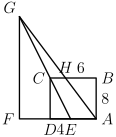
In rectangle we have is on with is on with line intersects line at and is on line with Find the length
Respuesta: B
Pista pequeña:
Coloca en el origen con sobre el semieje positivo .
Place at the origin with on the positive -axis
Pista grande:
Halla dónde se cruzan la recta y la recta , luego es la altura de sobre la recta .
Find where line and line meet, then is the height of above line
Solución:
Coloca y
La recta tiene ecuación y la recta tiene ecuación
Al igualarlas se obtiene y así que Como es perpendicular a la recta (el eje ), su longitud es la altura
Por lo tanto, la respuesta correcta es B.
Place and
Line has equation and line has equation
Setting them equal gives and so Since is perpendicular to line (the -axis), its length is the height
Thus, the correct answer is B.
23.
Se construye un triángulo equilátero grande usando palillos para crear filas de pequeños triángulos equiláteros. Por ejemplo, en la figura tenemos filas de pequeños triángulos equiláteros congruentes, con triángulos pequeños en la fila base. ¿Cuántos palillos se necesitarían para construir un triángulo equilátero grande si la fila base del triángulo consta de triángulos equiláteros pequeños?

A large equilateral triangle is constructed by using toothpicks to create rows of small equilateral triangles. For example, in the figure we have rows of small congruent equilateral triangles, with small triangles in the base row. How many toothpicks would be needed to construct a large equilateral triangle if the base row of the triangle consists of small equilateral triangles?
Respuesta: C
Pista pequeña:
Una fila base de triángulos pequeños significa que así que hay filas.
A base row of small triangles means so there are rows
Pista grande:
La fila necesita palillos, así que el total es .
Row needs toothpicks, so the total is
Solución:
Un triángulo con filas tiene triángulos pequeños en su fila base, así que da
Cada fila requiere palillos, así que el total es
Esto es igual a
Por lo tanto, la respuesta correcta es C.
A triangle with rows has small triangles in its base row, so gives
Each row requires toothpicks, so the total is
This equals
Thus, the correct answer is C.
24.
Sally tiene cinco cartas rojas numeradas del al y cuatro cartas azules numeradas del al Apila las cartas de modo que los colores se alternen y de modo que el número de cada carta roja divida exactamente al número de cada carta azul vecina. ¿Cuál es la suma de los números de las tres cartas centrales?
Sally has five red cards numbered through and four blue cards numbered through She stacks the cards so that the colors alternate and so that the number on each red card divides evenly into the number on each neighboring blue card. What is the sum of the numbers on the middle three cards?
Respuesta: E
Pista pequeña:
Considera con qué cartas azules puede ser vecina cada carta roja, ya que el número rojo debe dividir al número azul.
Consider which blue cards each red card can neighbor, since the red number must divide the blue number
Pista grande:
La roja y la roja dividen cada una a una sola carta azul, lo que obliga a que estén en los extremos de la pila.
Red and red each divide only one blue card, forcing the ends of the stack
Solución:
Entre las cartas azules la roja solo divide a y la roja solo divide a así que esos pares deben ir en los extremos.
La roja solo divide a y y la roja solo divide a y Encadenar esto obliga a que la pila sea
Las tres cartas centrales son que suman
Por lo tanto, la respuesta correcta es E.
Among blue cards red divides only and red divides only so those pairs must sit at the ends.
Red divides only and and red divides only and Chaining these forces the stack
The middle three cards are summing to
Thus, the correct answer is E.
25.
Sea un número de cifras, y sean y el cociente y el residuo, respectivamente, cuando se divide entre ¿Para cuántos valores de es divisible entre ?
Let be a -digit number, and let and be the quotient and remainder, respectively, when is divided by For how many values of is divisible by
Respuesta: B
Pista pequeña:
Escribe así que .
Write so
Pista grande:
Como es divisible entre es divisible entre exactamente cuando lo es.
Since is divisible by is divisible by exactly when is
Solución:
Escribe
Como es un múltiplo de es divisible entre si y solo si lo es.
Los múltiplos de de cifras satisfacen y hay
Por lo tanto, la respuesta correcta es B.
Write
Since is a multiple of is divisible by if and only if is.
The -digit multiples of satisfy and there are
Thus, the correct answer is B.