
2026 AIME I 第 15 题
先试着解答 2026 AIME I 第 15 题,然后核对你的答案与精心整理的解答,解答来自 LIVE by Po-Shen Loh。你也可以参加完整限时模拟考试、查看全部 2026 AIME I 解答,或核对答案。
所有题目均经美国数学协会(MAA)官方合法授权使用。
15.
设 、 和 为正整数,其中 和 都大于或等于 ,且小于或等于 。定义一个 的格子环:它位于一个 的方格网中,由 个围绕 (可能为空)矩形的格子组成。例如,下图展示了一种把 方格网分成 个格子环的方法。
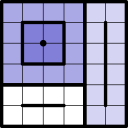
求把一个 方格网分成 个格子环的方法数,使得方格网中的每个格子都恰好属于一个格子环。
Let and be positive integers with both and greater than or equal to and less than or equal to Define an cell loop in a grid of cells to be the cells that surround an (possibly empty) rectangle of cells in the grid. For example, the following diagram shows a way to partition a grid of cells into cell loops.
Find the number of ways to partition a grid of cells into cell loops so that every cell of the grid belongs to exactly one cell loop.
小提示:
每个环的矩形内部必须恰好由其他环填满,而环的大小迫使 。研究最外层环的矩形。
Every loop’s rectangle must have its inner rectangle exactly filled by other loops, and the loop sizes force Study the rectangles of the outermost loops.
大提示:
面积与环数迫使最外层矩形成为整个正方形或平行的全长板条;板条宽度为偶数 ,每条恰好使用 个环
Area and loop counts force the outermost rectangles to be the full square or parallel full-length slabs of even width each using exactly loops
解答:
因为五个环覆盖了 个格子,所以 。每个环含偶数个格子,因此奇数乘奇数的矩形不能被环完全填满;并且填充一个最短偶数边为 的矩形至少需要 个环,因为剥去一个最外层环会使那条边正好缩短 ,而把矩形分成较小矩形只会把这些需求相加。现在考虑一个分割中的最外层环 (也就是其矩形不位于任何其他环的矩形内部的环):它们的矩形铺满 正方形。若最外层矩形 的最短偶数边为 ,它使用 个环,且最多覆盖 个格子。对这个铺法求和,,所以处处取等:每个 都在一个方向上跨满长度 ,宽度为偶数 ,并且恰好由 个环填充。两个不同方向的全长板条会相交,所以最外层矩形要么是整个正方形,要么是平行板条;同样的等号论证可在每个环的内部矩形中重复。
令 为填充一条全高、偶数宽度为 的板条的方法数,其中使用 个环,并要求板条自身的 边界是一个最外层环。宽度 的板条是一个单环:。宽度 的板条是一个 环围住一个 环:。宽度 的板条是一个 环,围住一个 区域,内部有两个环:要么嵌套 ( 围住 ),要么是两条 板条,所以 。宽度 的板条围住一个 区域,内部有三个环:一个 环围住一个含两个环的 区域(如前有 种);或全高板条宽度为 ( 种);或宽度为 的两种顺序 ( 种),所以 。同样的递推计数整个正方形:一个 环围住一个含四个环的 区域,其中 、,和 区域分别有 ,再有 ,再有 种填法(每一步为单个嵌套环、竖直板条或水平板条)。
最后统计最外层结构。单个 矩形给出 种分割。若为平行板条,其宽度构成 的偶数部分有序拆分,且至少有两部分,并且方向(竖直或水平)使计数翻倍: 给出 ; 的 种顺序给出 ; 的 种顺序给出 ; 的 种顺序给出 ; 的 种顺序给出 ; 的 种顺序给出 ,每个方向共 种。总数为 。
Since the five loops cover cells, Every loop has an even number of cells, so no odd-by-odd rectangle can be exactly filled by loops; and filling a rectangle whose shortest even side is requires at least loops, since peeling off an outermost loop shrinks that side by exactly while splitting a rectangle into smaller ones only adds up such requirements. Now consider the outermost loops of a partition (those whose rectangles lie inside no other loop’s rectangle): their rectangles tile the square. If outermost rectangle has shortest even side it uses loops and covers at most cells. Summing over the tiling, so equality holds throughout: each spans the full in one direction, has even width and is filled with exactly loops. Two full-length slabs in different directions would overlap, so the outermost rectangles are the whole square or parallel slabs, and the same equality argument repeats inside every loop’s inner rectangle.
Let be the number of ways to fill a full-height slab of even width with loops, subject to the slab’s own boundary being one outermost loop. (A split into smaller outermost slabs is counted later instead.) A width- slab is a single loop: A width- slab is a loop around an loop: A width- slab is a loop around an region holding two loops — either nested ( around ) or two slabs — so A width- slab surrounds an region holding three loops: an loop around a region with two loops ( ways as before), or full-height strips of widths ( way), or widths in two orders ( ways), so The same recursion counts the full square: a loop around an region with four loops, where the and regions admit then then fillings (single nested loop, vertical strips, or horizontal strips at each stage).
Finally, tally the outermost structures. The single rectangle gives partitions. For parallel slabs, the widths form a composition of into even parts with at least two parts, and orientations (vertical or horizontal) double the count: gives in orders gives in orders gives in orders gives in orders gives and in orders gives for per orientation. The total is
其他年份的第 15 题
1983 AIME · 1984 AIME · 1985 AIME · 1986 AIME · 1987 AIME · 1988 AIME · 1989 AIME · 1990 AIME · 1991 AIME · 1992 AIME · 1993 AIME · 1994 AIME · 1995 AIME · 1996 AIME · 1997 AIME · 1998 AIME · 1999 AIME · 2000 AIME I · 2000 AIME II · 2001 AIME I · 2001 AIME II · 2002 AIME I · 2002 AIME II · 2003 AIME I · 2003 AIME II · 2004 AIME I · 2004 AIME II · 2005 AIME I · 2005 AIME II · 2006 AIME I · 2006 AIME II · 2007 AIME I · 2007 AIME II · 2008 AIME I · 2008 AIME II · 2009 AIME I · 2009 AIME II · 2010 AIME I · 2010 AIME II · 2011 AIME I · 2011 AIME II · 2012 AIME I · 2012 AIME II · 2013 AIME I · 2013 AIME II · 2014 AIME I · 2014 AIME II · 2015 AIME I · 2015 AIME II · 2016 AIME I · 2016 AIME II · 2017 AIME I · 2017 AIME II · 2018 AIME I · 2018 AIME II · 2019 AIME I · 2019 AIME II · 2020 AIME I · 2020 AIME II · 2021 AIME I · 2021 AIME II · 2022 AIME I · 2022 AIME II · 2023 AIME I · 2023 AIME II · 2024 AIME I · 2024 AIME II · 2025 AIME I · 2025 AIME II · 2026 AIME II