
Problemas del 1992 AMC 8
¡Desplázate hacia abajo y presiona Iniciar para intentar el examen! O ve al PDF imprimible, la clave de respuestas, o las soluciones profesionales preparadas por LIVE by Po-Shen Loh.
Todos los problemas se usan con el permiso legal oficial de la Mathematical Association of America (MAA).
O salta directamente a un solo problema con su solución: 1 · 2 · 3 · 4 · 5 · 6 · 7 · 8 · 9 · 10 · 11 · 12 · 13 · 14 · 15 · 16 · 17 · 18 · 19 · 20 · 21 · 22 · 23 · 24 · 25
¿Quieres aprender de forma profesional con clases interactivas en video?
Con tiempo
40:00
1.
¿Cuál es el valor de la siguiente expresión?
What is the value of the following expression?
Respuesta: B
Pista pequeña:
Agrupa el numerador en parejas , y haz lo mismo con el denominador.
Group the numerator into pairs , and do the same for the denominator
Pista grande:
Cada pareja del numerador vale ; en el denominador agrupa , donde cada pareja vale , y sobra un
Each numerator pair equals ; in the denominator group , where each pair is , with a left over
Solución:
Agrupar el numerador en parejas da
Agrupar el denominador como da cuatro parejas de más , lo que es
Así, la expresión es
Por lo tanto, la respuesta correcta es B.
Grouping the numerator in pairs gives
Grouping the denominator as gives four pairs of plus , which is
So the expression is
Thus, the correct answer is B .
2.
¿Cuál de las siguientes no es igual a ?
Which of the following is not equal to
Respuesta: D
Pista pequeña:
Reescribe como el número mixto
Rewrite as the mixed number
Pista grande:
Un número mixto es igual a solo cuando ; revisa cada opción.
A mixed number equals only when ; check each choice
Solución:
Observa que Ahora revisa cada opción: y
Pero
Por lo tanto, la respuesta correcta es D.
Note Now check each choice: and
But
Thus, the correct answer is D .
3.
¿Cuál es la mayor diferencia que se puede formar restando dos números elegidos del conjunto ?
What is the largest difference that can be formed by subtracting two numbers chosen from the set
Respuesta: D
Pista pequeña:
Una diferencia es máxima cuando restas el número más pequeño del número más grande.
A difference is largest when you subtract the smallest number from the largest number
Pista grande:
Restar un negativo equivale a sumar; calcula
Subtracting a negative adds; compute
Solución:
La mayor diferencia usa el número más grande, , menos el número más pequeño,
Esto da
Por lo tanto, la respuesta correcta es D.
The largest difference uses the largest number, , minus the smallest number,
This gives
Thus, the correct answer is D .
4.
Durante la temporada de sóftbol, Judy consiguió hits. Entre ellos hubo jonrón, triple y dobles. Los demás fueron sencillos. ¿Qué porcentaje de sus hits fueron sencillos?
During the softball season, Judy had hits. Among her hits were home run, triple, and doubles. The rest of her hits were singles. What percent of her hits were singles?
Respuesta: E
Pista pequeña:
Primero halla cuántos hits no fueron sencillos.
First find how many hits were not singles
Pista grande:
Sencillos ; divide entre y conviértelo en porcentaje.
Singles ; divide by and convert to a percent
Solución:
Los hits que no son sencillos suman así que los sencillos son
La fracción de sencillos es
Por lo tanto, la respuesta correcta es E.
The non-single hits number so the singles number
The fraction of singles is
Thus, the correct answer is E .
5.
Como se muestra, se quita un círculo de diámetro de un rectángulo de . ¿Qué número entero está más cerca del área de la región sombreada?

A circle of diameter is removed from a rectangle, as shown. Which whole number is closest to the area of the shaded region?
Respuesta: E
Pista pequeña:
El rectángulo tiene área ; resta el área del círculo.
The rectangle has area ; subtract the area of the circle
Pista grande:
El círculo tiene radio así que su área es un poco menos que
The circle has radius so its area is a little less than
Solución:
El rectángulo tiene área y el círculo quitado tiene área
Así, la región sombreada tiene área cuyo entero más cercano es
Por lo tanto, la respuesta correcta es E.
The rectangle has area and the removed circle has area
So the shaded region has area whose closest whole number is
Thus, the correct answer is E .
6.
Una expresión en forma de triángulo con entrada superior , entrada inferior izquierda y entrada inferior derecha representa , como se muestra. ¿Cuál es la suma indicada?
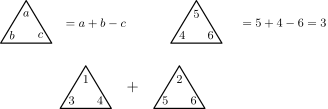
A triangular expression with top entry , lower-left entry , and lower-right entry means , as shown below. What is the indicated sum?
Respuesta: D
Pista pequeña:
Aplica la regla a cada terna por separado: el superior más el inferior izquierdo menos el inferior derecho.
Apply the rule to each triple separately: top plus lower-left minus lower-right
Pista grande:
Calcula y luego suma los dos resultados.
Compute and then add the two results
Solución:
La primera terna da y la segunda da
Su suma es
Por lo tanto, la respuesta correcta es D.
The first triple gives and the second gives
Their sum is
Thus, the correct answer is D .
7.
La suma de dígitos de es ¿Cuántos números enteros de dígitos, cuya suma de dígitos es , son pares?
The digit-sum of is How many -digit whole numbers, whose digit-sum is , are even?
Pista pequeña:
Una suma de dígitos de obliga a que los tres dígitos sean muy grandes.
A digit-sum of forces the three digits to be very large
Pista grande:
Los únicos dígitos que funcionan son y ; enumera los ordenamientos y quédate con los pares.
The only digits that work are and ; list the arrangements and keep the even ones
Solución:
Una suma de dígitos de con tres dígitos exige los dígitos y Los números de dígitos que los usan son y
De estos, solo es par, así que hay exactamente número de ese tipo.
Por lo tanto, la respuesta correcta es A.
A digit-sum of with three digits requires the digits and The -digit numbers using them are and
Of these, only is even, so there is exactly such number.
Thus, the correct answer is A .
8.
Un dueño de tienda compró lápices a cada uno. Si los vende a cada uno, ¿cuántos debe vender para obtener una ganancia de exactamente ?
A store owner bought pencils at each. If he sells them for each, how many of them must he sell to make a profit of exactly
Respuesta: C
Pista pequeña:
Primero halla el costo total de los lápices.
First find the total cost of the pencils
Pista grande:
Los ingresos deben ser el costo más divide esos ingresos necesarios entre el precio de
The revenue must be the cost plus divide that needed revenue by the price
Solución:
Los lápices cuestan Para obtener una ganancia de los ingresos deben ser
A cada uno, debe vender lápices.
Por lo tanto, la respuesta correcta es C.
The pencils cost To make a profit, the revenue must be
At each, he must sell pencils.
Thus, the correct answer is C .
9.
La población de un pueblo pequeño es La gráfica indica la cantidad de mujeres y hombres del pueblo, pero se omiten los valores de la escala vertical. Las barras marcadas y representan mujeres y hombres, respectivamente. ¿Cuántos hombres viven en el pueblo?
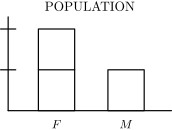
The population of a small town is The graph indicates the numbers of females and males in the town, but the vertical scale values are omitted. The bars labeled and represent females and males, respectively. How many males live in the town?
Respuesta: B
Pista pequeña:
Sea el número de hombres; entonces el número de mujeres es
Let the number of males be ; then the number of females is
Pista grande:
Como resuelve
Since solve
Solución:
Si hay hombres, entonces hay mujeres, y juntos
Así, lo que da
Por lo tanto, la respuesta correcta es B.
If there are males, then there are females, and together
So giving
Thus, the correct answer is B .
10.
Un triángulo rectángulo isósceles con catetos de longitud se divide en triángulos congruentes como se muestra. El área sombreada es
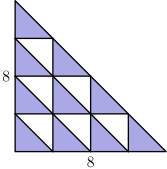
An isosceles right triangle with legs of length is partitioned into congruent triangles as shown. The shaded area is
Respuesta: B
Pista pequeña:
El triángulo completo tiene área dividida en partes iguales.
The whole triangle has area split into equal pieces
Pista grande:
Cada triángulo pequeño tiene área ; cuenta cuántos están sombreados.
Each small triangle has area ; count how many are shaded
Solución:
El triángulo grande tiene área así que cada uno de los triángulos pequeños congruentes tiene área
Diez de los triángulos pequeños están sombreados, así que el área sombreada es
Por lo tanto, la respuesta correcta es B.
The large triangle has area so each of the congruent small triangles has area
Ten of the small triangles are shaded, so the shaded area is
Thus, the correct answer is B .
11.
La gráfica de barras muestra los resultados de una encuesta sobre preferencias de color. De izquierda a derecha, las barras representan rojo, azul, marrón, rosa y verde. ¿Qué porcentaje prefirió el azul?
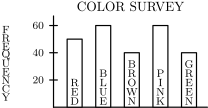
The bar graph shows the results of a survey on color preferences. From left to right, the bars represent red, blue, brown, pink, and green. What percent preferred blue?
Respuesta: B
Pista pequeña:
Suma los cinco conteos para obtener el número total de personas encuestadas.
Add the five counts to get the total number of people surveyed
Pista grande:
Divide la cantidad de personas que prefieren el azul entre el total y convierte el resultado en porcentaje.
The percent preferring blue is (blue count) divided by (total), converted to a percent
Solución:
El número total de encuestados es
El porcentaje que prefiere el azul es
Por lo tanto, la respuesta correcta es B.
The total number surveyed is
The percent preferring blue is
Thus, the correct answer is B .
12.
Los cinco neumáticos de un auto (cuatro neumáticos de carretera y una llanta de refacción de tamaño completo) se rotaron de modo que cada neumático se usara la misma cantidad de millas durante las primeras millas que el auto recorrió. ¿Durante cuántas millas se usó cada neumático?
The five tires of a car (four road tires and a full-sized spare) were rotated so that each tire was used the same number of miles during the first miles the car traveled. For how many miles was each tire used?
Respuesta: C
Pista pequeña:
En cualquier momento de los neumáticos están en el suelo, así que el kilometraje total de neumáticos es
At any moment of the tires are on the ground, so the total tire-mileage is
Pista grande:
Reparte ese kilometraje total de neumáticos por igual entre los neumáticos.
Share that total tire-mileage equally among the tires
Solución:
Durante las millas, siempre hay neumáticos en uso, así que el kilometraje total de neumáticos es neumático-millas.
Repartido por igual entre neumáticos, cada neumático se usa millas.
Por lo tanto, la respuesta correcta es C.
During the miles, tires are always in use, so the total tire-mileage is tire-miles.
Split equally among tires, each tire is used miles.
Thus, the correct answer is C .
13.
Cinco calificaciones de examen tienen una media (calificación promedio) de una mediana (calificación central) de y una moda (calificación más frecuente) de La suma de las dos calificaciones más bajas es
Five test scores have a mean (average score) of a median (middle score) of and a mode (most frequent score) of The sum of the two lowest test scores is
no se puede determinar con la información dada
not determined by the information given
Respuesta: B
Pista pequeña:
Las cinco calificaciones suman y la calificación central es
The five scores add up to and the middle score is
Pista grande:
La moda debe aparecer al menos dos veces, y ambas copias deben estar en o por encima de la mediana, así que las tres calificaciones más altas son y
The mode must appear at least twice, and both copies must be at or above the median, so the three highest scores are and
Solución:
Las cinco calificaciones suman La mediana es la tercera calificación, Como es la moda, debe aparecer al menos dos veces, y ambas copias están por encima de la mediana, así que las dos calificaciones más altas son y
Las tres calificaciones más altas son y que suman Así, las dos más bajas suman
Por lo tanto, la respuesta correcta es B.
The five scores sum to The median is the third score, Since is the mode, it must appear at least twice, and both copies lie above the median, so the two highest scores are and
The three highest scores are and summing to So the two lowest sum to
Thus, the correct answer is B .
14.
Cuando se agregan cuatro galones a un tanque que está lleno hasta un tercio, el tanque queda lleno hasta la mitad. La capacidad del tanque en galones es
When four gallons are added to a tank that is one-third full, the tank is then one-half full. The capacity of the tank in gallons is
Respuesta: D
Pista pequeña:
Agregar galones eleva el tanque de lleno a lleno.
Adding gallons raises the tank from full to full
Pista grande:
Así, galones equivalen a de la capacidad.
So gallons equals of the capacity
Solución:
Los galones corresponden al cambio de lleno a lleno, que es de la capacidad.
Si de la capacidad es galones, la capacidad total es galones.
Por lo tanto, la respuesta correcta es D.
The gallons account for the change from full to full, which is of the capacity.
If of the capacity is gallons, the full capacity is gallons.
Thus, the correct answer is D .
15.
¿Cuál es la letra número de esta secuencia?
ABCDEDCBAABCDEDCBAABCDEDCBAABCDEDC
What is the nd letter in this sequence?
ABCDEDCBAABCDEDCBAABCDEDCBAABCDEDC
Respuesta: C
Pista pequeña:
La cadena se repite una y otra vez; cuenta cuántas letras hay en un bloque.
The string repeats over and over; count how many letters are in one block
Pista grande:
Un bloque tiene letras, así que divide entre y usa el residuo para encontrar la posición dentro de un bloque.
One block has letters, so divide by and use the remainder to find the position within a block
Solución:
La secuencia es el bloque de letras repetido una y otra vez.
Como la letra número es la .ª letra de un bloque, que es
Por lo tanto, la respuesta correcta es C.
The sequence is the -letter block repeated again and again.
Since the nd letter is the rd letter of a block, which is
Thus, the correct answer is C .
16.
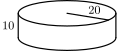
¿Qué cilindro tiene el doble del volumen del cilindro mostrado a la derecha?
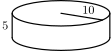
Which cylinder has twice the volume of the cylinder shown at right?
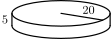
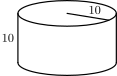
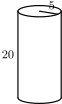
Ninguna de las anteriores
None of the above
Pista pequeña:
El volumen de un cilindro es ; primero calcula el volumen del cilindro dado.
The volume of a cylinder is ; first compute the volume of the given cylinder
Pista grande:
Duplicar la altura duplica el volumen, pero duplicar el radio multiplica el volumen por ; revisa las etiquetas y en cada opción.
Doubling the height doubles the volume, but doubling the radius multiplies the volume by ; check the and labels on each choice
Solución:
El cilindro dado tiene volumen así que un cilindro del doble del volumen tiene volumen
Las opciones tienen volúmenes (A), (B), (C) y (D). Solo (B) es igual a
Por lo tanto, la respuesta correcta es B.
The given cylinder has volume so a cylinder of twice the volume has volume
The choices have volumes (A), (B), (C), and (D). Only (B) equals
Thus, the correct answer is B .
17.
Los lados de un triángulo tienen longitudes y donde es un número entero. ¿Cuál es el menor valor posible de ?
The sides of a triangle have lengths and where is a whole number. What is the smallest possible value of
Respuesta: B
Pista pequeña:
Para un triángulo, los dos lados más cortos deben sumar más que el lado más largo.
For a triangle, the two shorter sides must add to more than the longest side
Pista grande:
Necesitas ; encuentra el menor número entero
You need ; find the smallest whole number
Solución:
Por la desigualdad triangular, debe superar el lado más largo así que
El menor número entero mayor que es y sí forma un triángulo válido.
Por lo tanto, la respuesta correcta es B.
By the triangle inequality, must exceed the longest side so
The smallest whole number greater than is and it does form a valid triangle.
Thus, the correct answer is B .
18.
En un viaje, un auto recorrió millas en una hora y media, luego estuvo detenido en el tráfico durante minutos y después recorrió millas durante las siguientes horas. ¿Cuál fue la velocidad promedio del auto en millas por hora durante el viaje de horas?
On a trip, a car traveled miles in an hour and a half, then was stopped in traffic for minutes, then traveled miles during the next hours. What was the car’s average speed in miles per hour for the -hour trip?
Respuesta: A
Pista pequeña:
La velocidad promedio es la distancia total dividida entre el tiempo total.
Average speed is total distance divided by total time
Pista grande:
La distancia total es millas; el tiempo total es horas, ya que la parada también cuenta.
Total distance is miles; total time is hours, since the stop still counts
Solución:
El auto recorrió millas en total, en horas (la parada en el tráfico también cuenta como tiempo).
La velocidad promedio es millas por hora.
Por lo tanto, la respuesta correcta es A.
The car covered miles in total, over hours (the traffic stop still counts as time).
The average speed is miles per hour.
Thus, the correct answer is A .
19.
La distancia entre la salida número y la salida número de una autopista interestatal es millas. Si dos salidas cualesquiera están separadas al menos millas, ¿cuál es el mayor número de millas que puede haber entre dos salidas consecutivas que estén entre la salida número y la salida número ?
The distance between the th and th exits on an interstate highway is miles. If any two exits are at least miles apart, then what is the largest number of miles there can be between two consecutive exits that are between the th and th exits?
Respuesta: C
Pista pequeña:
Entre la salida número y la salida número hay intervalos.
Between the th and th exits there are gaps
Pista grande:
Para hacer un intervalo lo más grande posible, haz los otros intervalos tan pequeños como se permite, millas cada uno.
To make one gap as large as possible, make the other gaps as small as allowed, miles each
Solución:
Desde la salida número hasta la salida número hay intervalos entre salidas consecutivas, cada uno de al menos millas.
Para maximizar un intervalo, haz los otros intervalos exactamente de millas, usando millas. El intervalo restante es millas.
Por lo tanto, la respuesta correcta es C.
From the th exit to the th exit there are gaps between consecutive exits, each at least miles.
To maximize one gap, make the other gaps exactly miles, using miles. The remaining gap is miles.
Thus, the correct answer is C .
20.
¿Qué patrón de cuadrados idénticos no se puede plegar a lo largo de las líneas mostradas para formar un cubo?
Which pattern of identical squares could not be folded along the lines shown to form a cube?


Respuesta: D
Pista pequeña:
Un cubo tiene caras, así que cada patrón tiene cuadrados; intenta plegar cada uno en tu mente.
A cube has faces, so each pattern has squares; try folding each one up in your mind
Pista grande:
Sigue dónde cae cada cuadrado al plegar el patrón; un patrón falla cuando dos cuadrados cubrirían la misma cara.
Track where each square lands as the pattern folds; a pattern fails when two squares would cover the same face
Solución:
Cada uno de los cinco patrones tiene cuadrados. Plegar los patrones (A), (B), (C) y (E) envuelve los cuadrados de forma ordenada sobre las seis caras de un cubo.
Para el patrón (D), cualquier intento de plegar obliga a que dos de los cuadrados caigan sobre la misma cara, así que se superponen y no se puede formar ningún cubo.
Por lo tanto, la respuesta correcta es D.
Each of the five patterns has squares. Folding patterns (A), (B), (C), and (E) wraps the squares neatly onto the six faces of a cube.
For pattern (D), any attempt to fold forces two of the squares to land on the same face, so they overlap and no cube can be formed.
Thus, the correct answer is D .
21.
La banda de tambores y cornetas de Northside recaudó dinero para un viaje. Los tamborileros y los cornetistas llevaron registros de ventas por separado. En cada par de la gráfica, la barra sin sombrear representa las ventas de los tamborileros y la barra sombreada representa las ventas de los cornetistas. Según la gráfica de doble barra de ventas mensuales de abajo, ¿en qué mes las ventas de un grupo superaron a las del otro por el mayor porcentaje?
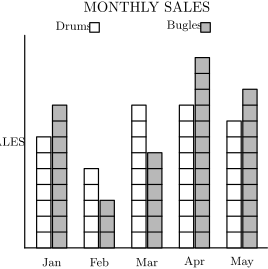
Northside’s Drum and Bugle Corps raised money for a trip. The drummers and bugle players kept separate sales records. In each pair on the graph, the open bar represents drums and the shaded bar represents bugles. According to the double bar graph of monthly sales below, in what month did one group’s sales exceed the other’s by the greatest percent?
enero
Jan
febrero
Feb
marzo
Mar
abril
Apr
mayo
May
Respuesta: B
Pista pequeña:
Para cada mes, lee las dos alturas de las barras y encuentra la diferencia entre ellas.
For each month, read off the two bar heights and find the gap between them
Pista grande:
Divide la diferencia entre el valor menor para hallar el porcentaje en que el mayor lo supera; compara esta razón entre los meses.
Divide the difference by the smaller value to find the percent by which the larger exceeds it; compare this ratio across the months
Solución:
Leer la gráfica da (tambores, cornetas): enero febrero marzo abril y mayo
El exceso porcentual del mayor sobre el menor es en enero, en febrero, en marzo, en abril, y en mayo. El mayor es febrero, donde supera a por cerca de
Por lo tanto, la respuesta correcta es B.
Reading the graph gives (drums, bugles): January February March April and May
The percent excess of the larger over the smaller is in January, in February, in March, in April, and in May. The greatest is February, where exceeds by about
Thus, the correct answer is B .
22.
Ocho baldosas cuadradas de están dispuestas como se muestra, de modo que sus bordes exteriores forman un polígono con un perímetro de unidades. Se agregan dos baldosas del mismo tamaño de modo que al menos un lado de cada baldosa agregada se comparta con un lado de uno de los cuadrados de la figura original. ¿Cuál de las siguientes podría ser el perímetro de la nueva figura?
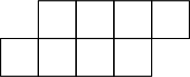
Eight square tiles are arranged as shown so their outside edges form a polygon with a perimeter of units. Two additional tiles of the same size are added to the figure so that at least one side of each added tile is shared with a side of one of the squares in the original figure. Which of the following could be the perimeter of the new figure?
Respuesta: C
Pista pequeña:
Agregar una baldosa que comparte exactamente un lado cambia el perímetro en ; compartir dos lados lo cambia en
Adding a tile that shares exactly one side changes the perimeter by ; sharing two sides changes it by
Pista grande:
Con dos baldosas agregadas, el cambio total puede ser o ; suma estos a
With two added tiles, the total change can be or ; add these to
Solución:
Una baldosa que comparte exactamente un lado añade al perímetro (cuatro bordes nuevos menos dos ocultos), mientras que una baldosa que comparte dos lados añade
Con dos baldosas agregadas el perímetro puede cambiar en o dando nuevos perímetros de o De las opciones, solo es posible.
Por lo tanto, la respuesta correcta es C.
A tile that shares exactly one side adds to the perimeter (four new edges minus two hidden), while a tile sharing two sides adds
With two added tiles the perimeter can change by or giving new perimeters of or Of the choices, only is possible.
Thus, the correct answer is C .
23.
Si se lanzan dos dados, la probabilidad de que el producto de los números que aparecen en las caras superiores de los dados sea mayor que es
If two dice are tossed, the probability that the product of the numbers showing on the tops of the dice is greater than is
Respuesta: B
Pista pequeña:
Hay resultados igualmente probables; cuenta los que tienen producto mayor que
There are equally likely outcomes; count those whose product exceeds
Pista grande:
Haz una tabla de multiplicar de y marca cada producto mayor que
Make a multiplication table and mark every product greater than
Solución:
Hay resultados igualmente probables. Contando los pares ordenados cuyo producto supera : con un primer dado de hay (a saber, ); de , hay ; de , hay ; de , hay ; de , hay
Es decir, resultados favorables, así que la probabilidad es
Por lo tanto, la respuesta correcta es B.
There are equally likely outcomes. Counting the ordered pairs whose product exceeds : with a first die of there is (namely ); of , there are ; of , there are ; of , there are ; of , there are
That is favorable outcomes, so the probability is
Thus, the correct answer is B .
24.
Cuatro círculos de radio están dispuestos como se muestra. Sus centros son los vértices de un cuadrado. El área de la región sombreada es más cercana a
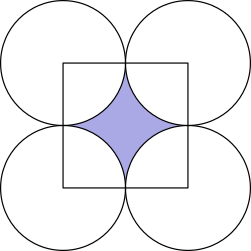
Four circles of radius are arranged as shown. Their centers are the vertices of a square. The area of the shaded region is closest to
Respuesta: A
Pista pequeña:
Como los círculos vecinos son tangentes, el lado del cuadrado equivale a dos radios, así que su lado es y su área es
Since neighboring circles are tangent, the square’s side equals two radii, so its side is and its area is
Pista grande:
Los cuatro cuartos de círculo dentro del cuadrado juntos forman un círculo completo de área ; resta eso del cuadrado.
The four quarter-circles inside the square together make one full circle of area ; subtract that from the square
Solución:
Como los círculos adyacentes son tangentes, el cuadrado que pasa por los centros tiene lado y área
Dentro del cuadrado, cada círculo aporta un cuarto de círculo y los cuatro cuartos forman un círculo completo de área La región sombreada es
Por lo tanto, la respuesta correcta es A.
Because adjacent circles are tangent, the square through the centers has side and area
Inside the square, each circle contributes a quarter-circle, and the four quarters make one full circle of area The shaded region is
Thus, the correct answer is A .
25.
Se vierte la mitad del agua de un recipiente lleno. Luego se vierte un tercio del resto. Continúa el proceso: un cuarto del resto en el tercer vertido, un quinto del resto en el cuarto vertido y así sucesivamente. ¿Después de cuántos vertidos queda exactamente una décima parte del agua original?
One half of the water is poured out of a full container. Then one third of the remainder is poured out. Continue the process: one fourth of the remainder for the third pouring, one fifth of the remainder for the fourth pouring, and so on. After how many pourings does exactly one tenth of the original water remain?
Respuesta: D
Pista pequeña:
Después del primer vertido queda ; después del segundo queda
After the first pouring remains; after the second remains
Pista grande:
La fracción restante se telescopa: después de vertidos es ; iguala esto a
The remaining fraction telescopes: after pourings it is ; set this equal to
Solución:
Después del .º vertido, la fracción restante es que se telescopa a
Igualar da
Por lo tanto, la respuesta correcta es D.
After the th pouring, the fraction remaining is which telescopes to
Setting gives
Thus, the correct answer is D .