
Problemas del 1982 AMC 12
¡Desplázate hacia abajo y presiona Iniciar para intentar el examen! O ve al PDF imprimible, la clave de respuestas, o las soluciones profesionales preparadas por LIVE by Po-Shen Loh.
Todos los problemas se usan con el permiso legal oficial de la Mathematical Association of America (MAA).
O salta directamente a un solo problema con su solución: 1 · 2 · 3 · 4 · 5 · 6 · 7 · 8 · 9 · 10 · 11 · 12 · 13 · 14 · 15 · 16 · 17 · 18 · 19 · 20 · 21 · 22 · 23 · 24 · 25 · 26 · 27 · 28 · 29 · 30
¿Quieres aprender de forma profesional con clases interactivas en video?
Con tiempo
1:15:00
1.
Cuando el polinomio se divide entre el polinomio el residuo es
When the polynomial is divided by the polynomial the remainder is
Respuesta: E
Pista pequeña:
Trabaja módulo
Work modulo
Pista grande:
Sustituye por en
Replace by in
Solución:
Módulo tenemos así que Este polinomio lineal es el residuo.
Por lo tanto, la respuesta correcta es E.
Modulo we have so This linear polynomial is the remainder.
Therefore, the correct answer is E.
2.
Si ocho veces se aumenta en dos, entonces la cuarta parte del resultado es
If a number eight times as large as is increased by two, then one fourth of the result equals
Respuesta: A
Pista pequeña:
Traduce las dos primeras operaciones antes de dividir
Translate the first two operations before dividing
Pista grande:
Simplifica término a término
Simplify term by term
Solución:
Ocho veces aumentado en dos, es Su cuarta parte es
Por lo tanto, la respuesta correcta es A.
Eight times increased by two, is One fourth is
Therefore, the correct answer is A.
3.
Evalúa en
Evaluate at
Respuesta: C
Pista pequeña:
Evalúa primero el interior
Evaluate the inner first
Pista grande:
El mismo valor se convierte tanto en la base como en el exponente
The same value becomes both the base and exponent
Solución:
Para Por tanto,
Por lo tanto, la respuesta correcta es C.
At Hence
Therefore, the correct answer is C.
4.
El perímetro de una región semicircular, medido en centímetros, es numéricamente igual a su área, medida en centímetros cuadrados. El radio del semicírculo, medido en centímetros, es
The perimeter of a semicircular region, measured in centimeters, is numerically equal to its area, measured in square centimeters. The radius of the semicircle, measured in centimeters, is
Respuesta: E
Pista pequeña:
Incluye el diámetro en el perímetro de la región
Include the diameter in the perimeter of the region
Pista grande:
Iguala a
Set equal to
Solución:
Para la igualdad del perímetro y el área da Al dividir entre y resolver se obtiene
Por lo tanto, la respuesta correcta es E.
For equality of perimeter and area gives Dividing by and solving yields
Therefore, the correct answer is E.
5.
Dos números positivos y están en la razón donde Si entonces el menor de y es
Two positive numbers and are in the ratio where If then the smaller of and is
Respuesta: C
Pista pequeña:
Escribe los números como y
Write the numbers as and
Pista grande:
Usa su suma para determinar el factor de escala común
Use their sum to determine the common scale factor
Solución:
Escribe y Como es menor. De se obtiene así que
Por lo tanto, la respuesta correcta es C.
Write and Since is smaller. From so
Therefore, the correct answer is C.
6.
La suma de todos menos uno de los ángulos interiores de un polígono convexo es El ángulo restante es
The sum of all but one of the interior angles of a convex polygon equals The remaining angle is
Respuesta: D
Pista pequeña:
La suma total de los ángulos interiores de un polígono es múltiplo de
A polygon’s total interior angle sum is a multiple of
Pista grande:
El ángulo convexo faltante debe situar el total estrictamente entre y
The missing convex angle must place the total strictly between and
Solución:
El total debe ser y el ángulo faltante está entre y El único múltiplo de entre y es por lo que queda
Por lo tanto, la respuesta correcta es D.
The total must be and the missing angle lies between and The only multiple of between and is leaving
Therefore, the correct answer is D.
7.
Si la operación se define mediante ¿cuál de las siguientes afirmaciones es falsa?
If the operation is defined by then which one of the following is false?
para todos los números reales y
for all real and
es igual a para todos los números reales y
equals for all real and
es igual a para todo número real
equals for all real
para todo número real
for all real
para todos los números reales y
for all real and
Respuesta: B
Pista pequeña:
Primero simplifica la operación a
First simplify the operation to
Pista grande:
Prueba la ley distributiva propuesta con y
Test the proposed distributive law with and
Solución:
Como la operación es conmutativa, tiene elemento neutro y se convierte en multiplicación ordinaria después de sumar Por ello es asociativa, y la expansión directa también verifica C. El enunciado B falla cuando y su lado izquierdo es pero su lado derecho es Por tanto, B es falsa.
Por lo tanto, la respuesta correcta es B.
Since the operation is commutative, has identity and becomes ordinary multiplication after adding Thus it is associative, and direct expansion also verifies C. Statement B fails when and its left side is but its right side is Hence B is false.
Therefore, the correct answer is B.
8.
Por definición, y donde son enteros positivos y Si forman una progresión aritmética con entonces es igual a
By definition and where are positive integers and If form an arithmetic progression with then equals
Respuesta: B
Pista pequeña:
El término central de una progresión aritmética es el promedio de sus vecinos
The middle term of an arithmetic progression is the average of its neighbors
Pista grande:
Sustituye las fórmulas factoriales en
Substitute the factorial formulas into
Solución:
La condición de progresión es Al sustituir y cancelar se obtiene o bien Como resulta
Por lo tanto, la respuesta correcta es B.
The progression condition is Substitution and cancellation give or Since
Therefore, the correct answer is B.
9.
Una recta vertical divide el triángulo de vértices y en el plano en dos regiones de igual área. La ecuación de la recta es
A vertical line divides the triangle with vertices and in the -plane into two regions of equal area. The equation of the line is
Respuesta: B
Pista pequeña:
Para el triángulo está entre y
For the triangle lies between and
Pista grande:
Iguala el área acumulada a la mitad del área total del triángulo
Set the accumulated area to one half of the triangle’s total area
Solución:
El triángulo tiene área La parte con tiene área Para un corte el área a su izquierda es Al igualarla a se obtiene cuya solución pertinente es
Por lo tanto, la respuesta correcta es B.
The triangle has area The portion with has area For a cut the area to its left is therefore Setting this equal to gives whose relevant solution is
Therefore, the correct answer is B.
10.
En el diagrama adjunto, biseca biseca y es paralela a Si y entonces el perímetro de es
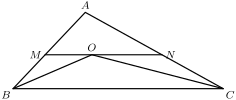
In the adjoining diagram, bisects bisects and is parallel to If and then the perimeter of is
Respuesta: A
Pista pequeña:
Como es el incentro, su distancia a es el inradio
Because is the incenter, its distance from is the inradius
Pista grande:
Compara la altura de con la altura de
Compare the altitude of with the altitude of
Solución:
Los lados tienen semiperímetro y área así que el inradio es Tomando como base, la altura es Por tanto, la razón de semejanza de a es Su perímetro es
Por lo tanto, la respuesta correcta es A.
The sides have semiperimeter and area so the inradius is Taking as base, the altitude is Thus the similarity scale from to is Its perimeter is
Therefore, the correct answer is A.
11.
¿Cuántos enteros de cuatro cifras distintas hay entre y tales que el valor absoluto de la diferencia entre la primera cifra y la última sea ?
How many integers with four different digits are there between and such that the absolute value of the difference between the first digit and the last digit is
Respuesta: C
Pista pequeña:
Cuenta primero los pares ordenados permitidos de primera y última cifra
First count the allowed ordered pairs of first and last digits
Pista grande:
Una vez fijadas esas cifras, elige dos cifras centrales distintas entre las ocho restantes
Once those digits are fixed, choose two distinct middle digits from the remaining eight
Solución:
Para las primeras cifras la cantidad de últimas cifras posibles que difieren en es más es decir, Además, un número cuya primera cifra es puede terminar en lo que da pares de cifras extremas. Las cifras centrales se pueden elegir entonces de maneras ordenadas. Por tanto, la cantidad es
Por lo tanto, la respuesta correcta es C.
For leading digits the number of possible last digits differing by is plus or In addition, leading digit may end in giving endpoint pairs. The middle digits can then be chosen in ordered ways. Thus the count is
Therefore, the correct answer is C.
12.
Sea donde y son constantes. Si entonces es igual a
Let where and are constants. If then equals
no se puede determinar de manera única
not uniquely determined
Respuesta: A
Pista pequeña:
Separa el término constante de los términos de potencia impar
Separate the constant term from the odd-powered terms
Pista grande:
Si compara con
If compare and
Solución:
Sea que es una función impar. Como se tiene Por lo tanto, y
Por lo tanto, la respuesta correcta es A.
Let which is odd. Since Therefore and
Therefore, the correct answer is A.
13.
Si y entonces es igual a
If and then equals
Pista pequeña:
Sea de modo que
Let so
Pista grande:
Reescribe como
Rewrite as
Solución:
Sea de modo que y Entonces que es igual a Por lo tanto,
Por lo tanto, la respuesta correcta es D.
Set so and Then which equals Therefore
Therefore, the correct answer is D.
14.
En la figura adjunta, los puntos y están en el segmento y y son los diámetros de los círculos y respectivamente. Los círculos y tienen radio y la recta es tangente al círculo en Si corta al círculo en los puntos y entonces la longitud de la cuerda es
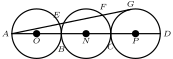
In the adjoining figure, points and lie on line segment and and are diameters of circles and respectively. Circles and all have radius and the line is tangent to circle at If intersects circle at points and then chord has length
ninguna de las anteriores
none of these
Respuesta: C
Pista pequeña:
Usa el triángulo rectángulo para hallar la distancia de a la recta
Use right triangle to find the distance from to line
Pista grande:
Una cuerda a distancia del centro de un círculo tiene longitud
A chord at distance from a circle’s center has length
Solución:
Aquí y La distancia de a varía en la proporción por lo que es Por lo tanto, la cuerda del círculo de radio tiene longitud
Por lo tanto, la respuesta correcta es C.
Here and The distance from to scales with so it is Therefore the chord in the radius- circle has length
Therefore, the correct answer is C.
15.
Sea el mayor entero que no excede a Sean y soluciones del sistema Si no es un entero, entonces es
Let denote the greatest integer not exceeding Let and satisfy the simultaneous equations If is not an integer, then is
un entero
an integer
un número entre y
between and
un número entre y
between and
un número entre y
between and
Respuesta: D
Pista pequeña:
Para no entero, relaciona con
For nonintegral relate to
Pista grande:
Sea e iguala las dos fórmulas de
Let and equate the two formulas for
Solución:
Para no entero, sea entonces Por tanto, de donde y Como se tiene
Por lo tanto, la respuesta correcta es D.
For nonintegral let then Thus so and Since we have
Therefore, the correct answer is D.
16.
En la figura adjunta, un cubo de madera tiene aristas de metros. En cada cara se abre un agujero cuadrado de un metro de lado, centrado en ella, que atraviesa el cubo hasta la cara opuesta. Los lados de los agujeros son paralelos a las aristas del cubo. El área total de la superficie, incluido el interior de los agujeros, en metros cuadrados, es

In the adjoining figure, a wooden cube has edges of length meters. Square holes of side one meter, centered in each face, are cut through to the opposite face. The edges of the holes are parallel to the edges of the cube. The entire surface area including the inside, in square meters, is
Respuesta: B
Pista pequeña:
Empieza con las caras exteriores después de quitar sus cuadrados centrales
Start with the outer faces after removing their central squares
Pista grande:
Para cada uno de los tres túneles, calcula la parte de sus cuatro paredes interiores que no eliminan los túneles perpendiculares
For each of the three tunnels, count the four interior walls not removed by the crossing tunnels
Solución:
Las seis caras exteriores aportan Cada uno de los tres túneles cuadrados de longitud tiene cuatro paredes interiores, pero un túnel perpendicular quita la franja central de ancho unitario de cada pared, de modo que queda un área de por pared. Así, el interior aporta El total es
Por lo tanto, la respuesta correcta es B.
The six outer faces contribute Each of the three length- square tunnels has four inner walls, but the central unit segment of every wall is removed by a perpendicular tunnel, leaving area per wall. Thus the inside contributes The total is
Therefore, the correct answer is B.
17.
¿Cuántos números reales satisfacen la ecuación ?
How many real numbers satisfy the equation
Respuesta: C
Pista pequeña:
Sustituye teniendo en cuenta que
Substitute noting that
Pista grande:
La ecuación se convierte en una cuadrática en
The equation becomes a quadratic in
Solución:
Sea Entonces cuyas raíces son y Ambas son positivas y cada una corresponde a un único número real así que hay soluciones.
Por lo tanto, la respuesta correcta es C.
Let Then whose roots are and Both are positive and each corresponds to one real so there are solutions.
Therefore, the correct answer is C.
18.
En la figura adjunta de un ortoedro, y Halla el coseno de
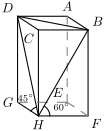
In the adjoining figure of a rectangular solid, and Find the cosine of
Respuesta: D
Pista pequeña:
Asigna coordenadas con origen en a lo largo de las tres aristas mutuamente perpendiculares
Assign coordinates at along the three mutually perpendicular edges
Pista grande:
Convierte los dos ángulos dados en relaciones entre las tres longitudes de arista y luego usa un producto escalar
Translate the two given angles into relationships among the three edge lengths, then use a dot product
Solución:
Sean y Entonces y La condición de da mientras que la condición de da Por consiguiente,
Por lo tanto, la respuesta correcta es D.
Let and Then and The condition gives while the condition gives Hence
Therefore, the correct answer is D.
19.
Sea para La suma de los valores máximo y mínimo de es
Let for The sum of the largest and smallest values of is
ninguna de las anteriores
none of these
Respuesta: B
Pista pequeña:
Divide el intervalo en los ceros y
Break the interval at the zeros and
Pista grande:
Simplifica en cada intervalo resultante
Simplify on each resulting interval
Solución:
En se tiene en se tiene y en se tiene Así, el mínimo es y el máximo es cuya suma es
Por lo tanto, la respuesta correcta es B.
On on and on Thus the minimum is and the maximum is whose sum is
Therefore, the correct answer is B.
20.
La cantidad de pares de enteros positivos que satisfacen la ecuación es
The number of pairs of positive integers which satisfy the equation is
infinita
not finite
ninguna de las anteriores
none of these
Respuesta: D
Pista pequeña:
Reordena la ecuación como
Rearrange as
Pista grande:
Elige como un cuadrado perfecto
Choose to be a perfect square
Solución:
Para cada entero positivo toma y Entonces por lo que Esto produce infinitos pares de enteros positivos.
Por lo tanto, la respuesta correcta es D.
For every positive integer take and Then so This supplies infinitely many positive-integer pairs.
Therefore, the correct answer is D.
21.
En la figura adjunta, el triángulo es rectángulo con La mediana es perpendicular a la mediana y el lado La longitud de es
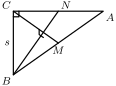
In the adjoining figure, the triangle is a right triangle with Median is perpendicular to median and side The length of is
Respuesta: E
Pista pequeña:
Sitúa y
Place and
Pista grande:
Usa un producto escalar con las direcciones de las dos medianas
Use a dot product for the directions of the two medians
Solución:
Fija y Entonces y La perpendicularidad da y por tanto Así,
Por lo tanto, la respuesta correcta es E.
Set and Then and Perpendicularity gives hence Therefore
Therefore, the correct answer is E.
22.
En un callejón estrecho de ancho se coloca una escalera de longitud con el pie en un punto entre las paredes. Al apoyarla contra una pared en a una altura sobre el suelo, la escalera forma un ángulo de con el suelo. Al apoyarla contra la otra pared en a una altura sobre el suelo, forma un ángulo de con el suelo. El ancho es igual a

In a narrow alley of width a ladder of length is placed with its foot at a point between the walls. Resting against one wall at a distance above the ground, the ladder makes a angle with the ground. Resting against the other wall at a distance above the ground, the ladder makes a angle with the ground. The width is equal to
Respuesta: E
Pista pequeña:
Expresa mediante cosenos los dos tramos horizontales del callejón
Express the two horizontal portions of the alley using cosines
Pista grande:
Compara con
Compare with
Solución:
Las distancias horizontales de a las paredes son y así que La identidad de suma a producto da Como se tiene
Por lo tanto, la respuesta correcta es E.
The horizontal distances from to the walls are and so The sum-to-product identity gives Since
Therefore, the correct answer is E.
23.
Las longitudes de los lados de un triángulo son enteros consecutivos, y el ángulo mayor es el doble del ángulo menor. El coseno del ángulo menor es
The lengths of the sides of a triangle are consecutive integers, and the largest angle is twice the smallest angle. The cosine of the smallest angle is
ninguna de las anteriores
none of these
Respuesta: A
Pista pequeña:
Sean el ángulo menor y el mayor y , respectivamente
Let the smallest and largest angles be and
Pista grande:
Usa la ley de los senos para comparar el lado más corto con el más largo
Use the law of sines to compare the shortest and longest consecutive sides
Solución:
Sean los lados consecutivos opuestos a los ángulos Por la ley de los senos, La ley de los cosenos aplicada al ángulo menor también da Al igualar estas expresiones se obtiene por lo que Así, los lados son y
Por lo tanto, la respuesta correcta es A.
Let the consecutive sides be opposite angles By the law of sines, The law of cosines at the smallest angle also gives Equating these expressions yields so Hence the sides are and
Therefore, the correct answer is A.
24.
En la figura adjunta, el círculo corta los lados de un triángulo equilátero en seis puntos. Si y entonces es igual a
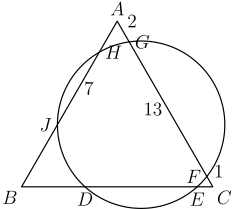
In the adjoining figure, the circle meets the sides of an equilateral triangle at six points. If and then equals
Respuesta: A
Pista pequeña:
Los tres lados del triángulo tienen longitud
All three sides of the triangle have length
Pista grande:
Aplica la potencia de un punto desde y para relacionar los dos segmentos de la base con
Apply power of a point from and to relate the two base segments and
Solución:
Primero, la potencia de da Este último producto es así que y Sean A partir de las secantes desde y Además, Al restar las ecuaciones de potencia y usar la suma se obtiene Por tanto, y Sustituir en da así que
Por lo tanto, la respuesta correcta es A.
First, power of gives The latter product is so and Let From the secants at and Also Subtracting the power equations and using the sum gives Hence and Substitution into gives so
Therefore, the correct answer is A.
25.
La figura adjunta es un mapa de una parte de una ciudad: los rectángulos pequeños son manzanas y los espacios entre ellos son calles. Cada mañana, un estudiante camina desde la intersección hasta la intersección siempre por las calles indicadas y siempre hacia el este o hacia el sur. Para variar, en cada intersección donde puede elegir, decide con probabilidad , independientemente de todas las demás decisiones, si va hacia el este o hacia el sur. Halla la probabilidad de que, en una mañana cualquiera, pase por la intersección
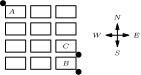
The adjoining figure is a map of part of a city: the small rectangles are blocks and the spaces in between are streets. Each morning a student walks from intersection to intersection always walking along streets shown, always going east or south. For variety, at each intersection where he has a choice, he chooses with probability (independent of all other choices) whether to go east or south. Find the probability that, on any given morning, he walks through intersection
Respuesta: D
Pista pequeña:
Llegar a significa dar el tercer paso hacia el este antes del cuarto paso hacia el sur
Reaching means making the third eastward move before the fourth southward move
Pista grande:
Clasifica según la cantidad de pasos hacia el sur dados antes del tercer paso hacia el este
Condition on the number of south moves made before the third east move
Solución:
Si se dan pasos hacia el sur antes del tercer paso hacia el este, el último paso para llegar a va hacia el este y los pasos anteriores contienen dos pasos hacia el este. Por tanto,
Por lo tanto, la respuesta correcta es D.
If south moves occur before the third east move, the final step to is east and the preceding steps contain two east moves. Thus
Therefore, the correct answer is D.
26.
Si la representación en base de un cuadrado perfecto es donde entonces es
If the base representation of a perfect square is where then is
no se puede determinar de manera única
not uniquely determined
Respuesta: B
Pista pequeña:
Módulo solo importan las dos últimas cifras en base
Only the last two base- digits matter modulo
Pista grande:
Enumera los residuos cuadráticos módulo que están entre y
List the quadratic residues modulo that lie between and
Solución:
Las dos últimas cifras octales representan Entre , el único cuadrado módulo es Por tanto, así que
Por lo tanto, la respuesta correcta es B.
The last two octal digits represent Squares modulo in the range include only Thus so
Therefore, the correct answer is B.
27.
Supón que es una solución de la ecuación polinómica donde y son constantes reales e ¿Cuál de las siguientes expresiones también debe ser una solución?
Suppose is a solution of the polynomial equation where and are real constants and Which one of the following must also be a solution?
ninguna de las anteriores
none of these
Respuesta: C
Pista pequeña:
Conjuga toda la ecuación
Conjugate the entire equation
Pista grande:
Compara la ecuación conjugada en con el polinomio original evaluado en
Compare the conjugated equation at with the original polynomial evaluated at
Solución:
Al conjugar la ecuación, cada cambia a y cambia a Como los términos de potencia impar también cambian de signo al negar la variable, esta ecuación conjugada es precisamente el polinomio original evaluado en Por tanto, debe ser una raíz.
Por lo tanto, la respuesta correcta es C.
Conjugating the equation changes each to and to Because the odd-powered terms also change sign when the input is negated, this conjugated equation is precisely the original polynomial evaluated at Thus must be a root.
Therefore, the correct answer is C.
28.
Se escribe en una pizarra un conjunto de enteros positivos consecutivos que comienza con Se borra uno de los números. El promedio, o media aritmética, de los números restantes es ¿Qué número se borró?
A set of consecutive positive integers beginning with is written on a blackboard. One number is erased. The average (arithmetic mean) of the remaining numbers is What number was erased?
no se puede determinar
can not be determined
Respuesta: B
Pista pequeña:
Si el último número escrito es quedan números
If the last written number is the remaining count is
Pista grande:
Usa las cotas para el valor borrado a fin de reducir los posibles valores de
Use the bounds on the erased value to narrow the possible values of
Solución:
El nuevo promedio es menor que el promedio original , pero difiere de él en menos de lo que obliga a que o Como la suma restante debe ser entera, es divisible por así que El número borrado es
Por lo tanto, la respuesta correcta es B.
The new average is below the original average but differs from it by less than forcing or Since the remaining sum must be integral, is divisible by so The erased number is
Therefore, the correct answer is B.
29.
Sean y tres números reales positivos cuya suma es Si ninguno de ellos es mayor que el doble de otro, entonces el valor mínimo posible del producto es
Let and be three positive real numbers whose sum is If no one of these numbers is more than twice any other, then the minimum possible value of the product is
ninguna de las anteriores
none of these
Respuesta: A
Pista pequeña:
Ordena las variables como ; entonces la restricción activa es
Order the variables ; then the active constraint is
Pista grande:
El mínimo se alcanza en la frontera donde
A minimum occurs on the boundary where
Solución:
Ordena En el mínimo, la separación entre las variables es máxima, así que y El orden exige Por tanto, Su único punto crítico interior es un máximo, de modo que comparamos los extremos: los valores son y respectivamente. El mínimo es
Por lo tanto, la respuesta correcta es A.
Order At a minimum the spread is maximal, so and The ordering requires Thus Its only interior critical point is a maximum, so compare endpoints: the values are and respectively. The minimum is
Therefore, the correct answer is A.
30.
Halla la cifra de las unidades en la expansión decimal de
Find the units digit in the decimal expansion of
ninguna de las anteriores
none of these
Respuesta: D
Pista pequeña:
Empareja con su conjugado
Pair with its conjugate
Pista grande:
Los enteros satisfacen una recurrencia breve, mientras que
The integers satisfy a short recurrence, while
Solución:
Sean y de modo que Los enteros satisfacen por lo que para todo Por tanto, es un múltiplo de menos un número positivo menor que Así, su parte entera termina en
Por lo tanto, la respuesta correcta es D.
Let and so The integers satisfy hence for every Therefore is a multiple of minus a positive number less than Its integer part therefore ends in
Therefore, the correct answer is D.