
Problemas del 2024 AMC 10B
¡Desplázate hacia abajo y presiona Iniciar para intentar el examen! O ve al PDF imprimible, la clave de respuestas, o las soluciones profesionales preparadas por LIVE by Po-Shen Loh.
Todos los problemas se usan con el permiso legal oficial de la Mathematical Association of America (MAA).
O salta directamente a un solo problema con su solución: 1 · 2 · 3 · 4 · 5 · 6 · 7 · 8 · 9 · 10 · 11 · 12 · 13 · 14 · 15 · 16 · 17 · 18 · 19 · 20 · 21 · 22 · 23 · 24 · 25
¿Quieres aprender de forma profesional con clases interactivas en video?
Con tiempo
1:15:00
1.
En una larga fila de personas, la ª persona desde la izquierda es también la ª persona desde la derecha. ¿Cuántas personas hay en la fila?
In a long line of people arranged left to right, the th person from the left is also the th person from the right. How many people are in the line?
Respuesta: B
Pista pequeña:
Hay personas a la izquierda de esta persona y a la derecha.
There are people to the left of this person and to the right
Pista grande:
Suma los dos conteos, pero no cuentes a esta persona dos veces.
Add the two counts, but do not count this one person twice
Solución:
Hay personas a la izquierda de este lugar y a la derecha. Suma esos dos grupos más la propia persona: O, igual de rápido, las dos posiciones se solapan en una persona, así que Por lo tanto, B es la respuesta correcta.
There are people to the left of this spot and to the right. Add those two groups plus the person themselves: Or, just as fast, the two positions overlap on one person, so Thus, B is the correct answer.
2.
¿Cuánto vale ?
What is
Respuesta: B
Pista pequeña:
Escribe .
Write
Pista grande:
Observa que es igual a .
Notice that equals
Solución:
Escribe Pero también , así que Los dos términos son iguales. Eso hace que Por lo tanto, la respuesta es B.
Write But too, so The two terms are the same. That makes Therefore, the answer is B.
3.
¿Para cuántos valores enteros de se cumple ?
For how many integer values of is
Respuesta: E
Pista pequeña:
Divide entre : la desigualdad es .
Divide by : the inequality is
Pista grande:
así que recorre los enteros con .
so ranges over the integers with
Solución:
Divide entre para obtener Los enteros que sirven van desde hasta y hay de ellos. Por lo tanto, E es la respuesta correcta.
Divide by to get The integers that fit run from up to and there are of them. Thus, E is the correct answer.
4.
Las bolas numeradas se colocan en recipientes, etiquetados y mediante el siguiente procedimiento. La bola se coloca en y las bolas y en Las siguientes bolas se colocan en las siguientes en y así sucesivamente, volviendo a después de colocar bolas en (Por ejemplo, las bolas se colocan en en el paso .) ¿En qué recipiente se coloca la bola ?
Balls numbered are deposited in bins, labeled and using the following procedure. Ball is deposited in bin and balls and are deposited in bin The next balls are deposited in bin the next in bin and so on, cycling back to bin after balls are deposited in bin (For example, balls numbered are deposited in bin at step of this process.) In which bin is ball deposited?
Respuesta: D
Pista pequeña:
El grupo tiene bolas, así que los grupos hasta usan bolas.
Group has balls, so groups through use balls
Pista grande:
Encuentra el grupo que contiene la bola luego lee su caja a partir de con el grupo correspondiendo a .
Find the group containing ball then read its bin from with group corresponding to
Solución:
El grupo contiene bolas, así que los primeros grupos consumen de ellas. Ahora y lo que coloca la bola en el grupo (bolas hasta ). Las cajas se repiten en el ciclo así que el grupo cae en la caja número Para eso es la caja Por lo tanto, la respuesta es D.
Group holds balls, so the first groups swallow of them. Now and which puts ball in group (balls through ). The bins cycle so group lands in bin number For that’s bin Therefore, the answer is D.
5.
En la siguiente expresión, Melanie cambió algunos de los signos más por signos menos:
Cuando se evaluó la nueva expresión, resultó negativa. ¿Cuál es el menor número de signos más que Melanie pudo haber cambiado por signos menos?
In the following expression, Melanie changed some of the plus signs to minus signs:
When the new expression was evaluated, it was negative. What is the least number of plus signs that Melanie could have changed to minus signs?
Respuesta: B
Pista pequeña:
La suma completa es cambiar el signo de un término reduce la suma en .
The full sum is flipping a term lowers the sum by
Pista grande:
Para bajar de con la menor cantidad de cambios, cambia los términos más grandes; su total duplicado debe superar .
To go below with the fewest flips, flip the largest terms; their doubled total must exceed
Solución:
La suma completa es Cambiar el signo de un término baja el total en así que para volverse negativo los términos cambiados deben sumar más de La jugada codiciosa es cambiar los números impares más grandes: cambiar los mayores da Queremos En es solo pero en salta a Así que cambios lo logran. Por lo tanto, B es la respuesta correcta.
The full sum is Flipping a term drops the total by so to go negative the flipped terms have to add up to more than The greedy move is to flip the biggest odd numbers: flipping the top gives We want At it’s only but at it jumps to So flips do it. Thus, B is the correct answer.
6.
Un rectángulo tiene lados de longitud entera y un área de ¿Cuál es el menor perímetro posible del rectángulo?
A rectangle has integer side lengths and an area of What is the least possible perimeter of the rectangle?
Respuesta: B
Pista pequeña:
Para un área fija, el perímetro es mínimo cuando los dos lados son lo más cercanos posible a ser iguales.
For a fixed area, the perimeter is smallest when the two sides are as close to equal as possible
Pista grande:
busca un par de factores cerca de .
look for a factor pair near
Solución:
El perímetro con es mínimo cuando y están lo más cerca posible entre sí. Factoriza El par de divisores más cercano a es que da un perímetro de Por lo tanto, la respuesta es B.
The perimeter with is smallest when and are as close together as possible. Factor The divisor pair nearest is which gives perimeter Therefore, the answer is B.
7.
¿Cuál es el residuo cuando se divide entre ?
What is the remainder when is divided by
Respuesta: A
Pista pequeña:
Factoriza sacando .
Factor out
Pista grande:
El factor restante es revisa su relación con .
The remaining factor is check its relationship to
Solución:
Saca la potencia común: Y así que el producto es un múltiplo de El residuo es Por lo tanto, A es la respuesta correcta.
Pull out the common power: And so the product is a multiple of The remainder is Thus, A is the correct answer.
8.
Sea el producto de todos los divisores enteros positivos de ¿Cuál es el dígito de las unidades de ?
Let be the product of all the positive integer divisors of What is the units digit of
Respuesta: D
Pista pequeña:
Un número con divisores tiene un producto de divisores igual a sí mismo elevado a la potencia .
A number with divisors has divisor product equal to itself raised to the power
Pista grande:
tiene divisores, así que sigue solo el dígito de las unidades.
has divisors, so track only the units digit
Solución:
Como tiene divisores, podemos emparejar cada divisor con su complementario, así que Solo importa el dígito de las unidades, y termina en así que también. Por lo tanto, la respuesta es D.
Since has divisors, we can pair each divisor with its complement, so Only the units digit matters, and ends in so does too. Therefore, the answer is D.
9.
Los números reales y tienen media aritmética La media aritmética de y es ¿Cuál es la media aritmética de y ?
Real numbers and have arithmetic mean The arithmetic mean of and is What is the arithmetic mean of and
Respuesta: A
Pista pequeña:
Media significa media significa .
Mean means mean means
Pista grande:
Usa .
Use
Solución:
Las medias nos dicen que y Eleva al cuadrado la primera: así que y Su media es Por lo tanto, A es la respuesta correcta.
The means tell us and Square the first: so and Their mean is Thus, A is the correct answer.
10.
El cuadrilátero es un paralelogramo, y es el punto medio del lado Sea la intersección de las rectas y ¿Cuál es la razón entre el área del cuadrilátero y el área del triángulo ?
Quadrilateral is a parallelogram, and is the midpoint of the side Let be the intersection of lines and What is the ratio of the area of quadrilateral to the area of triangle
Respuesta: A
Pista pequeña:
Las razones de áreas no cambian bajo una transformación afín, así que calcula con .
Area ratios are unchanged by an affine map, so compute with
Pista grande:
Encuentra como la intersección de la recta con la recta luego usa la fórmula del cordón de zapato.
Find as the intersection of line with line then use the shoelace formula
Solución:
Las razones de áreas no cambian bajo una transformación afín, así que coloca coordenadas convenientes: lo que hace La recta es y la recta va desde hasta se cruzan en La fórmula del cordón de zapato da al cuadrilátero un área de y al triángulo un área de Así que la razón es Por lo tanto, la respuesta es A.
Area ratios don’t change under an affine map, so drop in convenient coordinates: which makes Line is and line runs from to they cross at The shoelace formula gives quadrilateral area and triangle area So the ratio is Therefore, the answer is A.
11.
En la figura de abajo, es un rectángulo con y El punto está sobre el punto está sobre y es un ángulo recto. Las áreas de y son iguales. ¿Cuál es el área de ?
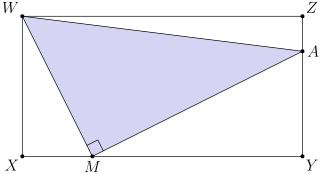
In the figure below is a rectangle with and Point lies on point lies on and is a right angle. The areas of and are equal. What is the area of
Respuesta: C
Pista pequeña:
Coloca con y .
Set with and
Pista grande:
La perpendicularidad da las áreas iguales dan .
Perpendicularity gives equal areas give
Solución:
Coloca así que y El ángulo recto significa que lo que da es decir Las áreas iguales y obligan a así que Sustituyendo de vuelta, Tomando queda y Entonces Por lo tanto, C es la respuesta correcta.
Set so and The right angle means which gives that is Equal areas and force so Substitute back and Taking leaves and Then Thus, C is the correct answer.
12.
Un grupo de estudiantes de diferentes países se reúne en una competencia de matemáticas. Cada estudiante habla el mismo número de idiomas y, para cada par de estudiantes y el estudiante habla algún idioma que el estudiante no habla, y el estudiante habla algún idioma que el estudiante no habla. ¿Cuál es el menor número total posible de idiomas hablados por todos los estudiantes?
A group of students from different countries meet at a mathematics competition. Each student speaks the same number of languages, and, for every pair of students and student speaks some language that student does not speak, and student speaks some language that student does not speak. What is the least possible total number of languages spoken by all the students?
Respuesta: A
Pista pequeña:
Asigna a cada estudiante el conjunto de idiomas que habla; la condición significa que ningún conjunto contiene a otro.
Give each student the set of languages they speak; the condition means no set contains another
Pista grande:
Conjuntos distintos del mismo tamaño nunca se contienen entre sí, así que necesitas para algún .
Equal-size distinct sets never contain one another, so you need for some
Solución:
Asigna a cada estudiante el conjunto de idiomas que habla. La condición dice que el conjunto de nadie está contenido en el de otro. Todos hablan el mismo número de idiomas, y dos conjuntos distintos de elementos nunca pueden contenerse mutuamente, así que todo lo que necesitamos son subconjuntos de elementos distintos de los idiomas, es decir Con lo mejor que logramos es por debajo de Pero Así que idiomas son a la vez suficientes y necesarios. Por lo tanto, la respuesta es A.
Give each student the set of languages they speak. The condition says no one’s set sits inside another’s. Everyone speaks the same number of languages, and two distinct -element sets can never contain each other, so all we need is different -subsets of the languages, i.e. With the best we can manage is short of But So languages are both enough and necessary. Therefore, the answer is A.
13.
Los enteros positivos e satisfacen la ecuación ¿Cuál es el valor mínimo posible de ?
Positive integers and satisfy the equation What is the minimum possible value of
Respuesta: B
Pista pequeña:
así que .
so
Pista grande:
Entonces y con minimiza .
Then and with minimize
Solución:
Como tenemos Al elevar al cuadrado la ecuación dada, se ve que es racional. Por tanto, y tienen la misma parte libre de cuadrados: escribimos y donde es libre de cuadrados y son enteros positivos. Entonces así que y Por consiguiente, que es mínimo cuando y son lo más cercanos posible. Tomando y , obtenemos Así, B es la respuesta correcta.
Since we have Squaring the given equation shows that is rational. Thus and have the same squarefree part: write and where is squarefree and are positive integers. Then so and Therefore which is smallest when and are as close as possible. Taking and gives Thus, B is the correct answer.
14.
Un tablero de dardos es la región en el plano coordenado que consiste en los puntos tales que Un objetivo es la región donde Se lanza un dardo a un punto aleatorio en La probabilidad de que el dardo caiga en se puede expresar como donde y son enteros positivos primos entre sí. ¿Cuánto vale ?
A dartboard is the region in the coordinate plane consisting of points such that A target is the region where A dart is thrown and lands at a random point in The probability that the dart lands in can be expressed as where and are relatively prime positive integers. What is
Respuesta: B
Pista pequeña:
es un cuadrado de diagonal y es el anillo .
is a square of diagonal and is the annulus
Pista grande:
El radio exterior es igual a la distancia del origen a cada lado de así que está completamente dentro de .
The outer radius equals the distance from the origin to each edge of so sits entirely inside
Solución:
es el cuadrado con área La condición del objetivo se convierte en es decir un anillo de área ¿Cabe dentro de ? La distancia del origen a un lado es exactamente el radio exterior, así que sí, el anillo está dentro del cuadrado. La probabilidad es lo que da Por lo tanto, la respuesta es B.
is the square with area The target condition unpacks to that is an annulus of area Does it fit inside The distance from the origin to an edge is exactly the outer radius, so yes, the annulus sits inside the square. The probability is giving Therefore, the answer is B.
15.
Una lista de números reales consiste en así como con El rango de la lista es y la media y la mediana son ambas enteros positivos. ¿Cuántas ternas ordenadas son posibles?
A list of real numbers consists of as well as with The range of the list is and the mean and median are both positive integers. How many ordered triples are possible?
infinitas
infinitely many
Respuesta: C
Pista pequeña:
Los seis números dados suman así que debe hacer que el total sea un múltiplo de .
The six given numbers sum to so must make the total a multiple of
Pista grande:
El rango fija los valores mínimo y máximo; luego exige que el º número más pequeño sea un entero positivo.
Range fixes the smallest and largest values; then require the th smallest number to be a positive integer
Solución:
Los seis números fijos suman Si la media es el entero entonces Como las entradas fijas ya abarcan de a la condición sobre el rango produce tres casos.
Si entonces Las cotas de obligan a que o Para la mediana es para tenemos así que , y la mediana es entera solo cuando lo que da
Si entonces En este caso, da mediana Para tenemos la mediana es entera solo cuando lo que da
En el caso restante, y El total está entre y así que y La mediana solo puede ser entera cuando lo que da Por tanto, funcionan exactamente ternas ordenadas. Así, C es la respuesta correcta.
The six fixed numbers total If the mean is the integer then Because the fixed entries already run from to the range condition gives three cases.
If then The bounds on force or For the median is for we have so and the median is integral only when giving
If then Here gives median For we have the median is integral only when giving
The remaining case has and The total lies between and so and The median can be an integer only when giving Hence exactly ordered triples work. Thus, C is the correct answer.
16.
A Jerry le gusta jugar con números. Un día, escribió todos los enteros desde hasta en la pizarra. Luego, repetidamente eligió cuatro números en la pizarra, los borró y los reemplazó por su suma o su producto. (Por ejemplo, el primer paso de Jerry pudo haber sido borrar y y luego escribir en la pizarra o bien su suma, o bien su producto.) Después de realizar repetidamente esta operación, Jerry notó que todos los números que quedaban en la pizarra eran impares. ¿Cuál es el número máximo posible de enteros en la pizarra en ese momento?
Jerry likes to play with numbers. One day, he wrote all the integers from to on the whiteboard. Then he repeatedly chose four numbers on the whiteboard, erased them, and replaced them by either their sum or their product. (For example, Jerry’s first step might have been to erase and and then write either their sum, or their product, on the whiteboard.) After repeatedly performing this operation, Jerry noticed that all the remaining numbers on the whiteboard were odd. What is the maximum possible number of integers on the whiteboard at that time?
Respuesta: A
Pista pequeña:
Cada movimiento convierte números en así que la cantidad disminuye en maximizar la cantidad significa minimizar los movimientos.
Each move turns numbers into so the count drops by maximizing the count means minimizing the moves
Pista grande:
Hay entradas pares, y cualquier movimiento disminuye su número a lo sumo en
There are even entries, and any move decreases their number by at most
Solución:
Entre hay números pares y impares. Cada operación sustituye entradas por así que el número total de entradas disminuye en Si una operación consume entradas pares, su resultado es impar, y el número de pares disminuye en o el resultado es par, y el número de pares disminuye en En ambos casos, el número de pares disminuye como máximo en Por tanto, eliminar las entradas pares requiere al menos operaciones. Esta cota se alcanza: usamos sumas formadas por un impar y tres pares, y luego una suma formada por tres impares y el último par. Todos los resultados son impares. Así, el máximo número de entradas restantes es Por lo tanto, la respuesta es A.
Among there are even numbers and odd numbers. Each operation replaces entries by so the total count falls by If a move consumes even entries, its output is either odd, reducing the even count by or even, reducing it by In either case the even count falls by at most Therefore eliminating all even entries takes at least moves. This is achievable: use sums containing one odd and three evens, then one sum containing three odds and the final even. Every output is odd. Thus the maximum remaining count is Therefore, the answer is A.
17.
En una carrera entre caracoles, hay a lo sumo un empate, pero ese empate puede involucrar cualquier número de caracoles. Por ejemplo, el resultado de la carrera podría ser que Dazzler es primero; Abby, Cyrus y Elroy empatan en el segundo lugar, y Bruna es quinta. ¿Cuántos resultados diferentes de la carrera son posibles?
In a race among snails, there is at most one tie, but that tie can involve any number of snails. For example, the result of the race might be that Dazzler is first; Abby, Cyrus, and Elroy are tied for second; and Bruna is fifth. How many different results of the race are possible?
Respuesta: D
Pista pequeña:
Cuenta por separado los resultados sin empate de los resultados con exactamente un grupo empatado.
Count results with no tie separately from results with exactly one tied group
Pista grande:
Para un grupo empatado de caracoles, elígelos de maneras y ordena los bloques resultantes de maneras.
For a tied group of snails, choose them in ways and order the resulting blocks in ways
Solución:
Si nadie empata, los caracoles terminan en órdenes. Ahora permite exactamente un grupo empatado de tamaño con Elige el grupo de maneras, luego trátalo como un bloque, dejando bloques para ordenar de maneras. Sumando sobre Suma el conteo sin empate: Por lo tanto, D es la respuesta correcta.
If nobody ties, the snails finish in orders. Now allow exactly one tied group of size with Choose the group in ways, then treat it as one block, leaving blocks to arrange in ways. Summing over Add the no-tie count: Thus, D is the correct answer.
18.
¿Cuántos residuos diferentes pueden resultar cuando la ª potencia de un entero se divide entre ?
How many different remainders can result when the th power of an integer is divided by
Respuesta: B
Pista pequeña:
y divide en coprimo con y divisible entre .
and split into coprime to and divisible by
Pista grande:
Si entonces si es divisible por entonces es divisible por .
If then if is divisible by then is divisible by
Solución:
Aquí y Si el teorema de Euler da Y si es divisible por entonces lleva un factor de por tanto de así que Eso deja solo dos residuos posibles, y Por lo tanto, la respuesta es B.
Here and If Euler’s theorem gives And if is divisible by then carries a factor of hence of so That leaves only two possible remainders, and Therefore, the answer is B.
19.
En la siguiente tabla, cada signo de interrogación debe reemplazarse por “Posible” o “No posible” para indicar si una recta no vertical con la pendiente dada puede contener el número dado de puntos reticulares (puntos cuyas dos coordenadas son enteras). ¿Cuántas de las casillas serán “Posible”?

In the following table, each question mark is to be replaced by “Possible” or “Not Possible” to indicate whether a nonvertical line with the given slope can contain the given number of lattice points (points both of whose coordinates are integers). How many of the entries will be “Possible”?
Respuesta: C
Pista pequeña:
Dos puntos reticulares en una recta obligan a que su pendiente sea racional; así que una pendiente irracional permite a lo sumo un punto reticular.
Two lattice points on a line force its slope to be rational; so an irrational slope allows at most one lattice point
Pista grande:
Una recta de pendiente racional que pasa por un punto reticular pasa por infinitos, así que tiene o bien o bien infinitos.
A rational-slope line through one lattice point passes through infinitely many, so it has either or infinitely many
Solución:
Dos puntos reticulares cualesquiera dan una pendiente racional. Así que una recta con pendiente irracional contiene a lo sumo un punto reticular: puede tener (digamos ) o exactamente (digamos ), nunca dos. Una recta con pendiente racional (incluido el cero) que pasa por un punto reticular también pasa por para su pendiente reducida así que toca infinitos; tal recta tiene o bien puntos reticulares (desplázala con una ordenada al origen irracional) o más de dos, nunca exactamente uno o dos. Así que cada fila da exactamente dos casillas “Posible”. Para pendiente racional cero y no cero esas son las columnas “cero” y “más de dos”; para pendiente irracional, las columnas “cero” y “exactamente uno”. Eso es en total. Por lo tanto, C es la respuesta correcta.
Any two lattice points give a rational slope. So a line with irrational slope holds at most one lattice point: it can have (say ) or exactly (say ), never two. A line with rational slope (zero included) through a lattice point also passes through for its reduced slope so it hits infinitely many; such a line has either lattice points (shift it by an irrational intercept) or more than two, never exactly one or two. So each row gives exactly two “Possible” entries. For zero and nonzero rational slope those are the “zero” and “more than two” columns; for irrational slope, the “zero” and “exactly one” columns. That’s in all. Thus, C is the correct answer.
20.
Tres pares de zapatos diferentes se colocan en una fila de modo que ningún zapato izquierdo esté junto a un zapato derecho de un par diferente. ¿De cuántas maneras se pueden alinear estos seis zapatos?
Three different pairs of shoes are placed in a row so that no left shoe is next to a right shoe from a different pair. In how many ways can these six shoes be lined up?
Respuesta: A
Pista pequeña:
La regla dice: dondequiera que un zapato izquierdo toque a un zapato derecho, deben ser compañeros del mismo par.
The rule says: wherever a left shoe touches a right shoe, they must be mates from the same pair
Pista grande:
Analiza según el patrón izquierda/derecha de los seis lugares; cada lugar donde el lado cambia fija un par.
Case on the left/right pattern of the six spots; each place where the side switches pins down one pair
Solución:
Siempre que una se encuentra con una en el patrón de lados, esos dos zapatos deben formar pareja. Por tanto, un bloque interior no puede tener longitud su único zapato tendría que emparejarse con ambos vecinos. Con tres y tres , los únicos patrones posibles son y Para cualquiera de los dos patrones con un solo cambio, elegimos el par en el cambio y ordenamos los zapatos restantes, obteniendo arreglos. Cada uno de los otros seis patrones tiene asignaciones de los tres pares a sus cambios. El total es Por lo tanto, la respuesta es A.
Wherever an meets an in the side pattern, those two shoes must be mates. Thus an interior run cannot have length its lone shoe would have to be the mate of both neighbors. With three ’s and three ’s, the only possible patterns are and For either one-switch pattern, choose the pair at the switch and order the remaining shoes, giving arrangements. Each of the other six patterns has assignments of the three pairs to its switches. Hence the total is Therefore, the answer is A.
21.
Dos tubos rectos (cilindros circulares), con radios y yacen paralelos y en contacto sobre un suelo plano. La figura de abajo muestra una vista frontal. ¿Cuál es la suma de los radios posibles de un tercer tubo paralelo que yace sobre el mismo suelo y en contacto con ambos?

Two straight pipes (circular cylinders), with radii and lie parallel and in contact on a flat floor. The figure below shows a head-on view. What is the sum of the possible radii of a third parallel pipe lying on the same floor and in contact with both?
Respuesta: C
Pista pequeña:
Para dos círculos de radios y apoyados en una recta y tocándose entre sí, sus puntos de contacto con el suelo están separados .
For two circles of radii and resting on a line and touching each other, their floor contact points are apart
Pista grande:
El punto de contacto del nuevo tubo está a del tubo grande y a del tubo pequeño; puede estar entre ellos o afuera.
The new pipe’s contact point is from the big pipe’s and from the small pipe’s; it can sit between them or outside
Solución:
Dos círculos de radios y apoyados en el suelo y tocándose entre sí tienen puntos de contacto separados por una distancia horizontal de . Así que los tubos de radio y radio tocan el suelo separados . Un tercer tubo de radio está a del punto de contacto del tubo grande y a del pequeño. Acomodado entre ellos, así que y Ubicado más allá del tubo pequeño, así que (Más allá del tubo grande no puede ocurrir.) La suma es Por lo tanto, C es la respuesta correcta.
Two circles of radii and resting on the floor and touching each other have contact points a horizontal distance apart. So the radius- and radius- pipes touch the floor apart. A third pipe of radius sits from the big pipe’s contact point and from the small pipe’s. Nestled between them, so and Sitting past the small pipe, so (Past the big pipe can’t happen.) The sum is Thus, C is the correct answer.
22.
personas serán divididas en comités indistinguibles de personas. Cada comité tendrá un presidente y un secretario. El número de maneras diferentes de hacer estas asignaciones se puede escribir como donde y son enteros positivos y no es divisible entre ¿Cuánto vale ?
A group of people will be partitioned into indistinguishable -person committees. Each committee will have one chairperson and one secretary. The number of different ways to make these assignments can be written as where and are positive integers and is not divisible by What is
Respuesta: A
Pista pequeña:
El número de maneras es el conteo de particiones por las elecciones de presidente/secretario por comité.
The number of ways is the partition count times chair/secretary choices per committee
Pista grande:
Cuenta los factores de en cada parte usando la fórmula de Legendre sobre y .
Count factors of in each piece using Legendre’s formula on and
Solución:
Divide personas en grupos indistinguibles de de maneras, luego cada comité elige un presidente y un secretario de maneras, un factor de Ahora cuenta los factores de En hay el denominador aporta y aporta El exponente es así que Por lo tanto, la respuesta es A.
Split people into indistinguishable groups of in ways, then each committee picks a chairperson and a secretary in ways, a factor of Now count factors of In there are the denominator contributes and contributes The exponent is so Therefore, the answer is A.
23.
Los números de Fibonacci se definen por y para ¿Cuánto vale
The Fibonacci numbers are defined by and for What is
Pista pequeña:
Cada término es usa la identidad donde es el número de Lucas.
Each term is use the identity where is the Lucas number
Pista grande:
La suma se convierte en las sumas de números de Lucas satisfacen .
The sum becomes sums of Lucas numbers satisfy
Solución:
Usa así que cada término el º número de Lucas. Eso reduce la suma a Con la identidad da Por lo tanto, B es la respuesta correcta.
Use so each term the th Lucas number. That collapses the sum to With the identity gives Thus, B is the correct answer.
24.
Sea
¿Cuántos de los valores y son enteros?
Let
How many of the values of and are integers?
Respuesta: E
Pista pequeña:
Sobre el denominador común .
Over the common denominator
Pista grande:
Revisa por separado para par e impar.
Check separately for even and odd
Solución:
Pon todo sobre Si es par, todo término de arriba es divisible entre Si es impar, entonces y así que el numerador es De cualquier forma es un entero, así que los valores son enteros. Por lo tanto, la respuesta es E.
Put everything over If is even, every term up top is divisible by If is odd, then and so the numerator is Either way is an integer, so all values are integers. Therefore, the answer is E.
25.
Cada uno de ladrillos (prismas rectangulares rectos) tiene dimensiones donde y son enteros positivos primos entre sí dos a dos. Estos ladrillos se disponen para formar un bloque , como se muestra a la izquierda abajo. Se introduce un º ladrillo con las mismas dimensiones, y estos ladrillos se reconfiguran en un bloque , mostrado a la derecha. El nuevo bloque es unidad más alto, unidad más ancho y unidad más profundo que el viejo. ¿Cuánto vale ?
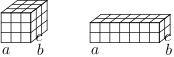
Each of bricks (right rectangular prisms) has dimensions where and are pairwise relatively prime positive integers. These bricks are arranged to form a block, as shown on the left below. A th brick with the same dimensions is introduced, and these bricks are reconfigured into a block, shown on the right. The new block is unit taller, unit wider, and unit deeper than the old one. What is
Respuesta: E
Pista pequeña:
El bloque viejo tiene longitudes de lado el bloque nuevo tiene longitudes de lado para alguna asignación de a .
The old block has side lengths the new block has side lengths for some assignment of to
Pista grande:
Renombra de modo que los lados nuevos sean ninguno de ellos puede ser igual al lado con la misma letra
Relabel so the new side lengths are no one of these can equal with the same letter
Solución:
Renombremos las dimensiones de los ladrillos de modo que el bloque nuevo tenga lados Estos deben ser los tres lados antiguos cada uno aumentado en Un lado nuevo no puede corresponder al lado antiguo con la misma letra: no tiene solución entera positiva, mientras que y darían longitudes negativas. Por lo tanto, la correspondencia debe ser uno de los dos ciclos de longitud tres. En una orientación, Las dos últimas ecuaciones dan y Al sustituir en la primera se obtiene de modo que El otro ciclo solo intercambia y Estas longitudes son coprimas dos a dos, y Así, E es la respuesta correcta.
Relabel the brick dimensions so the new block has sides These must be the three old side lengths each increased by A new side cannot match the old side with the same letter: has no positive integer solution, while and would give negative lengths. Therefore the matching must be one of the two three-cycles. In one orientation, The last two equations give and Substituting into the first gives so The other cycle merely exchanges and These lengths are pairwise relatively prime, and Thus, E is the correct answer.