
2008 AIME II 第 10 题
先试着解答 2008 AIME II 第 10 题,然后核对你的答案与精心整理的解答,解答来自 LIVE by Po-Shen Loh。你也可以参加完整限时模拟考试、查看全部 2008 AIME II 解答,或核对答案。
所有题目均经美国数学协会(MAA)官方合法授权使用。
10.
下图显示一个 的矩形点阵,每个点与其最近邻点相距 个单位。

定义一条增长路径为点阵中一列互不相同的点,并且序列中相邻两点之间的距离严格递增。令 为增长路径可能包含的最大点数,令 为恰好包含 个点的增长路径条数。求 。
The diagram below shows a rectangular array of points, each of which is unit away from its nearest neighbors.
Define a growing path to be a sequence of distinct points of the array with the property that the distance between consecutive points of the sequence is strictly increasing. Let be the maximum possible number of points in a growing path, and let be the number of growing paths consisting of exactly points. Find
小提示:
两个点阵点之间的距离平方为 ,其中 且不同时为零;这只有 个不同取值
The squared distance between two array points is with not both zero, which takes only distinct values
大提示:
从最长的一步开始反向构造最长路径:最后两个点必须是相对的角点,此后几乎每个更早的点都被迫确定
Build maximal paths backwards from the longest step: the last two points must be opposite corners, and nearly every earlier point is then forced
解答:
点阵中两点之间的距离平方为 ,其中 和 是坐标差,均属于 且不同时为零。可能的值为 ,只有 个值,所以增长路径最多有 个点;若有 个点,则必须按递增顺序使用全部九种距离。把这些点标为 ,使 且 。
只能由相对的角点实现,所以有 个有序选择 。接下来, 留下 种 的选择,即 的两个相邻点,它们关于主对角线对称。从这里开始,距离 会唯一决定 (对 ,另一个角点选择不可行,因为下一步需要的 会与 或 重合)。最后, 必须与 相距 ,而后者的邻点中有 个尚未使用。下面显示其中一条路径。
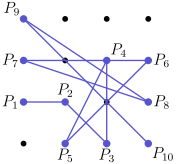
因此 ,,所以 。
The squared distance between two points of the array is where and are the coordinate differences, each in and not both zero. The possible values are — only values — so a growing path has at most points, and a path with points must use all nine distances in increasing order. Label its points so that and
Since is realized only by opposite corners, there are ordered choices of Next, leaves choices for the two neighbors of symmetric across the main diagonal. From there the distances force uniquely (for the alternative corner choice fails because the point needed next for would coincide with or ). Finally must be at distance from and of its neighbors are unused. One of the resulting paths is shown below.
Hence and so
其他年份的第 10 题
1983 AIME · 1984 AIME · 1985 AIME · 1986 AIME · 1987 AIME · 1988 AIME · 1989 AIME · 1990 AIME · 1991 AIME · 1992 AIME · 1993 AIME · 1994 AIME · 1995 AIME · 1996 AIME · 1997 AIME · 1998 AIME · 1999 AIME · 2000 AIME I · 2000 AIME II · 2001 AIME I · 2001 AIME II · 2002 AIME I · 2002 AIME II · 2003 AIME I · 2003 AIME II · 2004 AIME I · 2004 AIME II · 2005 AIME I · 2005 AIME II · 2006 AIME I · 2006 AIME II · 2007 AIME I · 2007 AIME II · 2008 AIME I · 2009 AIME I · 2009 AIME II · 2010 AIME I · 2010 AIME II · 2011 AIME I · 2011 AIME II · 2012 AIME I · 2012 AIME II · 2013 AIME I · 2013 AIME II · 2014 AIME I · 2014 AIME II · 2015 AIME I · 2015 AIME II · 2016 AIME I · 2016 AIME II · 2017 AIME I · 2017 AIME II · 2018 AIME I · 2018 AIME II · 2019 AIME I · 2019 AIME II · 2020 AIME I · 2020 AIME II · 2021 AIME I · 2021 AIME II · 2022 AIME I · 2022 AIME II · 2023 AIME I · 2023 AIME II · 2024 AIME I · 2024 AIME II · 2025 AIME I · 2025 AIME II · 2026 AIME I · 2026 AIME II