
Problemas del 2020 AMC 10B
¡Desplázate hacia abajo y presiona Iniciar para intentar el examen! O ve al PDF imprimible, la clave de respuestas, o las soluciones profesionales en video y soluciones escritas preparadas por LIVE by Po-Shen Loh.
Todos los problemas se usan con el permiso legal oficial de la Mathematical Association of America (MAA).
O salta directamente a un solo problema con su solución y video: 1 · 2 · 3 · 4 · 5 · 6 · 7 · 8 · 9 · 10 · 11 · 12 · 13 · 14 · 15 · 16 · 17 · 18 · 19 · 20 · 21 · 22 · 23 · 24 · 25
¿Quieres aprender de forma profesional con clases interactivas en video?
Con tiempo
1:15:00
1.
¿Cuál es el valor de
What is the value of
Respuesta: D
Pista pequeña:
Convierte la resta de un negativo en una suma antes de combinar los términos.
Turn subtraction of a negative into addition before combining terms
Pista grande:
Agrupa los términos positivos y los negativos para que las cuentas queden pequeñas.
Pair the positive and negative terms so the arithmetic stays small
Solución:
Restar un negativo es lo mismo que sumar el número positivo correspondiente, así que Ahora combinamos los términos:
Por lo tanto, la respuesta correcta es D.
Subtracting a negative is the same as adding the corresponding positive number, so Now combine the terms:
Thus, D is the correct answer.
2.
Carl tiene cubos, cada uno con lado y Kate tiene cubos, cada uno con lado ¿Cuál es el volumen total de los cubos?
Carl has cubes each having side length and Kate has cubes each having side length What is the total volume of these cubes?
Respuesta: E
Pista pequeña:
Un cubo de lado tiene volumen .
A cube with side length has volume
Pista grande:
Calcula por separado el volumen de los cubos de Carl y el de los cubos de Kate.
Find the volume from Carl’s cubes and Kate’s cubes separately
Solución:
Un cubo de lado tiene volumen Los cinco cubos de Carl tienen volumen total y los cinco cubos de Kate tienen volumen total
El volumen total es
Por lo tanto, la respuesta correcta es E.
A cube with side length has volume Carl’s five cubes have total volume and Kate’s five cubes have total volume
The total volume is
Thus, the correct answer is E .
3.
La razón de a es la razón de a es y la razón de a es ¿Cuál es la razón de a ?
The ratio of to is the ratio of to is and the ratio of to is What is the ratio of to
Respuesta: E
Pista pequeña:
Reescribe cada razón como una fracción con las mismas variables.
Rewrite each ratio as a fraction involving the same variables
Pista grande:
Expresa como .
Express as
Solución:
Las razones dan Entonces Por lo tanto .
Por lo tanto, la respuesta correcta es E.
The ratios give Then Therefore
Thus, E is the correct answer.
4.
Los ángulos agudos de un triángulo rectángulo son y donde y tanto como son números primos. ¿Cuál es el menor valor posible de ?
The acute angles of a right triangle are and where and both and are prime numbers. What is the least possible value of
Respuesta: D
Pista pequeña:
Los dos ángulos agudos de un triángulo rectángulo suman .
The two acute angles in a right triangle add to
Pista grande:
Para que sea pequeño, prueba el mayor valor primo posible de .
To make small, try the largest possible prime value of
Solución:
Los ángulos agudos satisfacen Probando los primos de menor a mayor, daría ninguno de los cuales es primo. Sin embargo, para es primo y mayor que
Por tanto, el menor valor posible de es Así, D es la respuesta correcta.
The acute angles satisfy Testing primes from least to greatest, would give none of which is prime. For however, is prime and is greater than
Therefore the least possible value of is Thus, D is the correct answer.
5.
¿Cuántos arreglos distinguibles hay de baldosa marrón, baldosa morada, baldosas verdes y baldosas amarillas en una fila de izquierda a derecha? (Las baldosas del mismo color son indistinguibles.)
How many distinguishable arrangements are there of brown tile, purple tile, green tiles, and yellow tiles in a row from left to right? (Tiles of the same color are indistinguishable.)
Respuesta: B
Pista pequeña:
Primero ordena las siete baldosas como si todas fueran distintas.
First arrange the seven tiles as if they were all different
Pista grande:
Luego divide entre las ordenaciones de las baldosas verdes y amarillas idénticas.
Divide by the orders of the identical green and yellow tiles
Solución:
En total hay baldosas. Si las siete baldosas fueran distintas, habría arreglos. Las dos baldosas verdes son indistinguibles, y las tres amarillas también, así que dividimos entre y
Por lo tanto, el número de arreglos es
Por lo tanto, la respuesta correcta es B.
There are total tiles. If all seven tiles were distinct, there would be arrangements. The two green tiles are indistinguishable, and the three yellow tiles are indistinguishable, so we divide by and
Thus the number of arrangements is
Thus, B is the correct answer.
6.
Mientras conducía por una autopista, Megan notó que su odómetro marcaba (millas). Este número es un palíndromo: se lee igual de izquierda a derecha que de derecha a izquierda. Luego, horas después, el odómetro mostró el siguiente palíndromo mayor. ¿Cuál fue su velocidad promedio, en millas por hora, durante ese periodo de horas?
Driving along a highway, Megan noticed that her odometer showed (miles). This number is a palindrome—it reads the same forward and backward. Then hours later, the odometer displayed the next higher palindrome. What was her average speed, in miles per hour, during this -hour period?
Respuesta: B
Pista pequeña:
Encuentra el siguiente palíndromo después de antes de calcular la velocidad.
Find the next palindrome after before computing the speed
Pista grande:
Aumentar el dígito central produce un acarreo que lleva al siguiente palíndromo.
Increasing the middle digit forces a carry to the next palindrome
Solución:
Un palíndromo de cinco dígitos queda determinado por sus tres primeros dígitos. La primera mitad de es ; al aumentarla a y reflejar los dos primeros dígitos se obtiene el siguiente palíndromo,
Megan recorrió millas en horas, así que su velocidad promedio fue de millas por hora. Por lo tanto, la respuesta correcta es B.
A five-digit palindrome is determined by its first three digits. The first half of is ; increasing this to and reflecting the first two digits gives the next palindrome,
Megan traveled miles in hours, so her average speed was miles per hour. Thus, B is the correct answer.
7.
¿Cuántos múltiplos pares positivos de menores que son cuadrados perfectos?
How many positive even multiples of less than are perfect squares?
Respuesta: A
Pista pequeña:
Un cuadrado que es múltiplo par de tiene raíz cuadrada divisible entre .
A square that is an even multiple of has a square root divisible by
Pista grande:
Cuenta los múltiplos positivos de cuyos cuadrados son menores que .
Count positive multiples of whose squares are less than
Solución:
Un número que es a la vez par y múltiplo de es múltiplo de . Si tal número también es un cuadrado perfecto, su raíz cuadrada debe ser divisible entre y , y por lo tanto entre . Así, los números contados son exactamente para enteros positivos .
Como y , tenemos , para un total de números.
Por lo tanto, la respuesta correcta es A.
A number that is both even and a multiple of is a multiple of If such a number is also a perfect square, its square root must be divisible by both and hence by Therefore the numbers counted are exactly for positive integers
Since and we have for a total of numbers.
Thus, A is the correct answer.
8.
Los puntos y están en un plano con ¿Cuántas ubicaciones para el punto hay en este plano tales que el triángulo con vértices y es un triángulo rectángulo con área unidades cuadradas?
Points and lie in a plane with How many locations for point in this plane are there such that the triangle with vertices and is a right triangle with area square units?
Respuesta: D
Pista pequeña:
La condición del área fija la distancia de a la recta .
The area condition fixes the distance from to line
Pista grande:
Separa los casos en que el ángulo recto está en o .
Separate the cases where the right angle is at or
Solución:
Coloca y . Como el área es y , la distancia de a la recta es , así que .
Si el ángulo recto está en , entonces , lo que da puntos. Si está en , entonces , lo que da puntos más.
Si el ángulo recto está en , entonces es la hipotenusa, así que Por lo tanto , lo que da , otros puntos.
El total es .
Por lo tanto, la respuesta correcta es D.
Place and Since the area is and the distance from to line is so
If the right angle is at then giving points. If it is at then giving more points.
If the right angle is at then is the hypotenuse, so Thus giving another points.
The total is
Thus, the correct answer is D .
9.
¿Cuántos pares ordenados de enteros satisfacen la ecuación
How many ordered pairs of integers satisfy the equation
Infinitos
infinitely many
Respuesta: D
Pista pequeña:
Completa el cuadrado en .
Complete the square in
Pista grande:
La ecuación obliga a así que solo son posibles unos pocos valores enteros de .
The equation forces so only a few integer -values are possible
Solución:
Pasamos todos los términos a un lado y completamos el cuadrado: Como , debe cumplirse . Como es entero, .
Si , entonces , así que . Si , entonces , así que o . Esto da pares ordenados.
Por lo tanto, la respuesta correcta es D.
Move all terms to one side and complete the square: Because we must have Since is an integer,
If then so If then so or This gives ordered pairs.
Thus, D is the correct answer.
10.
Un sector de tres cuartos de un círculo de radio pulgadas, junto con su interior, puede enrollarse para formar la superficie lateral de un cono circular recto pegando a lo largo de los dos radios mostrados. ¿Cuál es el volumen del cono en pulgadas cúbicas?
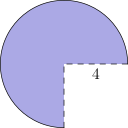
A three-quarter sector of a circle of radius inches together with its interior can be rolled up to form the lateral surface of a right circular cone by taping together along the two radii shown. What is the volume of the cone in cubic inches?
Respuesta: C
Pista pequeña:
El arco del sector se convierte en la circunferencia de la base del cono.
The sector arc becomes the circumference of the cone base
Pista grande:
El radio del sector se convierte en la generatriz del cono.
The sector radius becomes the slant height of the cone
Solución:
El arco del sector se convierte en la circunferencia de la base. Por tanto, si el radio de la base es entonces de donde El radio del sector se convierte en la generatriz del cono, así que la altura del cono es
Por consiguiente, el volumen es Así, C es la respuesta correcta.
The sector’s arc becomes the base circumference, so if the base radius is then giving The sector radius becomes the cone’s slant height, so the cone’s height is
Hence the volume is Thus, C is the correct answer.
11.
La señora Carr pide a sus estudiantes leer cualesquiera de los libros de una lista de lectura. Harold selecciona al azar libros de esta lista, y Betty hace lo mismo. ¿Cuál es la probabilidad de que haya exactamente libros que ambos seleccionen?
Ms. Carr asks her students to read any of the books on a reading list. Harold randomly selects books from this list, and Betty does the same. What is the probability that there are exactly books that they both select?
Respuesta: D
Pista pequeña:
Fija los cinco libros de Harold y cuenta las elecciones de Betty.
Fix Harold’s five books and count Betty’s choices
Pista grande:
Betty debe elegir exactamente dos de los libros de Harold y tres de los otros cinco.
Betty must choose exactly two from Harold’s books and three from the other five
Solución:
Supongamos que Harold ya eligió sus libros. De estos cinco libros, hay maneras en que Betty pudo elegir exactamente dos libros iguales a los de Harold, y maneras en que Betty puede elegir sus otros tres libros de los libros que no están en la lista de Harold.
Así, Betty tiene elecciones favorables de un total de elecciones igualmente probables. La probabilidad es Por lo tanto, la respuesta correcta es D.
Assume that Harold has already picked his books. Of these five books, there are ways that Betty can have picked exactly two of the same books as Harold, and ways that Betty can choose her other three books from the books not on Harold’s list.
Thus there are favorable choices for Betty out of equally likely choices. The probability is Thus, D is the correct answer.
12.
La representación decimal de consiste en una cadena de ceros después del punto decimal, seguida de un y luego varios dígitos más. ¿Cuántos ceros hay en esa cadena inicial de ceros después del punto decimal?
The decimal representation of consists of a string of zeros after the decimal point, followed by a and then several more digits. How many zeros are in that initial string of zeros after the decimal point?
Respuesta: D
Pista pequeña:
Reescribe como .
Rewrite as
Pista grande:
Averigua cuántos dígitos tiene para saber cuántos ceros iniciales aparecen.
Find how many digits has to know how many leading zeros appear
Solución:
Podemos escribir Ahora que tiene dígitos y comienza con Al dividir entre , este número de dígitos queda después del punto decimal con ceros antes del primer dígito.
Por lo tanto, la respuesta correcta es D.
We can write Now which has digits and begins with Dividing by places this -digit number after the decimal point with zeros before the first digit.
Thus, the correct answer is D .
13.
La hormiga Andy vive en un plano coordenado y actualmente está en mirando hacia el este (es decir, en la dirección positiva del eje ). Andy avanza unidad y luego gira a la izquierda. Desde ahí, Andy avanza unidades (hacia el norte) y luego gira a la izquierda. Después avanza unidades (hacia el oeste) y de nuevo gira a la izquierda. Andy continúa así, aumentando su distancia unidad cada vez y girando siempre a la izquierda. ¿Cuál es la ubicación del punto en el que Andy hace su giro a la izquierda?
Andy the Ant lives on a coordinate plane and is currently at facing east (that is, in the positive -direction). Andy moves unit and then turns left. From there, Andy moves units (north) and then turns left. He then moves units (west) and again turns left. Andy continues this process, increasing his distance each time by unit and always turning left. What is the location of the point at which Andy makes the left turn?
Respuesta: B
Pista pequeña:
Rastrea el desplazamiento neto a lo largo de cuatro movimientos.
Track the net displacement over four moves
Pista grande:
Hay exactamente ciclos completos de cuatro movimientos en movimientos.
There are exactly complete four-move cycles in moves
Solución:
En los primeros cuatro movimientos, Andy avanza al este, al norte, al oeste y al sur. El desplazamiento neto es y de nuevo queda mirando hacia el este.
Como Andy completa ciclos de este tipo. Partiendo de su posición final es
Por lo tanto, la respuesta correcta es B.
In the first four moves, Andy goes east, north, west, and south. The net change is and he is again facing east.
Since Andy completes such cycles. Starting from his final position is
Thus, B is the correct answer.
14.
Como se muestra en la figura de abajo, seis semicírculos están en el interior de un hexágono regular de lado de modo que los diámetros de los semicírculos coinciden con los lados del hexágono. ¿Cuál es el área de la región sombreada, dentro del hexágono pero fuera de todos los semicírculos?
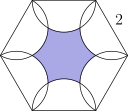
As shown in the figure below, six semicircles lie in the interior of a regular hexagon with side length so that the diameters of the semicircles coincide with the sides of the hexagon. What is the area of the shaded region—inside the hexagon but outside all of the semicircles?
Respuesta: D
Pista pequeña:
Usa la simetría del hexágono regular para dividir la región sombreada en seis piezas iguales.
Use the symmetry of the regular hexagon to split the shaded region into six equal pieces
Pista grande:
Cada pieza son dos triángulos equiláteros menos un sector de de radio .
Each piece is two equilateral triangles minus a sector of radius
Solución:
Por simetría, la región sombreada está formada por seis piezas congruentes. Una de esas piezas es la unión de dos triángulos equiláteros de lado , menos un sector de de un círculo de radio .
Los dos triángulos equiláteros tienen área total El sector tiene área Así, una pieza sombreada tiene área , y el área sombreada total es
Por lo tanto, la respuesta correcta es D.
By symmetry, the shaded region is made of six congruent pieces. One such piece is the union of two equilateral triangles with side length minus a sector of a circle of radius
The two equilateral triangles have total area The sector has area Thus one shaded piece has area and the total shaded area is
Thus, D is the correct answer.
15.
Steve escribió los dígitos y en orden repetidamente de izquierda a derecha, formando una lista de dígitos, que empieza Luego borró cada tercer dígito de su lista (es decir, los dígitos º, º, º, desde la izquierda), después borró cada cuarto dígito de la lista resultante (es decir, los dígitos º, º, º, desde la izquierda de lo que quedaba), y luego borró cada quinto dígito de lo que quedaba en ese punto. ¿Cuál es la suma de los tres dígitos que quedaron entonces en las posiciones y ?
Steve wrote the digits and in order repeatedly from left to right, forming a list of digits, beginning He then erased every third digit from his list (that is, the rd, th, th, digits from the left), then erased every fourth digit from the resulting list (that is, the th, th, th, digits from the left in what remained), and then erased every fifth digit from what remained at that point. What is the sum of the three digits that were then in positions and
Respuesta: D
Pista pequeña:
Después de cada paso de borrado, encuentra el nuevo bloque que se repite.
After each deletion step, find the new repeating block
Pista grande:
Usa el periodo final para reducir las posiciones y módulo la longitud del periodo.
Use the final period to reduce positions and modulo the period length
Solución:
Comienza con el bloque que se repite Borrar cada tercer dígito se repite cada posiciones originales: así que el nuevo periodo tiene longitud
Borrar cada cuarto dígito de este periodo se repite cada posiciones: así que el nuevo periodo tiene longitud
Borrar cada quinto dígito de este periodo da que tiene periodo Como los dígitos en las posiciones y son el .º, .º y .º dígitos de este periodo: Su suma es
Por lo tanto, la respuesta correcta es D.
Start with the repeating block Deleting every third digit repeats over original positions: so the new period has length
Deleting every fourth digit from this period repeats over positions: so the new period has length
Deleting every fifth digit from this period gives which has period Since the digits in positions and are the rd, th, and th digits of this period: Their sum is
Thus, the correct answer is D .
16.
Bela y Jenn juegan el siguiente juego en el intervalo cerrado de la recta de los números reales, donde es un entero fijo mayor que Juegan por turnos, y Bela empieza. En su primer turno, Bela elige cualquier número real del intervalo A partir de entonces, el jugador a quien le toca elige un número real que esté a más de una unidad de distancia de todos los números elegidos anteriormente por cualquiera de los dos jugadores. Un jugador que no puede elegir tal número pierde. Usando la estrategia óptima, ¿qué jugador ganará el juego?
Bela and Jenn play the following game on the closed interval of the real number line, where is a fixed integer greater than They take turns playing, with Bela going first. At his first turn, Bela chooses any real number in the interval Thereafter, the player whose turn it is chooses a real number that is more than one unit away from all numbers previously chosen by either player. A player unable to choose such a number loses. Using optimal strategy, which player will win the game?
Bela siempre ganará.
Bela will always win.
Jenn siempre ganará.
Jenn will always win.
Bela ganará si y solo si es impar.
Bela will win if and only if is odd.
Jenn ganará si y solo si es impar.
Jenn will win if and only if is odd.
Jenn ganará si y solo si n>8.
Jenn will win if and only if n>8.
Respuesta: A
Pista pequeña:
Busca una primera jugada que deje el intervalo simétrico.
Look for a first move that leaves the interval symmetric
Pista grande:
Después de que Jenn juega en Bela puede responder en .
After Jenn moves to Bela can respond at
Solución:
Bela puede elegir primero el punto medio Después de eso, cada vez que Jenn elige un número Bela elige el número reflejado
Este número reflejado es válido siempre que la jugada de Jenn sea válida: la reflexión respecto de preserva las distancias a los números elegidos anteriormente, y Jenn no puede elegir porque fue la primera jugada de Bela. Por lo tanto, cada jugada de Jenn tiene una respuesta correspondiente de Bela, así que Jenn es el primer jugador que puede quedarse sin jugadas válidas.
Por lo tanto, la respuesta correcta es A.
Bela can first choose the midpoint After that, whenever Jenn chooses a number Bela chooses the reflected number
This reflected number is legal whenever Jenn’s move is legal: distances from previously chosen numbers are preserved by the reflection about and Jenn cannot choose because it was Bela’s first move. Therefore every Jenn move has a matching Bela response, so Jenn is the first player who can run out of legal moves.
Thus, A is the correct answer.
17.
Hay personas paradas con igual separación alrededor de un círculo. Cada persona conoce exactamente a de las otras personas: las personas paradas junto a ella, así como la persona que está directamente al otro lado del círculo. ¿De cuántas maneras pueden las personas dividirse en parejas de modo que los miembros de cada pareja se conozcan?
There are people standing equally spaced around a circle. Each person knows exactly of the other people: the people standing next to her or him, as well as the person directly across the circle. How many ways are there for the people to split up into pairs so that the members of each pair know each other?
Respuesta: C
Pista pequeña:
Clasifica los emparejamientos según cuántas parejas opuestas se usan.
Classify pairings by how many opposite pairs are used
Pista grande:
Una vez elegidas las parejas opuestas, las personas restantes deben emparejarse a lo largo de arcos del círculo.
Once the opposite pairs are chosen, the remaining people must be matched along arcs of the circle
Solución:
Etiqueta a las personas alrededor del círculo. Cuenta según el número de parejas de personas opuestas.
Sin parejas opuestas, todos deben emparejarse con un vecino a lo largo del ciclo de Hay exactamente emparejamientos alternos con vecinos.
Con una pareja opuesta, elige esa pareja de maneras. Las personas restantes forman dos caminos de cuatro vértices, y cada camino tiene un único emparejamiento perfecto por parejas de vecinos, así que esto da emparejamientos.
Con dos o cuatro parejas opuestas, los caminos restantes para emparejar vecinos tienen longitud impar en algún lugar, así que no es posible ningún emparejamiento perfecto.
Con tres parejas opuestas, las dos parejas opuestas no elegidas deben ser adyacentes entre las cinco posiciones de parejas opuestas; de lo contrario, las personas restantes no pueden emparejarse por parejas de vecinos. Hay elecciones adyacentes para las dos parejas opuestas no elegidas, así que hay emparejamientos.
Con las cinco parejas opuestas, hay emparejamiento. El total es
Por lo tanto, la respuesta correcta es C.
Label the people around the circle. Count by the number of pairs of opposite people.
With no opposite pairs, everyone must be paired with a neighbor around the -cycle. There are exactly alternating neighbor matchings.
With one opposite pair, choose that pair in ways. The remaining people form two paths of four vertices, and each path has only one perfect matching by neighbor pairs, so this gives matchings.
With two or four opposite pairs, the remaining neighbor-pairing paths have odd length somewhere, so no perfect matching is possible.
With three opposite pairs, the two opposite pairs not chosen must be adjacent around the five opposite-pair positions; otherwise the remaining people cannot be matched by neighbor pairs. There are adjacent choices for the two unchosen opposite pairs, so there are matchings.
With all five opposite pairs, there is matching. The total is
Thus, the correct answer is C .
18.
Una urna contiene una bola roja y una bola azul. Cerca hay una caja de bolas rojas y azules adicionales. George realiza la siguiente operación cuatro veces: saca una bola de la urna al azar, luego toma una bola del mismo color de la caja y devuelve esas dos bolas iguales a la urna. Después de las cuatro iteraciones, la urna contiene seis bolas. ¿Cuál es la probabilidad de que la urna contenga tres bolas de cada color?
An urn contains one red ball and one blue ball. A box of extra red and blue balls lies nearby. George performs the following operation four times: he draws a ball from the urn at random and then takes a ball of the same color from the box and returns those two matching balls to the urn. After the four iterations the urn contains six balls. What is the probability that the urn contains three balls of each color?
Respuesta: B
Pista pequeña:
La urna final tiene tres de cada color exactamente cuando las cuatro extracciones contienen dos rojas y dos azules.
The final urn has three of each color exactly when the four draws contain two red and two blue
Pista grande:
Cada orden fijo de colores con dos extracciones rojas y dos azules tiene la misma probabilidad.
Each fixed color order with two red draws and two blue draws has the same probability
Solución:
La urna termina con tres bolas rojas y tres azules exactamente cuando las cuatro extracciones contienen dos extracciones rojas y dos azules. Hay órdenes de colores posibles de este tipo.
Para cualquier orden fijo con dos extracciones rojas y dos azules, la probabilidad es porque la primera y la segunda extracción de cada color tienen numeradores y , mientras que el número total de bolas antes de las cuatro extracciones es .
Así, la probabilidad buscada es .
Por lo tanto, la respuesta correcta es B.
The urn ends with three red and three blue balls exactly when the four draws contain two red draws and two blue draws. There are possible color orders of this type.
For any fixed order with two red draws and two blue draws, the probability is because the first and second draws of each color have numerators and while the total number of balls before the four draws is
Thus the desired probability is
Thus, the correct answer is B .
19.
En cierto juego de cartas, a un jugador se le reparte una mano de cartas de una baraja de cartas distintas. El número de manos distintas (sin orden) que se le pueden repartir al jugador puede escribirse como ¿Cuál es el dígito ?
In a certain card game, a player is dealt a hand of cards from a deck of distinct cards. The number of distinct (unordered) hands that can be dealt to the player can be written as What is the digit
Respuesta: A
Pista pequeña:
El número de manos es .
The number of hands is
Pista grande:
Después de factorizar un último solo se necesita el dígito de las unidades del producto restante.
After factoring out a final only the units digit of the remaining product is needed
Solución en video:

Click to load, then click again to play
Solución escrita:
Después de cancelar factores en el coeficiente binomial, Al dividir por el último factor la cifra de las unidades del producto restante es
Trabajando módulo Por tanto, Así, A es la respuesta correcta.
After canceling factors in the binomial coefficient, Dividing by the final factor the units digit of the remaining product is
Working modulo Hence Thus, A is the correct answer.
20.
Sea un prisma rectangular recto (caja) con longitudes de arista , y , junto con su interior. Para real, sea el conjunto de puntos en el espacio de dimensiones que están a una distancia menor o igual que de algún punto de . El volumen de puede expresarse como donde , , y son números reales positivos. ¿Cuánto vale ?
Let be a right rectangular prism (box) with edge lengths and together with its interior. For real let be the set of points in -dimensional space that lie within a distance of some point in The volume of can be expressed as where and are positive real numbers. What is
Respuesta: B
Pista pequeña:
Descompón el sólido agrandado en la caja original, las losas de las caras, los cuartos de cilindro de las aristas y los octavos de esfera de las esquinas.
Decompose the enlarged solid into the original box, face slabs, edge quarter-cylinders, and corner eighth-spheres
Pista grande:
El coeficiente de proviene de un cuarto de cilindro a lo largo de cada arista.
The coefficient of comes from one quarter-cylinder along each edge
Solución en video:
Click to load, then click again to play
Solución escrita:
Descompón según dónde se ubica el volumen añadido respecto de la caja.
La caja original tiene volumen . Las losas de las caras aportan el área de la superficie por , así que
A lo largo de cada arista hay un cuarto de cilindro de radio . La suma de todas las longitudes de las aristas es , así que En las ocho esquinas, los octavos de esfera se combinan en una esfera completa, así que
Por lo tanto
Por lo tanto, la respuesta correcta es B.
Decompose by where the added volume lies relative to the box.
The original box has volume The face slabs contribute surface area times so
Along each edge is a quarter-cylinder of radius The sum of all edge lengths is so At the eight corners, the eighth-spheres combine to one full sphere, so
Therefore
Thus, the correct answer is B .
21.
En el cuadrado los puntos y están en y respectivamente, de modo que Los puntos y están en y respectivamente, y los puntos y están en de modo que y Observa la figura de abajo. El triángulo el cuadrilátero el cuadrilátero y el pentágono tienen cada uno área ¿Cuánto vale ?
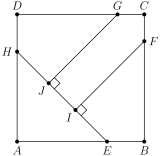
In square points and lie on and respectively, so that Points and lie on and respectively, and points and lie on so that and See the figure below. Triangle quadrilateral quadrilateral and pentagon each has area What is
Respuesta: B
Pista pequeña:
Las cuatro regiones dadas llenan el cuadrado, así que se conoce la longitud del lado del cuadrado.
The four given regions fill the square, so the square’s side length is known
Pista grande:
Prolonga la perpendicular que pasa por hasta que corte a y compara los dos triángulos rectángulos isósceles resultantes
Extend the perpendicular through to meet and compare the two resulting right isosceles triangles
Solución en video:
Click to load, then click again to play
Solución escrita:
Las cuatro regiones nombradas llenan el cuadrado y cada una tiene área así que el cuadrado tiene área y lado Como el triángulo es rectángulo isósceles con área tenemos
Prolonguemos hasta cortar en y sea y Como tiene pendiente la recta tiene pendiente así que Si estuviera en el segmento la región estaría dentro del triángulo cuya área sería a lo sumo una contradicción. Por tanto, está a la izquierda de y
El triángulo es rectángulo isósceles con área El triángulo es rectángulo isósceles con hipotenusa así que su área es Como su diferencia es la región Por tanto,
Además, y por lo que Se sigue que
Por lo tanto, B es la respuesta correcta.
The four named regions fill the square and each has area so the square has area and side length Since triangle is right isosceles with area we have
Extend to meet at and set and Because has slope line has slope so If were on segment then region would lie inside triangle whose area would be at most a contradiction. Thus lies to the left of and
Triangle is right isosceles with area Triangle is right isosceles with hypotenuse so its area is Since their difference is region Therefore
Also, and so It follows that
Thus, the correct answer is B .
22.
¿Cuál es el residuo cuando se divide entre ?
What is the remainder when is divided by
Respuesta: D
Pista pequeña:
Intenta factorizar el numerador usando una diferencia de cuadrados.
Try to factor the numerator using a difference of squares
Pista grande:
Escribe como un múltiplo del divisor más un residuo pequeño.
Write as a multiple of the divisor plus a small remainder
Solución en video:
Click to load, then click again to play
Solución escrita:
Sea . Factorizamos el numerador alrededor de este divisor: Por la diferencia de cuadrados, que es un múltiplo de . Por lo tanto
Por lo tanto, la respuesta correcta es D.
Let We factor the numerator around this divisor: By the difference of squares, which is a multiple of Therefore
Thus, the correct answer is D .
23.
El cuadrado en el plano coordenado tiene vértices en los puntos y Considera las siguientes cuatro transformaciones:
• una rotación de en sentido antihorario alrededor del origen;
• una rotación de en sentido horario alrededor del origen;
• una reflexión respecto del eje ; y
• una reflexión respecto del eje .
Cada una de estas transformaciones lleva el cuadrado sobre sí mismo, pero las posiciones de los vértices etiquetados cambiarán. Por ejemplo, aplicar y luego enviaría el vértice en a y enviaría el vértice en a sí mismo. ¿Cuántas secuencias de transformaciones elegidas de enviarán todos los vértices etiquetados de vuelta a sus posiciones originales? (Por ejemplo, es una secuencia de transformaciones que enviará los vértices de vuelta a sus posiciones originales.)
Square in the coordinate plane has vertices at the points and Consider the following four transformations:
• a rotation of counterclockwise around the origin;
• a rotation of clockwise around the origin;
• a reflection across the -axis; and
• a reflection across the -axis.
Each of these transformations maps the square onto itself, but the positions of the labeled vertices will change. For example, applying and then would send the vertex at to and would send the vertex at to itself. How many sequences of transformations chosen from will send all of the labeled vertices back to their original positions? (For example, is one sequence of transformations that will send the vertices back to their original positions.)
Respuesta: C
Pista pequeña:
Después de un número impar de movimientos permitidos, un vértice siempre queda en la paridad opuesta de las esquinas del cuadrado.
After an odd number of allowed moves, a vertex always lies on the opposite parity of square corners
Pista grande:
Para cualesquiera primeras transformaciones, exactamente una transformación final devuelve el cuadrado a su etiquetado original.
For any first transformations, exactly one final transformation returns the square to its original labeling
Solución en video:
Click to load, then click again to play
Solución escrita:
Cada una de las transformaciones mueve cada vértice a una esquina adyacente del cuadrado. Por lo tanto, después de un número impar de transformaciones el etiquetado está en uno de los cuatro estados de paridad impar, y después de un número par está en uno de los cuatro estados de paridad par.
Después de cualesquiera primeras transformaciones, el cuadrado está en un estado de paridad impar. Desde cada estado de paridad impar, exactamente una de envía los vértices etiquetados de vuelta a sus posiciones originales. Así, cada secuencia de las primeras transformaciones tiene exactamente una transformación final válida.
Hay opciones para las primeras transformaciones, así que hay secuencias válidas.
Por lo tanto, la respuesta correcta es C.
Each of moves every vertex to an adjacent corner of the square. Therefore after an odd number of transformations the labeling is in one of the four odd-parity states, and after an even number it is in one of the four even-parity states.
After any first transformations, the square is in an odd-parity state. From each odd-parity state, exactly one of sends the labeled vertices back to their original positions. Thus every sequence of the first transformations has exactly one valid final transformation.
There are choices for the first transformations, so there are valid sequences.
Thus, C is the correct answer.
24.
¿Cuántos enteros positivos satisfacen
(Recuerda que es el mayor entero que no excede a )
How many positive integers satisfy
(Recall that is the greatest integer not exceeding )
Respuesta: C
Pista pequeña:
Sea de modo que .
Let so
Pista grande:
Usa para acotar los enteros posibles.
Use to bound the possible integers
Solución en video:
Click to load, then click again to play
Solución escrita:
Sea La ecuación da Además, por la definición de la función piso, Sustituyendo obtenemos
La desigualdad de la izquierda es así que La desigualdad de la derecha es Las raíces de son aproximadamente y Por tanto, junto con los valores enteros posibles son Hay valores.
Así, C es la respuesta correcta.
Let The equation gives Also, by the definition of the floor function, Substituting we get
The left inequality is so The right inequality is The roots of are which are approximately and Thus, together with the possible integer values are There are such values.
Thus, C is the correct answer.
25.
Sea el número de maneras de escribir el entero positivo como un producto donde , los son enteros estrictamente mayores que , y el orden en que se listan los factores importa (es decir, dos representaciones que difieren solo en el orden de los factores se cuentan como distintas). Por ejemplo, el número puede escribirse como , y , así que . ¿Cuánto vale ?
Let denote the number of ways of writing the positive integer as a product where the are integers strictly greater than and the order in which the factors are listed matters (that is, two representations that differ only in the order of the factors are counted as distinct). For example, the number can be written as and so What is
Respuesta: A
Pista pequeña:
Escribe .
Write
Pista grande:
Para un producto con factores, elige qué factor contiene el único y distribuye los cinco factores de .
For a product with factors, choose which factor contains the single and distribute the five factors of
Solución en video:
Click to load, then click again to play
Solución escrita:
Escribe . Supongamos que una factorización ordenada tiene factores. Exactamente un factor contiene el único factor primo ; elige su posición de maneras.
Los otros factores deben contener cada uno al menos un factor de , mientras que el factor que contiene el puede contener cualquier cantidad de factores de . Distribuir los cinco factores de bajo estas condiciones puede hacerse de maneras. Por lo tanto, el número de factorizaciones ordenadas con factores es , donde .
Así Haciendo , esto se convierte en
Por lo tanto, la respuesta correcta es A.
Write Suppose an ordered factorization has factors. Exactly one factor contains the single prime factor ; choose its position in ways.
The other factors must each contain at least one factor of while the factor containing may contain any number of factors of Distributing the five factors of under these conditions can be done in ways. Therefore the number of ordered factorizations with factors is where
Thus Letting this becomes
Thus, A is the correct answer.