
Problemas del 1999 AIME
¡Desplázate hacia abajo y presiona Iniciar para intentar el examen! O ve al PDF imprimible, la clave de respuestas, o las soluciones profesionales preparadas por LIVE by Po-Shen Loh.
Todos los problemas se usan con el permiso legal oficial de la Mathematical Association of America (MAA).
O salta directamente a un solo problema con su solución: 1 · 2 · 3 · 4 · 5 · 6 · 7 · 8 · 9 · 10 · 11 · 12 · 13 · 14 · 15
¿Quieres aprender de forma profesional con clases interactivas en video?
Con tiempo
3:00:00
1.
Halla el menor número primo que sea el quinto término de una progresión aritmética creciente, en la que los cuatro términos anteriores también sean primos.
Find the smallest prime that is the fifth term of an increasing arithmetic sequence, all four preceding terms also being prime.
Respuesta: 29
Pista pequeña:
Si la diferencia común no es múltiplo de uno de los tres primeros términos es divisible entre
If the common difference is not a multiple of one of the first three terms is divisible by
Pista grande:
La diferencia debe ser múltiplo de así que prueba progresiones de cinco términos con diferencia empezando desde primos pequeños
The difference must be a multiple of so try five-term progressions with difference starting from small primes
Solución:
Sean los términos El primo par no puede ser el primer término: una diferencia par hace par al segundo término, mientras que una diferencia impar hace par al tercero. Si fuera impar, términos consecutivos tendrían paridad opuesta, así que algún término distinto del primero sería par y mayor que , lo cual es imposible. Si no fuera múltiplo de entonces cubrirían todos los residuos módulo por lo que algún término sería divisible entre ese término tendría que ser el propio , lo que obliga a pero entonces es compuesto. Por lo tanto es divisible entre
Como , el quinto término es al menos Probando y se obtiene todos primos, y no es posible un quinto término menor puesto que (los inicios y fallan como arriba). La respuesta es
Let the terms be The even prime cannot be the first term: an even difference makes the second term even, while an odd difference makes the third term even. If were odd, consecutive terms would have opposite parity, so some term other than the first would be even and greater than — impossible. If were not a multiple of then would cover all residues mod so some term would be divisible by that term would have to be itself, forcing but then is composite. Hence is divisible by
With the fifth term is at least Trying and gives all prime, and no smaller fifth term is possible since (the starts and fail as above). The answer is
2.
Considera el paralelogramo con vértices y Una recta que pasa por el origen divide esta figura en dos polígonos congruentes. La pendiente de la recta es donde y son enteros positivos primos entre sí. Halla
Consider the parallelogram with vertices and A line through the origin cuts this figure into two congruent polygons. The slope of the line is where and are relatively prime positive integers. Find
Respuesta: 118
Pista pequeña:
Una recta divide un paralelogramo en dos piezas congruentes cuando pasa por el centro de simetría del paralelogramo
A line cuts a parallelogram into two congruent pieces when it passes through the parallelogram’s center of symmetry
Pista grande:
El centro es el punto medio de la diagonal desde hasta
The center is the midpoint of the diagonal from to
Solución:
Dos piezas congruentes tienen igual área. Para cualquier dirección fija, hay una única recta de esa dirección que biseca el área de una figura convexa; como el paralelogramo es centralmente simétrico, esa recta pasa por su centro. Por lo tanto, la recta buscada que pasa por el origen también debe pasar por el centro. Recíprocamente, un paralelogramo es simétrico bajo la rotación de en torno a su centro, de modo que cualquier recta que pase por el centro lo divide en dos piezas que se intercambian mediante esa rotación, y por tanto son congruentes. El centro es el punto medio de una diagonal:
La recta que pasa por el origen y tiene pendiente y así que
Congruent pieces have equal area. For any fixed direction, there is only one line in that direction that bisects the area of a convex figure; because a parallelogram is centrally symmetric, that line passes through its center. Thus the required line through the origin must also pass through the center. Conversely, the rotation about the center swaps the two pieces cut by such a line, so they are congruent. The center is the midpoint of a diagonal:
The line through the origin and has slope and so
3.
Halla la suma de todos los enteros positivos para los cuales es un cuadrado perfecto.
Find the sum of all positive integers for which is a perfect square.
Respuesta: 38
Pista pequeña:
Multiplica por y completa el cuadrado:
Multiply by and complete the square:
Pista grande:
Si la expresión es igual a entonces factoriza como diferencia de cuadrados de todas las formas posibles
If the expression equals then factor as a difference of squares in every way
Solución:
Supongamos que Multiplicando por y completando el cuadrado se obtiene así que La suma de estos dos factores es por lo que ambos son positivos: los pares de factores son y
Restando el primer factor del segundo se obtiene o de modo que o Cada uno de ellos hace efectivamente que la expresión sea un cuadrado perfecto ( ), y la suma es
Suppose Multiplying by and completing the square gives so The two factors sum to so both are positive: the factor pairs are and
Subtracting the first factor from the second gives or so or Each indeed makes the expression a perfect square ( ), and the sum is
4.
Los dos cuadrados mostrados comparten el mismo centro y tienen lados de longitud La longitud de es y el área del octágono es donde y son enteros positivos primos entre sí. Halla
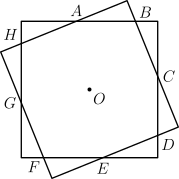
The two squares shown share the same center and have sides of length The length of is and the area of octagon is where and are relatively prime positive integers. Find
Respuesta: 185
Pista pequeña:
Por las simetrías que intercambian los dos cuadrados y que rotan los ocho lados del octágono son congruentes
By the symmetries swapping the two squares and rotating by all eight sides of the octagon are congruent
Pista grande:
Divide el octágono en triángulos con vértice cada lado del octágono está sobre un lado de un cuadrado, a distancia de
Cut the octagon into triangles with apex each side of the octagon lies on a side of a square, at distance from
Solución:
Toda la configuración queda invariante al rotar en torno a lo que lleva el lado del octágono sucesivamente a y también queda invariante bajo la reflexión que intercambia los dos cuadrados, la cual lleva esos lados a Así que los ocho lados del octágono tienen la misma longitud,
Los segmentos desde hasta los ocho vértices dividen el octágono en triángulos. Cada uno tiene base situada sobre un lado de uno de los cuadrados unitarios, así que su altura desde es la distancia del centro a ese lado, es decir El área es
Como la respuesta es
The whole configuration is unchanged by rotating about which cycles the octagon side to and it is also unchanged by the reflection that swaps the two squares, which carries those sides to So all eight sides of the octagon have the same length,
Segments from to the eight vertices cut the octagon into triangles. Each has base lying on a side of one of the unit squares, so its height from is the distance from the center to that side, namely The area is
Since the answer is
5.
Para cualquier entero positivo sea la suma de los dígitos de y sea igual a Por ejemplo, ¿Cuántos valores no exceden ?
For any positive integer let be the sum of the digits of and let be For example, How many values do not exceed
Respuesta: 223
Pista pequeña:
Si al sumar no se produce ningún acarreo, El acarreo ocurre solo cuando termina en o
If adding causes no carrying, Carrying happens only when ends in or
Pista grande:
Sigue cómo cambia la suma de dígitos cuando termina en una serie de nueves; los valores con acarreo forman una progresión aritmética de diferencia común
Track how the digit sum changes when ends in a run of nines; the carrying values form an arithmetic progression with common difference
Solución:
Si el último dígito de es a lo sumo sumar no cambia ningún otro dígito, así que En caso contrario hay acarreo. Si termina en el dígito precedido por exactamente nueves, entonces reemplaza por así que y Si termina en exactamente nueves, entonces reemplaza por así que y
Ambas familias con acarreo dan exactamente los valores es decir, para y cada uno de esos valores se alcanza. Así que los valores posibles de son junto con todos los Exigir da lo que son valores, y añade uno más, para un total de
If the last digit of is at most adding changes no other digit, so Otherwise there is carrying. If ends in the digit preceded by exactly nines, then replaces by so and If ends in exactly nines, then replaces by so and
Both carrying families give exactly the values that is, for and every such value occurs. So the possible values of are together with all Requiring gives which is values, and adds one more, for a total of
6.
Una transformación del primer cuadrante del plano coordenado lleva cada punto al punto Los vértices del cuadrilátero son y Sea el área de la región encerrada por la imagen del cuadrilátero Halla el mayor entero que no excede
A transformation of the first quadrant of the coordinate plane maps each point to the point The vertices of quadrilateral are and Let be the area of the region enclosed by the image of quadrilateral Find the greatest integer that does not exceed
Respuesta: 314
Pista pequeña:
En lugar de seguir los vértices, averigua qué le hace la aplicación a cada una de las cuatro rectas del contorno
Instead of tracking the vertices, find what the map does to each of the four boundary lines
Pista grande:
y se transforman en rectas que pasan por el origen, mientras que se transforma en un arco de
and map to lines through the origin, while maps to an arc of
Solución:
Sigue las cuatro aristas. Los lados y están sobre las rectas y que se transforman en las rectas y , rayos desde el origen con ángulos y Los lados y están sobre y que se transforman en arcos de las circunferencias y
Así que la imagen es la parte del anillo entre los radios y situada entre los rayos de y , una doceava parte del anillo completo:
Como tenemos así que el mayor entero que no excede es
Follow the four edges. Sides and lie on the lines and which map to the lines and — rays from the origin at angles and Sides and lie on and which map to arcs of the circles and
So the image is the part of the annulus between radii and lying between the and rays, one twelfth of the full annulus:
Since we have so the greatest integer not exceeding is
7.
Hay un conjunto de interruptores, cada uno de los cuales tiene cuatro posiciones, llamadas y Cuando la posición de cualquier interruptor cambia, solo lo hace de a de a de a o de a Inicialmente cada interruptor está en la posición Los interruptores están etiquetados con los enteros distintos donde y toman los valores En el paso de un proceso de pasos, el -ésimo interruptor avanza un paso, y también lo hacen todos los demás interruptores cuyas etiquetas dividen la etiqueta del -ésimo interruptor. Después de completar el paso , ¿cuántos interruptores estarán en la posición ?
There is a set of switches, each of which has four positions, called and When the position of any switch changes, it is only from to from to from to or from to Initially each switch is in position The switches are labeled with the different integers where and take on the values At step of a -step process, the th switch is advanced one step, and so are all the other switches whose labels divide the label on the th switch. After step has been completed, how many switches will be in position
Respuesta: 650
Pista pequeña:
El interruptor etiquetado avanza una vez por cada etiqueta que sea múltiplo de cuenta esos múltiplos en términos de los exponentes
The switch labeled is advanced once for every label that is a multiple of count those multiples in terms of the exponents
Pista grande:
La etiqueta avanza veces; cuenta las ternas para las cuales este producto no es múltiplo de
The label advances times; count the triples for which this product is not a multiple of
Solución:
El interruptor etiquetado avanza exactamente una vez por cada paso cuya etiqueta sea múltiplo de Los múltiplos de entre las etiquetas son los con etc., así que ese interruptor avanza veces. Regresa a la posición exactamente cuando este número es múltiplo de
Escribamos recorriendo cada uno desde hasta Contamos las ternas en las que no es divisible entre o bien los tres son impares, o bien exactamente uno es par pero no divisible entre Entre hay valores impares y valores ( ) que son el doble de un número impar. Eso da ternas del primer tipo y del segundo, o sea en total.
Por lo tanto interruptores terminan en la posición
The switch labeled is advanced exactly once for each step whose label is a multiple of The multiples of among the labels are the with etc., so that switch advances times. It returns to position exactly when this count is a multiple of
Write each ranging over through We count the triples where is not divisible by either all three are odd, or exactly one is even but not divisible by Among there are odd values and values ( ) that are twice an odd number. That gives triples of the first kind and of the second, or in all.
Therefore switches end in position
8.
Sea el conjunto de las ternas ordenadas de números reales no negativos que están en el plano Digamos que sostiene a cuando exactamente dos de las siguientes son verdaderas: Sea el conjunto de aquellas ternas de que sostienen a El área de dividida entre el área de es donde y son enteros positivos primos entre sí. Halla
Let be the set of ordered triples of nonnegative real numbers that lie in the plane Let us say that supports when exactly two of the following are true: Let consist of those triples in that support The area of divided by the area of is where and are relatively prime positive integers. Find
Respuesta: 25
Pista pequeña:
es un triángulo, y cada condición como recorta una esquina con una recta paralela a un lado
is a triangle, and each condition like cuts off a corner with a line parallel to a side
Pista grande:
Como las tres desigualdades se cumplen simultáneamente solo en un punto de la frontera; aparte de ese punto, cada región de dos desigualdades es un triángulo semejante a
Since all three inequalities hold only at one boundary point; apart from that point, each two-inequality region is a triangle similar to
Solución:
es el triángulo con vértices Como siempre que se cumplen dos de las desigualdades , la tercera solo puede cumplirse en un punto de la frontera, de área cero. Así que es, salvo medida cero, la unión de las tres regiones donde se cumple un par específico de desigualdades.
La región con y se convierte, tras sustituir y en una copia de con suma de coordenadas es decir, un triángulo semejante a con razón y área de la de De igual modo, los pares y dan triángulos semejantes con razones y
La razón de las áreas es así que
is the triangle with vertices Because whenever two of the inequalities hold, the third can hold only at a boundary point of zero area. So is, up to measure zero, the union of the three regions where a specific pair of inequalities holds.
The region with and becomes, after substituting and a copy of with coordinate sum i.e. a triangle similar to with ratio and area of Likewise the pairs and give similar triangles with ratios and
The ratio of areas is so
9.
Una función está definida sobre los números complejos por donde y son números positivos. Esta función tiene la propiedad de que la imagen de cada punto del plano complejo equidista de ese punto y del origen. Dado que y que donde y son enteros positivos primos entre sí, halla
A function is defined on the complex numbers by where and are positive numbers. This function has the property that the image of each point in the complex plane is equidistant from that point and the origin. Given that and that where and are relatively prime positive integers, find
Respuesta: 259
Pista pequeña:
La condición dice que para todo escribe ambos lados como un módulo por
The condition says for every write both sides as a modulus times
Pista grande:
Necesitas lo que determina luego usa
You need which pins down then use
Solución:
La condición es para todo es decir, Dividiendo entre (para ) se obtiene así que lo que obliga a
Como tenemos así que Como la respuesta es
The condition is for all that is, Dividing by (for ) gives so which forces
Since we have so As the answer is
10.
Se dan diez puntos en el plano, sin que haya tres colineales. Se eligen al azar cuatro segmentos distintos que unen pares de estos puntos, siendo igualmente probables todas esas selecciones. La probabilidad de que algunos tres de los segmentos formen un triángulo cuyos vértices estén entre los diez puntos dados es donde y son enteros positivos primos entre sí. Halla
Ten points in the plane are given, with no three collinear. Four distinct segments joining pairs of these points are chosen at random, all such segments being equally likely. The probability that some three of the segments form a triangle whose vertices are among the ten given points is where and are relatively prime positive integers. Find
Respuesta: 489
Pista pequeña:
Cuatro segmentos pueden contener a lo sumo un triángulo, porque dos triángulos distintos usan siempre al menos cinco segmentos
Four segments can contain at most one triangle, because two different triangles always use at least five segments
Pista grande:
Cuenta las elecciones favorables así: elige un triángulo de los posibles, luego elige cualquier cuarto segmento
Count favorable choices as: pick a triangle from the possible ones, then pick any fourth segment
Solución:
Hay segmentos, así que elecciones igualmente probables. Dos triángulos distintos comparten a lo sumo una arista, de modo que juntos usan al menos segmentos; por tanto un conjunto de segmentos contiene a lo sumo un triángulo, y los conjuntos favorables se cuentan exactamente una vez eligiendo un triángulo y luego un cuarto segmento:
La probabilidad es ya en su forma más simple (), así que
There are segments, so equally likely choices. Two distinct triangles share at most one edge, so together they use at least segments; hence a set of segments contains at most one triangle, and the favorable sets are counted exactly once by choosing a triangle and then a fourth segment:
The probability is already in lowest terms (), so
11.
Dado que donde los ángulos se miden en grados, y y son enteros positivos primos entre sí que satisfacen halla
Given that where angles are measured in degrees, and and are relatively prime positive integers that satisfy find
Respuesta: 177
Pista pequeña:
Multiplica la suma por y usa para telescopar
Multiply the sum by and use to telescope
Pista grande:
Los dos términos que sobreviven se combinan porque termina con
The two surviving terms combine because finish with
Solución:
Multiplica la suma por y aplica de modo que la suma se telescopa:
Por lo tanto la suma es igual a Como y obtenemos
Multiply the sum by and apply so the sum telescopes:
Hence the sum equals Since and we get
12.
La circunferencia inscrita del triángulo es tangente a en y su radio es Dado que y halla el perímetro del triángulo.
The inscribed circle of triangle is tangent to at and its radius is Given that and find the perimeter of the triangle.
Respuesta: 345
Pista pequeña:
Los segmentos tangentes desde cada vértice son iguales, así que las longitudes tangentes desde son y una incógnita
Tangent segments from each vertex are equal, so the tangent lengths from are and an unknown
Pista grande:
Iguala el área de dos maneras: y la fórmula de Herón; la ecuación resultante es lineal en
Set the area two ways: and Heron’s formula; the resulting equation is linear in
Solución:
Los segmentos tangentes desde un punto son iguales, así que las longitudes tangentes desde son y cierto Entonces los lados son el semiperímetro es y la fórmula de Herón da el área
El área también es igual a Elevando al cuadrado y dividiendo entre se obtiene así que y
El perímetro es
Tangent segments from a point are equal, so the tangent lengths from are and some Then the sides are the semiperimeter is and Heron’s formula gives area
The area also equals Squaring and dividing by gives so and
The perimeter is
13.
Cuarenta equipos juegan un torneo en el que cada equipo juega contra cada otro equipo exactamente una vez. No hay empates, y cada equipo tiene una probabilidad del de ganar cualquier partido que juegue. La probabilidad de que no haya dos equipos que ganen el mismo número de partidos es donde y son enteros positivos primos entre sí. Halla
Forty teams play a tournament in which every team plays every other team exactly once. No ties occur, and each team has a chance of winning any game it plays. The probability that no two teams win the same number of games is where and are relatively prime positive integers. Find
Respuesta: 742
Pista pequeña:
Los totales de victorias distintos deben ser exactamente y ese ordenamiento determina el ganador de cada partido
Distinct win totals must be exactly and that ranking determines the winner of every single game
Pista grande:
La probabilidad es dividido entre simplifica contando los factores de en
The probability is divided by reduce by counting the factors of in
Solución:
Hay partidos, y por tanto resultados igualmente probables. Si los totales de victorias son todos distintos, deben ser exactamente En ese caso el equipo con victorias venció a todos, el equipo con victorias venció a todos excepto a ese equipo, y así sucesivamente: la asignación de totales a los equipos determina cada partido. Recíprocamente, cada una de las asignaciones proviene de exactamente un resultado, así que la probabilidad es
Por la fórmula de Legendre, la potencia de que divide a es En su forma más simple, el denominador es por tanto así que
There are games, hence equally likely outcomes. If all win totals are distinct, they must be exactly In that case the team with wins beat everyone, the team with wins beat everyone except that team, and so on: the assignment of totals to teams determines every game. Conversely each of the assignments arises from exactly one outcome, so the probability is
By Legendre’s formula the power of dividing is In lowest terms the denominator is therefore so
14.
El punto está situado dentro del triángulo de modo que los ángulos y son todos congruentes. Los lados del triángulo tienen longitudes y y la tangente del ángulo es donde y son enteros positivos primos entre sí. Halla
Point is located inside triangle so that angles and are all congruent. The sides of the triangle have lengths and and the tangent of angle is where and are relatively prime positive integers. Find
Respuesta: 463
Pista pequeña:
Llama al ángulo común y calcula de dos maneras, desde los triángulos y con la ley de los senos
Call the common angle and compute two ways, from triangles and with the law of sines
Pista grande:
La comparación se simplifica a y cada cotangente puede escribirse en términos de las longitudes de los lados y el área
The comparison simplifies to and each cotangent can be written in terms of the side lengths and the area
Solución:
Sea En el triángulo los ángulos en y son y así que y la ley de los senos da En el triángulo los ángulos en y son y así que y
Igualando y sustituyendo resulta Desarrollando y dividiendo entre se obtiene y como el lado izquierdo es Por lo tanto
Usando y sus análogas, donde es el área, y dado que el triángulo -- tiene área se obtiene así que que está en su forma más simple, y
Let In triangle the angles at and are and so and the law of sines gives In triangle the angles at and are and so and
Equating and substituting yields Expanding and dividing by and since the left side is Hence
Using and its analogues, where is the area, since the -- triangle has area So which is in lowest terms, and
15.
Considera el triángulo de papel cuyos vértices son y Los vértices de su triángulo medial son los puntos medios de sus lados. Se forma una pirámide triangular doblando el triángulo a lo largo de los lados de su triángulo medial. ¿Cuál es el volumen de esta pirámide?
Consider the paper triangle whose vertices are and The vertices of its midpoint triangle are the midpoints of its sides. A triangular pyramid is formed by folding the triangle along the sides of its midpoint triangle. What is the volume of this pyramid?
Respuesta: 408
Pista pequeña:
Las tres esquinas dobladas se encuentran en un único vértice, cuya distancia a cada punto medio es igual a la mitad del lado original correspondiente
The three folded corners meet at a single apex, whose distance to each midpoint equals half of the corresponding original side
Pista grande:
Mantén el triángulo medial en el plano y resuelve tres ecuaciones de distancia para el vértice
Keep the midpoint triangle in the plane and solve three distance equations for the apex
Solución:
Los puntos medios son y Al doblar hacia arriba los tres triángulos de las esquinas a lo largo de los lados del triángulo medial, las esquinas se juntan en un único vértice (cada par de semilados pegados tiene igual longitud). El vértice conserva sus distancias tras el doblado: (la mitad del lado de longitud que biseca), (la mitad de ), y (la mitad de ).
Mantén el triángulo medial en el plano y sea Restando de se obtiene así que restando de se obtiene así que Entonces de modo que el vértice está a la altura
La base es el triángulo medial, con área igual a un cuarto de la del triángulo original es decir El volumen es
The midpoints are and Folding the three corner triangles up along the sides of the midpoint triangle brings the corners together at one apex (each pair of glued half-sides has equal length). The apex keeps its folded distances: (half of the side of length that bisects), (half of ), and (half of ).
Keep the midpoint triangle in the plane and let Subtracting from gives so subtracting from gives so Then so the apex is at height
The base is the midpoint triangle, with area one quarter of the original triangle’s i.e. The volume is