
Problemas del 1997 AMC 12
¡Desplázate hacia abajo y presiona Iniciar para intentar el examen! O ve al PDF imprimible, la clave de respuestas, o las soluciones profesionales preparadas por LIVE by Po-Shen Loh.
Todos los problemas se usan con el permiso legal oficial de la Mathematical Association of America (MAA).
O salta directamente a un solo problema con su solución: 1 · 2 · 3 · 4 · 5 · 6 · 7 · 8 · 9 · 10 · 11 · 12 · 13 · 14 · 15 · 16 · 17 · 18 · 19 · 20 · 21 · 22 · 23 · 24 · 25 · 26 · 27 · 28 · 29 · 30
¿Quieres aprender de forma profesional con clases interactivas en video?
Con tiempo
1:15:00
1.
Si y son dígitos tales que entonces
If and are digits for which then
Respuesta: C
Pista pequeña:
Usa el primer producto parcial para determinar el número de dos dígitos de arriba
Use the first partial product to determine the two-digit top factor
Pista grande:
El segundo producto parcial es el número de arriba multiplicado por
The second partial product is the top factor multiplied by
Solución:
Del primer producto parcial se obtiene así que Del segundo se obtiene así que Por lo tanto, y la respuesta correcta es C.
The first partial product says so The second says so Thus and the correct answer is C.
2.
Los lados adyacentes del decágono mostrado forman ángulos rectos. ¿Cuál es su perímetro?
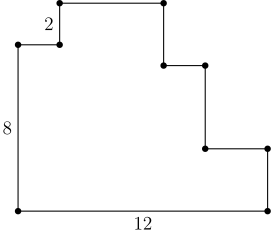
The adjacent sides of the decagon shown meet at right angles. What is its perimeter?
Respuesta: D
Pista pequeña:
La suma de las longitudes de los lados horizontales que avanzan hacia la derecha y no están marcados es igual a la longitud de la base
The unlabeled rightward horizontal lengths together equal the bottom width
Pista grande:
Halla la altura total sumando la altura marcada y la del escalón superior
Find the total vertical extent by combining the labeled height and the upper step
Solución:
La suma de los lados horizontales que avanzan hacia la derecha es por lo que la suma de todos los lados horizontales es La altura total es así que la suma de los lados verticales es Por lo tanto, el perímetro es y la respuesta correcta es D.
The total of the rightward horizontal sides is so all horizontal sides total The full height is so the vertical sides total Therefore the perimeter is and the correct answer is D.
3.
Si y son números reales tales que entonces
If and are real numbers such that then
Respuesta: D
Pista pequeña:
El cuadrado de todo número real es no negativo
Each squared real quantity is nonnegative
Pista grande:
Una suma de términos no negativos solo es cero si todos los términos son cero
A sum of nonnegative terms is zero only when every term is zero
Solución:
Los tres cuadrados son no negativos, así que cada uno debe ser Por lo tanto, y La respuesta correcta es D.
All three squares are nonnegative, so each must be Hence and The correct answer is D.
4.
Si es un mayor que y es un mayor que ¿en qué porcentaje es mayor que ?
If is larger than and is larger than then is what percent larger than
Respuesta: A
Pista pequeña:
Escribe tanto como como múltiplos de
Write both and as multiples of
Pista grande:
El porcentaje pedido usa , no , como base
The requested percentage uses , not , as its base
Solución:
Tenemos y Entonces por lo que es un mayor que La respuesta correcta es A.
We have and Thus so is larger than The correct answer is A.
5.
Un rectángulo de perímetro está dividido en cinco rectángulos congruentes, como se muestra en el diagrama. ¿Cuál es el perímetro de uno de los cinco rectángulos congruentes?
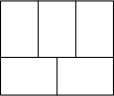
A rectangle with perimeter is divided into five congruent rectangles as shown in the diagram. What is the perimeter of one of the five congruent rectangles?
Respuesta: C
Pista pequeña:
Sean y los lados corto y largo de un rectángulo pequeño
Let the short and long sides of a small rectangle be and
Pista grande:
El ancho total es en la parte superior y también en la parte inferior
The total width is both across the top and across the bottom
Solución:
Sean y los lados de un rectángulo pequeño. El ancho común da mientras que las dimensiones del rectángulo grande son y Su perímetro satisface Como esto se convierte en de donde y El perímetro de un rectángulo pequeño es así que C es la respuesta correcta.
Let a small rectangle have sides and The common width gives while the large rectangle has dimensions by Its perimeter is Since this is so and One small perimeter is making C correct.
6.
Considera la sucesión cuyo término -ésimo es ¿Cuál es el promedio de los primeros términos de la sucesión?
Consider the sequence whose th term is What is the average of the first terms of the sequence?
Respuesta: B
Pista pequeña:
Agrupa los términos consecutivos en pares de términos impares y pares
Group consecutive terms into odd-even pairs
Pista grande:
Cada par tiene la misma suma, y hay pares
Each pair has the same sum, and there are pairs
Solución:
Cada par tiene suma Por lo tanto, los pares suman y el promedio de los términos es La respuesta correcta es B.
Each pair has sum The pairs therefore total and their -term average is The correct answer is B.
7.
La suma de siete enteros es ¿Cuál es la cantidad máxima de esos siete enteros que pueden ser mayores que ?
The sum of seven integers is What is the maximum number of the seven integers that can be larger than
Respuesta: D
Pista pequeña:
Los siete enteros no pueden ser mayores que , pues entonces su suma sería positiva
All seven cannot exceed because their sum would be positive
Pista grande:
No hay cota inferior para el entero restante
There is no lower bound on the remaining integer
Solución:
Si los siete enteros fueran mayores que su suma sería al menos Sí es posible que seis sean mayores que : se toman seis enteros iguales a y un séptimo entero igual a Por lo tanto, el máximo es y la respuesta correcta es D.
If all seven integers exceeded their sum would be at least Six can exceed : take six copies of and a seventh integer of Thus the maximum is and the correct answer is D.
8.
La editorial Mientka fija el precio de su éxito de ventas ¿Dónde está Walter? de la siguiente manera: donde es la cantidad de libros pedidos y es el costo, en dólares, de libros. Observa que libros cuestan menos que libros. ¿Para cuántos valores de resulta más barato comprar más de libros que comprar exactamente libros?
Mientka Publishing Company prices its best seller Where’s Walter? as follows: where is the number of books ordered, and is the cost in dollars of books. Notice that books cost less than books. For how many values of is it cheaper to buy more than books than to buy exactly books?
Respuesta: D
Pista pequeña:
Solo los dos puntos de cambio de precio pueden hacer que un pedido mayor resulte más barato
Only the two price-break points can make a larger order cheaper
Pista grande:
Cerca del primer cambio, compara con ; cerca del segundo, compáralo con
Compare with near the first break and with near the second
Solución:
En el primer cambio, es menor que y lo que da y En el segundo, es menor que cuando No funciona ningún otro , porque cada tramo es creciente. Hay así que D es la respuesta correcta.
At the first break, is below and giving and At the second, is below for No other works because each piece increases. There are so D is correct.
9.
En la figura, es un cuadrado de por , es el punto medio de y está sobre Si es perpendicular a entonces el área del cuadrilátero es
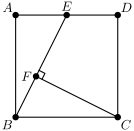
In the figure, is a by square, is the midpoint of and is on If is perpendicular to then the area of quadrilateral is
Respuesta: C
Pista pequeña:
Ubica y
Place and
Pista grande:
Halla como la intersección de con la recta que pasa por y es perpendicular a
Find as the intersection of with the line through perpendicular to
Solución:
Con las coordenadas del primer indicio, tiene ecuación y la perpendicular que pasa por es Su intersección es El cuadrado tiene área mientras que los triángulos y tienen áreas y respectivamente. Por lo tanto, así que C es la respuesta correcta.
With the coordinates in the first hint, has equation and the perpendicular through is Their intersection is The square has area while triangles and have areas and respectively. Hence so C is correct.
10.
Dos dados de seis caras son equilibrados, en el sentido de que cada cara tiene la misma probabilidad de salir. Sin embargo, en uno de los dados se reemplazó el por un , y en el otro se reemplazó el por un Al lanzar estos dados, ¿cuál es la probabilidad de que la suma sea impar?
Two six-sided dice are fair in the sense that each face is equally likely to turn up. However, one of the dice has the replaced by and the other die has the replaced by When these dice are rolled, what is the probability that the sum is odd?
Respuesta: D
Pista pequeña:
Para que la suma sea impar, un resultado debe ser impar y el otro par
An odd sum requires one odd result and one even result
Pista grande:
Cuenta las caras con números impares en cada dado modificado, incluidos los números repetidos
Count odd-labeled faces on each modified die, including repeated labels
Solución:
El primer dado modificado tiene caras impares y caras pares; el segundo tiene impares y pares. Por lo tanto, la probabilidad es La respuesta correcta es D.
The first modified die has odd faces and even faces; the second has odd and even. Thus the probability is The correct answer is D.
11.
En los partidos de baloncesto sexto, séptimo, octavo y noveno de la temporada, una jugadora anotó y puntos, respectivamente. Su promedio de puntos por partido después de nueve partidos era mayor que después de los primeros cinco. Si su promedio después de diez partidos era mayor que ¿cuál es la menor cantidad de puntos que pudo haber anotado en el décimo partido?
In the sixth, seventh, eighth, and ninth basketball games of the season, a player scored and points, respectively. Her points-per-game average was higher after nine games than it was after the first five games. If her average after ten games was greater than what is the least number of points she could have scored in the tenth game?
Respuesta: D
Pista pequeña:
Sea el total de puntos que anotó en los primeros cinco partidos
Let be her point total in the first five games
Pista grande:
Usa la comparación después de nueve partidos para maximizar , y luego aplica la cota estricta para el promedio después de diez partidos
Use the nine-game comparison to maximize , then apply the strict ten-game average bound
Solución:
Los partidos – suman La condición da así que el mayor valor entero de es Un promedio superior a después de diez partidos exige un total de al menos por lo que la puntuación del décimo partido es al menos Este valor se puede alcanzar, así que D es la respuesta correcta.
Games – total The condition gives so the greatest integral is A ten-game average above requires a total at least hence the tenth score is at least This is attainable, so D is correct.
12.
Si y son números reales y entonces la recta cuya ecuación es no puede contener el punto
If and are real numbers and then the line whose equation is cannot contain the point
Respuesta: E
Pista pequeña:
La condición significa que la pendiente y la ordenada al origen tienen el mismo signo
The condition means the slope and vertical intercept have the same sign
Pista grande:
Sustituye cada punto; una intersección positiva con el eje obliga a que la pendiente y la ordenada al origen tengan signos opuestos
Substitute each point; a positive -intercept forces the slope and intercept to have opposite signs
Solución:
Si estuviera en la recta, entonces así que y lo cual es una contradicción. Cada uno de los otros puntos puede pertenecer a una recta con valores adecuados de del mismo signo. Por lo tanto, la respuesta correcta es E.
If were on the line, then so and a contradiction. Each other point can occur for suitable same-sign Thus the correct answer is E.
13.
¿Cuántos enteros positivos de dos dígitos tienen la propiedad de que la suma de y el número obtenido al invertir el orden de los dígitos de es un cuadrado perfecto?
How many two-digit positive integers have the property that the sum of and the number obtained by reversing the order of the digits of is a perfect square?
Respuesta: E
Pista pequeña:
Escribe y súmale el número con los dígitos invertidos
Write and add its reversal
Pista grande:
Determina cuándo puede ser un cuadrado, con y
Determine when , with and , can be square
Solución:
La suma es Como solo es un cuadrado cuando lo que da El dígito de las decenas puede ser cualquiera de con Hay enteros, así que E es la respuesta correcta.
The sum is Since this is square only when giving The tens digit can be any of with There are integers, so E is correct.
14.
La cantidad de gansos de una bandada aumenta de tal manera que la diferencia entre las poblaciones del año y del año es directamente proporcional a la población del año Si las poblaciones de los años y fueron y respectivamente, entonces la población de fue
The number of geese in a flock increases so that the difference between the populations in year and year is directly proportional to the population in year If the populations in the years and were and respectively, then the population in was
Respuesta: B
Pista pequeña:
Sea la población de y la constante de proporcionalidad
Let be the population and the constant of proportionality
Pista grande:
Convierte los datos de – y – en dos ecuaciones que usen el mismo
Translate the years – and – into two equations using the same
Solución:
La regla da y Al eliminar , se obtiene o bien La población es positiva, así que y B es la respuesta correcta.
The rule gives and Eliminating yields or The population is positive, so and B is correct.
15.
Las medianas y del triángulo son perpendiculares, y El área del triángulo es
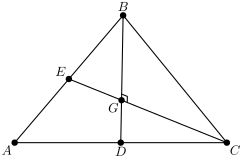
Medians and of triangle are perpendicular, and The area of triangle is
Respuesta: D
Pista pequeña:
Considera y como las diagonales del cuadrilátero
View and as the diagonals of quadrilateral
Pista grande:
El triángulo es semejante a con razón de semejanza
Triangle is similar to with scale factor
Solución:
El cuadrilátero tiene diagonales perpendiculares y por lo que su área es Como son puntos medios, el triángulo tiene la cuarta parte del área de de modo que tiene las tres cuartas partes. Por lo tanto, así que D es la respuesta correcta.
Quadrilateral has perpendicular diagonals and so its area is Since are midpoints, triangle has one fourth the area of making three fourths of it. Thus so D is correct.
16.
Las tres sumas de las filas y las tres sumas de las columnas del arreglo son iguales. ¿Cuál es la menor cantidad de entradas que deben modificarse para que las seis sumas sean distintas entre sí?
The three row sums and the three column sums of the array are the same. What is the least number of entries that must be altered to make all six sums different from one another?
Respuesta: D
Pista pequeña:
Si solo se modifican tres entradas, examina las filas y columnas que no contienen ninguna modificación
With only three altered entries, examine the rows and columns containing no alteration
Pista grande:
Para obtener una cota superior, intenta cambiar cuatro entradas de modo que sus efectos sobre las filas y las columnas sean todos distintos
For an upper bound, try changing four entries so that their row and column effects are all distinct
Solución:
Con a lo sumo tres modificaciones, o bien dos de las seis líneas quedan sin cambios, o bien alguna entrada modificada es la única modificación tanto de su fila como de su columna. En el primer caso, esas dos sumas siguen siendo iguales; en el segundo, esa entrada cambia la suma de su fila y la de su columna en la misma cantidad, por lo que esas dos sumas siguen siendo iguales. Cuatro modificaciones bastan: se reemplazan por respectivamente. Las sumas de las filas resultantes son , y las de las columnas son Por lo tanto, el mínimo es y D es la respuesta correcta.
With at most three alterations, either two of the six lines are unchanged, or some altered entry is the only alteration in both its row and its column. In the first case those two sums remain equal; in the second, that entry changes its row sum and column sum by the same amount, so those two sums remain equal. Four suffice: replace by respectively. The resulting row sums are and column sums are Hence the minimum is and D is correct.
17.
Una recta interseca las gráficas de y La distancia entre los puntos de intersección es Dado que donde y son enteros, ¿cuánto vale ?
A line intersects the graph of and the graph of The distance between the points of intersection is Given that where and are integers, what is
Respuesta: A
Pista pequeña:
Como ambos puntos tienen coordenada igual a , su distancia es la diferencia entre sus logaritmos
Because both points have -coordinate , their distance is the difference of their logarithms
Pista grande:
Combina los logaritmos y eleva a la potencia resultante
Combine the logarithms and exponentiate base
Solución:
La distancia vertical satisface Por lo tanto, así que Entonces y A es la respuesta correcta.
The vertical distance is Thus so Therefore and A is correct.
18.
Una lista de enteros tiene moda y media El menor número de la lista es La mediana pertenece a la lista. Si se reemplazara el elemento por la media y la mediana de la nueva lista serían y respectivamente. Si, en cambio, se reemplazara por la mediana de la nueva lista sería ¿Cuál es el valor de ?
A list of integers has mode and mean The smallest number in the list is The median of the list is a member of the list. If the list member were replaced by the mean and median of the new list would be and respectively. If were instead replaced by the median of the new list would be What is
Pista pequeña:
Un aumento total de eleva la media en , lo cual determina la longitud de la lista
A total increase of raises the mean by , determining the list length
Pista grande:
Ordena los cinco elementos y usa los dos cambios de mediana indicados para identificar los elementos contiguos a
Order the five entries and use the two stated median changes to identify the entries beside
Solución:
La lista tiene elementos. Se escriben como Al reemplazar por , ese valor se convierte en la mediana, por lo que y como la moda es debe cumplirse La suma original es de modo que Al reemplazar por , la mediana pasa a ser así que y Por lo tanto, E es la respuesta correcta.
The list has entries. Write them Replacing by makes that value the median, so and because the mode is we must have The original total is giving Replacing by makes the median so and Thus E is correct.
19.
Un círculo con centro es tangente a los ejes coordenados y a la hipotenusa del triángulo -- , como se muestra, donde Redondeado a la centésima más cercana, ¿cuál es el radio del círculo?
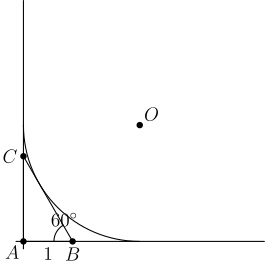
A circle with center is tangent to the coordinate axes and to the hypotenuse of the -- triangle as shown, where To the nearest hundredth, what is the radius of the circle?
Respuesta: D
Pista pequeña:
Si el radio del círculo es , entonces en las coordenadas mostradas
If the circle radius is , then in the displayed coordinates
Pista grande:
Escribe la ecuación de la recta que contiene la hipotenusa del triángulo -- e iguala su distancia desde a
Write the hypotenuse line of the -- triangle and set its distance from equal to
Solución:
Toma y La hipotenusa está en la recta y el centro del círculo es La tangencia da Para el círculo exterior mostrado, por lo que Así, D es la respuesta correcta.
Take and The hypotenuse is and the circle center is Tangency gives The pictured external circle has so Thus D is correct.
20.
¿Cuál de los siguientes enteros puede expresarse como la suma de enteros positivos consecutivos?
Which one of the following integers can be expressed as the sum of consecutive positive integers?
Respuesta: A
Pista pequeña:
Escribe los términos como
Write the terms as
Pista grande:
Su suma debe ser congruente con módulo
Their sum must be congruent to modulo
Solución:
La suma es así que termina en Solo tiene esa propiedad, y produce el entero positivo Por lo tanto, A es la respuesta correcta.
The sum is so it ends in Only has that property, and it gives the positive integer Thus A is correct.
21.
Para todo entero positivo se define ¿Cuánto vale ?
For any positive integer let What is
Respuesta: C
Pista pequeña:
Determina qué enteros pueden ser potencias racionales de
Determine which integers can be rational powers of
Pista grande:
Enumera las potencias de que no superan y suma sus logaritmos en base
List the powers of not exceeding and sum their base- logarithms
Solución:
Para un entero es racional exactamente cuando es una potencia de Los valores pertinentes son para y Por lo tanto, la suma es así que C es la respuesta correcta.
For integer is rational exactly when is a power of The relevant values are for and Therefore the sum is so C is correct.
22.
Ashley, Betty, Carlos, Dick y Elgin fueron de compras. Cada uno tenía una cantidad entera de dólares para gastar, y entre todos tenían La diferencia absoluta entre las cantidades que Ashley y Betty tenían para gastar era La diferencia absoluta entre las cantidades de Betty y Carlos era entre Carlos y Dick era entre Dick y Elgin era y entre Elgin y Ashley era ¿Cuánto dinero tenía Elgin?
Ashley, Betty, Carlos, Dick, and Elgin went shopping. Each had a whole number of dollars to spend, and together they had The absolute difference between the amounts Ashley and Betty had to spend was The absolute difference between the amounts Betty and Carlos had was between Carlos and Dick was between Dick and Elgin was and between Elgin and Ashley was How much did Elgin have?
Respuesta: E
Pista pequeña:
Asigna un signo a cada diferencia sucesiva alrededor del ciclo de cinco personas
Assign a sign to each successive difference around the five-person cycle
Pista grande:
Las diferencias con signo deben sumar cero antes de sumar las cinco cantidades
The signed differences must total zero before the five amounts can be summed
Solución:
Las diferencias con signo alrededor del ciclo tienen magnitudes y suman Por lo tanto, uno de los dos grupos de signos debe sumar la mitad de es decir, La única separación es Con una orientación, las cantidades son y Su suma es así que y Invertir todos los signos daría que no produce un valor entero de Por lo tanto, Elgin tenía y E es la respuesta correcta.
The signed differences around the cycle have magnitudes and sum Thus one side of the sign split must total half of namely The only split is In one orientation, the amounts are and Their total is so and Reversing every sign would give not an integral Thus Elgin had and E is correct.
23.
En la figura, los polígonos y son triángulos rectángulos isósceles; y son cuadrados de lado y es un triángulo equilátero. La figura puede plegarse por sus aristas para formar un poliedro cuyas caras son los polígonos. El volumen de este poliedro es
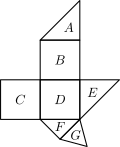
In the figure, polygons and are isosceles right triangles; and are squares with sides of length and is an equilateral triangle. The figure can be folded along its edges to form a polyhedron having the polygons as faces. The volume of this polyhedron is
Respuesta: D
Pista pequeña:
Reconoce los tres cuadrados unitarios como caras que se encuentran en un vértice de un cubo unitario
Recognize the three unit-square faces as faces meeting at a corner of a unit cube
Pista grande:
Las caras triangulares cierran el sólido que se obtiene al cortar un vértice de ese cubo
The triangular faces cap the solid obtained by slicing one corner from that cube
Solución:
El desarrollo forma un cubo unitario con un vértice cortado. La parte retirada es una pirámide triangular con tres aristas unitarias mutuamente perpendiculares, por lo que su volumen es El poliedro restante tiene volumen y la respuesta correcta es D.
The net forms a unit cube with one corner cut off. The removed corner is a triangular pyramid with three mutually perpendicular unit edges, so its volume is The remaining polyhedron has volume and the correct answer is D.
24.
Un número creciente, como es un entero positivo en el que cada dígito es mayor que todos los dígitos situados a su izquierda. Hay números crecientes de cinco dígitos. Cuando se ordenan de menor a mayor, el número que ocupa la posición en la lista no contiene el dígito
A rising number, such as is a positive integer each digit of which is larger than each of the digits to its left. There are five-digit rising numbers. When these numbers are arranged from smallest to largest, the th number in the list does not contain the digit
Respuesta: B
Pista pequeña:
Cuenta cuántos números crecientes comienzan con , y luego cuántos comienzan con
Count how many rising numbers begin with , then with
Pista grande:
Después de esos bloques, enumera los primeros números que comienzan con
After those blocks, list the first few numbers beginning with
Solución:
Hay que comienzan con Entre los que comienzan con los primeros comienzan con y ocupan las posiciones – Por lo tanto, el que ocupa la posición es el séptimo que comienza con El número no contiene así que B es la respuesta correcta.
There are beginning with Among those beginning with the first begin with occupying positions – Thus the th overall is the seventh beginning with The number omits so B is correct.
25.
Sea un paralelogramo, y sean y rayos paralelos en el espacio, situados en el mismo lado del plano determinado por Si y y son los puntos medios de y respectivamente, entonces
Let be a parallelogram and let and be parallel rays in space on the same side of the plane determined by If and and are the midpoints of and respectively, then
Respuesta: B
Pista pequeña:
Usa vectores y la identidad del paralelogramo
Use vectors and the parallelogram identity
Pista grande:
Las componentes en el plano de los dos puntos medios coinciden; compara solo sus componentes en la dirección de los rayos
The planar components of the two midpoints coincide; compare only their ray-direction components
Solución:
Elige la dirección común de los rayos como un vector unitario Entonces Como en un paralelogramo, por lo que La respuesta correcta es B.
Choose the common ray direction as a unit vector Then Since for a parallelogram, so The correct answer is B.
26.
Se dan el triángulo y el punto en el mismo plano. El punto equidista de y el ángulo es el doble del ángulo y interseca en el punto Si y entonces
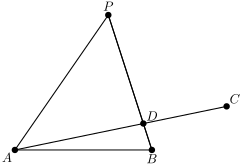
Triangle and point in the same plane are given. Point is equidistant from and angle is twice angle and intersects at point If and then
Respuesta: A
Pista pequeña:
Traza el círculo con centro que pasa por y
Draw the circle centered at through and
Pista grande:
La condición sobre el ángulo central sitúa a en ese círculo; aplica entonces el teorema de las cuerdas que se intersecan en
The central-angle condition puts on that circle, so apply intersecting chords at
Solución:
Como se traza el círculo con centro que pasa por ambos puntos. La condición es la relación entre un ángulo central y uno inscrito, por lo que pertenece al mismo círculo. Sobre la recta la otra intersección con el círculo es , con La potencia de da Por lo tanto, A es la respuesta correcta.
Because draw their circle with center The condition is the central-inscribed angle relation, so lies on the same circle. Along line the other circle intersection is with Power of gives Thus A is correct.
27.
Considera las funciones que satisfacen para todo real. Cada una de esas funciones es periódica, y existe un menor período positivo común para todas ellas. Halla
Consider those functions that satisfy for all real Any such function is periodic, and there is a least common positive period for all of them. Find
Respuesta: D
Pista pequeña:
Para un fijo, estudia la sucesión
For fixed , study the sequence
Pista grande:
Usa repetidamente para averiguar cuándo regresa cada par inicial
Use repeatedly to find when every initial pair returns
Solución:
Para la ecuación es A partir de la sucesión es por lo que toda función de este tipo tiene período Este es el menor posible porque satisface la ecuación y tiene período fundamental Por lo tanto, D es la respuesta correcta.
For the equation is Starting from the sequence is so every such function has period This is least because satisfies the equation and has fundamental period Hence D is correct.
28.
¿Cuántas ternas ordenadas de enteros satisfacen
How many ordered triples of integers satisfy
Respuesta: E
Pista pequeña:
Define , de modo que , y separa los casos según el signo de
Set , so , and split according to the sign of
Pista grande:
Cuando , reescribe las ecuaciones resultantes como productos iguales a
When , rewrite the resulting equations as products equal to
Solución:
Si la sustitución y la factorización no producen ningún par compatible con el signo necesario de Por lo tanto, de modo que y Si entonces lo que produce los pares no ordenados Si entonces lo que produce Cada par no ordenado tiene dos órdenes, lo que da ternas. La respuesta correcta es E.
If substitution and factoring lead to no pair consistent with the required sign of Thus so and If then producing the unordered pairs If then producing Each unordered pair has two orders, giving triples. The correct answer is E.
29.
Un número real positivo se llama especial si tiene una representación decimal formada únicamente por los dígitos y Por ejemplo, y son números especiales. ¿Cuál es el menor tal que puede escribirse como suma de números especiales?
Call a positive real number special if it has a decimal representation that consists entirely of digits and For example, and are special numbers. What is the smallest such that can be written as a sum of special numbers?
no puede representarse como suma de una cantidad finita de números especiales
cannot be represented as a sum of finitely many special numbers
Respuesta: B
Pista pequeña:
Si sumandos tienen un en la posición decimal , divide la suma por
If summands have in decimal place , divide the sum by
Pista grande:
Compara los conteos de dígitos resultantes con el decimal periódico de , y luego busca una construcción periódica de seis dígitos
Compare the resulting digit counts with the repeating decimal for , then seek a six-digit repeating construction
Solución:
Supón que es la suma de números especiales, y sea la cantidad de sumandos que tienen un en la posición decimal . Al dividir por , se obtiene Para cada es un dígito, por lo que de aquí Ocho bastan porque los decimales especiales periódicos representados por suman Por lo tanto, el mínimo es y B es la respuesta correcta.
Suppose is a sum of special numbers, and let count summands having a in the th decimal place. Dividing by gives For each is a digit, so hence Eight suffice because the repeating special decimals represented by Their sum is Therefore the minimum is and B is correct.
30.
Para los enteros positivos sea la cantidad de pares de dígitos adyacentes distintos en la representación binaria de Por ejemplo, y ¿Para cuántos enteros positivos menores o iguales que se cumple ?
For positive integers denote by the number of pairs of different adjacent digits in the binary (base two) representation of For example, and For how many positive integers less than or equal to does
Respuesta: C
Pista pequeña:
Un número binario válido consta de un bloque de , luego un bloque de , y finalmente otro bloque de
A valid binary numeral consists of a block of s, then s, then s
Pista grande:
Cuenta por longitud hasta seis bits, y luego trata por separado el límite de siete bits
Count by bit length through six bits, then handle the seven-bit cutoff separately
Solución:
Un número de bits con exactamente dos cambios tiene la forma , con positivos, lo que da posibilidades. Para el total es Entre los números de siete bits no mayores que funcionan las cinco formas que comienzan con un solo , y la única forma que comienza con al menos dos es el propio . Por lo tanto, hay y C es la respuesta correcta.
A -bit numeral with exactly two changes has form with positive giving choices. For the total is Among seven-bit numbers at most the five forms beginning with one all work, and the only form beginning with at least two s is itself. Thus there are and C is correct.