
Problemas del 1968 AMC 12
¡Desplázate hacia abajo y presiona Iniciar para intentar el examen! O ve al PDF imprimible, la clave de respuestas, o las soluciones profesionales preparadas por LIVE by Po-Shen Loh.
Todos los problemas se usan con el permiso legal oficial de la Mathematical Association of America (MAA).
O salta directamente a un solo problema con su solución: 1 · 2 · 3 · 4 · 5 · 6 · 7 · 8 · 9 · 10 · 11 · 12 · 13 · 14 · 15 · 16 · 17 · 18 · 19 · 20 · 21 · 22 · 23 · 24 · 25 · 26 · 27 · 28 · 29 · 30 · 31 · 32 · 33 · 34 · 35
¿Quieres aprender de forma profesional con clases interactivas en video?
Con tiempo
1:15:00
1.
Si el diámetro de un círculo aumenta unidades y, como resultado, su circunferencia aumenta unidades, entonces es igual a:
Let units be the increase in the circumference of a circle resulting from an increase of units in the diameter. Then equals:
Respuesta: D
Pista pequeña:
Expresa la circunferencia como
Write circumference as
Pista grande:
Sustituye por y resta
Replace by and subtract
Solución:
La circunferencia original es Después de que el diámetro aumenta es Por lo tanto, el aumento es
Por lo tanto, la respuesta correcta es D.
The original circumference is After the diameter increases by it is The increase is therefore
Therefore, the correct answer is D.
2.
El valor real de para el cual dividido entre es igual a es:
The real value of such that divided by equals is:
Respuesta: B
Pista pequeña:
Combina el cociente porque las potencias tienen el mismo exponente
Combine the quotient because its powers have the same exponent
Pista grande:
Expresa ambos lados como potencias de
Write both sides as powers of
Solución:
El lado izquierdo es mientras que Por consiguiente, así que
Por lo tanto, la respuesta correcta es B.
The left side is while Hence so
Therefore, the correct answer is B.
3.
Una recta que pasa por el punto es perpendicular a la recta Su ecuación es:
A straight line passing through the point is perpendicular to the line Its equation is:
Respuesta: A
Pista pequeña:
La recta dada tiene pendiente
The given line has slope
Pista grande:
Usa la pendiente recíproca negativa en una recta que pasa por
Use the negative reciprocal slope through
Solución:
La recta dada tiene pendiente así que una recta perpendicular tiene pendiente Al pasar por , su ecuación es o bien
Por lo tanto, la respuesta correcta es A.
The given line has slope so a perpendicular line has slope Through its equation is or
Therefore, the correct answer is A.
4.
Se define una operación para números reales positivos mediante Entonces es igual a:
Define an operation for positive real numbers by Then equals:
Respuesta: C
Pista pequeña:
Evalúa primero la operación interior
Evaluate the inner operation first
Pista grande:
Después de hallar sustituye el resultado como segundo argumento
After finding substitute it as the second input
Solución:
Primero, Por lo tanto, que es igual a
Por lo tanto, la respuesta correcta es C.
First, Therefore which equals
Therefore, the correct answer is C.
5.
Si entonces es igual a:
If then equals:
Respuesta: A
Pista pequeña:
Sustituye y por separado
Substitute and separately
Pista grande:
Extrae el factor común
Factor out
Solución:
Tenemos y Su diferencia se factoriza como multiplicado por El resultado es
Por lo tanto, la respuesta correcta es A.
We have and Factor their difference as times The result is
Therefore, the correct answer is A.
6.
Se prolonga el lado del cuadrilátero convexo más allá de y se prolonga el lado más allá de hasta que se cortan en el punto Sea la suma, en grados, de los ángulos y y sea la suma, en grados, de los ángulos y Si entonces:
Let side of convex quadrilateral be extended through and let side be extended through to meet in point Let represent the degree-sum of angles and and let represent the degree-sum of angles and If then:
a veces y a veces
sometimes, sometimes
a veces y a veces
sometimes, sometimes
Respuesta: E
Pista pequeña:
Expresa ambas sumas en función del ángulo
Express both sums using angle
Pista grande:
Aplica la suma de ángulos de un triángulo a y
Apply the triangle angle sum to and
Solución:
En el triángulo Como está en y está en el triángulo también da Por tanto, y
Por lo tanto, la respuesta correcta es E.
In triangle Since lies on and lies on triangle gives as well. Thus and
Therefore, the correct answer is E.
7.
Sea el punto de intersección de las medianas y del triángulo Si mide pulgadas, entonces en pulgadas, es:
Let be the intersection point of medians and of triangle If is inches, then in inches, is:
indeterminado
undetermined
Respuesta: E
Pista pequeña:
El baricentro da una razón únicamente sobre cada mediana por separado
A centroid gives a ratio only along each individual median
Pista grande:
Conocer una parte de no determina la longitud de
Knowing part of does not determine the length of
Solución:
El baricentro divide cada mediana en razón , por lo que determina Esto no establece ninguna relación entre las longitudes de las dos medianas distintas y Hay triángulos con y distintos valores de así que es indeterminado.
Por lo tanto, la respuesta correcta es E.
The centroid divides each median in a ratio, so determines It gives no relation between the lengths of the two different medians and Triangles with can have different so is undetermined.
Therefore, the correct answer is E.
8.
Por error, un número positivo se divide entre en vez de multiplicarse por Tomando como referencia el resultado correcto, el error porcentual cometido, redondeado al entero más cercano, es:
A positive number is mistakenly divided by instead of being multiplied by Based on the correct answer, the error thus committed, to the nearest percent, is:
Respuesta: B
Pista pequeña:
Sea el número y compara con
Let the number be and compare with
Pista grande:
Divide el error absoluto entre el resultado correcto
Divide the absolute error by the correct result
Solución:
El resultado correcto es mientras que el resultado erróneo es Con respecto al resultado correcto, el error es
Por lo tanto, la respuesta correcta es B.
The correct result is while the mistaken result is Relative to the correct result, the error is
Therefore, the correct answer is B.
9.
La suma de los valores reales de que satisfacen es:
The sum of the real values of satisfying is:
Respuesta: E
Pista pequeña:
Eleva ambos lados al cuadrado; los dos son no negativos
Square both sides; both sides are nonnegative
Pista grande:
Usa la suma de las raíces de la ecuación cuadrática resultante
Use the sum of the roots of the resulting quadratic
Solución:
Al elevar al cuadrado se obtiene o Ambas raíces satisfacen la ecuación original con valores absolutos, y su suma es
Por lo tanto, la respuesta correcta es E.
Squaring gives or Both roots satisfy the original absolute-value equation, and their sum is
Therefore, the correct answer is E.
10.
Supón que, en cierta escuela, son verdaderas las afirmaciones
Algunos estudiantes no son honestos.
Todos los miembros de la fraternidad son honestos.
Una conclusión necesaria es:
Assume that, for a certain school, it is true that
Some students are not honest.
All fraternity members are honest.
A necessary conclusion is:
Algunos estudiantes son miembros de la fraternidad
Some students are fraternity members
Algunos miembros de la fraternidad no son estudiantes
Some fraternity members are not students
Algunos estudiantes no son miembros de la fraternidad
Some students are not fraternity members
Ningún miembro de la fraternidad es estudiante
No fraternity member is a student
Ningún estudiante es miembro de la fraternidad
No student is a fraternity member
Respuesta: C
Pista pequeña:
Elige un estudiante cuya existencia esté garantizada por la afirmación
Choose a student whose existence is guaranteed by statement
Pista grande:
Según la afirmación , ¿podría ese estudiante deshonesto pertenecer a la fraternidad?
Could that dishonest student be a fraternity member under statement
Solución:
La afirmación garantiza la existencia de un estudiante deshonesto. La afirmación dice que todos los miembros de la fraternidad son honestos, por lo que ese estudiante deshonesto no puede pertenecer a ella. Por consiguiente, algún estudiante no es miembro de la fraternidad.
Por lo tanto, la respuesta correcta es C.
Statement guarantees a dishonest student. Statement says every fraternity member is honest, so that dishonest student cannot be a fraternity member. Hence some student is not a fraternity member.
Therefore, the correct answer is C.
11.
Si un arco de del círculo tiene la misma longitud que un arco de del círculo la razón entre el área del círculo y la del círculo es:
If an arc of on circle has the same length as an arc of on circle the ratio of the area of circle to that of circle is:
ninguna de las anteriores
none of these
Respuesta: B
Pista pequeña:
Iguala para los dos arcos
Equate for the two arcs
Pista grande:
Eleva al cuadrado la razón de radios resultante para obtener la razón de áreas
Square the resulting radius ratio to get the area ratio
Solución:
La igualdad de las longitudes de arco da por lo que Las áreas de los círculos varían como los cuadrados de sus radios, lo que da
Por lo tanto, la respuesta correcta es B.
Equal arc lengths give so Circle areas scale as the squares of the radii, giving
Therefore, the correct answer is B.
12.
Un círculo pasa por los vértices de un triángulo cuyas longitudes de lado son El radio del círculo es:
A circle passes through the vertices of a triangle with side-lengths The radius of the circle is:
Respuesta: C
Pista pequeña:
Las longitudes de los lados son veces una terna pitagórica conocida
The side lengths are times a familiar Pythagorean triple
Pista grande:
La hipotenusa de un triángulo rectángulo es el diámetro de su circunferencia circunscrita
A right triangle’s hypotenuse is the circumcircle’s diameter
Solución:
Los lados son así que el triángulo es rectángulo y su hipotenusa mide La hipotenusa es el diámetro de la circunferencia circunscrita, de modo que el radio es
Por lo tanto, la respuesta correcta es C.
The sides are so the triangle is right with hypotenuse The hypotenuse is the circumdiameter, making the radius
Therefore, the correct answer is C.
13.
Si y son las raíces de con y entonces la suma de las raíces es:
If and are the roots of then the sum of the roots is:
indeterminada
undetermined
Respuesta: B
Pista pequeña:
Usa tanto la suma como el producto en las fórmulas de Vieta
Use both the sum and product forms of Vieta’s formulas
Pista grande:
La ecuación del producto y determinan
The product equation and determine
Solución:
Como las raíces son las fórmulas de Vieta dan y Dado que la segunda ecuación da y entonces Su suma es
Por lo tanto, la respuesta correcta es B.
Because the roots are Vieta gives and Since the second equation gives and then Their sum is
Therefore, the correct answer is B.
14.
Si y son números no nulos tales que y entonces es igual a:
If and are nonzero numbers such that and then equals:
Respuesta: E
Pista pequeña:
Multiplica cada ecuación por su denominador
Multiply each equation by its denominator
Pista grande:
Ambas ecuaciones producen una expresión para
Both equations produce an expression for
Solución:
Las ecuaciones dan y Por lo tanto, así que
Por lo tanto, la respuesta correcta es E.
The equations give and Therefore so
Therefore, the correct answer is E.
15.
Sea el producto de tres enteros positivos impares consecutivos cualesquiera. El mayor entero que divide a todos esos valores de es:
Let be the product of any three consecutive positive odd integers. The largest integer dividing all such is:
Respuesta: D
Pista pequeña:
Examina los residuos módulo de tres enteros impares consecutivos
Among three consecutive odd integers, inspect residues modulo
Pista grande:
Usa dos ejemplos para descartar cualquier divisor común mayor
Use two examples to rule out every larger common divisor
Solución:
Tres enteros impares consecutivos ocupan tres residuos consecutivos módulo de modo que uno es divisible entre Por tanto, todo producto es divisible entre Los productos y tienen máximo común divisor así que ningún entero mayor divide siempre al producto.
Por lo tanto, la respuesta correcta es D.
Three consecutive odd integers occupy three consecutive residues modulo so one is divisible by Thus every product is divisible by The products and have greatest common divisor so no larger integer always divides the product.
Therefore, the correct answer is D.
16.
Si satisface y entonces:
If is such that and then:
o
or
o
or
Respuesta: E
Pista pequeña:
Combina las condiciones como
Combine the conditions as
Pista grande:
Al tomar recíprocos, considera por separado los valores positivos y negativos de
Treat positive and negative separately when taking reciprocals
Solución:
Para da mientras que la otra desigualdad se cumple automáticamente. Para da mientras que la primera se cumple automáticamente. Por tanto, o
Por lo tanto, la respuesta correcta es E.
For gives while the other inequality is automatic. For gives while the first is automatic. Thus or
Therefore, the correct answer is E.
17.
Sea donde es un entero positivo. Si para el conjunto de valores posibles de es:
Let where is a positive integer. If the set of possible values of is:
Pista pequeña:
Agrupa términos consecutivos como
Pair consecutive terms
Pista grande:
Considera por separado los valores pares e impares de
Separate even and odd values of
Solución:
Si es par, los términos se agrupan para dar suma así que Si es impar, queda un último así que Por lo tanto, los valores posibles son
Por lo tanto, la respuesta correcta es C.
If is even, the terms pair to give sum so If is odd, one final remains, so The possible values are therefore
Therefore, the correct answer is C.
18.
El lado del triángulo mide pulgadas. Se traza la recta paralela a , con en el segmento y en el segmento La prolongación de la recta biseca el ángulo Si mide pulgadas, entonces la longitud de en pulgadas, es:
Side of triangle has length inches. Line is drawn parallel to so that is on segment and is on segment Line extended bisects angle If has length inches, then the length of in inches, is:
Respuesta: D
Pista pequeña:
Toma en la prolongación de más allá de , de modo que la condición de la bisectriz sea
Put on the extension of beyond , so the bisector condition is
Pista grande:
Después de demostrar usa la semejanza de y
After showing use similarity of and
Solución:
Toma en la prolongación de más allá de La condición de la bisectriz da Como tenemos Además, los rayos y son opuestos, al igual que los rayos y por lo que Así, el triángulo es isósceles y Los triángulos semejantes y dan Por consiguiente, y
Por lo tanto, la respuesta correcta es D.
Put on the extension of beyond The bisector condition gives Since we have Also, rays and are opposite, as are rays and so Thus triangle is isosceles and Similar triangles and give Hence so
Therefore, the correct answer is D.
19.
Sea el número de maneras de cambiar dólares en monedas de diez y de veinticinco centavos, usando al menos una moneda de cada tipo. Entonces es igual a:
Let be the number of ways that dollars can be changed into dimes and quarters, with at least one of each coin being used. Then equals:
Respuesta: E
Pista pequeña:
En centavos, resuelve
In cents, solve
Pista grande:
Usa la paridad para escribir y luego exige cantidades positivas de ambas monedas
Use parity to write , then enforce positive coin counts
Solución:
La ecuación se reduce a Por lo tanto, debe ser par; escribe lo que da La positividad exige así que hay maneras.
Por lo tanto, la respuesta correcta es E.
The equation reduces to Thus must be even; write giving Positivity requires so there are ways.
Therefore, the correct answer is E.
20.
Las medidas de los ángulos interiores de un polígono convexo de lados están en progresión aritmética. Si la diferencia común es y el ángulo mayor es entonces es igual a:
The measures of the interior angles of a convex polygon of sides are in arithmetic progression. If the common difference is and the largest angle is then equals:
Respuesta: A
Pista pequeña:
Expresa el ángulo menor como
Write the smallest angle as
Pista grande:
Iguala la suma de la progresión aritmética a
Equate the arithmetic-series sum to
Solución:
El ángulo menor es La suma de los ángulos es multiplicado por y es igual a Esto se simplifica a Por tanto,
Por lo tanto, la respuesta correcta es A.
The smallest angle is The angle sum is times and it equals This simplifies to Thus
Therefore, the correct answer is A.
21.
Si entonces el dígito de las unidades de es:
If then the units digit in the value of is:
Respuesta: D
Pista pequeña:
Todo factorial desde en adelante termina en cero
Every factorial from onward ends in zero
Pista grande:
Suma únicamente los dígitos de las unidades de los primeros cuatro términos
Only add the units digits of the first four terms
Solución:
Para es divisible entre Solo importan los primeros cuatro términos. Su suma es cuyo dígito de las unidades es
Por lo tanto, la respuesta correcta es D.
For is divisible by Only the first four terms matter. Their sum is whose units digit is
Therefore, the correct answer is D.
22.
Un segmento de longitud se divide en cuatro segmentos. Existe un cuadrilátero cuyos lados son esos cuatro segmentos si y solo si cada segmento es:
A segment of length is divided into four segments. Then there exists a quadrilateral with the four segments as sides if and only if each segment is:
igual a
equal to
mayor o igual que y menor que
equal to or greater than and less than
mayor que y menor que
greater than and less than
mayor que y menor que
greater than and less than
menor que
less than
Respuesta: E
Pista pequeña:
Un cuadrilátero no degenerado existe exactamente cuando el lado más largo es menor que la suma de los otros tres
A nondegenerate quadrilateral exists exactly when the longest side is shorter than the other three combined
Pista grande:
Las cuatro longitudes suman
The four lengths sum to
Solución:
Un cuadrilátero simple no degenerado existe exactamente cuando cada lado es menor que la suma de los otros tres. Como el total es para cada segmento esta condición es o
Por lo tanto, la respuesta correcta es E.
A simple nondegenerate quadrilateral exists exactly when each side is less than the sum of the other three. Since the total is this condition is or for every segment.
Therefore, the correct answer is E.
23.
Si todos los logaritmos son números reales, la igualdad
se satisface para:
If all the logarithms are real numbers, the equality
is satisfied for:
todos los valores reales de
all real values of
ningún valor real de
no real values of
todos los valores reales de excepto
all real values of except
ningún valor real de excepto
no real values of except
todos los valores reales de excepto
all real values of except
Respuesta: B
Pista pequeña:
Combina los dos logaritmos del lado izquierdo
Combine the two logarithms on the left
Pista grande:
Resuelve la ecuación algebraica resultante y luego comprueba su dominio
Solve the resulting algebraic equation, then test its domain
Solución:
Combinar los logaritmos exigiría Esto da Pero entonces de modo que el logaritmo de la izquierda no es real. Por consiguiente, no hay soluciones reales.
Por lo tanto, la respuesta correcta es B.
Combining logarithms would require This gives But then so the logarithm on the left is not real. Hence there are no real solutions.
Therefore, the correct answer is B.
24.
Se colocará una pintura de en un marco de madera, con la dimensión mayor en posición vertical. La madera de arriba y abajo tiene el doble de ancho que la de los lados. Si el área del marco es igual a la de la pintura, la razón entre la dimensión menor y la mayor de la pintura enmarcada es:
A painting is to be placed into a wooden frame with the longer dimension vertical. The wood at the top and bottom is twice as wide as the wood on the sides. If the frame area equals that of the painting itself, the ratio of the smaller to the larger dimension of the framed painting is:
Respuesta: C
Pista pequeña:
Sea el ancho de cada franja lateral, de modo que cada franja superior e inferior mide
Let each side strip have width , so each top strip has width
Pista grande:
Iguala el área exterior al doble de
Set the outside area equal to twice
Solución:
Las dimensiones exteriores son y Como el área del marco es igual a la de la pintura, Esto da así que Las dimensiones son y cuya razón es
Por lo tanto, la respuesta correcta es C.
The outside dimensions are and Since the frame area equals the painting area, This gives so The dimensions are and with ratio
Therefore, the correct answer is C.
25.
Ace corre a velocidad constante y Flash corre veces más rápido, con Flash le da a Ace una ventaja de yardas y, al recibir una señal, ambos parten en la misma dirección. Entonces la cantidad de yardas que Flash debe correr para alcanzar a Ace es:
Ace runs with constant speed and Flash runs times as fast, Flash gives Ace a head start of yards, and, at a given signal, they start off in the same direction. Then the number of yards Flash must run to catch Ace is:
Respuesta: C
Pista pequeña:
Si la velocidad de Ace es la velocidad relativa es
If Ace’s speed is the closing speed is
Pista grande:
Multiplica el tiempo de alcance por la velocidad de Flash
Multiply the catch-up time by Flash’s speed
Solución:
Si Ace corre a velocidad Flash corre a por lo que su velocidad relativa es El tiempo para alcanzarlo es durante el cual Flash recorre
Por lo tanto, la respuesta correcta es C.
If Ace runs at speed Flash runs at so their closing speed is The catch-up time is during which Flash runs
Therefore, the correct answer is C.
26.
Sea donde es el menor entero positivo tal que Entonces la suma de los dígitos de es:
Let where is the smallest positive integer such that Then the sum of the digits of is:
Respuesta: E
Pista pequeña:
La suma es
The sum is
Pista grande:
Compara y con un millón
Compare and with one million
Solución:
Tenemos Para resulta mientras que para resulta Por tanto, cuya suma de dígitos es
Por lo tanto, la respuesta correcta es E.
We have For this is while for it is Thus whose digit sum is
Therefore, the correct answer is E.
27.
Sea
Aquí Entonces es igual a:
Let
Here Then equals:
Respuesta: B
Pista pequeña:
Agrupa los términos como
Pair terms as
Pista grande:
Para par, para impar,
For even for odd
Solución:
Al agrupar se obtiene para par y para impar. Por consiguiente, y su suma es
Por lo tanto, la respuesta correcta es B.
Pairing gives for even and for odd Hence and their sum is
Therefore, the correct answer is B.
28.
Si la media aritmética de y es el doble de su media geométrica, con entonces un posible valor de la razón redondeado al entero más cercano, es:
If the arithmetic mean of and is double their geometric mean, with then a possible value for the ratio to the nearest integer, is:
ninguna de las anteriores
none of these
Respuesta: D
Pista pequeña:
Sea y divide la ecuación de las medias entre
Set and divide the mean equation by
Pista grande:
La ecuación se vuelve cuadrática después de elevarla al cuadrado
The equation becomes quadratic after squaring
Solución:
Sea La condición da por lo que La raíz mayor que es cuyo entero más cercano es
Por lo tanto, la respuesta correcta es D.
Let The condition gives so The root greater than is whose nearest integer is
Therefore, the correct answer is D.
29.
Dados los tres números con Ordenados de menor a mayor, son:
Given the three numbers with Arranged in order of increasing magnitude, they are:
Respuesta: A
Pista pequeña:
Para compara las potencias mediante sus exponentes positivos
For compare powers by comparing their positive exponents
Pista grande:
Primero demuestra y luego compara
First show , then compare
Solución:
Como y elevar al exponente da Para una base entre y un exponente mayor produce un valor menor. Como tenemos Así,
Por lo tanto, la respuesta correcta es A.
Since and raising to the exponent gives For a base between and a larger exponent gives a smaller value. Because we have Thus
Therefore, the correct answer is A.
30.
En un mismo plano se dibujan los polígonos convexos y con y lados respectivamente, donde Si y no tienen ningún segmento de recta en común, entonces el número máximo de puntos de intersección entre y es:
Convex polygons and are drawn in the same plane with and sides, respectively, If and do not have any line segment in common, then the maximum number of intersections of and is:
ninguna de las anteriores
none of these
Respuesta: A
Pista pequeña:
Un segmento puede entrar y salir de un polígono convexo a lo sumo una vez
A line segment can enter and leave a convex polygon at most once
Pista grande:
Aplica esa cota a cada lado del polígono que tiene menos lados
Apply that bound to each side of the polygon with fewer sides
Solución:
Cada lado de está contenido en una recta, y su intersección con la región convexa es un solo segmento o es vacía. Por lo tanto, ese lado cruza la frontera de a lo sumo dos veces. En los lados hay como máximo y un -gono convexo suficientemente delgado que cruce un -gono convexo alcanza esta cota.
Por lo tanto, la respuesta correcta es A.
Each side of lies on a line, and its intersection with the convex region is a single segment or empty. Thus that side crosses the boundary of at most twice. Across sides there are at most and a suitable thin convex -gon crossing a convex -gon attains this bound.
Therefore, the correct answer is A.
31.
En este diagrama, que no está dibujado a escala, las figuras y son regiones triangulares equiláteras con áreas respectivas de y pulgadas cuadradas. La figura es una región cuadrada de área pulgadas cuadradas. Se reduce la longitud del segmento en un de sí misma, mientras las longitudes de y permanecen sin cambio. El porcentaje de disminución del área del cuadrado es:
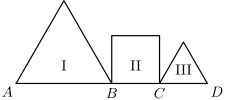
In this diagram, not drawn to scale, figures and are equilateral triangular regions with respective areas of and square inches. Figure is a square region with area square inches. Let the length of segment be decreased by of itself, while the lengths of and remain unchanged. The percent decrease in the area of the square is:
Respuesta: D
Pista pequeña:
Convierte las tres áreas dadas en las longitudes de lado
Convert the three given areas into the side lengths
Pista grande:
La disminución de recae por completo en el lado del cuadrado
The decrease in is absorbed entirely by the square’s side
Solución:
De se obtiene El cuadrado tiene y el triángulo equilátero menor también tiene Por tanto, Reducirlo en resta de cuya nueva longitud es El área del cuadrado baja de a una disminución del
Por lo tanto, la respuesta correcta es D.
From The square has and the smaller equilateral triangle also has Thus Decreasing it by removes from whose new length is The square’s area falls from to a decrease.
Therefore, the correct answer is D.
32.
y se mueven uniformemente por dos trayectorias rectas que se cortan perpendicularmente en el punto Cuando está en a le faltan yardas para llegar a Al cabo de minutos están a la misma distancia de y minutos después vuelven a estar a la misma distancia de Entonces la razón entre la velocidad de y la de es:
and move uniformly along two straight paths intersecting at right angles in point When is at is yards short of In minutes they are equidistant from and in minutes more they are again equidistant from Then the ratio of ’s speed to ’s speed is:
Respuesta: C
Pista pequeña:
Sean las velocidades ; cuando
Let the speeds be ; at
Pista grande:
Cuando ya pasó por así que
At has passed so
Solución:
Sean las velocidades de Cuando por lo que Cuando ya pasó por y de modo que Por consiguiente, y
Por lo tanto, la respuesta correcta es C.
Let the speeds of be At so At has passed and so Hence and
Therefore, the correct answer is C.
33.
Un número tiene tres dígitos cuando se expresa en base Cuando se expresa en base , los dígitos aparecen en orden inverso. Entonces el dígito central es:
A number has three digits when expressed in base When is expressed in base the digits are reversed. Then the middle digit is:
Respuesta: A
Pista pequeña:
Llama a los dígitos en base e iguala con
Call the base- digits and equate to
Pista grande:
Reordena para obtener y usa las cotas de los dígitos
Rearrange to and use the digit bounds
Solución:
Sea Entonces así que Con y la única posibilidad es En efecto,
Por lo tanto, la respuesta correcta es A.
Let Then so With and the only possibility is Indeed,
Therefore, the correct answer is A.
34.
Con miembros votando, la Cámara de Representantes rechazó un proyecto de ley. En una segunda votación con los mismos miembros, el proyecto fue aprobado por un margen igual al doble del margen por el que había sido rechazado. El número de votos a favor en la segunda votación fue del número de votos en contra en la primera. ¿Cuántos miembros más votaron a favor del proyecto la segunda vez que la primera?
With members voting, the House of Representatives defeated a bill. A re-vote, with the same members voting, resulted in passage of the bill by twice the margin by which it was originally defeated. The number voting for the bill on the re-vote was of the number voting against it originally. How many more members voted for the bill the second time than voted for it the first time?
Respuesta: B
Pista pequeña:
Sean y las cantidades de votos a favor en la primera y la segunda votación
Let the original and second numbers voting for be and
Pista grande:
Usa y
Use and
Solución:
Sean las cantidades de votos a favor en la primera y la segunda votación. La condición de la razón da El margen de aprobación es el doble del margen de rechazo original, por lo que o Al resolver se obtiene así que miembros más votaron a favor.
Por lo tanto, la respuesta correcta es B.
Let be the original and second numbers voting for the bill. The ratio condition gives The passage margin is twice the original defeat margin, so or Solving gives so more members voted for it.
Therefore, the correct answer is B.
35.
En este diagrama, el centro del círculo es el radio mide pulgadas, la cuerda es paralela a la cuerda los puntos son colineales y es el punto medio de Sea , en pulgadas cuadradas, el área del trapecio , y sea , en pulgadas cuadradas, el área del rectángulo Al trasladar y hacia arriba, de modo que aumente y se acerque al valor mientras siempre sea igual a la razón se aproxima tanto como se quiera a:
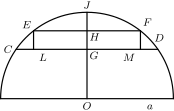
In this diagram the center of the circle is the radius is inches, chord is parallel to chord are collinear, and is the midpoint of Let (square inches) represent the area of trapezoid and let (square inches) represent the area of rectangle Then, as and are translated upward so that increases toward the value while always equals the ratio becomes arbitrarily close to:
Pista pequeña:
Sea de modo que y
Let so and
Pista grande:
Expresa las dos semicuerdas mediante el teorema de Pitágoras y luego haz que se acerque a
Express the two half-chords with the Pythagorean theorem, then let approach
Solución:
Sea Entonces y Las semicuerdas son Como ambas figuras tienen altura Cuando se acerca a la última fracción se acerca a Por lo tanto, se acerca a
Por lo tanto, la respuesta correcta es D.
Let Then and The half-chords are Since both figures have height As approaches the latter fraction approaches Thus approaches
Therefore, the correct answer is D.