
Problemas del 1992 AIME
¡Desplázate hacia abajo y presiona Iniciar para intentar el examen! O ve al PDF imprimible, la clave de respuestas, o las soluciones profesionales preparadas por LIVE by Po-Shen Loh.
Todos los problemas se usan con el permiso legal oficial de la Mathematical Association of America (MAA).
O salta directamente a un solo problema con su solución: 1 · 2 · 3 · 4 · 5 · 6 · 7 · 8 · 9 · 10 · 11 · 12 · 13 · 14 · 15
¿Quieres aprender de forma profesional con clases interactivas en video?
Con tiempo
3:00:00
1.
Halla la suma de todos los números racionales positivos menores que cuyo denominador es cuando se escriben en su mínima expresión.
Find the sum of all positive rational numbers that are less than and that have denominator when written in lowest terms.
Respuesta: 400
Pista pequeña:
Escribe cada número como e impón la condición
Write every number as and impose the condition
Pista grande:
Agrupa los numeradores admisibles en diez bloques de longitud
Group the eligible numerators into ten blocks of length
Solución:
Los números son para y Hay residuos admisibles en cada bloque de cuya suma es Por lo tanto, la suma de todos los numeradores admisibles es Al dividir entre , se obtiene
The numbers are for and There are eligible residues in each block of and their sum is Thus the sum of all eligible numerators is Dividing by gives
2.
Se llama ascendente a un entero positivo cuya representación decimal tiene al menos dos cifras y en la que cada cifra es menor que cualquiera de las cifras situadas a su derecha. ¿Cuántos enteros positivos ascendentes hay?
A positive integer is called ascending if, in its decimal representation, there are at least two digits and each digit is less than any digit to its right. How many ascending positive integers are there?
Respuesta: 502
Pista pequeña:
Una vez elegido un conjunto de cifras no nulas, el orden queda determinado
Once a set of nonzero digits is chosen, their order is forced
Pista grande:
Excluye los subconjuntos de tamaños y de los subconjuntos de
Exclude subsets of sizes and from the subsets of
Solución:
La cifra no puede aparecer, pues tendría que ser la primera y los ceros iniciales no forman parte de una representación decimal. Cada subconjunto de al menos dos cifras de produce exactamente un entero ascendente al escribirlas en orden creciente. Por consiguiente, la cantidad es
The digit cannot occur, because it would have to be the first digit and leading zeroes are not part of a decimal representation. Every subset of at least two digits from gives exactly one ascending integer when written in increasing order. Hence the number is
3.
Una tenista calcula su proporción de victorias dividiendo el número de partidos ganados entre el número total de partidos jugados. Al comienzo de un fin de semana, su proporción de victorias es exactamente Durante ese fin de semana juega cuatro partidos, gana tres y pierde uno. Al terminar el fin de semana, su proporción de victorias es mayor que ¿Cuál es el mayor número de partidos que podría haber ganado antes de comenzar el fin de semana?
A tennis player computes her win ratio by dividing the number of matches she has won by the total number of matches she has played. At the start of a weekend, her win ratio is exactly During the weekend, she plays four matches, winning three and losing one. At the end of the weekend, her win ratio is greater than What’s the largest number of matches she could’ve won before the weekend began?
Respuesta: 164
Pista pequeña:
Si inicialmente había ganado partidos, una proporción de significa que había jugado partidos
If she had wins initially, a ratio means she had played matches
Pista grande:
Expresa la proporción final mediante una desigualdad estricta antes de buscar el mayor entero
Translate the final ratio into a strict inequality before taking the largest integer
Solución:
Si inicialmente había ganado partidos, entonces había jugado partidos. La condición final es Al multiplicar en cruz se obtiene de modo que y El mayor entero posible es
If she initially had wins, then she had played matches. The final condition is Cross-multiplication gives so and The largest possible integer is
4.
En el triángulo de Pascal, cada entrada es la suma de las dos entradas situadas sobre ella. A continuación se muestran las primeras filas.
¿En qué fila del triángulo de Pascal aparecen tres entradas consecutivas en la razón ?
In Pascal’s Triangle, each entry is the sum of the two entries above it. The first few rows of the triangle are shown below.
In which row of Pascal’s Triangle do three consecutive entries occur that are in the ratio
Respuesta: 62
Pista pequeña:
Representa las tres entradas como y
Represent the three entries as and
Pista grande:
Usa las razones entre coeficientes binomiales consecutivos para obtener dos ecuaciones lineales en y
Use the ratios of consecutive binomial coefficients to obtain two linear equations in and
Solución:
Para tres entradas consecutivas que comienzan en la posición Por lo tanto, y Al resolver, se obtiene y
For three consecutive entries beginning at position Thus and Solving gives and
5.
Sea el conjunto de todos los números racionales con que tienen una expansión decimal periódica de la forma donde las cifras y no son necesariamente distintas. Para escribir los elementos de como fracciones en su mínima expresión, ¿cuántos numeradores distintos se necesitan?
Let be the set of all rational numbers that have a repeating decimal expansion in the form where the digits and are not necessarily distinct. To write the elements of as fractions in lowest terms, how many different numerators are required?
Respuesta: 660
Pista pequeña:
Cada elemento tiene la forma , y su denominador reducido debe dividir a
Every element has the form , and its reduced denominator must divide
Pista grande:
Cuenta los numeradores coprimos con y luego determina qué múltiplos adicionales de pueden aparecer con denominador
Count numerators coprime to , then check which additional multiples of can occur with denominator
Solución:
Cada elemento es para Cualquier coprimo con aparece como numerador reducido con denominador lo que da valores. Si es divisible por pero no por solo puede ser coprimo con un denominador reducido cuando este es esto añade los múltiplos de menores que Un numerador divisible por necesitaría un denominador que dividiera a y fuera mayor que él, así que no aparecen más valores. Por lo tanto, el total es
Every element is for Any coprime to occurs as a reduced numerator with denominator giving values. If is divisible by but not it can be coprime to a reduced denominator only when that denominator is this adds the multiples of below A numerator divisible by would need a denominator dividing and larger than it, so no further values occur. Therefore the total is
6.
¿Para cuántos pares de enteros consecutivos de no se necesita llevar al sumar los dos enteros?
For how many pairs of consecutive integers in is no carrying required when the two integers are added?
Respuesta: 156
Pista pequeña:
Escribe el entero menor como y separa los casos según el número de cifras finales
Write the smaller integer as and separate cases by the number of trailing s
Pista grande:
Una cifra que no cambia debe ser a lo sumo , y la cifra que aumenta en también debe sumarse sin llevar
A digit that is unchanged must be at most , and the digit increased by must also pair without a carry
Solución:
Escribe el número menor como Si entonces y las cifras que no cambian, y son a lo sumo lo que da pares. Si pero entonces y lo que da pares. Si pero hay opciones para Por último, tampoco necesita llevar. El total es
Write the smaller number as If then and the unchanged digits and are each at most giving pairs. If but then and giving pairs. If but there are choices for Finally, also needs no carry. The total is
7.
Las caras y del tetraedro forman un ángulo diedro de El área de la cara es el área de la cara es y Halla el volumen del tetraedro.
Faces and of tetrahedron meet at an angle of The area of face is the area of face is and Find the volume of the tetrahedron.
Respuesta: 320
Pista pequeña:
Halla las alturas desde y hasta la arista común
Find the altitudes from and to the common edge
Pista grande:
La altura desde hasta el plano es la altura de su cara multiplicada por
The height from to plane is its face altitude multiplied by
Solución:
Las alturas hasta en las caras y son y respectivamente. Como el ángulo diedro es la altura perpendicular desde hasta el plano es Usando la cara como base, el volumen es
The altitudes to in faces and are and respectively. Because the dihedral angle is the perpendicular height from to plane is Using face as the base, the volume is
8.
Para cualquier sucesión de números reales define como la sucesión cuyo término -ésimo es Supón que todos los términos de la sucesión son y que Halla
For any sequence of real numbers define to be the sequence whose th term is Suppose that all of the terms of the sequence are and that Find
Respuesta: 819
Pista pequeña:
Una sucesión con segunda diferencia constante igual a viene dada por un polinomio cuadrático con coeficiente principal
A sequence with constant second difference is given by a quadratic with leading coefficient
Pista grande:
Usa los dos términos nulos para escribir el polinomio cuadrático en forma factorizada
Use the two zero terms to write the quadratic in factored form
Solución:
Una sucesión cuadrática con segunda diferencia tiene coeficiente principal Como sus valores se anulan en los índices y Por lo tanto,
A quadratic sequence with second difference has leading coefficient Since its values vanish at indices and Therefore
9.
El trapecio tiene lados y con paralelo a Se traza un círculo con centro sobre , tangente a y Dado que donde y son enteros positivos coprimos, halla
Trapezoid has sides and with parallel to A circle with center on is drawn tangent to and Given that where and are relatively prime positive integers, find
Respuesta: 164
Pista pequeña:
Coloca sobre el eje y compara las distancias de a los dos lados no paralelos
Put on the -axis and compare the distances from to the two legs
Pista grande:
La altura común del trapecio se cancela y queda una ecuación con y divididos entre las longitudes de los lados no paralelos
The common trapezoid height cancels, leaving an equation involving and divided by the leg lengths
Solución:
Toma y sea la altura del trapecio. Si sus distancias perpendiculares a los lados y son y respectivamente. La tangencia con ambos lados hace que estas distancias sean iguales, así que Por consiguiente, y Por lo tanto,
Put and let the height of the trapezoid be If its perpendicular distances to legs and are and respectively. Tangency to both legs makes these equal, so Hence and Therefore
10.
Considera la región del plano complejo formada por todos los puntos tales que tanto como tienen sus partes real e imaginaria entre y inclusive. ¿Cuál es el entero más cercano al área de ?
Consider the region in the complex plane that consists of all points such that both and have real and imaginary parts between and inclusive. What is the integer that is nearest the area of
Respuesta: 572
Pista pequeña:
Escribe ; la primera condición da un cuadrado y la segunda da dos desigualdades que describen círculos
Write ; the first condition gives a square, and the second gives two circle inequalities
Pista grande:
Resta del cuadrado de por la unión de dos semicírculos, teniendo en cuenta su intersección en forma de lente
Subtract from the -by- square the union of two semicircles, accounting for their lens-shaped overlap
Solución:
Escribe La condición sobre da y Como la otra condición exige y Por lo tanto, dentro del cuadrado se eliminan dos semicírculos de radio
Su intersección es la lente formada por dos círculos de radio cuyos centros distan . Su área es Así, la unión eliminada tiene área , es decir, Sea el área de Entonces El entero más cercano es
Write The condition on gives and Since the other condition requires and Thus, within the square, we remove two semicircles of radius
Their overlap is the lens formed by two radius- circles whose centers are apart. Its area is Hence the removed union has area , or Let denote the area of Then The nearest integer is
11.
Las rectas y pasan por el origen y forman, respectivamente, ángulos del primer cuadrante de y radianes con el semieje positivo . Para cualquier recta la transformación produce otra recta de la siguiente manera: se refleja respecto de y luego la recta resultante se refleja respecto de Sea y Dado que es la recta halla el menor entero positivo para el cual
Lines and both pass through the origin and make first-quadrant angles of and radians, respectively, with the positive -axis. For any line the transformation produces another line as follows: is reflected in and the resulting line is reflected in Let and Given that is the line find the smallest positive integer for which
Respuesta: 945
Pista pequeña:
Dos reflexiones respecto de rectas que se cortan equivalen a una rotación del doble del ángulo entre ellas
Two reflections in intersecting lines compose to a rotation through twice the angle between the lines
Pista grande:
Una recta no orientada vuelve a coincidir consigo misma cuando la rotación acumulada es un múltiplo de
An unoriented line returns to itself when its accumulated rotation is a multiple of
Solución:
La composición es una rotación de Una recta que pasa por el origen queda inalterada por una rotación exactamente cuando el ángulo de rotación es un múltiplo de Por lo tanto, debe satisfacer Como el menor valor de es
The composition is rotation through A line through the origin is unchanged by a rotation exactly when the rotation angle is a multiple of Thus must satisfy Since the least such is
12.
En un juego de Chomp, dos jugadores se turnan para dar mordiscos a una cuadrícula de por cuadrados unitarios. Para dar un mordisco, un jugador elige uno de los cuadrados restantes y luego elimina (“come”) todos los cuadrados del cuadrante definido por el borde izquierdo del cuadrado elegido, prolongado hacia arriba, y su borde inferior, prolongado hacia la derecha. Por ejemplo, el mordisco determinado por el cuadrado sombreado del diagrama eliminaría ese cuadrado y los cuatro cuadrados marcados con (Los cuadrados con dos o más bordes punteados fueron eliminados del tablero original en jugadas anteriores.)
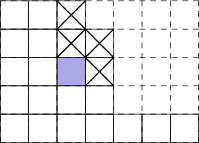
El objetivo del juego es obligar al oponente a dar el último mordisco. El diagrama muestra uno de los muchos subconjuntos del conjunto de cuadrados unitarios que pueden aparecer durante una partida de Chomp. ¿Cuántos subconjuntos distintos hay en total? Incluye en el conteo el tablero completo y el tablero vacío.
In a game of Chomp, two players alternately take bites from a -by- grid of unit squares. To take a bite, a player chooses one of the remaining squares, then removes (“eats”) all squares in the quadrant defined by the left edge (extended upward) and the lower edge (extended rightward) of the chosen square. For example, the bite determined by the shaded square in the diagram would remove the shaded square and the four squares marked by (The squares with two or more dotted edges have been removed from the original board in previous moves.)
The object of the game is to make one’s opponent take the last bite. The diagram shows one of the many subsets of the set of unit squares that can occur during the game of Chomp. How many different subsets are there in all? Include the full board and empty board in your count.
Respuesta: 792
Pista pequeña:
Un conjunto alcanzable queda determinado por alturas de columnas no crecientes entre y
A reachable set is determined by nonincreasing column heights between and
Pista grande:
Codifica el borde de tal conjunto como un camino reticular con pasos verticales y horizontales
Encode the boundary of such a set as a lattice path with vertical and horizontal steps
Solución:
Después de cualquier sucesión de mordiscos, los cuadrados restantes forman un conjunto cerrado hacia abajo y hacia la izquierda: las alturas de las siete columnas son enteros no crecientes entre y Recíprocamente, todo borde de este tipo puede producirse y corresponde a un camino reticular a través de un rectángulo de por . Cada camino consta de pasos verticales y horizontales, así que el número de estados, incluidos el completo y el vacío, es
After any sequence of bites, the remaining squares form a lower-left order ideal: the seven column heights are nonincreasing integers between and Conversely, every such boundary can be produced and corresponds to a lattice path across a -by- rectangle. Each path consists of vertical and horizontal steps, so the number of states, including full and empty, is
13.
El triángulo satisface y ¿Cuál es el área máxima que puede tener?
Triangle has and What’s the largest area that this triangle can have?
Respuesta: 820
Pista pequeña:
Toma y aplica la ley de los cosenos con
Set and use the Law of Cosines with
Pista grande:
Expresa el área como función de y maximiza su cuadrado
Express the area as a function of and maximize its square
Solución:
Toma y La ley de los cosenos da mientras que el área es Por consiguiente, es igual a Al derivar su logaritmo, se observa que el máximo ocurre cuando Entonces y de modo que el área máxima es
Set and The Law of Cosines gives while the area is Hence it equals Differentiating its logarithm shows the maximum occurs at Then and so the maximum area is
14.
En el triángulo los puntos y están sobre los lados y respectivamente. Dado que y concurren en el punto y que halla
In triangle and are on the sides and respectively. Given that and are concurrent at the point and that find
Respuesta: 94
Pista pequeña:
Sean las coordenadas baricéntricas normalizadas de
Let be normalized barycentric coordinates of
Pista grande:
Escribe las tres razones como , y
Write the three ratios as , , and
Solución:
Sean las coordenadas baricéntricas de Entonces Al desarrollar ambos lados y usar , se obtiene la identidad Como el producto pedido es
Let be the barycentric coordinates of Then Expanding both sides using gives the standard identity Since the requested product is
15.
Se dice que un entero positivo es una cola factorial si existe algún entero positivo tal que la representación decimal de termina exactamente en ceros. ¿Cuántos enteros positivos menores que no son colas factoriales?
Define a positive integer to be a factorial tail if there is some positive integer such that the decimal representation of ends with exactly zeroes. How many positive integers less than are not factorial tails?
Respuesta: 396
Pista pequeña:
Sea , el número de ceros finales de
Let , the number of trailing zeroes in
Pista grande:
Cada valor positivo que toma aparece por primera vez en algún múltiplo , donde
Every positive value attained by first appears at a multiple , where
Solución:
El número de ceros finales es Sus distintos valores positivos aparecen en los múltiplos y es estrictamente creciente con Ahora, así que Para el mismo cálculo da y por eso Por lo tanto, exactamente valores positivos hasta son colas factoriales. De los enteros positivos menores que la cantidad omitida es
The number of trailing zeroes is Its positive distinct values occur at the multiples and is strictly increasing with Now so For the same calculation gives hence Therefore exactly positive values through are factorial tails. Of the positive integers below the number omitted is