
2023 AMC 12A 真题
计时
1:15:00
1.
城市 和 相距 英里。Alicia 住在 ,Beth 住在 。Alicia 以每小时 英里的速度骑车前往 。Beth 同时出发,以每小时 英里的速度骑车前往 。她们相遇时距离城市 多少英里?
Cities and are miles apart. Alicia lives in and Beth lives in Alicia bikes towards at miles per hour. Leaving at the same time, Beth bikes toward at miles per hour. How many miles from City will they be when they meet?
答案:E
小提示:
她们的接近速度是每小时 英里
Their closing speed is miles per hour
大提示:
先求相遇所需时间,再乘以 Alicia 的速度
Find the time until they meet, then multiply by Alicia’s speed
解答:
两人之间的距离以每小时 英里的速度缩短,所以她们在 小时后相遇。
在这段时间里,Alicia 从城市 出发骑了 英里。
所以正确答案是 E。
The gap between them closes at miles per hour, so they meet after hours.
In that time Alicia has ridden miles from City
Thus, the correct answer is E.
2.
一个大披萨的 加上 杯橙子片的重量,等于一个大披萨的 加上 杯橙子片的重量。一杯橙子片重 磅。一个大披萨重多少磅?
The weight of of a large pizza together with cups of orange slices is the same as the weight of of a large pizza together with cup of orange slices. A cup of orange slices weighs of a pound. What is the weight, in pounds, of a large pizza?
小提示:
设披萨重 磅;每杯橙子片重 磅
Let the pizza weigh pounds; each cup of orange slices weighs
大提示:
把两边重量列成相等方程,并把含 的项移到同一边
Set the two weights equal and gather the terms on one side
解答:
设披萨重 磅。则 杯重 而 杯重 。
方程为
相减得 ,所以 ,从而 。
所以正确答案是 A。
Let the pizza weigh pounds. Then cups weigh and cup weighs
The equation is
Subtracting gives so and
Thus, the correct answer is A.
3.
小于 且能被 整除的正完全平方数有多少个?
How many positive perfect squares less than are divisible by
小提示:
一个完全平方数能被 整除,当且仅当它的平方根是 的倍数
A perfect square is divisible by exactly when its root is a multiple of
大提示:
这些平方数形如 ;求有多少个满足
The squares are ; find how many satisfy
解答:
一个完全平方数能被 整除,只有它的平方根也能被五整除,因此这些平方数形如 。
因为 ,而且这个数 ,所以平方根可以是 ,也就是 到 。
所以正确答案是 A。
A perfect square is divisible by only if its root is, so the squares are
Since the root can be which is through
Thus, the correct answer is A.
4.
的通常数字表示有多少位数字?
How many digits are in the base-ten representation of
小提示:
把每个底数分解质因数:,。
Factor each base into primes:
大提示:
把每个 与一个 配对形成 的幂,还会剩下一个小因子
Pair every with a to form a power of leaving a small factor
解答:
全部分解为质因数:
这等于 也就是 后接 个零,总共有 位数字。
所以正确答案是 E。
Writing everything in primes,
This equals which is followed by zeros, for a total of digits.
Thus, the correct answer is E.
5.
Janet 掷一个标准 面骰子 次,并持续记录掷出点数的累加和。她的累加和在某一时刻等于 的概率是多少?
Janet rolls a standard -sided die times and keeps a running total of the numbers she rolls. What is the probability that at some point, her running total will equal
小提示:
一旦累加和超过 ,就不可能回到三,所以只有前几次掷骰有关
Once the running total passes it can never return, so only the first few rolls matter
大提示:
把互斥的开头 、、 和 的概率相加
Add the probabilities of the disjoint openings and
解答:
累加和递增,所以它恰好到达 当且仅当出现以下互斥开头之一:第一次掷出 ;前两次为 ;前两次为 ;或前三次为 。
它们的概率之和为
所以正确答案是 B。
The running total is increasing, so it hits exactly when one of these disjoint openings occurs: a first roll of rolls rolls or rolls
Their probabilities are
Thus, the correct answer is B.
6.
点 和 在 的图像上。线段 的中点是 。 和 的 坐标的正差是多少?
Points and lie on the graph of The midpoint of is What is the positive difference between the -coordinates of and
7.
一个电子显示屏把当前日期显示为一个 位整数:先是 位年份,再是 位月份,最后是该月内的 位日期。例如,今年的植树节显示为 。在 年中,有多少个日期的 位显示中每个数字都出现偶数次?
A digital display shows the current date as an -digit integer consisting of a -digit year, followed by a -digit month, followed by a -digit date within the month. For example, Arbor Day this year is displayed as For how many dates in will each digit appear an even number of times in the -digit display for that date?
小提示:
固定年份 已经贡献了两个 、一个 ,和一个 。
The fixed year already contributes two ’s, one and one
大提示:
月份和日期的四个数字必须使 和 的个数变为奇数, 的个数保持偶数,其他数字也保持偶数
The four month-day digits must make the counts of and odd, the count of even, and every other digit even
解答:
年份贡献数字 ,所以 出现两次,而 和 各出现一次。为了让每个数字最终出现偶数次,月份和日期的四个数字必须提供奇数个 、奇数个 ,以及偶数个其他每种数字。
只有四个数字可用,因此月份日期串必须恰好包含一个 、一个 ,以及由某个数字组成的一对。检查合法月份和日期,得到九个日期:、、、、、、、 和 。
所以正确答案是 E。
The year contributes the digits so appears twice while and each appear once. For every digit to end up with an even count, the four digits of the month and day must supply an odd number of ’s, an odd number of ’s, and an even number of every other digit.
With only four digits available, the month-day string must use exactly one one and a repeated pair of some digit. Checking valid months and days leaves nine dates: and
Thus, the correct answer is E.
8.
Maureen 正在记录本学期小测成绩的平均分。如果 Maureen 下一次小测得 分,她的平均分会增加 。如果她接下来三次小测都得 分,她的平均分会增加 。她当前的小测平均分是多少?
Maureen is keeping track of the mean of her quiz scores this semester. If Maureen scores an on the next quiz, her mean will increase by If she scores an on each of the next three quizzes, her mean will increase by What is the mean of her quiz scores currently?
小提示:
设当前平均分为 ,已有 次小测,总分为 。
Let her current mean be over quizzes, with total
大提示:
一次额外的 分给出 ;化简为 。
One extra gives simplify to
解答:
设当前 次小测的平均分为 ,所以总分为 。加入一次 分后,有 化简得 。
加入三次 分后,有 化简得 。
解 和 得到 。
所以正确答案是 D。
Let the current mean be over quizzes, so the total is Adding one gives which simplifies to
Adding three ’s gives which simplifies to
Solving and gives
Thus, the correct answer is D.
9.
一个面积为 的正方形内接于一个面积为 的正方形中,形成四个全等三角形,如下图所示。阴影直角三角形的较短直角边与较长直角边之比是多少?
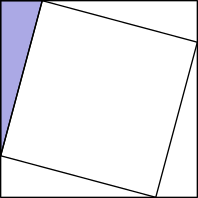
A square of area is inscribed in a square of area creating four congruent triangles, as shown below. What is the ratio of the shorter leg to the longer leg in the shaded right triangle?
小提示:
外正方形边长为 ,内正方形边长为
The outer square has side and the inner square has side
大提示:
若直角边为 和 ,则 ,且
If the legs are and then and
解答:
外正方形边长为 ,内正方形边长为 。每个三角形是直角三角形,其两条直角边 和 沿着外正方形的一条边,所以 ;其斜边是内正方形的一条边,所以 。
由 可得 ,所以 和 是 的两个根,即 。
较短边与较长边之比为
所以正确答案是 C。
The outer square has side and the inner square has side Each triangle is right, with legs and along an outer side, so and with hypotenuse an inner side, so
Then gives so and are the roots of namely
The ratio of shorter to longer leg is
Thus, the correct answer is C.
10.
正实数 和 满足 且 。求 ?
Positive real numbers and satisfy and What is
小提示:
开平方得 。
Taking square roots,
大提示:
正数条件排除其中一个符号,并迫使 ;再代入 。
Positivity rules out one sign and forces substitute into
解答:
由 ,可得 。若 ,则 ,不可能;因此 ,也就是 。
代入 得到 ,所以 ,。
所以正确答案是 D。
From we get The choice gives impossible, so meaning
Substituting into gives hence and
Thus, the correct answer is D.
11.
斜率为 和 的两条直线所成锐角的度数是多少?
What is the degree measure of the acute angle formed by lines with slopes and
12.
13.
在一场乒乓球锦标赛中,每位参赛者都与其他每位参赛者恰好比赛一次。虽然右手选手的人数是左手选手的两倍,但左手选手赢的场数比右手选手赢的场数多 。(没有平局,也没有双利手选手。)总共进行了多少场比赛?
In a table tennis tournament every participant played every other participant exactly once. Although there were twice as many right-handed players as left-handed players, the number of games won by left-handed players was more than the number of games won by right-handed players. (There were no ties and no ambidextrous players.) What is the total number of games played?
小提示:
设有 名左手选手和 名右手选手,所以总人数为 。
Let there be left-handed and right-handed players, so players total
大提示:
若右手选手赢 场,则总场数为 ,所以总场数必须是 的倍数
If right-handers win games, the total is so the total must be a multiple of
解答:
设有 名左手选手和 名右手选手,则共有 人,总场数为 。
若右手选手赢 场,则左手选手赢 场,所以总场数为 。要使它是整数场数,总场数必须是 的倍数。
左手选手至多能赢下所有至少有一名左手选手参加的比赛,即 场。另一方面,他们必须赢 场。比较这两个量可得 ,所以 。
依次试 ,总场数为 ;其中只有 是 的倍数,且可实现: 名左手选手可以赢下全部 场混合对局以及左手内部的 场,共 场。
所以正确答案是 B。
Let there be left-handed and right-handed players, for players and games total.
If right-handers win games, left-handers win so the total is For this to be an integer count, the total number of games must be a multiple of
The left-handers can win at most every game involving at least one left-hander, namely On the other hand, they must win games. Comparing these quantities gives so
Testing gives totals only is a multiple of It is achievable: the left-handers can win all mixed games and their internal games, giving wins.
Thus, the correct answer is B.
14.
有多少个复数满足方程 ,其中 是复数 的共轭?
How many complex numbers satisfy the equation where is the conjugate of the complex number
小提示:
取模长:,所以 或 。
Take absolute values: so or
大提示:
乘以 得 ;单独处理 。
Multiplying by gives handle separately
解答:
取模长得 ,所以 或 。 满足方程,给出一个解。
若 ,把原方程乘以 得到 。这有 个不同的根,并且这些根的模长都等于 。
总共有 个解。
所以正确答案是 E。
Taking magnitudes gives so or The value works, giving one solution.
If multiply the equation by to get This has distinct roots, all of modulus
Altogether there are solutions.
Thus, the correct answer is E.
15.
Usain 为了锻炼,在一块 米乘 米的矩形场地中之字形行走,从点 出发并在 上结束。他想像下图所示()通过之字形增加行走距离。什么角 会使路径长度为 米?(不要假设之字形路径恰好有图中所示的四段;段数可能更多或更少。)
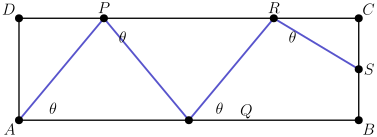
Usain is walking for exercise by zigzagging across a -meter by -meter rectangular field, beginning at point and ending on the segment He wants to increase the distance walked by zigzagging as shown in the figure below (). What angle will produce a length that is meters? (Do not assume the zigzag path has exactly four segments as shown; there could be more or fewer.)
小提示:
之字形每一段的水平投影等于它的长度乘以
The horizontal projection of each zigzag segment is its length multiplied by
大提示:
把所有段的水平投影相加,再把 米的前进距离与 米的路径长度作比较
Add the horizontal projections of all the segments and compare the -meter progress with the -meter path
解答:
之字形的每一段都与场地的水平边成角 。因此,长度为 的一段在水平方向前进 米。即使最后一段在横跨场地完整宽度之前结束,这一点仍然成立。
将整条 米路径的水平投影相加,得到 。
所以 ,从而 。
因此,正确答案是 A。
Every segment of the zigzag makes angle with a horizontal side of the field. Therefore a segment of length advances meters horizontally. This remains true for the last segment even if it ends before crossing the full width of the field.
Adding the horizontal projections over the entire -meter path gives
Therefore so
Thus, the correct answer is A.
16.
考虑满足 的复数 的集合。 的虚部的最大值可写成 ,其中 和 是互质正整数。求 ?
Consider the set of complex numbers satisfying The maximum value of the imaginary part of can be written in the form where and are relatively prime positive integers. What is
小提示:
令 ,并展开 。
Write and expand
大提示:
使 最大时会出现对称情形 ;再用所得方程解 。
Maximizing forces the symmetric case solve the resulting equation for
解答:
令 。则 ,约束条件为
在这条闭合有界曲线上 取最大值的点处,隐函数求导(或拉格朗日乘数法)给出 ,其中 。但 ,所以 。
此时 ,约束化为 。取 ,得 ,所以最大值为 。
这里 、,所以 。
所以正确答案是 B。
Write Then and the constraint is
At a point where is maximal on this closed, bounded curve, implicit differentiation (or Lagrange multipliers) gives where But so
Then so the constraint reduces to Taking gives so the maximum is
Here and so
Thus, the correct answer is B.
17.
青蛙 Flora 从数轴上的 出发,向右进行一系列跳跃。每次跳跃中,不受之前跳跃影响,Flora 以 的概率跳跃一个正整数距离 。Flora 最终会落在 上的概率是多少?
Flora the frog starts at on the number line and makes a sequence of jumps to the right. In any one jump, independent of previous jumps, Flora leaps a positive integer distance with probability What is the probability that Flora will eventually land at
小提示:
设 为 Flora 曾经落在 上的概率;按第一次跳跃的大小分类
Let be the probability Flora ever lands on condition on the size of the first jump
大提示:
递推式 会给出所有 的同一个值
The recursion gives the same value for every
解答:
设 为 Flora 曾经恰好落在 上的概率,其中 。按第一次跳跃分类,
我们用归纳法证明对每个 都有 。 的情形是显然的。若结论直到 都成立,则
因此落在 上的概率是 。
所以正确答案是 E。
Let be the probability that Flora ever lands exactly on with Conditioning on the first jump,
We prove by induction that for every The case is immediate. If the claim holds through then
Hence the probability of landing on is
Thus, the correct answer is E.
18.
圆 和 的半径都为 ,两圆圆心之间的距离为 。圆 是同时内切于 和 的最大圆。圆 同时内切于 和 ,并且外切于 。圆 的半径是多少?
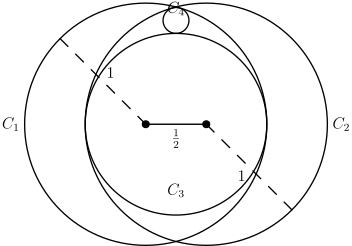
Circle and each have radius and the distance between their centers is Circle is the largest circle internally tangent to both and Circle is internally tangent to both and and externally tangent to What is the radius of
小提示:
由对称性, 的圆心在 的中点;其半径为
By symmetry is centered at the midpoint of its radius is
大提示:
把 放在垂直平分线上;其圆心到单位圆圆心距离为 ,到 圆心距离为 。
Place on the perpendicular bisector; its center is from a unit circle’s center and from the center of
解答:
把圆心放在 和 。由对称性, 以原点为圆心;与 内切给出其半径为 。
设 的半径为 ,圆心为对称轴上的 。与 外切可得 ,与 内切可得 。
代入得 ,化简为 ,所以 。
所以正确答案是 D。
Put the centers at and By symmetry is centered at the origin, and internal tangency to gives radius
Let have radius centered at on the axis of symmetry. External tangency to gives and internal tangency to gives
Substituting, which simplifies to so
Thus, the correct answer is D.
19.
求下列方程所有解的乘积:
What is the product of all the solutions to the equation
小提示:
换成以 为底,并设 ;注意 ,所以 。
Convert to base and set note so
大提示:
方程会变成关于 的二次方程,且两个根之和为 。
The equation becomes a quadratic in whose two roots sum to
解答:
设 ,。因为 ,所以 。令 ,每个对数都变成倒数,方程化为
展开并使用 ,一次项相消,留下 。两个根满足 。
对应的解乘积为 。
所以正确答案是 C。
Let and Since we have Writing each logarithm becomes a reciprocal, and the equation turns into
Expanding and using the linear terms cancel, leaving Its two roots satisfy
The corresponding solutions multiply to
Thus, the correct answer is C.
20.
下方展示了一个整数三角形阵列的第 ,,, 和 行。
第一行之后,每一行都在两端放置 ,每个内部项比上一行中斜上方两个数之和大 。第 行的 个数之和的个位数字是多少?
Rows and of a triangular array of integers are shown below.
Each row after the first row is formed by placing a at each end of the row, and each interior entry is greater than the sum of the two numbers diagonally above it in the previous row. What is the units digit of the sum of the numbers in the rd row?
小提示:
设 为第 行的和;每个内部项贡献上一行的两个副本再加
Let be the sum of row each interior entry adds two copies of the row above plus a
大提示:
得到 ,其闭式为 。
This yields whose closed form is
解答:
设 为第 行的和。每个内部项比上一行斜上方两个项之和大 ,对整行求和得到递推
由 ,可解得 (检验: )。
所以 。 的幂的个位数字按 循环,且 ,所以 的个位是 。于是 个位数字为 。
所以正确答案是 C。
Let be the sum of row Each interior entry is more than the sum of the two entries above it, and summing over the row gives the recurrence
With this solves to (check: ).
So Since powers of cycle with units digits and ends in Then gives units digit
Thus, the correct answer is C.
21.
如果 和 是一个多面体的顶点,定义距离 为沿该多面体的棱从 连接到 所必须经过的最少棱数。例如,如果 是该多面体的一条棱,则 ;但如果 和 是棱且 不是棱,则 。从一个正二十面体(由 个等边三角形组成的正多面体)的顶点中随机选出互不相同的顶点 、 和 。求 的概率。
If and are vertices of a polyhedron, define the distance to be the minimum number of edges of the polyhedron one must traverse in order to connect and For example, if is an edge of the polyhedron, then but if and are edges and is not an edge, then Let and be randomly chosen distinct vertices of a regular icosahedron (regular polyhedron made up of equilateral triangles). What is the probability that
小提示:
固定 。其他 个顶点中,有 个距离为 , 个距离为 , 个距离为 。
Fix The other vertices split into at distance at distance and at distance
大提示:
由对称性,严格大于的概率是不相等概率的一半: 。
By symmetry
解答:
固定 。正二十面体的其他 个顶点中,有 个到该点的距离为 , 个距离为 ,还有 个(对顶点)距离为 。
有序选取互不相同的 时, 的概率为
由 和 的对称性,
所以正确答案是 A。
Fix Among the other vertices of the icosahedron, are at distance are at distance and (the antipode) is at distance
Choosing ordered distinct the probability that is
By the symmetry between and
Thus, the correct answer is A.
22.
设 是定义在正整数上的唯一函数,满足对所有正整数 都有 其中求和遍历 的所有正因数。求 ?
Let be the unique function defined on the positive integers such that for all positive integers where the sum is taken over all positive divisors of What is
小提示:
这个关系递归地确定 ; 实际上是积性函数
The relation determines recursively; turns out to be multiplicative
大提示:
计算 、 和 ;这里
Compute and here
解答:
令 ,得 。对素数 ,令 ,得 ,所以 。令 ,由 得 。
由于定义关系是积性函数的 Dirichlet 卷积, 也是积性的。又 ,
所以正确答案是 B。
Setting gives For a prime gives so For gives
Since the defining relation is a Dirichlet convolution of multiplicative functions, is multiplicative. With
Thus, the correct answer is B.
23.
有多少个正实数有序对 满足方程
How many ordered pairs of positive real numbers satisfy the equation
无穷多个
an infinite number
答案:B
小提示:
分别对 、 和 使用 AM-GM
Apply AM-GM separately to and
大提示:
乘积至少为 ,所以等号必须在三个不等式中同时成立
The product is at least so equality must hold in all three inequalities at once
解答:
由 AM-GM,,,且 。相乘得
等号要求 、 和 同时成立。这给出 、,且三者相容,所以恰有一个解。
所以正确答案是 B。
By AM-GM, and Multiplying,
Equality requires and simultaneously. These give which are consistent, so there is exactly one solution.
Thus, the correct answer is B.
24.
设 为满足以下条件的序列 ,,, 的数量: 是不超过 的正整数,每个 都是 的子集,并且对每个介于 和 之间(含端点)的 ,都有 是 的子集。例如,、、、、 是这样一个序列,其中 。 除以 的余数是多少?
Let be the number of sequences such that is a positive integer less than or equal to each is a subset of and is a subset of for each between and inclusive. For example, is one such sequence, with What is the remainder when is divided by
小提示:
对固定的 ,这 个元素各自独立选择第一次进入哪个集合,或选择永不进入
For a fixed each of the elements independently chooses the first set it enters, or never enters
大提示:
这给出 条链,所以 ;把每项模 化简
That gives chains, so reduce each term modulo
解答:
对固定长度 , 中的每个元素可以独立选择永不出现,或第一次出现在 中的某一个,因此每个元素有 种选择。于是长度为 的链有 条。
因此 模 时, 各项化为 ,和为 。
所以正确答案是 C。
For a fixed length each element of independently either never appears or first appears in one of giving choices. Hence there are chains of length
Summing, Modulo the terms reduce to which sum to
Thus, the correct answer is C.
25.
存在唯一的整数序列 ,,,使得只要 有定义,就有 求 ?
There is a unique sequence of integers such that whenever is defined. What is
小提示:
展开 ,并用 。
Expand and use
大提示:
除以 后, 的最高次系数为
Dividing by the top coefficient of is
解答:
由 De Moivre 公式, 。展开左边并取虚部与实部之比,再把分子、分母同除以 ,即可把 写成题中关于 的有理函数。
系数 是分子中 的系数,来自 项:
所以正确答案是 C。
By De Moivre, Expanding the left side and taking the ratio of imaginary to real parts gives as the stated rational function of after dividing numerator and denominator by
The coefficient is the coefficient of in the numerator, which comes from the term:
Thus, the correct answer is C.