
2000 AIME I 第 13 题
先试着解答 2000 AIME I 第 13 题,然后核对你的答案与精心整理的解答,解答来自 LIVE by Po-Shen Loh。你也可以参加完整限时模拟考试、查看全部 2000 AIME I 解答,或核对答案。
所有题目均经美国数学协会(MAA)官方合法授权使用。
13.
在广阔草原中央,一辆消防车停在两条互相垂直的笔直公路交叉口。车在公路上的速度为每小时 英里,在草原上的速度为每小时 英里。考虑消防车在六分钟内可以到达的所有点所组成的区域。该区域的面积为 平方英里,其中 和 是互质的正整数。求 。
In the middle of a vast prairie, a firetruck is stationed at the intersection of two perpendicular straight highways. The truck travels at miles per hour along the highways and at miles per hour across the prairie. Consider the set of points that can be reached by the firetruck within six minutes. The area of this region is square miles, where and are relatively prime positive integers. Find
小提示:
六分钟内,车可在公路上行驶 英里,或在草原上行驶 英里。先只看第一象限。
In six minutes the truck covers miles on highway or miles across the prairie. Work in one quadrant.
大提示:
若从公路上的 离开,可到达半径为 的圆盘;这些圆盘并集的边界是从 到半径为 的圆所作的切线。
Leaving the highway at reaches a disk of radius the union of these disks is bounded by the tangent line from to the circle of radius
解答:
六分钟内车可沿公路行驶 英里,或穿过草原行驶 英里。最优路线是一段公路加一段直线草原路。以公路为坐标轴,在第一象限中,若先行驶到 ,用时 小时,剩余草原可达半径为 英里。当 从 变到 时,这些圆盘线性缩小到一点,所以它们的并集是以原点为圆心、半径 的圆盘和点 的凸包,由从 作圆的切线围成。切线长为 ,对应 -- 比例,所以切线为 。-轴方向给出对称区域,其边界为 。
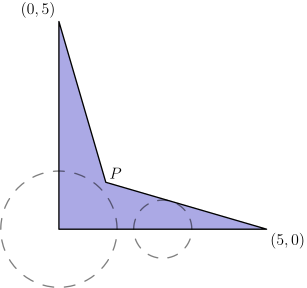
两条切线交于 ,它到原点的距离为 ,在圆外。因此第一象限可达区域恰好是顶点为 、、、 的非凸四边形。沿原点到 的对角线分成两个三角形,每个面积为 ,所以第一象限面积为 。
整个区域由四份组成,面积为 平方英里。因为 ,所以答案是 。
In six minutes the truck can drive miles on a highway or miles across the prairie, and an optimal route is a highway stretch followed by a straight prairie segment. Work in the first quadrant with the highways as axes. Driving to takes hours, leaving a prairie range of miles. As runs from to these disks shrink linearly to a point, so their union is the “cone”: the convex hull of the disk of radius about the origin and the point bounded by the tangent line from The tangent length is so the ratios are –– and the tangent line is The -axis gives the mirror-image region bounded by
The two tangent lines meet at which lies at distance from the origin — outside the circle — so in the first quadrant the reachable set is exactly the (non-convex) quadrilateral with vertices Splitting it along the diagonal from the origin to gives two triangles, each with area for a quadrant area of
The full region is four copies, with area square miles. Since the answer is
其他年份的第 13 题
1983 AIME · 1984 AIME · 1985 AIME · 1986 AIME · 1987 AIME · 1988 AIME · 1989 AIME · 1990 AIME · 1991 AIME · 1992 AIME · 1993 AIME · 1994 AIME · 1995 AIME · 1996 AIME · 1997 AIME · 1998 AIME · 1999 AIME · 2000 AIME II · 2001 AIME I · 2001 AIME II · 2002 AIME I · 2002 AIME II · 2003 AIME I · 2003 AIME II · 2004 AIME I · 2004 AIME II · 2005 AIME I · 2005 AIME II · 2006 AIME I · 2006 AIME II · 2007 AIME I · 2007 AIME II · 2008 AIME I · 2008 AIME II · 2009 AIME I · 2009 AIME II · 2010 AIME I · 2010 AIME II · 2011 AIME I · 2011 AIME II · 2012 AIME I · 2012 AIME II · 2013 AIME I · 2013 AIME II · 2014 AIME I · 2014 AIME II · 2015 AIME I · 2015 AIME II · 2016 AIME I · 2016 AIME II · 2017 AIME I · 2017 AIME II · 2018 AIME I · 2018 AIME II · 2019 AIME I · 2019 AIME II · 2020 AIME I · 2020 AIME II · 2021 AIME I · 2021 AIME II · 2022 AIME I · 2022 AIME II · 2023 AIME I · 2023 AIME II · 2024 AIME I · 2024 AIME II · 2025 AIME I · 2025 AIME II · 2026 AIME I · 2026 AIME II