
Problemas del 1993 AMC 12
¡Desplázate hacia abajo y presiona Iniciar para intentar el examen! O ve al PDF imprimible, la clave de respuestas, o las soluciones profesionales preparadas por LIVE by Po-Shen Loh.
Todos los problemas se usan con el permiso legal oficial de la Mathematical Association of America (MAA).
O salta directamente a un solo problema con su solución: 1 · 2 · 3 · 4 · 5 · 6 · 7 · 8 · 9 · 10 · 11 · 12 · 13 · 14 · 15 · 16 · 17 · 18 · 19 · 20 · 21 · 22 · 23 · 24 · 25 · 26 · 27 · 28 · 29 · 30
¿Quieres aprender de forma profesional con clases interactivas en video?
Con tiempo
1:15:00
1.
Para enteros y se define como Entonces es igual a
For integers and define to mean Then equals
Respuesta: D
Pista pequeña:
Sustituye las tres entradas en el orden indicado
Substitute the three entries in their stated order
Pista grande:
Recuerda que y
Remember that and
Solución:
Por la definición, Por lo tanto, la respuesta correcta es D.
By the definition, Thus the correct answer is D.
2.
En está en el lado y está en el lado Si entonces
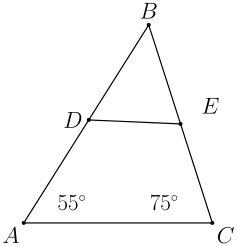
In is on side and is on side If then
Respuesta: D
Pista pequeña:
Determina primero
First determine
Pista grande:
El triángulo es isósceles con vértice en
Triangle is isosceles with vertex at
Solución:
Se tiene igual a Como y pertenecen a y respectivamente, Puesto que los dos ángulos de la base de miden Por lo tanto, la respuesta correcta es D.
We have equal to Because and lie on and respectively, Since the two base angles of are Thus the correct answer is D.
3.
Respuesta: E
Pista pequeña:
Escribe como
Write as
Pista grande:
Combina el numerador y el denominador dentro de una sola potencia decimoquinta
Combine the numerator and denominator inside one fifteenth power
Solución:
Usando un exponente común, Por lo tanto, la respuesta correcta es E.
Using a common exponent, Thus the correct answer is E.
4.
Se define la operación “” mediante para todos los números reales e ¿Para cuántos números reales se cumple ?
Define the operation “” by for all real numbers and For how many real numbers does
más de
more than
Respuesta: E
Pista pequeña:
Sustituye en la operación
Substitute into the operation
Pista grande:
Comprueba si se cancelan los términos que contienen
Check whether the terms containing cancel
Solución:
Para todo número real Por consiguiente, todo número real sirve, así que hay más de de estos números. Por lo tanto, la respuesta correcta es E.
For every real Hence every real number works, so there are more than such numbers. Thus the correct answer is E.
5.
El año pasado una bicicleta costaba y un casco de ciclismo costaba Este año, el costo de la bicicleta aumentó un y el costo del casco aumentó un El aumento porcentual del costo combinado de la bicicleta y el casco es
Last year a bicycle cost and a cycling helmet cost This year the cost of the bicycle increased by and the cost of the helmet increased by The percent increase in the combined cost of the bicycle and the helmet is
Respuesta: A
Pista pequeña:
Halla el aumento en dólares de cada artículo
Find the dollar increase for each item
Pista grande:
Compara el aumento total con el costo combinado del año pasado
Compare the total increase with last year’s combined cost
Solución:
La bicicleta aumenta y el casco para un aumento total de El costo combinado del año pasado era así que el aumento porcentual es Por lo tanto, la respuesta correcta es A.
The bicycle increases by and the helmet by for a total increase of Last year’s combined cost was so the percent increase is Thus the correct answer is A.
6.
Respuesta: B
Pista pequeña:
Reescribe cada potencia con base
Rewrite every power with base
Pista grande:
Extrae como factor la menor potencia del numerador y del denominador
Factor the smaller power from the numerator and denominator
Solución:
Escribiendo todos los términos como potencias de Su raíz cuadrada positiva es Por lo tanto, la respuesta correcta es B.
Writing all terms as powers of Its positive square root is Thus the correct answer is B.
7.
El símbolo representa un entero cuya escritura en base diez es una sucesión de unos. Por ejemplo, etc. Al dividir entre el cociente es un entero cuya escritura en base diez contiene solamente unos y ceros. El número de ceros en es
The symbol stands for an integer whose base-ten representation is a sequence of ones. For example, etc. When is divided by the quotient is an integer whose base-ten representation is a sequence containing only ones and zeros. The number of zeros in is
Respuesta: E
Pista pequeña:
Usa
Use
Pista grande:
El cociente tiene seis unos, separados de cuatro en cuatro posiciones
The quotient has six ones, each four places apart
Solución:
Al agrupar los dígitos en seis bloques de cuatro se obtiene Así, tiene seis unos, con tres ceros entre cada par consecutivo. Por lo tanto, tiene ceros. La respuesta correcta es E.
Grouping the digits into six blocks of four gives Thus has six ones, with three zeros between each consecutive pair. It therefore has zeros. Thus the correct answer is E.
8.
Sean y dos círculos de radio que están en el mismo plano y son tangentes entre sí. ¿Cuántos círculos de radio están en este plano y son tangentes tanto a como a ?
Let and be circles of radius that are in the same plane and tangent to each other. How many circles of radius are in this plane and tangent to both and
Respuesta: D
Pista pequeña:
Un círculo de radio puede ser tangente interior o exteriormente a cada círculo unitario
A radius- circle can be internally or externally tangent to each unit circle
Pista grande:
Para su centro, considera los pares de distancias y
For its center, consider distance pairs and
Solución:
Los centros de los círculos unitarios tangentes están separados unidades. Para tangencia exterior, el nuevo centro debe estar a unidades del centro de un círculo unitario; para tangencia interior, a unidades. El par de distancias da dos centros, al igual que Cada par mixto y da un centro porque los círculos correspondientes para los centros son tangentes interiormente. Por tanto, hay círculos. La respuesta correcta es D.
Let the centers of the tangent unit circles be units apart. The new center must be units from a unit-circle center for external tangency and units away for internal tangency. The distance pair gives two centers, as does Each mixed pair and gives one center because the corresponding center-circles are internally tangent. Hence there are circles. Thus the correct answer is D.
9.
El país tiene el de la población mundial y posee el de la riqueza mundial. El país tiene el de la población mundial y el de su riqueza. Supón que los ciudadanos de comparten por igual la riqueza de , y que los de comparten por igual la riqueza de . Halla la razón entre la riqueza de un ciudadano de y la de un ciudadano de
Country has of the world’s population and owns of the world’s wealth. Country has of the world’s population and of its wealth. Assume that the citizens of share the wealth of equally, and assume that those of share the wealth of equally. Find the ratio of the wealth of a citizen of to the wealth of a citizen of
Respuesta: D
Pista pequeña:
La riqueza per cápita es la riqueza total dividida entre la población
Per-capita wealth is total wealth divided by population
Pista grande:
Forma la razón
Form the ratio
Solución:
La riqueza per cápita del país es proporcional a mientras que la del país es proporcional a Su razón es Por lo tanto, la respuesta correcta es D.
Country ’s per-capita share is proportional to while country ’s is proportional to Their ratio is Thus the correct answer is D.
10.
Sea el número que resulta al triplicar tanto la base como el exponente de , donde Si es igual al producto de y , donde entonces
Let be the number that results when both the base and the exponent of are tripled, where If equals the product of and where then
Respuesta: C
Pista pequeña:
Triplicar ambas partes transforma en
Tripling both parts changes to
Pista grande:
Reescribe la igualdad de modo que ambos lados sean potencias de exponente
Rewrite the equality so both sides are th powers
Solución:
Se tiene Además, Como las cantidades son positivas, podemos igualar las bases; así, y Por lo tanto, la respuesta correcta es C.
We have Also Positivity allows us to equate the bases, so and Thus the correct answer is C.
11.
Si ¿cuántos dígitos tiene la representación en base diez de ?
If then how many digits are in the base-ten representation for
Respuesta: A
Pista pequeña:
Deshaz los logaritmos uno a uno, comenzando por el exterior
Undo the logarithms one at a time from the outside
Pista grande:
Los valores sucesivos son y antes de despejar
The successive values are and before solving for
Solución:
Al deshacer los logaritmos se obtiene Este número tiene dígitos decimales. Por lo tanto, la respuesta correcta es A.
Undoing the logarithms gives This number has decimal digits. Thus the correct answer is A.
12.
Si para todo entonces
If for all then
Respuesta: E
Pista pequeña:
Para obtener sustituye la variable de entrada dada por
To obtain replace the given input variable by
Pista grande:
Simplifica
Simplify
Solución:
Al sustituir el dado por se obtiene Por lo tanto, Así, la respuesta correcta es E.
Replacing the given by yields Therefore Thus the correct answer is E.
13.
Un cuadrado de perímetro está inscrito en un cuadrado de perímetro ¿Cuál es la mayor distancia entre un vértice del cuadrado interior y un vértice del cuadrado exterior?
A square of perimeter is inscribed in a square of perimeter What is the greatest distance between a vertex of the inner square and a vertex of the outer square?
Respuesta: D
Pista pequeña:
Un vértice del cuadrado interior divide un lado exterior en segmentos de longitudes e
A vertex of the inner square divides an outer side into lengths and
Pista grande:
Usa y
Use and
Solución:
Las longitudes de los lados exterior e interior son y En cualquier vértice interior, los dos segmentos del lado exterior tienen longitudes e , con Por tanto, así que Desde un vértice interior situado en un lado, el vértice exterior opuesto más lejano está a un desplazamiento horizontal de y vertical de La mayor distancia es, por lo tanto, La respuesta correcta es D.
The outer and inner side lengths are and At any inner vertex, the two pieces of the outer side have lengths and with Hence so From an inner vertex on one side, the farther opposite outer vertex has horizontal displacement and vertical displacement The greatest distance is therefore Thus the correct answer is D.
14.
El pentágono convexo satisface y ¿Cuál es el área de ?
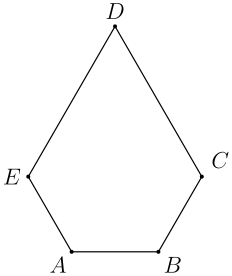
The convex pentagon has and What is the area of
Respuesta: B
Pista pequeña:
Traza para dividir el pentágono en un trapecio y un triángulo
Draw to split the pentagon into a trapezoid and a triangle
Pista grande:
Las condiciones sobre los ángulos dan por lo que es equilátero
The angle conditions give so is equilateral
Solución:
Coloca y Los ángulos de y las longitudes dan Así, es un trapecio de altura y bases y por lo que su área es Además, de modo que es equilátero y tiene área El área total es Por lo tanto, la respuesta correcta es B.
Place and The angles and side lengths give Thus is a trapezoid of height and bases and so its area is Also making equilateral with area The total area is Thus the correct answer is B.
15.
¿Para cuántos valores de tendrá un polígono regular de lados ángulos interiores cuyas medidas en grados sean enteras?
For how many values of will an -sided regular polygon have interior angles with integral degree measures?
Respuesta: D
Pista pequeña:
Un ángulo interior mide
An interior angle is
Pista grande:
Cuenta los divisores de y excluye los valores menores que
Count divisors of and exclude values below
Solución:
El ángulo interior mide y es entero exactamente cuando es divisible por Como tiene divisores positivos. Al excluir y quedan valores admisibles. Por lo tanto, la respuesta correcta es D.
The interior angle is which is integral exactly when is divisible by Since it has positive divisors. Excluding and leaves allowable values. Thus the correct answer is D.
16.
Considera la sucesión no decreciente de enteros positivos en la que el -ésimo entero positivo aparece veces. El residuo al dividir el término número entre es
Consider the non-decreasing sequence of positive integers in which the th positive integer appears times. The remainder when the rd term is divided by is
Respuesta: D
Pista pequeña:
La última aparición de ocupa la posición
The final occurrence of is in position
Pista grande:
Compara con los números triangulares correspondientes a y
Compare with the triangular numbers for and
Solución:
El último aparece en la posición mientras que el último aparece en la posición Por consiguiente, el término número es cuyo residuo módulo es Por lo tanto, la respuesta correcta es D.
The last occurs in position while the last occurs in position Thus the rd term is whose remainder modulo is Thus the correct answer is D.
17.
Amy pintó una diana sobre la carátula cuadrada de un reloj usando las posiciones de las horas como fronteras. [Véase la figura.] Si es el área de una de las ocho regiones triangulares, como la que está entre las posiciones de las y la , y es el área de uno de los cuatro cuadriláteros de las esquinas, como el que está entre las posiciones de la y las , entonces

Amy painted a dart board over a square clock face using the “hour positions” as boundaries. [See figure.] If is the area of one of the eight triangular regions such as that between o’clock and o’clock, and is the area of one of the four corner quadrilaterals such as that between o’clock and o’clock, then
Respuesta: A
Pista pequeña:
Cambia la escala del cuadrado para que sus lados sean e
Scale the square so its sides are and
Pista grande:
El rayo correspondiente a la corta el lado superior en
The o’clock ray meets the top side at
Solución:
Sea el cuadrado y su centro el origen. El rayo correspondiente a la corta el lado superior en por lo que El cuadrilátero de la esquina tiene vértices Su área es Por tanto, La respuesta correcta es A.
Let the square be and its center be the origin. The o’clock ray meets the top side at so The corner quadrilateral has vertices Its area is Hence Thus the correct answer is A.
18.
Al y Barb comienzan sus nuevos trabajos el mismo día. El horario de Al consiste en días de trabajo seguidos de día de descanso. El horario de Barb consiste en días de trabajo seguidos de días de descanso. Durante sus primeros días, ¿cuántos días descansan ambos a la vez?
Al and Barb start their new jobs on the same day. Al’s schedule is work-days followed by rest-day. Barb’s schedule is work-days followed by rest-days. On how many of their first days do both have rest-days on the same day?
Respuesta: E
Pista pequeña:
El horario combinado se repite cada días
The combined schedule repeats every days
Pista grande:
Dentro de un ciclo de días, compara los días de descanso de Al con los de Barb
Within one -day cycle, compare Al’s rest days with Barb’s
Solución:
El patrón combinado se repite cada días. Al descansa los días mientras que Barb descansa los días Sus días de descanso comunes son y dos por ciclo. Hay ciclos, lo que da días de descanso comunes. Por lo tanto, la respuesta correcta es E.
The combined pattern repeats every days. Al rests on days while Barb rests on days Their common rest days are and two per cycle. There are cycles, giving common rest days. Thus the correct answer is E.
19.
¿Cuántos pares ordenados de enteros positivos son soluciones de
How many ordered pairs of positive integers are solutions to
más de
more than
Respuesta: D
Pista pequeña:
Elimina los denominadores y completa un producto que contenga y
Clear denominators and complete a product involving and
Pista grande:
La ecuación es equivalente a
The equation is equivalent to
Solución:
Al eliminar los denominadores y reordenar se obtiene Ambos factores deben ser positivos. Los cuatro pares ordenados de factores positivos de dan Por lo tanto, la respuesta correcta es D.
Clearing denominators and rearranging gives Both factors must be positive. The four ordered positive factor pairs of give Thus the correct answer is D.
20.
Considera la ecuación donde es una variable compleja e ¿Cuál de las siguientes afirmaciones es verdadera?
Consider the equation where is a complex variable and Which of the following statements is true?
Para todo número real positivo ambas raíces son imaginarias puras.
For all positive real numbers both roots are pure imaginary.
Para todo número real negativo ambas raíces son imaginarias puras.
For all negative real numbers both roots are pure imaginary.
Para todo número imaginario puro ambas raíces son reales y racionales.
For all pure imaginary numbers both roots are real and rational.
Para todo número imaginario puro ambas raíces son reales e irracionales.
For all pure imaginary numbers both roots are real and irrational.
Para todo número complejo ninguna raíz es real.
For all complex numbers neither root is real.
Respuesta: B
Pista pequeña:
Aplica la fórmula cuadrática y simplifica el discriminante
Apply the quadratic formula and simplify the discriminant
Pista grande:
Para un real negativo, determina el tipo de
For negative real determine the type of
Solución:
Las raíces son Si es real y negativo, entonces es real y negativo, por lo que sus raíces cuadradas son imaginarias puras. Así, ambos valores resultantes de son imaginarios puros. Las demás afirmaciones universales son falsas; por ejemplo, basta tomar o según corresponda. Por lo tanto, la respuesta correcta es B.
The roots are If is negative and real, then is negative real, so its square roots are pure imaginary. Both resulting values of are therefore pure imaginary. The other universal claims fail, for example by taking or as appropriate. Thus the correct answer is B.
21.
Sea una sucesión aritmética finita tal que
y
Si entonces
Let be a finite arithmetic sequence with
and
If then
Respuesta: B
Pista pequeña:
Usa los términos centrales para hallar y
Use the middle terms to find and
Pista grande:
La diferencia entre y determina la diferencia común
The difference between and determines the common difference
Solución:
Como el promedio de términos simétricos de una sucesión aritmética es el término central, Así, y por lo que la diferencia común es Como se tiene Por lo tanto, la respuesta correcta es B.
Because symmetric terms of an arithmetic sequence average to the middle term, Thus and so the common difference is Since we have Thus the correct answer is B.
22.
Se disponen veinte bloques cúbicos como se muestra. Primero se colocan en un patrón triangular; luego una capa de también en patrón triangular, se centra sobre los después una capa de dispuestos en patrón triangular, se centra sobre los finalmente, se centra un bloque sobre la tercera capa. Los bloques de la capa inferior se numeran del al en algún orden. A cada bloque de las capas y se le asigna la suma de los números de los tres bloques sobre los que descansa. Halla el menor número posible que podría asignarse al bloque superior.
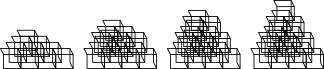
Twenty cubical blocks are arranged as shown. First, are arranged in a triangular pattern; then a layer of arranged in a triangular pattern, is centered on the then a layer of arranged in a triangular pattern, is centered on the and finally one block is centered on top of the third layer. The blocks in the bottom layer are numbered through in some order. Each block in layers and is assigned the number which is the sum of the numbers assigned to the three blocks on which it rests. Find the smallest possible number which could be assigned to the top block.
Respuesta: C
Pista pequeña:
Determina cuántas veces contribuye cada bloque inferior al número de arriba
Determine how many times each bottom block contributes to the top
Pista grande:
El centro, las seis posiciones del borde y las tres esquinas tienen coeficientes y
The center, six edge positions, and three corner positions have coefficients and
Solución:
Al desarrollar las sumas capa por capa, el valor superior es donde es el bloque central de la capa inferior, los son los seis bloques del borde que no están en las esquinas y los son los tres bloques de las esquinas. Para minimizar esta suma ponderada, asigna a la posición de coeficiente los números a las posiciones de coeficiente y a las posiciones de coeficiente El mínimo es Por lo tanto, la respuesta correcta es C.
Expanding the sums layer by layer, the top value is where is the center bottom block, the are the six non-corner boundary blocks, and the are the three corner blocks. To minimize this weighted sum, assign to the coefficient- position, to the coefficient- positions, and to the coefficient- positions. The minimum is Thus the correct answer is C.
23.
Los puntos y están en un círculo de diámetro y está sobre el diámetro Si y entonces
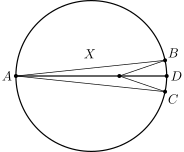
Points and are on a circle of diameter and is on diameter If and then
Respuesta: B
Pista pequeña:
Como el diámetro que pasa por biseca
Because the diameter through bisects
Pista grande:
Halla usando el triángulo rectángulo y luego aplica la ley de los senos en
Find using right triangle then apply the Law of Sines in
Solución:
Como la recta biseca y la simetría también da Como es un diámetro, por lo que Además, La ley de los senos en da Por lo tanto, la respuesta correcta es B.
Since the line bisects and symmetry also gives Because is a diameter, so Also The Law of Sines in gives Thus the correct answer is B.
24.
Una caja contiene centavos brillantes y opacos. Se extraen los centavos al azar, uno a uno y sin reemplazo. Si la probabilidad de que hagan falta más de cuatro extracciones para que aparezca el tercer centavo brillante es , y está en su mínima expresión, entonces
A box contains shiny pennies and dull pennies. One by one, pennies are drawn at random from the box and not replaced. If the probability is that it will take more than four draws until the third shiny penny appears and is in lowest terms, then
Respuesta: E
Pista pequeña:
Considera que los tres centavos brillantes ocupan tres de las siete posiciones de extracción
View the three shiny pennies as occupying three of seven draw positions
Pista grande:
Resta los casos en los que los tres centavos brillantes aparecen entre las primeras cuatro posiciones
Subtract the cases in which all three shiny pennies occur among the first four positions
Solución:
Los centavos brillantes ocupan un subconjunto de elementos elegido uniformemente entre las posiciones de extracción. Hay posibilidades. El tercer centavo brillante aparece a más tardar en la extracción exactamente cuando las tres posiciones brillantes están entre las primeras cuatro, lo que ocurre en casos. La probabilidad pedida es Por lo tanto, Así, la respuesta correcta es E.
The shiny pennies occupy a uniformly chosen -element subset of the draw positions. There are possibilities. The third shiny penny appears by draw exactly when all three shiny positions lie among the first four, which occurs in cases. The requested probability is Therefore Thus the correct answer is E.
25.
Sea el conjunto de puntos sobre los rayos que forman los lados de un ángulo de , y sea un punto fijo dentro del ángulo y sobre su bisectriz. Considera todos los triángulos equiláteros distintos con y en (Los puntos y pueden estar sobre el mismo rayo, e intercambiar los nombres de y no crea un triángulo distinto.) Hay
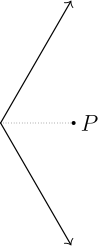
Let be the set of points on the rays forming the sides of a angle, and let be a fixed point inside the angle on the angle bisector. Consider all distinct equilateral triangles with and in (Points and may be on the same ray, and switching the names of and does not create a distinct triangle.) There are
exactamente de estos triángulos.
exactly such triangles.
exactamente de estos triángulos.
exactly such triangles.
exactamente de estos triángulos.
exactly such triangles.
exactamente de estos triángulos.
exactly such triangles.
más de de estos triángulos.
more than such triangles.
Respuesta: E
Pista pequeña:
Llama al vértice del ángulo y elige sobre un rayo de modo que sea equilátero
Call the angle’s vertex and choose on one ray so that is equilateral
Pista grande:
Varía continuamente un punto sobre y construye el punto correspondiente sobre el otro rayo
Vary a point continuously on and construct a matching point on the other ray
Solución:
Sea el vértice. Elige sobre un rayo de modo que como biseca el ángulo de , es equilátero. Para cualquier en elige en el otro rayo de modo que Entonces por LAL. Por consiguiente, y de modo que es equilátero. Un continuo de elecciones de produce triángulos distintos, así que ciertamente hay más de Por lo tanto, la respuesta correcta es E.
Let be the vertex. Choose on one ray so that because bisects the angle, is equilateral. For any on choose on the other ray with Then by SAS. Consequently and so is equilateral. Continuously many choices of give distinct triangles, hence certainly more than Thus the correct answer is E.
26.
Halla el mayor valor positivo que alcanza la función donde es un número real.
Find the largest positive value attained by the function a real number.
Respuesta: C
Pista pequeña:
Factoriza ambos radicandos usando el factor común
Factor both radicands using the common factor
Pista grande:
En el dominio racionaliza
On the domain rationalize
Solución:
Ambos radicales son reales exactamente cuando Al factorizar y racionalizar, En este intervalo, el numerador disminuye mientras el denominador aumenta, por lo que el máximo ocurre en Su valor es Por lo tanto, la respuesta correcta es C.
Both radicals are real exactly when Factoring and rationalizing, On this interval the numerator decreases while the denominator increases, so the maximum occurs at Its value is Thus the correct answer is C.
27.
Los lados de tienen longitudes y Un círculo de centro y radio rueda por el interior de manteniéndose siempre tangente al menos a un lado del triángulo. Cuando vuelve por primera vez a su posición inicial, ¿qué distancia ha recorrido ?
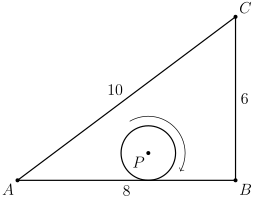
The sides of have lengths and A circle with center and radius rolls around the inside of always remaining tangent to at least one side of the triangle. When first returns to its original position, through what distance has traveled?
Respuesta: B
Pista pequeña:
El centro recorre un triángulo menor cuyos lados son paralelos a los lados originales
The center traces a smaller triangle whose sides are parallel to the original sides
Pista grande:
El triángulo original -- tiene inradio mientras que la trayectoria del centro tiene inradio
The original -- triangle has inradius while the center’s path has inradius
Solución:
El centro permanece a una unidad del lado que toca, así que su trayectoria es el triángulo formado por las tres rectas paralelas desplazadas unidad hacia el interior. Este triángulo es semejante a El triángulo rectángulo original tiene área y semiperímetro por lo que su inradio es El triángulo de la trayectoria tiene inradio así que su escala lineal es Su perímetro, y por lo tanto la distancia recorrida, es La respuesta correcta es B.
The center remains one unit from the side it touches, so its path is the triangle formed by the three inward parallel lines at distance This triangle is similar to The original right triangle has area and semiperimeter hence inradius The path triangle has inradius so its linear scale is Its perimeter, and therefore the distance traveled, is Thus the correct answer is B.
28.
¿Cuántos triángulos de área positiva tienen como vértices puntos del plano con coordenadas enteras que satisfacen y ?
How many triangles with positive area are there whose vertices are points in the -plane whose coordinates are integers satisfying and
Respuesta: D
Pista pequeña:
Comienza con las ternas y resta las que son colineales
Start with all triples and subtract collinear ones
Pista grande:
Tres puntos de la cuadrícula pueden ser colineales solo horizontalmente, verticalmente o en una diagonal de pendiente
Three collinear grid points can occur only horizontally, vertically, or on a slope- diagonal
Solución:
Hay ternas de puntos de la cuadrícula. Las cuatro filas y las cuatro columnas aportan ternas colineales. Para pendiente las longitudes de diagonales capaces de contener tres puntos son que aportan la pendiente aporta otras Ninguna otra pendiente permite tres puntos de la red dentro de un arreglo de puntos de por Así, el número de triángulos de área positiva es Por lo tanto, la respuesta correcta es D.
There are triples of grid points. The four rows and four columns contribute collinear triples. For slope the diagonal lengths capable of containing three points are contributing slope contributes another No other slope fits three lattice points inside a -by- point array. Thus the number of positive-area triangles is Thus the correct answer is D.
29.
¿Cuál de los siguientes conjuntos NO podría contener las longitudes de las diagonales exteriores de un prisma rectangular recto, es decir, una “caja”? (Una diagonal exterior es una diagonal de una de las caras rectangulares de la caja.)
Which of the following sets could NOT be the lengths of the external diagonals of a right rectangular prism [a “box”]? (An external diagonal is a diagonal of one of the rectangular faces of the box.)
Respuesta: B
Pista pequeña:
Si son las diagonales de las caras, expresa los cuadrados de las aristas en términos de
If are the face diagonals, express the edge squares in terms of
Pista grande:
Una condición necesaria y suficiente de positividad es
A necessary and sufficient positivity condition is
Solución:
Si las longitudes de las aristas son entonces los cuadrados de las tres diagonales de las caras son Para diagonales ordenadas por lo que necesariamente las fórmulas análogas muestran que esto también es suficiente. Solo falla , pues Por lo tanto, la respuesta correcta es B.
If the edge lengths are then the three face-diagonal squares are For sorted diagonals so necessarily the analogous formulas show this is also sufficient. Only fails, since Thus the correct answer is B.
30.
Dado define para todo entero ¿Para cuántos valores de se cumple ?
Given let for all integers For how many is it true that
infinitos
infinitely many
Respuesta: D
Pista pequeña:
Cada paso toma la parte fraccionaria del doble del valor anterior
Each step takes the fractional part of twice the preceding value
Pista grande:
Por lo tanto, es la parte fraccionaria de
Thus is the fractional part of
Solución:
La recurrencia es por lo que La igualdad exige y, por tanto, es un entero. Los valores para satisfacen la recurrencia y pertenecen a Hay valores. Por lo tanto, la respuesta correcta es D.
The recurrence is so The equality requires hence is an integer. The values for all satisfy the recurrence and lie in There are values. Thus the correct answer is D.