
Problemas del 2014 AIME II
¡Desplázate hacia abajo y presiona Iniciar para intentar el examen! O ve al PDF imprimible, la clave de respuestas, o las soluciones profesionales preparadas por LIVE by Po-Shen Loh.
Todos los problemas se usan con el permiso legal oficial de la Mathematical Association of America (MAA).
O salta directamente a un solo problema con su solución: 1 · 2 · 3 · 4 · 5 · 6 · 7 · 8 · 9 · 10 · 11 · 12 · 13 · 14 · 15
¿Quieres aprender de forma profesional con clases interactivas en video?
Con tiempo
3:00:00
1.
Abe puede pintar la habitación en horas, Bea puede pintar un por ciento más rápido que Abe, y Coe puede pintar el doble de rápido que Abe. Abe empieza a pintar la habitación y trabaja solo durante la primera hora y media. Luego Bea se une a Abe, y trabajan juntos hasta que la mitad de la habitación está pintada. Luego Coe se une a Abe y Bea, y trabajan juntos hasta que toda la habitación está pintada. Halla el número de minutos que transcurren desde que Abe empieza hasta que los tres terminan de pintar la habitación.
Abe can paint the room in hours, Bea can paint percent faster than Abe, and Coe can paint twice as fast as Abe. Abe begins to paint the room and works alone for the first hour and a half. Then Bea joins Abe, and they work together until half the room is painted. Then Coe joins Abe and Bea, and they work together until the entire room is painted. Find the number of minutes after Abe begins for the three of them to finish painting the room.
Pista pequeña:
Trabaja en habitaciones por minuto: la tasa de Abe es así que la de Bea es y la de Coe es
Work in rooms per minute: Abe’s rate is so Bea’s is and Coe’s is
Pista grande:
Después de minutos solo, se ha pintado de la habitación. Divide cada porción restante de la habitación entre la tasa combinada de los pintores que trabajan en ese momento.
After minutes alone, of the room is done. Divide each remaining portion of the room by the combined rate of the painters working then.
Solución:
Abe pinta de la habitación por minuto, así que Bea pinta por minuto y Coe pinta por minuto. En los primeros minutos Abe pinta de la habitación.
Abe y Bea juntos pintan por minuto, y deben llevar el total desde hasta lo cual toma minutos. Los tres juntos pintan por minuto, así que la mitad restante de la habitación toma minutos.
El tiempo total es minutos.
Abe paints of the room per minute, so Bea paints per minute and Coe paints per minute. In the first minutes Abe paints of the room.
Abe and Bea together paint per minute, and they must bring the total from up to which takes minutes. All three together paint per minute, so the remaining half of the room takes minutes.
The total time is minutes.
2.
Arnold está estudiando la prevalencia de tres factores de riesgo para la salud, denotados por y dentro de una población de hombres. Para cada uno de los tres factores, la probabilidad de que un hombre elegido al azar de la población tenga solo este factor de riesgo (y ninguno de los otros) es Para cualesquiera dos de los tres factores, la probabilidad de que un hombre elegido al azar tenga exactamente estos dos factores de riesgo (pero no el tercero) es La probabilidad de que un hombre elegido al azar tenga los tres factores de riesgo, dado que tiene y es La probabilidad de que un hombre no tenga ninguno de los tres factores de riesgo dado que no tiene el factor de riesgo es donde y son enteros positivos primos entre sí. Halla
Arnold is studying the prevalence of three health risk factors, denoted by and within a population of men. For each of the three factors, the probability that a randomly selected man in the population has only this risk factor (and none of the others) is For any two of the three factors, the probability that a randomly selected man has exactly these two risk factors (but not the third) is The probability that a randomly selected man has all three risk factors, given that he has and is The probability that a man has none of the three risk factors given that he does not have risk factor is where and are relatively prime positive integers. Find
Respuesta: 76
Pista pequeña:
Toma una población de y completa un diagrama de Venn: cada región con exactamente un factor tiene hombres y cada región con exactamente dos factores tiene
Take a population of and fill in a Venn diagram: each exactly-one region holds men and each exactly-two region holds
Pista grande:
Si hombres tienen los tres factores, entonces Luego cuenta los hombres fuera de y los hombres que no tienen ningún factor.
If men have all three factors, then Then count the men outside and the men with no factor at all.
Solución:
Toma una población de hombres y completa un diagrama de Venn. Cada una de las tres regiones con exactamente un factor contiene hombres, y cada una de las tres regiones con exactamente dos factores contiene Si hombres tienen los tres factores, entonces los hombres que tienen tanto como suman así que la probabilidad condicional dada dice lo que da
La unión de los tres conjuntos contiene por tanto hombres, dejando sin ningún factor de riesgo. Los hombres con el factor de riesgo suman así que hombres no tienen
La probabilidad buscada es que está en su forma más simple, así que
Take a population of men and fill in a Venn diagram. Each of the three exactly-one regions contains men, and each of the three exactly-two regions contains If men have all three factors, then the men with both and number so the given conditional probability says giving
The union of the three sets therefore contains men, leaving with no risk factor. The men with risk factor number so men do not have
The desired probability is which is in lowest terms, so
3.
Un rectángulo tiene lados de longitud y Se instala una bisagra en cada vértice del rectángulo y en el punto medio de cada lado de longitud Los lados de longitud se pueden presionar uno hacia el otro manteniendo esos dos lados paralelos, de modo que el rectángulo se convierte en un hexágono convexo como se muestra. Cuando la figura es un hexágono con los lados de longitud paralelos y separados por una distancia de el hexágono tiene la misma área que el rectángulo original. Halla
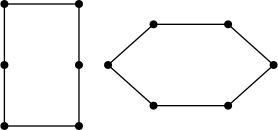
A rectangle has sides of length and A hinge is installed at each vertex of the rectangle and at the midpoint of each side of length The sides of length can be pressed toward each other keeping those two sides parallel so the rectangle becomes a convex hexagon as shown. When the figure is a hexagon with the sides of length parallel and separated by a distance of the hexagon has the same area as the original rectangle. Find
Respuesta: 720
Pista pequeña:
Cada mitad de un lado de es una barra articulada de longitud cuya extensión vertical en el hexágono es el teorema de Pitágoras da su alcance horizontal
Each half of a -side is a hinged bar of length whose vertical extent in the hexagon is the Pythagorean theorem gives its horizontal reach
Pista grande:
Corta el hexágono a lo largo de la recta que pasa por las dos bisagras de los puntos medios en dos trapecios congruentes y establece que el área total sea igual a
Cut the hexagon along the line through the two midpoint hinges into two congruent trapezoids and set the total area equal to
Solución:
En el hexágono, cada lado de longitud se ha plegado en su punto medio en dos barras de longitud Los dos lados de longitud están separados por , así que cada barra abarca una distancia vertical de y por tanto una distancia horizontal de
La recta que pasa por las dos bisagras de los puntos medios divide el hexágono en dos trapecios congruentes con lados paralelos y y altura así que el hexágono tiene área
Igualando esto al área del rectángulo se obtiene así que y
In the hexagon, each side of length has folded at its midpoint into two bars of length The two sides of length are apart, so each bar spans a vertical distance of and hence a horizontal distance of
The line through the two midpoint hinges splits the hexagon into two congruent trapezoids with parallel sides and and height so the hexagon has area
Setting this equal to the rectangle’s area gives so and
4.
Los decimales periódicos y satisfacen donde y son dígitos (no necesariamente distintos). Halla el número de tres cifras
The repeating decimals and satisfy where and are (not necessarily distinct) digits. Find the three-digit number
Respuesta: 447
Pista pequeña:
Escribe los decimales como y luego elimina los denominadores usando y
Write the decimals as and then clear denominators using and
Pista grande:
Reducir la ecuación módulo obliga a que luego una breve ecuación lineal fija los dígitos
Reducing the equation modulo forces then a short linear equation pins down the digits
Solución:
Escribiendo y para los números de dos y tres cifras, los decimales son iguales a y Como y el denominador común es y multiplicar la ecuación por él da
Módulo como y esto obliga a que sea divisible por así que Entonces y dividir la ecuación entre da Como esto es lo cual requiere y
Por tanto y el número de tres cifras es
Writing and for the two- and three-digit numbers, the decimals equal and Since and the common denominator is and multiplying the equation by it gives
Modulo since and this forces to be divisible by so Then and dividing the equation by gives Since this is which requires and
Thus and the three-digit number is
5.
Los números reales y son raíces de y y son raíces de Halla la suma de todos los valores posibles de
Real numbers and are roots of and and are roots of Find the sum of all possible values of
Respuesta: 420
Pista pequeña:
Ninguna de las cúbicas tiene un término , así que las terceras raíces son y Iguala los coeficientes de en las dos cúbicas.
Neither cubic has an term, so the third roots are and Equate the coefficients of in the two cubics.
Pista grande:
Comparar los términos constantes y sustituir produce termina cada caso usando
Comparing constant terms and substituting yields finish each case using
Solución:
Ambas cúbicas tienen coeficiente igual a cero, así que sus raíces suman la tercera raíz de es y la tercera raíz de es El coeficiente de es en ambas, así que lo cual se simplifica a
Los términos constantes dan y así que es decir Sustituir reduce esto a así que o
Si entonces y así que las raíces son y Si entonces así que las raíces son y La suma pedida es
Both cubics have zero coefficient, so their roots sum to the third root of is and the third root of is The coefficient of is in both, so which simplifies to
The constant terms give and so i.e. Substituting reduces this to so or
If then and so the roots are and If then so the roots are and The requested sum is
6.
Charles tiene dos dados de seis caras. Uno de los dados es justo, y el otro dado está sesgado de modo que sale seis con probabilidad y cada una de las otras cinco caras tiene probabilidad Charles elige uno de los dos dados al azar y lo lanza tres veces. Dado que las dos primeras tiradas son ambas seises, la probabilidad de que la tercera tirada sea también un seis es donde y son enteros positivos primos entre sí. Halla
Charles has two six-sided dice. One of the dice is fair, and the other die is biased so that it comes up six with probability and each of the other five sides has probability Charles chooses one of the two dice at random and rolls it three times. Given that the first two rolls are both sixes, the probability that the third roll will also be a six is where and are relatively prime positive integers. Find
Respuesta: 167
Pista pequeña:
La respuesta es la probabilidad de tres seises dividida entre la probabilidad de dos seises, cada una promediada sobre los dos dados igualmente probables
The answer is the probability of three sixes divided by the probability of two sixes, each averaged over the two equally likely dice
Pista grande:
Dos seises seguidos hacen que el dado sesgado sea mucho más probable: pondera cada dado por su probabilidad de producir los dos seises observados antes de predecir la tercera tirada
Two sixes in a row make the biased die much more likely: weight each die by its chance of producing the observed two sixes before predicting the third roll
Solución:
La probabilidad condicional buscada es ya que cada dado se elige con probabilidad y el dado justo muestra un seis con probabilidad
El numerador es y el denominador es así que la probabilidad es
Como y no comparten ningún factor,
The desired conditional probability is since each die is chosen with probability and the fair die shows a six with probability
The numerator is and the denominator is so the probability is
Since and share no factor,
7.
Sea Halla la suma de todos los enteros positivos para los que
Let Find the sum of all positive integers for which
Respuesta: 21
Pista pequeña:
Como el producto de los es telescópico: los pares aportan y los impares aportan su recíproco
Since the product of the telescopes: even contribute and odd contribute its reciprocal
Pista grande:
Para par el producto es para impar es La suma de logaritmos es cuando el producto es o
For even the product is for odd it is The sum of logs is when the product is or
Solución:
Como y tenemos La suma de los logaritmos es el logaritmo del producto que es telescópico: los factores consecutivos y dejan solo los términos de frontera.
Para par el producto es y para impar es El valor absoluto del logaritmo es igual a exactamente cuando el producto es o
Para par, da para impar, da La suma pedida es
Since and we have The sum of the logarithms is the log of the product which telescopes: consecutive factors and leave only boundary terms.
For even the product is and for odd it is The absolute value of the log equals exactly when the product is or
For even gives for odd gives The requested sum is
8.
El círculo con radio tiene diámetro El círculo es tangente interiormente al círculo en El círculo es tangente interiormente al círculo tangente exteriormente al círculo y tangente a El radio del círculo es tres veces el radio del círculo y se puede escribir en la forma donde y son enteros positivos. Halla
Circle with radius has diameter Circle is internally tangent to circle at Circle is internally tangent to circle externally tangent to circle and tangent to The radius of circle is three times the radius of circle and can be written in the form where and are positive integers. Find
Respuesta: 254
Pista pequeña:
Sea el radio del círculo y sea el pie de la perpendicular trazada desde su centro a expresa y con el teorema de Pitágoras
Let be the radius of circle and drop its center to a foot on express and with the Pythagorean theorem
Pista grande:
da aislar un radical y elevar al cuadrado dos veces deja una ecuación cuadrática en
gives isolating one radical and squaring twice leaves a quadratic in
Solución:
Sean también los nombres de los centros de los círculos, sea el radio del círculo de modo que el círculo tiene radio y sea el pie de sobre La tangencia da y mientras que está sobre con
Los triángulos rectángulos y dan y Como está en el lado opuesto de respecto de tenemos así que
Pasar a la izquierda y elevar al cuadrado da es decir elevar al cuadrado de nuevo produce así que El radio del círculo es y
Let also name the circles’ centers, let be the radius of circle so circle has radius and let be the foot of on Tangency gives and while lies on with
Right triangles and give and Since is on the opposite side of from we have so
Moving to the left and squaring gives i.e. squaring again yields so The radius of circle is and
9.
Diez sillas están dispuestas en un círculo. Halla el número de subconjuntos de este conjunto de sillas que contienen al menos tres sillas adyacentes.
Ten chairs are arranged in a circle. Find the number of subsets of this set of chairs that contain at least three adjacent chairs.
Respuesta: 581
Pista pequeña:
Cuenta los subconjuntos distintos del conjunto completo localizando una silla vacía seguida, en sentido horario, por tres sillas del subconjunto
Count subsets other than the full set by locating an empty chair followed clockwise by three chairs of the subset
Pista grande:
Cada patrón formado por una silla no elegida seguida de tres elegidas deja opciones para las sillas restantes; resta los subconjuntos contados dos veces que contienen dos rachas separadas de tres o más
Each such empty-full-full-full pattern leaves choices for the remaining chairs; subtract the double-counted subsets containing two separate runs of three or more
Solución:
El conjunto completo de sillas cumple; cuenta los demás localizando el inicio, en sentido horario, de cada racha máxima de al menos tres sillas elegidas adyacentes. Cualquier subconjunto de este tipo contiene un bloque de cuatro sillas consecutivas formado por una no elegida seguida de tres elegidas. Hay posiciones para este bloque, y las sillas restantes son libres, lo que da
Esto cuenta una vez por cada racha máxima de longitud al menos Dos rachas de este tipo requieren al menos sillas elegidas más dos huecos, así que tres rachas son imposibles, y los subconjuntos con exactamente dos rachas se cuentan dos veces. Para tener dos rachas, coloca dos bloques disjuntos, cada uno formado por una silla no elegida seguida de tres elegidas: maneras (el segundo bloque cabe en posiciones entre las sillas restantes), con las últimas sillas libres, para subconjuntos.
El total es
The full set of chairs qualifies; count the others by locating each maximal run of at least three adjacent chosen chairs at its clockwise start. Any such subset contains a block of four consecutive chairs that is empty-chosen-chosen-chosen. There are positions for this block, and the remaining chairs are free, giving
This counts once for each maximal run of length at least Two such runs require at least chosen chairs plus two gaps, so three runs are impossible, and subsets with exactly two runs are counted twice. To have two runs, place two disjoint empty-chosen-chosen-chosen blocks: ways (the second block fits in positions among the remaining chairs), with the last chairs free, for subsets.
The total is
10.
Sea un número complejo con Sea el polígono en el plano complejo cuyos vértices son y todo tal que Entonces el área encerrada por se puede escribir en la forma donde es un entero. Halla el residuo cuando se divide entre
Let be a complex number with Let be the polygon in the complex plane whose vertices are and every such that Then the area enclosed by can be written in the form where is an integer. Find the remainder when is divided by
Respuesta: 147
Pista pequeña:
Elimina los denominadores en para obtener
Clear denominators in to get
Pista grande:
Multiplicar por da así que los vértices son por las raíces cúbicas de la unidad: un triángulo equilátero con circunradio
Multiplying by gives so the vertices are times the cube roots of unity: an equilateral triangle with circumradius
Solución:
Multiplicar por da es decir Multiplicar por produce así que o donde es una raíz cúbica primitiva de la unidad (y ambas satisfacen efectivamente la ecuación original).
Por tanto es el triángulo equilátero con vértices inscrito en el círculo de radio Su área es así que
El residuo cuando se divide entre es
Multiplying by gives i.e. Multiplying by yields so or where is a primitive cube root of unity (and both indeed satisfy the original equation).
Thus is the equilateral triangle with vertices inscribed in the circle of radius Its area is so
The remainder when is divided by is
11.
En y Sea el punto medio del segmento El punto está sobre el lado tal que Extiende el segmento a través de hasta el punto tal que Entonces donde y son enteros positivos primos entre sí, y es un entero positivo. Halla
In and Let be the midpoint of segment Point lies on side such that Extend segment through to point such that Then where and are relatively prime positive integers, and is a positive integer. Find
Respuesta: 56
Pista pequeña:
Coloca en el origen y sobre el eje positivo; entonces y la ley de senos da
Place at the origin and on the positive -axis; then and the law of sines gives
Pista grande:
Las pendientes perpendiculares localizan sobre el eje , y es una ecuación lineal en la coordenada de
Perpendicular slopes locate on the -axis, and is a linear equation in the -coordinate of
Solución:
Como coloca con sobre el eje positivo, de modo que La ley de senos da y
La pendiente de es así que la recta tiene pendiente Descender desde en hasta el eje nos mueve hacia la izquierda en así que con
Para la condición se escribe que es lineal en Entonces así que
Since place with on the positive -axis, so The law of sines gives and
The slope of is so line has slope Descending from by to the -axis moves us left by so with
For the condition reads which is linear in Then so
12.
Supón que los ángulos de satisfacen Dos lados del triángulo tienen longitudes y Existe un entero positivo tal que la máxima longitud posible para el lado restante de es Halla
Suppose that the angles of satisfy Two sides of the triangle have lengths and There is a positive integer so that the maximum possible length for the remaining side of is Find
Respuesta: 399
Pista pequeña:
Escribe y combina mediante suma-a-producto; toda la condición se factoriza
Write and combine by sum-to-product; the whole condition factors
Pista grande:
Un ángulo debe ser igual a El lado restante es el más largo cuando ese ángulo se encuentra entre los lados de longitudes y
One angle must equal The remaining side is longest when that angle lies between the sides of lengths and
Solución:
Usando y junto con de modo que la condición se convierte en
Para un ángulo de un triángulo, está estrictamente entre y así que exactamente cuando Por tanto un ángulo del triángulo es
El lado restante es el más largo cuando el ángulo de se sitúa entre los lados de longitudes y (si estuviera opuesto a uno de ellos, el lado restante sería más corto que ese lado). Por la ley de cosenos su longitud es así que
Using and together with so that the condition becomes
For an angle of a triangle, lies strictly between and so exactly when Hence one angle of the triangle is
The remaining side is longest when the angle sits between the sides of lengths and (if were opposite one of them, the remaining side would be shorter than that side). By the law of cosines its length is so
13.
Diez adultos entran en una habitación, se quitan los zapatos y arrojan sus zapatos a un montón. Después, un niño empareja al azar cada zapato izquierdo con un zapato derecho sin tener en cuenta qué zapatos van juntos. La probabilidad de que, para todo entero positivo ninguna colección de pares formados por el niño contenga los zapatos de exactamente de los adultos es donde y son enteros positivos primos entre sí. Halla
Ten adults enter a room, remove their shoes, and toss their shoes into a pile. Later, a child randomly pairs each left shoe with a right shoe without regard to which shoes belong together. The probability that for every positive integer no collection of pairs made by the child contains the shoes from exactly of the adults is where and are relatively prime positive integers. Find
Respuesta: 28
Pista pequeña:
Emparejar el zapato izquierdo con el zapato derecho define una permutación aleatoria; una colección de pares que usa los zapatos de exactamente adultos es una unión de ciclos
Pairing left shoe with right shoe defines a random permutation; a collection of pairs using exactly adults’ shoes is a union of cycles
Pista grande:
La condición dice que todo ciclo de tiene longitud al menos cuenta los -ciclos y los productos de dos -ciclos
The condition says every cycle of has length at least count -cycles and products of two -cycles
Solución:
El emparejamiento del niño hace corresponder el zapato izquierdo con el zapato derecho para una permutación uniformemente aleatoria de Una colección de pares usa zapatos izquierdos y derechos, así que involucra exactamente adultos precisamente cuando los índices de esos adultos forman un conjunto cerrado bajo , es decir, cuando la colección es una unión de ciclos de Por tanto la condición dice que no tiene ningún ciclo de longitud menor que
Las longitudes de los ciclos deben partir en partes de tamaño al menos o bien un -ciclo o bien dos -ciclos. Hay ciclos de diez, y permutaciones que son productos de dos -ciclos.
La probabilidad es así que
The child’s pairing matches left shoe with right shoe for a uniformly random permutation of A collection of pairs uses left and right shoes, so it involves exactly adults precisely when those adults’ indices are closed under — that is, when the collection is a union of cycles of The condition therefore says has no cycle of length less than
The cycle lengths must partition into parts of size at least either one -cycle or two -cycles. There are ten-cycles, and permutations that are products of two -cycles.
The probability is so
14.
En y Sean y puntos sobre la recta tales que y El punto es el punto medio del segmento y el punto está sobre el rayo tal que Entonces donde y son enteros positivos primos entre sí. Halla
In and Let and be points on line such that and Point is the midpoint of segment and point is on ray such that Then where and are relatively prime positive integers. Find
Respuesta: 77
Pista pequeña:
Extiende el rayo hasta el circuncírculo: vuelve a cortarlo en el punto medio del arco cuya proyección sobre la recta es exactamente
Extend ray to the circumcircle: it meets it at the midpoint of arc whose projection onto line is exactly
Pista grande:
Como es el punto medio de es el punto medio de Halla a partir del triángulo con la ley de senos.
Since is the midpoint of is the midpoint of Find from triangle with the law of sines.
Solución:
Sea el segundo punto en que el rayo corta el circuncírculo de Como bisecta el ángulo el punto es el punto medio del arco así que está sobre la mediatriz de y se proyecta sobre la recta en Las proyecciones de los puntos colineales sobre la recta son y la proyección conserva las razones a lo largo de una recta; como es el punto medio de el punto es el punto medio de
Aquí y (ambos subtienden el arco ), así que Además (ambos subtienden el arco ). La ley de senos en da
Por tanto así que y
Let ray meet the circumcircle of again at Since bisects angle the point is the midpoint of arc so lies on the perpendicular bisector of and projects onto line at The projections of the collinear points onto line are and projection preserves ratios along a line; since is the midpoint of point is the midpoint of
Here and (both subtend arc ), so Also (both subtend arc ). The law of sines in gives
Therefore so and
15.
Para cualquier entero sea el menor primo que no divide a Define la función entera como el producto de todos los primos menores que si y si Sea la sucesión definida por y para Halla el menor entero positivo tal que
For any integer let be the smallest prime which does not divide Define the integer function to be the product of all primes less than if and if Let be the sequence defined by and for Find the smallest positive integer such that
Respuesta: 149
Pista pequeña:
Calcula hasta y factoriza cada uno; compara el conjunto de primos que aparecen en con los dígitos binarios de
Compute through and factor each; compare the set of primes appearing in with the binary digits of
Pista grande:
La recursión es un conteo binario: dividir entre elimina los bits finales iguales a uno, representados por primos, y multiplicar por lleva un al siguiente bit
The recursion is binary counting: dividing by clears the trailing prime “ones” and multiplying by carries a into the next bit
Solución:
Enumera los primos en orden como Cada es libre de cuadrados, así que queda descrito por el conjunto de primos que lo dividen, y afirmamos que este conjunto codifica en binario: si con entonces
En efecto, supón que y sea el menor índice con Entonces y es exactamente el producto de los primos que representan los bits finales iguales a (con cuando ). Así elimina los unos finales e inserta , que es precisamente sumar en binario. Como corresponde a la inducción demuestra la afirmación.
Ahora que corresponde a dígitos binarios en las posiciones Por tanto
List the primes in order as Every is squarefree, so it is described by the set of primes dividing it, and we claim this set encodes in binary: if with then
Indeed, suppose and let be the smallest index with Then and is exactly the product of the primes for the trailing -bits (with when ). So removes the trailing ones and inserts — precisely adding in binary. Since corresponds to induction proves the claim.
Now which corresponds to binary digits at positions Hence