
Problemas del 1988 AIME
¡Desplázate hacia abajo y presiona Iniciar para intentar el examen! O ve al PDF imprimible, la clave de respuestas, o las soluciones profesionales preparadas por LIVE by Po-Shen Loh.
Todos los problemas se usan con el permiso legal oficial de la Mathematical Association of America (MAA).
O salta directamente a un solo problema con su solución: 1 · 2 · 3 · 4 · 5 · 6 · 7 · 8 · 9 · 10 · 11 · 12 · 13 · 14 · 15
¿Quieres aprender de forma profesional con clases interactivas en video?
Con tiempo
3:00:00
1.
Una cerradura comercial de diez botones se abre al presionar, en cualquier orden, los cinco botones correctos. Un ejemplo tiene como combinación. Supón que estas cerraduras se rediseñan para permitir como combinaciones conjuntos de entre uno y nueve botones. ¿Cuántas combinaciones adicionales permitiría esto?
One commercially available ten-button lock may be opened by depressing—in any order—the correct five buttons. One sample has as its combination. Suppose that these locks are redesigned so that sets of as many as nine buttons or as few as one button could serve as combinations. How many additional combinations would this allow?
Respuesta: 770
Pista pequeña:
Cuenta todos los subconjuntos propios no vacíos de los diez botones
Count all nonempty proper subsets of the ten buttons
Pista grande:
Resta las combinaciones de cinco botones que el diseño original ya permitía
Subtract the five-button combinations that the original design already allowed
Solución:
La cerradura rediseñada permite todo subconjunto no vacío salvo el conjunto completo, lo que da combinaciones. La cerradura original permite Por tanto, la cantidad de combinaciones adicionales es
The redesigned lock permits every nonempty subset except the full set, giving combinations. The original lock permits Thus the number of additional combinations is
2.
Para todo entero positivo sea el cuadrado de la suma de las cifras de Para sea Halla
For any positive integer let denote the square of the sum of the digits of For let Find
Respuesta: 169
Pista pequeña:
Calcula las primeras iteraciones hasta que se repita un valor
Compute the first several iterates until a value repeats
Pista grande:
Después de los valores transitorios, la sucesión alterna entre dos números
After the transient values, the sequence alternates between two numbers
Solución:
Las iteraciones comienzan con seguidos por Por tanto, desde la cuarta iteración, los índices pares dan y los impares dan Como es par,
The iterates begin followed by Thus from the fourth iterate onward, even indices give and odd indices give Since is even,
3.
Halla si
Find if
Respuesta: 27
Pista pequeña:
Sea y reescribe cada logaritmo en base usando la base
Set and rewrite every base- logarithm in base
Pista grande:
Resuelve la ecuación lineal resultante para
Solve the resulting linear equation for
Solución:
Sea Como la ecuación se convierte en Entonces así que Por tanto,
Put Since the equation becomes Hence so Therefore
4.
Supón que para Supón además que
¿Cuál es el menor valor posible de ?
Suppose that for Suppose further that
What is the smallest possible value of
Respuesta: 20
Pista pequeña:
Sea la suma de los términos positivos y la suma de los valores absolutos de los términos negativos
Let be the sum of the positive terms and the sum of the absolute values of the negative terms
Pista grande:
El lado izquierdo menos el último valor absoluto es igual a
The left side minus the final absolute value equals
Solución:
Sea la suma de los positivos y la suma de los valores absolutos de los términos negativos Entonces así que tanto como son al menos Como todo cada signo requiere al menos términos, lo que da La igualdad se alcanza con diez términos iguales a y diez iguales a así que el mínimo es
Let be the sum of the positive and the sum of the absolute values of the negative Then so both and are at least Because every each sign requires at least terms, giving Equality is attainable with ten terms equal to and ten equal to so the minimum is
5.
Sea en términos irreducibles, la probabilidad de que un divisor positivo de , elegido al azar, sea un múltiplo entero de Halla
Let in lowest terms, be the probability that a randomly chosen positive divisor of is an integer multiple of Find
Respuesta: 634
Pista pequeña:
Escribe cada divisor como
Write every divisor as
Pista grande:
Cuenta los pares de exponentes con y , y reduce la probabilidad resultante
Count exponent pairs with and and reduce the resulting probability
Solución:
Todo divisor es con y así que hay divisores. Un múltiplo de requiere y lo que da divisores. La probabilidad es y
Every divisor is with and so there are divisors. A multiple of requires and giving divisors. The probability is and
6.
Es posible colocar enteros positivos en las veintiuna casillas vacías del cuadrado de que se muestra, de modo que los números de cada fila y columna formen sucesiones aritméticas. Halla el número que debe ocupar la casilla vacía marcada con el asterisco
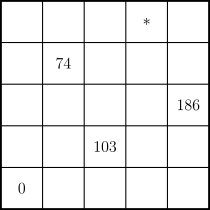
It is possible to place positive integers into the vacant twenty-one squares of the square shown below so that the numbers in each row and column form arithmetic sequences. Find the number that must occupy the vacant square marked by the asterisk
Respuesta: 142
Pista pequeña:
Numera las filas y columnas desde hasta
Index the rows and columns from through
Pista grande:
Una cuadrícula en la que cada fila y columna es una sucesión aritmética tiene la forma
A grid whose rows and columns are arithmetic has the form
Solución:
Numera las filas y columnas de a Las condiciones de filas y columnas dan la entrada general Los cuatro valores mostrados producen Al resolver se obtiene y El asterisco está en así que su valor es
Index rows and columns from to The row and column conditions give the general entry The four shown values yield Solving gives and The asterisk is at so its value is
7.
En el triángulo y la altura desde divide a en segmentos de longitudes y ¿Cuál es el área del triángulo ?
In triangle and the altitude from divides into segments of length and What is the area of triangle
Respuesta: 110
Pista pequeña:
Sea la longitud de la altura y sitúa su pie en el origen
Let the altitude have length and place its foot at the origin
Pista grande:
Usa el producto vectorial dividido por el producto escalar para expresar la tangente del ángulo entre los vectores que siguen los dos lados
Use cross product over dot product to express the tangent of the angle between the two side vectors
Solución:
Sea la longitud de la altura Desde pueden tomarse como vectores hacia los extremos de a y Por tanto, Así, cuya raíz positiva es Como el área es
Let the altitude length be From vectors to the endpoints of may be taken as and Therefore Thus whose positive root is Since the area is
8.
La función definida sobre el conjunto de pares ordenados de enteros positivos, satisface las siguientes propiedades:
Calcula
The function defined on the set of ordered pairs of positive integers, satisfies the following properties:
Calculate
Respuesta: 364
Pista pequeña:
Aplica la tercera propiedad a cuando
Apply the third property to when
Pista grande:
Compara la regla de resta resultante con la misma regla para
Compare the resulting subtraction rule with the same rule for
Solución:
Para la tercera propiedad aplicada a da El mínimo común múltiplo satisface la misma relación, porque Por tanto, el cociente no cambia en cada paso de resta del algoritmo de Euclides. En la diagonal es igual a así que Por tanto,
For the third property applied to gives The least common multiple obeys the identical relation, because Hence the quotient is unchanged by each subtraction step of the Euclidean algorithm. On the diagonal it equals so Therefore
9.
Halla el menor entero positivo cuyo cubo termina en
Find the smallest positive integer whose cube ends in
Respuesta: 192
Pista pequeña:
La cifra de las unidades obliga a que el número tenga la forma
The units digit forces the number to have the form
Pista grande:
Reduce primero módulo
Reduce first modulo
Solución:
Escribe el número como Al desarrollar la congruencia requerida módulo y dividir entre se obtiene Al reducir primero módulo se obtiene al sustituir se obtiene después Así, y el menor candidato es Es par, así que su cubo también es y en efecto
Write the number as Expanding the required congruence modulo and dividing by gives Reducing first modulo gives substituting then gives Thus and the smallest candidate is It is even, so its cube is also and indeed
10.
Un poliedro convexo tiene como caras cuadrados, hexágonos regulares y octágonos regulares. En cada vértice del poliedro se encuentran un cuadrado, un hexágono y un octágono. ¿Cuántos segmentos que unen vértices del poliedro están en su interior, en vez de estar sobre una arista o una cara?
A convex polyhedron has for its faces squares, regular hexagons, and regular octagons. At each vertex of the polyhedron one square, one hexagon, and one octagon meet. How many segments joining vertices of the polyhedron lie in the interior of the polyhedron rather than along an edge or a face?
Respuesta: 840
Pista pequeña:
Cuenta por duplicado las incidencias cara-vértice y cara-arista para hallar y
Double-count face-vertex and face-edge incidences to find and
Pista grande:
Cuenta todos los pares de vértices y resta los que están juntos en una cara, corrigiendo el doble conteo de las aristas
Count all vertex pairs, then subtract pairs lying together on a face, correcting the double count of edges
Solución:
La cantidad total de incidencias cara-vértice es En cada vértice se encuentran tres caras, así que La misma suma cuenta dos veces cada arista, por lo que
Hay pares de vértices. Al sumar los pares de cada cara se obtiene Cada arista se contó dos veces en esta suma y cada otro par de una misma cara una vez, así que la cantidad de pares distintos de la frontera es Por tanto, segmentos que unen vértices están en el interior.
The total number of face-vertex incidences is Three faces meet at each vertex, so The same sum counts each edge twice, so
There are vertex pairs. Summing pairs on faces gives Every edge was counted twice in this sum and every other same-face pair once, so the number of distinct boundary pairs is Hence joining segments lie in the interior.
11.
Sean números complejos. Una recta del plano complejo se llama recta media de los puntos si contiene puntos (números complejos) tales que
Para los números y hay una única recta media cuya intersección con el eje es Halla la pendiente de esta recta media.
Let be complex numbers. A line in the complex plane is called a mean line for the points if contains points (complex numbers) such that
For the numbers and there is a unique mean line with -intercept Find the slope of this mean line.
Respuesta: 163
Pista pequeña:
Usa la ecuación para comparar los promedios de los dos conjuntos de puntos
Average the equation
Pista grande:
Una recta media es exactamente una recta que pasa por el centroide de los puntos dados
A mean line is exactly a line through the centroid of the given points
Solución:
La condición dice que el promedio de los es igual al promedio de los Como todos los están en su promedio está en a la inversa, cualquier recta que pase por el promedio funciona tomando todos los iguales a ese punto. El centroide satisface La recta que pasa por este punto y tiene pendiente
The condition says that the average of the equals the average of the Since all lie on their average lies on conversely, any line through the average works by taking all equal to that point. The centroid satisfies The line through this point and has slope
12.
Sea un punto interior del triángulo . Desde cada vértice, traza una recta que pase por y llegue al lado opuesto. Sean y las longitudes de los segmentos indicados en la figura. Halla el producto si y
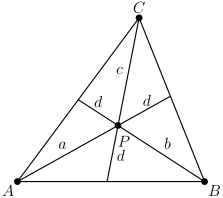
Let be an interior point of triangle and extend lines from the vertices through to the opposite sides. Let and denote the lengths of the segments indicated in the figure. Find the product if and
Respuesta: 441
Pista pequeña:
Expresa las tres coordenadas baricéntricas de usando las razones
Express the three barycentric coordinates of using the ratios
Pista grande:
Usa y desarrolla simétricamente
Use and expand symmetrically
Solución:
A lo largo de la ceviana desde la coordenada baricéntrica correspondiente a es y de forma análoga en los otros vértices. Como las tres coordenadas suman y Sean y Al eliminar denominadores se obtiene Por tanto, así que
Along the cevian from the barycentric coordinate at is and similarly at the other vertices. Since the three coordinates sum to and Put and Clearing denominators gives Therefore so
13.
Halla si y son enteros tales que es un factor de
Find if and are integers such that is a factor of
Respuesta: 987
Pista pequeña:
Módulo las potencias satisfacen
Modulo powers satisfy
Pista grande:
Iguala a cero ambos coeficientes del resto lineal y usa la identidad de Cassini
Set both coefficients of the linear remainder equal to zero and use Cassini’s identity
Solución:
Módulo la relación da Por tanto, el resto es Ambos coeficientes deben anularse. Por la identidad de Cassini, el determinante de la matriz de coeficientes es y la regla de Cramer da entonces
Modulo the relation gives Hence the remainder is Both coefficients must vanish. The determinant of the coefficient matrix is by Cassini’s identity. Cramer’s rule then gives
14.
Sea la gráfica de y sea la reflexión de respecto de la recta Escribe la ecuación de en la forma
Halla el producto
Let be the graph of and denote by the reflection of in the line Let the equation of be written in the form
Find the product
Respuesta: 84
Pista pequeña:
Halla la matriz de reflexión respecto de la recta generada por
Find the reflection matrix for the line spanned by
Pista grande:
Como una reflexión es su propia inversa, sustituye las coordenadas reflejadas en
Because reflection is its own inverse, substitute the reflected coordinates into
Solución:
La reflexión respecto de la recta generada por tiene matriz Así, un punto de corresponde a un punto cuyas coordenadas son y situado en Al sustituir se obtiene o bien Por tanto, y
Reflection in the line spanned by has matrix Thus a point on came from and on Substituting gives or Hence and
15.
En una oficina, en distintos momentos del día, el jefe entrega a la secretaria una carta para mecanografiar y cada vez la pone encima de la pila de su bandeja de entrada. Cuando tiene tiempo, la secretaria retira la carta superior y la mecanografía. Hay nueve cartas para mecanografiar durante el día, y el jefe las entrega en el orden
Al salir a almorzar, la secretaria le dice a un colega que la carta ya fue mecanografiada, pero no cuenta nada más sobre el trabajo de la mañana. El colega se pregunta cuáles de las nueve cartas quedan para después del almuerzo y en qué orden se mecanografiarán. Según la información anterior, ¿cuántas secuencias de mecanografiado para después del almuerzo son posibles? (Que no quede ninguna carta es una de las posibilidades.)
In an office at various times during the day, the boss gives the secretary a letter to type, each time putting the letter on top of the pile in the secretary’s in-box. When there is time, the secretary takes the top letter off the pile and types it. There are nine letters to be typed during the day, and the boss delivers them in the order
While leaving for lunch, the secretary tells a colleague that letter has already been typed, but says nothing else about the morning’s typing. The colleague wonders which of the nine letters remain to be typed after lunch and in what order they will be typed. Based upon the above information, how many such after-lunch typing orders are possible? (That there are no letters left to be typed is one of the possibilities.)
Respuesta: 704
Pista pequeña:
Después de mecanografiar , las cartas restantes entre deben mecanografiarse luego en orden decreciente
After has been typed, any remaining letters among must later be typed in decreasing order
Pista grande:
Separa los casos según que haya sido mecanografiada antes del almuerzo o quede por insertar en el orden posterior
Separate the cases according to whether was typed before lunch or remains to be inserted into the later order
Solución:
Cualquier subconjunto de puede permanecer en la pila después de mecanografiar , y esas cartas restantes deben mecanografiarse luego en orden decreciente. Si ya fue mecanografiada, elegir ese subconjunto da órdenes posibles.
Si permanece, elige de las siete cartas menores e inserta en cualquiera de las posiciones de su orden decreciente. Esto da Toda secuencia de este tipo puede realizarse mediante una organización adecuada de las entregas y la mecanografía durante la mañana, por lo que el total es
Any subset of can remain in the stack after has been typed, and those remaining letters must later be typed in decreasing order. If was already typed, choosing that subset gives possible orders.
If remains, choose of the seven smaller letters and insert into any of the positions in their decreasing order. This gives Every such order can be realized by suitable morning choices, so the total is