
2022 AMC 10B 第 19 题
先试着解答 2022 AMC 10B 第 19 题,然后核对你的答案与精心整理的解答,解答来自 LIVE by Po-Shen Loh。你也可以参加完整限时模拟考试、查看全部 2022 AMC 10B 解答,或核对答案。
所有题目均经美国数学协会(MAA)官方合法授权使用。
19.
方格中的每个小方格要么被填充,要么为空;每个小方格最多有八个相邻小方格,相邻表示共边或共顶点。按以下规则变换方格:
• 任意一个已填充的小方格,如果有两个或三个已填充的相邻小方格,则保持填充。
• 任意一个空小方格,如果恰有三个已填充的相邻小方格,则变为填充。
• 所有其他小方格保持为空或变为空。
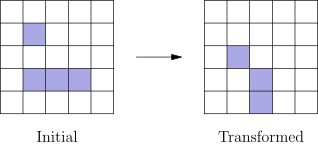
下图显示一个变换示例。
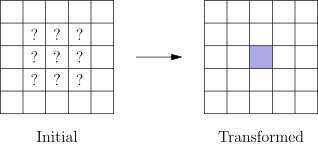
假设这个 方格有一圈空边框,围住一个 子方格。经过一次变换后,最终方格只在中心有一个已填充小方格。有多少种初始配置会产生这种结果?(旋转或翻折后相同的配置仍视为不同。)
Each square in a grid is either filled or empty, and has up to eight adjacent neighboring squares, where neighboring squares share either a side or a corner. The grid is transformed by the following rules:
• Any filled square with two or three filled neighbors remains filled.
• Any empty square with exactly three filled neighbors becomes a filled square.
• All other squares remain empty or become empty.
A sample transformation is shown in the figure below.
Suppose the grid has a border of empty squares surrounding a subgrid. How many initial configurations will lead to a transformed grid consisting of a single filled square in the center after a single transformation? (Rotations and reflections of the same configuration are considered different.)
小提示:
分别讨论中心格初始时是否被填充。
Split into cases according to whether the center is initially filled or empty
大提示:
每个初始填充的非中心格都必须消失,而且不能产生其他新的填充格
Every initially filled noncenter square must disappear, and no other empty square may be born
解答:
先假设中心格初始已填充。它必须恰有 或 个已填充邻格才能保持填充。每个这样的邻格已经与中心格相邻,所以要在变换后消失,它不能再与其他已填充邻格相邻。检查这些两两不相邻的位置后,唯一不会同时使某个空格恰有 个已填充邻格的选择,是两个相对的角格。这样的配置有 种。
再假设中心格初始为空。它的八个邻格中必须恰有 个被填充。这三个格都必须在变换后消失,所以其中任何一个都不能同时与另外两个相邻。此外,除中心格以外,不能有任何空格同时与这三个填充格相邻。应用这两个条件,可得到以下四种代表性图案:
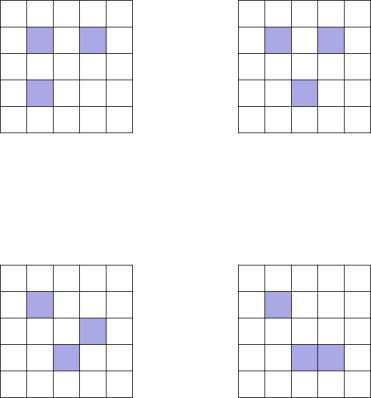
前三种图案各有 个不同的旋转。最后一种有 个旋转及其 个镜像,共 种配置。因此,中心格初始为空的情形共有 种,全部配置共有 种。
所以正确答案是 C。
First suppose the center is initially filled. It must have exactly or filled neighbors to survive. Every such neighbor already touches the center, so to disappear it cannot touch any other filled neighbor. Checking these pairwise nonadjacent positions, the only choices that do not also give some empty square exactly filled neighbors are two opposite corners. There are such configurations.
Now suppose the center is initially empty. Exactly of its eight neighbors must be filled. Each of those three must disappear, so none may be adjacent to both of the others. Also, no empty square besides the center may be adjacent to all three. Applying these two tests gives the following four representative patterns:
Each of the first three patterns has distinct rotations. The last has rotations and their reflected images, for configurations. Thus the center-empty case contributes and the total is
Thus, the answer is C .
其他年份的第 19 题
2000 AMC 10 · 2001 AMC 10 · 2002 AMC 10A · 2002 AMC 10B · 2003 AMC 10A · 2003 AMC 10B · 2004 AMC 10A · 2004 AMC 10B · 2005 AMC 10A · 2005 AMC 10B · 2006 AMC 10A · 2006 AMC 10B · 2007 AMC 10A · 2007 AMC 10B · 2008 AMC 10A · 2008 AMC 10B · 2009 AMC 10A · 2009 AMC 10B · 2010 AMC 10A · 2010 AMC 10B · 2011 AMC 10A · 2011 AMC 10B · 2012 AMC 10A · 2012 AMC 10B · 2013 AMC 10A · 2013 AMC 10B · 2014 AMC 10A · 2014 AMC 10B · 2015 AMC 10A · 2015 AMC 10B · 2016 AMC 10A · 2016 AMC 10B · 2017 AMC 10A · 2017 AMC 10B · 2018 AMC 10A · 2018 AMC 10B · 2019 AMC 10A · 2019 AMC 10B · 2020 AMC 10A · 2020 AMC 10B · 2021 AMC 10A Spring · 2021 AMC 10B Spring · 2021 AMC 10A Fall · 2021 AMC 10B Fall · 2022 AMC 10A · 2023 AMC 10A · 2023 AMC 10B · 2024 AMC 10A · 2024 AMC 10B · 2025 AMC 10A · 2025 AMC 10B