
Problemas del 1980 AMC 12
¡Desplázate hacia abajo y presiona Iniciar para intentar el examen! O ve al PDF imprimible, la clave de respuestas, o las soluciones profesionales preparadas por LIVE by Po-Shen Loh.
Todos los problemas se usan con el permiso legal oficial de la Mathematical Association of America (MAA).
O salta directamente a un solo problema con su solución: 1 · 2 · 3 · 4 · 5 · 6 · 7 · 8 · 9 · 10 · 11 · 12 · 13 · 14 · 15 · 16 · 17 · 18 · 19 · 20 · 21 · 22 · 23 · 24 · 25 · 26 · 27 · 28 · 29 · 30
¿Quieres aprender de forma profesional con clases interactivas en video?
Con tiempo
1:15:00
1.
El mayor número entero no negativo tal que siete veces el número es menor que es
The largest whole number such that seven times the number is less than is
Respuesta: C
Pista pequeña:
Traduce «siete veces el número es menor que » a una desigualdad
Translate “seven times the number is less than ” into an inequality
Pista grande:
Ubica entre dos enteros no negativos consecutivos
Locate between two consecutive whole numbers
Solución:
El número debe ser menor que El mayor entero no negativo menor que este valor es
Por lo tanto, la respuesta correcta es C.
The number must be less than The largest whole number below this value is
Therefore, the correct answer is C.
2.
El grado de como polinomio en es
The degree of as a polynomial in is
Pista pequeña:
Halla la mayor potencia que aporta cada factor entre paréntesis
Find the highest power contributed by each parenthesized factor
Pista grande:
Los grados se suman al multiplicar polinomios no nulos
Degrees add when nonzero polynomials are multiplied
Solución:
El primer factor tiene grado y el segundo tiene grado Por tanto, su producto tiene grado
Por lo tanto, la respuesta correcta es D.
The first factor has degree and the second has degree Their product therefore has degree
Therefore, the correct answer is D.
3.
Si la razón de a es ¿cuál es la razón de a ?
If the ratio of to is what is the ratio of to
Respuesta: E
Pista pequeña:
Escribe la razón dada como una igualdad entre dos fracciones
Write the stated ratio as an equation of two fractions
Pista grande:
Multiplica en cruz y agrupa por separado los términos con y con
Cross-multiply and collect the -terms and -terms separately
Solución:
La condición da Entonces de modo que y
Por lo tanto, la respuesta correcta es E.
The condition gives Thus so and
Therefore, the correct answer is E.
4.
En la figura adjunta, es un triángulo equilátero, y y son cuadrados. La medida de es
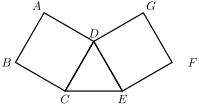
In the adjoining figure, is an equilateral triangle and and are squares. The measure of is
Respuesta: C
Pista pequeña:
Identifica los tres ángulos conocidos en
Identify the three known angles at
Pista grande:
Usa el ángulo completo de alrededor del punto
Use the full angle around point
Solución:
En los dos ángulos de los cuadrados miden cada uno y el ángulo del triángulo equilátero mide Por tanto,
Por lo tanto, la respuesta correcta es C.
At the two square angles are each and the equilateral-triangle angle is Hence
Therefore, the correct answer is C.
5.
Si y son diámetros perpendiculares del círculo en y entonces la longitud de dividida entre la longitud de es
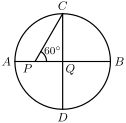
If and are perpendicular diameters of circle in and then the length of divided by the length of is
Respuesta: B
Pista pequeña:
Usa los diámetros perpendiculares para identificar un ángulo recto en
Use the perpendicular diameters to identify a right angle in
Pista grande:
Relaciona los catetos corto y largo del triángulo -- resultante
Relate the short and long legs of the resulting -- triangle
Solución:
El triángulo es rectángulo en y tiene así que es un triángulo --. Como
Por lo tanto, la respuesta correcta es B.
Triangle is right at and has so it is a -- triangle. Since
Therefore, the correct answer is B.
6.
Un número positivo satisface la desigualdad si y solo si
A positive number satisfies the inequality if and only if
Respuesta: A
Pista pequeña:
Usa el hecho de que ambos lados son positivos
Use the fact that both sides are positive
Pista grande:
Divide entre antes de elevar al cuadrado o aislar
Divide by before squaring or isolating
Solución:
Como dividir entre conserva la desigualdad: Así, lo cual equivale a
Por lo tanto, la respuesta correcta es A.
Because division by preserves the inequality: Thus which is equivalent to
Therefore, the correct answer is A.
7.
Los lados y del polígono convexo miden y respectivamente; además, es un ángulo recto. El área del cuadrilátero es
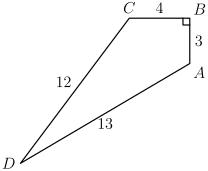
Sides and of convex polygon have lengths and respectively; and is a right angle. The area of the quadrilateral is
Respuesta: B
Pista pequeña:
Traza la diagonal y halla su longitud usando
Draw diagonal and find its length from
Pista grande:
Reconoce un segundo triángulo rectángulo a partir de las longitudes y
Recognize a second right triangle using the side lengths and
Solución:
El triángulo es un triángulo rectángulo --, así que y su área es Como el triángulo es rectángulo en y tiene área El área del cuadrilátero es
Por lo tanto, la respuesta correcta es B.
Triangle is a -- right triangle, so and its area is Since triangle is right at and has area The quadrilateral’s area is
Therefore, the correct answer is B.
8.
¿Cuántos pares de números reales no nulos satisfacen la ecuación
How many pairs of nonzero real numbers satisfy the equation
ninguno
none
un par para cada
one pair for each
dos pares para cada
two pairs for each
Respuesta: A
Pista pequeña:
Elimina los denominadores, teniendo en cuenta que y deben ser no nulos
Clear the denominators, noting that and must be nonzero
Pista grande:
Considera la cuadrática homogénea resultante como una ecuación en la razón
Treat the resulting homogeneous quadratic as an equation in the ratio
Solución:
Al eliminar los denominadores se obtiene o bien Como sea Entonces cuyo discriminante es Por lo tanto, no hay pares reales.
Por lo tanto, la respuesta correcta es A.
Clearing denominators gives or Since let Then whose discriminant is Thus there are no real pairs.
Therefore, the correct answer is A.
9.
Un hombre camina millas hacia el oeste, gira a su izquierda y camina millas en la nueva dirección. Si termina en un punto situado a millas de su punto de partida, entonces es
A man walks miles due west, turns to his left and walks miles in the new direction. If he finishes at a point miles from his starting point, then is
no está determinado de manera única por la información dada
not uniquely determined by the given information
Respuesta: E
Pista pequeña:
Descompón el segundo desplazamiento en componentes horizontal y vertical
Resolve the second walk into horizontal and vertical components
Pista grande:
La ecuación de distancia es cuadrática en ; comprueba si sus dos raíces positivas son válidas
The distance equation is quadratic in ; check whether both positive roots are valid
Solución:
Toma el este como dirección horizontal positiva. Después del giro, el desplazamiento de millas tiene componentes Por lo tanto, De aquí, lo que da o El valor no es único.
Por lo tanto, la respuesta correcta es E.
Take east as the positive horizontal direction. After the turn, the -mile displacement has components Therefore Hence giving or The value is not unique.
Therefore, the correct answer is E.
10.
Los números de dientes de tres engranajes circulares acoplados son respectivamente. (Los dientes de todos los engranajes tienen el mismo tamaño y están espaciados regularmente como en la figura). Las velocidades angulares, en revoluciones por minuto, de están en la proporción
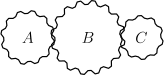
The number of teeth in three meshed circular gears are respectively. (The teeth on all gears are the same size and regularly spaced as in the figure.) The angular speeds, in revolutions per minute, of are in the proportion
Respuesta: D
Pista pequeña:
Los dientes acoplados tienen la misma rapidez tangencial en sus puntos de contacto
Meshed teeth have the same tangential speed at their points of contact
Pista grande:
La velocidad angular es inversamente proporcional a la circunferencia y, por tanto, al número de dientes
Angular speed is inversely proportional to circumference and hence to the number of teeth
Solución:
Las circunferencias de los engranajes son proporcionales a y mientras que sus velocidades tangenciales tienen la misma magnitud. Por lo tanto, sus velocidades angulares son proporcionales a Al multiplicar los tres términos por se obtiene
Por lo tanto, la respuesta correcta es D.
The gears’ circumferences are proportional to and while their tangential speeds have equal magnitude. Their angular speeds are therefore proportional to Multiplying all three terms by gives
Therefore, the correct answer is D.
11.
Si la suma de los primeros términos y la suma de los primeros términos de una progresión aritmética dada son y respectivamente, entonces la suma de los primeros términos es
If the sum of the first terms and the sum of the first terms of a given arithmetic progression are and respectively, then the sum of the first terms is
Respuesta: D
Pista pequeña:
Escribe
Write
Pista grande:
Usa las dos sumas parciales conocidas para hallar la expresión
Use the two known partial sums to find the expression
Solución:
Las dos sumas dadas producen Al restar se obtiene así que y Por lo tanto,
Por lo tanto, la respuesta correcta es D.
The two given sums yield Subtracting gives so and Therefore
Therefore, the correct answer is D.
12.
Las ecuaciones de y son y respectivamente. Supón que forma con la horizontal un ángulo dos veces mayor (medido en sentido antihorario desde el eje positivo) que el de y que tiene veces la pendiente de Si no es horizontal, entonces es
The equations of and are and respectively. Suppose makes twice as large an angle with the horizontal (measured counterclockwise from the positive -axis) as does and that has times the slope of If is not horizontal, then is
no está determinado de manera única por la información dada
not uniquely determined by the given information
Respuesta: C
Pista pequeña:
Sea el ángulo de inclinación de
Let the angle of inclination of be
Pista grande:
Sustituye en
Substitute into
Solución:
Sea Entonces y también Por lo tanto, La condición de que no sea horizontal da así que o Por consiguiente,
Por lo tanto, la respuesta correcta es C.
Let Then and also Hence The nonhorizontal condition gives so or Thus
Therefore, the correct answer is C.
13.
Un insecto (de tamaño despreciable) parte del origen en el plano de coordenadas. Primero se mueve unidad hacia la derecha hasta Luego gira en sentido antihorario y recorre unidad hasta Si continúa de esta forma, girando cada vez en sentido antihorario y recorriendo la mitad de la distancia del movimiento anterior, ¿a cuál de los siguientes puntos se acercará más?
A bug (of negligible size) starts at the origin on the coordinate plane. First it moves unit right to Then it makes a turn counterclockwise and travels a unit to If it continues in this fashion, each time making a turn counterclockwise and traveling half as far as in the previous move, to which of the following points will it come closest?
Respuesta: B
Pista pequeña:
Representa un giro de en sentido antihorario mediante la multiplicación por
Represent a counterclockwise turn by multiplication by
Pista grande:
Los vectores de desplazamiento forman una serie geométrica infinita con razón
The displacement vectors form an infinite geometric series with ratio
Solución:
Como números complejos, los vectores de desplazamiento sucesivos son Su suma es Así, el insecto se aproxima a
Por lo tanto, la respuesta correcta es B.
As complex numbers, the successive displacement vectors are Their sum is Thus the bug approaches
Therefore, the correct answer is B.
14.
Si es una constante y la función definida por satisface para todos los números reales excepto entonces es
If is a constant and the function defined by satisfies for all real numbers except then is
no está determinado de manera única por la información dada
not uniquely determined by the given information
Respuesta: A
Pista pequeña:
Calcula como una sola expresión racional
Compute as a single rational expression
Pista grande:
Para que el resultado sea idéntico a , compara el coeficiente de en el denominador
For the result to equal identically, compare the coefficient of in the denominator
Solución:
La composición directa da Para que sea idéntica a el denominador debe ser la constante Por tanto, y condiciones que juntas dan
Por lo tanto, la respuesta correcta es A.
Direct composition gives For this to equal identically, the denominator must be the constant Thus and both of which give
Therefore, the correct answer is A.
15.
Una tienda fija el precio de un artículo en dólares y centavos de modo que, al añadir un impuesto sobre las ventas del , no se necesita redondear porque el resultado es exactamente dólares, donde es un entero positivo. El menor valor de es
A store prices an item in dollars and cents so that when sales tax is added no rounding is necessary because the result is exactly dollars, where is a positive integer. The smallest value of is
Respuesta: B
Pista pequeña:
Sea el precio antes de impuestos un número entero de centavos
Let the untaxed price be an integer number of cents
Pista grande:
Reduce la ecuación a una condición de divisibilidad sobre
Reduce the equation to a divisibility condition on
Solución:
Sea el precio centavos. Entonces de modo que Como y son primos relativos, debe dividir a La menor posibilidad positiva es
Por lo tanto, la respuesta correcta es B.
Let the price be cents. Then so Since and are relatively prime, must divide The smallest positive possibility is
Therefore, the correct answer is B.
16.
Cuatro de los ocho vértices de un cubo son vértices de un tetraedro regular. Halla la razón entre el área superficial del cubo y el área superficial del tetraedro.

Four of the eight vertices of a cube are vertices of a regular tetrahedron. Find the ratio of the surface area of the cube to the surface area of the tetrahedron.
Respuesta: B
Pista pequeña:
Si la arista del cubo es cada arista del tetraedro es la diagonal de una cara
If the cube edge is each tetrahedron edge is a face diagonal
Pista grande:
Compara con cuatro triángulos equiláteros de lado
Compare with four equilateral triangles of side
Solución:
Sea la arista del cubo. Cada arista del tetraedro es la diagonal de una cara del cubo, por lo que mide El área superficial del tetraedro es El área superficial del cubo es así que la razón es
Por lo tanto, la respuesta correcta es B.
Let the cube edge be Each tetrahedron edge is a cube face diagonal, so it has length The tetrahedron’s surface area is The cube’s surface area is so the ratio is
Therefore, the correct answer is B.
17.
Dado que ¿para cuántos enteros es un entero?
Given that for how many integers is an integer?
ninguno
none
Respuesta: D
Pista pequeña:
Expande y aísla su parte imaginaria
Expand and isolate its imaginary part
Pista grande:
Un entero tiene parte imaginaria cero; resuelve la factorización cúbica resultante
An integer has imaginary part zero, so solve the resulting cubic factorization
Solución:
La expansión da La parte imaginaria se anula exactamente cuando o Para cada uno de estos tres enteros, la parte real es un entero, así que hay valores.
Por lo tanto, la respuesta correcta es D.
Expansion gives The imaginary part vanishes exactly when or For each of these three integers the real part is an integer, so there are values.
Therefore, the correct answer is D.
18.
Si y entonces es igual a
If and then equals
ninguna de estas
none of these
Respuesta: D
Pista pequeña:
Convierte en una ecuación exponencial
Convert into an exponential equation
Pista grande:
Usa y la positividad de
Use and the positivity of
Solución:
Tenemos por lo que Por consiguiente,
Por lo tanto, la respuesta correcta es D.
We have so Therefore
Therefore, the correct answer is D.
19.
Sean y tres cuerdas paralelas de un círculo situadas al mismo lado del centro. La distancia entre y es igual a la distancia entre y Las longitudes de las cuerdas son y El radio del círculo es
Let and be three parallel chords of a circle on the same side of the center. The distance between and is the same as the distance between and The lengths of the chords are and The radius of the circle is
no está determinado de manera única por la información dada
not uniquely determined by the given information
Respuesta: D
Pista pequeña:
Una perpendicular desde el centro biseca cada cuerda
A perpendicular from the center bisects each chord
Pista grande:
Sea la distancia desde el centro hasta la cuerda más cercana y el espaciamiento común
Let the nearest chord be distance from the center and the common spacing be
Solución:
Sean el radio, la distancia a la cuerda de longitud y el espaciamiento común. Entonces Las restas consecutivas dan y de modo que y Por lo tanto, y
Por lo tanto, la respuesta correcta es D.
Let be the radius, the distance to the -unit chord, and the common spacing. Then Consecutive subtraction gives and so and Hence and
Therefore, the correct answer is D.
20.
Una caja contiene monedas de un centavo, monedas de cinco centavos y monedas de diez centavos. Se extraen seis monedas sin reemplazo, y cada moneda tiene la misma probabilidad de ser elegida. ¿Cuál es la probabilidad de que el valor de las monedas extraídas sea al menos centavos?
A box contains pennies, nickels and dimes. Six coins are drawn without replacement, with each coin having an equal probability of being chosen. What is the probability that the value of the coins drawn is at least cents?
ninguna de estas
none of these
Respuesta: C
Pista pequeña:
Hay conjuntos de seis monedas igualmente probables
There are equally likely sets of six coins
Pista grande:
Clasifica las selecciones favorables según contengan seis, cinco o cuatro monedas de diez centavos
Classify favorable selections by whether they contain six, five, or four dimes
Solución:
Hay selecciones. Se obtiene un valor de al menos centavos con seis monedas de diez centavos; con cinco de diez centavos y cualquier otra moneda; o con cuatro de diez centavos y dos de cinco centavos. El número de selecciones favorables es Por lo tanto, la probabilidad es
Por lo tanto, la respuesta correcta es C.
There are selections. A value of at least cents occurs with six dimes; with five dimes and any one other coin; or with four dimes and two nickels. The favorable count is Thus the probability is
Therefore, the correct answer is C.
21.
En el triángulo es el punto medio del lado y es un punto del lado tal que y se cortan en La razón entre el área de y el área del cuadrilátero es
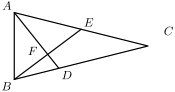
In triangle is the midpoint of side and is a point on side such that and intersect at The ratio of the area of to the area of quadrilateral is
ninguna de estas
none of these
Respuesta: A
Pista pequeña:
Las razones de áreas no cambian bajo una transformación afín, así que puedes usar coordenadas convenientes
Area ratios are unchanged by an affine transformation, so convenient coordinates may be used
Pista grande:
Halla la razón y luego compara los triángulos pequeños con
Find the ratio , then compare the small triangles with
Solución:
Escala el área total de a Como tenemos y Las condiciones de punto medio y trisección dan Por lo tanto, Además, Así, y la razón pedida es
Por lo tanto, la respuesta correcta es A.
Scale the total area of to Since we have and The midpoint and trisection conditions give Hence Also Therefore and the requested ratio is
Therefore, the correct answer is A.
22.
Para cada número real sea el mínimo de los números y Entonces el valor máximo de es
For each real number let be the minimum of the numbers and Then the maximum value of is
Respuesta: E
Pista pequeña:
Traza las tres rectas y sigue su envolvente inferior
Sketch the three lines and follow their lower envelope
Pista grande:
El máximo ocurre donde la recta creciente activa se encuentra con la recta decreciente
The maximum occurs where the active increasing line meets the decreasing line
Solución:
La envolvente inferior es hasta que se encuentra con en luego es hasta que esa recta se encuentra con en y después es Por tanto, su máximo ocurre en y es
Por lo tanto, la respuesta correcta es E.
The lower envelope is until it meets at then is until that line meets at and thereafter is Thus its maximum occurs at and equals
Therefore, the correct answer is E.
23.
Los segmentos trazados desde el vértice opuesto a la hipotenusa de un triángulo rectángulo hasta los puntos que trisecan la hipotenusa tienen longitudes y donde es un número real tal que La longitud de la hipotenusa es
Line segments drawn from the vertex opposite the hypotenuse of a right triangle to the points trisecting the hypotenuse have lengths and where is a real number such that The length of the hypotenuse is
no está determinada de manera única por la información dada
not uniquely determined by the given information
Respuesta: C
Pista pequeña:
Coloca la hipotenusa sobre el eje y asigna coordenadas al vértice del ángulo recto
Put the hypotenuse on the -axis and assign coordinates to the right-angle vertex
Pista grande:
Suma los cuadrados de las longitudes de los dos segmentos a los puntos de trisección para cancelar la posición horizontal desconocida
Add the squares of the two trisector-segment lengths so the unknown horizontal position cancels
Solución:
Sean y los extremos de la hipotenusa, y sea el vértice del ángulo recto. La condición de ángulo recto da La suma de los cuadrados de las distancias a y es Esto también es igual a Por consiguiente,
Por lo tanto, la respuesta correcta es C.
Let the hypotenuse have endpoints and and let the right-angle vertex be The right-angle condition gives The squared distances to and sum to This also equals Hence
Therefore, the correct answer is C.
24.
Para cierto número real el polinomio es divisible por ¿Cuál de los siguientes números es el más cercano a ?
For some real number the polynomial is divisible by Which of the following numbers is closest to
Respuesta: D
Pista pequeña:
Una raíz repetida aparece como un factor lineal al cuadrado
A repeated root appears as a squared linear factor
Pista grande:
Factoriza por completo el polinomio cúbico y luego compara la raíz repetida con los decimales dados
Factor the cubic completely and then compare the repeated root with the listed decimals
Solución:
El polinomio se factoriza como Así, la raíz repetida es y el número dado más cercano es
Por lo tanto, la respuesta correcta es D.
The polynomial factors as Thus the repeated root is and the nearest listed number is
Therefore, the correct answer is D.
25.
En la sucesión no decreciente de enteros impares cada entero impar positivo aparece veces. Se sabe que existen enteros y tales que, para todos los enteros positivos donde denota el mayor entero que no excede a La suma es
In the nondecreasing sequence of odd integers each positive odd integer appears times. It is a fact that there are integers and such that, for all positive integers where denotes the largest integer not exceeding The sum equals
Respuesta: C
Pista pequeña:
Los primeros enteros impares positivos suman
The first positive odd integers have sum
Pista grande:
Expresa el menor que satisface usando el piso de
Express the least with using a floor of
Solución:
La última aparición de está en la posición Por lo tanto, Así, y por lo que
Por lo tanto, la respuesta correcta es C.
The final occurrence of is in position Therefore Thus and so
Therefore, the correct answer is C.
26.
Cuatro esferas de radio son mutuamente tangentes; tres descansan sobre el piso y la cuarta descansa sobre las otras. Un tetraedro, cada una de cuyas aristas tiene longitud está circunscrito alrededor de las esferas. Entonces es igual a
Four balls of radius are mutually tangent, three resting on the floor and the fourth resting on the others. A tetrahedron, each of whose edges has length is circumscribed around the balls. Then equals
Respuesta: E
Pista pequeña:
Los cuatro centros de las esferas forman un tetraedro regular de arista
The four ball centers form a regular tetrahedron of edge
Pista grande:
Las caras exteriores son paralelas a las caras correspondientes del tetraedro de centros y están un radio más lejos
The outer faces are parallel to the corresponding center-tetrahedron faces and one radius farther away
Solución:
Los centros de las esferas forman un tetraedro regular de arista Su inradio es Cada cara del tetraedro circunscrito es paralela a la cara correspondiente del tetraedro de centros y se encuentra una unidad más lejos del centro común. Por semejanza, Por lo tanto,
Por lo tanto, la respuesta correcta es E.
The ball centers form a regular tetrahedron of edge Its inradius is Each face of the circumscribed tetrahedron is parallel to the corresponding face of this center tetrahedron and lies one unit farther from the common center. By similarity, Hence
Therefore, the correct answer is E.
27.
La suma es igual a
The sum equals
ninguna de estas
none of these
Respuesta: E
Pista pequeña:
Llama y a las dos raíces cúbicas y calcula
Call the two cube roots and , and compute
Pista grande:
Usa
Use
Solución:
Sean y las dos raíces cúbicas reales. Entonces Si entonces así que La única solución real es que no aparece entre las opciones.
Por lo tanto, la respuesta correcta es E.
Let the two real cube roots be and Then If then so The only real solution is which is not listed.
Therefore, the correct answer is E.
28.
El polinomio no es divisible por si es igual a
The polynomial is not divisible by if equals
Respuesta: C
Pista pequeña:
Evalúa el polinomio en una raíz cúbica no real de la unidad
Evaluate the polynomial at a nonreal cube root of unity
Pista grande:
Usa y considera módulo
Use and consider modulo
Solución:
Sea Como al evaluar el polinomio en se obtiene Esto es salvo que en cuyo caso es Esto último ocurre exactamente cuando es divisible por Entre las opciones, solo es divisible por así que este es el valor para el cual falla la divisibilidad.
Por lo tanto, la respuesta correcta es C.
Let Since the polynomial evaluated at is This is unless in which case it is The latter occurs exactly when is divisible by Among the choices only is divisible by so that is the value for which divisibility fails.
Therefore, the correct answer is C.
29.
¿Cuántas ternas ordenadas de enteros satisfacen el siguiente sistema de ecuaciones?
How many ordered triples of integers satisfy the system of equations below?
un número finito mayor que dos
a finite number greater than two
infinitas
infinitely many
Respuesta: A
Pista pequeña:
Suma las tres ecuaciones antes de intentar resolver las variables
Add all three equations before trying to solve for the variables
Pista grande:
Reescribe la forma cuadrática resultante como una suma de dos cuadrados y reduce módulo
Rewrite the resulting quadratic form as a sum of two squares and reduce modulo
Solución:
Al sumar las tres ecuaciones se obtiene o bien Un cuadrado es congruente con o así que una suma de dos cuadrados no puede ser congruente con Pero una contradicción. Por lo tanto, no hay ternas enteras.
Por lo tanto, la respuesta correcta es A.
Adding the three equations gives or A square is congruent to or so a sum of two squares cannot be congruent to But a contradiction. Thus there are no integer triples.
Therefore, the correct answer is A.
30.
Un número de seis cifras (en base ) es cuadradizo si satisface las siguientes condiciones:
(i) ninguna de sus cifras es cero;
(ii) es un cuadrado perfecto; y
(iii) las dos primeras cifras, las dos cifras centrales y las dos últimas cifras del número son cuadrados perfectos al considerarlas como números de dos cifras.
¿Cuántos números cuadradizos hay?
A six digit number (base ) is squarish if it satisfies the following conditions:
(i) none of its digits is zero;
(ii) it is a perfect square; and
(iii) the first two digits, the middle two digits and the last two digits of the number are all perfect squares when considered as two digit numbers.
How many squarish numbers are there?
Respuesta: B
Pista pequeña:
Enumera los cuadrados perfectos de dos cifras que no contienen ningún cero
List the two-digit perfect squares having no zero digit
Pista grande:
Usa el primer par para restringir la raíz cuadrada a un intervalo corto y luego filtra por el último par
Use the first pair to restrict the square root to a short interval, then filter by the final pair
Solución:
Cada bloque de dos cifras debe pertenecer a Al restringir la raíz cuadrada mediante el primer bloque y conservar solo los cuadrados cuyo bloque final está permitido, quedan los siguientes bloques centrales posibles:
primer bloque posibles bloques centrales
Solo está permitido el bloque central lo cual produce Por lo tanto, hay números cuadradizos.
Por lo tanto, la respuesta correcta es B.
Each two-digit block must belong to Restricting the square root by the first block and retaining only squares with an allowed final block leaves the following possible middle blocks:
first block possible middle blocks
Only the middle block is allowed, producing Thus there are squarish numbers.
Therefore, the correct answer is B.