
2025 AMC 12A 真题
计时
1:15:00
1.
Andy 和 Betsy 都住在 Mathville。Andy 在 从 Mathville 骑自行车出发,以稳定的每小时 英里向正北行驶。Betsy 在 从同一点骑自行车出发,以稳定的每小时 英里向正东行驶。什么时候他们离共同出发点的距离恰好相同?
Andy and Betsy both live in Mathville. Andy leaves Mathville on his bicycle at traveling due north at a steady miles per hour. Betsy leaves on her bicycle from the same point at traveling due east at a steady miles per hour. At what time will they be exactly the same distance from their common starting point?
小提示:
从 开始计时;Betsy 骑行的时间比 Andy 少一小时
Measure time from ; Betsy has been riding one hour less than Andy
大提示:
如果 Andy 已骑行 小时,列方程
If Andy has ridden hours, set
解答:
设 为从 起经过的小时数。Andy 向北行驶了 英里,而 Betsy 晚一小时出发,向东行驶了 英里。
令两人的距离相等,得到 所以 ,。
从 算起,三小时后的时间是 。
因此,正确答案是 E。
Let be the number of hours since Andy has traveled miles north, and Betsy, who started an hour later, has traveled miles east.
Setting the distances equal, so and
Three hours after is
Thus, the correct answer is E.
2.
一个盒子里有 磅坚果混合物,其中花生占 %,腰果占 %,杏仁占 %。向盒子中加入另一种坚果混合物,其中花生占 %,腰果占 %,杏仁占 %,得到的新混合物中花生占 %。现在盒子里有多少磅腰果?
A box contains pounds of a nut mix that is percent peanuts, percent cashews, and percent almonds. A second nut mix containing percent peanuts, percent cashews, and percent almonds is added to the box resulting in a new nut mix that is percent peanuts. How many pounds of cashews are now in the box?
小提示:
第一盒中有 磅花生、 磅腰果和 磅杏仁
The first box holds lb peanuts, lb cashews, and lb almonds
大提示:
如果加入 磅第二种混合物,解 。
If pounds of the second mix are added, solve
解答:
第一盒中有 磅花生、 磅腰果和 磅杏仁。加入 磅第二种混合物会增加 磅花生和 磅腰果。
新的花生比例是 ,所以 这给出 ,所以 。
现在腰果总量为 磅。
因此,正确答案是 B。
The first box has lb peanuts, lb cashews, and lb almonds. Adding pounds of the second mix contributes lb peanuts and lb cashews.
The new peanut fraction is so This gives so
The cashews now total pounds.
Thus, the correct answer is B.
3.
一队学生将和一队老师进行知识竞赛。学生和老师总共有 人。Ash 是其中一名学生的表亲,他想加入比赛。如果 Ash 加入学生队,该队的平均年龄会从 岁增加到 岁。如果 Ash 加入老师队,该队的平均年龄会从 岁降低到 岁。Ash 多少岁?
A team of students is going to compete against a team of teachers in a trivia contest. The total number of students and teachers is Ash, a cousin of one of the students, wants to join the contest. If Ash plays with the students, the average age on that team will increase from to If Ash plays with the teachers, the average age on that team will decrease from to How old is Ash?
小提示:
设学生人数为 ;学生年龄总和为 。
Let be the number of students; their ages total
大提示:
加入 Ash 后有 和
Adding Ash gives and
解答:
设学生人数为 ,Ash 的年龄为 。学生年龄总和为 ,加入 Ash 后得到
老师有 人,年龄总和为 ,加入 Ash 后得到
令 ,得 ,所以 。
因此,正确答案是 A。
Let be the number of students and be Ash’s age. The students’ ages total and adding Ash gives
There are teachers with ages totaling and adding Ash gives
Setting gives so
Thus, the correct answer is A.
4.
Agnes 在一张空白纸上写下下面四个陈述。
• 这些陈述中至少有一个是真的。
• 这些陈述中至少有两个是真的。
• 这些陈述中至少有两个是假的。
• 这些陈述中至少有一个是假的。
每个陈述要么真,要么假。Agnes 在纸上写了多少个假陈述?
Agnes writes the following four statements on a blank piece of paper.
• At least one of these statements is true.
• At least two of these statements are true.
• At least two of these statements are false.
• At least one of these statements is false.
Each statement is either true or false. How many false statements did Agnes write on the paper?
小提示:
设 为真陈述的数量;四个说法分别是 ,,,。
Let be the number of true statements; the four claims say
大提示:
找到一个 值,使四个条件中恰好有 个成立
Find the value of for which exactly of the four conditions hold
解答:
设 为真陈述的数量。这四个陈述分别断言 、、 和 。
检查 :条件 、、 成立,也就是第一、第二、第四个陈述为真;而 不成立,也就是第三个陈述为假。恰好有 个陈述为真,与 一致。
对 ,成立的条件个数依次为 ,所以没有其他值是自洽的。因此恰好有一个陈述是假的。
因此,正确答案是 B。
Let be the number of true statements. The statements assert and respectively.
Testing : the conditions hold (statements one, two, four) and fails (statement three). Exactly statements are true, matching
For the respective numbers of true conditions are so no other value is self-consistent. Therefore exactly one statement is false.
Thus, the correct answer is B.
5.
在下图中,外面的正方形包含无限多个正方形,每个正方形都有相同的中心,且边都平行于外面的正方形。一个正方形的边长与下一个内层正方形的边长之比为 ,其中 。正方形之间的区域如图所示交替涂色(图不一定按比例绘制)。

图中阴影部分的面积是原正方形面积的 。 是多少?
In the figure below, the outside square contains infinitely many squares, each of them with the same center and sides parallel to the outside square. The ratio of the side length of a square to the side length of the next inner square is where The spaces between squares are alternately shaded, as shown in the figure (which is not necessarily drawn to scale).
The area of the shaded portion of the figure is of the area of the original square. What is
小提示:
设外层正方形面积为 ;这些正方形的面积为 。
Take the outer square to have area ; the squares have areas
大提示:
阴影环带构成一个等比级数,其和为 。
The shaded rings form a geometric series that sums to
解答:
设外层正方形面积为 。嵌套正方形的面积为 ,因此第 个正方形与第 个正方形之间的环带面积为 。
阴影环带是交替的那些,即 ,总面积为
令 ,得 ,所以 ,。
因此,正确答案是 D。
Let the outer square have area The nested squares have areas so the ring between the th and th squares has area
The shaded rings are the alternate ones with total area
Setting gives so and
Thus, the correct answer is D.
6.
六把椅子围着一张圆桌摆放。两名学生和两名老师随机选择其中四把椅子坐下。两名学生坐在相邻两把椅子上,并且两名老师也坐在相邻两把椅子上的概率是多少?
Six chairs are arranged around a round table. Two students and two teachers randomly select four of the chairs to sit in. What is the probability that the two students will sit in two adjacent chairs and the two teachers will also sit in two adjacent chairs?
小提示:
数一数把一对椅子给学生、另一对椅子给老师的方法数
Count the ways to give the students one pair of chairs and the teachers another pair
大提示:
共有 对相邻椅子;固定学生的一对后,数留给老师的相邻椅子对
There are adjacent pairs; after fixing the students’ pair, count the adjacent pairs left for the teachers
解答:
给学生选择 把椅子、给老师选择 把椅子,共有 种等可能结果。
圆桌周围有 对相邻椅子。学生可以得到任意一对相邻椅子;在剩下的 把椅子中,老师正好有 对相邻椅子可选。因此有 种有利结果。
所求概率为 。
因此,正确答案是 B。
Choosing chairs for the students and for the teachers gives equally likely outcomes.
A round table has adjacent pairs of chairs. Give the students any adjacent pair; among the remaining chairs there are exactly adjacent pairs for the teachers. That is favorable outcomes.
The probability is
Thus, the correct answer is B.
7.
在某个外星世界中,生物的最大奔跑速度 取决于它的脚趾数 和眼睛数 。这种关系可以表示为 厘米每小时,其中 ,,和 是整数常数。在所有生物都有 个脚趾的群体中,;在所有生物都有 只眼睛的群体中,,其中对数均以 为底。 是多少?
In a certain alien world, the maximum running speed of an organism is dependent on its number of toes and number of eyes The relationship can be expressed as centimeters per hour, where and are integer constants. In a population where all organisms have toes, and in a population where all organisms have eyes, where the logarithms are base What is
8.
五边形 内接于一个圆,且 。令 和 交于点 ,并且 、。 是多少?
Pentagon is inscribed in a circle, and Let and intersect at point and suppose that and What is
小提示:
和 都对着 的弧,所以 平分 。
and both subtend arcs, so bisects
大提示:
在 中用余弦定理求 ,再用角平分线定理
Find with the Law of Cosines in then use the Angle Bisector Theorem
解答:
圆周角 对着弧 ,所以同样对着弧 的 等于 。同理,。
因此 平分 。在 中, 所以 。
因为 (沿着 )平分 , 由角平分线定理, 。因此 。
因此,正确答案是 E。
The inscribed angle subtends arc so which also subtends arc equals Likewise
Thus bisects In so
Since (along ) bisects the Angle Bisector Theorem gives Hence
Thus, the correct answer is E.
9.
令 为复数 ,其中 。哪个实数 具有这样的性质:,,和 在复平面中是三个共线点?
Let be the complex number where What real number has the property that and are three collinear points in the complex plane?
小提示:
计算 ,并把 和 看作平面上的点
Compute and treat and as points in the plane
大提示:
求过 和 的直线与实轴的交点
Find where the line through and meets the real axis
解答:
计算得 ,所以这些点是 和 。
过它们的直线斜率为 ,因而方程为 。令 得到 。
所以 。
因此,正确答案是 E。
Compute so the points are and
The line through them has slope giving Setting yields
So
Thus, the correct answer is E.
10.
如下图所示,优弧 和劣弧 有同一个圆心 。并且 在 和 之间, 在 和 之间。优弧 、劣弧 ,以及两条线段 和 的长度都为 。
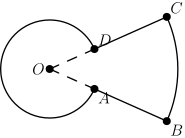
到 的距离是多少?
In the figure shown below, major arc and minor arc have the same center, Also, lies between and and lies between and Major arc minor arc and each of the two segments and have length
What is the distance from to
小提示:
设 ,,;弧长给出 和
Let and ; the arcs give and
大提示:
线段给出 ;消去半径可得
The segments give ; eliminating the radii yields
解答:
设 ,,并设 (两条射线重合)。劣弧 的长度为 ,而优弧 是其反向的大弧,所以 。
每条线段 。
由前两个方程,,。代入 并两边除以 ,得到 它可化简为 。
较大的根大于 ,不可能是这段劣弧的圆心角,所以 。于是 其中最后一步作了有理化(分母乘以 等于 )。
因此,正确答案是 B。
Let and and let (the rays coincide). The minor arc has length and the major arc is the reflex arc, so
Each segment
From the first two equations, and Substituting into and dividing by gives which simplifies to
The larger root is greater than so it cannot be an angle of this minor arc. Thus Then after rationalizing (the denominator times equals ).
Thus, the correct answer is B.
11.
三角形的垂心是三条(必要时延长的)高的共点交点。顶点为 、 和 的三角形,其垂心坐标之和是多少?
The orthocenter of a triangle is the concurrent intersection of the three (possibly extended) altitudes. What is the sum of the coordinates of the orthocenter of the triangle whose vertices are and
小提示:
和 同在直线 上,所以从 作的高是竖直直线
and share so the altitude from is the vertical line
大提示:
从 作的高垂直于 ;将它与 相交
The altitude from is perpendicular to ; intersect it with
解答:
由于 和 都在直线 上,边 是水平的,所以从 作的高是竖直直线 。
边 的斜率为 ,所以从 作的高斜率为 :
当 时,。垂心为 ,坐标和为 。
因此,正确答案是 A。
Since and both have side is horizontal and the altitude from is the vertical line
Side has slope so the altitude from has slope :
At The orthocenter is with coordinate sum
Thus, the correct answer is A.
12.
一组数的调和平均数定义为这些数的倒数的算术平均数的倒数。例如,, 和 的调和平均数为 求下面这个 次多项式所有实根的调和平均数:
The harmonic mean of a collection of numbers is the reciprocal of the arithmetic mean of the reciprocals of the numbers in the collection. For example, the harmonic mean of and is What is the harmonic mean of all the real roots of the th degree polynomial
小提示:
调和平均数是 ,其中 是根的个数
The harmonic mean is where is the number of roots
大提示:
对 ,两个根的倒数和为 ,与 无关
For the two roots have reciprocal-sum the same for every
解答:
每个因式 的判别式为 ,所以它有两个实根;总共有 个根。
对 的根,倒数之和为 ,与 无关。
对全部 个因式求和,。调和平均数为
因此,正确答案是 B。
Each factor has discriminant so it has two real roots; there are roots in all.
For the roots of the sum of reciprocals is independent of
Summing over all factors, The harmonic mean is
Thus, the correct answer is B.
13.
令 。令 为最大的整数,使得存在一个有 个元素的 的子集,并且该子集不含五个连续整数。现在从 中随机不放回地选出 个整数。所选元素不包含五个连续整数的概率是多少?
Let Let be the greatest integer such that there exists a subset of with elements that does not contain five consecutive integers. Suppose integers are chosen at random from without replacement. What is the probability that the chosen elements do not include five consecutive integers?
小提示:
去掉两个合适的元素就能打断每一段五连整数,所以 。
Removing two well-placed elements breaks every run of five, so
大提示:
选 个等价于去掉 个;数一数哪两个被去掉的元素能碰到每一段五个连续整数
Choosing means removing ; count removals whose two elements hit every block of five consecutive integers
解答:
要避免五个连续整数,只需去掉两个元素(例如 和 ),而去掉一个元素不可能同时击中两个不相交的区块 和 。因此 。
从 个元素中选 个,等价于去掉 个,共有 种。所选集合不含五个连续整数,当且仅当两个被去掉的元素合起来与每个窗口 相交,其中 。
这迫使一个被去掉的元素在 中,另一个在 中,并且两者相距不超过 。有效的去法为 、 和 ,共 种。
概率为 。
因此,正确答案是 D。
To avoid five consecutive integers, it suffices to remove two elements (for example and ), and no single removal can hit both disjoint blocks and Thus
Choosing of elements is the same as removing which can be done in ways. The chosen set avoids five consecutive integers exactly when the two removed elements together intersect every window for
This forces one removed element in the other in and the two within of each other. The valid removals are and giving of them.
The probability is
Thus, the correct answer is D.
14.
点 、 和 共线,且 在 和 之间。以 和 为焦点的椭圆与以 和 为焦点的椭圆内切,如下图所示。
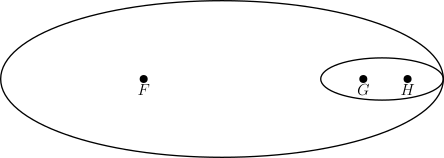
这两个椭圆的离心率相同,均为 ,且它们的面积之比为 。(回忆:椭圆的离心率为 ,其中 是从中心到焦点的距离, 是长轴长度。) 是多少?
Points and are collinear with between and The ellipse with foci at and is internally tangent to the ellipse with foci at and as shown below.
The two ellipses have the same eccentricity and the ratio of their areas is (Recall that the eccentricity of an ellipse is where is the distance from the center to a focus, and is the length of the major axis.) What is
小提示:
离心率相同使面积与 成正比,所以 。
Equal eccentricity makes area proportional to so
大提示:
两个椭圆共用焦点 ;令它们的右顶点重合,得到
The ellipses share focus ; equate their right vertices to get
解答:
离心率相同,则 ,所以面积 。面积之比为 ,因此 ,其中 是两个半长轴。
两个椭圆共用焦点 。在大椭圆中, 是右焦点,所以右顶点位于 右侧 处。在小椭圆中, 是左焦点,所以右顶点位于 右侧 处。内切使这两个点重合:
利用 ,得 ,所以 ,从而 ,。
因此,正确答案是 D。
With the same eccentricity, so the area The area ratio gives where are the semi-major axes.
Both ellipses share focus On the large ellipse is the right focus, so its right vertex lies to the right of On the small ellipse is the left focus, so its right vertex lies to the right of Internal tangency makes these coincide:
Using so giving and
Thus, the correct answer is D.
15.
如果一个数集满足:只要 和 是该集合中的元素(不要求互不相同), 就不是该集合中的元素,则称这个数集为无和集。例如, 和空集是无和集,但 不是。从 中取出的无和子集最多可以有多少个元素?
A set of numbers is called sum-free if whenever and are (not necessarily distinct) elements of the set, is not an element of the set. For example, and the empty set are sum-free, but is not. What is the greatest possible number of elements in a sum-free subset of
小提示:
集合 是无和集
The set is sum-free
大提示:
若 都在 中,则差 都不在 中,从而迫使 。
If are in the differences are not in forcing
解答:
集合 有 个元素,并且是无和集,因为其中任意两个元素之和至少为 。
为了证明上界,设 是一个无和子集。对每个 ,差 不能在 中,因为若在,则 ,违反无和性。
这 个差互不相同,属于 ,并且与 的 个元素不相交。所以 ,得到 。
因此,正确答案是 C。
The set has elements and is sum-free, since any two elements sum to at least
For the upper bound, let be a sum-free subset. Each difference for cannot lie in because would violate sum-freeness.
These differences are distinct, lie in and are disjoint from the elements of So giving
Thus, the correct answer is C.
16.
三角形 的边长为 ,,和 。 的角平分线与到边 的高相交于点 。 是多少?
Triangle has side lengths and The bisector of and the altitude to side intersect at point What is
小提示:
。
大提示:
高的垂足在边 上,距 为 ,且 。
The altitude’s foot is from along and
解答:
由余弦定理,
到 的高是从 作出的,其垂足在边 上,距 的距离为 。
沿着从 出发的角平分线,平行于 的分量是 ,它必须到达高的垂足:。
因为 ,所以 。
因此,正确答案是 D。
By the Law of Cosines,
The altitude to is drawn from and its foot is at distance from along
Along the bisector from the component parallel to is which must reach the altitude’s foot:
Since we get
Thus, the correct answer is D.
17.
多项式 在复平面中有三个根,其中 。这些根所形成的三角形面积是多少?
The polynomial has three roots in the complex plane, where What is the area of the triangle formed by these roots?
小提示:
平移到重心:令 ,使根以原点为中心
Shift by the centroid: let to center the roots at the origin
大提示:
多项式变为
The polynomial becomes
解答:
根的和为 ,所以重心为 。代入 ,得
因为 是一个根, ,所以根为 和 。
这些点是 、、。 与 之间的底边长为 ,到 的水平距离为 ,所以面积为 。平移不改变面积。
因此,正确答案是 A。
The sum of the roots is so the centroid is Substituting
Since is a root, giving roots and
These are the points The base between and has length at horizontal distance from so the area is Translation does not change the area.
Thus, the correct answer is A.
18.
有多少个有序三元组 ,其中三个分量是互不相同且不超过 的非负整数,并满足 、 和 ?
How many ordered triples of distinct nonnegative integers less than or equal to satisfy and
小提示:
中没有一个能为 ,因为那样某个乘积等于 ,不可能大于一个非负值
None of can be since then some product equals and cannot exceed a nonnegative value
大提示:
对互异的 ,唯一真正限制条件是 ;数这样的 -元素子集,再乘以 。
For distinct the only binding condition is ; count such -subsets, then multiply by
解答:
如果某个变量为 ,例如 ,那么 不可能成立。因此 是互不相同的正整数。
条件是对称的。对互异的数值 有 和 自动成立,所以唯一真正的限制是 。只要它成立,所有 种排列都可行。
对每个可能的最小值 ,满足 的数对 的个数为 对固定的 ,这个个数来自在 与 之间选取 。因此共有 个无序三元组,而且每个三元组的全部 种排序都可行。答案为 。
因此,正确答案是 C。
If any variable is say then is impossible. So are distinct positive integers.
The conditions are symmetric. For distinct values we have and automatically, so the only real constraint is When it holds, all orderings work.
For each possible smallest value the numbers of pairs satisfying are For fixed this count comes from choosing between and Thus there are unordered triples, and all orderings of each work. The answer is
Thus, the correct answer is C.
19.
设 ,,和 是多项式 的根。求下面这个和:
Let and be the roots of the polynomial What is the sum
20.
下图所示五面体的底面是一个 的矩形,它的侧面包括两个底边长为 、两腰长为 的等腰三角形,以及两个底边长分别为 和 、非平行边长为 的等腰梯形。
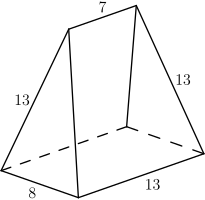
这个五面体的体积是多少?
The base of the pentahedron shown below is a rectangle, and its lateral faces are two isosceles triangles with base of length and congruent sides of length and two isosceles trapezoids with bases of lengths and and nonparallel sides of length
What is the volume of the pentahedron?
小提示:
将长为 的棱放在高度 处;斜边给出 ,所以 。
Place the ridge of length at height ; a slant edge gives so
大提示:
高度 处的截面是一个 的矩形
The cross-section at height is a rectangle
解答:
顶部是一条长为 的棱,居中位于底面上方某个高度 。它的两个端点分别在 底面的 和 上方。从端点到一个底面顶点的斜边长为 ,所以 。
在高度 处,水平截面是一个矩形,尺寸为 乘 。当 时面积为 ;当 时面积为 ;当 时顶棱面积为 。
由棱台公式,
因此,正确答案是 C。
The top is a ridge of length centered above the base at some height Its endpoints sit above and of the base. A slant edge to a base corner has length so
At height the horizontal cross-section is a rectangle measuring by At its area is ; at it is ; at the ridge has area
By the prismatoid formula,
Thus, the correct answer is C.
21.
存在唯一一个由非负整数组成的有序三元组 ,使得
是多少?
There is a unique ordered triple of nonnegative integers such that
What is
小提示:
分别求两个等比级数的和,并使用
Sum both geometric series and use
大提示:
剩下的分数是奇数除以奇数,所以比较 的幂次与 ,可知必有 。
The remaining fraction is odd over odd, so comparing powers of with forces
解答:
如果 或 ,原比值就是 ,不可能等于 。所以 。
对等比级数求和,分子为 ,分母为 。利用 ,比值化简为
左边的分数是奇数除以奇数,所以它的 的指数为 。因为 ,必须有 ,并且 将此式模 化简,得到 是 的倍数,所以 。当 时,所需的 的幂将分别为 ,而它们都不是 的幂。然而当 时,,所以 且 。这也证明了解的唯一性。
于是 。
因此,正确答案是 A。
If or the original ratio is just which cannot equal Hence
Summing the geometric series, the numerator is and the denominator is Using the ratio simplifies to
The fraction on the left is odd over odd, so its power of is Since we must have and Reducing this equation modulo shows that is divisible by so For the required powers of would be none of which is a power of For however, so and This also proves uniqueness.
Then
Thus, the correct answer is A.
22.
从 到 之间独立均匀随机地选出三个实数。这三个数中最大的那个数大于另外两个数各自的 倍的概率是多少?(换句话说,如果所选的数为 ,则 。)
Three real numbers are chosen independently and uniformly at random between and What is the probability that the greatest of these three numbers is greater than times each of the other two numbers? (In other words, if the chosen numbers are then )
小提示:
对顺序统计量 ,在区域 上联合密度为 。
With order statistics the joint density is on the region
大提示:
在 ,,和 上积分
Integrate over and
解答:
将数按大小排列为 ;顺序统计量在这个区域上的联合密度为 。所求事件为 。
对 从 到 积分,会贡献因子 。于是
这等于 。
因此,正确答案是 E。
Order the values as ; the joint density of the order statistics is on this region. The event is
Integrating from to contributes a factor of Then
This equals
Thus, the correct answer is E.
23.
若一个正整数不重复使用任何数字,没有数字 ,并且没有任何数字同时与两个更大的数字相邻,则称它为公平数。例如,,,和 是公平数,但 ,,和 不是。共有多少个公平正整数?
Call a positive integer fair if no digit is used more than once, it has no s, and no digit is adjacent to two greater digits. For example, and are fair, but and are not fair. How many fair positive integers are there?
小提示:
公平数没有任何内部数字小于它的两个相邻数字
A fair number has no interior digit smaller than both of its neighbors
大提示:
对选定的数字集合,从大到小构造有效排列,每个新数字放在任一端: 个数字有 种
Build a valid arrangement of a chosen digit set by placing digits largest-to-smallest, each at either end: ways for digits
解答:
数字互不相同,并且来自 ,条件“没有数字同时与两个更大的数字相邻”等价于没有内部数字小于它的两个相邻数字。
对固定的 个数字,从大到小插入来构造排列;每个新的较小数字必须放在当前排列的两个端点之一,因此有 个有效排列。
对所有非空数字子集求和,
因此,正确答案是 C。
The digits are distinct and drawn from and “no digit adjacent to two greater digits” means no interior digit is smaller than both neighbors.
For a fixed set of digits, build the arrangement by inserting digits from largest to smallest; each new (smaller) digit must go to one of the two ends, giving valid arrangements.
Summing over all nonempty digit subsets,
Thus, the correct answer is C.
24.
一个半径为 的圆被 个半径为 的圆围住,这些圆与中央圆外切,并且相邻的圆彼此相切,如图所示。那么 可以写成 ,其中 ,,和 是整数。 是多少?
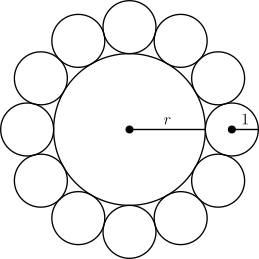
A circle of radius is surrounded by circles of radius externally tangent to the central circle and sequentially tangent to each other, as shown. Then can be written as where and are integers. What is
小提示:
个外圆圆心形成一个外接圆半径为 的正 边形,相邻圆心距离为
The outer centers form a regular -gon of circumradius with adjacent centers apart
大提示:
所以 ,且 。
So and
解答:
个外圆的圆心位于半径为 的圆上,形成一个正 边形。相邻圆心距离为 (两个圆半径都为 ),它们之间的圆心角为 。
因此 ,所以 。由于 ,
于是 ,所以 。
因此,正确答案是 C。
The centers of the outer circles lie on a circle of radius forming a regular -gon. Adjacent centers are apart (both circles have radius ), and the central angle between them is
Thus so Since
Then so
Thus, the correct answer is C.
25.
多项式 和 都是 次,首项系数都是 ,并且它们的根都属于 。函数 具有如下性质:存在实数 ,使得所有满足 的实数 的集合由闭区间 与开区间 组成。可能有多少个函数 ?
Polynomials and each have degree and leading coefficient and their roots are all elements of The function has the property that there exist real numbers such that the set of all real numbers such that consists of the closed interval together with the open interval How many functions are possible?
小提示:
闭区间的端点必须是 的零点,开区间的端点必须是 的零点
The closed endpoints must be zeros of and the open endpoints must be zeros of
大提示:
这四个端点因子固定后,分子和分母剩下的因子必须相消;要数的是不同的函数,而不是多项式对
After those four endpoint factors are fixed, the remaining numerator and denominator factors must cancel; count distinct functions, not polynomial pairs
解答:
本题已作废:按题面作答,正确答案不在选项中。下面给出计数。
对于 ,闭区间端点 必须是 的零点,且在这些点 ,而 必须是极点。因此符号的变化必须与下面这个函数一致: 中未使用的第三个因子必须与 中未使用的第三个因子相同;否则会多出零点、极点或符号变化。
如果这个公共因子是 之外的第五个值,它不能在任一区间内部形成空点。在五个数从小到大的排列中,它只能位于 之前、 与 之间,或 之后,因此给出 个函数。
另一种可能是公共因子等于 或 。对 的每一种选择(共 种),这两个多项式对化简为同一个公式 ,且定义域相同(都排除 ),所以只定义一个函数。这再给出 个函数,按题面字面理解总数为 。
如果在后五种情形中把两个多项式对分别计数,就会得到 ,即临时答案 (E),但这没有回答题目所问的函数个数。因此印刷的选项都不正确。
This problem was voided: as written, its answer is not among the choices. Here is the count.
For the endpoints of the closed interval must be zeros of at which while must be poles. The required sign pattern is therefore that of The unused third factor of must match the unused third factor of otherwise there would be an extra zero, pole, or sign change.
If the common factor is the fifth value not among it cannot make a hole inside either interval. In the ordered list of five values it may therefore occur before between and or after giving functions.
Alternatively, the common factor can equal or For each of the choices of these two polynomial pairs simplify to the same formula and have the same domain (both omit ), so they define only one function. This gives more functions, for a literal total of
Counting the two polynomial pairs separately in each of the last five cases gives the provisional answer (E), but that does not answer the stated question about functions. Thus none of the printed choices is correct.