
2021 AMC 12B Fall 真题
计时
1:15:00
1.
求下式的值:
What is the value of
小提示:
数字 各自在每一个位值上都出现一次。
Each of the digits appears once in every place value
大提示:
每一列的数字和都是 。
Every column adds to
解答:
数字 在千位、百位、十位和个位上各恰好出现一次,因此每一列的和都是 。
所以总和为 。
所以正确答案是 E。
Each of the digits appears exactly once in the thousands, hundreds, tens, and units columns. So each column sums to
The total is therefore
Thus, the correct answer is E.
2.
下图阴影图形的面积是多少?
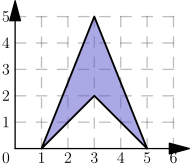
What is the area of the shaded figure shown below?
小提示:
阴影区域是一个大三角形减去底部挖掉的一个小三角形。
The shaded region is a large triangle with a triangular notch removed from its base
大提示:
两个三角形沿 -轴的底边长度都是 。
Both triangles have base along the -axis
解答:
外层三角形的顶点依次为 、 和 ,底为 ,高为 ,所以面积为 。
被挖去的三角形顶点依次为 、 和 ,底为 ,高为 ,所以面积为 。
阴影面积为 。
所以正确答案是 B。
The outer triangle has vertices and giving base and height so its area is
Removed from it is the triangle with vertices and which has base and height so area
The shaded area is
Thus, the correct answer is B.
3.
某天中午,Minneapolis 比 St. Louis 暖 度。到 ,Minneapolis 的温度下降了 度,而 St. Louis 的温度上升了 度,此时两城市温度相差 度。所有可能的 值的乘积是多少?
At noon on a certain day, Minneapolis is degrees warmer than St. Louis. At the temperature in Minneapolis has fallen by degrees while the temperature in St. Louis has risen by degrees, at which time the temperatures in the two cities differ by degrees. What is the product of all possible values of
小提示:
中午的温差是 ;追踪两个温度变化如何改变这个差。
At noon the difference is ; track how each change affects the gap
大提示:
新温差为 。
The new difference is
解答:
中午温差为 。之后 Minneapolis 的温度下降 度,St. Louis 的温度上升 度,所以温差改变了 度。新的绝对温差为 。
由此得到 或 ,乘积为 。
所以正确答案是 C。
At noon the gap is Minneapolis then loses degrees and St. Louis gains so the gap changes by The new absolute difference is
This gives or whose product is
Thus, the correct answer is C.
4.
设 。下列哪一个等于
Let Which of the following is equal to
答案:E
小提示:
把所有数都改写成 的幂。
Rewrite everything as a power of
大提示:
。
解答:
写成二的幂,有 。于是
又因为 ,所以它对应最后一个选项。
所以正确答案是 E。
Write Then
Since this matches the last option.
Thus, the correct answer is E.
5.
若分数 的正整数分子 与分母 之和为 则称该分数为特殊分数,分数不必是最简形式。有多少个不同的整数可以表示为两个特殊分数之和?这两个分数可以相同。
Call a fraction not necessarily in the simplest form, special if and are positive integers whose sum is How many distinct integers can be written as the sum of two, not necessarily different, special fractions?
小提示:
列出所有特殊分数,并注意其中哪些是整数、哪些是半整数、哪些是四分之一整数。
List the special fractions and note which are integers, half-integers, or quarter-integers
大提示:
两个特殊分数之和为整数时,它们的小数部分之和也必须为整数。
Two specials sum to an integer only when their fractional parts cancel
解答:
对 逐一列出 :其中的整数是 ;小数部分为 的分数是 ;而 的小数部分互补,分别为 。
其余的小数部分是 ,而它们各自的补数都没有出现。因此只有整数、半整数和四分之一这三类才可能凑出整数和。
整数对给出 。半整数对 给出 。四分之一型的一对 给出 。
去重后得到 共 个不同整数。
所以正确答案是 C。
Listing for the integers are the fractions with fractional part are and have complementary fractional parts
The remaining fractional parts are and none of their complements occurs. Thus only the integer, half-integer, and quarter cases can give integer sums.
Integer pairs give Half-integer pairs give The quarter pair gives
The distinct integers are a total of
Thus, the correct answer is C.
6.
的最大质因数是 ,因为 。 的最大质因数的数字和是多少?
The greatest prime number that is a divisor of is because What is the sum of the digits of the greatest prime number that is a divisor of
7.
下列哪一个条件足以保证整数 、、 满足方程
Which of the following conditions is sufficient to guarantee that integers and satisfy the equation
且
and
且
and
且
and
且
and
小提示:
乘以 :左边的两倍等于
Multiply by : the left side equals
大提示:
对整数而言,这个平方和等于 只可能是两个差为 ,另一个差为 。
For integers, that sum equals only when two differences are and one is
解答:
有恒等式 所以原方程成立恰好当这个平方和等于 。
由于三个差的和为 ,这要求其中两个为 ,一个为 。
选项 D 给出 、、,平方和为 。因此对所有满足该条件的整数都成立。
所以正确答案是 D。
The expression satisfies So the equation holds exactly when this sum of squares equals
Since the three differences sum to this requires two of them to be and one to be
Option D gives and so the squares are This works for all such integers.
Thus, the correct answer is D.
8.
一个钝角等腰三角形的两条相等边长度的乘积,等于底边长度与该底边上高的两倍的乘积。这个三角形顶角的度数是多少?
The product of the lengths of the two congruent sides of an obtuse isosceles triangle is equal to the product of the base and twice the triangle’s height to the base. What is the measure, in degrees, of the vertex angle of this triangle?
小提示:
用两条腰和顶角 把面积写成两种形式。
Write the area two ways using the legs and the vertex angle
大提示:
面积既可以写成 ,也可以写成 。
The area is both and
解答:
设两条相等边长为 ,底边为 ,到底边的高为 。题设条件为 。
三角形面积既等于 ,也等于 ,其中 是顶角。因此 。
代入 ,得到 ,所以 。由于三角形为钝角,。
所以正确答案是 D。
Let the congruent sides have length the base be and the height to the base be The given condition is
The area equals and also where is the vertex angle. So
Substituting gives so Since the triangle is obtuse,
Thus, the correct answer is D.
9.
等边三角形 的边长为 。设 是该三角形内切圆的圆心。经过 、 和 三点的圆的面积是多少?
Triangle is equilateral with side length Suppose that is the center of the inscribed circle of this triangle. What is the area of the circle passing through and
答案:B
小提示:
在等边三角形中,内心和外心重合。
In an equilateral triangle the incenter coincides with the circumcenter
大提示:
在三角形 中,角 ,且 ;应用正弦定理
In triangle angle and ; apply the law of sines
解答:
对于等边三角形, 也是外心,所以 。中心角 。
在三角形 中,边 所对的角为 ,因此该三角形的外接圆半径 满足 从而 。
该圆的面积为 。
所以正确答案是 B。
For an equilateral triangle, is also the circumcenter, so The central angle
In triangle side is opposite the angle, so the circumradius of this triangle satisfies giving
The area of the circle is
Thus, the correct answer is B.
10.
坐标平面上的三点 ,和 构成等腰三角形。求 到 之间所有可能的 之和。
What is the sum of all possible values of between and such that the triangle in the coordinate plane whose vertices are and is isosceles?
小提示:
三个点都在单位圆上,所以边相等等价于对应弦相等,也就是圆弧间隔相等。
All three points lie on the unit circle, so equal sides mean equal chords, i.e. equal arc separations
大提示:
分三种情况:第三点到 的距离相等、到 的距离相等,或位于它们的垂直平分线上。
Consider the three cases where the third point matches distance to to or lies on their perpendicular bisector
解答:
三个点位于单位圆上,对应角分别为 ,,。
若第三点到其余两点的距离相等,它必在这两点连线的垂直平分线上,故 或 。
若它到 所对点的距离等于两个已知点间的弦长(角度差为 ),则 ( 时三角形退化)。同理,若它到 所对点的距离相等,则 ( 时退化)。
有效值为 ,总和为 。
所以正确答案是 E。
The three points lie on the unit circle at angles and A chord’s length depends only on the angular separation of its endpoints.
If the third point is equidistant from the other two, it lies on the perpendicular bisector: or
If its distance to equals the fixed chord (separation ), then (since is degenerate). If its distance to matches, then (since is degenerate).
The valid values are summing to
Thus, the correct answer is E.
11.
Una 同时掷 个标准 面骰,并计算掷出的 个数的乘积。该乘积能被 整除的概率是多少?
Una rolls standard -sided dice simultaneously and calculates the product of the numbers obtained. What is the probability that the product is divisible by
小提示:
用补集计数:乘积中少于两个因子 。
Use complementary counting: the product has fewer than two factors of
大提示:
追踪每个骰子贡献零个、一个或两个因子 。
Track whether each die contributes zero, one, or two factors of
解答:
当乘积中至多含一个因子 时,它不能被 整除。每个骰子掷出奇数的概率为 ;恰好贡献一个因子 (即掷出 或 )的概率为 ;贡献两个因子(即掷出 )的概率为 。
六个骰子全为奇数:。恰有一个骰子为 或 ,其余为奇数:。
不能被四整除的概率为 ,因此所求概率为 。
所以正确答案是 C。
The product fails to be divisible by when it has at most one factor of Each die is odd with probability contributes exactly one factor of (a or ) with probability and two factors (a ) with probability
All six odd: Exactly one die a or and the rest odd:
The complement is so the answer is
Thus, the correct answer is C.
12.
对正整数 ,令 为 的所有正因数之和除以 得到的商。例如, 求 ?
For a positive integer, let be the quotient obtained when the sum of all positive divisors of is divided by For example, What is
13.
设 。求下式的值:
Let What is the value of
小提示:
每个角都是 的倍数;将分子中的角按模 化简。
Each angle is a multiple of ; reduce the numerator angles modulo
大提示:
用 将剩余的分子因子与分母因子联系起来
Use to relate leftover numerator factors to denominator factors
解答:
每个角都可写成 。按 取模后,,且 。
因此分子为 。约去公共因子 、、,剩下 。
又有 ,并且 ,所以比值为 。
所以正确答案是 E。
Write each angle as Reducing modulo and
So the numerator is Cancelling the common factors leaves
Now and so the ratio equals
Thus, the correct answer is E.
14.
设 、、 是实系数多项式,次数分别为 、、,常数项分别为 、、。令 为满足方程 的不同复数 的个数。 的最小可能值是多少?
Suppose that and are polynomials with real coefficients, having degrees and respectively, and constant terms and respectively. Let be the number of distinct complex numbers that satisfy the equation What is the minimum possible value of
小提示:
考虑 ;它的次数和常数项是什么?
Consider ; what is its degree and constant term?
大提示:
一个次数为 的多项式可以只有一个重数为 的根。
A degree- polynomial can have a single root of multiplicity
解答:
令 。因为 的次数为 ,而 的次数为 ,所以 的次数为 。它的常数项为 。
由于 除这些限制外没有其他限制, 可以成为任意次数为 、常数项为 的实系数多项式,例如 。
这样的多项式只有一个不同的根,所以最小值为 。
所以正确答案是 B。
Let Since has degree and has degree the degree of is Its constant term is
Because is otherwise unconstrained, can be made equal to any real degree- polynomial with constant term for instance
Such a polynomial has a single distinct root, so the minimum is
Thus, the correct answer is B.
15.
三张相同的边长为 的正方形纸片叠在一起。中间的纸片绕其中心顺时针旋转 ,最上面的纸片绕其中心顺时针旋转 ,得到下图所示的 边形。该多边形面积可表示为 ,其中 、、 为正整数,且 不被任何质数的平方整除。求 。
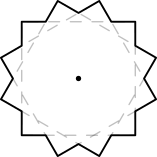
Three identical square sheets of paper each with side length are stacked on top of each other. The middle sheet is rotated clockwise about its center and the top sheet is rotated clockwise about its center, resulting in the -sided polygon shown in the figure below. The area of this polygon can be expressed in the form where and are positive integers, and is not divisible by the square of any prime. What is
小提示:
由对称性,多边形的顶点每隔 交替为外侧正方形顶点和内部边交点。
By symmetry the polygon’s vertices alternate between outer square-corners and inner edge-crossings, every
大提示:
外侧顶点到中心的距离为 ,内部顶点到中心的距离为 。
The outer vertices are at distance from the center and the inner ones at distance
解答:
因为三个正方形分别旋转 ,,,图形有 重对称。它的 个顶点每隔 交替出现:外侧顶点到中心的距离为 ,内侧交点到中心的距离为 。
连接中心与全部 个顶点,把多边形分成 个三角形,每个三角形的两边为 和 ,夹角为 。总面积是
这化简为 ,所以 。
所以正确答案是 E。
Because the three squares are rotated by and the figure has -fold symmetry. Its vertices alternate every : outer vertices are the square corners at distance from the center, and inner vertices are edge crossings at distance
Connecting the center to all vertices splits the polygon into triangles, each with sides and and included angle The total area is
This simplifies to so
Thus, the correct answer is E.
16.
设 、、 为正整数,满足 且 所有可能的不同 值之和是多少?
Suppose are positive integers such that and What is the sum of all possible distinct values of
小提示:
由对称性可设 ;那么 ,并且
By symmetry assume then and
大提示:
利用 ,并检查不长的范围
Use and check the short range
解答:
条件是对称的,所以不妨设 。于是 ,且对每个固定的 ,有 以及 。最大公因数之和可以写成
逐一检查这些不长的范围, 时可能的最大公因数之和分别是 、、、、、 和 。取值 只在 和 处出现。
三元组 的 之和为 ,并且 。三元组 的 之和为 ,并且 。
不同值之和为 。
所以正确答案是 B。
The condition is symmetric, so assume Then and for each fixed we have and The gcd sum can be evaluated as
Checking these short ranges, the possible gcd sums for are, respectively, and The value occurs only at and
The triple has sum and The triple has sum and
The sum of the distinct values is
Thus, the correct answer is B.
17.
一只虫子从由边长为 的等边三角形组成的网格的一个顶点出发。每一步,虫子都沿网格线在 个可能方向中随机且独立地等概率移动。经过 步后,虫子在整个过程中从未距离起点超过 个单位的概率是多少?
A bug starts at a vertex of a grid made of equilateral triangles of side length At each step the bug moves in one of the possible directions along the grid lines randomly and independently with equal probability. What is the probability that after moves the bug never will have been more than unit away from the starting position?
小提示:
虫子必须始终在起点或起点的 个相邻顶点上。
The bug must always be at the start or one of its neighbors
大提示:
从一个相邻顶点出发, 个方向中只有 个仍保持在距离 以内:回到起点或到两个相邻的邻点。
From a neighbor, only of the moves stay within distance : back to start or to the two adjacent neighbors
解答:
保持在距离 以内意味着虫子始终在原点或其 个相邻顶点上。从原点出发,所有 个方向都可行;从相邻顶点出发,只有 个方向可行:回到原点,或到两个相邻的邻点之一。
令 和 分别表示有效的 步路径中,结束在原点和结束在某个相邻点的路径数。则 、,初值为 、。
迭代得 ,、、、。有效路径总数为 。
所求概率为 。
所以正确答案是 A。
Staying within distance means the bug is always at the origin or one of its neighbors. From the origin, all moves are allowed. From a neighbor, only moves keep it in range: back to the origin, or to either of the two adjacent neighbors.
Let and count valid -step paths ending at the origin and at a neighbor. Then and starting from
Iterating gives then The total number of valid paths is
The probability is
Thus, the correct answer is A.
18.
设 ,且对 , 由如下递推式确定: 该数列趋于一个极限,记这个极限为 。使下式成立的最小 值是多少?
Set and for let be determined by the recurrence This sequence tends to a limit; call it What is the least value of such that
小提示:
极限为 ;作代换 。
The limit is ; substitute
大提示:
代换后得到 ,所以 会反复平方。
The substitution gives so squares repeatedly
解答:
极限满足 ,得 。令 。于是
由 ,可得 ,所以 。
需要 ,也就是 。满足条件的最小 是 ,因为 。
所以正确答案是 A。
The limit satisfies giving Let Then
Since we get so
We need i.e. The least such is since
Thus, the correct answer is A.
19.
边数为 、、、 的正多边形内接于同一个圆。没有两个多边形共用顶点,也没有三条边交于同一点。在圆内部,有多少个点是其中两个多边形的边的交点?
Regular polygons with and sides are inscribed in the same circle. No two of the polygons share a vertex, and no three of their sides intersect at a common point. At how many points inside the circle do two of their sides intersect?
小提示:
分别考虑每一对多边形。
Consider each pair of polygons separately
大提示:
一般位置下,边数为 和 的两个内接多边形有 个交点。
Two inscribed polygons with and sides in general position cross at points
解答:
对同圆内接且没有共顶点的两个凸多边形,较小多边形的每条边会与较大多边形的边界相交两次,因此交点数为 。
对所有多边形对求和: 各给出 个交点; 各给出 个; 给出 个。
总数为 。
所以正确答案是 E。
For two convex polygons inscribed in the same circle with no shared vertices, each side of the smaller polygon crosses the larger polygon’s boundary exactly twice, so they meet at points.
Summing over all pairs: give each; give each; gives
The total is
Thus, the correct answer is E.
20.
用 个白色单位立方体和 个蓝色单位立方体构造一个 的立方体。有多少种不同的构造方式?(若一种构造可以旋转后与另一种重合,则两者视为相同。)
A cube is constructed from white unit cubes and blue unit cubes. How many different ways are there to construct the cube using these smaller cubes? (Two constructions are considered the same if one can be rotated to match the other.)
小提示:
对立方体的 个旋转作用在 个角位置上使用 Burnside 引理。
Use Burnside’s lemma over the rotations of the cube acting on the corner positions
大提示:
对每种旋转类型,数出它固定的恰有 个蓝色小立方体的涂色数。
For each rotation type, count the colorings with exactly blue cubes that it fixes
解答:
由 Burnside 引理,答案是 个旋转作用于 个小立方体位置时,每个旋转固定的“恰有 个蓝色”的构造数的平均值。
恒等旋转固定 种。 个面四分之一转各固定 种,共 种; 个面半转各固定 种,共 种; 个顶点旋转各固定 种,共 种; 个棱半转各固定 种,共 种。
固定构造数之和为 ,平均数为 。
所以正确答案是 A。
By Burnside’s lemma, the count is the average number of -blue colorings fixed by each of the rotations acting on the cubies.
The identity fixes The face quarter-turns fix each The face half-turns fix each The vertex rotations fix each The edge half-turns fix each
The total is and
Thus, the correct answer is A.
21.
对实数 ,令 其中 。在 中,有多少个 满足
For real numbers let where For how many values of with does
小提示:
写成 ,并要求实部和虚部都为零。
Write and require both the real and imaginary parts to vanish
大提示:
虚部可分解为
The imaginary part factors as
解答:
由 Euler 公式,。其虚部为
它在 时为零,此时 ;或者在 时为零,此时 。
逐一检查实部 ,在这些值处结果为 或 ,从不为 。所以不存在 使 。
所以正确答案是 A。
Group by Euler’s formula: The imaginary part is
This vanishes when (so ) or (so ).
Checking the real part at each of these values gives or never So no makes
Thus, the correct answer is A.
22.
直角三角形 的边长为 、、。以 为圆心的圆在 点与直线 相切,并经过 。以 为圆心的圆在 点与直线 相切,并经过 。求 。
Right triangle has side lengths and A circle centered at is tangent to line at and passes through A circle centered at is tangent to line at and passes through What is
小提示:
将 放在原点,并让两条直角边沿坐标轴。
Place at the origin with legs along the axes
大提示:
切点处的半径垂直于切线,所以 在 的正上方, 在 的正右方。
A tangent point’s radius is perpendicular to the tangent line, so lies directly above and directly across from
解答:
令 ,,,于是直角在 。
圆 与直线 (-轴)在 点相切,所以 。令 ,得 ,所以 ,即 。
圆 与直线 (-轴)在 点相切,所以 。由 得 ,所以 ,且 。
因此 。
所以正确答案是 C。
Place and so the right angle is at
Circle is tangent to line (the -axis) at so Setting gives so and
Circle is tangent to line (the -axis) at so Setting gives so and
Then
Thus, the correct answer is C.
23.
从集合 中随机选出 个不同整数组成一个子集。这个子集中相邻整数对的平均个数是多少?(例如集合 有 对相邻整数。)
What is the average number of pairs of consecutive integers in a randomly selected subset of distinct integers chosen from the set (For example the set has pairs of consecutive integers.)
小提示:
对 个可能的相邻对 使用期望的线性性。
Use linearity of expectation over the possible consecutive pairs
大提示:
同时选中 和 的概率为 。
The probability that both and are chosen is
解答:
对 个相邻对中的每一对 ,设指标变量在两数都被选中时为 。这个事件的概率为 。
由期望的线性性,相邻整数对的期望数为 。
所以正确答案是 A。
For each of the adjacent pairs let an indicator be if both are in the subset. The probability of this is
By linearity of expectation, the expected number of consecutive pairs is
Thus, the correct answer is A.
24.
三角形 的边长为 、、。 的角平分线与 交于点 ,并与 的外接圆交于 。 的外接圆与直线 交于点 和 。求 。
Triangle has side lengths and The bisector of intersects in point and intersects the circumcircle of in point The circumcircle of intersects the line in points and What is
小提示:
对经过 、、 的圆使用点 的幂:。
Apply power of the point to the circle through :
大提示:
因为 ,得到 ,所以 。
Because we get so
解答:
点 ,, 共线于角平分线上,点 ,, 共线于直线 。对经过 ,, 的圆,点 的幂给出 。
因为 且 (同弦 所对的角),三角形 与 相似,所以 。因此 。
取 、。由 、,可得 。点 在射线 上,且 ,所以 。
因此 ,所以 。
所以正确答案是 C。
Points are collinear on the bisector, and are collinear on line The power of with respect to the circle through gives
Since and (subtending ), triangles and are similar, so Therefore
Place From point Point lies on ray with so
Then so
Thus, the correct answer is C.
25.
对正整数 ,令 为 分别除以 、、、、、、、、 时所得余数之和。例如, 有多少个两位正整数 满足
For a positive integer, let be the sum of the remainders when is divided by and For example, How many two-digit positive integers satisfy
小提示:
当 增加 时,每个余数通常增加 ;若 是 的倍数,则该余数降为 。
When increases by each remainder rises by unless is divisible by where it drops to
大提示:
,其中只对 在 中的因数求和;需要这些因子之和为 。
so you need the divisors of among to sum to
解答:
从 变为 时,每个余数 都增加 ,除非 是 的倍数,此时它从 降为 。所以
从 到 的互异整数之和等于 的方式只有 ,或 。因数的闭包性质排除了除 外的所有情形:例如, 的倍数也有因数 ,而 的倍数也有因数 和 。因此 必须是 的倍数,并且在 中没有其他因数。
检查所需范围内的倍数 ,只留下 和 。所以 或 ,共有 个值。
因此,正确答案是 C。
Going from to each remainder increases by unless is divisible by in which case it drops from to So
Distinct integers from through can sum to only as or Divisibility closure eliminates every case except for example, a multiple of also has divisor and a multiple of also has divisors and Thus must be a multiple of with no other divisor in
Testing the multiples in the required range leaves only and Hence or giving values.
Thus, the correct answer is C.